


 Скачать презентацию Signalling Experiment game We ran an
818a9e524b941212367cfdad82772f75.ppt
- Количество слайдов: 21
 Signalling
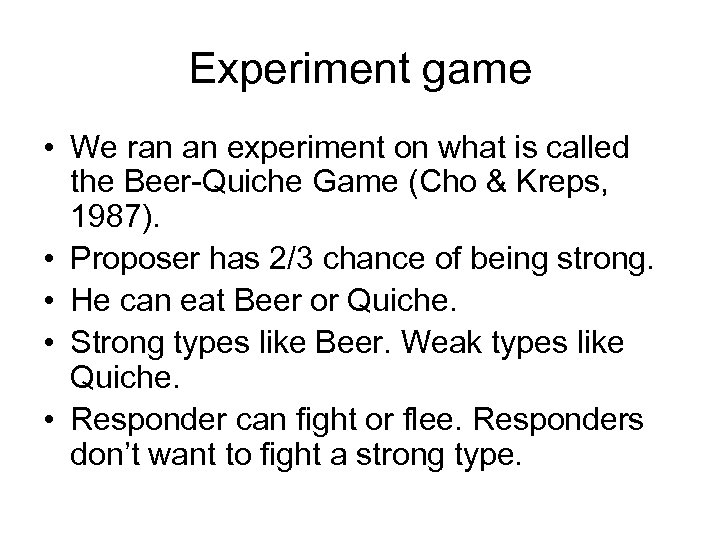 Experiment game • We ran an experiment on what is called the Beer-Quiche Game (Cho & Kreps, 1987). • Proposer has 2/3 chance of being strong. • He can eat Beer or Quiche. • Strong types like Beer. Weak types like Quiche. • Responder can fight or flee. Responders don’t want to fight a strong type.
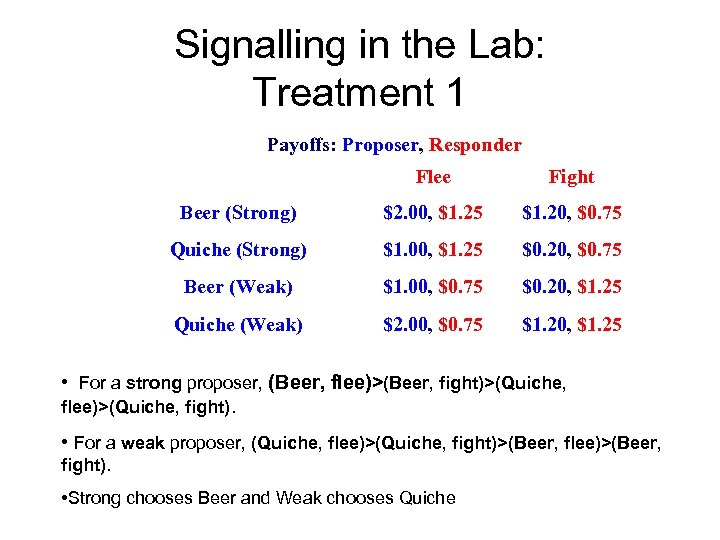 Signalling in the Lab: Treatment 1 Payoffs: Proposer, Responder Flee Fight Beer (Strong) $2. 00, $1. 25 $1. 20, $0. 75 Quiche (Strong) $1. 00, $1. 25 $0. 20, $0. 75 Beer (Weak) $1. 00, $0. 75 $0. 20, $1. 25 Quiche (Weak) $2. 00, $0. 75 $1. 20, $1. 25 • For a strong proposer, (Beer, flee)>(Beer, fight)>(Quiche, flee)>(Quiche, fight). • For a weak proposer, (Quiche, flee)>(Quiche, fight)>(Beer, flee)>(Beer, fight). • Strong chooses Beer and Weak chooses Quiche
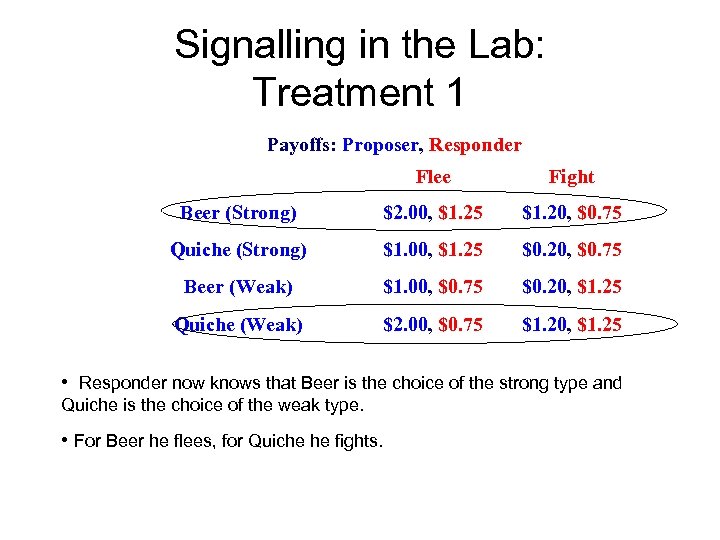 Signalling in the Lab: Treatment 1 Payoffs: Proposer, Responder Flee Fight Beer (Strong) $2. 00, $1. 25 $1. 20, $0. 75 Quiche (Strong) $1. 00, $1. 25 $0. 20, $0. 75 Beer (Weak) $1. 00, $0. 75 $0. 20, $1. 25 Quiche (Weak) $2. 00, $0. 75 $1. 20, $1. 25 • Responder now knows that Beer is the choice of the strong type and Quiche is the choice of the weak type. • For Beer he flees, for Quiche he fights.
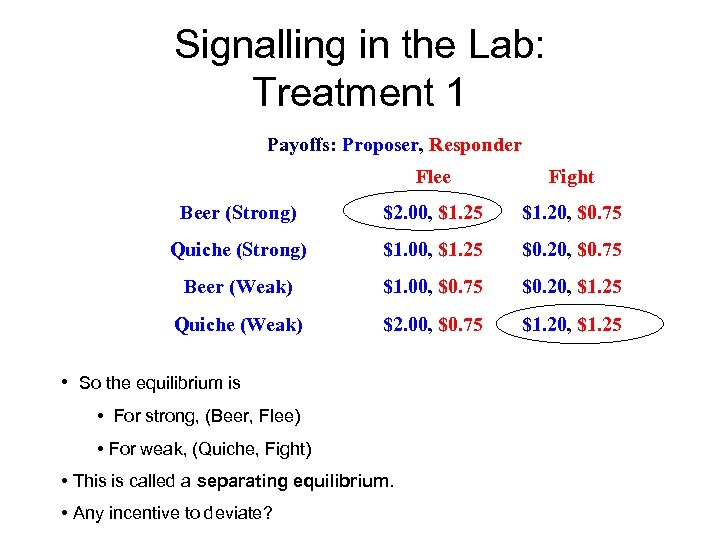 Signalling in the Lab: Treatment 1 Payoffs: Proposer, Responder Flee Fight Beer (Strong) $2. 00, $1. 25 $1. 20, $0. 75 Quiche (Strong) $1. 00, $1. 25 $0. 20, $0. 75 Beer (Weak) $1. 00, $0. 75 $0. 20, $1. 25 Quiche (Weak) $2. 00, $0. 75 $1. 20, $1. 25 • So the equilibrium is • For strong, (Beer, Flee) • For weak, (Quiche, Fight) • This is called a separating equilibrium. • Any incentive to deviate?
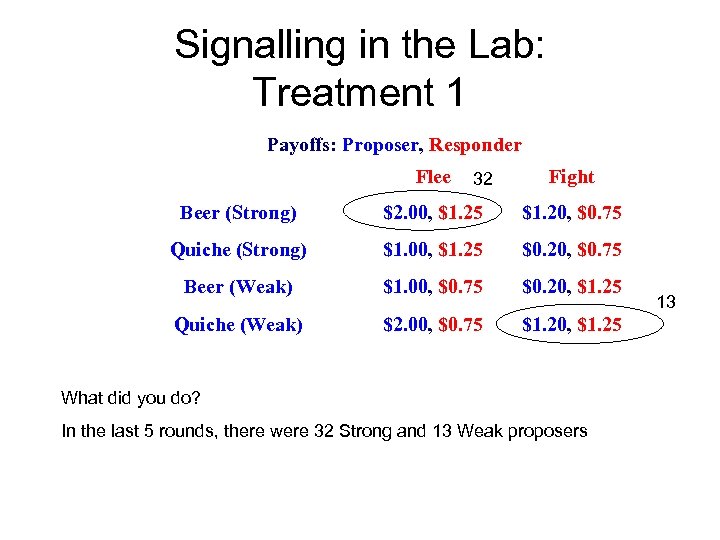 Signalling in the Lab: Treatment 1 Payoffs: Proposer, Responder Flee 32 Fight Beer (Strong) $2. 00, $1. 25 $1. 20, $0. 75 Quiche (Strong) $1. 00, $1. 25 $0. 20, $0. 75 Beer (Weak) $1. 00, $0. 75 $0. 20, $1. 25 Quiche (Weak) $2. 00, $0. 75 $1. 20, $1. 25 What did you do? In the last 5 rounds, there were 32 Strong and 13 Weak proposers 13
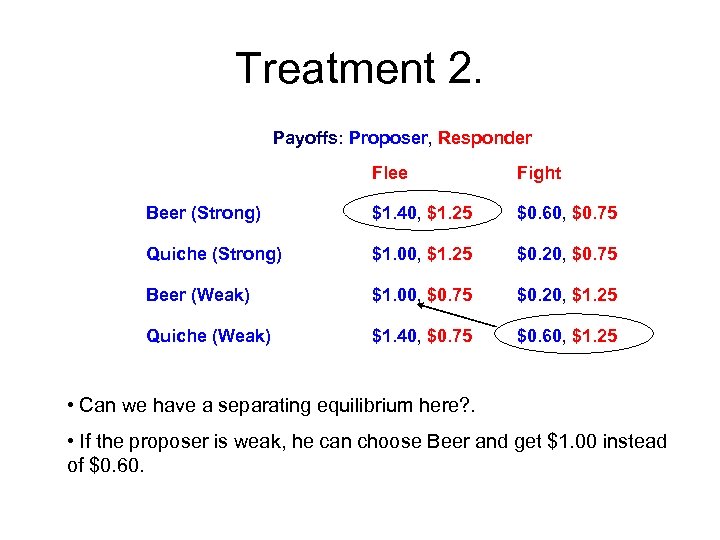 Treatment 2. Payoffs: Proposer, Responder Flee Fight Beer (Strong) $1. 40, $1. 25 $0. 60, $0. 75 Quiche (Strong) $1. 00, $1. 25 $0. 20, $0. 75 Beer (Weak) $1. 00, $0. 75 $0. 20, $1. 25 Quiche (Weak) $1. 40, $0. 75 $0. 60, $1. 25 • Can we have a separating equilibrium here? . • If the proposer is weak, he can choose Beer and get $1. 00 instead of $0. 60.
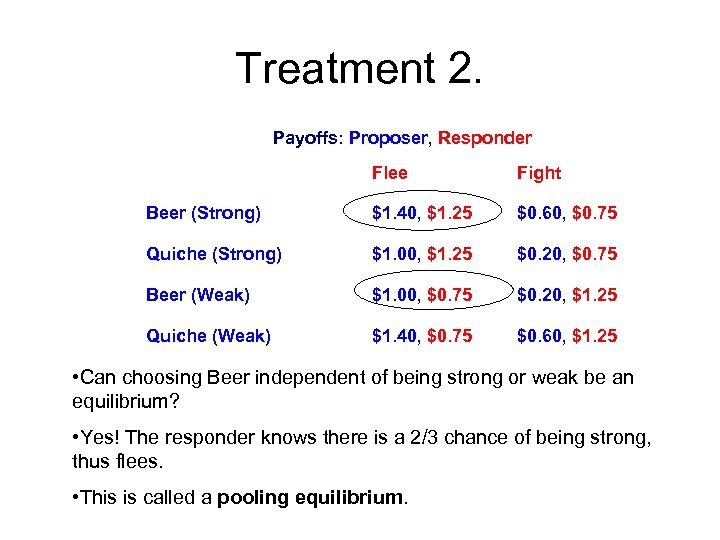 Treatment 2. Payoffs: Proposer, Responder Flee Fight Beer (Strong) $1. 40, $1. 25 $0. 60, $0. 75 Quiche (Strong) $1. 00, $1. 25 $0. 20, $0. 75 Beer (Weak) $1. 00, $0. 75 $0. 20, $1. 25 Quiche (Weak) $1. 40, $0. 75 $0. 60, $1. 25 • Can choosing Beer independent of being strong or weak be an equilibrium? • Yes! The responder knows there is a 2/3 chance of being strong, thus flees. • This is called a pooling equilibrium.
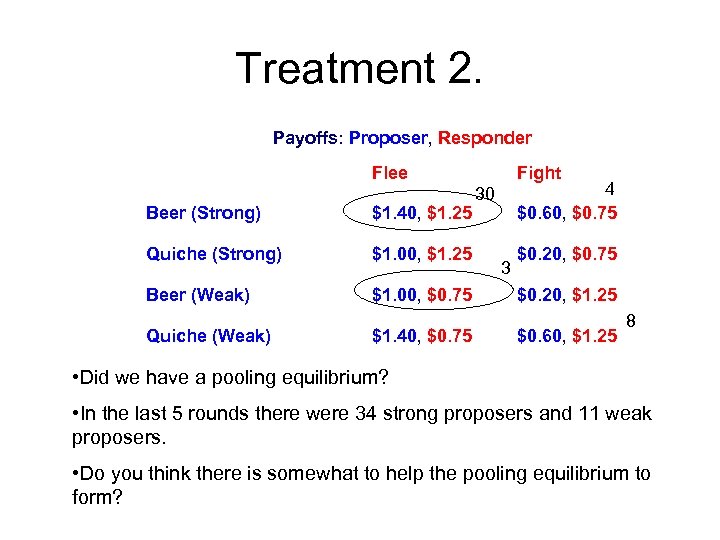 Treatment 2. Payoffs: Proposer, Responder Flee Beer (Strong) $1. 40, $1. 25 Quiche (Strong) $1. 00, $1. 25 Beer (Weak) $1. 00, $0. 75 Quiche (Weak) $1. 40, $0. 75 Fight 4 $0. 60, $0. 75 30 3 $0. 20, $0. 75 $0. 20, $1. 25 $0. 60, $1. 25 8 • Did we have a pooling equilibrium? • In the last 5 rounds there were 34 strong proposers and 11 weak proposers. • Do you think there is somewhat to help the pooling equilibrium to form?
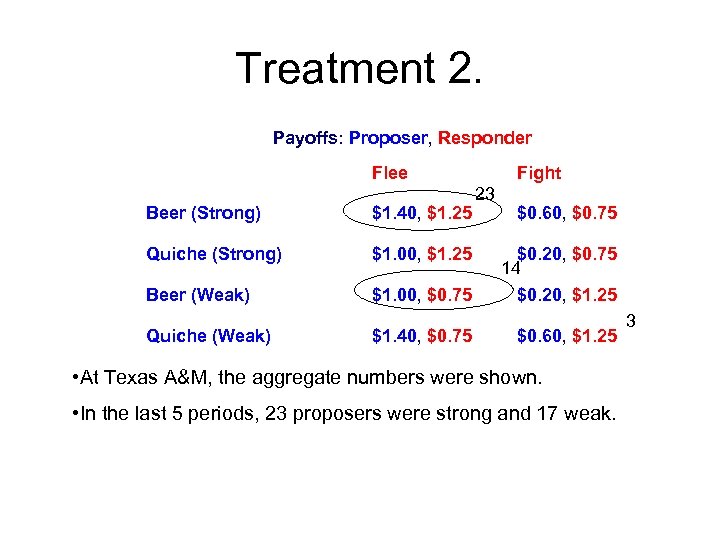 Treatment 2. Payoffs: Proposer, Responder Flee Beer (Strong) $1. 40, $1. 25 Quiche (Strong) $1. 00, $1. 25 Beer (Weak) $1. 00, $0. 75 Quiche (Weak) $1. 40, $0. 75 Fight 23 $0. 60, $0. 75 $0. 20, $0. 75 14 $0. 20, $1. 25 $0. 60, $1. 25 • At Texas A&M, the aggregate numbers were shown. • In the last 5 periods, 23 proposers were strong and 17 weak. 3
 Signalling game • Spence got the Nobel prize in 2001 for this. • There are two players: A and B. Player A is either strong or weak. – Player B will chose one action (flee) if he knows player A is strong – and another action (fight) if he knows player A is weak. • Player A can send a costly signal to Player B (in this case it was to drink beer).
 Signal • For signalling to have meaning, – we must have either cost of the signal higher for the weak type. – Or the gain from the action higher for the strong type.
 Types of equilibria • Separating. – Strong signal – Weak don’t signal. • Pooling. – Strong and weak both send the signal. – (or Strong and weak both don’t send the signal. )
 Types of equilibria • • Player A is the proposer and B the responder. The types of player A are s and w. Let us normalize the value to A when B fights to 0. The values to A when B flees are Vs and Vw. The cost to signalling (drinking beer) are Cs and Cw. We get a separating equilibria if Vs-Cs>0 and Vw-Cw<0. We get a pooling equilibria if Vs-Cs<0 and Vw-Cw<0 (no one signals). • We may also get a pooling equilibria if Vs-Cs>0 and Vw. Cw>0 and there are enough s types. – For this to happen, there must be enough s types such that the expected payoff of B is higher fleeing than fighting.
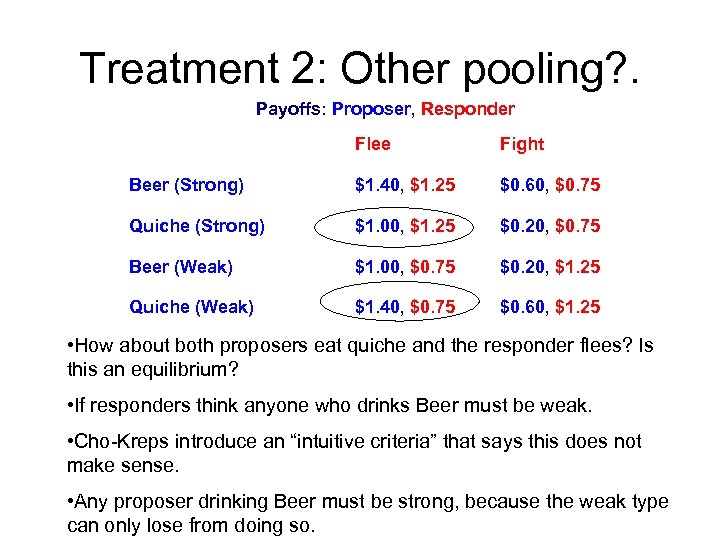 Treatment 2: Other pooling? . Payoffs: Proposer, Responder Flee Fight Beer (Strong) $1. 40, $1. 25 $0. 60, $0. 75 Quiche (Strong) $1. 00, $1. 25 $0. 20, $0. 75 Beer (Weak) $1. 00, $0. 75 $0. 20, $1. 25 Quiche (Weak) $1. 40, $0. 75 $0. 60, $1. 25 • How about both proposers eat quiche and the responder flees? Is this an equilibrium? • If responders think anyone who drinks Beer must be weak. • Cho-Kreps introduce an “intuitive criteria” that says this does not make sense. • Any proposer drinking Beer must be strong, because the weak type can only lose from doing so.
 Gift giving • Gift giving can be wasteful. (Why not give $$$? ) • Basically, you get someone a gift to signal your intent. • American Indian tribes, a ceremony to initiate relations with another tribe included the burning of the tribe’s most valuable possession,
 Courtship gifts. • Dating Advice. • Advice 1: never take such advice from an economist. • Advice 2. : – Say that there is someone that is a perfect match for you. You know this, they just haven’t figured it out yet. – Offer to take them to a really expensive place. – It would only make sense for you to do this, if you knew that you would get a relationship out of it. – That person should then agree to go.
 Valentine’s Day • Who bought a card, chocolate, etc? • We are forced to spend in order to signal that we “really” care. • Say that you are either serious or not serious about your relationship. • If your partner knew you were not serious, he or she would break up with you. • A card is pretty inexpensive, so both types buy it to keep the relationship going. • Your partner keeps the relationship since there is a real chance you are serious. • No real information is gained, but if you didn’t buy the card, your partner would assume that you are not serious and break up with you.
 Higher value and/or Lower Cost Higher value • You buy someone a gift to signal that you care. • Sending a costly signal means that they mean a lot to you. • For someone that doesn’t mean so much, you wouldn’t buy them such a gift. Lower cost • The person knows you well. • Shopping for you costs them less. • They signal that they know you well.
 Other types of signalling in the world • • • University Education. Showing up to class. Praying. Mobile phone for Orthodox Jews Poker: Raising stakes (partial). Peacock tails. Limit pricing.
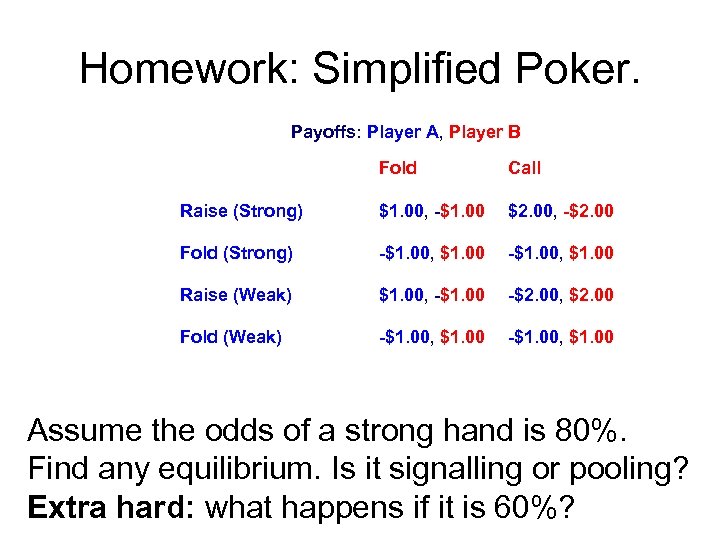 Homework: Simplified Poker. Payoffs: Player A, Player B Fold Call Raise (Strong) $1. 00, -$1. 00 $2. 00, -$2. 00 Fold (Strong) -$1. 00, $1. 00 Raise (Weak) $1. 00, -$1. 00 -$2. 00, $2. 00 Fold (Weak) -$1. 00, $1. 00 Assume the odds of a strong hand is 80%. Find any equilibrium. Is it signalling or pooling? Extra hard: what happens if it is 60%?