 Скачать презентацию Signal Strength-Based Localization in Indoor Wireless Networks A
db9dd75219b4337cc4ede5396fd70dec.ppt
- Количество слайдов: 36



Signal Strength-Based Localization in Indoor Wireless Networks A. S. Krishnakumar Avaya Labs ask@avaya. com 5 April 2006 2003 Copyright© 2002 Avaya Inc. All rights reserved Avaya – Proprietary Use pursuant to Company instructions
Outline • Introduction • Applications of Location Information • Location determination in Radio Networks • Problem definition for 802. 11 Networks • Current research and examples • Limits of location determination • Conclusion ask/15 -Mar-18 2
Introduction A wireless terminal is untethered and may be mobile. To deliver a variety of services, it may be desirable to know the location of a wireless terminal with some degree of precision. • Can we estimate the location – with enhancements to the end device? – Without enhancements? • What techniques are available? • How accurately can we make this determination? ask/15 -Mar-18 3
Outline • Introduction • Applications of Location Information • Location determination in Radio Networks • Problem definition for 802. 11 Networks • Current research and examples • Limits of location determination • Conclusion ask/15 -Mar-18 4
Applications Wireless location estimation is an important enabling technology to provide value-added location-aware services: In the enterprise: – Using closest resource in the enterprise – Privileges based on security regions – Enhanced e 911 services, etc. In Public spaces: – – Emergency services Map/route information Recreation/Entertainment information Many others ask/15 -Mar-18 5
Outline • Introduction • Applications of Location Information • Location determination in Radio Networks • Problem definition for 802. 11 Networks • Current research and examples • Limits of location determination • Conclusion ask/15 -Mar-18 6
Location Determination in Radio Networks Location estimation in indoor environments can be based on different characteristics of radio signals • Signal strength (RSSI) (e. g. , RADAR) • Angle of arrival - AOA • Time of arrival - TOA • Time difference of arrival – TDOA (e. g. , Cricket) ask/15 -Mar-18 7
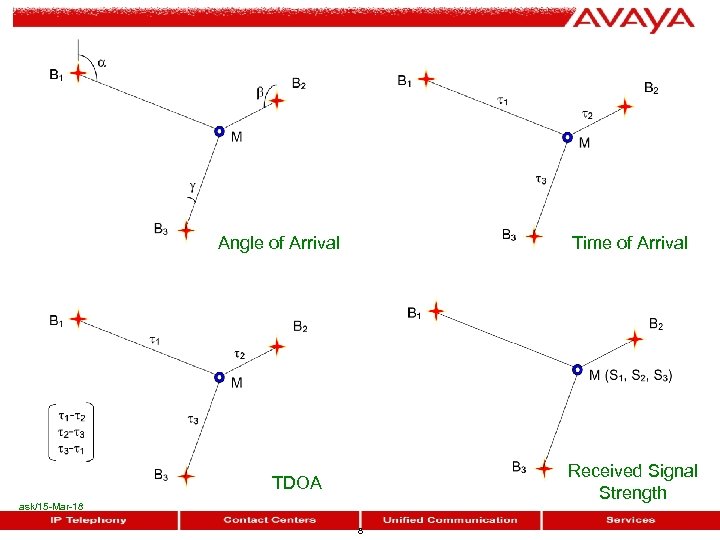
Angle of Arrival Time of Arrival Received Signal Strength TDOA ask/15 -Mar-18 8
Is this new? It has all been done before! • Radar • LORAN • GPS • etc. So what is new ? A lot! ask/15 -Mar-18 9
Outline • Introduction • Applications of Location Information • Location determination in Radio Networks • Problem definition for 802. 11 Networks • Current research and examples • Limits of location determination • Conclusion ask/15 -Mar-18 10
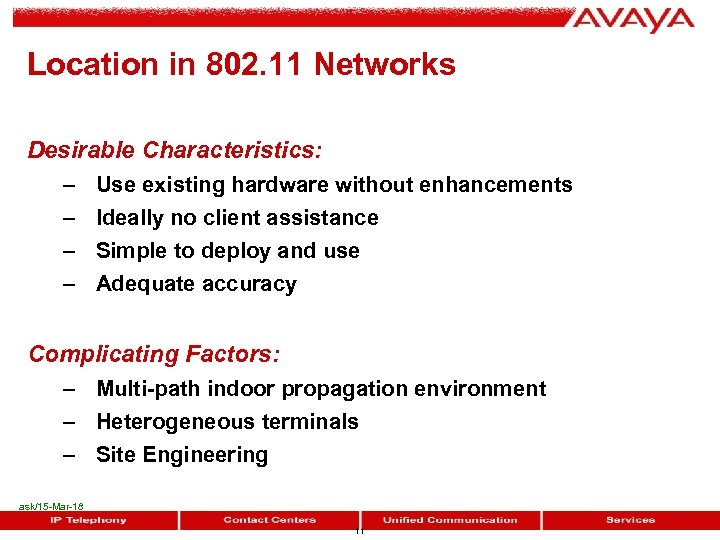
Location in 802. 11 Networks Desirable Characteristics: – – Use existing hardware without enhancements Ideally no client assistance Simple to deploy and use Adequate accuracy Complicating Factors: – Multi-path indoor propagation environment – Heterogeneous terminals – Site Engineering ask/15 -Mar-18 11
Location in 802. 11 Networks Attention has been focused on RSSI-based techniques since they: • Can be implemented with currently available hardware • Are reasonably accurate ask/15 -Mar-18 12
Issues in Wireless Location Estimation • Location accuracy • Deployment and cost of ownership • Management • • Security considerations Zero-profiling techniques Deployment for coverage vs. location estimation Techniques for model adaptation ask/15 -Mar-18 13
RSSI-based Techniques Client-based approach: – Client measures the signal strength from “visible” Access Points and this information is used to locate the client Infrastructure-based approach: – Deploy wireless sniffers that monitor client activity and measure signal strength information – No client changes required – Sniffers can also be used for other monitoring and security applications ask/15 -Mar-18 14

Grouping of RSSI-based Techniques Client-based Infrastructure-based † Deterministic Probabilistic RADAR (Bahl et al. ) [4] Prasithsangaree et al. [31] Pandey et al. [30] Youssef et al. [40] HORUS [41] Bayesian Nets [24] Abnizova et al. [1] † LEASE [22] Bayesian Nets [24] Nibble The reference numbers here correspond to the bibliography in A. S. Krishnakumar et al. , Collaborate. Com 2005. ask/15 -Mar-18 15 [9]
Outline • Introduction • Applications of Location Information • Location determination in Radio Networks • Problem definition for 802. 11 Networks • Current research and examples • Limits of location determination • Conclusion ask/15 -Mar-18 16
RSSI-based Techniques • Profiling-Based (Collected data is the model) • Needs a lot of data collection to build the model – Take signal strength measures at many points in the site and do a closest match to these points in signal strength vector space. [e. g. , RADAR; INFOCOM 2000] – Build a prior probability distribution at many chosen points and use posterior distributions to determine best estimate of location [e. g. , Robotics; IROS 2003] • Use physical characteristics of signal strength propagation and build a model augmented with a wall attenuation factor • Needs detailed (wall) map of the building; model portability needs to be determined – [e. g. , RADAR; INFOCOM 2000] based on [Rappaport 1992] • Adaptation – Environmental and other changes require model rebuilding ask/15 -Mar-18 17
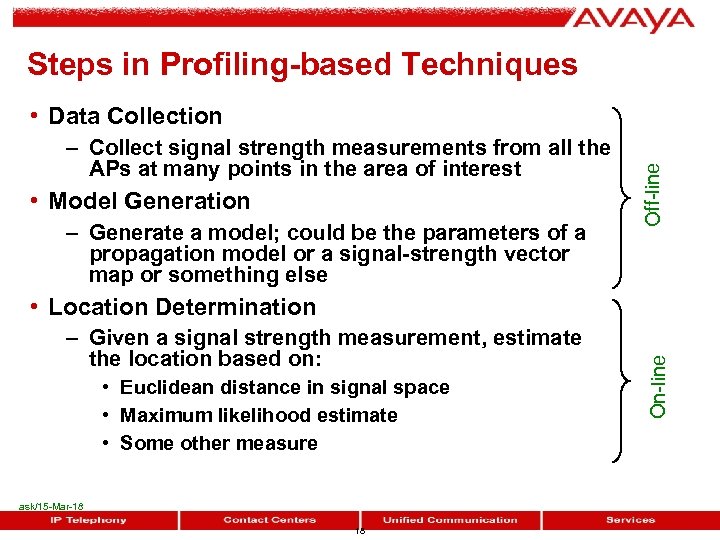
Steps in Profiling-based Techniques – Collect signal strength measurements from all the APs at many points in the area of interest • Model Generation – Generate a model; could be the parameters of a propagation model or a signal-strength vector map or something else Off-line • Data Collection – Given a signal strength measurement, estimate the location based on: • Euclidean distance in signal space • Maximum likelihood estimate • Some other measure ask/15 -Mar-18 18 On-line • Location Determination
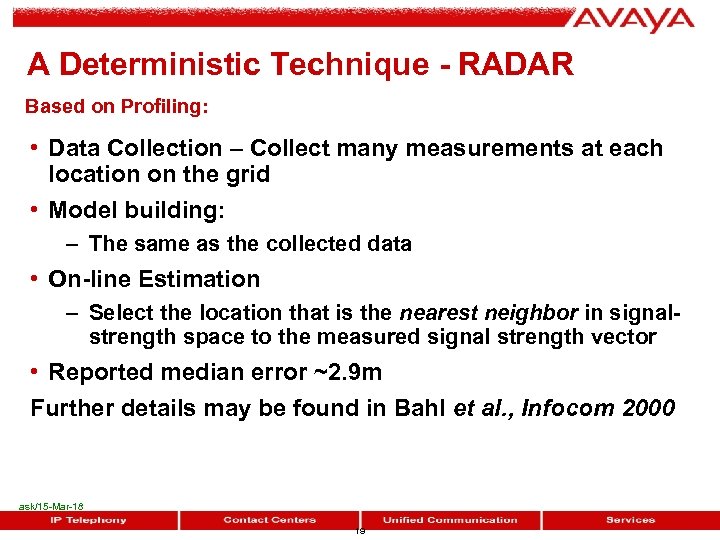
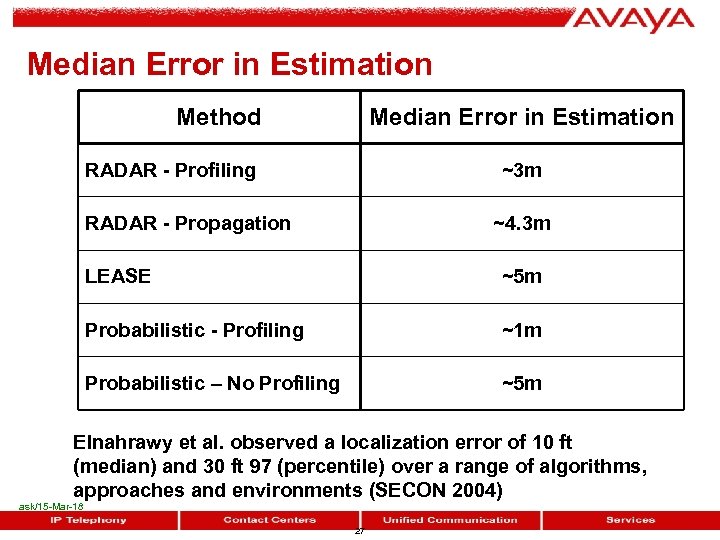
A Deterministic Technique - RADAR Based on Profiling: • Data Collection – Collect many measurements at each location on the grid • Model building: – The same as the collected data • On-line Estimation – Select the location that is the nearest neighbor in signalstrength space to the measured signal strength vector • Reported median error ~2. 9 m Further details may be found in Bahl et al. , Infocom 2000 ask/15 -Mar-18 19
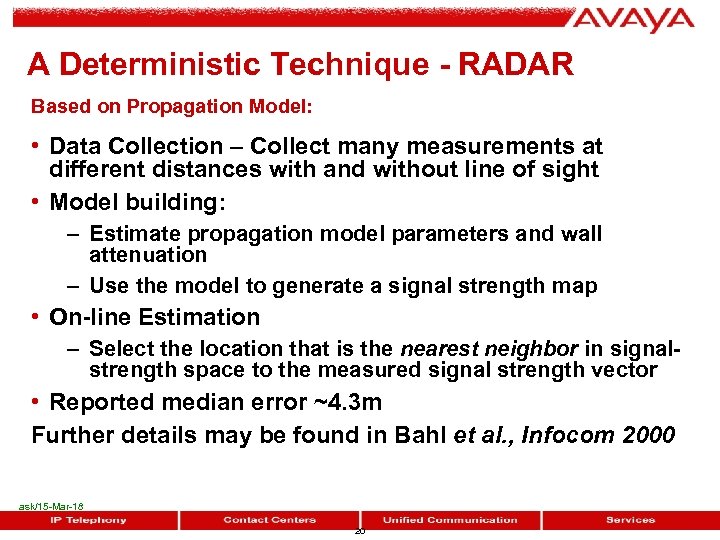
A Deterministic Technique - RADAR Based on Propagation Model: • Data Collection – Collect many measurements at different distances with and without line of sight • Model building: – Estimate propagation model parameters and wall attenuation – Use the model to generate a signal strength map • On-line Estimation – Select the location that is the nearest neighbor in signalstrength space to the measured signal strength vector • Reported median error ~4. 3 m Further details may be found in Bahl et al. , Infocom 2000 ask/15 -Mar-18 20
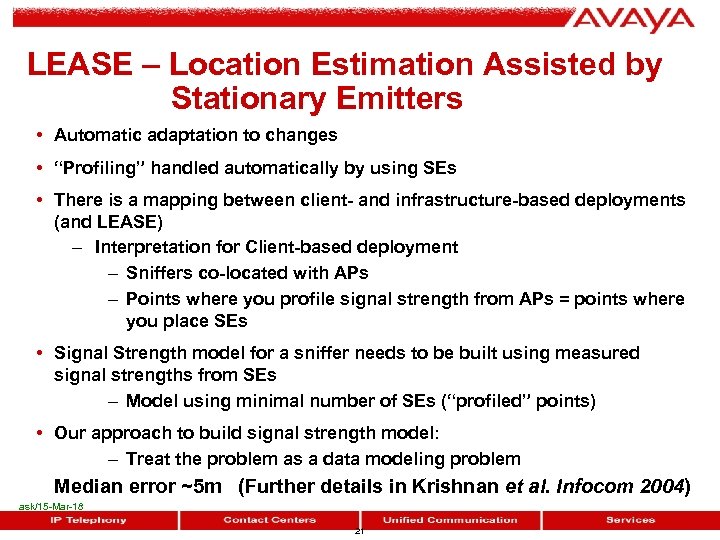
LEASE – Location Estimation Assisted by Stationary Emitters • Automatic adaptation to changes • “Profiling” handled automatically by using SEs • There is a mapping between client- and infrastructure-based deployments (and LEASE) – Interpretation for Client-based deployment – Sniffers co-located with APs – Points where you profile signal strength from APs = points where you place SEs • Signal Strength model for a sniffer needs to be built using measured signal strengths from SEs – Model using minimal number of SEs (“profiled” points) • Our approach to build signal strength model: – Treat the problem as a data modeling problem • Median error ~5 m (Further details in Krishnan et al. Infocom 2004) ask/15 -Mar-18 21
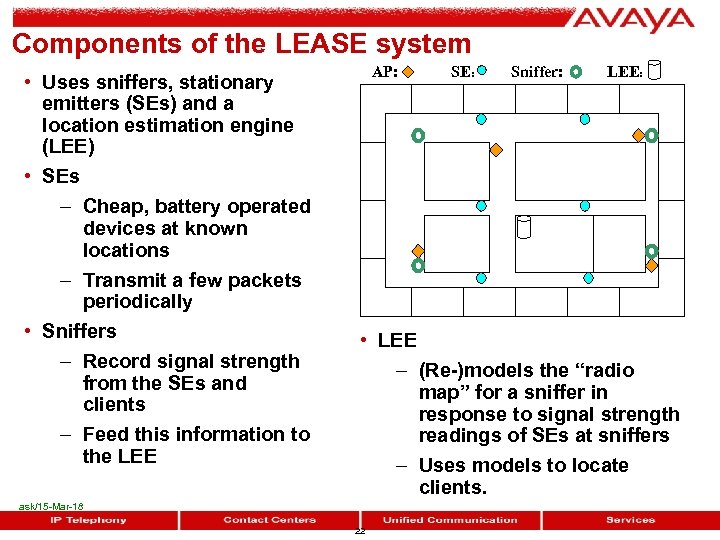
Components of the LEASE system • Uses sniffers, stationary emitters (SEs) and a location estimation engine (LEE) • SEs – Cheap, battery operated devices at known locations – Transmit a few packets periodically • Sniffers – Record signal strength from the SEs and clients – Feed this information to the LEE AP: SE: Sniffer: LEE: • LEE – (Re-)models the “radio map” for a sniffer in response to signal strength readings of SEs at sniffers – Uses models to locate clients. ask/15 -Mar-18 22
A Profiling-based Probabilistic Technique • Data Collection – Collect many measurements at each location on the grid • Model building: – Histogram of signal strengths at each location (i. e. joint probability distributions) • On-line Estimation – Select the location that maximizes the probability P(location|measured signal vector) • Reported median error ~1 m Further details of this technique may be found in Youssef et al. , Per. Com 2003 ask/15 -Mar-18 23
A Probabilistic Technique without Profiling • Based on hierarchical Bayesian networks • Simultaneously estimate the location of a number of terminals • The signal strength model is a hyperparameter of the Bayesian model • Assume reasonable prior distributions and compute the posterior density given the measurements • Use the computed posterior density to estimate the quantities of interest • Currently uses Markov Chain Monte Carlo techniques • Median error ~5 m ask/15 -Mar-18 24
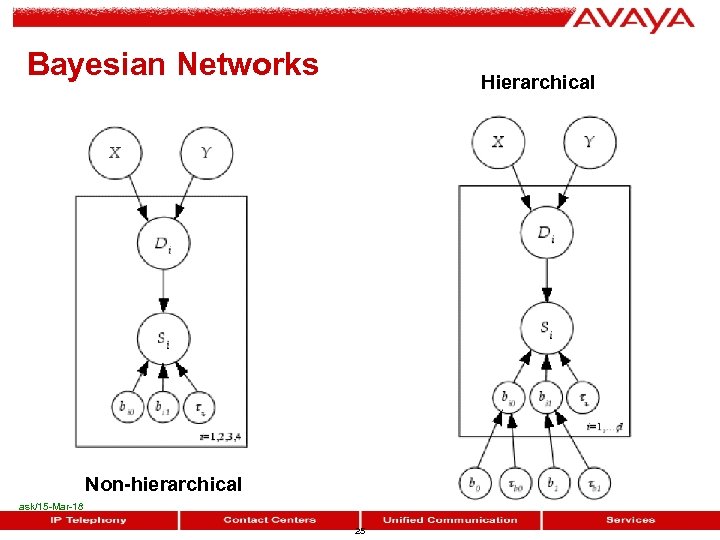
Bayesian Networks Hierarchical Non-hierarchical ask/15 -Mar-18 25
Outline • Introduction • Applications of Location Information • Location determination in Radio Networks • Problem definition for 802. 11 Networks • Current research and examples • Limits of location determination • Conclusion ask/15 -Mar-18 26
Median Error in Estimation Method Median Error in Estimation RADAR - Profiling ~3 m RADAR - Propagation ~4. 3 m LEASE ~5 m Probabilistic - Profiling ~1 m Probabilistic – No Profiling ~5 m Elnahrawy et al. observed a localization error of 10 ft (median) and 30 ft 97 (percentile) over a range of algorithms, approaches and environments (SECON 2004) ask/15 -Mar-18 27
Estimation Accuracy The median error values are widely variable. This raises the following questions: • Why are they different? • How do we compare these values? • Is some kind of normalization possible? If so, how? • Are there fundamental limits to location accuracy with this technique? • What is the dependency on factors such as distance between APs? A preliminary analytical attempt to address these questions appeared in A. S. Krishnakumar and P. Krishnan, Infocom 2005. ask/15 -Mar-18 28
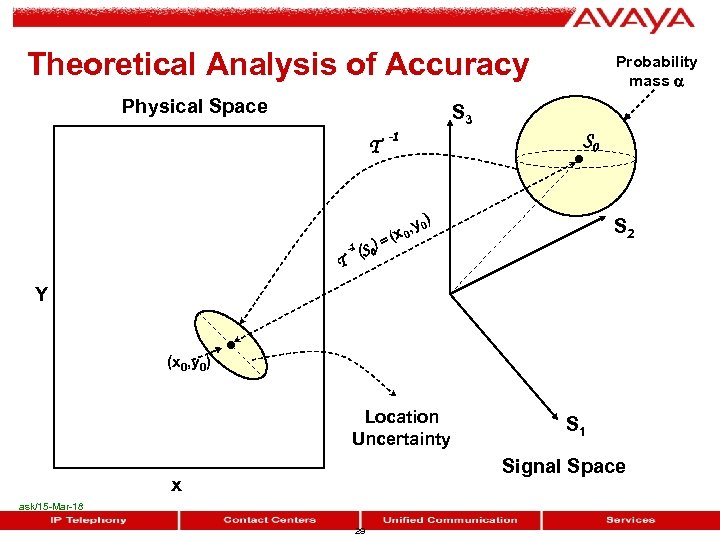
Theoretical Analysis of Accuracy Physical Space Probability mass S 3 T T -1 (S 0) -1 S 0 y 0) x 0, =( S 2 Y (x 0, y 0) Location Uncertainty S 1 Signal Space x ask/15 -Mar-18 29
Estimation Accuracy The analysis shows that the minimum value of location uncertainty depends upon: • Desired probability α • Signal variance • Propagation constant • Number of APs • Distance between APs ask/15 -Mar-18 30
Outline • Introduction • Applications of Location Information • Location determination in Radio Networks • Problem definition for 802. 11 Networks • Current research and examples • Limits of location determination • Conclusion ask/15 -Mar-18 31
Conclusion • Indoor location determination presents challenges due multipath propagation and other factors • We can still estimate location accurately enough for many applications • Site engineering affects location accuracy • The same technique has been applied to Bluetooth networks with comparable results • About the only factor affecting location uncertainty that is in control of the algorithm designer appears to be the signal variance ask/15 -Mar-18 32
Open issues and research topics • • Security considerations Zero-profiling techniques Deployment for coverage vs. location estimation Techniques for model adaptation ask/15 -Mar-18 33
![Bibliography - 1 • [Bahl Infocom 2000] P. Bahl, V. N. Padmanabhan, “RADAR: An](https://present5.com/presentation/db9dd75219b4337cc4ede5396fd70dec/image-34.jpg "Bibliography - 1 • [Bahl Infocom 2000] P. Bahl, V. N. Padmanabhan, “RADAR: An")
Bibliography - 1 • [Bahl Infocom 2000] P. Bahl, V. N. Padmanabhan, “RADAR: An In-Building RFbased User Location and Tracking System, ” Proceedings of IEEE Infocom 2000, Tel Aviv, Israel, March 2000. • [Youssef Per. Com 2003] Moustafa Youssef, Ashok Agrawala, A. Udaya Shankar, “WLAN Location Determination via Clustering and Probability Distributions, ” IEEE International Conference on Pervasive Computing and Communications (Per. Com) 2003, Fort Worth, Texas, March 23 -26, 2003. • [Krishnan Infocom 2004] P. Krishnan, A. S. Krishnakumar, Wen-Hua Ju, Colin Mallows, Sachin Ganu, “A System for LEASE: Location Estimation Assisted by Stationary Emitters for Indoor RF Wireless Networks, ” Proceedings of IEEE Infocom 2004, Hong Kong. • [Krishnakumar Infocom 2005] A. S. Krishnakumar and P. Krishnan, “On the Accuracy of Signal Strength-based Location Estimation Techniques, ” to appear in the Proceeding of IEEE Infocom 2005, Miami, Florida, March 2005. • [Madigan Infocom 2005] David Madigan, Eiman Elnahrawy, Richard P. Martin, Wen-Hua Ju, P. Krishnan, and A. S. Krishnakumar, “Bayesian Indoor Positioning Systems, ” to appear in the Proceedings of IEEE Infocom 2005, Miami, Florida, March 2005. ask/15 -Mar-18 34
![Bibliography - 2 • [Robotics] Andrew M. Ladd, Kostas E. Bekris, Algis Rudys, Lydia](https://present5.com/presentation/db9dd75219b4337cc4ede5396fd70dec/image-35.jpg "Bibliography - 2 • [Robotics] Andrew M. Ladd, Kostas E. Bekris, Algis Rudys, Lydia")
Bibliography - 2 • [Robotics] Andrew M. Ladd, Kostas E. Bekris, Algis Rudys, Lydia E. Kavraki, Dan S. Wallach, and Guillaume Marceau, “Robotics-based location sensing using wireless ethernet, ” In Proceedings of the eighth Annual International Conference on Mobile Computing and Networking (MOBICOM-02), pages 227– 238, New York, September 23– 28 2002. ACM Press. • [Rappaport] T. S. Rapport, “Wireless Communications – Principles and Practice, ” IEEE Press, 1996. • P. Bahl, V. N. Padmanabhan, and A. Balachandran, “Enhancements to the RADAR user location and tracking system, ” Technical report, Microsoft Research Technical Report, February 2000. • Prasithsangaree, P. Krishnamurthy, and P. K. Chrysanthis, “On indoor position location with wireless LANs, ” In The 13 th IEEE International Symposium on Personal, Indoor, and Mobile Radio Communications (PIMRC 2002), 2002. • N. B. Priyantha, A. Chakraborty, and H. Balakrishnan, “The cricket location support system, ” In Proceedings of the Sixth Annual ACM International Conference on Mobile Computing and Networking, 2000, pages 51– 56, 2003. • M. Youssef and A. K. Agrawala, “Handling samples correlation in the HORUS system, ” In IEEE Infocom, 2004. ask/15 -Mar-18 35
![Bibliography - 3 • [Krishnakumar Collaborate. Com 2005] A. S. Krishnakumar and P. Krishnan,](https://present5.com/presentation/db9dd75219b4337cc4ede5396fd70dec/image-36.jpg "Bibliography - 3 • [Krishnakumar Collaborate. Com 2005] A. S. Krishnakumar and P. Krishnan,")
Bibliography - 3 • [Krishnakumar Collaborate. Com 2005] A. S. Krishnakumar and P. Krishnan, “The Theory and Practice of Signal Strength-Based Location Estimation, ” The first international conference on collaborative computing, San Jose, California, December 2005. • T. Roos, P. Myllymaki, and H. Tirri, “A statistical modeling approach to location estimation, ” IEEE Transactions on Mobile Computing, 1: 59– 69, 2002. • S. Saha, K. Chaudhuri, D. Sanghi, and P. Bhagwat, “Location determination of a mobile device using IEEE 802. 11 access point signals, ” In IEEE Wireless Communications and Networking Conference (WCNC), 2003. • A. Smailagic, D. P. Siewiorek, J. Anhalt, D. Kogan, and Y. Wang, “Location sensing and privacy in a context aware computing environment, ” Pervasive Computing 2001, 2001. ask/15 -Mar-18 36
Скачать презентацию Signal Strength-Based Localization in Indoor Wireless Networks A
db9dd75219b4337cc4ede5396fd70dec.ppt