


 Скачать презентацию SIETAR Europa Congress 2007 Can cross-cultural training make
77b726cea1dda52c9c81d635fb8d1ed1.ppt
- Количество слайдов: 16
 SIETAR Europa Congress 2007 Can cross-cultural training make matters worse? Lessons to be learnt from an empirical study of expatriate EFL teachers in Taiwan Wei Ju Liao Robert Johnson University of Bedfordshire
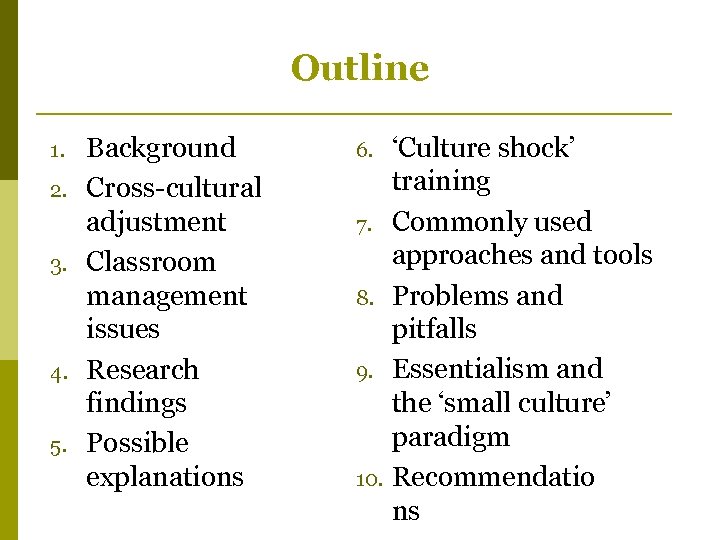 Outline 1. 2. 3. 4. 5. Background Cross-cultural adjustment Classroom management issues Research findings Possible explanations ‘Culture shock’ training 7. Commonly used approaches and tools 8. Problems and pitfalls 9. Essentialism and the ‘small culture’ paradigm 10. Recommendatio ns 6.
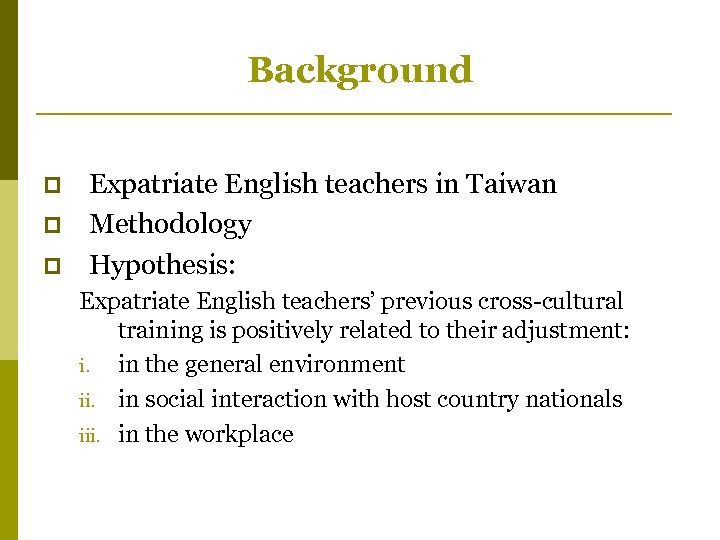 Background p p p Expatriate English teachers in Taiwan Methodology Hypothesis: Expatriate English teachers’ previous cross-cultural training is positively related to their adjustment: i. in the general environment ii. in social interaction with host country nationals iii. in the workplace
 Cross-cultural adjustment p What is cross-cultural adjustment? p Is there an effective model for researching cross -cultural adjustment?
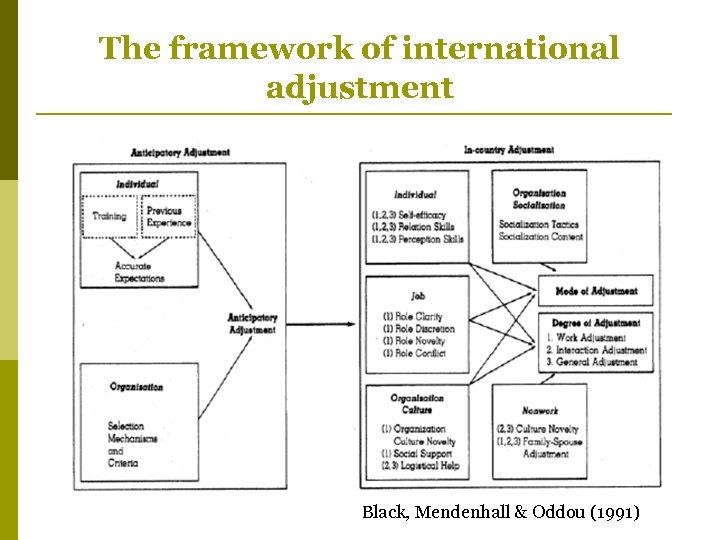 The framework of international adjustment Black, Mendenhall & Oddou (1991)
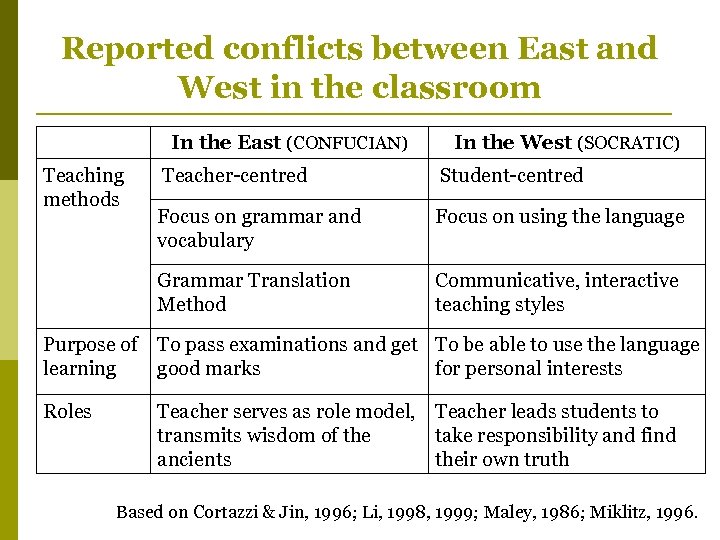 Reported conflicts between East and West in the classroom In the East (CONFUCIAN) Teaching methods In the West (SOCRATIC) Teacher-centred Student-centred Focus on grammar and vocabulary Focus on using the language Grammar Translation Method Communicative, interactive teaching styles Purpose of To pass examinations and get To be able to use the language learning good marks for personal interests Roles Teacher serves as role model, Teacher leads students to transmits wisdom of the take responsibility and find ancients their own truth Based on Cortazzi & Jin, 1996; Li, 1998, 1999; Maley, 1986; Miklitz, 1996.
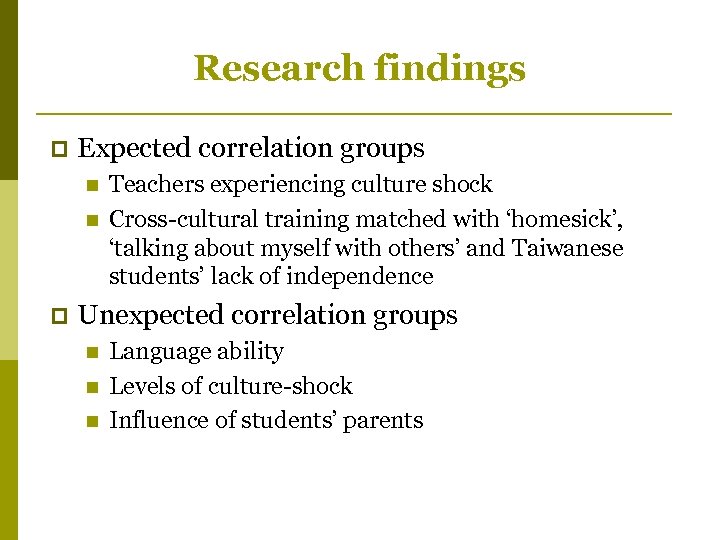 Research findings p Expected correlation groups n n p Teachers experiencing culture shock Cross-cultural training matched with ‘homesick’, ‘talking about myself with others’ and Taiwanese students’ lack of independence Unexpected correlation groups n n n Language ability Levels of culture-shock Influence of students’ parents
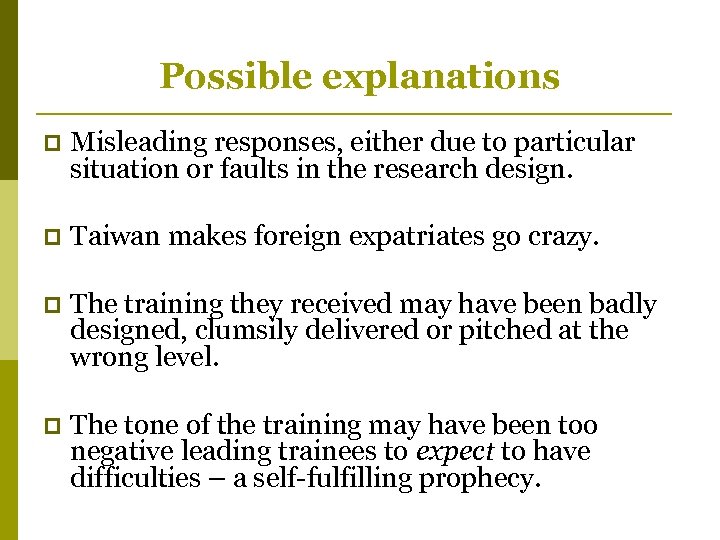 Possible explanations p Misleading responses, either due to particular situation or faults in the research design. p Taiwan makes foreign expatriates go crazy. p The training they received may have been badly designed, clumsily delivered or pitched at the wrong level. p The tone of the training may have been too negative leading trainees to expect to have difficulties – a self-fulfilling prophecy.
 ‘Culture shock’ training p What is it? p Time and resources p Participation p Delivery and quality control p Content
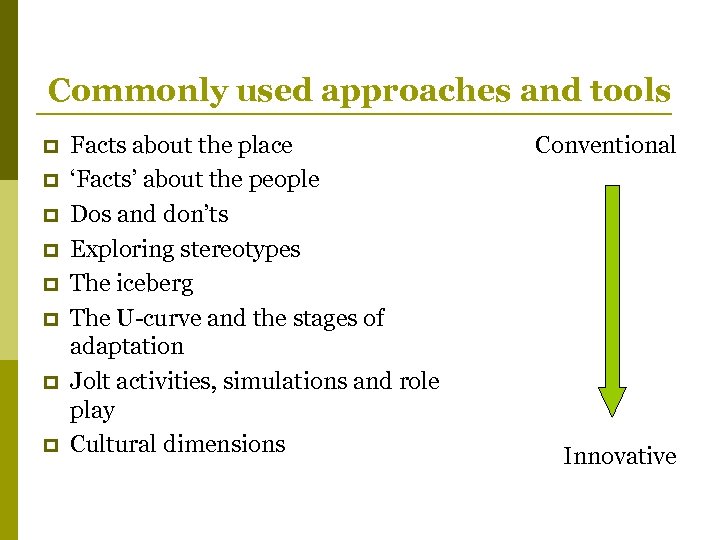 Commonly used approaches and tools p p p p Facts about the place ‘Facts’ about the people Dos and don’ts Exploring stereotypes The iceberg The U-curve and the stages of adaptation Jolt activities, simulations and role play Cultural dimensions Conventional Innovative
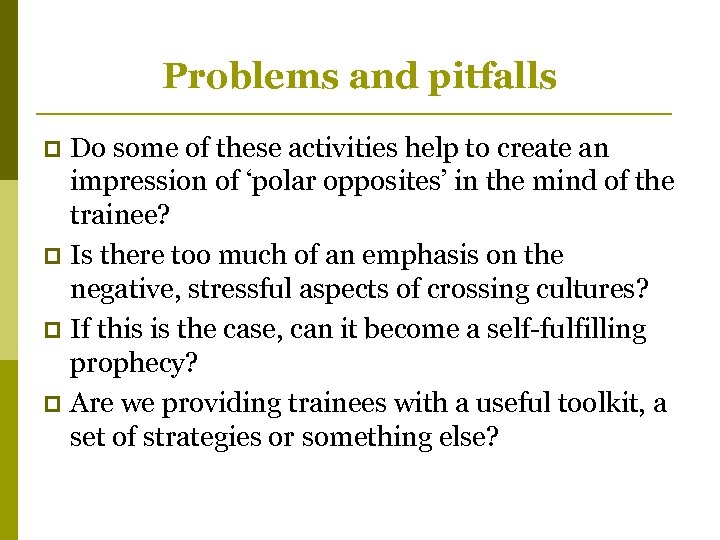 Problems and pitfalls Do some of these activities help to create an impression of ‘polar opposites’ in the mind of the trainee? p Is there too much of an emphasis on the negative, stressful aspects of crossing cultures? p If this is the case, can it become a self-fulfilling prophecy? p Are we providing trainees with a useful toolkit, a set of strategies or something else? p
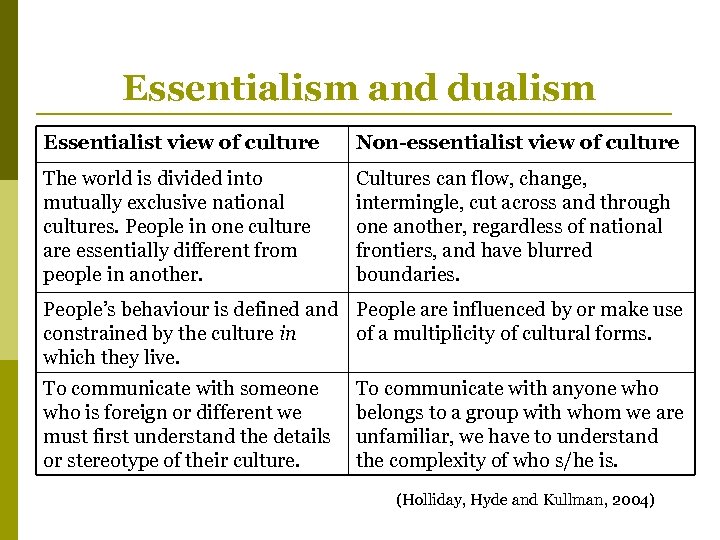 Essentialism and dualism Essentialist view of culture Non-essentialist view of culture The world is divided into mutually exclusive national cultures. People in one culture are essentially different from people in another. Cultures can flow, change, intermingle, cut across and through one another, regardless of national frontiers, and have blurred boundaries. People’s behaviour is defined and People are influenced by or make use constrained by the culture in of a multiplicity of cultural forms. which they live. To communicate with someone who is foreign or different we must first understand the details or stereotype of their culture. To communicate with anyone who belongs to a group with whom we are unfamiliar, we have to understand the complexity of who s/he is. (Holliday, Hyde and Kullman, 2004)
 The ‘small culture’ paradigm ‘Small culture’ vs ‘large culture’ p The slippery slope of Culturism: reductionism, otherisation, cultural fundamentalism p Small culture is: p n n Any social grouping from a neighbourhood to a work group. A dynamic, ongoing group process which operates in changing circumstances to enable group members to make sense of and operate meaningfully within those circumstances. (Holliday, 1999)
 Recommendations p p p Institutional: training is not ‘the icing on the cake’ Personal: trainers must engage in pedagogical reflection and professional development Professional: international standards for cross-cultural training? Design: more effort needed in planning stage; more consideration of pedagogical principles Content: dynamic process not fixed product Evaluation: a measure of effectiveness or a marketing tool?
 Questions to consider p What do you think of these research findings? p In your experience, does cross-cultural training overemphasize the stressful aspects of crossing cultures? p What can trainers do to avoid this kind of negative effect?
 Thank you very much p Wei Ju Liao E-mail: weiju. liao@beds. co. uk p Robert Johnson E-mail: rpk_johnson@yahoo. co. uk