 Скачать презентацию Sierra Club Palo Verde Group PVG July 2016
946d6596607c96fb6dd77a71694ef752.ppt
- Количество слайдов: 66



Sierra Club Palo Verde Group PVG July, 2016, Program Electric Utilities vs Solar Energy Enterprise Ronald Roedel Emeritus Professor of Electrical Engineering Arizona State University July 21, 2016
Ronald Roedel: Email: r. roedel@asu. edu Webpage: http: //roedel. faculty. asu. edu Main Affiliation: Professional Science Masters – Solar Energy Engineering and Commercialization: http: //semte. engineering. asu. edu/solar-energyengineering-commercialization
The Solar Enterprise Both nationally and globally, the solar business has grown by leaps and bounds in the last two decades Current US Solar Power 29. 3 GW 3
![US Photovoltaic (PV) System Installations SEIA [1] 4](https://present5.com/presentation/946d6596607c96fb6dd77a71694ef752/image-4.jpg "US Photovoltaic (PV) System Installations SEIA [1] 4")
US Photovoltaic (PV) System Installations SEIA [1] 4
The Solar Enterprise Both nationally and globally, the solar business has grown by leaps and bounds in the last two decades Current US Solar Power 29. 3 GW (2% of US electricity demand) 5
![The Solar Enterprise SEIA [1] 6](https://present5.com/presentation/946d6596607c96fb6dd77a71694ef752/image-6.jpg "The Solar Enterprise SEIA [1] 6")
The Solar Enterprise SEIA [1] 6
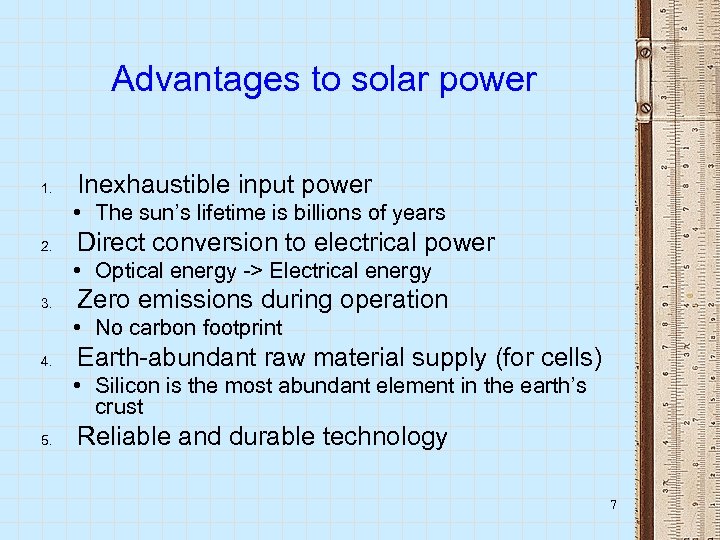
Advantages to solar power 1. Inexhaustible input power • The sun’s lifetime is billions of years 2. Direct conversion to electrical power • Optical energy -> Electrical energy 3. Zero emissions during operation • No carbon footprint 4. Earth-abundant raw material supply (for cells) • Silicon is the most abundant element in the earth’s crust 5. Reliable and durable technology 7
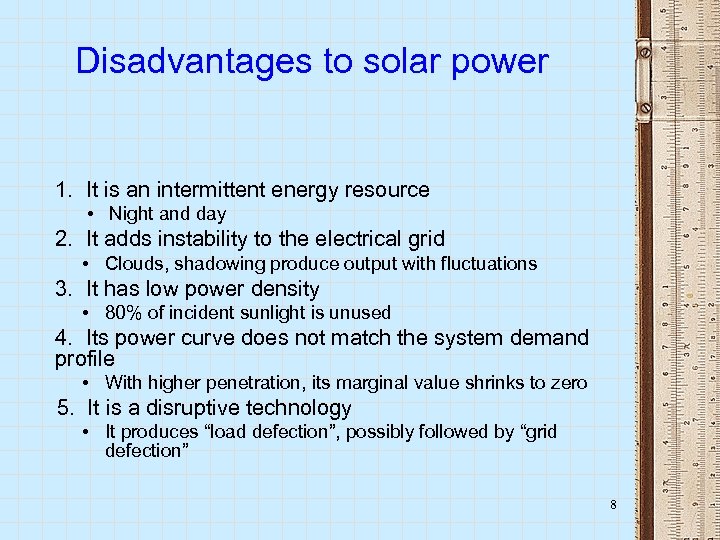
Disadvantages to solar power 1. It is an intermittent energy resource • Night and day 2. It adds instability to the electrical grid • Clouds, shadowing produce output with fluctuations 3. It has low power density • 80% of incident sunlight is unused 4. Its power curve does not match the system demand profile • With higher penetration, its marginal value shrinks to zero 5. It is a disruptive technology • It produces “load defection”, possibly followed by “grid defection” 8
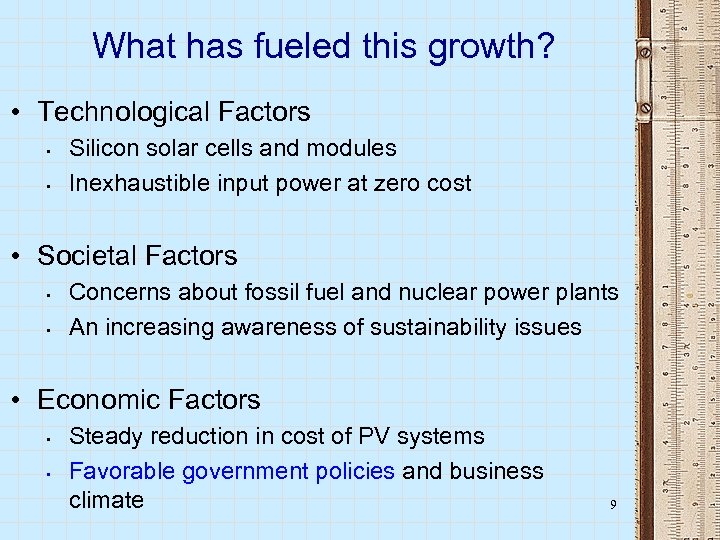
What has fueled this growth? • Technological Factors • • Silicon solar cells and modules Inexhaustible input power at zero cost • Societal Factors • • Concerns about fossil fuel and nuclear power plants An increasing awareness of sustainability issues • Economic Factors • • Steady reduction in cost of PV systems Favorable government policies and business climate 9
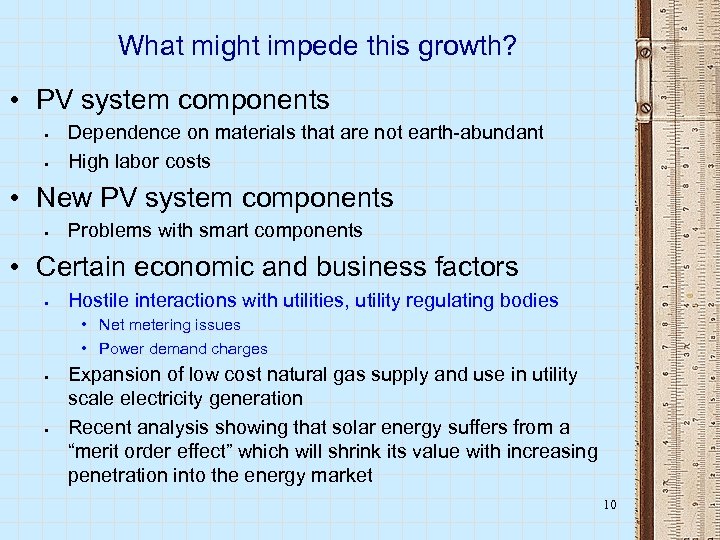
What might impede this growth? • PV system components • • Dependence on materials that are not earth-abundant High labor costs • New PV system components • Problems with smart components • Certain economic and business factors • Hostile interactions with utilities, utility regulating bodies • Net metering issues • Power demand charges • • Expansion of low cost natural gas supply and use in utility scale electricity generation Recent analysis showing that solar energy suffers from a “merit order effect” which will shrink its value with increasing penetration into the energy market 10
The Photovoltaic (PV) System A photovoltaic system (or PV system) is an engineered system that carries out these operations: o o o Absorption of incident solar radiation (optical energy) Conversion of the absorbed solar energy to DC electrical energy Controlled transfer of the DC electrical energy to a storage device (such as an array of batteries) Controlled inversion of the DC electrical energy to AC electrical energy Controlled transfer of the electrical energy to electrical loads or to the electrical grid 11
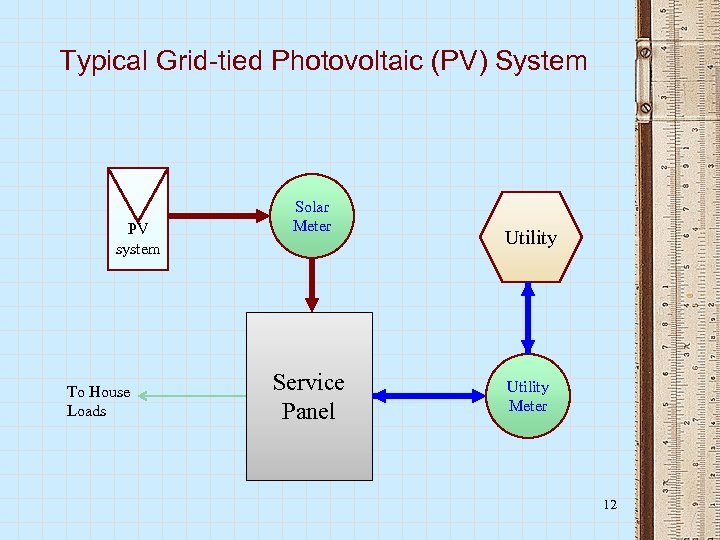
Typical Grid-tied Photovoltaic (PV) System PV system To House Loads Solar Meter Service Panel Utility Meter 12
The Real Problem • The Solar Enterprise needs the Electrical Utilities and the Electrical Grid BUT • The Electrical Utilities and the Electrical Grid do not need the Solar Enterprise 13
The Solar Enterprise The growth in all renewable energy systems has produced challenges for the electric utilities that must be viewed as disruptive Warren Buffett recently stated, “Solar and Wind Power could erode the economics of the incumbent utility!” The Edison Electric Institute wrote “the cycle of decline [utilities are facing] has been previously witnessed in technology-disrupted sectors (telecommunications and airlines)” [2] 14
![Some (seldom mentioned) Utility Issues David Roberts, Grist, 04/10/13 [3] 15](https://present5.com/presentation/946d6596607c96fb6dd77a71694ef752/image-15.jpg "Some (seldom mentioned) Utility Issues David Roberts, Grist, 04/10/13 [3] 15")
Some (seldom mentioned) Utility Issues David Roberts, Grist, 04/10/13 [3] 15
Some (seldom mentioned) Utility Issues • The electrical power generated by distributed PV (and other renewable approaches) is not generated and sold by the utilities • A belief that increasing PV deployment will lead first to load defection and ultimately to grid defection • The utilities make money from a guaranteed return on capital investment, and since they don’t own the PV systems, they can’t add that 16 value to the rate base
The Utility Response 1. Fight, hammer and tong, the changes to the traditional model 1. Recognize that renewable energy systems are here to stay, so develop and embrace a new business model that has a new outlook and generates a novel partnership among all stakeholders 1. Wait and see 17
The utilities that fight the changes 1. Propose eliminating or altering the net electrical metering (NEM) policy This proposal is related to the energy content of both the solar produced electricity and the utility produced electricity Utilities have never expected or planned to buy power from residential or commercial sources, and they do not like doing it now 18
The utilities that fight the changes 2. Propose adding a demand charge to the monthly bill of the utility residential customer This proposal is related to the electrical power delivered by the utility For decades, utilities have charged their residential customers only for the electrical energy. No Investor Owned Utility (IOU) has ever charged for the electrical power 19
A Quick Review of Energy and Power • Energy is a measurement of capacity to do work. It is expressed in units of joules (J) • Power is the rate at which energy is employed. It is expressed in units of watts (W). One watt equals one joule per second 20
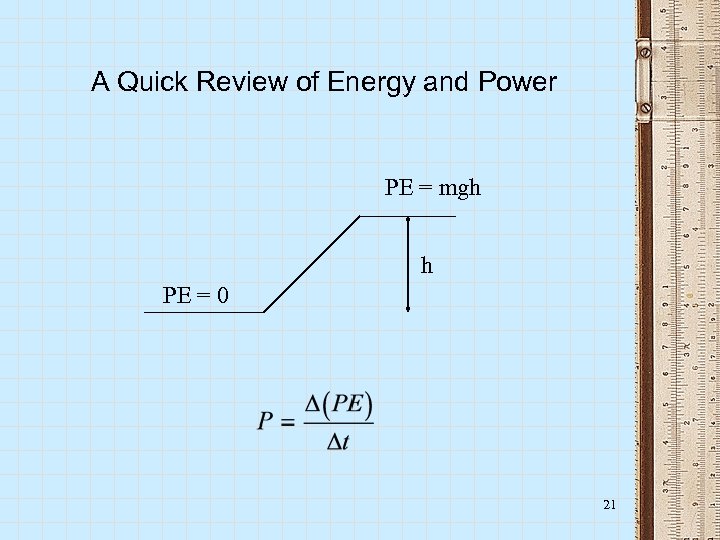
A Quick Review of Energy and Power PE = mgh h PE = 0 21
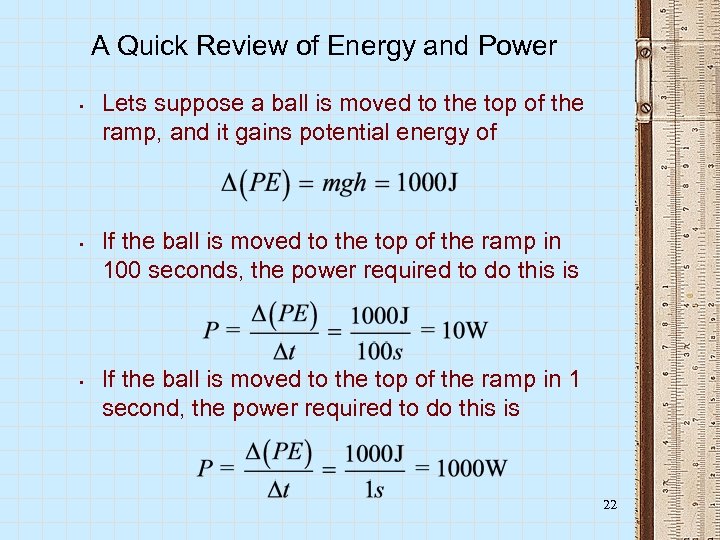
A Quick Review of Energy and Power • • • Lets suppose a ball is moved to the top of the ramp, and it gains potential energy of If the ball is moved to the top of the ramp in 100 seconds, the power required to do this is If the ball is moved to the top of the ramp in 1 second, the power required to do this is 22
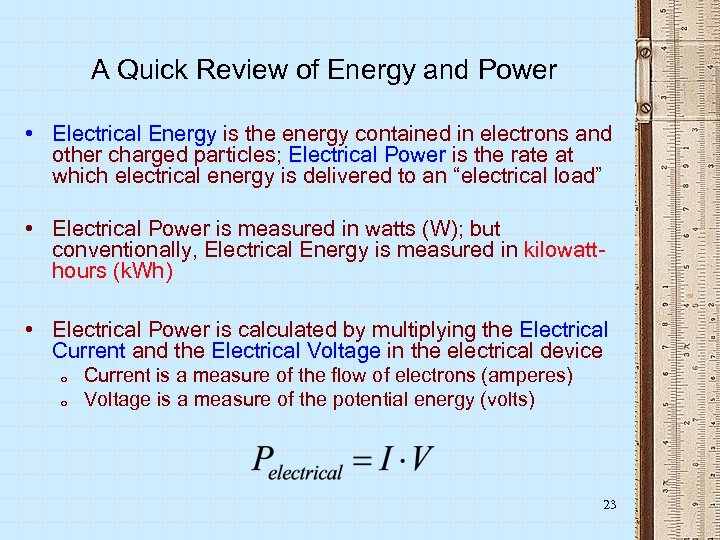
A Quick Review of Energy and Power • Electrical Energy is the energy contained in electrons and other charged particles; Electrical Power is the rate at which electrical energy is delivered to an “electrical load” • Electrical Power is measured in watts (W); but conventionally, Electrical Energy is measured in kilowatthours (k. Wh) • Electrical Power is calculated by multiplying the Electrical Current and the Electrical Voltage in the electrical device o o Current is a measure of the flow of electrons (amperes) Voltage is a measure of the potential energy (volts) 23
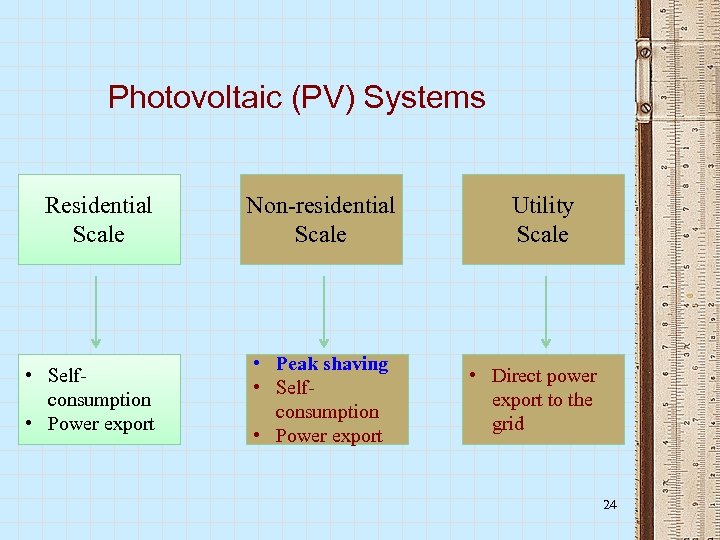
Photovoltaic (PV) Systems Residential Scale • Selfconsumption • Power export Non-residential Scale • Peak shaving • Selfconsumption • Power export Utility Scale • Direct power export to the grid 24
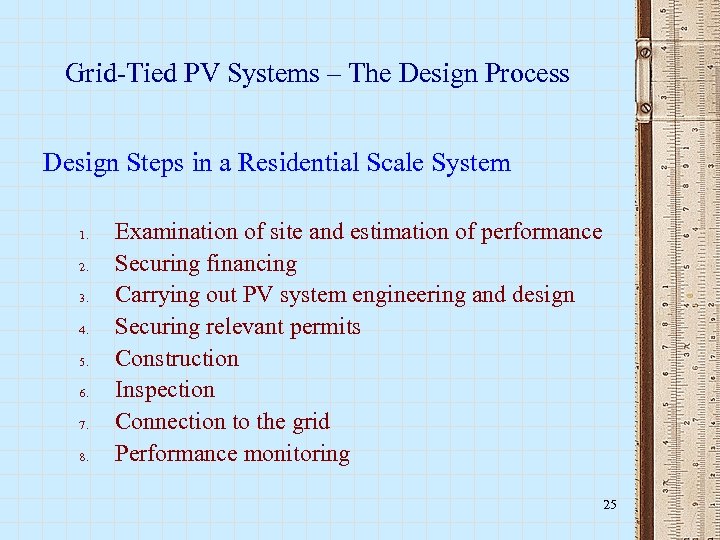
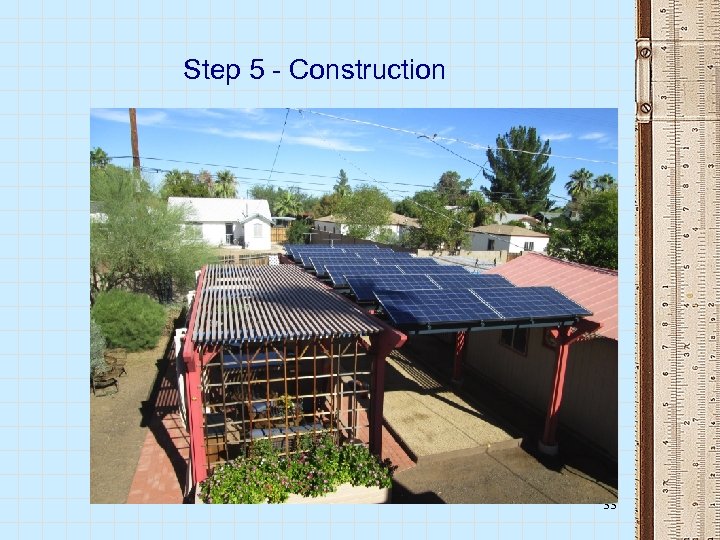
Grid-Tied PV Systems – The Design Process Design Steps in a Residential Scale System 1. 2. 3. 4. 5. 6. 7. 8. Examination of site and estimation of performance Securing financing Carrying out PV system engineering and design Securing relevant permits Construction Inspection Connection to the grid Performance monitoring 25
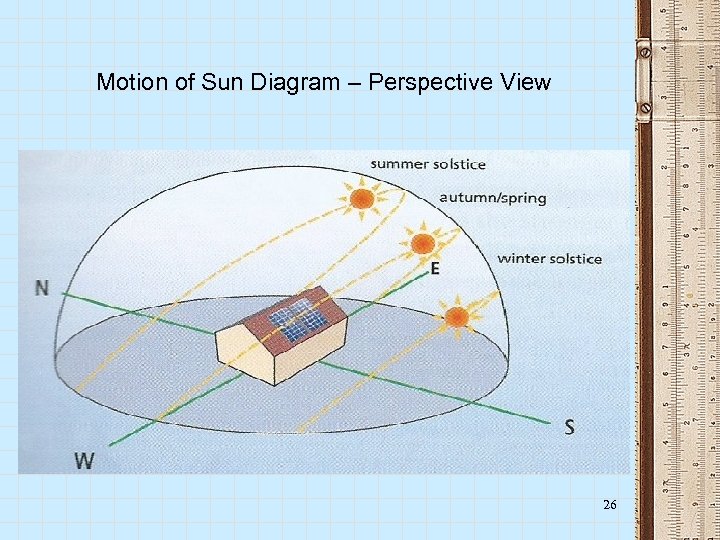
Motion of Sun Diagram – Perspective View 26
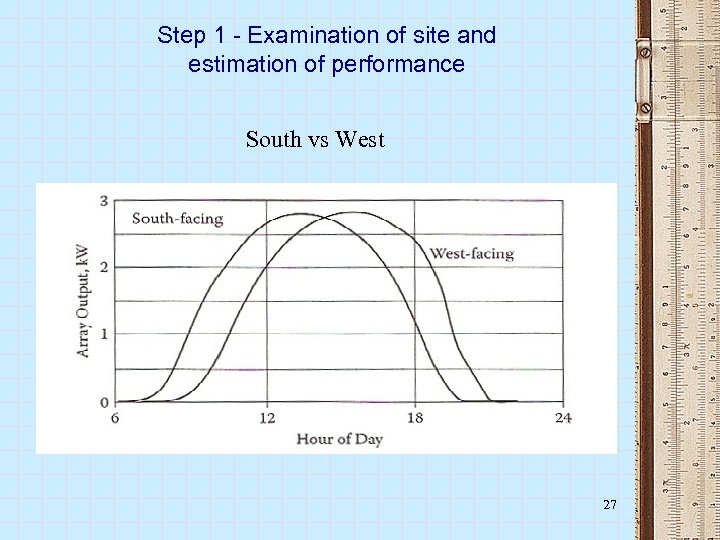
Step 1 - Examination of site and estimation of performance South vs West 27
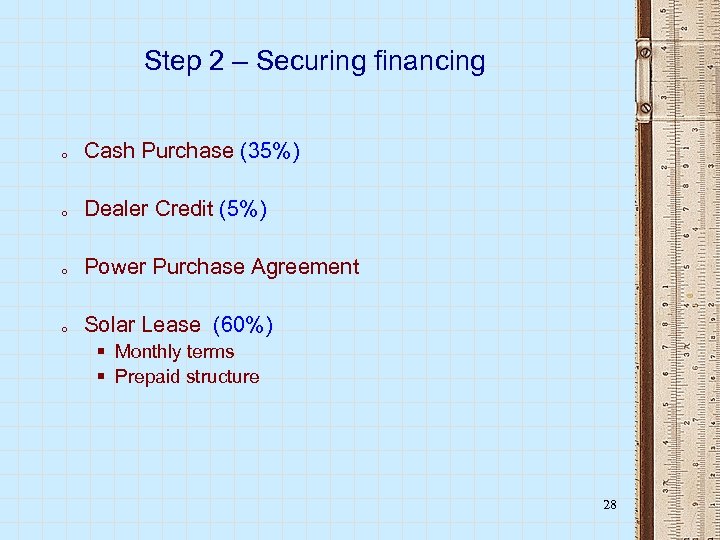
Step 2 – Securing financing o Cash Purchase (35%) o Dealer Credit (5%) o Power Purchase Agreement o Solar Lease (60%) § Monthly terms § Prepaid structure 28
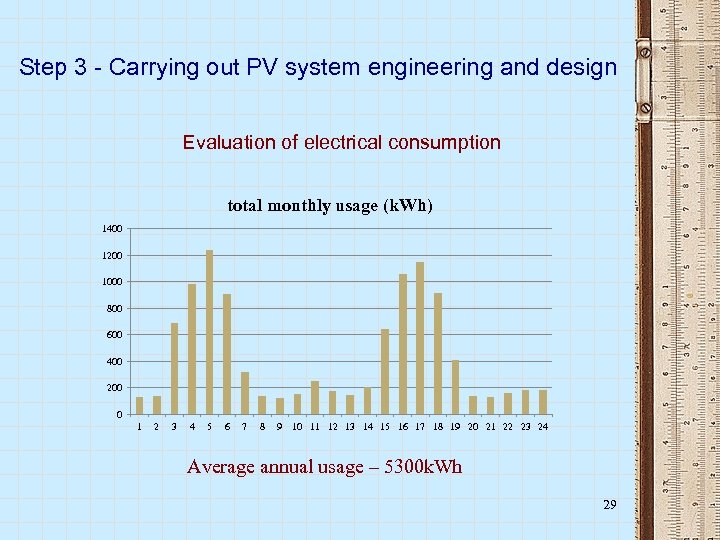
Step 3 - Carrying out PV system engineering and design Evaluation of electrical consumption total monthly usage (k. Wh) 1400 1200 1000 800 600 400 200 0 1 2 3 4 5 6 7 8 9 10 11 12 13 14 15 16 17 18 19 20 21 22 23 24 Average annual usage – 5300 k. Wh 29
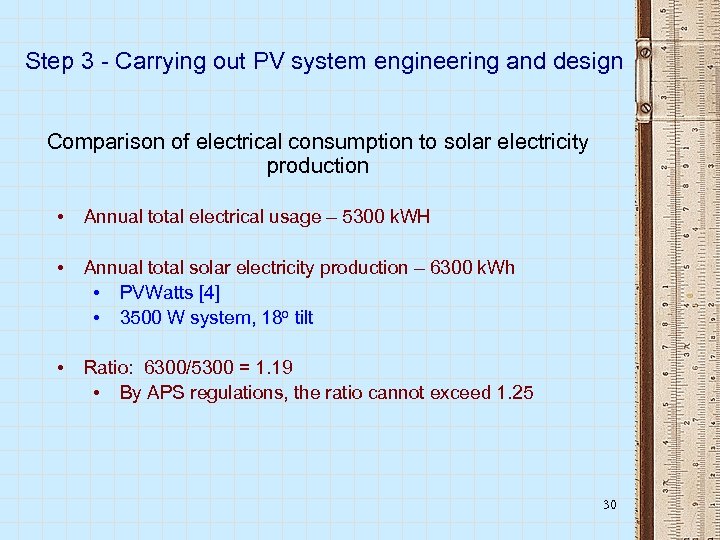
Step 3 - Carrying out PV system engineering and design Comparison of electrical consumption to solar electricity production • Annual total electrical usage – 5300 k. WH • Annual total solar electricity production – 6300 k. Wh • PVWatts [4] • 3500 W system, 18 o tilt • Ratio: 6300/5300 = 1. 19 • By APS regulations, the ratio cannot exceed 1. 25 30
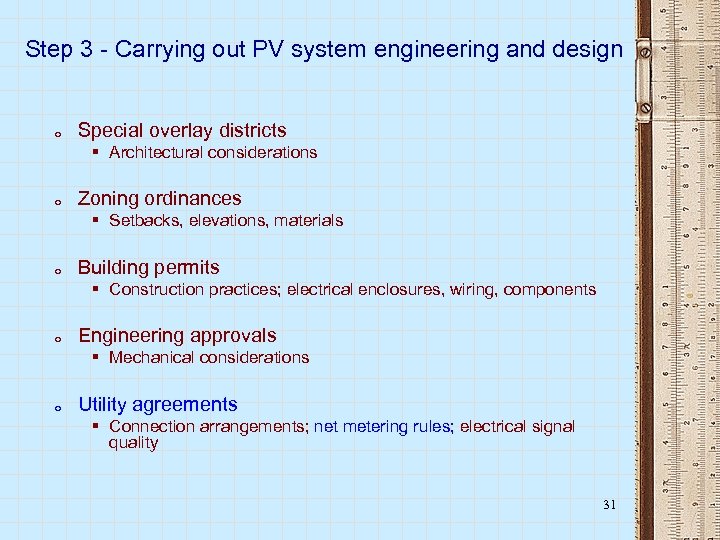
Step 3 - Carrying out PV system engineering and design o Special overlay districts § Architectural considerations o Zoning ordinances § Setbacks, elevations, materials o Building permits § Construction practices; electrical enclosures, wiring, components o Engineering approvals § Mechanical considerations o Utility agreements § Connection arrangements; net metering rules; electrical signal quality 31
Grid-Tied PV Systems – The Design Process Step 5 – Construction Step 6 – Inspection Step 7 – Connection to the grid Step 8 – Performance monitoring 32
Step 5 - Construction 33
Policies impacting Residential PV Systems • Renewable Portfolio Standards (RPS) o Often has a “solar carve-out” – a portion of the RPS must be met by Distributed Generation (DG), or rooftop solar • Incentives o Federal Investment Tax Credit (ITC) – Reduces Initial Investment o o o Had been scheduled to end 12/2016; recently extended to 2021 State Tax Credits Utility incentives • Public Utility Commission Policies o Net Electrical Metering – Reduces Annual Cash Payments o Presently under review (attack? ) in 41 states 34
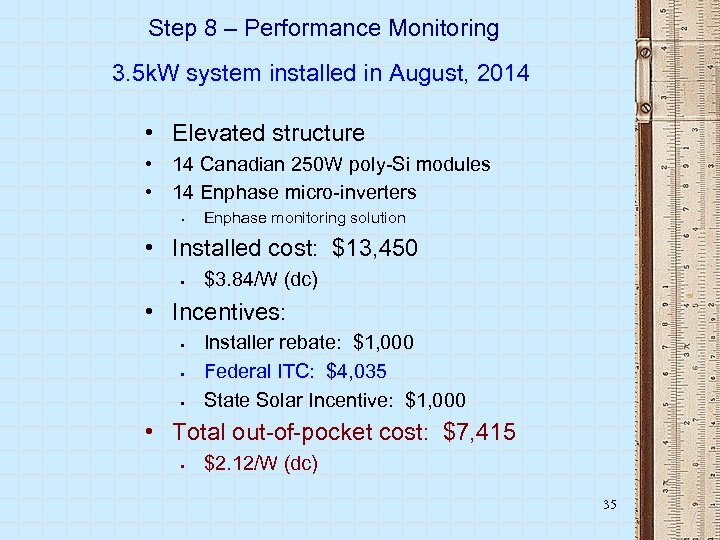
Step 8 – Performance Monitoring 3. 5 k. W system installed in August, 2014 • Elevated structure • 14 Canadian 250 W poly-Si modules • 14 Enphase micro-inverters • Enphase monitoring solution • Installed cost: $13, 450 • $3. 84/W (dc) • Incentives: • • • Installer rebate: $1, 000 Federal ITC: $4, 035 State Solar Incentive: $1, 000 • Total out-of-pocket cost: $7, 415 • $2. 12/W (dc) 35
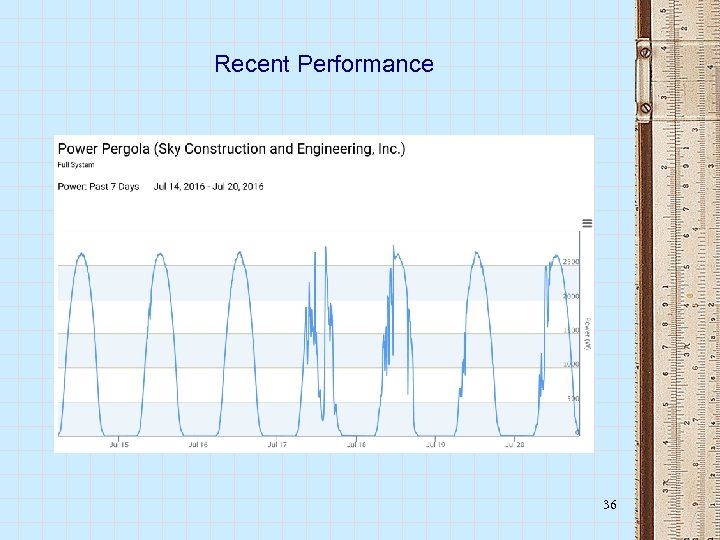
Recent Performance 36
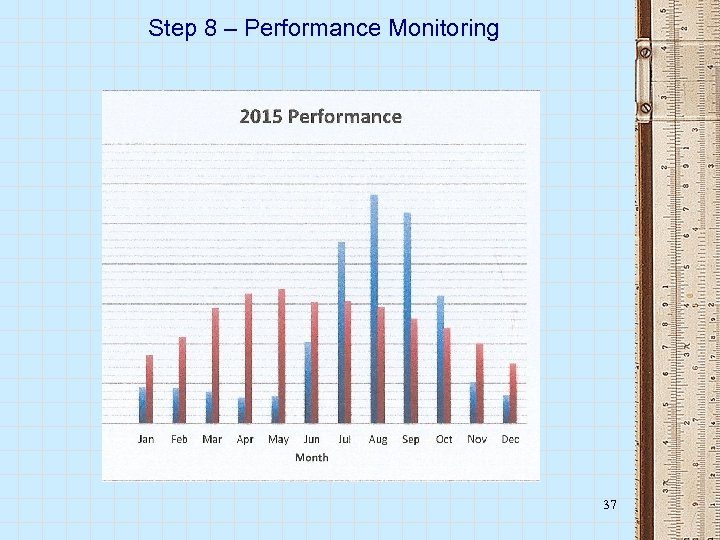
Step 8 – Performance Monitoring 37
Net Metering • At the end of each month, a utility bill is calculated: Electricity Generation = Number of k. Wh purchased from utility (after self-consumption) – Number of k. Wh exported to utility – Residual credits (in k. Wh) from “energy bank” • This is all carried out at the retail rate • Once a year, the residual credits are cashed in: • • This is carried out at the wholesale rate For APS, the “settle-up” date is 12/31 38
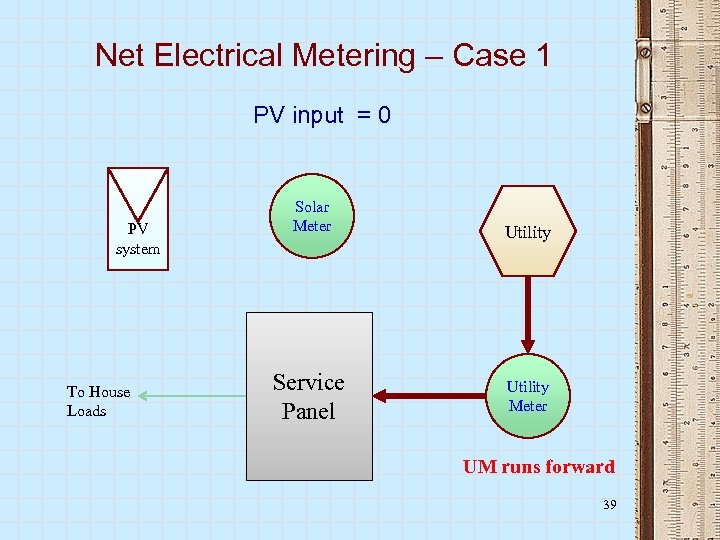
Net Electrical Metering – Case 1 PV input = 0 PV system To House Loads Solar Meter Service Panel Utility Meter UM runs forward 39
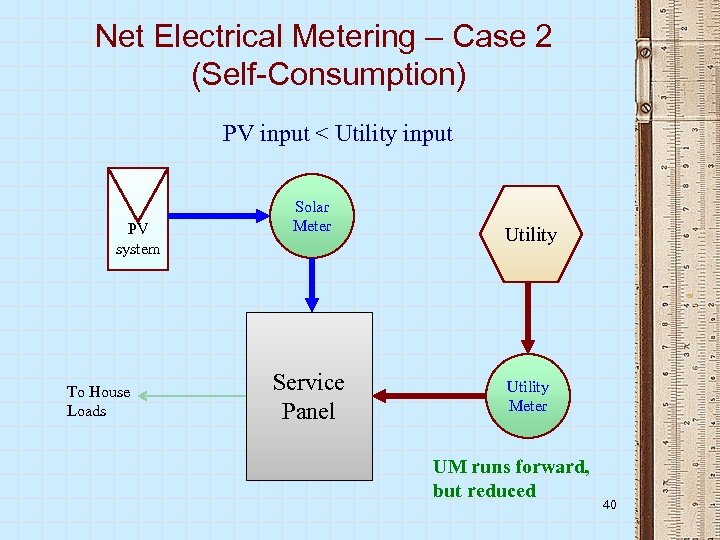
Net Electrical Metering – Case 2 (Self-Consumption) PV input < Utility input PV system To House Loads Solar Meter Service Panel Utility Meter UM runs forward, but reduced 40
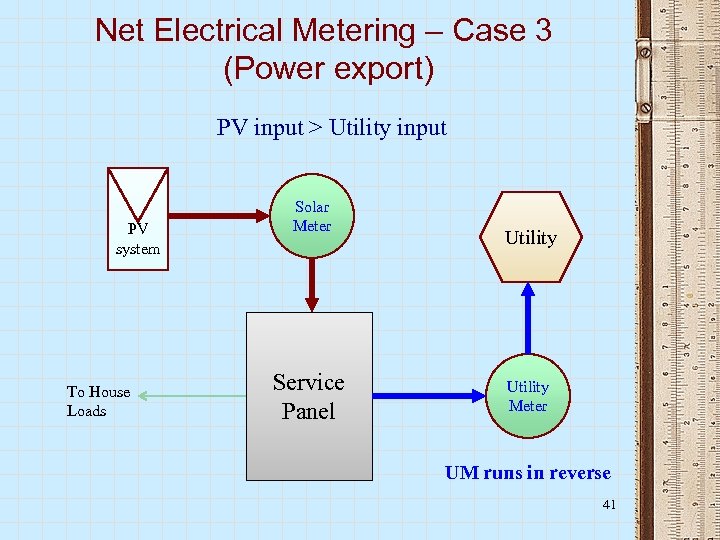
Net Electrical Metering – Case 3 (Power export) PV input > Utility input PV system To House Loads Solar Meter Service Panel Utility Meter UM runs in reverse 41
![Net Metering Crossborder Energy, 02/25/16 [5] 42](https://present5.com/presentation/946d6596607c96fb6dd77a71694ef752/image-42.jpg "Net Metering Crossborder Energy, 02/25/16 [5] 42")
Net Metering Crossborder Energy, 02/25/16 [5] 42
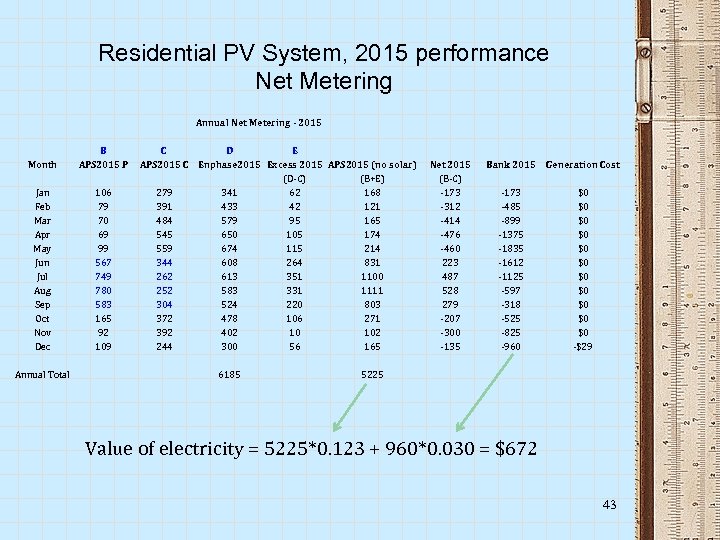
Residential PV System, 2015 performance Net Metering Annual Net Metering - 2015 Month B APS 2015 P Jan Feb Mar Apr May Jun Jul Aug Sep Oct Nov Dec 106 79 70 69 99 567 749 780 583 165 92 109 Annual Total C D E APS 2015 C Enphase 2015 Excess 2015 APS 2015 (no solar) (D-C) (B+E) 279 341 62 168 391 433 42 121 484 579 95 165 545 650 105 174 559 674 115 214 344 608 264 831 262 613 351 1100 252 583 331 1111 304 524 220 803 372 478 106 271 392 402 10 102 244 300 56 165 6185 Net 2015 (B-C) -173 -312 -414 -476 -460 223 487 528 279 -207 -300 -135 Bank 2015 Generation Cost -173 -485 -899 -1375 -1835 -1612 -1125 -597 -318 -525 -825 -960 $0 $0 $0 -$29 5225 Value of electricity = 5225*0. 123 + 960*0. 030 = $672 43
Economic Analysis Current residential PV system example • • Assume that the installed cost of a 3. 5 k. W PV system is $2. 12/W after all incentives are accounted for. Assume that the system will produce an annual electrical amount of 6250 k. Wh (as measured). Assume the utility cost of electricity as $0. 123/k. Wh. The plan here is to calculate the Life Cycle Cost on both an annualized and cumulative basis, and see when it crosses zero
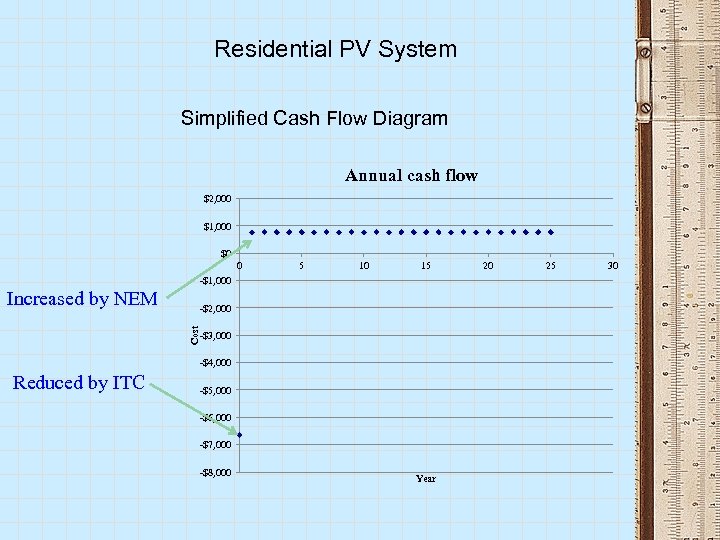
Residential PV System Simplified Cash Flow Diagram Annual cash flow $2, 000 $1, 000 $0 0 5 10 15 -$1, 000 Increased by NEM Cost -$2, 000 -$3, 000 -$4, 000 Reduced by ITC -$5, 000 -$6, 000 -$7, 000 -$8, 000 Year 20 25 30
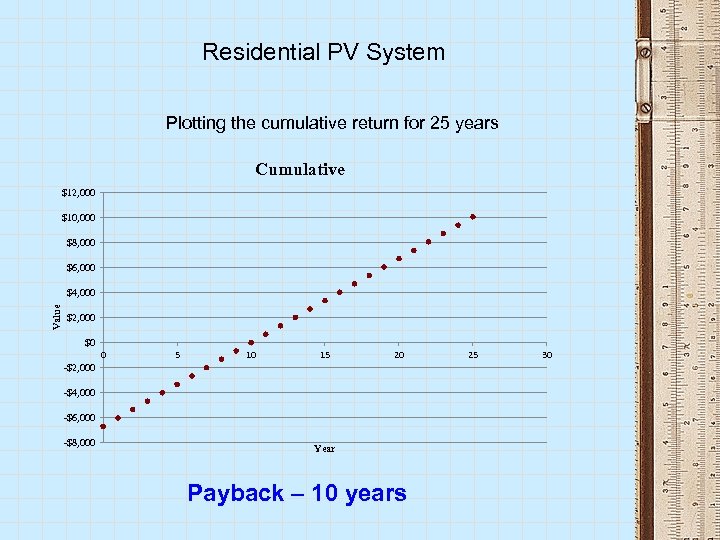
Residential PV System Plotting the cumulative return for 25 years Cumulative $12, 000 $10, 000 $8, 000 $6, 000 Value $4, 000 $2, 000 $0 0 5 10 15 20 -$2, 000 -$4, 000 -$6, 000 -$8, 000 Year Payback – 10 years 25 30
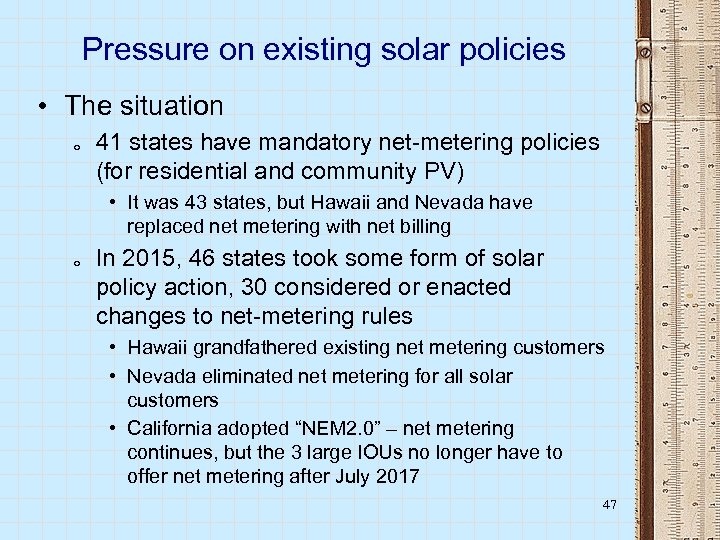
Pressure on existing solar policies • The situation o 41 states have mandatory net-metering policies (for residential and community PV) • It was 43 states, but Hawaii and Nevada have replaced net metering with net billing o In 2015, 46 states took some form of solar policy action, 30 considered or enacted changes to net-metering rules • Hawaii grandfathered existing net metering customers • Nevada eliminated net metering for all solar customers • California adopted “NEM 2. 0” – net metering continues, but the 3 large IOUs no longer have to offer net metering after July 2017 47
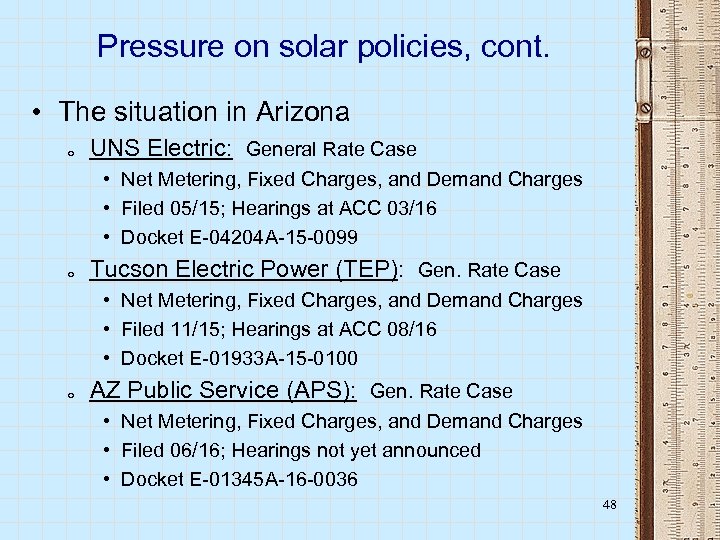
Pressure on solar policies, cont. • The situation in Arizona o UNS Electric: General Rate Case • Net Metering, Fixed Charges, and Demand Charges • Filed 05/15; Hearings at ACC 03/16 • Docket E-04204 A-15 -0099 o Tucson Electric Power (TEP): Gen. Rate Case • Net Metering, Fixed Charges, and Demand Charges • Filed 11/15; Hearings at ACC 08/16 • Docket E-01933 A-15 -0100 o AZ Public Service (APS): Gen. Rate Case • Net Metering, Fixed Charges, and Demand Charges • Filed 06/16; Hearings not yet announced • Docket E-01345 A-16 -0036 48
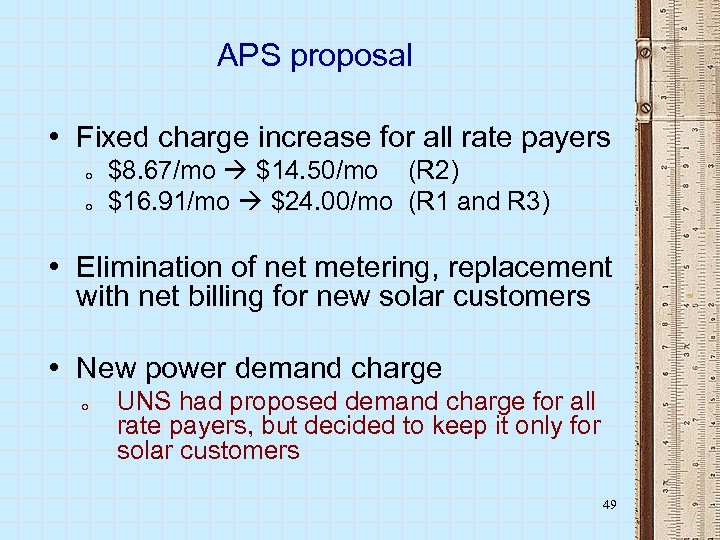
APS proposal • Fixed charge increase for all rate payers o o $8. 67/mo $14. 50/mo (R 2) $16. 91/mo $24. 00/mo (R 1 and R 3) • Elimination of net metering, replacement with net billing for new solar customers • New power demand charge o UNS had proposed demand charge for all rate payers, but decided to keep it only for solar customers 49
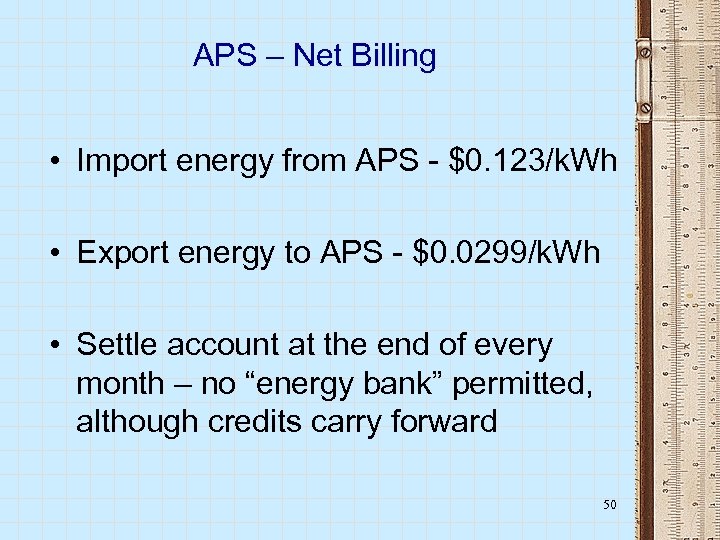
APS – Net Billing • Import energy from APS - $0. 123/k. Wh • Export energy to APS - $0. 0299/k. Wh • Settle account at the end of every month – no “energy bank” permitted, although credits carry forward 50
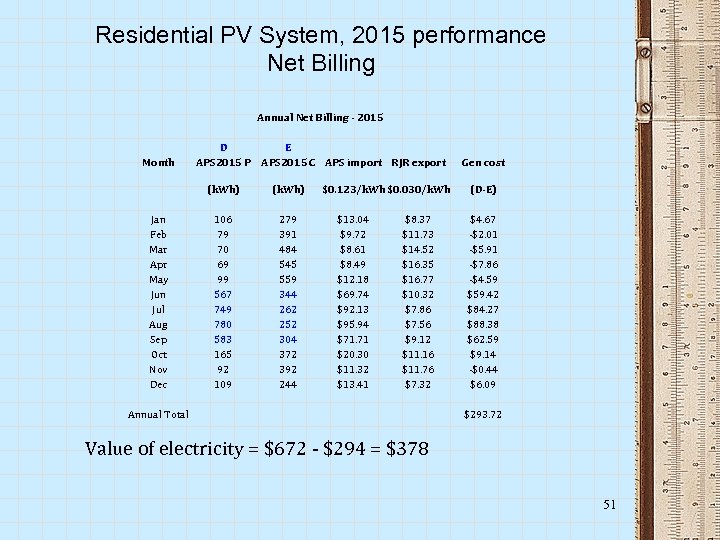
Residential PV System, 2015 performance Net Billing Annual Net Billing - 2015 Month D E APS 2015 P APS 2015 C APS import RJR export (k. Wh) Jan Feb Mar Apr May Jun Jul Aug Sep Oct Nov Dec (k. Wh) 106 79 70 69 99 567 749 780 583 165 92 109 279 391 484 545 559 344 262 252 304 372 392 244 $0. 123/k. Wh $0. 030/k. Wh $13. 04 $9. 72 $8. 61 $8. 49 $12. 18 $69. 74 $92. 13 $95. 94 $71. 71 $20. 30 $11. 32 $13. 41 $8. 37 $11. 73 $14. 52 $16. 35 $16. 77 $10. 32 $7. 86 $7. 56 $9. 12 $11. 16 $11. 76 $7. 32 Annual Total Gen cost (D-E) $4. 67 -$2. 01 -$5. 91 -$7. 86 -$4. 59 $59. 42 $84. 27 $88. 38 $62. 59 $9. 14 -$0. 44 $6. 09 $293. 72 Value of electricity = $672 - $294 = $378 51
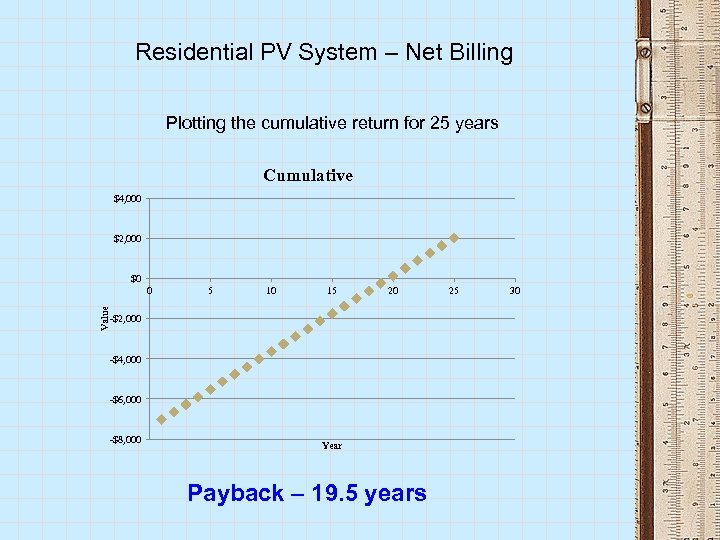
Residential PV System – Net Billing Plotting the cumulative return for 25 years Cumulative $4, 000 $2, 000 $0 Value 0 5 10 15 20 -$2, 000 -$4, 000 -$6, 000 -$8, 000 Year Payback – 19. 5 years 25 30
SRP Demand Charges • The billing demand is the maximum thirty-minute integrated k. W demand occurring during the onpeak periods of the billing cycle • These charges are modest in the months of low utility region usage, but can be quite substantial in the months of high utility region usage • The power demand charges are an additional charge above the electrical energy usage charge • SRP calls the demand charge a “price signal” 53
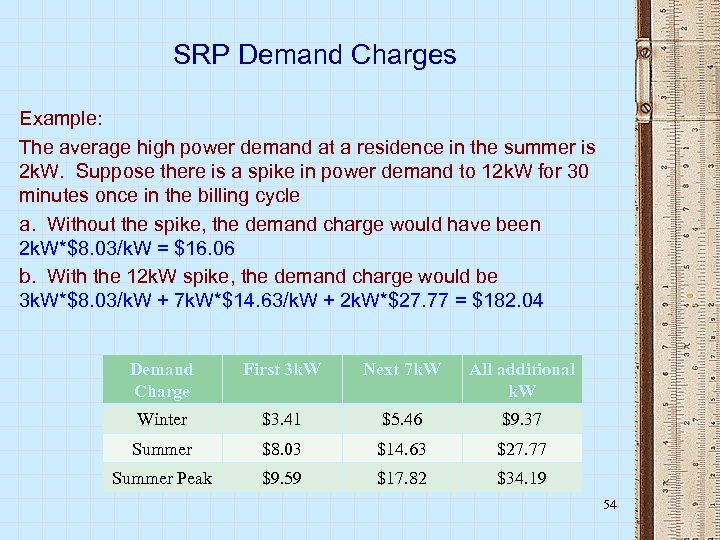
SRP Demand Charges Example: The average high power demand at a residence in the summer is 2 k. W. Suppose there is a spike in power demand to 12 k. W for 30 minutes once in the billing cycle a. Without the spike, the demand charge would have been 2 k. W*$8. 03/k. W = $16. 06 b. With the 12 k. W spike, the demand charge would be 3 k. W*$8. 03/k. W + 7 k. W*$14. 63/k. W + 2 k. W*$27. 77 = $182. 04 Demand Charge First 3 k. W Next 7 k. W All additional k. W Winter $3. 41 $5. 46 $9. 37 Summer $8. 03 $14. 63 $27. 77 Summer Peak $9. 59 $17. 82 $34. 19 54
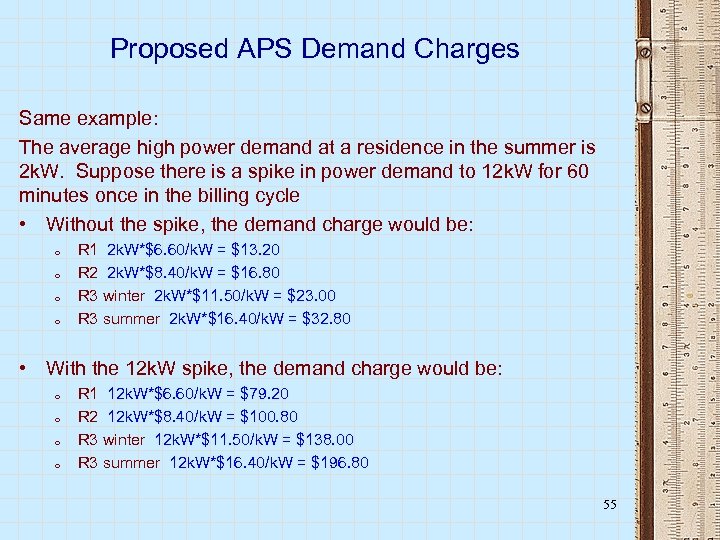
Proposed APS Demand Charges Same example: The average high power demand at a residence in the summer is 2 k. W. Suppose there is a spike in power demand to 12 k. W for 60 minutes once in the billing cycle • Without the spike, the demand charge would be: o o R 1 2 k. W*$6. 60/k. W = $13. 20 R 2 2 k. W*$8. 40/k. W = $16. 80 R 3 winter 2 k. W*$11. 50/k. W = $23. 00 R 3 summer 2 k. W*$16. 40/k. W = $32. 80 • With the 12 k. W spike, the demand charge would be: o o R 1 12 k. W*$6. 60/k. W = $79. 20 R 2 12 k. W*$8. 40/k. W = $100. 80 R 3 winter 12 k. W*$11. 50/k. W = $138. 00 R 3 summer 12 k. W*$16. 40/k. W = $196. 80 55
What can a rooftop solar customer do? o o Put in a rooftop PV system NOW! These proposed changes may go into effect on Jun 1, 2017 Design the system to “shave” the power demand peaks • Orient the solar modules to the west, to maximize the solar power generated late in the day • Consider solar+storage option o Operate the system with energy management strategies to eliminate the occurrences of peak surges 56
What can a rooftop solar customer do? o o Put in a rooftop PV system NOW! These proposed changes may go into effect on Jun 1, 2017 Design the system to “shave” the power demand peaks • Orient the solar modules to the west, to maximize the solar power generated late in the day • Consider solar+storage option o Operate the system with energy management strategies to eliminate the occurrences of peak surges 57
![What can a rooftop solar customer do? APS [5] 58](https://present5.com/presentation/946d6596607c96fb6dd77a71694ef752/image-58.jpg "What can a rooftop solar customer do? APS [5] 58")
What can a rooftop solar customer do? APS [5] 58
![New Approaches A new utility model • A partnership among all stake-holders Sunpower [6]](https://present5.com/presentation/946d6596607c96fb6dd77a71694ef752/image-59.jpg "New Approaches A new utility model • A partnership among all stake-holders Sunpower [6]")
New Approaches A new utility model • A partnership among all stake-holders Sunpower [6] 59
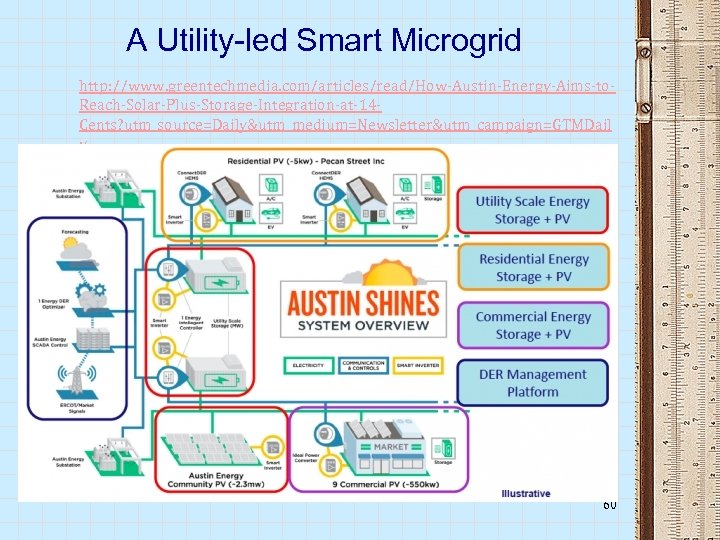
A Utility-led Smart Microgrid http: //www. greentechmedia. com/articles/read/How-Austin-Energy-Aims-to. Reach-Solar-Plus-Storage-Integration-at-14 Cents? utm_source=Daily&utm_medium=Newsletter&utm_campaign=GTMDail y 60
![Utility-led Smart Microgrid Austin Energy [7] received a $4 million grant from DOE (SHINES](https://present5.com/presentation/946d6596607c96fb6dd77a71694ef752/image-61.jpg "Utility-led Smart Microgrid Austin Energy [7] received a $4 million grant from DOE (SHINES")
Utility-led Smart Microgrid Austin Energy [7] received a $4 million grant from DOE (SHINES program) to launch a Solar+Storage+Grid system, called “almost dispatchable”, using: • Austin Energy’s advanced distribution grid management and control system • A distributed energy resource optimizer from 1 Energy • Solar analytics from Clean Power Research • Grid batteries from Tesla and Samsung • Smart inverters from Solar Edge and Ideal Power • Smart meters and communications from Landis+Gyr • Integration with Texas grid operator ERCOT • Cost – 14 cents/k. Wh 61
![Another Utility-led Smart Microgrid Duke Energy [8] 62](https://present5.com/presentation/946d6596607c96fb6dd77a71694ef752/image-62.jpg "Another Utility-led Smart Microgrid Duke Energy [8] 62")
Another Utility-led Smart Microgrid Duke Energy [8] 62
Next Steps 1. Contact the Arizona Corporation Commission with letters, written comments, testimony at the public hearings. APS does not practice Quaker Capitalism, and responds only to direct orders from the ACC 2. Tell the ACC that renewable electrical energy, especially solar energy, is still a start-up enterprise and needs additional support – just as all energy technologies before them. Keep net-metering in place. 63
Next Steps 3. Tell the ACC that electricity utilities have billed their customers for energy only for decades. Imposing power demand charges, without providing the means to monitor and alter power usage, is simply a punitive act 4. Tell the ACC that they should direct APS to devise a plan to become a proper 21 st century utility. Tell them to take testimony from forward-looking utilities like PG&E (CA), Com. Ed (IL), Con. Ed (NY), Duke Energy (NC), and Austin Energy (TX). Tell them to examine the proposals from progressive think tanks like Rocky Mountain Institute, 21 st Century Utility, the Sun. Shot program from the Department of Energy 64
References 1. The Solar Energy Industries Association http: //www. seia. org 2. Peter Kind, “Disruptive Challenges, ” Edison Electric Institute, 2013 http: //www. eei. org 3. David Roberts, “Utilities for Dummies, ” Grist, 04/11/13 http: //grist. org/author/david-roberts 4. PVWatts http: //pvwatts. nrel. gov 65
References 5. Arizona Public Service Rate Review http: //www. azenergyfuture. com/rate-review/ 6. Sunpower https: //us. sunpower. com/solar-resources/ 7. Austin Energy SHINES http: //austinenergy. com/wps/portal/ae/green-power/austinshines/austin-shines-innovations-energy-storage 8. Duke Energy http: //www. duke-energy. com 66
Скачать презентацию Sierra Club Palo Verde Group PVG July 2016
946d6596607c96fb6dd77a71694ef752.ppt