 Скачать презентацию Sideseadmed probleemid ja lahendused 2 Avo Ots 13
cbaf6292a69c787ccbfb706ecd8f16ac.ppt
- Количество слайдов: 14



Sideseadmed, probleemid ja lahendused (2) Avo Ots 13. märts 2006
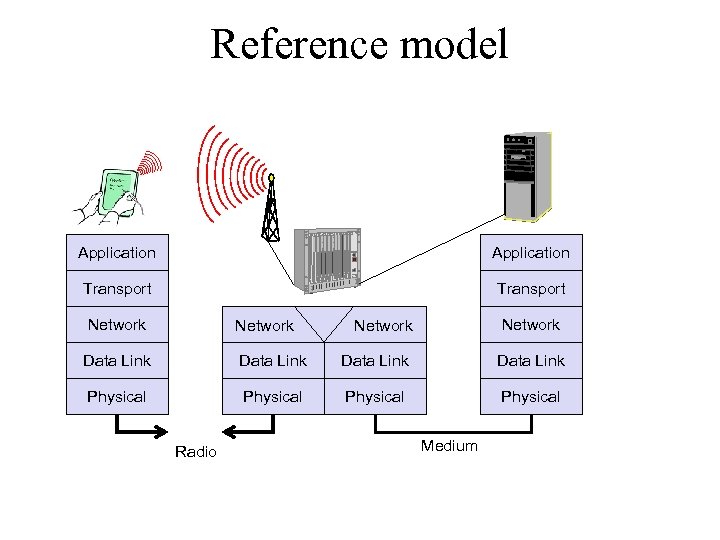
Reference model Application Transport Network Data Link Physical Data Link Physical Radio Network Physical Medium
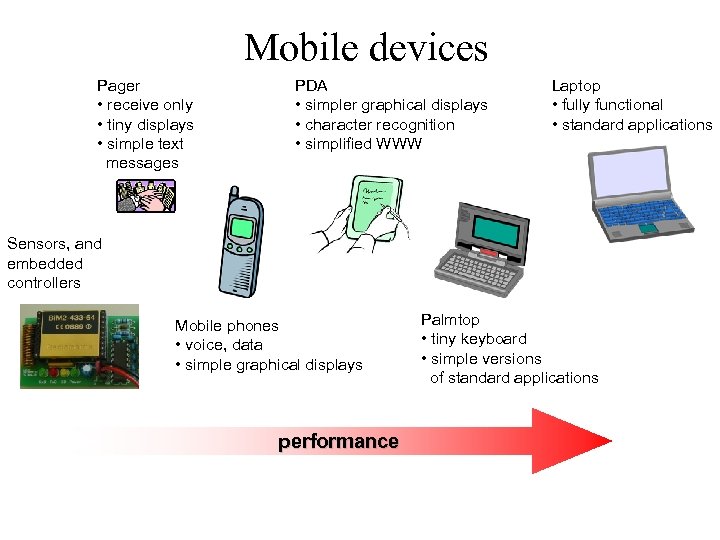
Mobile devices Pager • receive only • tiny displays • simple text messages PDA • simpler graphical displays • character recognition • simplified WWW Laptop • fully functional • standard applications Sensors, and embedded controllers Mobile phones • voice, data • simple graphical displays performance Palmtop • tiny keyboard • simple versions of standard applications
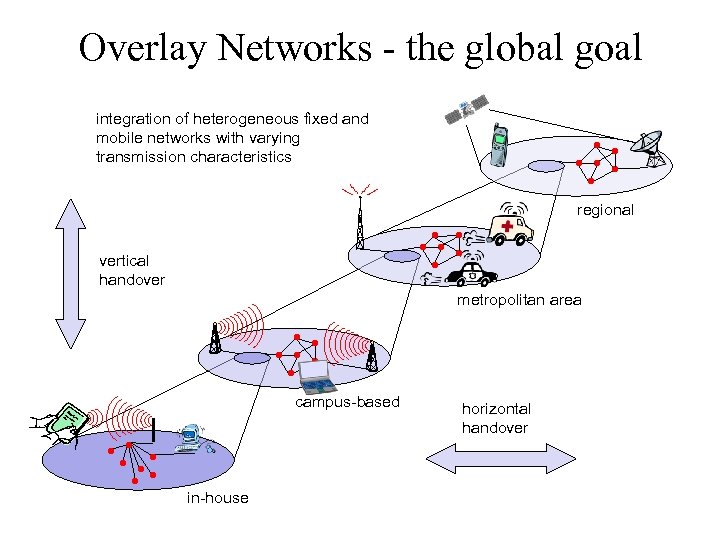
Overlay Networks - the global goal integration of heterogeneous fixed and mobile networks with varying transmission characteristics regional vertical handover metropolitan area campus-based in-house horizontal handover
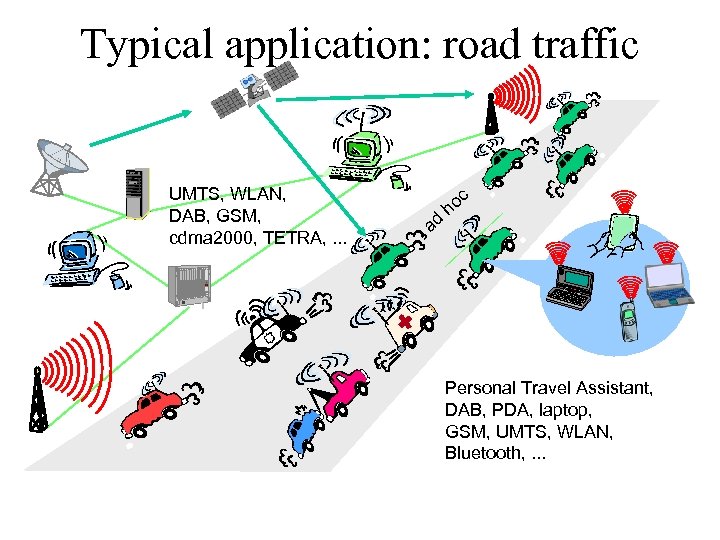
Typical application: road traffic UMTS, WLAN, DAB, GSM, cdma 2000, TETRA, . . . c ad ho Personal Travel Assistant, DAB, PDA, laptop, GSM, UMTS, WLAN, Bluetooth, . . .
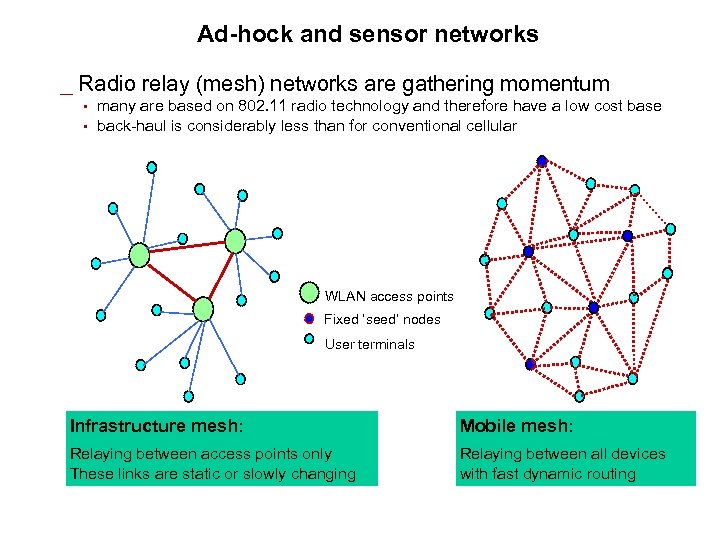
Ad-hock and sensor networks _ Radio relay (mesh) networks are gathering momentum • • many are based on 802. 11 radio technology and therefore have a low cost base back-haul is considerably less than for conventional cellular WLAN access points Fixed ‘seed’ nodes User terminals Infrastructure mesh: Mobile mesh: Relaying between access points only These links are static or slowly changing Relaying between all devices with fast dynamic routing
DECT • DECT (Digital European Cordless Telephone) standardized by ETSI (ETS 300. 175 -x) for cordless telephones • standard describes air interface between base-station and mobile phone • DECT has been renamed for international marketing reasons into „Digital Enhanced Cordless Telecommunication“ • Characteristics – frequency: 1880 -1990 MHz – channels: 120 full duplex – duplex mechanism: TDD (Time Division Duplex) with 10 ms frame length – multplexing scheme: FDMA with 10 carrier frequencies, TDMA with 2 x 12 slots – modulation: digital, Gaußian Minimum Shift Key (GMSK) – power: 10 m. W average (max. 250 m. W)
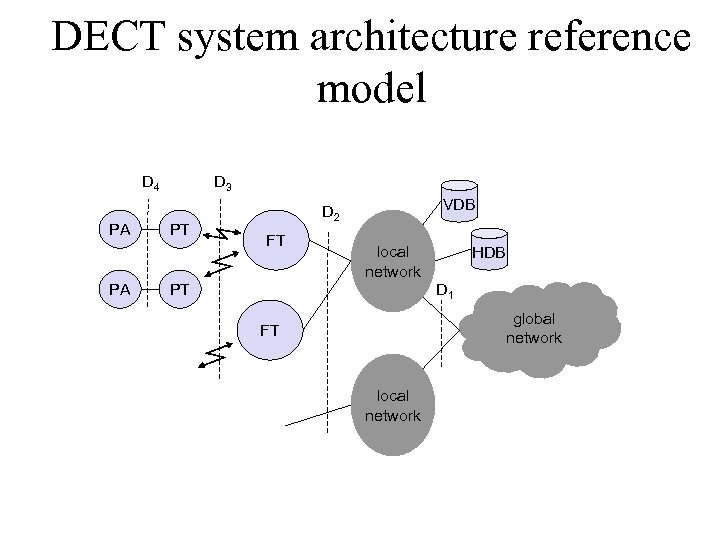
DECT system architecture reference model D 4 PA PA D 3 PT VDB D 2 FT local network PT HDB D 1 global network FT local network
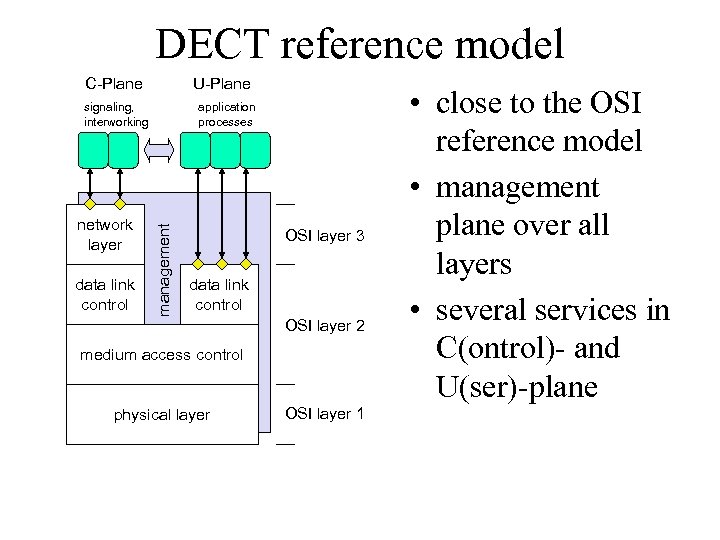
DECT reference model C-Plane U-Plane network layer data link control application processes management signaling, interworking OSI layer 3 data link control OSI layer 2 medium access control physical layer OSI layer 1 • close to the OSI reference model • management plane over all layers • several services in C(ontrol)- and U(ser)-plane
DECT layers I • Physical layer – modulation/demodulation – generation of the physical channel structure with a guaranteed throughput – controlling of radio transmission • • channel assignment on request of the MAC layer detection of incoming signals sender/receiver synchronization collecting status information for the management plane • MAC layer – maintaining basic services, activating/deactivating physical channels – multiplexing of logical channels • e. g. , C: signaling, I: user data, P: paging, Q: broadcast – segmentation/reassembly – error control/error correction
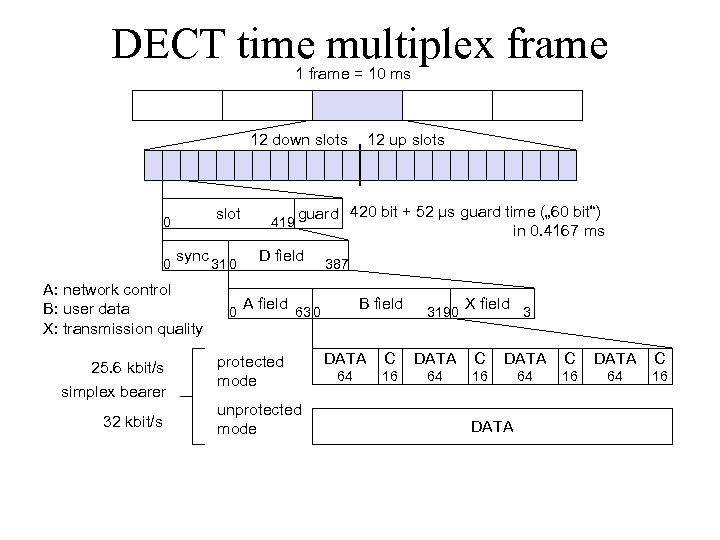
DECT time multiplex frame 1 frame = 10 ms 12 down slots slot 0 0 sync A: network control B: user data X: transmission quality 25. 6 kbit/s simplex bearer 32 kbit/s 31 0 0 419 guard 420 bit + 52 µs guard time („ 60 bit“) in 0. 4167 ms D field A field 12 up slots 387 B field 63 0 protected mode unprotected mode 319 0 X field 3 DATA C 64 16 DATA
DECT layers II • Data link control layer – creation and keeping up reliable connections between the mobile terminal and basestation – two DLC protocols for the control plane (C-Plane) • connectionless broadcast service: paging functionality • Lc+LAPC protocol: in-call signaling (similar to LAPD within ISDN), adapted to the underlying MAC service – several services specified for the user plane (U-Plane) • • null-service: offers unmodified MAC services frame relay: simple packet transmission frame switching: time-bounded packet transmission error correcting transmission: uses FEC, for delay critical, time -bounded services • bandwidth adaptive transmission • „Escape“ service: for further enhancements of the standard
DECT layers III • Network layer – similar to ISDN (Q. 931) and GSM (04. 08) – offers services to request, check, reserve, control, and release resources at the basestation and mobile terminal – resources • necessary for a wireless connection • necessary for the connection of the DECT system to the fixed network – main tasks • call control: setup, release, negotiation, control • call independent services: call forwarding, accounting, call redirecting • mobility management: identity management, authentication, management of the location register
Analüüsitav setup http: //www. mmwave. com/pdf/basestation_vari_da tasheet. pdf
Скачать презентацию Sideseadmed probleemid ja lahendused 2 Avo Ots 13
cbaf6292a69c787ccbfb706ecd8f16ac.ppt