


 Скачать презентацию Side Event Food Security Statistics and Information for
f17e242da69be66daf58c17394f899f4.ppt
- Количество слайдов: 22
 Side Event Food Security Statistics and Information for Targeting Poor and Hungry Populations at Sub-national Levels Beijing, China 25 October, 2007 SECURITY STATISTICS AND INFORMATION FOR TARGETING POOR AND HUNGRY POPULATIONS AT SUB-NATIONAL LEVELS Philippines A Gender Analysis on Food Security Statistics by Specific Population Groups in the Philippine 2003 FIES EC-FAO Food Security Information for Action Statistics Division
 Side Event Food Security Statistics and Information for Targeting Poor and Hungry Populations at Sub-national Levels Beijing, China 25 October, 2007 Outline • About the paper • Background • Sources & Methodology • Food Security Statistics Relating to Gender • Conclusion & Remarks EC-FAO Food Security Information for Action Statistics Division
 Side Event Food Security Statistics and Information for Targeting Poor and Hungry Populations at Sub-national Levels Beijing, China 25 October, 2007 Purpose • Provides analysis of gender dynamics relating to food insecurity based on food security statistics derived from the 2003 FIES • Inputs for planning geared toward gender equality, equity and female empowerment within a framework of national development • Important to understand gender dynamics of food security in developing countries in Asia-Pacific region (given trends of increasing female headship—and management—of rural agricultural households) EC-FAO Food Security Information for Action Statistics Division
 Side Event Food Security Statistics and Information for Targeting Poor and Hungry Populations at Sub-national Levels Beijing, China 25 October, 2007 BACKGROUND Developing countries in Asia-Pacific region still face considerable challenges to reduce poverty & food insecurity, to improve human development, and to meet Millennium Development Goals (MDG) and World Food Summit (WFS) targets. Indicator GDI UNDP 2006 19% FAO 2006 66 th out of 136 Proportion of population undernourished Source 84 th out of 177 HDI Rank UNDP 2006 EC-FAO Food Security Information for Action Statistics Division
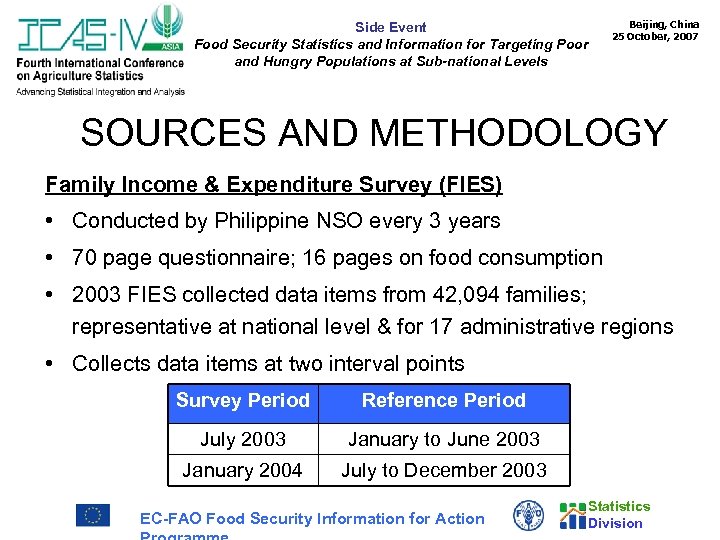 Beijing, China 25 October, 2007 Side Event Food Security Statistics and Information for Targeting Poor and Hungry Populations at Sub-national Levels SOURCES AND METHODOLOGY Family Income & Expenditure Survey (FIES) • Conducted by Philippine NSO every 3 years • 70 page questionnaire; 16 pages on food consumption • 2003 FIES collected data items from 42, 094 families; representative at national level & for 17 administrative regions • Collects data items at two interval points Survey Period Reference Period July 2003 January to June 2003 January 2004 July to December 2003 EC-FAO Food Security Information for Action Statistics Division
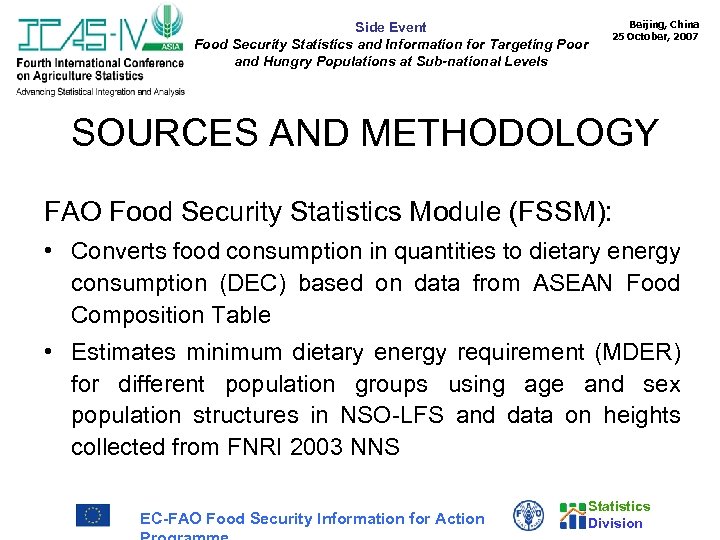 Side Event Food Security Statistics and Information for Targeting Poor and Hungry Populations at Sub-national Levels Beijing, China 25 October, 2007 SOURCES AND METHODOLOGY FAO Food Security Statistics Module (FSSM): • Converts food consumption in quantities to dietary energy consumption (DEC) based on data from ASEAN Food Composition Table • Estimates minimum dietary energy requirement (MDER) for different population groups using age and sex population structures in NSO-LFS and data on heights collected from FNRI 2003 NNS EC-FAO Food Security Information for Action Statistics Division
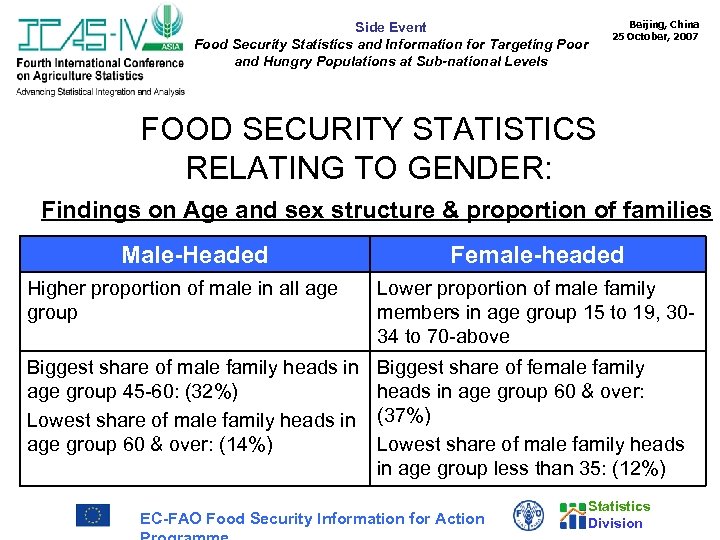 Beijing, China 25 October, 2007 Side Event Food Security Statistics and Information for Targeting Poor and Hungry Populations at Sub-national Levels FOOD SECURITY STATISTICS RELATING TO GENDER: Findings on Age and sex structure & proportion of families Male-Headed Female-headed Higher proportion of male in all age group Lower proportion of male family members in age group 15 to 19, 3034 to 70 -above Biggest share of male family heads in age group 45 -60: (32%) Lowest share of male family heads in age group 60 & over: (14%) Biggest share of female family heads in age group 60 & over: (37%) Lowest share of male family heads in age group less than 35: (12%) EC-FAO Food Security Information for Action Statistics Division
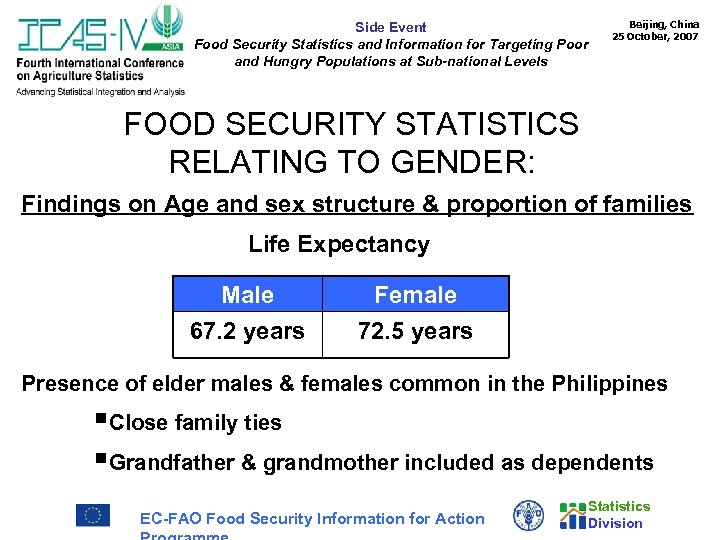 Side Event Food Security Statistics and Information for Targeting Poor and Hungry Populations at Sub-national Levels Beijing, China 25 October, 2007 FOOD SECURITY STATISTICS RELATING TO GENDER: Findings on Age and sex structure & proportion of families Life Expectancy Male 67. 2 years Female 72. 5 years Presence of elder males & females common in the Philippines §Close family ties §Grandfather & grandmother included as dependents EC-FAO Food Security Information for Action Statistics Division
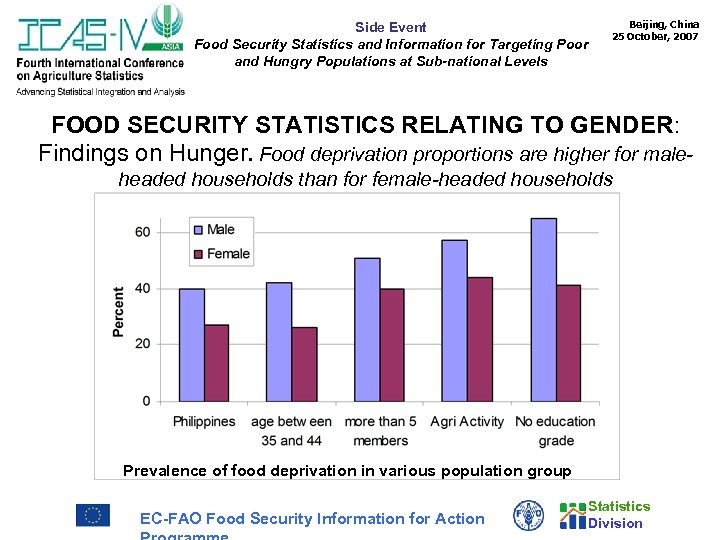 Side Event Food Security Statistics and Information for Targeting Poor and Hungry Populations at Sub-national Levels Beijing, China 25 October, 2007 FOOD SECURITY STATISTICS RELATING TO GENDER: Findings on Hunger. Food deprivation proportions are higher for maleheaded households than for female-headed households Prevalence of food deprivation in various population group EC-FAO Food Security Information for Action Statistics Division
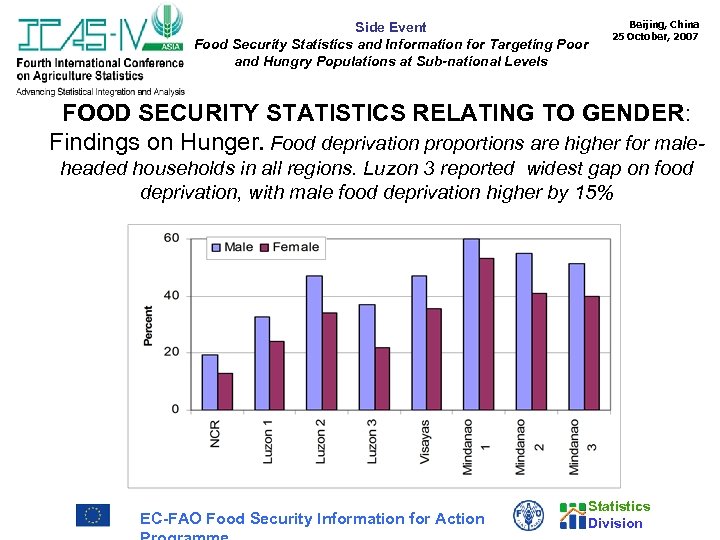 Side Event Food Security Statistics and Information for Targeting Poor and Hungry Populations at Sub-national Levels Beijing, China 25 October, 2007 FOOD SECURITY STATISTICS RELATING TO GENDER: Findings on Hunger. Food deprivation proportions are higher for maleheaded households in all regions. Luzon 3 reported widest gap on food deprivation, with male food deprivation higher by 15% EC-FAO Food Security Information for Action Statistics Division
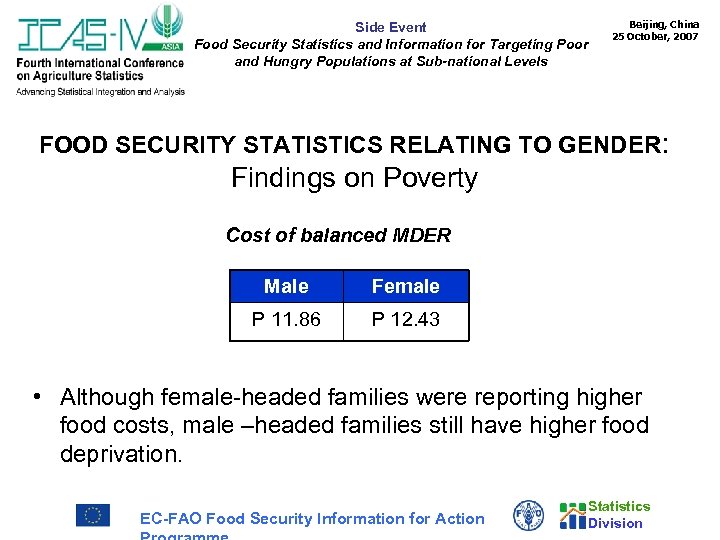 Side Event Food Security Statistics and Information for Targeting Poor and Hungry Populations at Sub-national Levels Beijing, China 25 October, 2007 FOOD SECURITY STATISTICS RELATING TO GENDER: Findings on Poverty Cost of balanced MDER Male Female P 11. 86 P 12. 43 • Although female-headed families were reporting higher food costs, male –headed families still have higher food deprivation. EC-FAO Food Security Information for Action Statistics Division
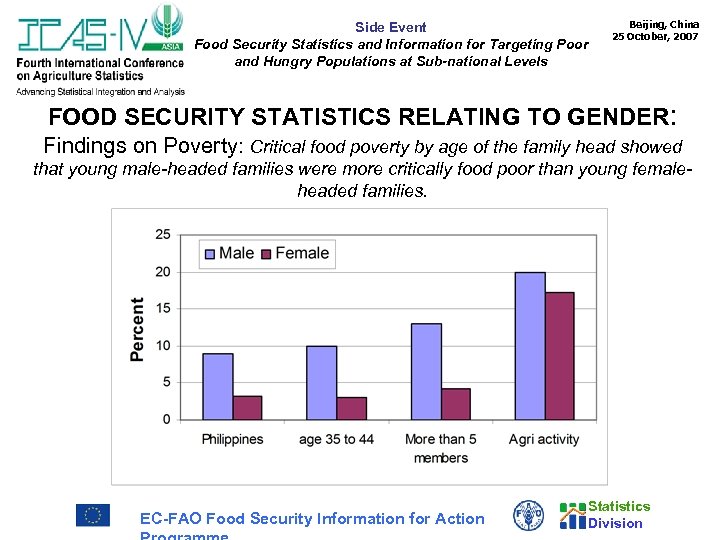 Side Event Food Security Statistics and Information for Targeting Poor and Hungry Populations at Sub-national Levels Beijing, China 25 October, 2007 FOOD SECURITY STATISTICS RELATING TO GENDER: Findings on Poverty: Critical food poverty by age of the family head showed that young male-headed families were more critically food poor than young femaleheaded families. EC-FAO Food Security Information for Action Statistics Division
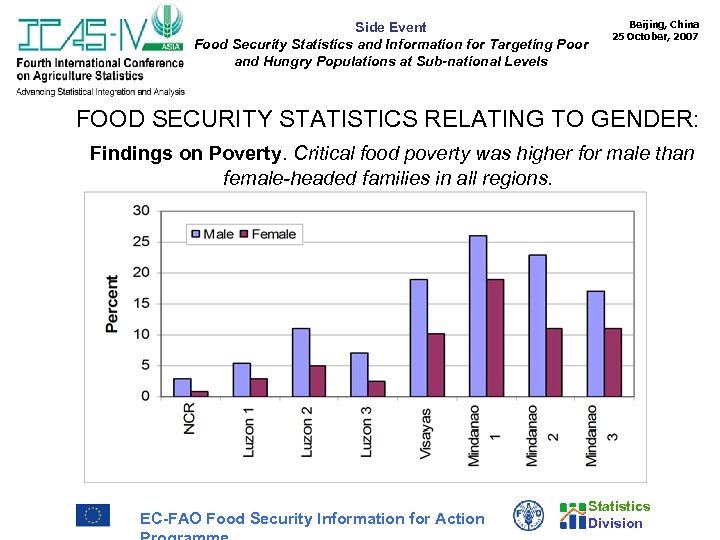 Side Event Food Security Statistics and Information for Targeting Poor and Hungry Populations at Sub-national Levels Beijing, China 25 October, 2007 FOOD SECURITY STATISTICS RELATING TO GENDER: Findings on Poverty. Critical food poverty was higher for male than female-headed families in all regions. EC-FAO Food Security Information for Action Statistics Division
 Side Event Food Security Statistics and Information for Targeting Poor and Hungry Populations at Sub-national Levels Beijing, China 25 October, 2007 FOOD SECURITY STATISTICS RELATING TO GENDER: Findings on food consumption and expenditure: Dietary energy consumption and dietary energy prices. • Filipino female headed families consumed and spent more on food; higher dietary energy prices compared to maleheaded families • Higher prevalence of food deprivation among male-headed families mainly linked to low food consumption EC-FAO Food Security Information for Action Statistics Division
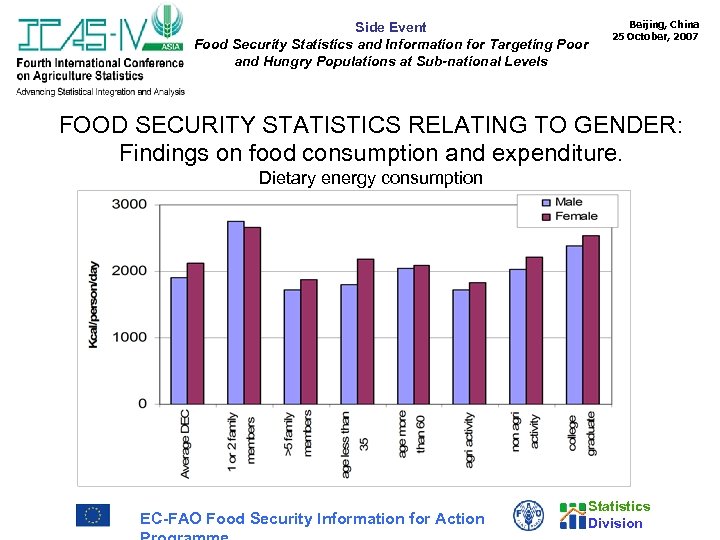 Side Event Food Security Statistics and Information for Targeting Poor and Hungry Populations at Sub-national Levels Beijing, China 25 October, 2007 FOOD SECURITY STATISTICS RELATING TO GENDER: Findings on food consumption and expenditure. Dietary energy consumption EC-FAO Food Security Information for Action Statistics Division
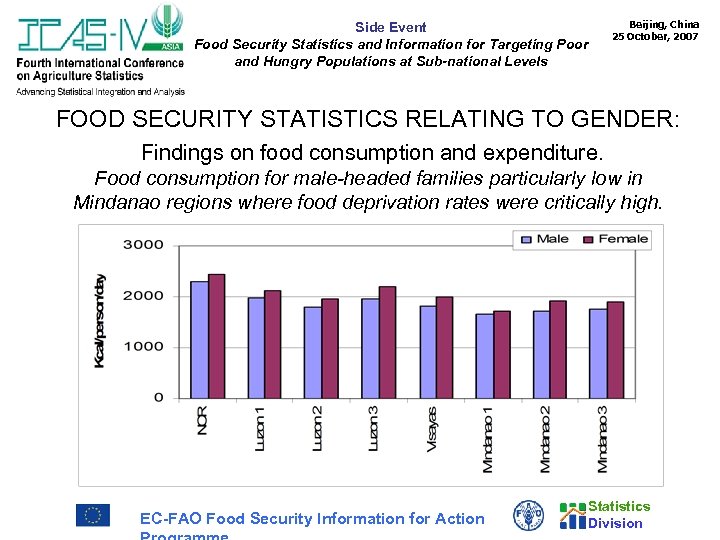 Beijing, China 25 October, 2007 Side Event Food Security Statistics and Information for Targeting Poor and Hungry Populations at Sub-national Levels FOOD SECURITY STATISTICS RELATING TO GENDER: Findings on food consumption and expenditure. Food consumption for male-headed families particularly low in Mindanao regions where food deprivation rates were critically high. EC-FAO Food Security Information for Action Statistics Division
 Side Event Food Security Statistics and Information for Targeting Poor and Hungry Populations at Sub-national Levels Beijing, China 25 October, 2007 FOOD SECURITY STATISTICS RELATING TO GENDER: Findings on share of food consumption by food source. • • • Both female- and male-headed families purchased high proportion of food consumed. Most vulnerable groups are those who purchased higher share of food consumed; more affected from price variation. Both types of families had large share of food consumed received as gifts from other sources. EC-FAO Food Security Information for Action Statistics Division
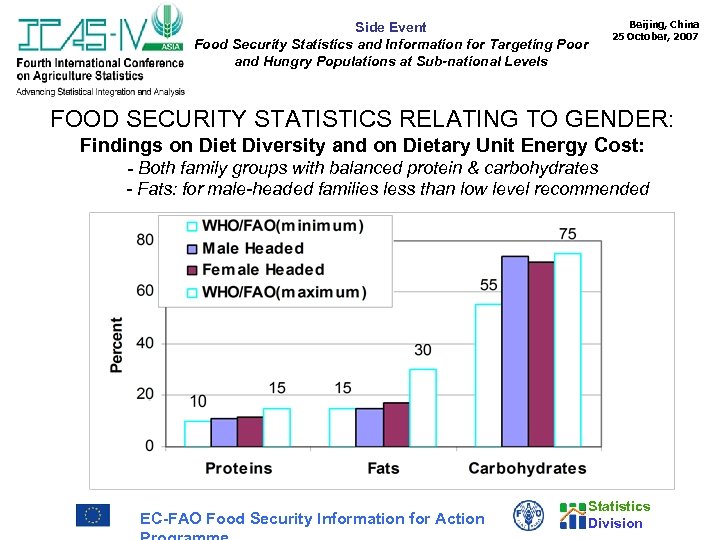 Side Event Food Security Statistics and Information for Targeting Poor and Hungry Populations at Sub-national Levels Beijing, China 25 October, 2007 FOOD SECURITY STATISTICS RELATING TO GENDER: Findings on Diet Diversity and on Dietary Unit Energy Cost: - Both family groups with balanced protein & carbohydrates - Fats: for male-headed families less than low level recommended EC-FAO Food Security Information for Action Statistics Division
 Beijing, China 25 October, 2007 Side Event Food Security Statistics and Information for Targeting Poor and Hungry Populations at Sub-national Levels FOOD SECURITY STATISTICS RELATING TO GENDER: Findings on share of food in total consumption • Filipino female-headed families spent on average larger share of their total consumption on food; less money left for buying other goods than food. • Female-headed families in better position than male-headed families that had less money to buy any kind of goods, including food. Findings on Inequality in access to food • CV of food dietary energy consumption was 29. 4 percent for both female and male-headed families; indicates no difference between men and women in inequality in access to food. EC-FAO Food Security Information for Action Statistics Division
 Beijing, China 25 October, 2007 Side Event Food Security Statistics and Information for Targeting Poor and Hungry Populations at Sub-national Levels CONCLUSION AND REMARKS • At national level, poor situation of food deprivation for maleheaded families compared to female-headed families. • Pattern also confirmed with findings on critical food poverty; male-headed families had rates three times higher than female-headed families. • Lower income (or proxy total consumption expenditure) of 62. 47 pesos/person/day in male-headed families compared to 91. 36 pesos/person/ day in female-headed families may explain male-headed families’ condition; male family heads may be only source of income for larger families. EC-FAO Food Security Information for Action Statistics Division
 Side Event Food Security Statistics and Information for Targeting Poor and Hungry Populations at Sub-national Levels Beijing, China 25 October, 2007 CONCLUSION AND REMARKS • At regional level, regions with high food deprivation & critical food poverty were rural regions with agriculture as main activity; important to analyze gender dynamics into urban-rural areas, may provide important details to food insecurity analysis. • Food, for female-headed families is major investment; women more knowledgeable about it than men. • Mechanisms such as micro credit could improve financial status and increase community cohesion; positive effects on reducing food deprivation and critical food poverty especially in disadvantaged groups & areas where agriculture is major activity. EC-FAO Food Security Information for Action Statistics Division
 Side Event Food Security Statistics and Information for Targeting Poor and Hungry Populations at Sub-national Levels Beijing, China 25 October, 2007 THANK YOU Maraming Salamat EC-FAO Food Security Information for Action Statistics Division