 Скачать презентацию Si D http silicondetector org Philip Burrows John
431cbd95684e823964211eef82f677c6.ppt
- Количество слайдов: 60



Si. D http: //silicondetector. org Philip Burrows John Adams Institute Oxford University Thanks to: Marco Oriunno, Marcel Stanitzki, Harry Weerts
Outline • Si. D overview • Outline of Si. D subsystems: VXD + tracker ECAL HCAL muon system forward region machine-detector interface issues • Preparing for Si. D Lo. I Philip Burrows ACFA Workshop, Sendai 3/03/08
Si. D session Wednesday 16. 00 • Preparing for Si. D Lo. I • Vertex and tracking • ECAL and KPIX • HCAL • PFA and bench-marking • Discussion Philip Burrows ACFA Workshop, Sendai 3/03/08
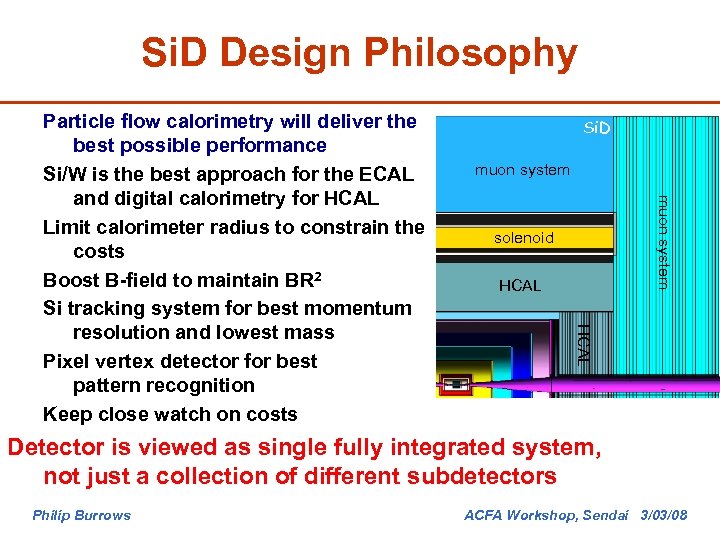
Si. D Design Philosophy Si. D muon system solenoid HCAL Particle flow calorimetry will deliver the best possible performance Si/W is the best approach for the ECAL and digital calorimetry for HCAL Limit calorimeter radius to constrain the costs Boost B-field to maintain BR 2 Si tracking system for best momentum resolution and lowest mass Pixel vertex detector for best pattern recognition Keep close watch on costs Detector is viewed as single fully integrated system, not just a collection of different subdetectors Philip Burrows ACFA Workshop, Sendai 3/03/08
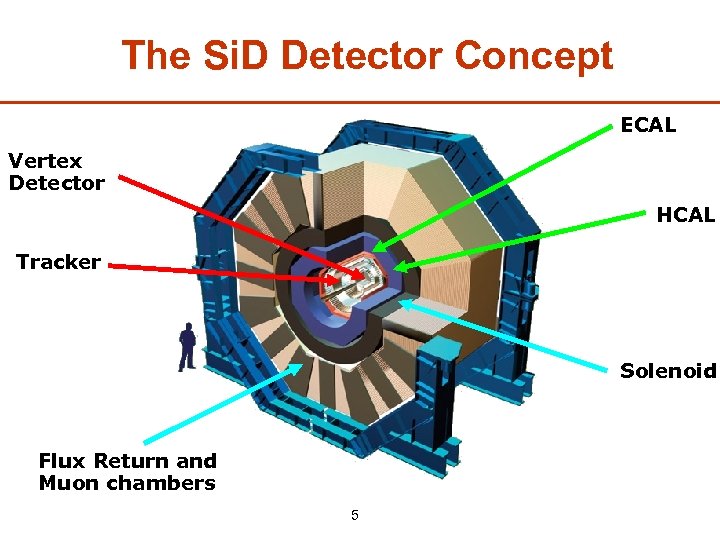
The Si. D Detector Concept ECAL Vertex Detector HCAL Tracker Solenoid Flux Return and Muon chambers 5
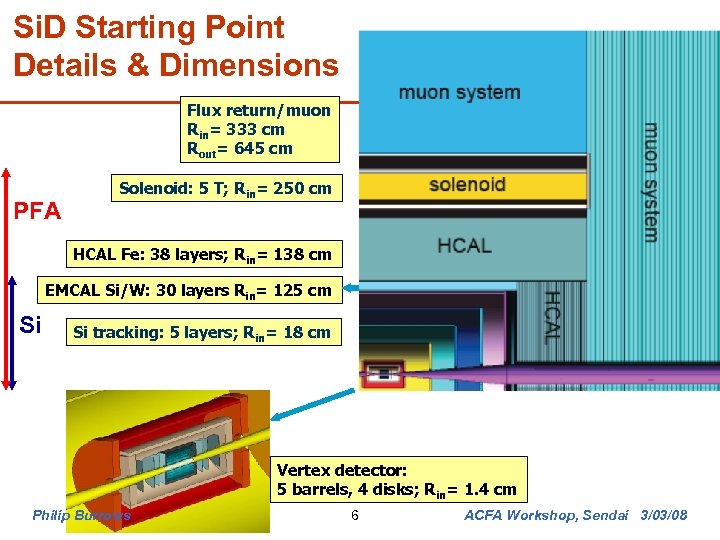
Si. D Starting Point Details & Dimensions Flux return/muon Rin= 333 cm Rout= 645 cm PFA Solenoid: 5 T; Rin= 250 cm HCAL Fe: 38 layers; Rin= 138 cm EMCAL Si/W: 30 layers Rin= 125 cm Si Si tracking: 5 layers; Rin= 18 cm Vertex detector: 5 barrels, 4 disks; Rin= 1. 4 cm Philip Burrows 6 ACFA Workshop, Sendai 3/03/08
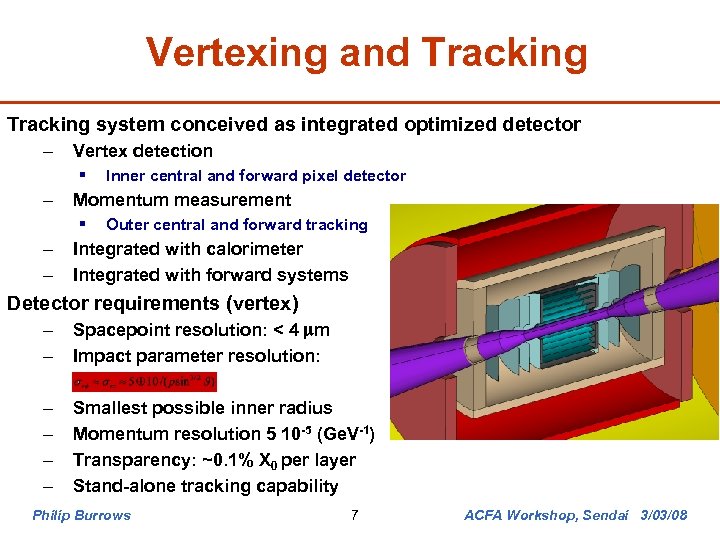
Vertexing and Tracking system conceived as integrated optimized detector – Vertex detection § – Momentum measurement § – – Inner central and forward pixel detector Outer central and forward tracking Integrated with calorimeter Integrated with forward systems Detector requirements (vertex) – – Spacepoint resolution: < 4 mm Impact parameter resolution: – – Smallest possible inner radius Momentum resolution 5 10 -5 (Ge. V-1) Transparency: ~0. 1% X 0 per layer Stand-alone tracking capability Philip Burrows 7 ACFA Workshop, Sendai 3/03/08
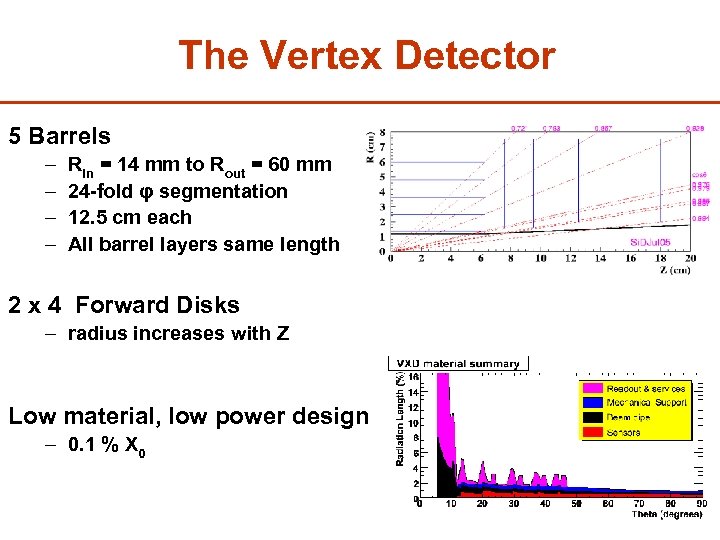
The Vertex Detector 5 Barrels – – Rin = 14 mm to Rout = 60 mm 24 -fold φ segmentation 12. 5 cm each All barrel layers same length 2 x 4 Forward Disks – radius increases with Z Low material, low power design – 0. 1 % X 0
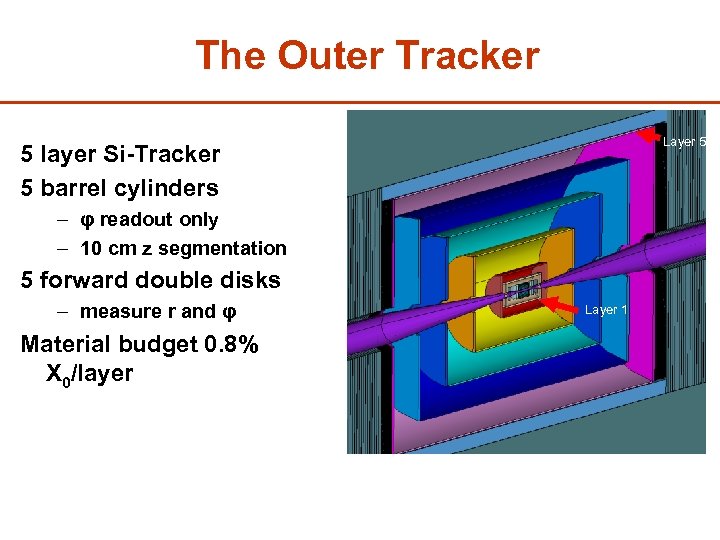
The Outer Tracker Layer 5 5 layer Si-Tracker 5 barrel cylinders – φ readout only – 10 cm z segmentation 5 forward double disks – measure r and φ Material budget 0. 8% X 0/layer Layer 1
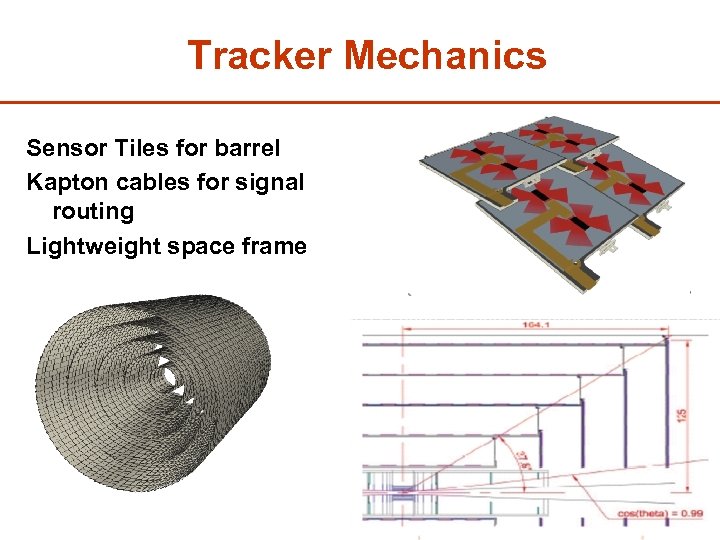
Tracker Mechanics Sensor Tiles for barrel Kapton cables for signal routing Lightweight space frame
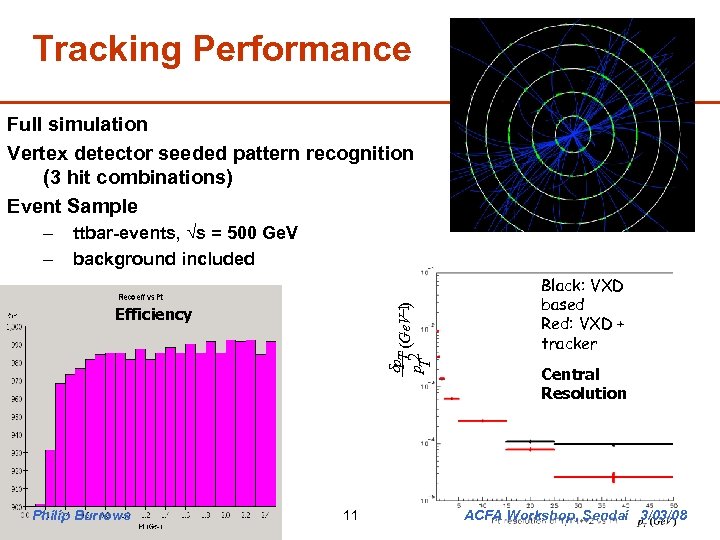
Tracking Performance Full simulation Vertex detector seeded pattern recognition (3 hit combinations) Event Sample ttbar-events, √s = 500 Ge. V background included 1 T (Ge. V-) p 2 T – – dp Efficiency Philip Burrows 11 Black: VXD based Red: VXD + tracker Central Resolution ACFA Workshop, Sendai 3/03/08
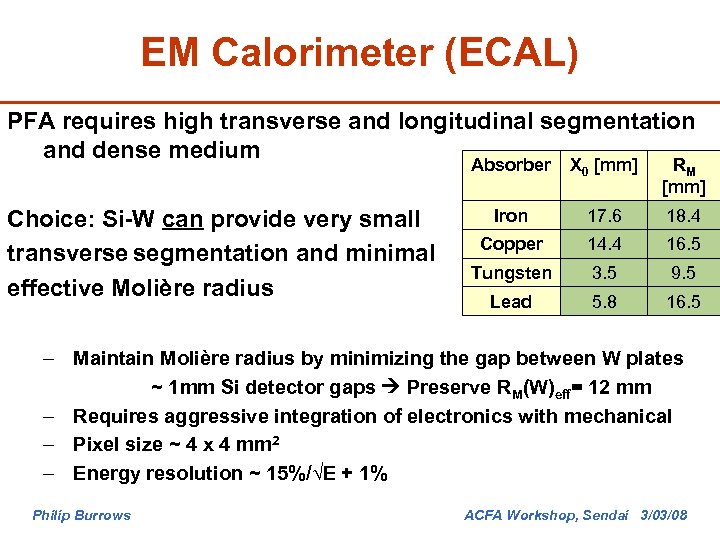
EM Calorimeter (ECAL) PFA requires high transverse and longitudinal segmentation and dense medium Absorber Choice: Si-W can provide very small transverse segmentation and minimal effective Molière radius X 0 [mm] RM [mm] Iron 17. 6 18. 4 Copper 14. 4 16. 5 Tungsten 3. 5 9. 5 Lead 5. 8 16. 5 – Maintain Molière radius by minimizing the gap between W plates ~ 1 mm Si detector gaps Preserve RM(W)eff= 12 mm – Requires aggressive integration of electronics with mechanical – Pixel size ~ 4 x 4 mm 2 – Energy resolution ~ 15%/√E + 1% Philip Burrows ACFA Workshop, Sendai 3/03/08
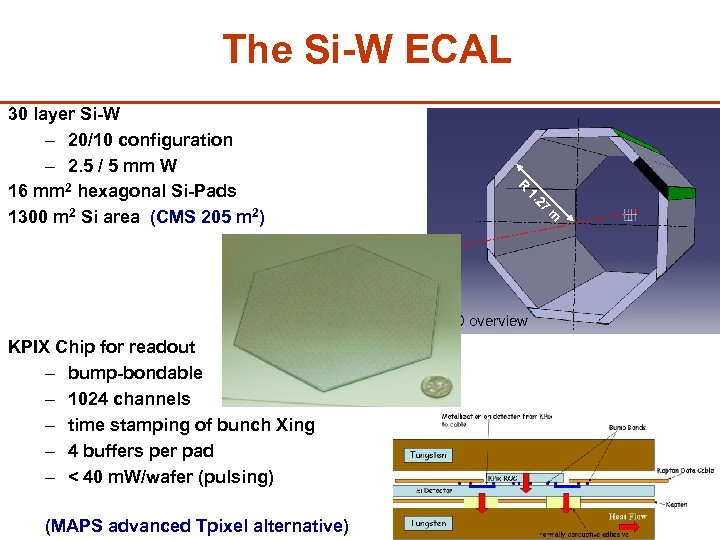
The Si-W ECAL R 27 1. m 30 layer Si-W – 20/10 configuration – 2. 5 / 5 mm W 16 mm 2 hexagonal Si-Pads 1300 m 2 Si area (CMS 205 m 2) CAD overview KPIX Chip for readout – bump-bondable – 1024 channels – time stamping of bunch Xing – 4 buffers per pad – < 40 m. W/wafer (pulsing) (MAPS advanced Tpixel alternative)
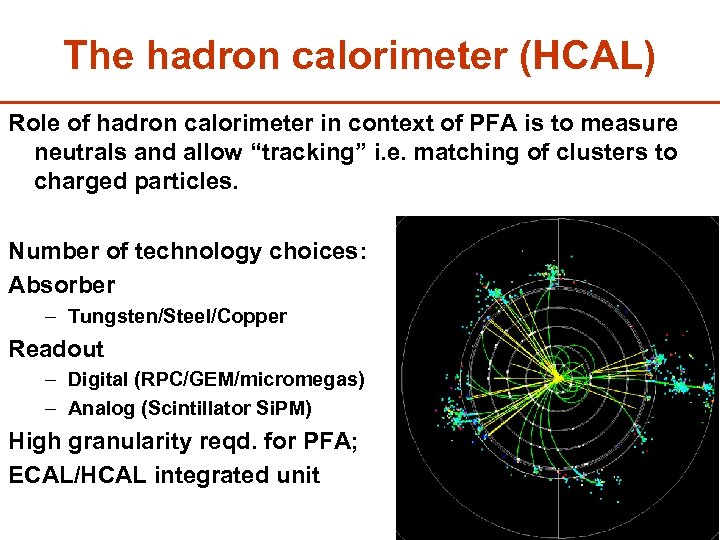
The hadron calorimeter (HCAL) Role of hadron calorimeter in context of PFA is to measure neutrals and allow “tracking” i. e. matching of clusters to charged particles. Number of technology choices: Absorber – Tungsten/Steel/Copper Readout – Digital (RPC/GEM/micromegas) – Analog (Scintillator Si. PM) High granularity reqd. for PFA; ECAL/HCAL integrated unit
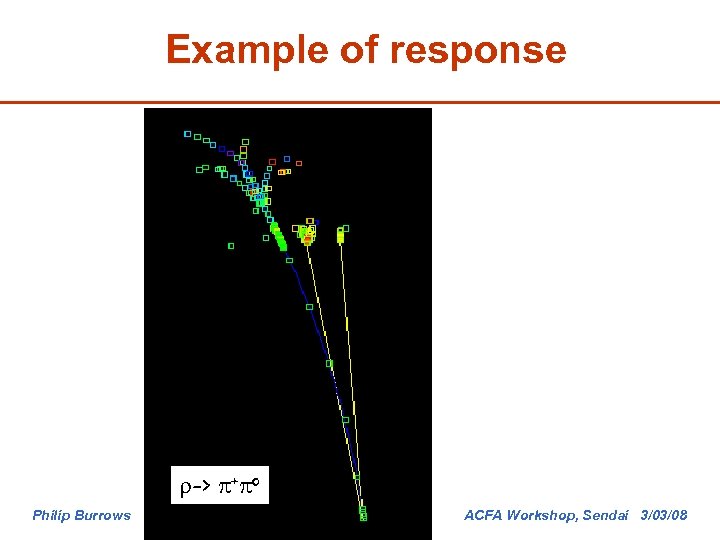
Example of response r-> p+po Philip Burrows 15 ACFA Workshop, Sendai 3/03/08
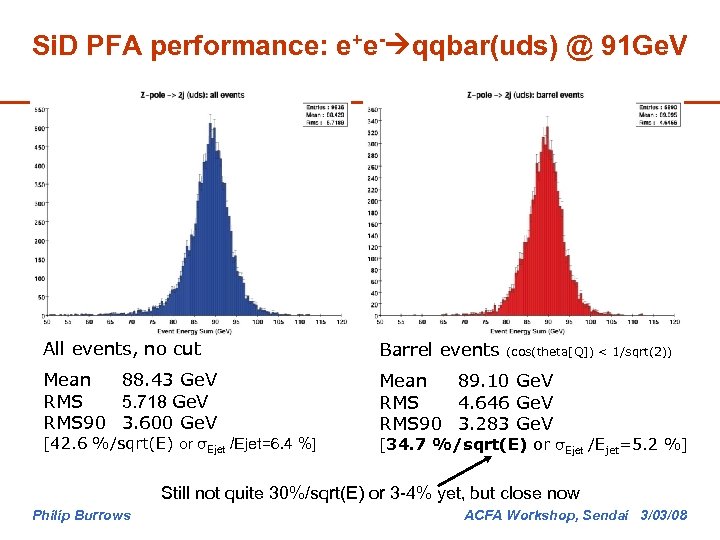
Si. D PFA performance: e+e- qqbar(uds) @ 91 Ge. V All events, no cut Barrel events Mean 88. 43 Ge. V RMS 5. 718 Ge. V RMS 90 3. 600 Ge. V Mean 89. 10 Ge. V RMS 4. 646 Ge. V RMS 90 3. 283 Ge. V [42. 6 %/sqrt(E) or σEjet /Ejet=6. 4 %] (cos(theta[Q]) < 1/sqrt(2)) [34. 7 %/sqrt(E) or σEjet /Ejet=5. 2 %] Still not quite 30%/sqrt(E) or 3 -4% yet, but close now Philip Burrows ACFA Workshop, Sendai 3/03/08
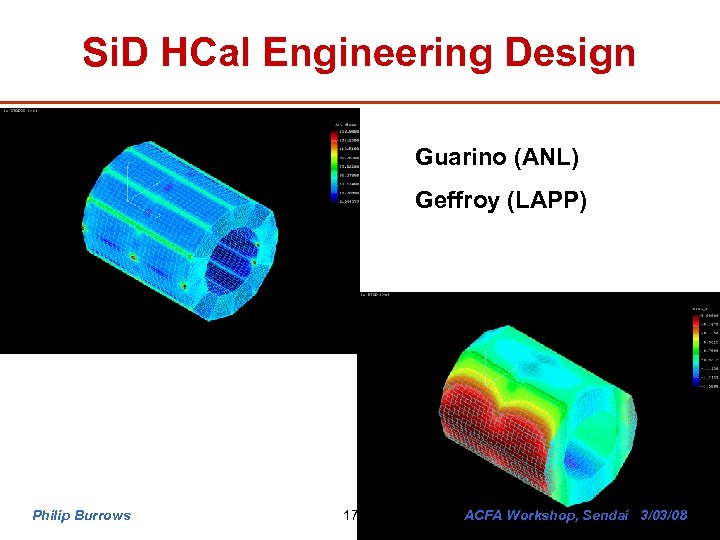
Si. D HCal Engineering Design Guarino (ANL) Geffroy (LAPP) Philip Burrows 17 ACFA Workshop, Sendai 3/03/08
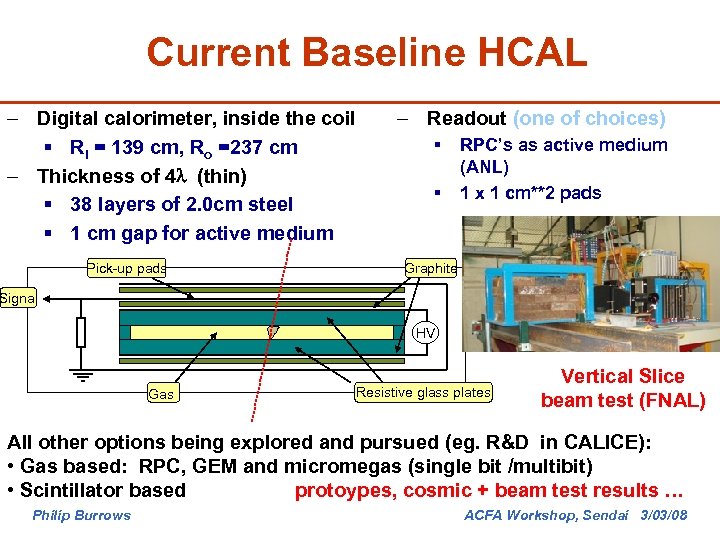
Current Baseline HCAL – Digital calorimeter, inside the coil § Ri = 139 cm, Ro =237 cm – Thickness of 4 l (thin) § 38 layers of 2. 0 cm steel § 1 cm gap for active medium Pick-up pads – Readout (one of choices) § § RPC’s as active medium (ANL) 1 x 1 cm**2 pads Graphite Signal HV Gas Resistive glass plates Vertical Slice beam test (FNAL) All other options being explored and pursued (eg. R&D in CALICE): • Gas based: RPC, GEM and micromegas (single bit /multibit) • Scintillator based protoypes, cosmic + beam test results … Philip Burrows ACFA Workshop, Sendai 3/03/08
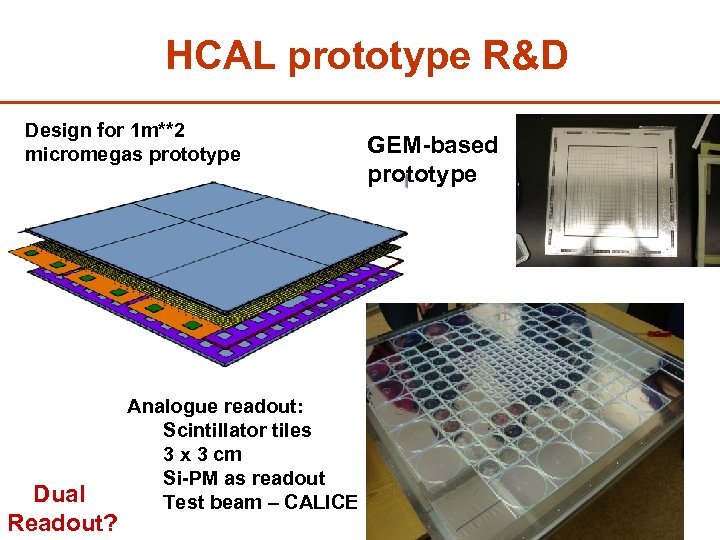
HCAL prototype R&D Design for 1 m**2 micromegas prototype Dual Readout? Analogue readout: Scintillator tiles 3 x 3 cm Si-PM as readout Test beam – CALICE GEM-based prototype
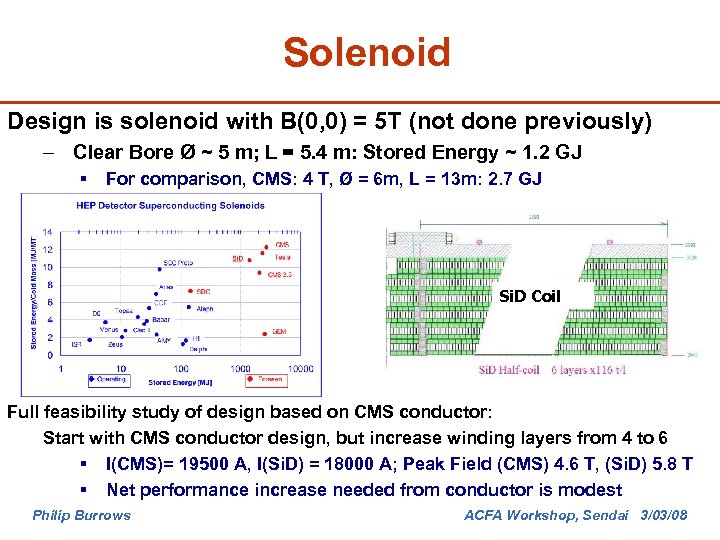
Solenoid Design is solenoid with B(0, 0) = 5 T (not done previously) – Clear Bore Ø ~ 5 m; L = 5. 4 m: Stored Energy ~ 1. 2 GJ § For comparison, CMS: 4 T, Ø = 6 m, L = 13 m: 2. 7 GJ Si. D Coil Full feasibility study of design based on CMS conductor: Start with CMS conductor design, but increase winding layers from 4 to 6 § I(CMS)= 19500 A, I(Si. D) = 18000 A; Peak Field (CMS) 4. 6 T, (Si. D) 5. 8 T § Net performance increase needed from conductor is modest Philip Burrows ACFA Workshop, Sendai 3/03/08
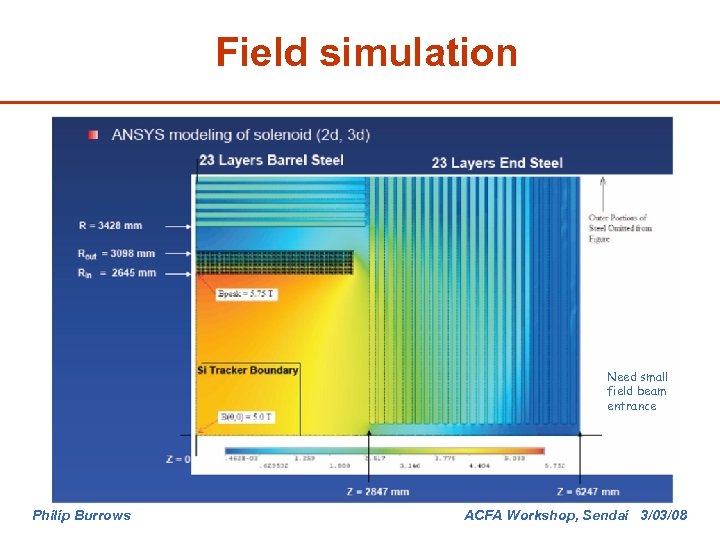
Field simulation Need small field beam entrance Philip Burrows ACFA Workshop, Sendai 3/03/08
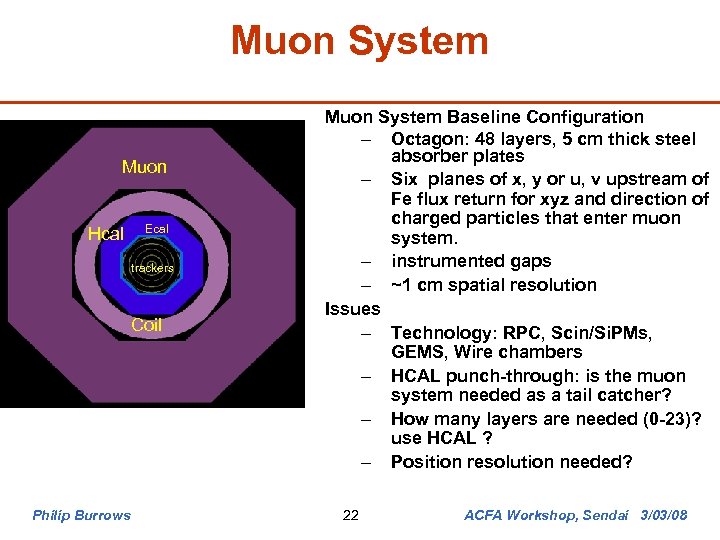
Muon System Muon Hcal Ecal trackers Coil Philip Burrows Muon System Baseline Configuration – Octagon: 48 layers, 5 cm thick steel absorber plates – Six planes of x, y or u, v upstream of Fe flux return for xyz and direction of charged particles that enter muon system. – instrumented gaps – ~1 cm spatial resolution Issues – Technology: RPC, Scin/Si. PMs, GEMS, Wire chambers – HCAL punch-through: is the muon system needed as a tail catcher? – How many layers are needed (0 -23)? use HCAL ? – Position resolution needed? 22 ACFA Workshop, Sendai 3/03/08
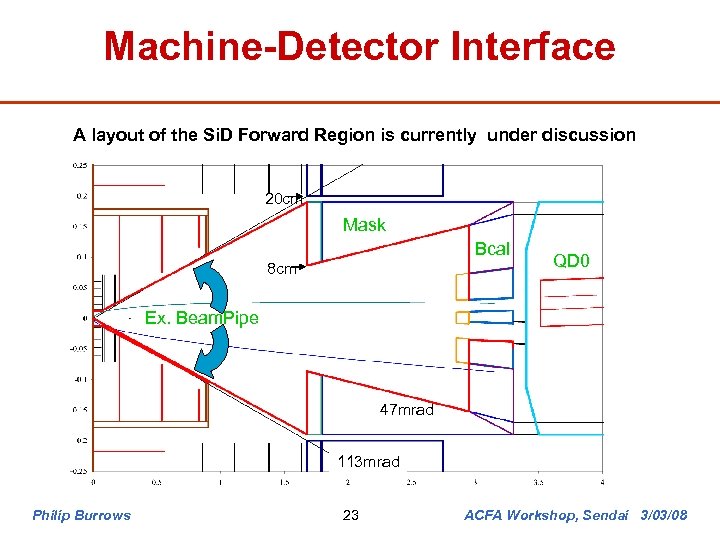
Machine-Detector Interface A layout of the Si. D Forward Region is currently under discussion 20 cm Mask Bcal 8 cm QD 0 Ex. Beam. Pipe 47 mrad 113 mrad Philip Burrows 23 ACFA Workshop, Sendai 3/03/08
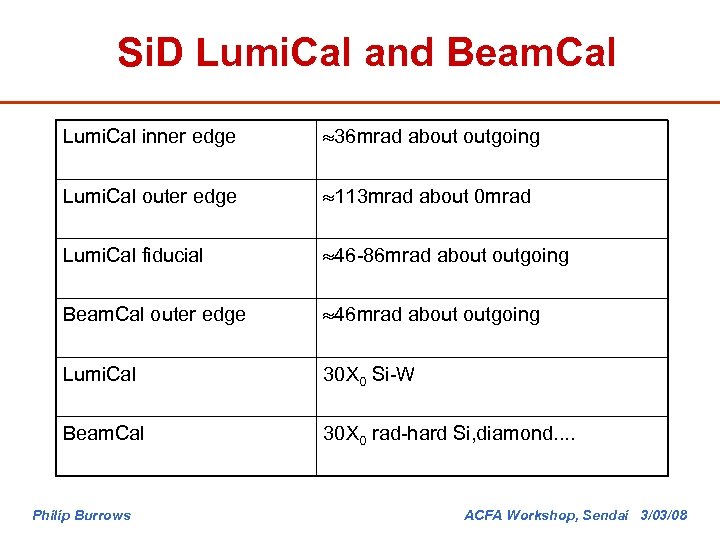
Si. D Lumi. Cal and Beam. Cal Lumi. Cal inner edge 36 mrad about outgoing Lumi. Cal outer edge 113 mrad about 0 mrad Lumi. Cal fiducial 46 -86 mrad about outgoing Beam. Cal outer edge 46 mrad about outgoing Lumi. Cal 30 X 0 Si-W Beam. Cal 30 X 0 rad-hard Si, diamond. . Philip Burrows ACFA Workshop, Sendai 3/03/08
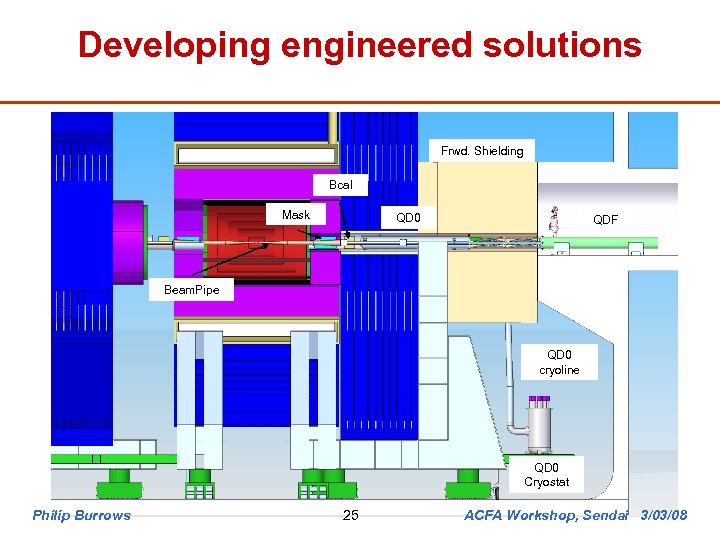
Developing engineered solutions Frwd. Shielding Bcal Mask QD 0 QDF Beam. Pipe QD 0 cryoline QD 0 Cryostat Philip Burrows 25 ACFA Workshop, Sendai 3/03/08
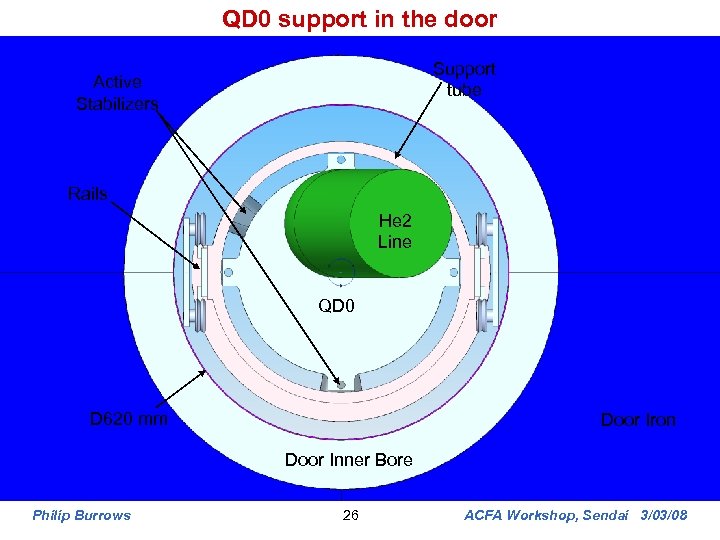
QD 0 support in the door Support tube Active Stabilizers Rails He 2 Line QD 0 D 620 mm Door Iron Door Inner Bore Philip Burrows 26 ACFA Workshop, Sendai 3/03/08
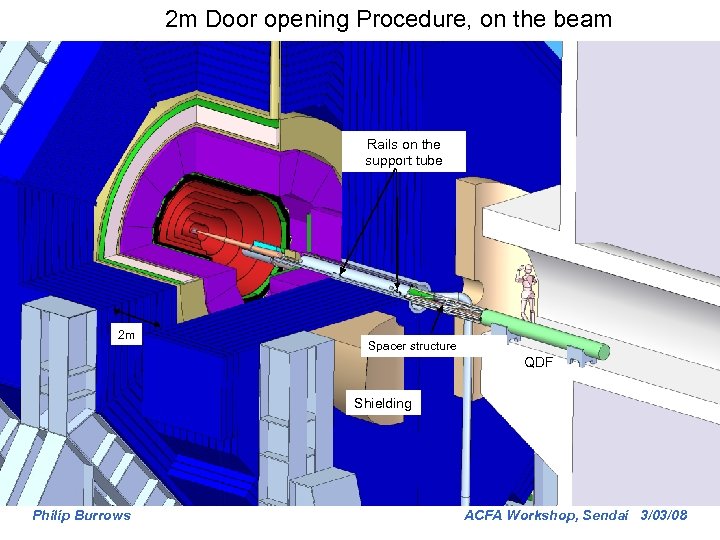
2 m Door opening Procedure, on the beam Rails on the support tube 2 m Spacer structure QDF Shielding Philip Burrows ACFA Workshop, Sendai 3/03/08
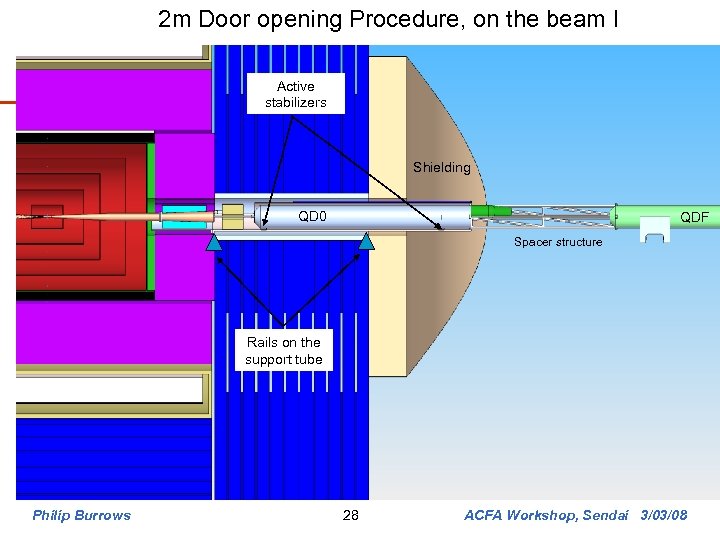
2 m Door opening Procedure, on the beam I Active stabilizers Shielding QD 0 QDF Spacer structure Rails on the support tube Philip Burrows 28 ACFA Workshop, Sendai 3/03/08
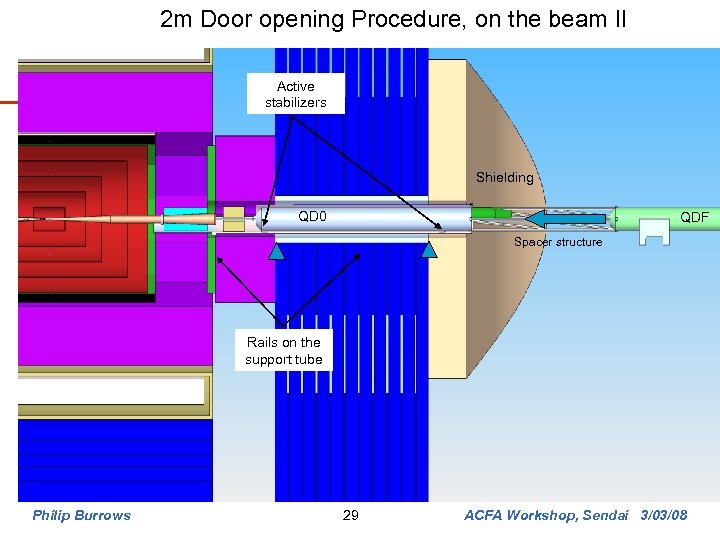
2 m Door opening Procedure, on the beam II Active stabilizers Shielding QD 0 QDF Spacer structure Rails on the support tube Philip Burrows 29 ACFA Workshop, Sendai 3/03/08
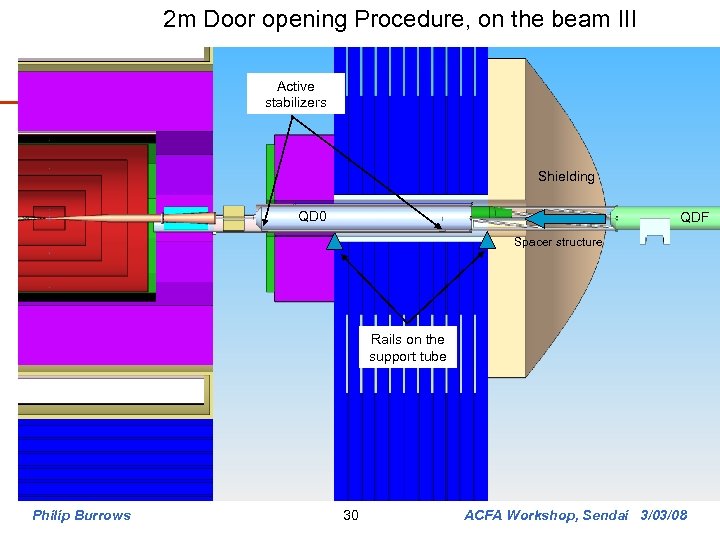
2 m Door opening Procedure, on the beam III Active stabilizers Shielding QD 0 QDF Spacer structure Rails on the support tube Philip Burrows 30 ACFA Workshop, Sendai 3/03/08
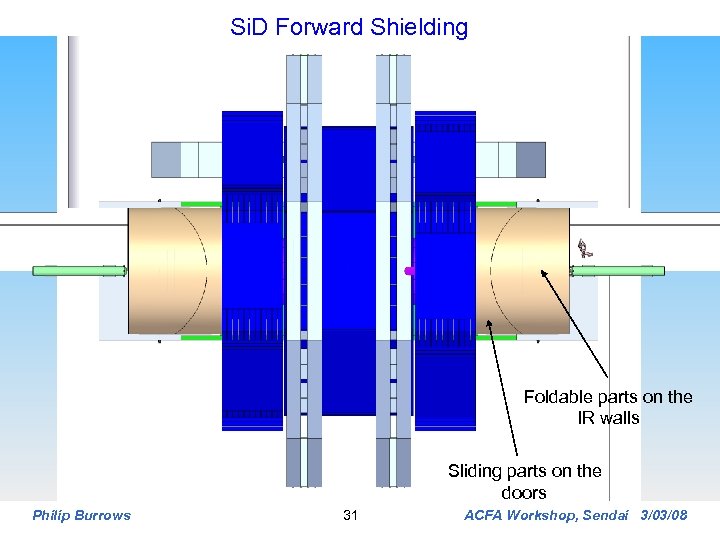
Si. D Forward Shielding Foldable parts on the IR walls Sliding parts on the doors Philip Burrows 31 ACFA Workshop, Sendai 3/03/08
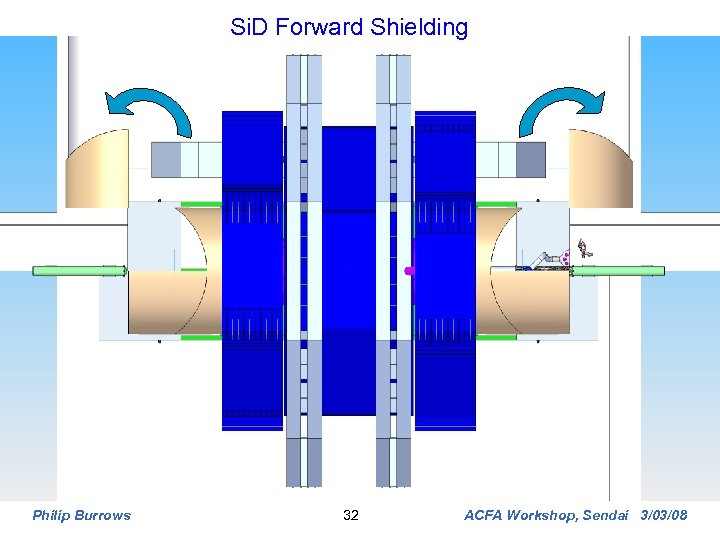
Si. D Forward Shielding Philip Burrows 32 ACFA Workshop, Sendai 3/03/08
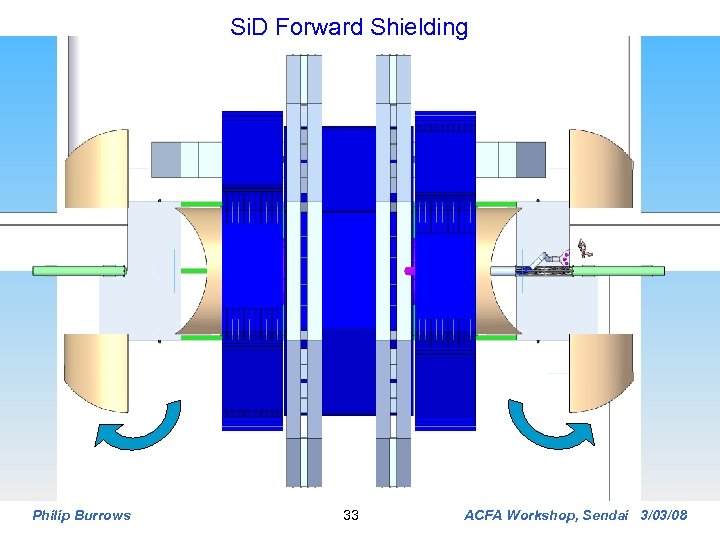
Si. D Forward Shielding Philip Burrows 33 ACFA Workshop, Sendai 3/03/08
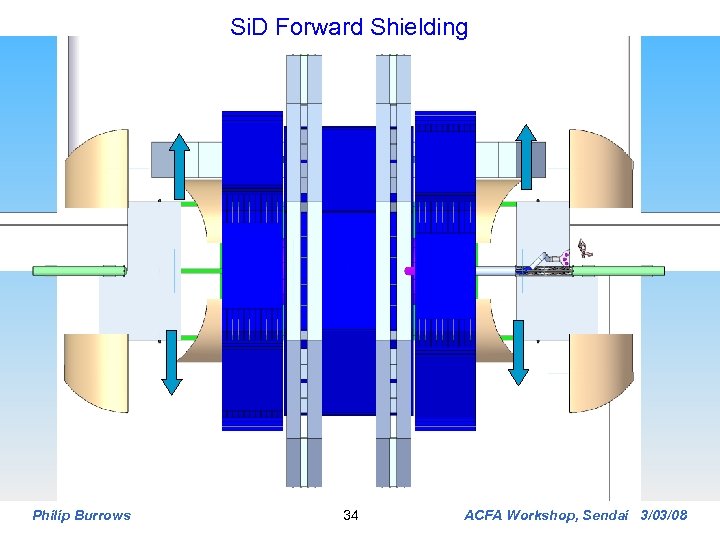
Si. D Forward Shielding Philip Burrows 34 ACFA Workshop, Sendai 3/03/08
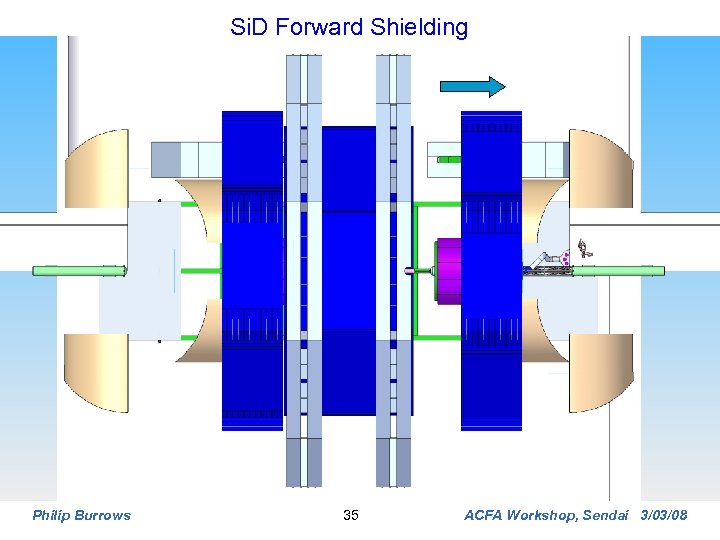
Si. D Forward Shielding Philip Burrows 35 ACFA Workshop, Sendai 3/03/08
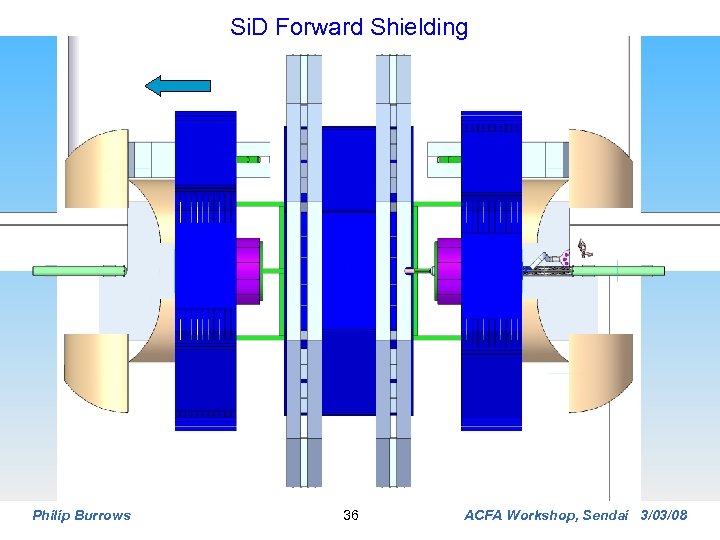
Si. D Forward Shielding Philip Burrows 36 ACFA Workshop, Sendai 3/03/08
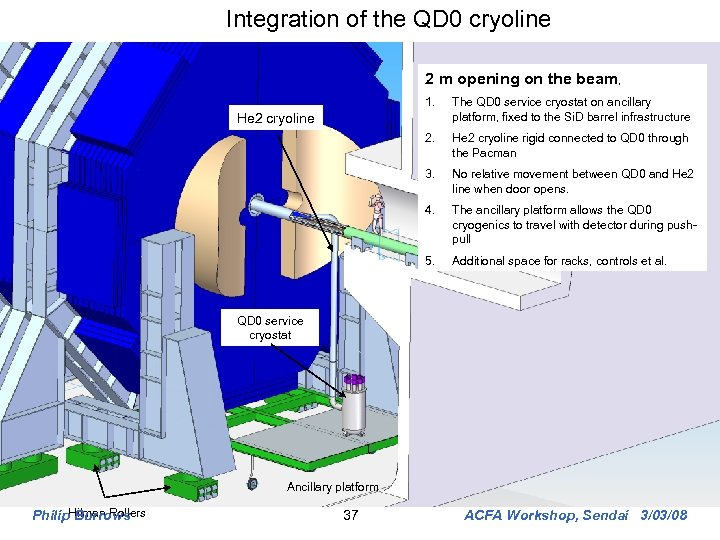
Integration of the QD 0 cryoline 2 m opening on the beam, 1. The QD 0 service cryostat on ancillary platform, fixed to the Si. D barrel infrastructure 2. He 2 cryoline rigid connected to QD 0 through the Pacman 3. No relative movement between QD 0 and He 2 line when door opens. 4. The ancillary platform allows the QD 0 cryogenics to travel with detector during pushpull 5. Additional space for racks, controls et al. He 2 cryoline QD 0 service cryostat Ancillary platform Philip. Hilman Rollers Burrows 37 ACFA Workshop, Sendai 3/03/08
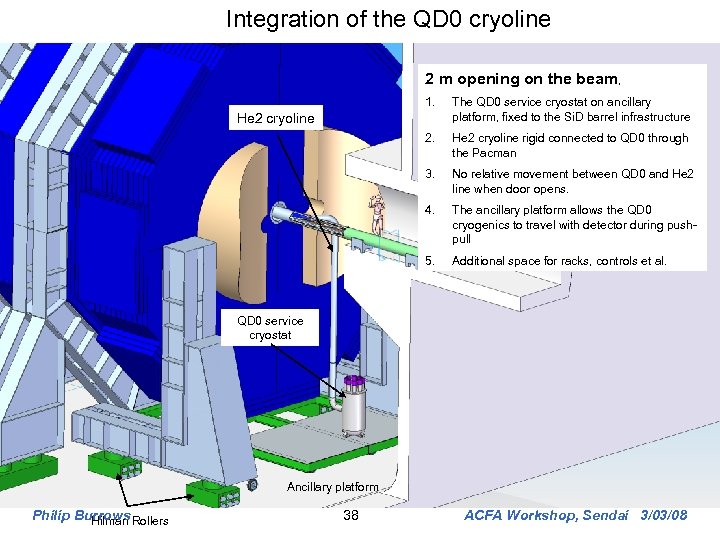
Integration of the QD 0 cryoline 2 m opening on the beam, 1. The QD 0 service cryostat on ancillary platform, fixed to the Si. D barrel infrastructure 2. He 2 cryoline rigid connected to QD 0 through the Pacman 3. No relative movement between QD 0 and He 2 line when door opens. 4. The ancillary platform allows the QD 0 cryogenics to travel with detector during pushpull 5. Additional space for racks, controls et al. He 2 cryoline QD 0 service cryostat Ancillary platform Philip Burrows Rollers Hilman 38 ACFA Workshop, Sendai 3/03/08
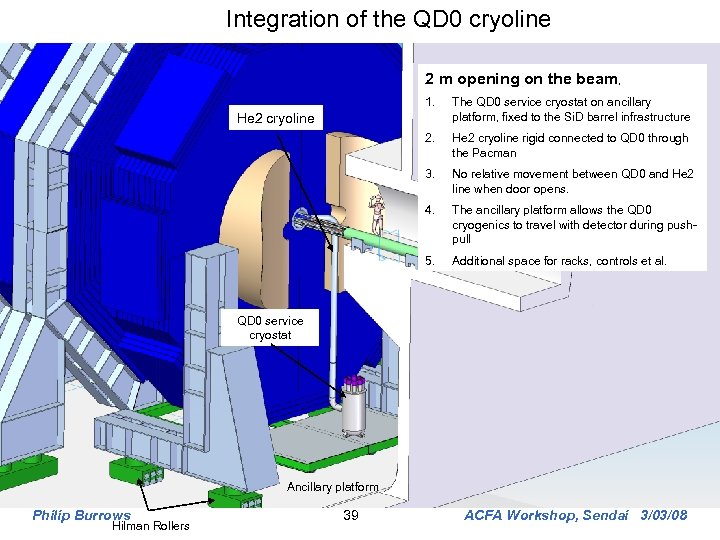
Integration of the QD 0 cryoline 2 m opening on the beam, 1. The QD 0 service cryostat on ancillary platform, fixed to the Si. D barrel infrastructure 2. He 2 cryoline rigid connected to QD 0 through the Pacman 3. No relative movement between QD 0 and He 2 line when door opens. 4. The ancillary platform allows the QD 0 cryogenics to travel with detector during pushpull 5. Additional space for racks, controls et al. He 2 cryoline QD 0 service cryostat Ancillary platform Philip Burrows Hilman Rollers 39 ACFA Workshop, Sendai 3/03/08
Push-pull: Si. D assumptions • Having two detectors on beamline ‘permanently’, and sharing the luminosity, i. e. two IPs, is clearly the ideal solution for physics • Luminosity delivery to two IPs, with fast switchover between IPs, is not possible • Two detectors in push-pull mode will: - save cost of one BDS - increase likelihood of two detectors from start - provide equal access to luminosity for both detectors Philip Burrows ACFA Workshop, Sendai 3/03/08
Si. D statement on technical Issues • Push-pull can probably be engineered to work - many technical issues will need to be solved • Full access to offline detector is mandatory • Best accomplished with self-shielding detectors - self shielding is technically feasible • Mechanisms for moving detector should not reduce acceptance • Need to align ‘captured’ beamline components independent of overall detector position Philip Burrows ACFA Workshop, Sendai 3/03/08
Si. D: technical questions • Can detector be engineered so magnetic field map remains invariant under detector in/out? • Can tracking chamber alignment be restored without calibration runs (eg. with internal alignment system)? • Can detector remain fully operable in ‘out’ position? - cosmic ray data-taking to maintain operability • Can switchover time be made short enough? Philip Burrows ACFA Workshop, Sendai 3/03/08
Si. D: sociological issues • Need well defined procedure for scheduling swaps • Machine luminosity must be shared equitably • Period between swaps should be of order 1 month: - neither detector can gain significant lumi advantage in 1 period • Switch-over time << running period Philip Burrows ACFA Workshop, Sendai 3/03/08
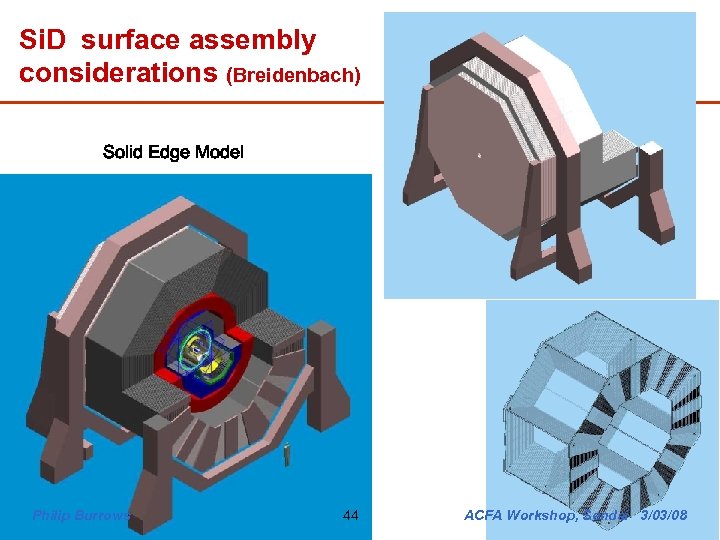
Si. D surface assembly considerations (Breidenbach) Solid Edge Model Philip Burrows 44 ACFA Workshop, Sendai 3/03/08
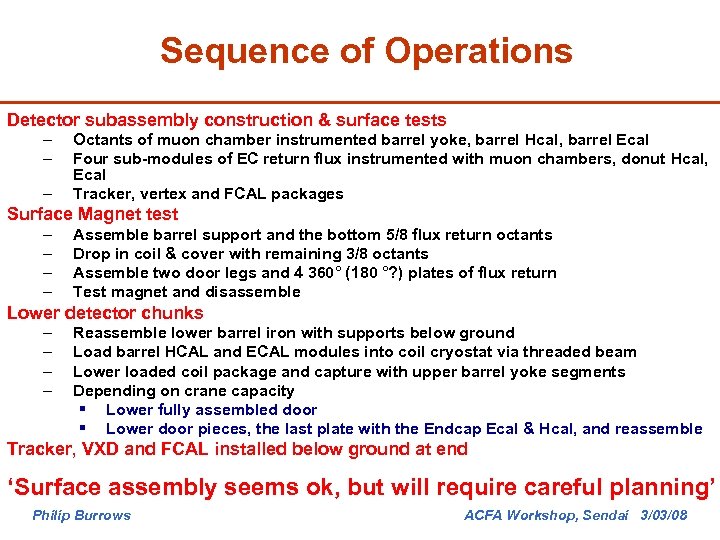
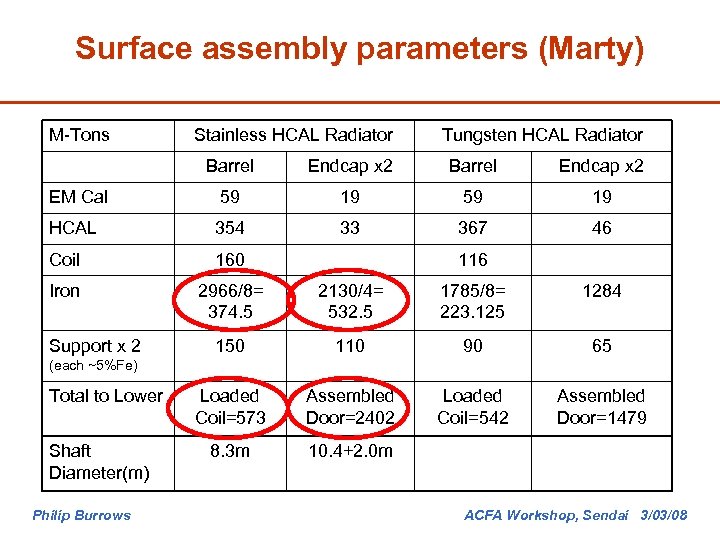
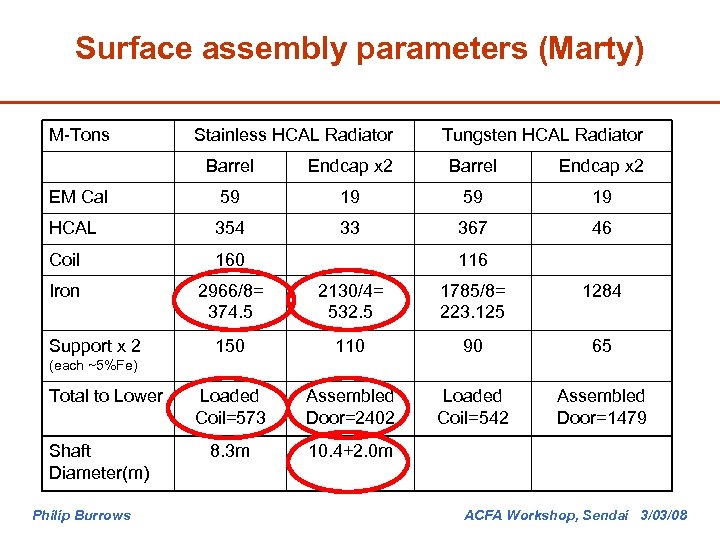
Sequence of Operations Detector subassembly construction & surface tests – – – Octants of muon chamber instrumented barrel yoke, barrel Hcal, barrel Ecal Four sub-modules of EC return flux instrumented with muon chambers, donut Hcal, Ecal Tracker, vertex and FCAL packages Surface Magnet test – – Assemble barrel support and the bottom 5/8 flux return octants Drop in coil & cover with remaining 3/8 octants Assemble two door legs and 4 360° (180 °? ) plates of flux return Test magnet and disassemble Lower detector chunks – – Reassemble lower barrel iron with supports below ground Load barrel HCAL and ECAL modules into coil cryostat via threaded beam Lower loaded coil package and capture with upper barrel yoke segments Depending on crane capacity § Lower fully assembled door § Lower door pieces, the last plate with the Endcap Ecal & Hcal, and reassemble Tracker, VXD and FCAL installed below ground at end ‘Surface assembly seems ok, but will require careful planning’ Philip Burrows ACFA Workshop, Sendai 3/03/08
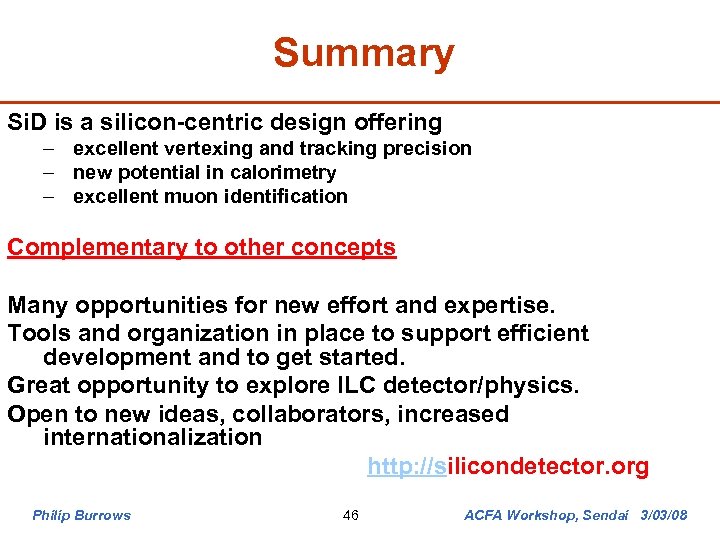
Summary Si. D is a silicon-centric design offering – excellent vertexing and tracking precision – new potential in calorimetry – excellent muon identification Complementary to other concepts Many opportunities for new effort and expertise. Tools and organization in place to support efficient development and to get started. Great opportunity to explore ILC detector/physics. Open to new ideas, collaborators, increased internationalization http: //silicondetector. org Philip Burrows 46 ACFA Workshop, Sendai 3/03/08
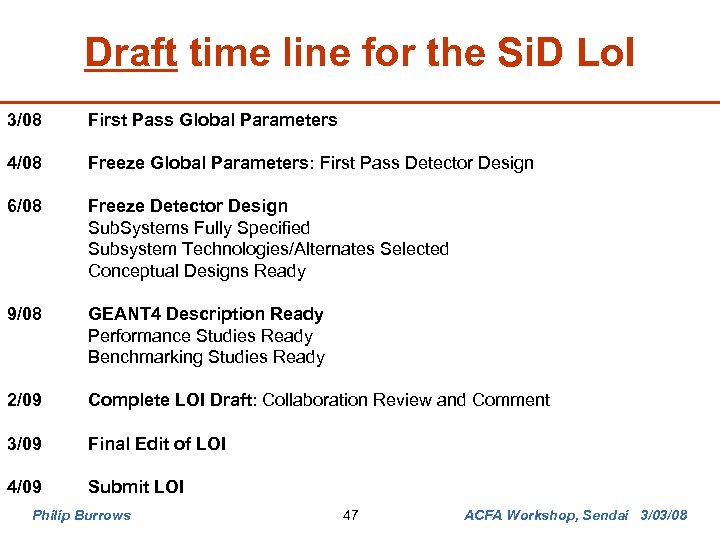
Draft time line for the Si. D Lo. I 3/08 First Pass Global Parameters 4/08 Freeze Global Parameters: First Pass Detector Design 6/08 Freeze Detector Design Sub. Systems Fully Specified Subsystem Technologies/Alternates Selected Conceptual Designs Ready 9/08 GEANT 4 Description Ready Performance Studies Ready Benchmarking Studies Ready 2/09 Complete LOI Draft: Collaboration Review and Comment 3/09 Final Edit of LOI 4/09 Submit LOI Philip Burrows 47 ACFA Workshop, Sendai 3/03/08
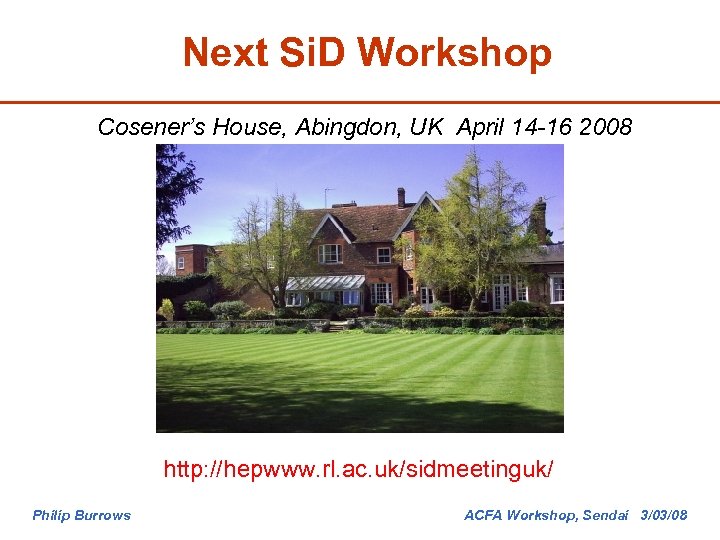
Next Si. D Workshop Cosener’s House, Abingdon, UK April 14 -16 2008 http: //hepwww. rl. ac. uk/sidmeetinguk/ Philip Burrows ACFA Workshop, Sendai 3/03/08
Extra material follows Philip Burrows ACFA Workshop, Sendai 3/03/08
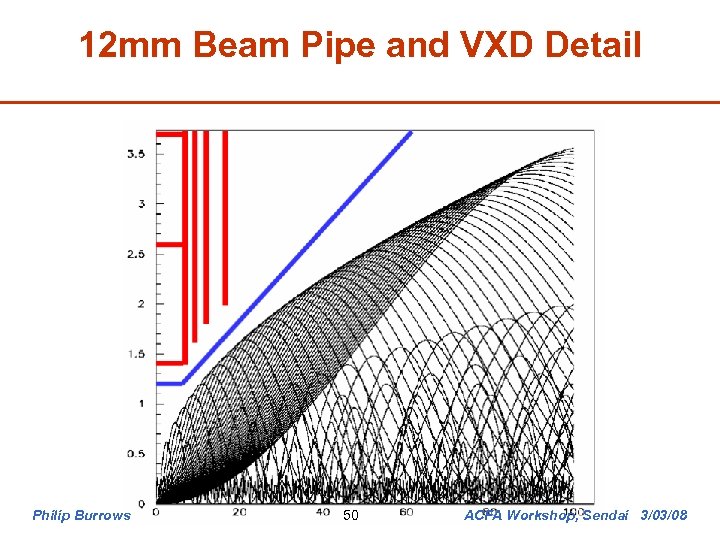
12 mm Beam Pipe and VXD Detail Philip Burrows 50 ACFA Workshop, Sendai 3/03/08
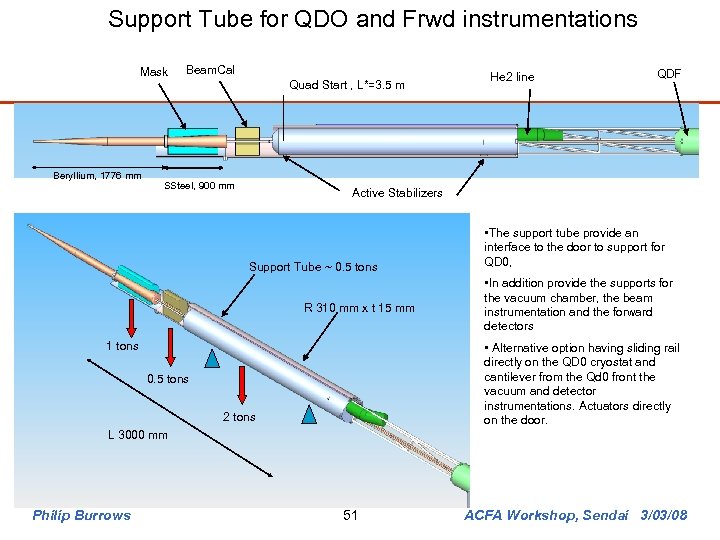
Support Tube for QDO and Frwd instrumentations Mask Beryllium, 1776 mm Beam. Cal Quad Start , L*=3. 5 m SSteel, 900 mm He 2 line QDF Active Stabilizers Support Tube ~ 0. 5 tons R 310 mm x t 15 mm 1 tons • The support tube provide an interface to the door to support for QD 0, • In addition provide the supports for the vacuum chamber, the beam instrumentation and the forward detectors • Alternative option having sliding rail directly on the QD 0 cryostat and cantilever from the Qd 0 front the vacuum and detector instrumentations. Actuators directly on the door. 0. 5 tons 2 tons L 3000 mm Philip Burrows 51 ACFA Workshop, Sendai 3/03/08
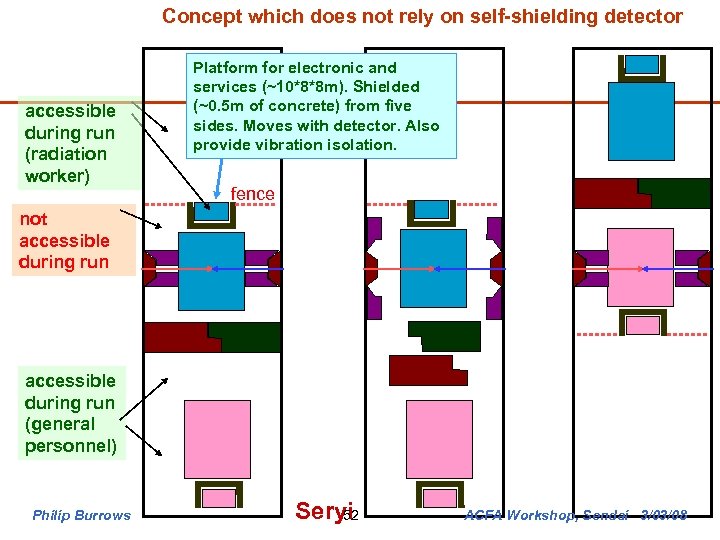
Concept which does not rely on self-shielding detector accessible during run (radiation worker) Platform for electronic and services (~10*8*8 m). Shielded (~0. 5 m of concrete) from five sides. Moves with detector. Also provide vibration isolation. fence not accessible during run (general personnel) Philip Burrows Seryi 52 ACFA Workshop, Sendai 3/03/08
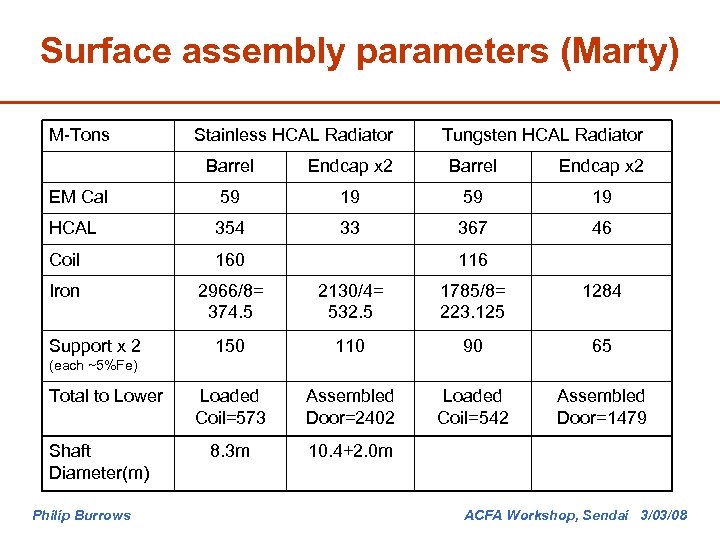
Surface assembly parameters (Marty) M-Tons Stainless HCAL Radiator Tungsten HCAL Radiator Barrel Endcap x 2 EM Cal 59 19 HCAL 354 33 367 46 Coil 160 Iron 2966/8= 374. 5 2130/4= 532. 5 1785/8= 223. 125 1284 150 110 90 65 Loaded Coil=573 Assembled Door=2402 Loaded Coil=542 Assembled Door=1479 8. 3 m 10. 4+2. 0 m Support x 2 116 (each ~5%Fe) Total to Lower Shaft Diameter(m) Philip Burrows ACFA Workshop, Sendai 3/03/08
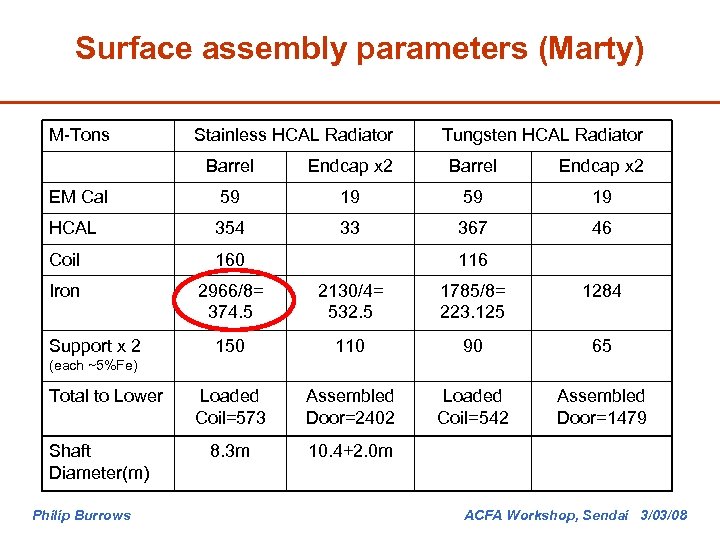
Surface assembly parameters (Marty) M-Tons Stainless HCAL Radiator Tungsten HCAL Radiator Barrel Endcap x 2 EM Cal 59 19 HCAL 354 33 367 46 Coil 160 Iron 2966/8= 374. 5 2130/4= 532. 5 1785/8= 223. 125 1284 150 110 90 65 Loaded Coil=573 Assembled Door=2402 Loaded Coil=542 Assembled Door=1479 8. 3 m 10. 4+2. 0 m Support x 2 116 (each ~5%Fe) Total to Lower Shaft Diameter(m) Philip Burrows ACFA Workshop, Sendai 3/03/08
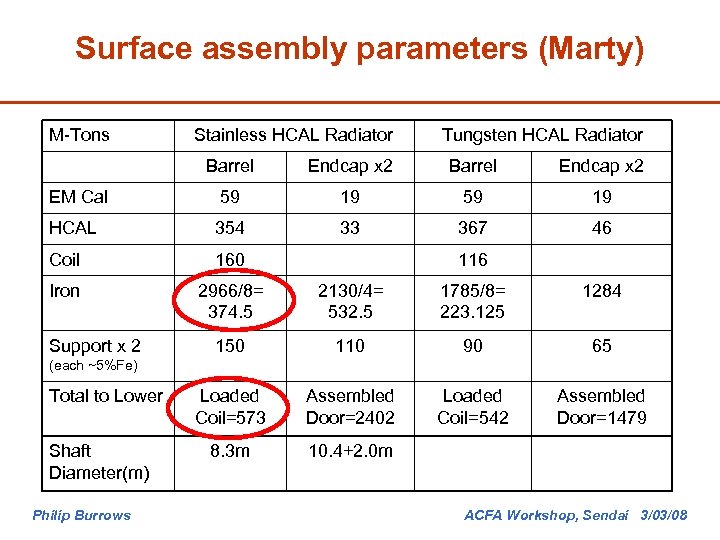
Surface assembly parameters (Marty) M-Tons Stainless HCAL Radiator Tungsten HCAL Radiator Barrel Endcap x 2 EM Cal 59 19 HCAL 354 33 367 46 Coil 160 Iron 2966/8= 374. 5 2130/4= 532. 5 1785/8= 223. 125 1284 150 110 90 65 Loaded Coil=573 Assembled Door=2402 Loaded Coil=542 Assembled Door=1479 8. 3 m 10. 4+2. 0 m Support x 2 116 (each ~5%Fe) Total to Lower Shaft Diameter(m) Philip Burrows ACFA Workshop, Sendai 3/03/08
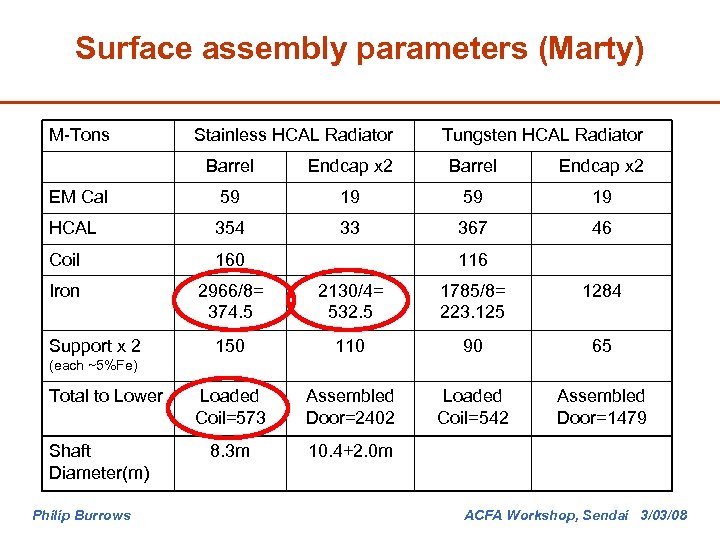
Surface assembly parameters (Marty) M-Tons Stainless HCAL Radiator Tungsten HCAL Radiator Barrel Endcap x 2 EM Cal 59 19 HCAL 354 33 367 46 Coil 160 Iron 2966/8= 374. 5 2130/4= 532. 5 1785/8= 223. 125 1284 150 110 90 65 Loaded Coil=573 Assembled Door=2402 Loaded Coil=542 Assembled Door=1479 8. 3 m 10. 4+2. 0 m Support x 2 116 (each ~5%Fe) Total to Lower Shaft Diameter(m) Philip Burrows ACFA Workshop, Sendai 3/03/08
Surface assembly parameters (Marty) M-Tons Stainless HCAL Radiator Tungsten HCAL Radiator Barrel Endcap x 2 EM Cal 59 19 HCAL 354 33 367 46 Coil 160 Iron 2966/8= 374. 5 2130/4= 532. 5 1785/8= 223. 125 1284 150 110 90 65 Loaded Coil=573 Assembled Door=2402 Loaded Coil=542 Assembled Door=1479 8. 3 m 10. 4+2. 0 m Support x 2 116 (each ~5%Fe) Total to Lower Shaft Diameter(m) Philip Burrows ACFA Workshop, Sendai 3/03/08
Surface assembly parameters (Marty) M-Tons Stainless HCAL Radiator Tungsten HCAL Radiator Barrel Endcap x 2 EM Cal 59 19 HCAL 354 33 367 46 Coil 160 Iron 2966/8= 374. 5 2130/4= 532. 5 1785/8= 223. 125 1284 150 110 90 65 Loaded Coil=573 Assembled Door=2402 Loaded Coil=542 Assembled Door=1479 8. 3 m 10. 4+2. 0 m Support x 2 116 (each ~5%Fe) Total to Lower Shaft Diameter(m) Philip Burrows ACFA Workshop, Sendai 3/03/08
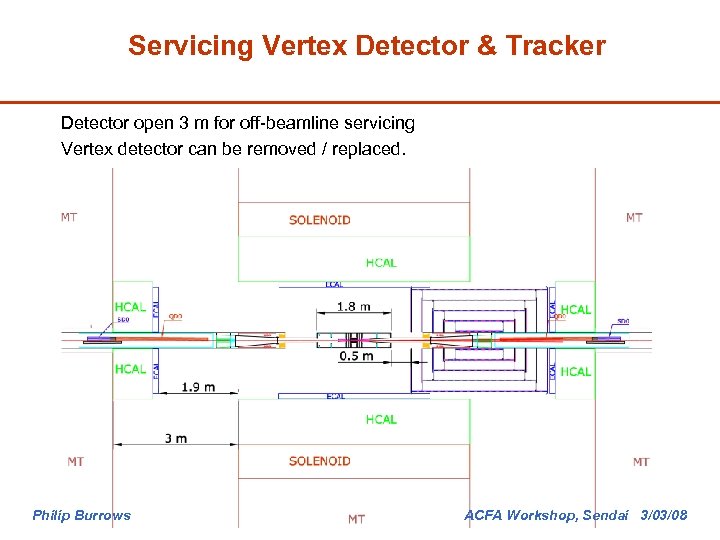
Servicing Vertex Detector & Tracker Detector open 3 m for off-beamline servicing Vertex detector can be removed / replaced. Philip Burrows ACFA Workshop, Sendai 3/03/08
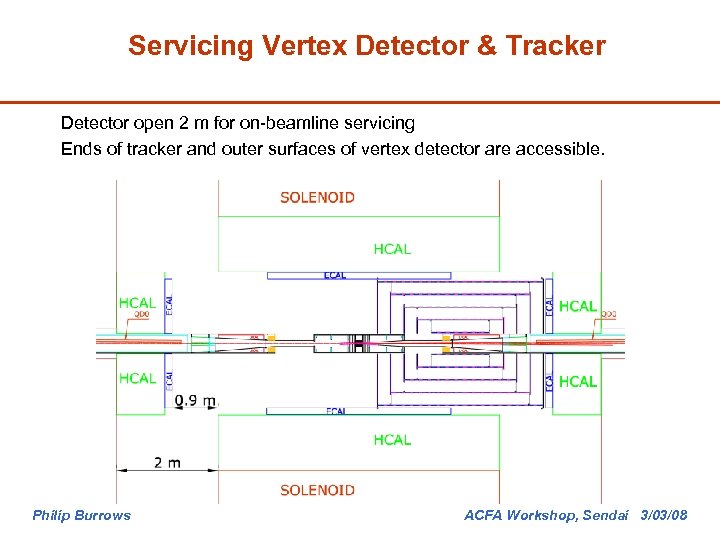
Servicing Vertex Detector & Tracker Detector open 2 m for on-beamline servicing Ends of tracker and outer surfaces of vertex detector are accessible. Philip Burrows ACFA Workshop, Sendai 3/03/08
Скачать презентацию Si D http silicondetector org Philip Burrows John
431cbd95684e823964211eef82f677c6.ppt