


 Скачать презентацию Shrimp Prawn Crayfish Aquaculture World harvest of
ce50d3846d8b709b4a8a84efbd8a0aea.ppt
- Количество слайдов: 81
 Shrimp, Prawn, Crayfish Aquaculture
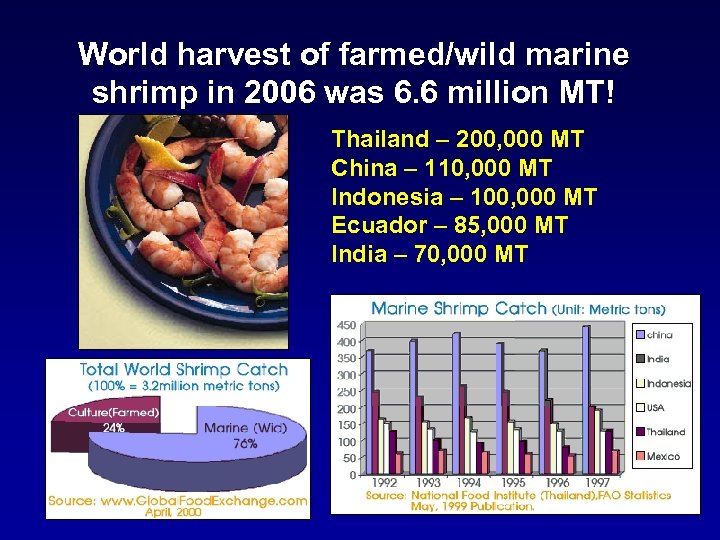 World harvest of farmed/wild marine shrimp in 2006 was 6. 6 million MT! Thailand – 200, 000 MT China – 110, 000 MT Indonesia – 100, 000 MT Ecuador – 85, 000 MT India – 70, 000 MT
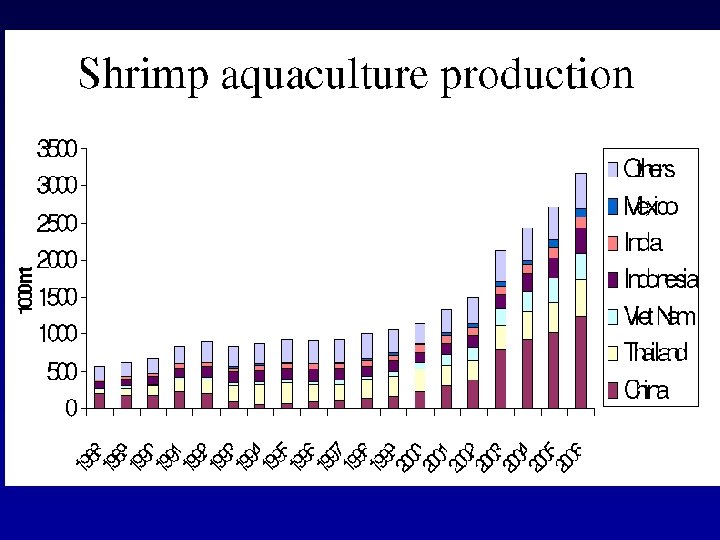
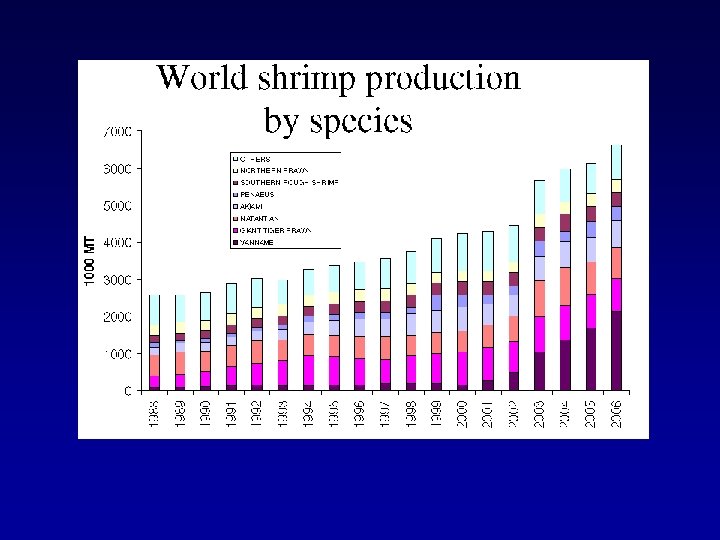
 Shrimp Gee-Whiz • Shrimp, crabs, lobsters and crayfish all decapods (they have 10 feet) • Hundreds of spp. found in brackish and marine • All farm-raised shrimp and most of the shrimp caught by fishermen belong to the Penaeidae family of decapod crustaceans and are referred to as "penaeids".
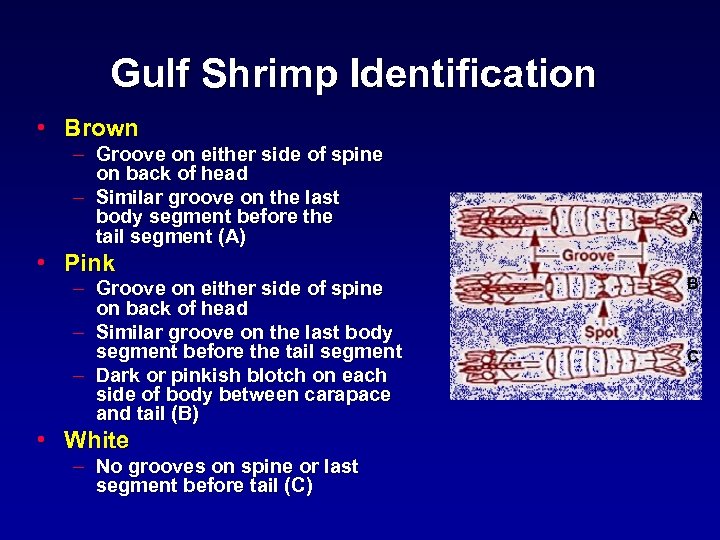 Gulf Shrimp Identification • Brown – Groove on either side of spine on back of head – Similar groove on the last body segment before the tail segment (A) • Pink – Groove on either side of spine on back of head – Similar groove on the last body segment before the tail segment – Dark or pinkish blotch on each side of body between carapace and tail (B) • White – No grooves on spine or last segment before tail (C)
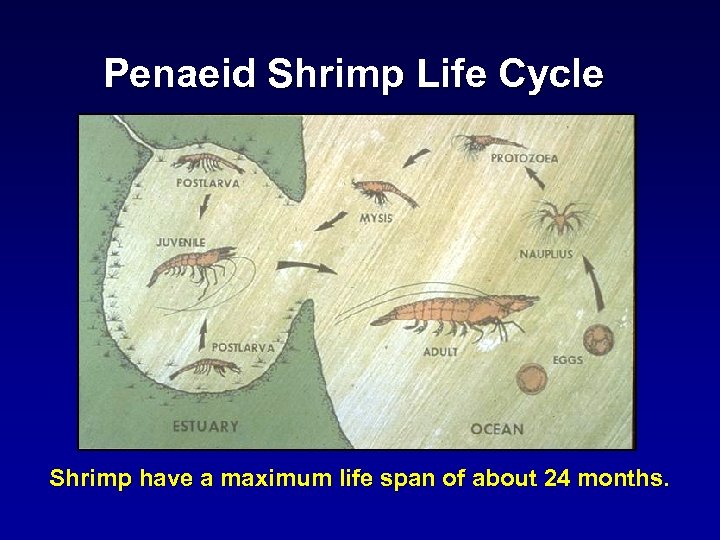 Penaeid Shrimp Life Cycle Shrimp have a maximum life span of about 24 months.
 Larval Staging • Penaeid Shrimp pass through three larval stages – Nauplii – Zoeal – Mysis • Postlarval (PL) follows larval stages – Look like shrimp by this stage
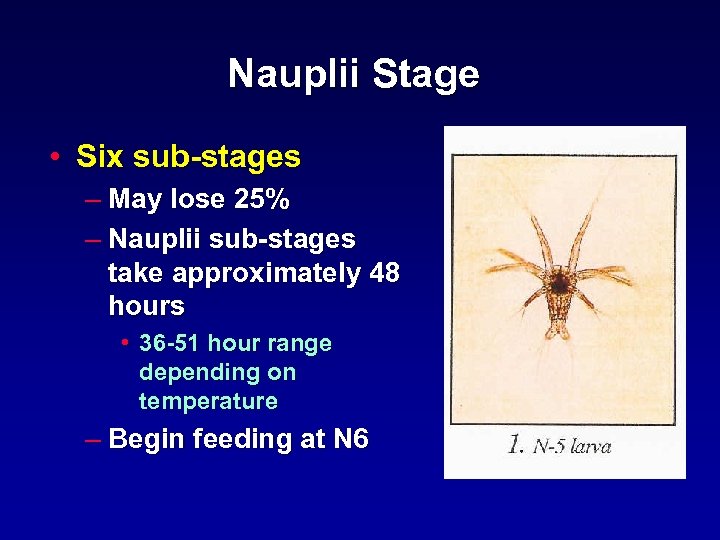 Nauplii Stage • Six sub-stages – May lose 25% – Nauplii sub-stages take approximately 48 hours • 36 -51 hour range depending on temperature – Begin feeding at N 6
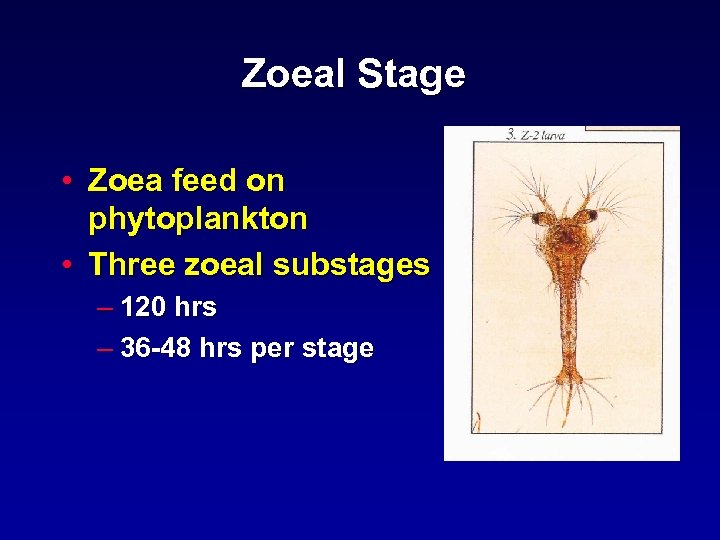 Zoeal Stage • Zoea feed on phytoplankton • Three zoeal substages – 120 hrs – 36 -48 hrs per stage
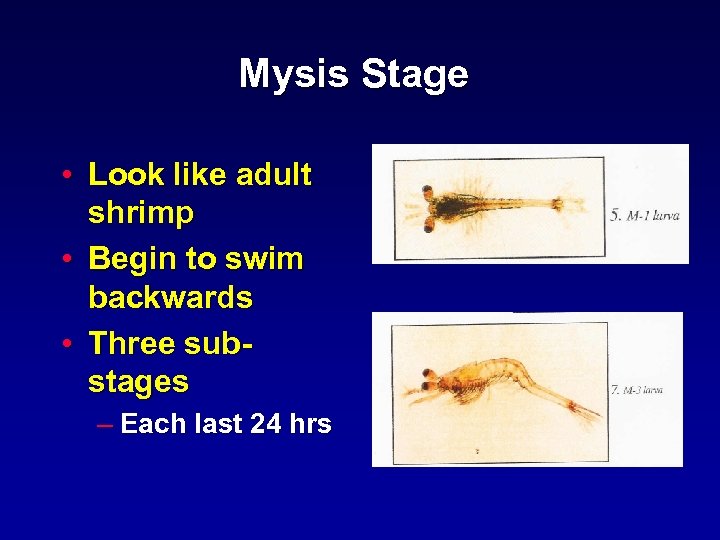 Mysis Stage • Look like adult shrimp • Begin to swim backwards • Three substages – Each last 24 hrs
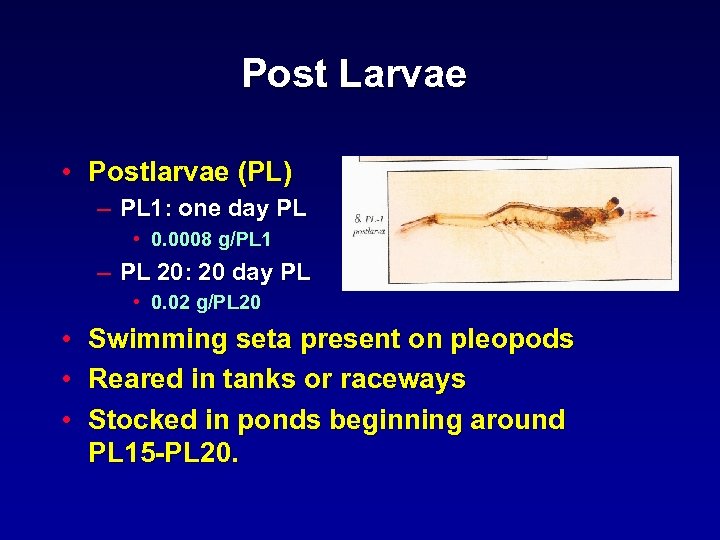 Post Larvae • Postlarvae (PL) – PL 1: one day PL • 0. 0008 g/PL 1 – PL 20: 20 day PL • 0. 02 g/PL 20 • • • Swimming seta present on pleopods Reared in tanks or raceways Stocked in ponds beginning around PL 15 -PL 20.
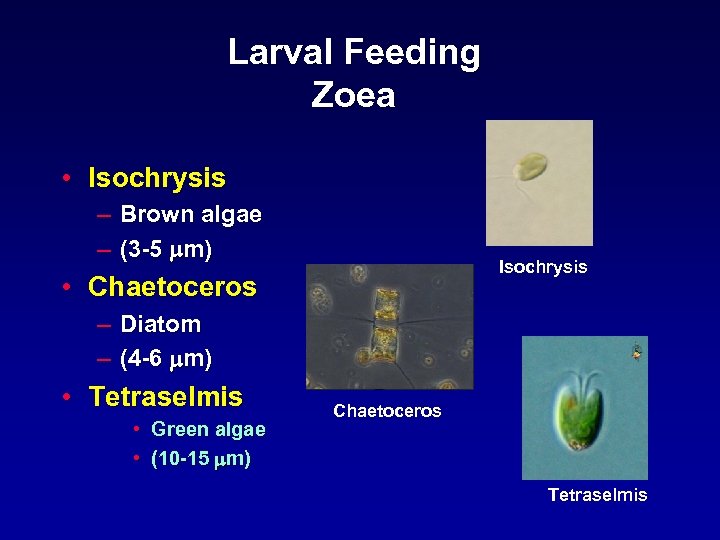 Larval Feeding Zoea • Isochrysis – Brown algae – (3 -5 mm) Isochrysis • Chaetoceros – Diatom – (4 -6 mm) • Tetraselmis • Green algae • (10 -15 mm) Chaetoceros Tetraselmis
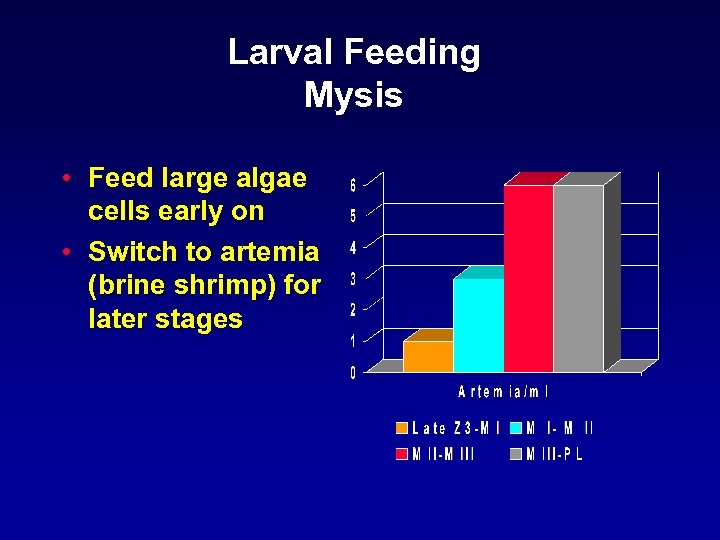 Larval Feeding Mysis • Feed large algae cells early on • Switch to artemia (brine shrimp) for later stages
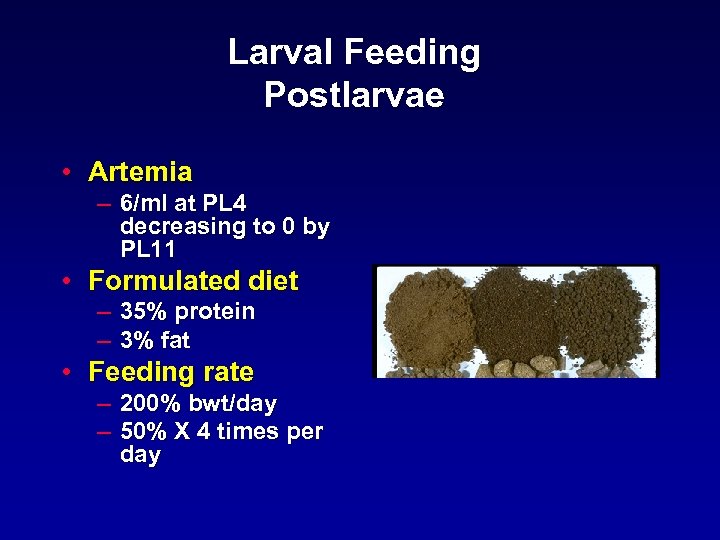 Larval Feeding Postlarvae • Artemia – 6/ml at PL 4 decreasing to 0 by PL 11 • Formulated diet – 35% protein – 3% fat • Feeding rate – 200% bwt/day – 50% X 4 times per day
 General Shrimp Farming Concepts • Marine shrimp are grown in earthen ponds located in coastal areas of countries with tropical and subtropical climates. • Ponds are filled with saltwater pumped from estuaries and oceans. Small shrimp reproduced and raised in captivity are stocked into the ponds and are ready for harvest in 90 to 120 days.
 Farm Location • Locate ponds close to good quality brackish water – 5 -30 ppt – Farms can be inland if suitable aquifers are available • Soil should have high clay content – 25% • Water table should not be within three feet of surface
 Farm Permits • Construction permits from Corps of Engineers • Aquaculture Permits from state • Local permits
 Farming Strategies • Extensive – Large ponds – Low stocking densities – Little management or investment • Semi-Intensive – Falls in between the two extreme of intensive and extensive • Intensive – – Smaller ponds Aeration High stocking densities Feeding
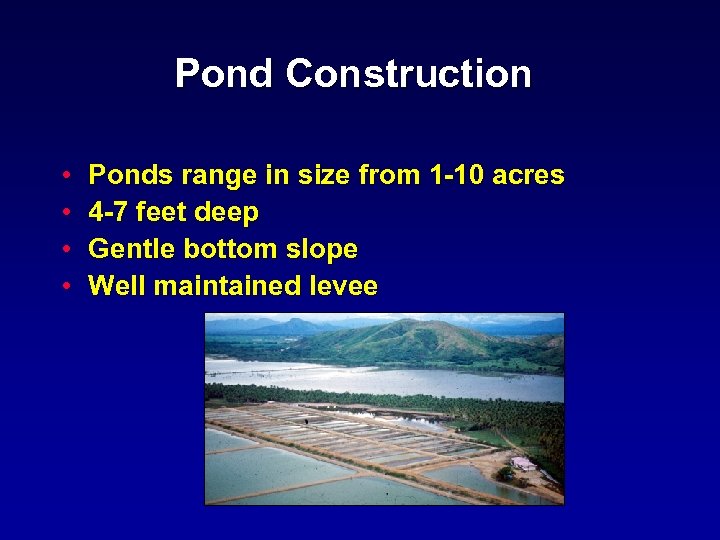 Pond Construction • • Ponds range in size from 1 -10 acres 4 -7 feet deep Gentle bottom slope Well maintained levee
 Gulf and Inland Shrimp Species • Food – Western white shrimp • Penaeus vannamei – Northern white shrimp • Litopenaeus setiferus – Freshwater shrimp • Macrobrachium spp. • Bait – Brown shrimp • Farfantepenaeus aztecus
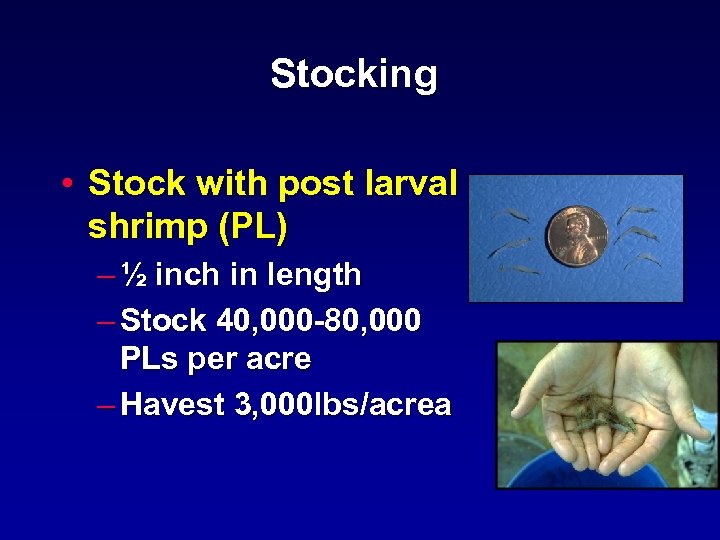 Stocking • Stock with post larval shrimp (PL) – ½ inch in length – Stock 40, 000 -80, 000 PLs per acre – Havest 3, 000 lbs/acrea
 Management • Fertilize ponds prior to stocking • Feed good quality shrimp feed – 35% protein – 3 -5% bwt per day • Provide aeration when necessary
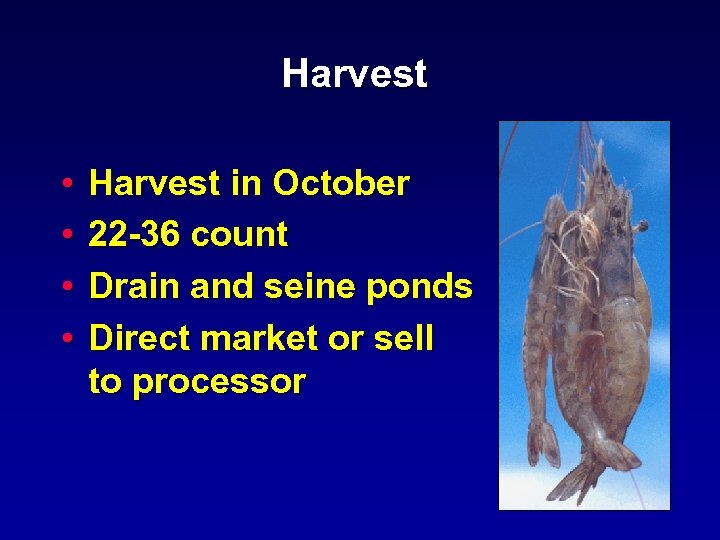 Harvest • • Harvest in October 22 -36 count Drain and seine ponds Direct market or sell to processor
 Common Problems • Shortage of PLs • Shrimp viruses
 Commonly Cultured Marine Shrimp • • Penaeus merguiensis – Banana prawn Penaeus indicus – Indian prawn Penaeus japonicus - Kuruma prawn Penaeus duorarum – Atlantic pink shrimp Penaeus aztecus – Atlantic brown shrimp Penaeus setiferous – Atlantic white shrimp Litopenaeus vannamei – Pacific white shrimp Penaeus monodon – Black tiger prawn
 Shrimp Species • Giant Tiger Prawn (Penaeus monodon) – Named for its huge size and banded tail, P. monodon still accounts for most of the farmed shrimp coming out of Asia, but it's likely to lose that position to P. vannamei over the next couple of years. – Native to the Indian Ocean and the southwestern Pacific Ocean from Japan to Australia, "tigers" are the largest (maximum length 363 mm) and fastest growing of the farmed shrimp. – They tolerate a wide range of salinities, but shortages of wild broodstock often exist, captive breeding is difficult and hatchery survivals are low (20 to 30%). Tigers are very susceptible to two of the most lethal shrimp viruses: yellowhead and whitespot. – Reddish-orange on the sides and pearly-white on the top and bottom
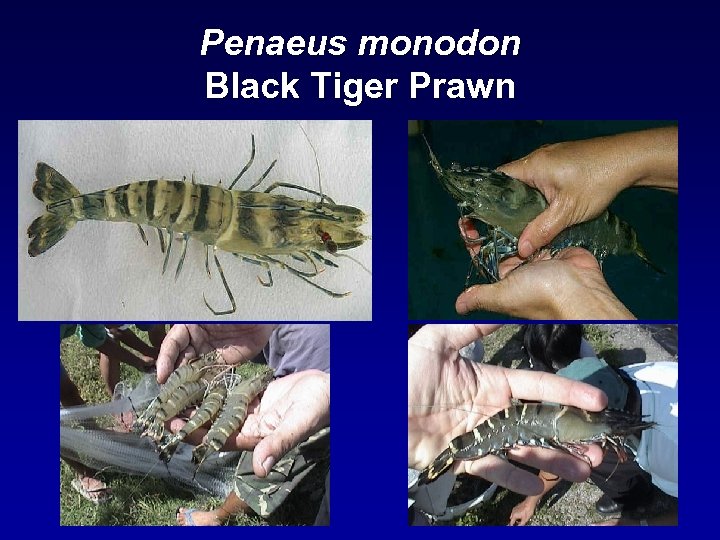 Penaeus monodon Black Tiger Prawn
 Shrimp Species • Western White Shrimp (Penaeus vannamei) – Native to the Pacific coast of Central and South America, – Leading farm-raised species in the Western Hemisphere, representing more than 95% of production. – Because vannamei feeds on organisms which grow naturally in the pond, it is cheaper to feed than monodon. – White shrimp can be stocked at small sizes, have a uniform growth rate and reach a maximum length of 230 millimeters. – They breed in captivity better than monodon – Hatchery survivals are high, from 50 to 60%. Throughout Latin America, hatcheries maintain captive stocks of vannamei broodstock. – Look for it to become the dominant species in Asia over the next couple of years.
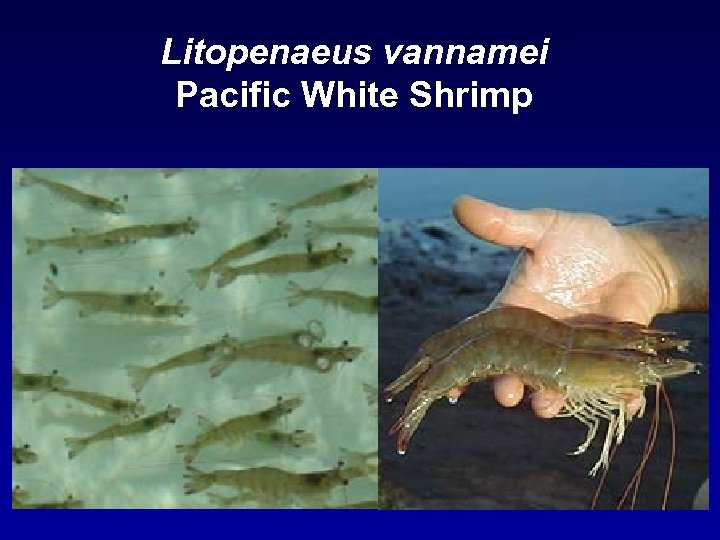 Litopenaeus vannamei Pacific White Shrimp
 Shrimp Species • Chinese White Shrimp (Penaeus chinensis) – Native to the coast of China and the west coast of the Korean peninsula. – Chinese white shrimp grow better in lower water temperatures (down to 16 degrees Celsius) than vannamei and monodon – Tolerate muddy bottoms and very low salinities— and, unlike the above species, Chinese white shrimp readily mature and spawn in ponds. – On the negative side, they have a high protein requirement (40 to 60%), a small size (maximum length of 183 millimeters), and a lower meat yield (56%) than monodon (61%) and vannamei (63%). – Also, chinensis appears to be more susceptible to viruses than vannamei.
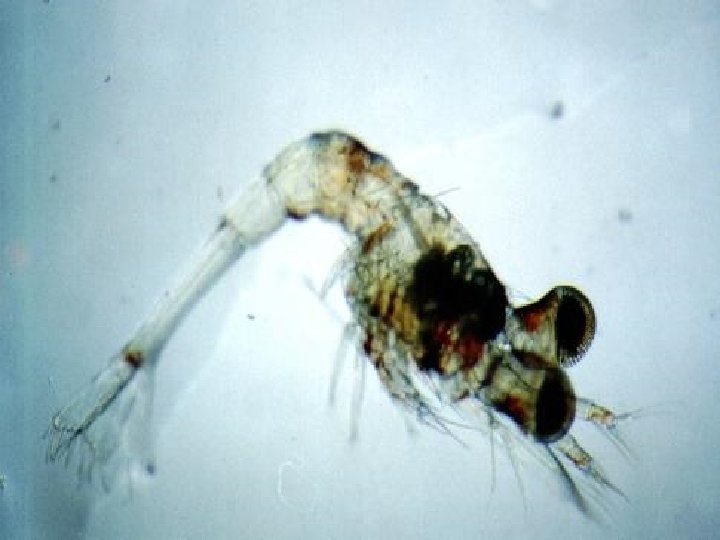
 Shrimp Species • Freshwater Prawns (Macrobrachium spp. ) – World production of farmed prawns has risen to around 200, 000 metric tons, worth about a billion dollars, most of it from Bangladesh and China. – The genus Macrobrachium, which includes about 200 species, almost all of which live in freshwater for at least part of their life cycle, native to all continents except Europe. – The favored species for farming has always been M. rosenbergii, sometimes called the "giant river prawn" or the "Malaysian prawn – In the United States, there are more than 500 small freshwater prawn farms (M. rosenbergii). – Resemble giant tiger shrimp, but they're bigger, chunkier, lighter in color, and their shells are always on. – If the bottom part of the shell on the second tail segment overlaps the shell on the first and third segments, it's a freshwater prawn.
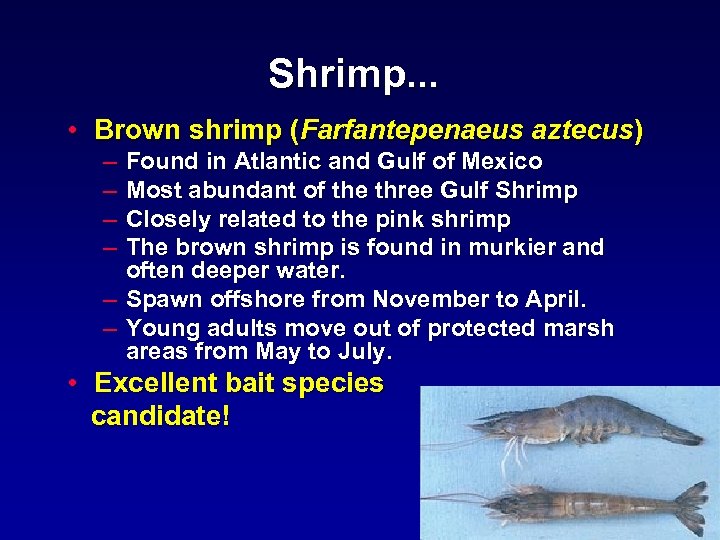 Shrimp. . . • Brown shrimp (Farfantepenaeus aztecus) – – – Found in Atlantic and Gulf of Mexico Most abundant of the three Gulf Shrimp Closely related to the pink shrimp The brown shrimp is found in murkier and often deeper water. Spawn offshore from November to April. Young adults move out of protected marsh areas from May to July. • Excellent bait species candidate!
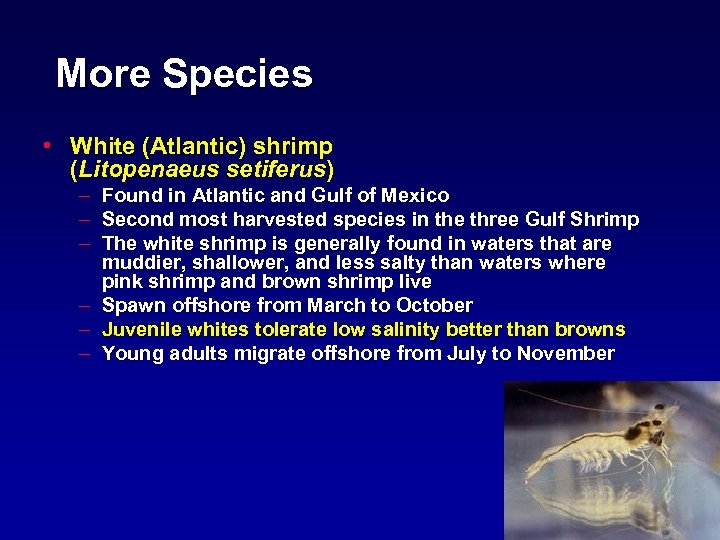 More Species • White (Atlantic) shrimp (Litopenaeus setiferus) – Found in Atlantic and Gulf of Mexico – Second most harvested species in the three Gulf Shrimp – The white shrimp is generally found in waters that are muddier, shallower, and less salty than waters where pink shrimp and brown shrimp live – Spawn offshore from March to October – Juvenile whites tolerate low salinity better than browns – Young adults migrate offshore from July to November
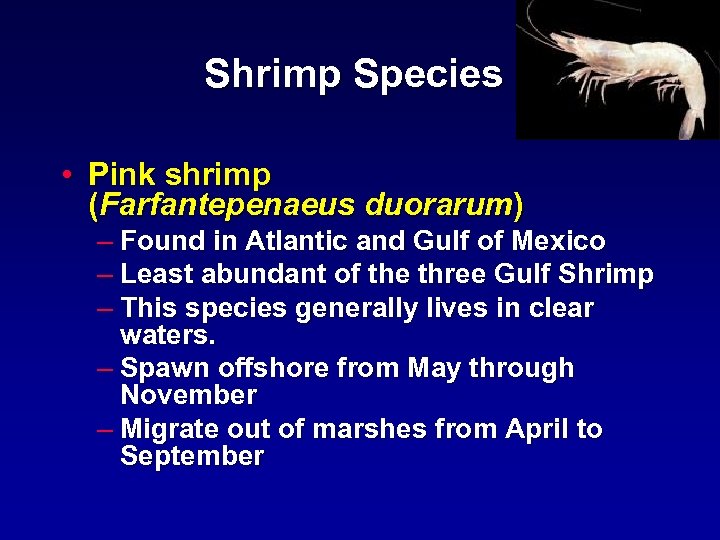 Shrimp Species • Pink shrimp (Farfantepenaeus duorarum) – Found in Atlantic and Gulf of Mexico – Least abundant of the three Gulf Shrimp – This species generally lives in clear waters. – Spawn offshore from May through November – Migrate out of marshes from April to September
 Broodstock Performance • • 40 g females, 35 g males Daily spawning rate (natural mating), As a % of the total female population: 5 -8%/day Egg Production: 200 -250, 000 per female per spawn. • Nauplii production: 100 -150, 000 per female per spawn. • Useful productive life of the broodstock: 3 -6 months • Total spawns per female during her useful life: 1015
 Specific Pathogen Free • • • White Spot Syndrome Virus (WSSV) Taura Syndrome Virus (TSV) Yellow Head Virus (YHV) IHHN Virus (IHHNV) MBV BP/MBV HPV NHP Gregarines Microsporidians Haplosporidians
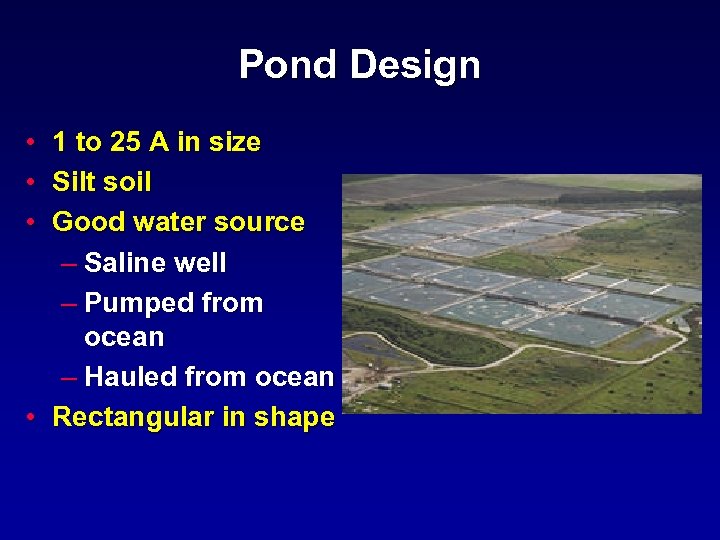 Pond Design • • • 1 to 25 A in size Silt soil Good water source – Saline well – Pumped from ocean – Hauled from ocean • Rectangular in shape
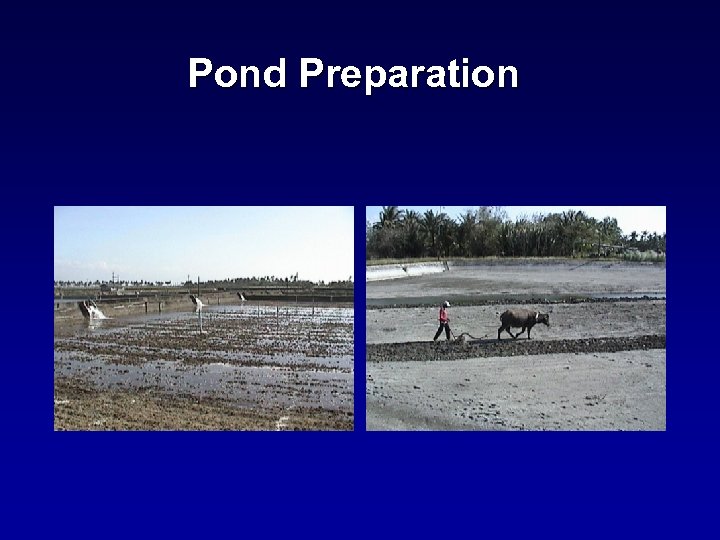 Pond Preparation
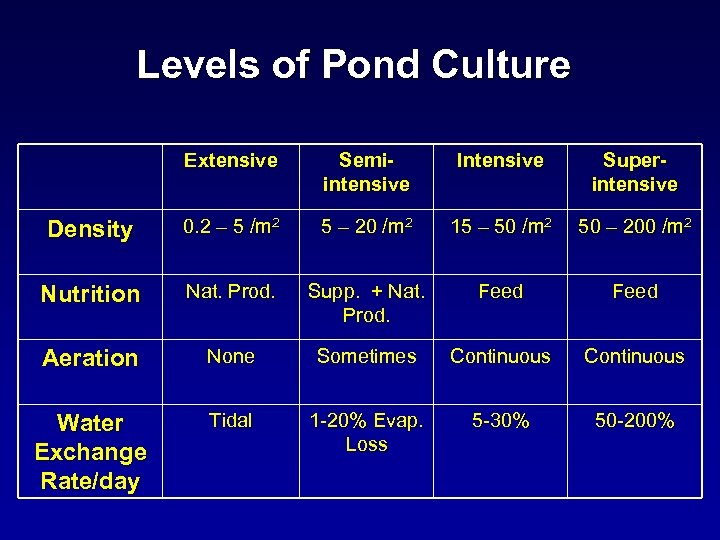 Levels of Pond Culture Extensive Semiintensive Intensive Superintensive Density 0. 2 – 5 /m 2 5 – 20 /m 2 15 – 50 /m 2 50 – 200 /m 2 Nutrition Nat. Prod. Supp. + Nat. Prod. Feed Aeration None Sometimes Continuous Water Exchange Rate/day Tidal 1 -20% Evap. Loss 5 -30% 50 -200%
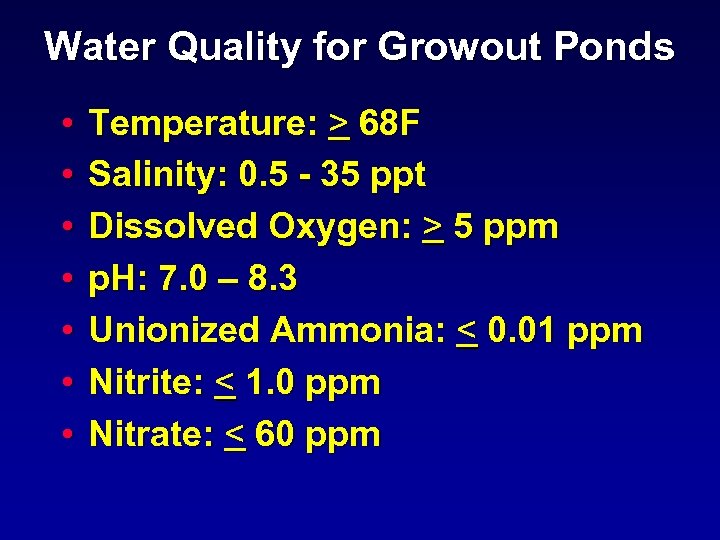 Water Quality for Growout Ponds • • Temperature: > 68 F Salinity: 0. 5 - 35 ppt Dissolved Oxygen: > 5 ppm p. H: 7. 0 – 8. 3 Unionized Ammonia: < 0. 01 ppm Nitrite: < 1. 0 ppm Nitrate: < 60 ppm
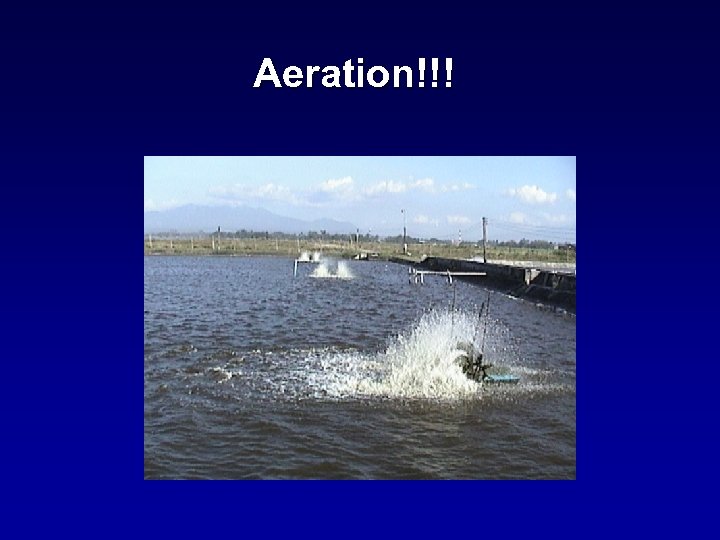 Aeration!!!
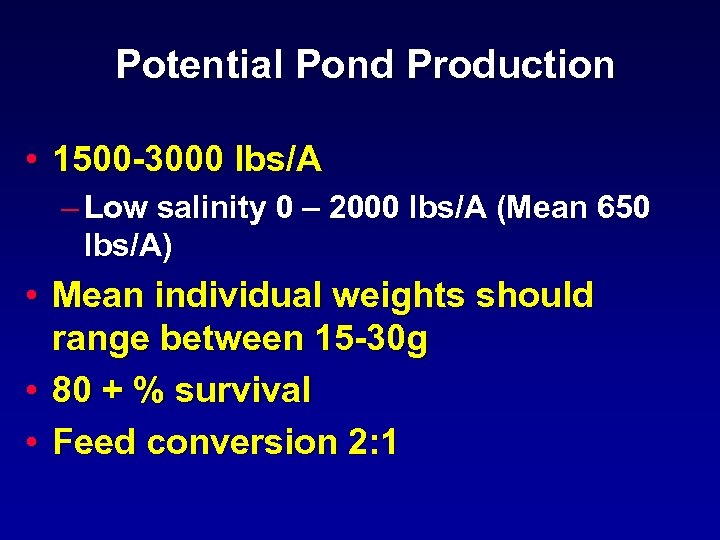 Potential Pond Production • 1500 -3000 lbs/A – Low salinity 0 – 2000 lbs/A (Mean 650 lbs/A) • Mean individual weights should range between 15 -30 g • 80 + % survival • Feed conversion 2: 1
 Biosecure Zero Exchange System
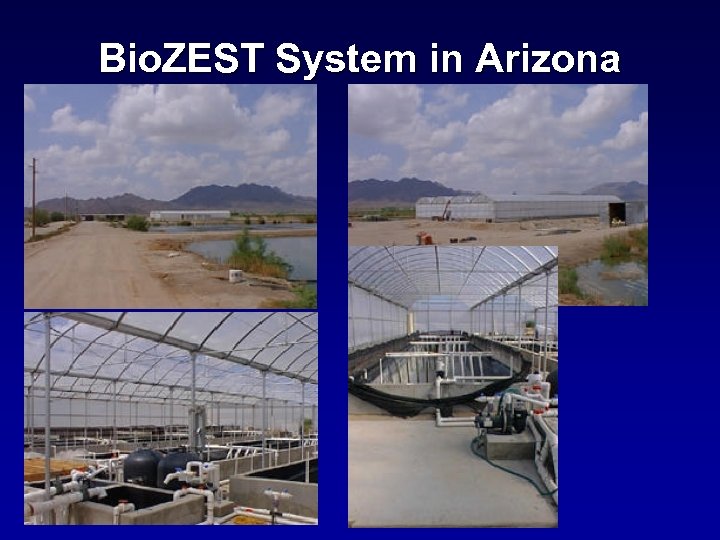 Bio. ZEST System in Arizona
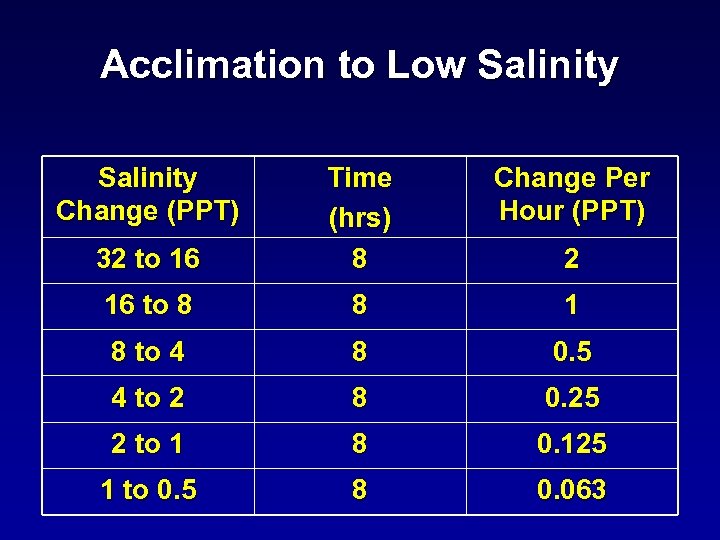 Acclimation to Low Salinity Change (PPT) Change Per Hour (PPT) 32 to 16 Time (hrs) 8 16 to 8 8 1 8 to 4 8 0. 5 4 to 2 8 0. 25 2 to 1 8 0. 125 1 to 0. 5 8 0. 063 2
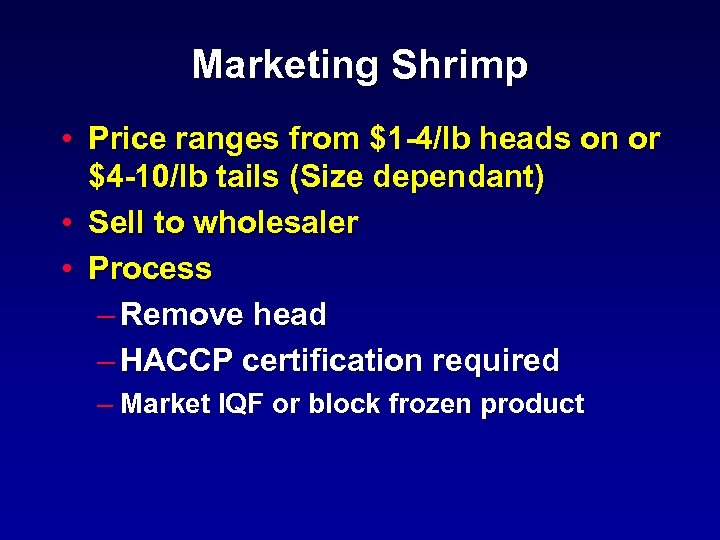 Marketing Shrimp • Price ranges from $1 -4/lb heads on or $4 -10/lb tails (Size dependant) • Sell to wholesaler • Process – Remove head – HACCP certification required – Market IQF or block frozen product
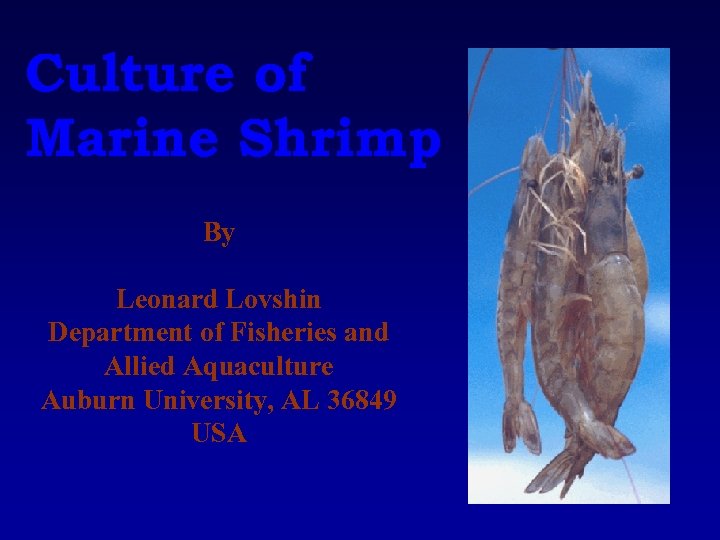 Culture of Marine Shrimp By Leonard Lovshin Department of Fisheries and Allied Aquaculture Auburn University, AL 36849 USA
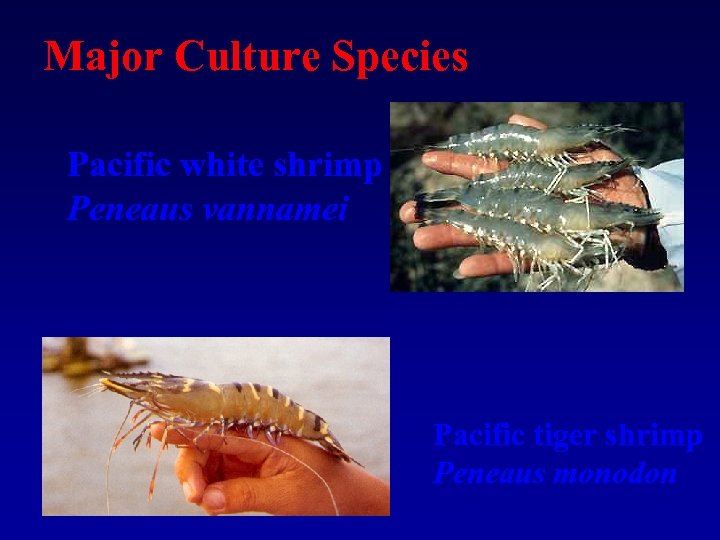 Major Culture Species Pacific white shrimp Peneaus vannamei Pacific tiger shrimp Peneaus monodon
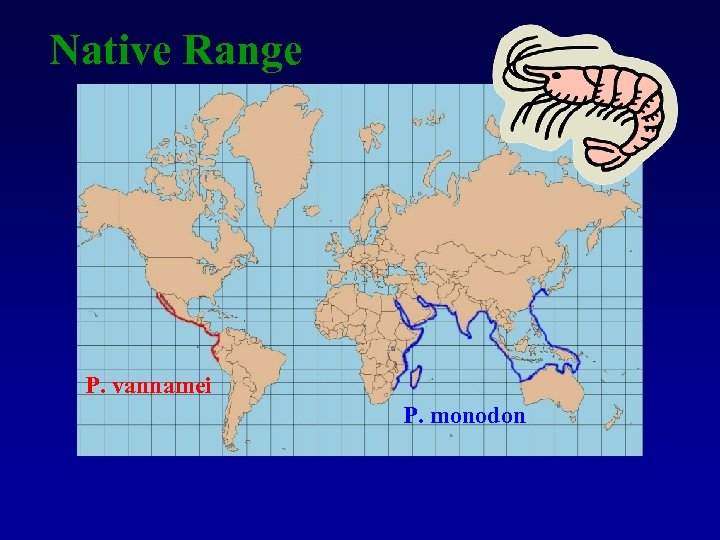 Native Range P. vannamei P. monodon
 Pacific white shrimp biology §Food habits – benthic organizms, detritus §Preferred water temperatures – 25 to 30 o C §Preferred salinity – 15 to 25 ppt §Sexual maturity - 1 year
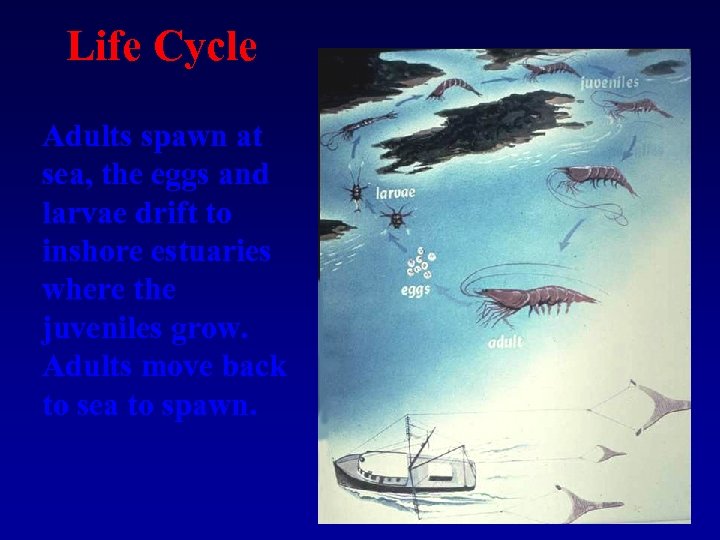 Life Cycle Adults spawn at sea, the eggs and larvae drift to inshore estuaries where the juveniles grow. Adults move back to sea to spawn.
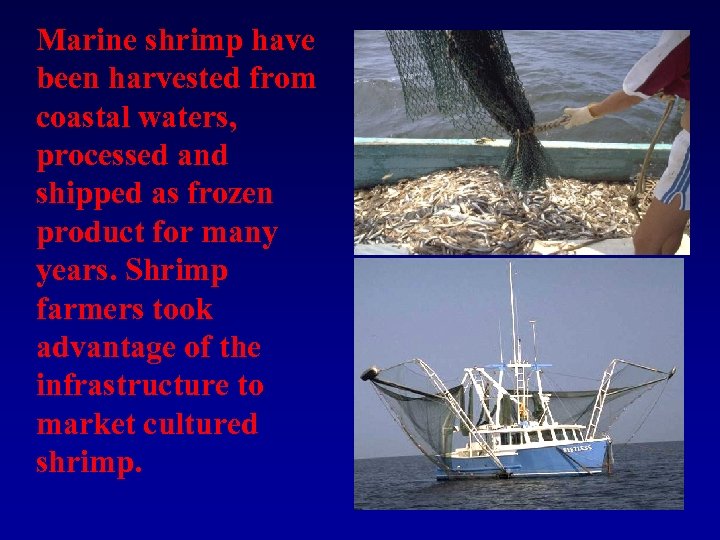 Marine shrimp have been harvested from coastal waters, processed and shipped as frozen product for many years. Shrimp farmers took advantage of the infrastructure to market cultured shrimp.
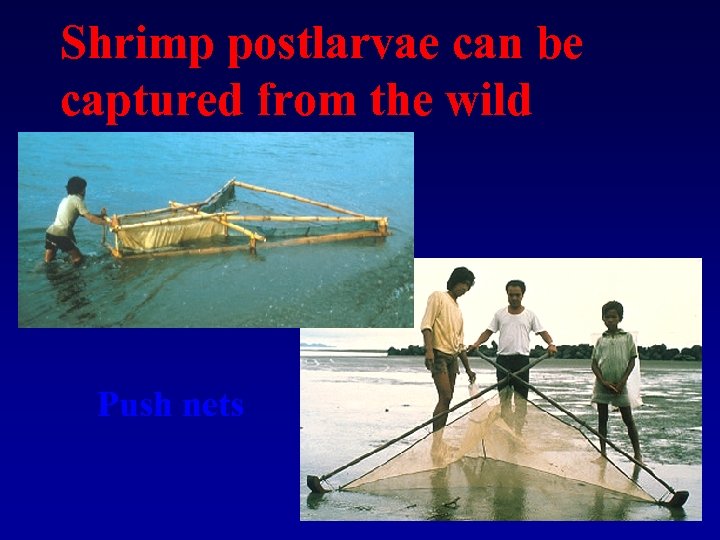 Shrimp postlarvae can be captured from the wild Push nets
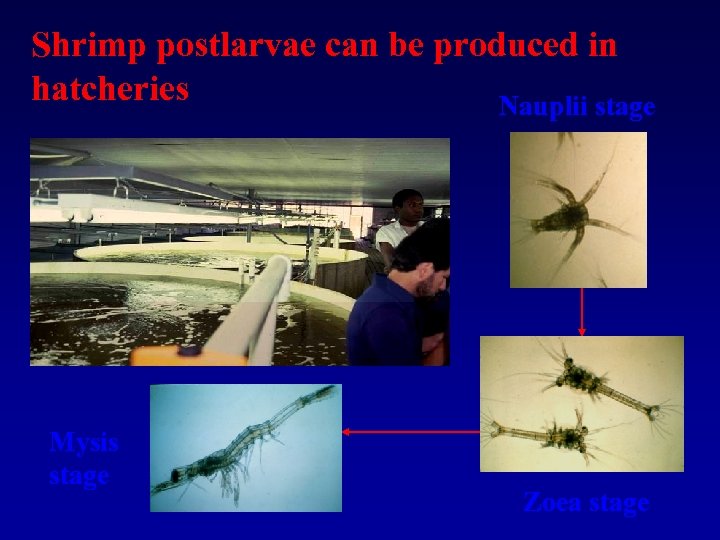 Shrimp postlarvae can be produced in hatcheries Nauplii stage Mysis stage Zoea stage
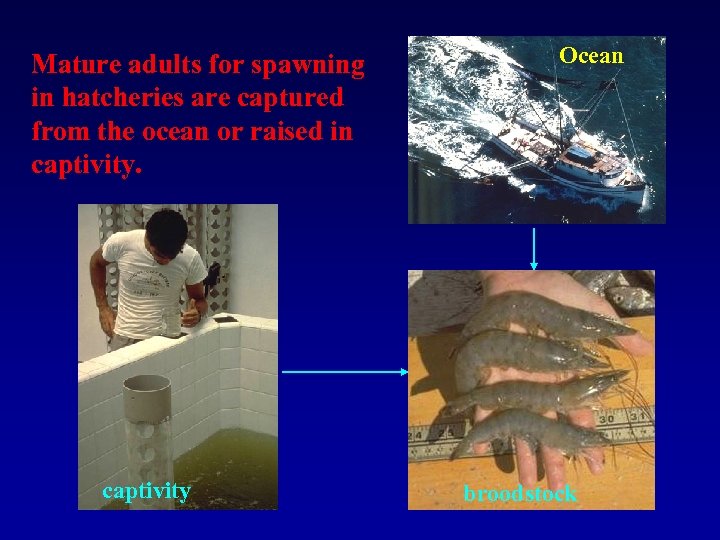 Mature adults for spawning in hatcheries are captured from the ocean or raised in captivity Ocean broodstock
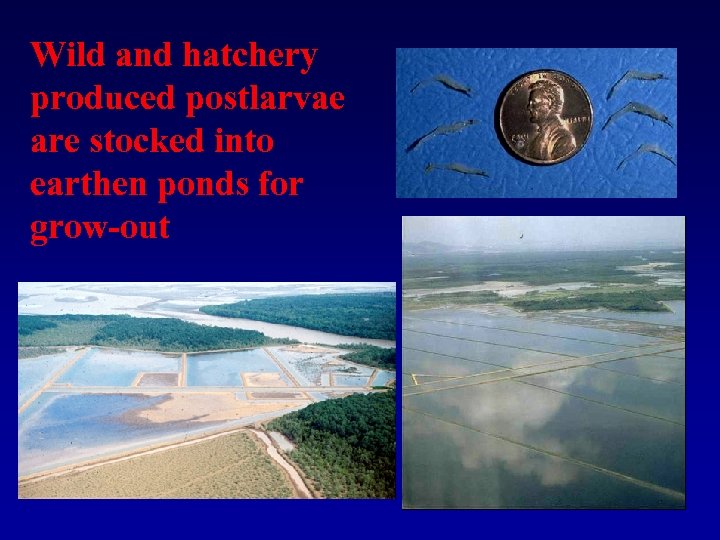 Wild and hatchery produced postlarvae are stocked into earthen ponds for grow-out
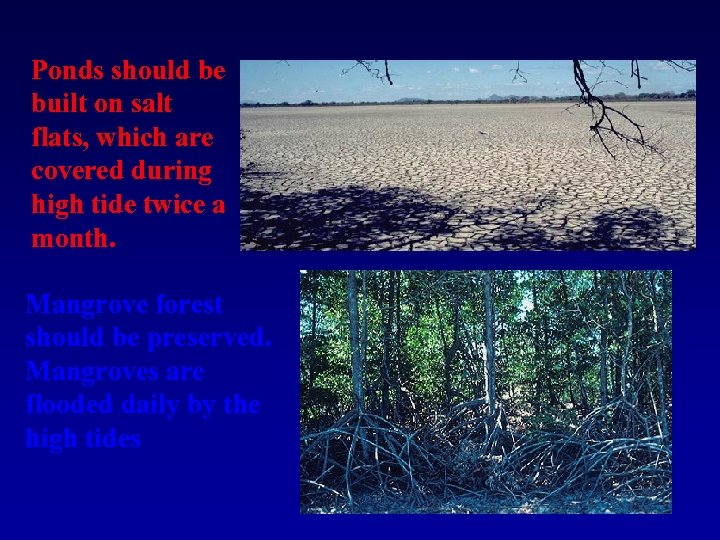 Ponds should be built on salt flats, which are covered during high tide twice a month. Mangrove forest should be preserved. Mangroves are flooded daily by the high tides
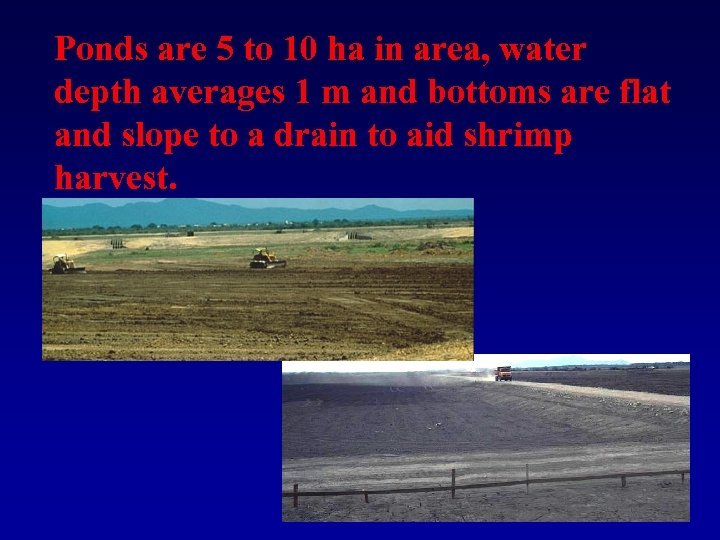 Ponds are 5 to 10 ha in area, water depth averages 1 m and bottoms are flat and slope to a drain to aid shrimp harvest.
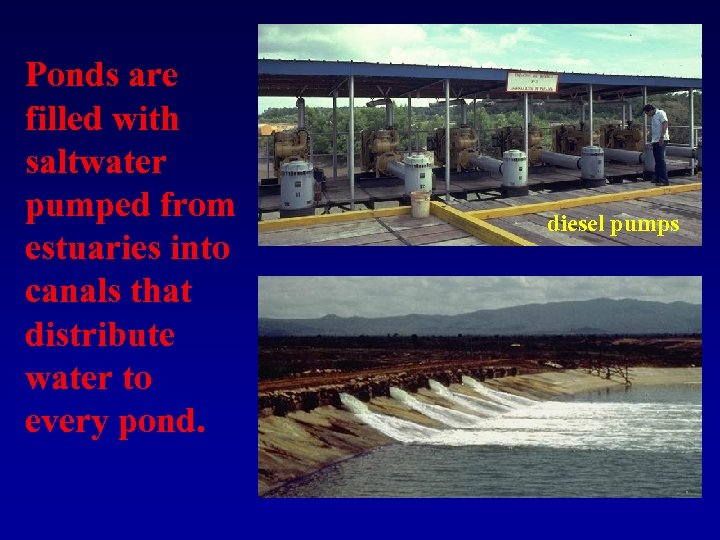 Ponds are filled with saltwater pumped from estuaries into canals that distribute water to every pond. diesel pumps
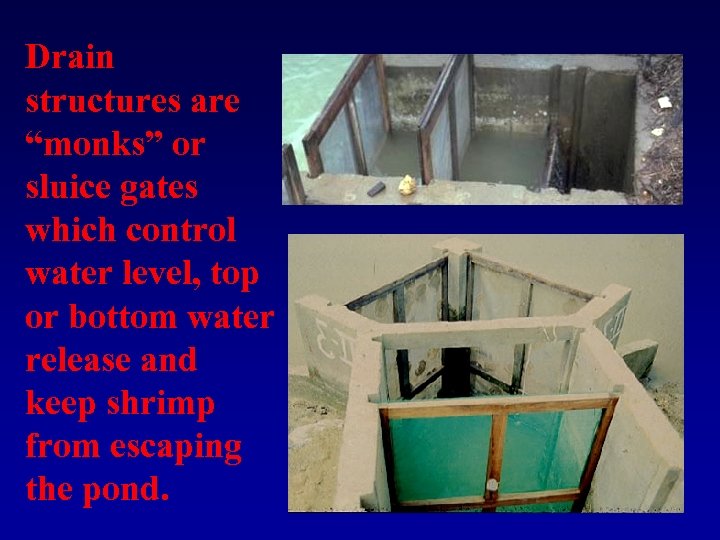 Drain structures are “monks” or sluice gates which control water level, top or bottom water release and keep shrimp from escaping the pond.
 Shrimp can be cultured: 1. Extensively 2. Semi-intensively 3. Intensively
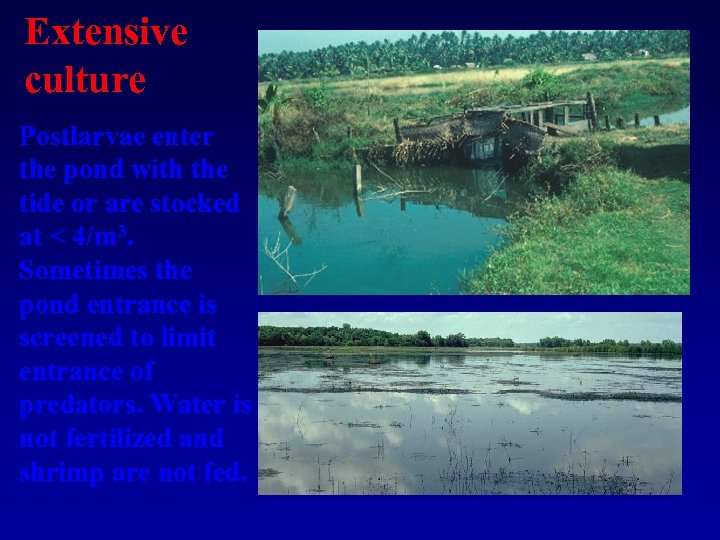 Extensive culture Postlarvae enter the pond with the tide or are stocked at < 4/m 3. Sometimes the pond entrance is screened to limit entrance of predators. Water is not fertilized and shrimp are not fed.
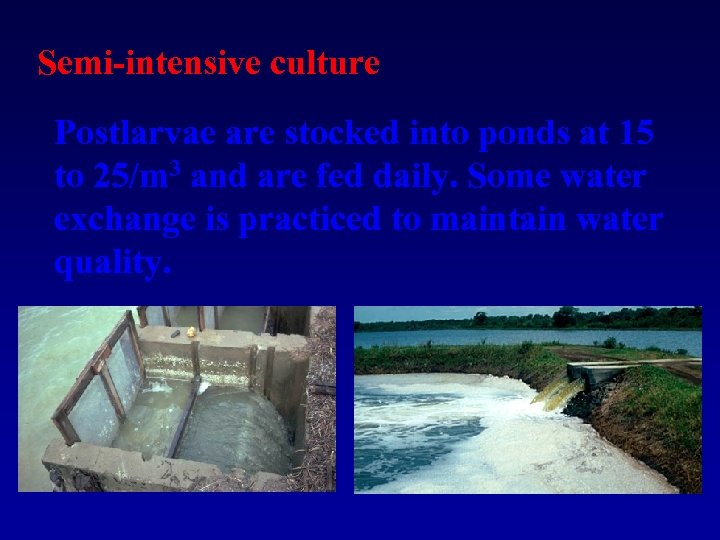 Semi-intensive culture Postlarvae are stocked into ponds at 15 to 25/m 3 and are fed daily. Some water exchange is practiced to maintain water quality.
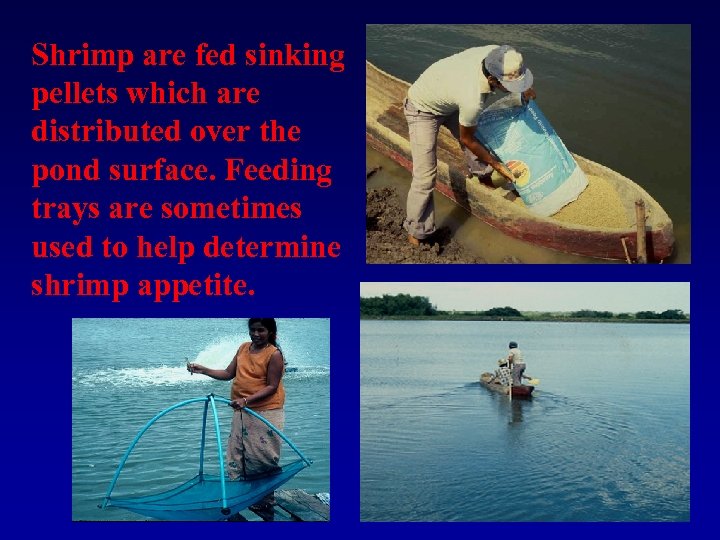 Shrimp are fed sinking pellets which are distributed over the pond surface. Feeding trays are sometimes used to help determine shrimp appetite.
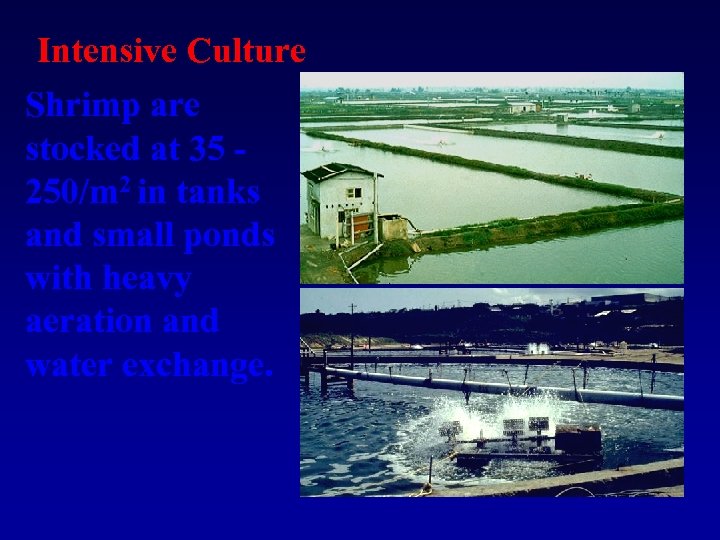 Intensive Culture Shrimp are stocked at 35 250/m 2 in tanks and small ponds with heavy aeration and water exchange.
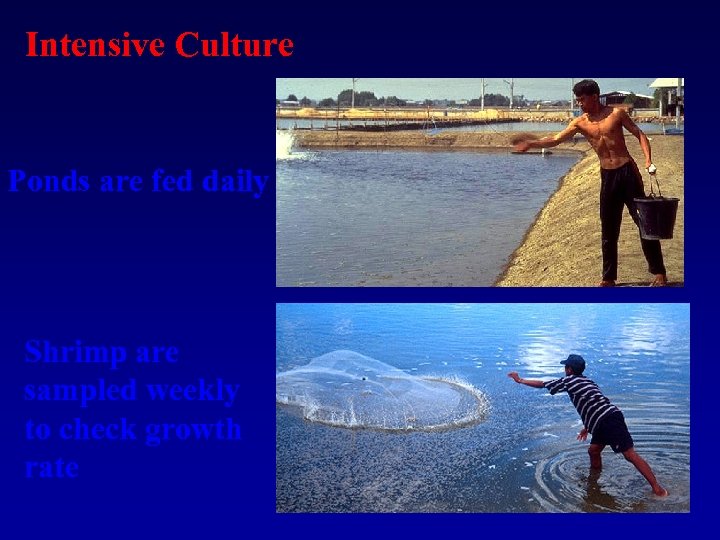 Intensive Culture Ponds are fed daily Shrimp are sampled weekly to check growth rate
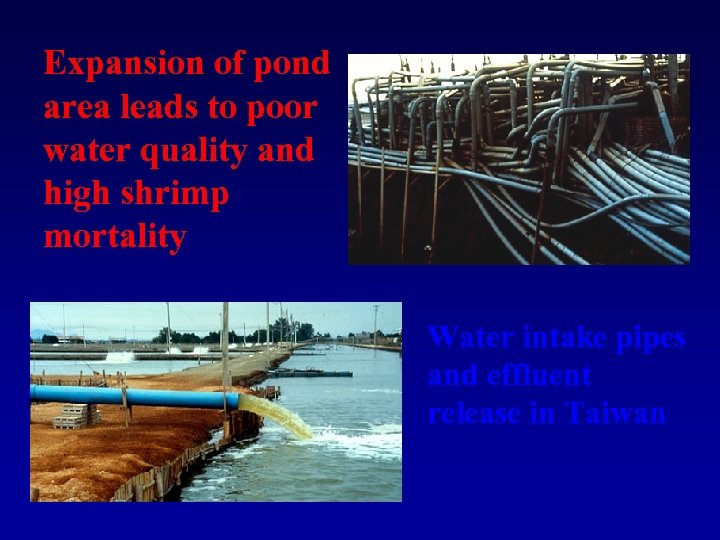 Expansion of pond area leads to poor water quality and high shrimp mortality Water intake pipes and effluent release in Taiwan
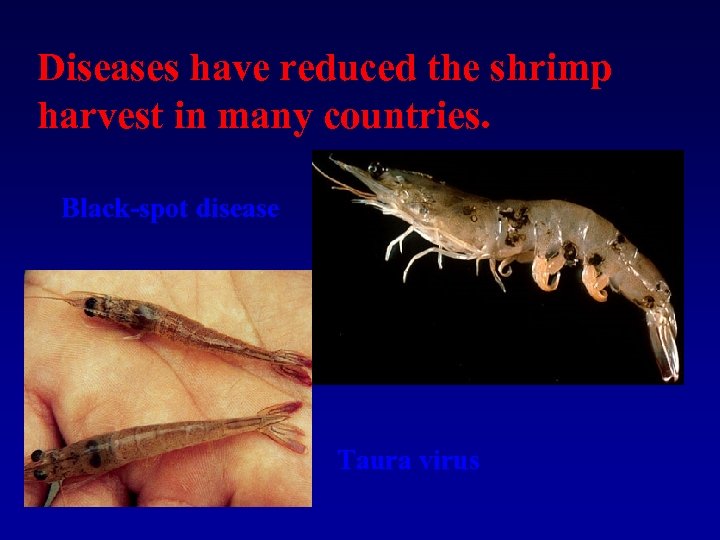 Diseases have reduced the shrimp harvest in many countries. Black-spot disease Taura virus
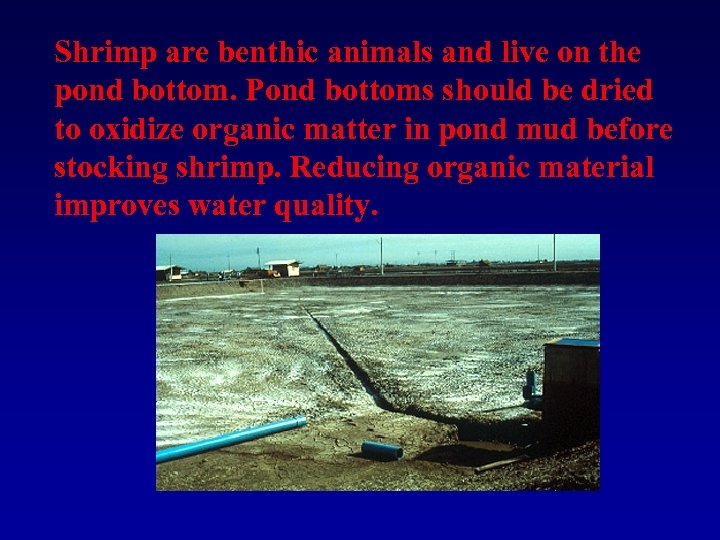 Shrimp are benthic animals and live on the pond bottom. Pond bottoms should be dried to oxidize organic matter in pond mud before stocking shrimp. Reducing organic material improves water quality.
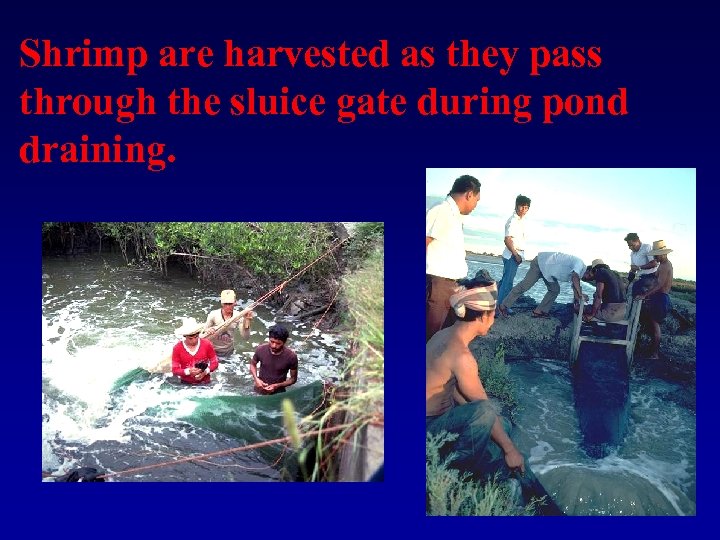 Shrimp are harvested as they pass through the sluice gate during pond draining.
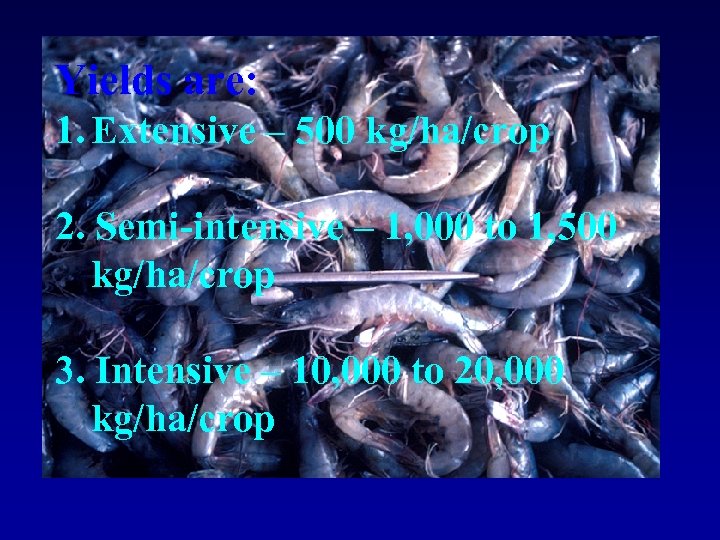 Yields are: 1. Extensive – 500 kg/ha/crop 2. Semi-intensive – 1, 000 to 1, 500 kg/ha/crop 3. Intensive – 10, 000 to 20, 000 kg/ha/crop
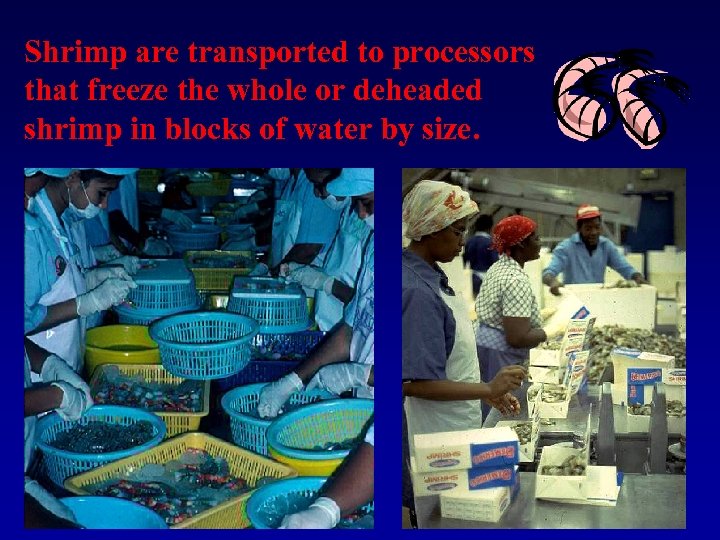 Shrimp are transported to processors that freeze the whole or deheaded shrimp in blocks of water by size.
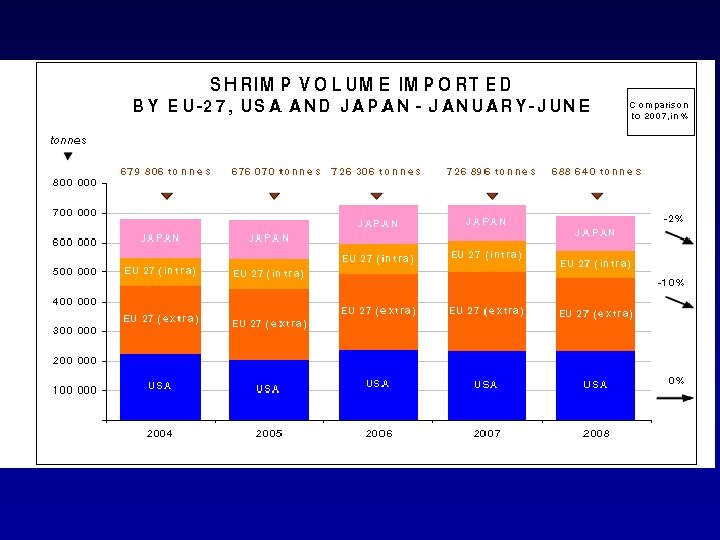
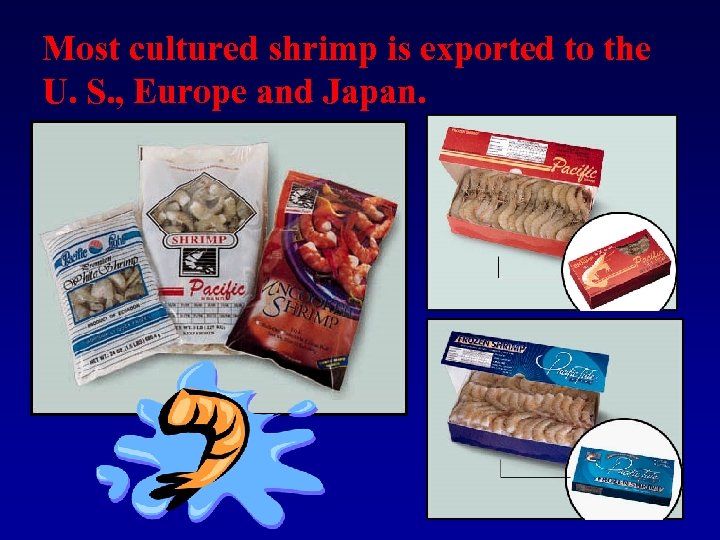 Most cultured shrimp is exported to the U. S. , Europe and Japan.
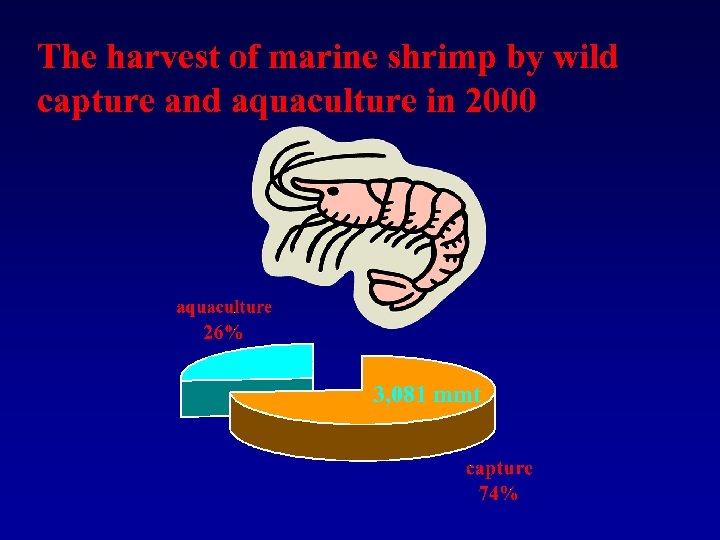 The harvest of marine shrimp by wild capture and aquaculture in 2000 1, 087 mmt 3, 081 mmt
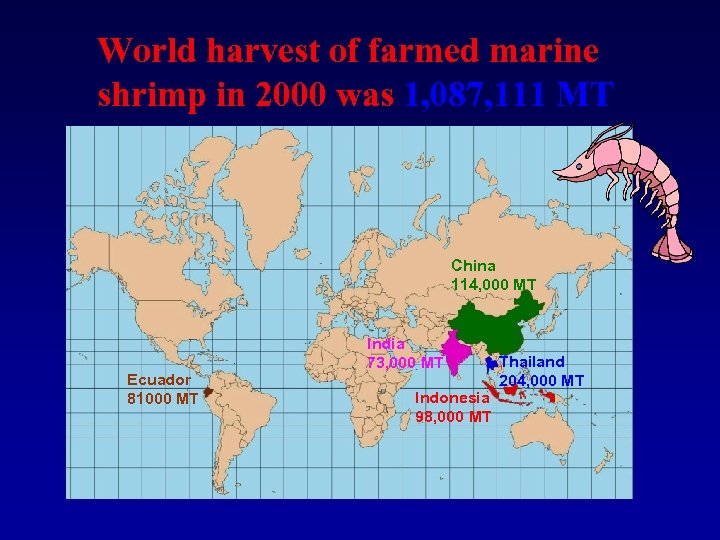 World harvest of farmed marine shrimp in 2000 was 1, 087, 111 MT China 114, 000 MT Ecuador 81000 MT India 73, 000 MT Indonesia 98, 000 MT Thailand 204, 000 MT
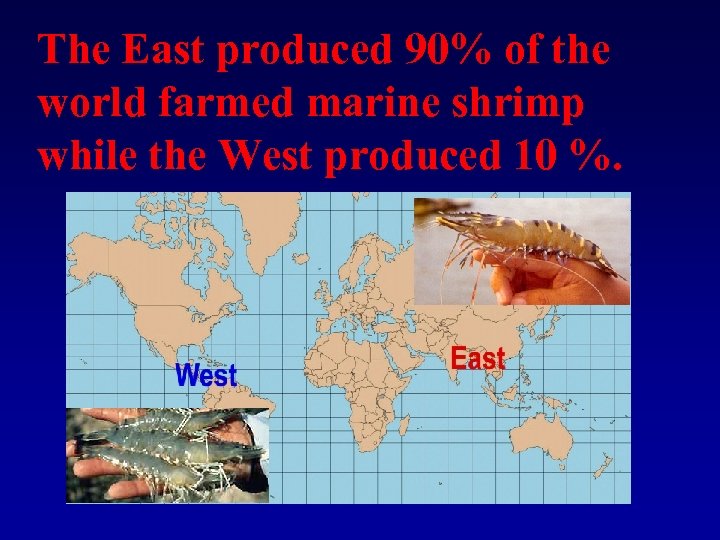 The East produced 90% of the world farmed marine shrimp while the West produced 10 %.
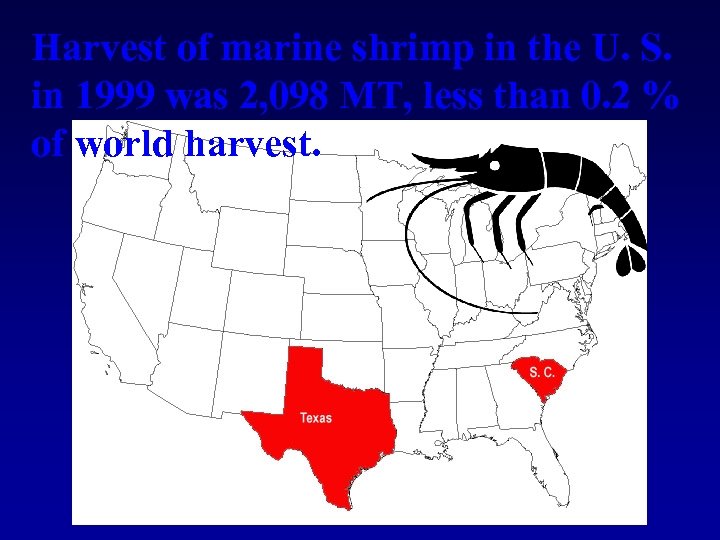 Harvest of marine shrimp in the U. S. in 1999 was 2, 098 MT, less than 0. 2 % of world harvest.
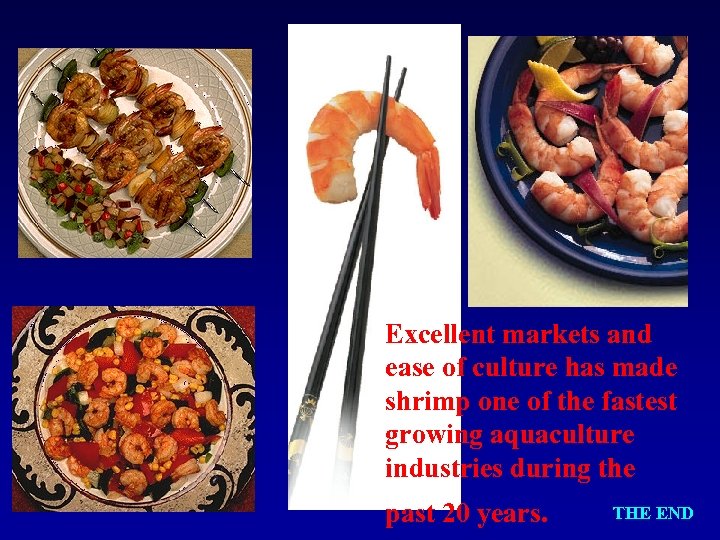 Excellent markets and ease of culture has made shrimp one of the fastest growing aquaculture industries during the past 20 years. THE END