 Скачать презентацию Should You Establish a Project Management Office PMO
6be82863c0fb1273e82c2d2e811cf7b3.ppt
- Количество слайдов: 37



Should You Establish a Project Management Office (PMO)?
What is a PMO? n n n Deploys a consistent methodology Provides common management structure Promotes best practices Training/Mentoring/Coaching Gathers/Tracks metrics from all projects Promotes PM throughout the organization
The PMO Value Proposition n A successful PMO enhances an organization’s ability to execute projects and make deliverables on time and under budget while improving the overall level of quality.
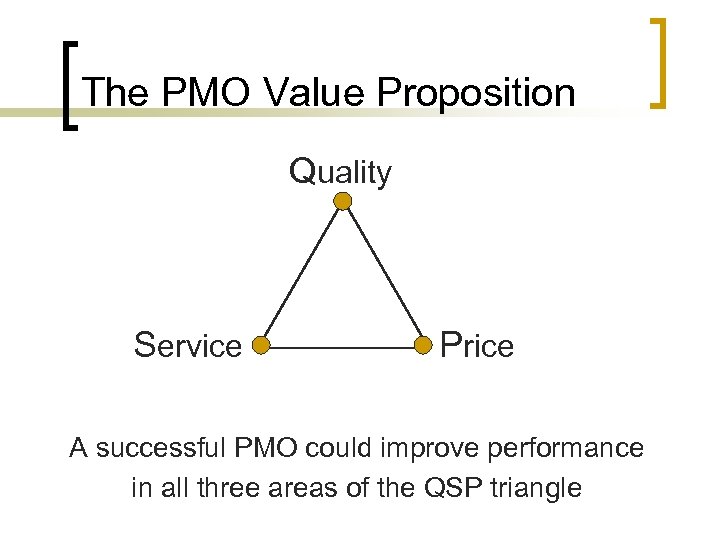
The PMO Value Proposition Quality Service Price A successful PMO could improve performance in all three areas of the QSP triangle
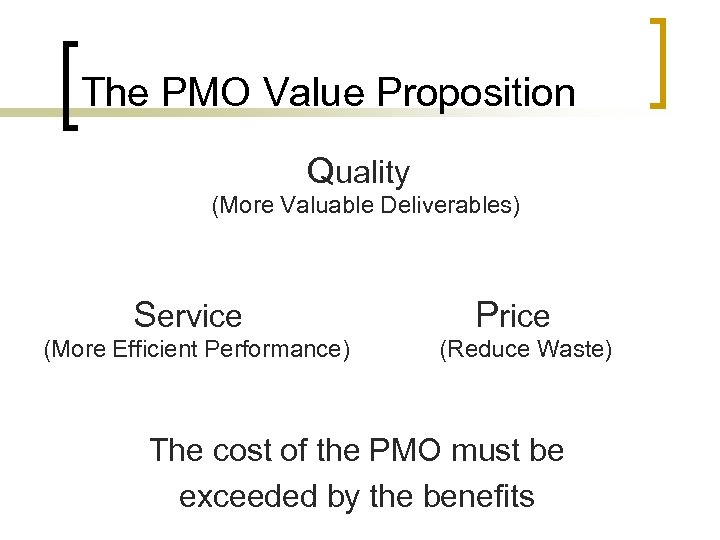
The PMO Value Proposition Quality (More Valuable Deliverables) Service (More Efficient Performance) Price (Reduce Waste) The cost of the PMO must be exceeded by the benefits
Styles of PMOs - Centralized n n One PMO office with a group of managers and services Every project includes a PM from the PMO Easier to manage and consolidate metrics Expertise may not be portable among projects
Styles of PMOs - Distributed n n n Central PMO organization not including PMs Might have multiple document repositories (for different disciplines) Supports PMs on projects Consistency is harder Coordination might be harder
Styles of PMOs - Assistive n n No, or very small, central organization Offers guidance to other departments on project management issues Training/coaching Good way to do a little that could pay off a lot
PMO’s in IT n n n PMOs have been around for years IT “discovered” PMOs during Y 2 K Consulting firms used PMOs
Building a PMO n No two PMOs are alike ¡ n Define the PMO’s function ¡ n PMOs are customized to the organization Full/limited Formalize the PMO organizationally ¡ Decision making/expectations
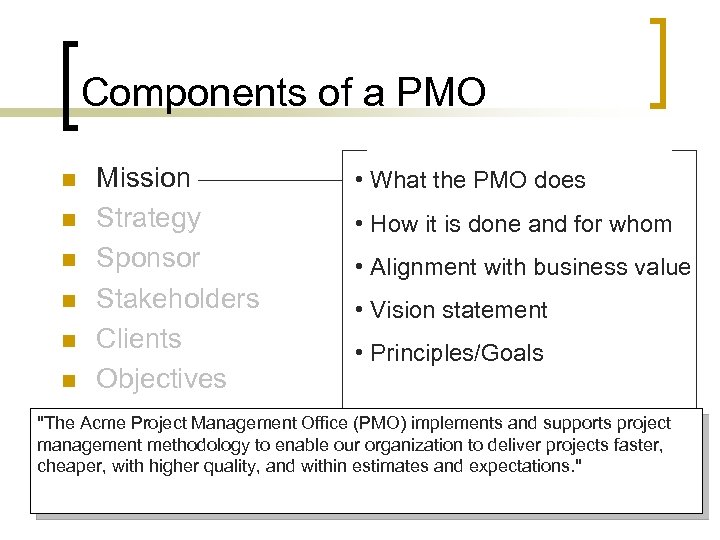
Components of a PMO Mission • What the PMO does n Strategy • How it is done and for whom n Sponsor • Alignment with business value n Stakeholders • Vision statement n Clients • Principles/Goals n Objectives n Products/Services "The Acme Project Management Office (PMO) implements and supports project management methodology to enable our organization to deliver projects faster, n Transitional Activities cheaper, with higher quality, and within estimates and expectations. " n
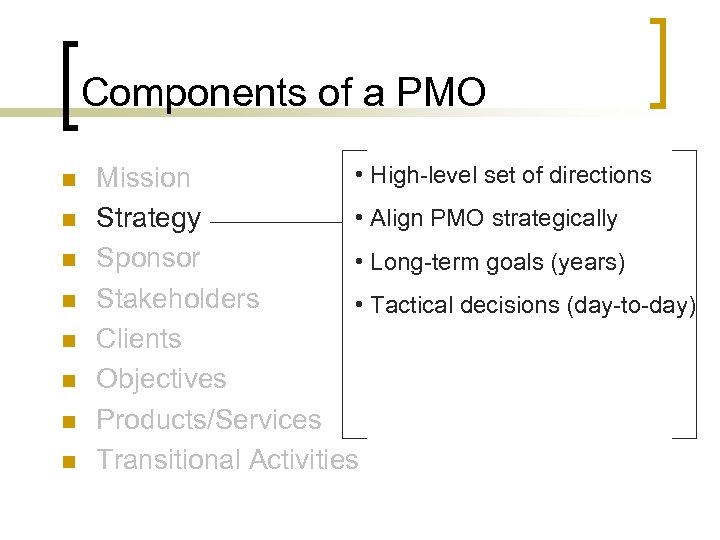
Components of a PMO n n n n • High-level set of directions Mission • Align PMO strategically Strategy Sponsor • Long-term goals (years) Stakeholders • Tactical decisions (day-to-day) Clients Objectives Products/Services Transitional Activities
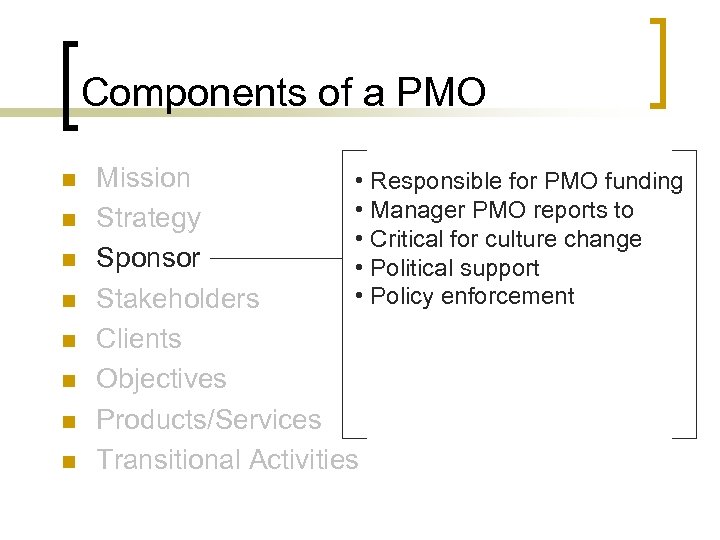
Components of a PMO n n n n Mission • Responsible for PMO funding • Manager PMO reports to Strategy • Critical for culture change Sponsor • Political support • Policy enforcement Stakeholders Clients Objectives Products/Services Transitional Activities
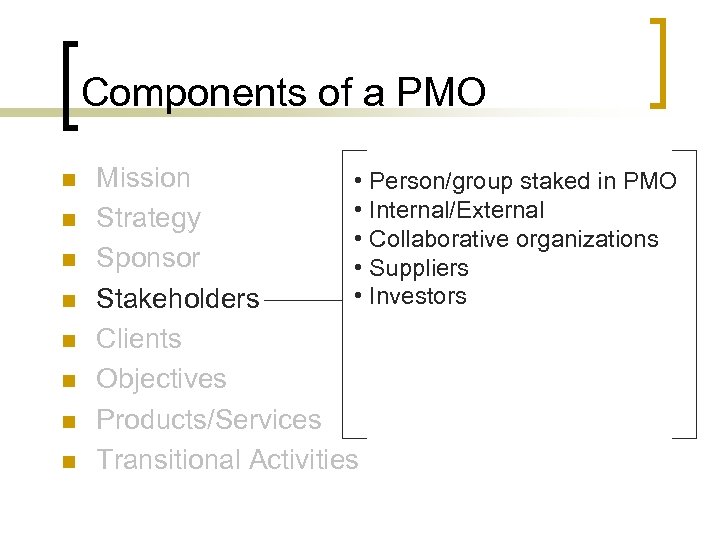
Components of a PMO n n n n Mission • Person/group staked in PMO • Internal/External Strategy • Collaborative organizations Sponsor • Suppliers • Investors Stakeholders Clients Objectives Products/Services Transitional Activities
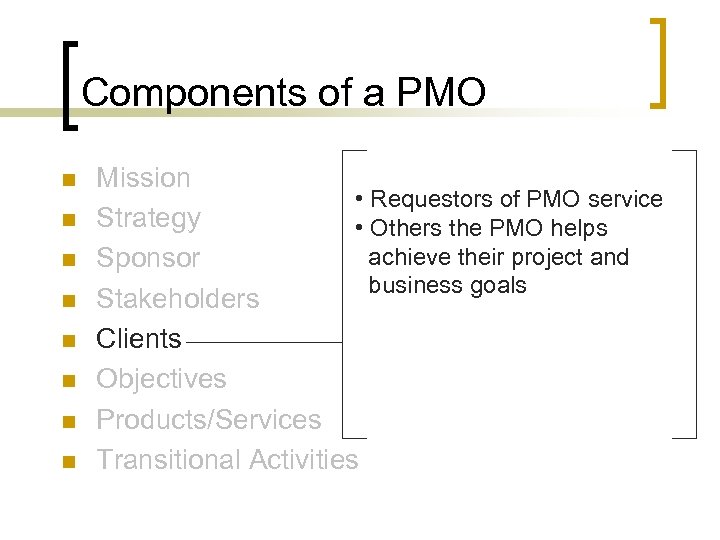
Components of a PMO n n n n Mission • Requestors of PMO service Strategy • Others the PMO helps achieve their project and Sponsor business goals Stakeholders Clients Objectives Products/Services Transitional Activities
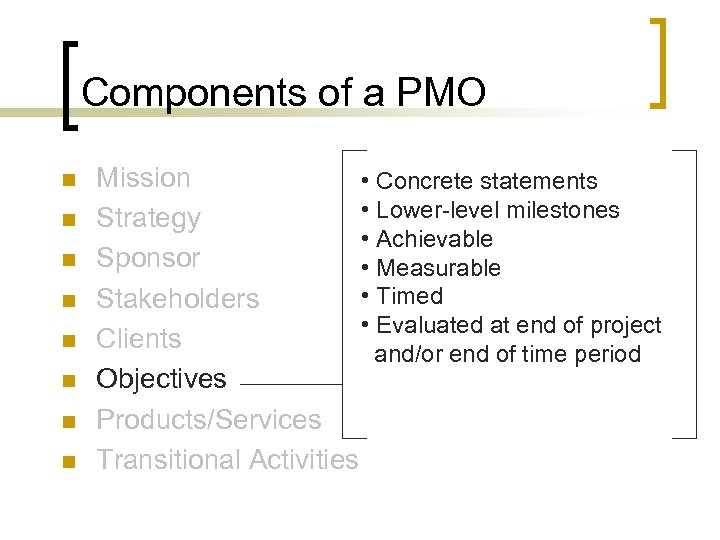
Components of a PMO n n n n Mission • Concrete statements • Lower-level milestones Strategy • Achievable Sponsor • Measurable • Timed Stakeholders • Evaluated at end of project Clients and/or end of time period Objectives Products/Services Transitional Activities
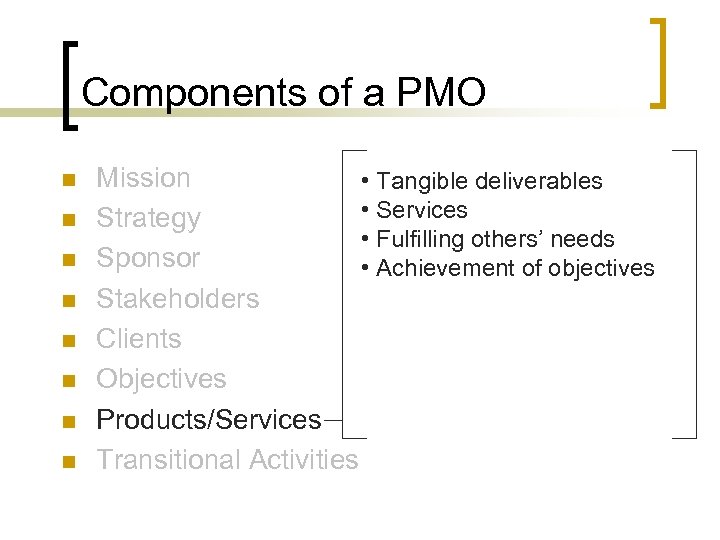
Components of a PMO n n n n Mission • Tangible deliverables • Services Strategy • Fulfilling others’ needs Sponsor • Achievement of objectives Stakeholders Clients Objectives Products/Services Transitional Activities
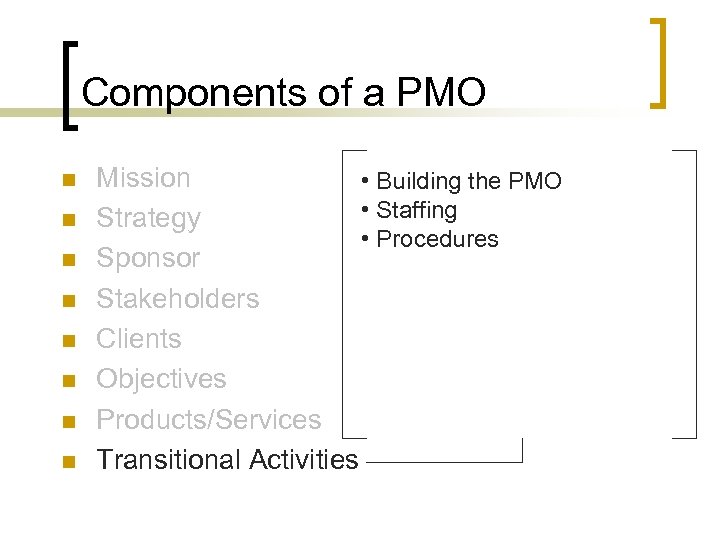
Components of a PMO n n n n Mission • Building the PMO • Staffing Strategy • Procedures Sponsor Stakeholders Clients Objectives Products/Services Transitional Activities
Deploying a PMO n n n n Create (or buy) a project methodology Provide training and coaching Conduct project audits/assessments Provide consolidated metrics Consulting firms can fill gaps Culture change Deploy in waves
Deploying a PMO n Culture change ¡ ¡ People will have to do things differently Requires different behaviors More than teaching new skills Evaluate aspects driving behavior n n n Reinforce positives Eliminate/change negatives Consultants can drive change sometimes
Deploying a PMO n Culture change ¡ First do a gap analysis to show need n n n n Culture Enablers/Barriers/Attitudes Success rates Roles Skills Standards Work environment
Deploying a PMO n Culture change ¡ First do a gap analysis to show need n n ¡ Use a cross section of staff Interviews Surveys Focus groups Use the gap analysis to define the future look of the PMO
Deploying a PMO n Deploy in waves ¡ ¡ ¡ ¡ Don’t change things all at once General awareness sessions Project management training Standards/Templates Reward/Recognition system Get management buy-in Audits and evaluations PMO support organization
The Methodology n n n n Processes Procedures Templates Best Practices Standards/Guidelines/Policies Must be adaptable “Methodology management”
Methodology Management n Development ¡ n Support ¡ n Build/Buy and Customize Questions/Repository/Training Enhancements ¡ Expanding/Training/Enhancing Don’t over-engineer it. Don’t let methodology get in the way.
PMO Training n Scope of training ¡ ¡ n Determine needs ¡ n Respond to feedback Create training strategy ¡ n Teach all stakeholders Decide which skills you will teach Delivery, audience, timing, in/outside Develop/buy curriculum
PMO Coaching n n More informal than training More one-on-one Talking through situations Align coaching services with deployment
Audits n n In order for new processes to be adopted successfully, they must be used properly Project-level audits ¡ ¡ n Don’t audit every projects Identifies failures to use methodology Organizational audits
Audits n Project-level audits ¡ ¡ ¡ ¡ Did stakeholders participate? Stakeholders approve project definition? Work plan being used? Is it accurate? All deliverables completed? On track: cost, duration, quality? Are risks being managed? Are issues being managed? Consider outsourcing this effort.
Audits n Organizational-level audits ¡ ¡ ¡ Show the “gap” is closing Keep you stakeholders informed Identifies compliance (or not) Identifies whether or not the PMO is a good idea for the organization Identifies if PMO is being delivered in the best way for the organization Consider outsourcing this effort.
Audits n n n Trend successive audits Identify changes that need to be made Identify training needs Stress progress along lines of business alignment Don’t be afraid to say things are wrong It’s probably not going to be totally successful
Metrics n n Consolidate metrics and reporting Organization-wide portfolio ¡ ¡ n This is a great way to be visible and useful to upper management This can also be time consuming Very hard to measure the value of the PMO precisely (like holding a cloud)
Metrics n Problems gathering project metrics ¡ ¡ ¡ n n Timeliness –response is low priority Accuracy – reported status is not correct Completeness – too brief Be clear and concise Use standards and automation
Metrics n n n Savings with scope change mgmt. Savings with risk management Savings by proactive action Savings by way of re-use Assess the value of increased quality The PMO is likely to increase everyone’s workload and responsibility… so probably won’t be liked by everyone
Other PMO Services n Document Repository ¡ ¡ ¡ Re-use of templates, schedules, project documents, etc. Use technology Historical archive
Other PMO Services n Best Practices ¡ ¡ ¡ Post-mortem analysis on projects Lessons learned Improve methods, procedures
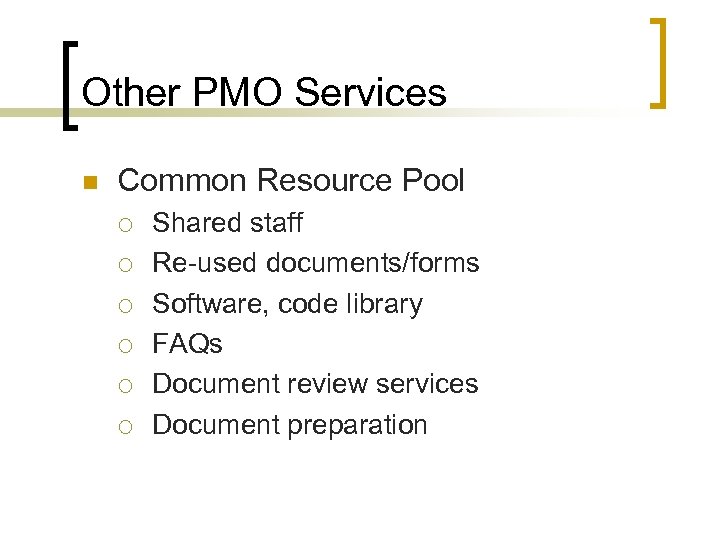
Other PMO Services n Common Resource Pool ¡ ¡ ¡ Shared staff Re-used documents/forms Software, code library FAQs Document review services Document preparation
Скачать презентацию Should You Establish a Project Management Office PMO
6be82863c0fb1273e82c2d2e811cf7b3.ppt