


 Скачать презентацию Shortage of Nurses and other Health Care Professionals
74d847b32a1630c4b55a0406e4950812.ppt
- Количество слайдов: 67

 Shortage of Nurses and other Health. Care Professionals in the US
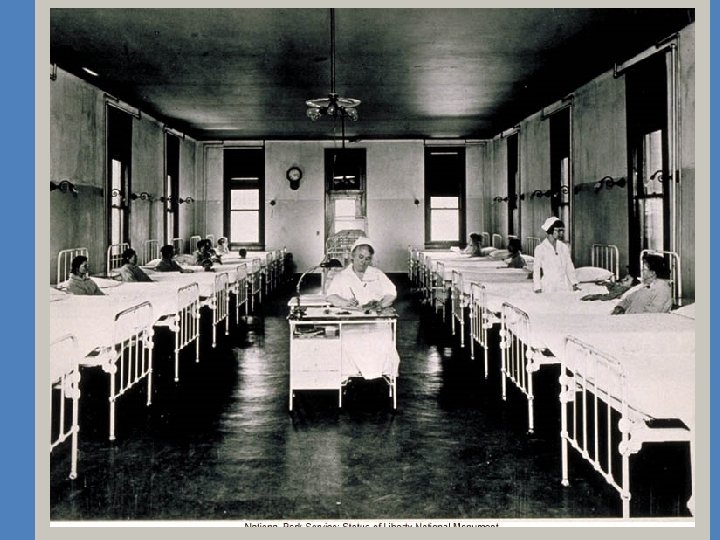
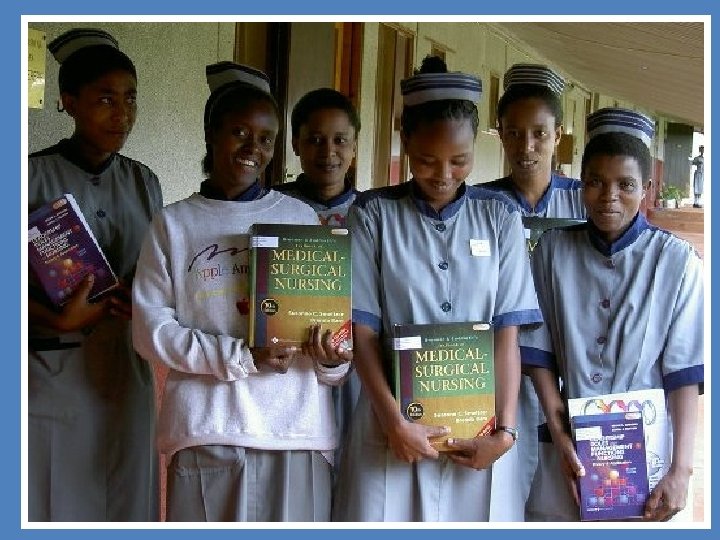
 “Since the late 1990 s, the United States has struggled to recruit enough nurses to serve its rapidly aging population” Source: Washington Post Newspaper, Tuesday, September 16, 2008. Page HE 01
 By 2020, just about three years from now, the United States will need about 2. 9 million nurses. By that time, it will only have about 1. 8 million nurses, which represents a 36 percent shortfall. Source: United States Department of Health and Human Services
 In the US State of Louisiana, the need for nurses is expected to grow by 19% in the coming years, faster than the average of any other occupation. Source: Louisiana Hospital Association The US State of South Carolina is expected to see a shortage of 12, 100 nurses by 2020. Source: Projection by United States Department of Health and Human Services
 About 17 percent of hospitals in the United States recruit staff from overseas, especially from countries in Africa and Asia. Source: American Hospital Association There is no debate regarding if there is a serious nurse supply problem in the US. The national shortage is expected to double to 12% by reach 800, 000 by 2020. Source: Medscape Today
 While U. S. healthcare facilities struggle to fill current registered nurse staffing vacancies, a more critical nurse under-supply is predicted over the next twenty years. Source: Health Affairs Magazine, Volume 23, No. 3, 2004: Pages 78 -87. Between 2000 and 2020, the population of the U. S. is projected to grow at least 18 percent, while the segment of the population aged sixty-five and older will increase at three times that rate. The United States Department of Health and Human Services projects that to meet this shortfall, the US would need 275, 000 full-time-equivalent (FTE) RNs by 2010. By 2020 the shortfall in FTE RNs needed would have risen to 800, 000. Source: United States Department of Health and Human Services
 Experienced nurses, especially those with specially skills in surgical, neonatal or critical care nursing are in very high demand in the United States’ health sector. Source: Health Affairs Magazine, Volume 23, No. 3, 2004. Pages 78 -87 The United States will require 1. 2 million new Registered Nurses (RNs) by 2020 to meet the demand for new nurses in the United States. It will need approximately 500, 000 RNs to replace nurses leaving the field, mainly because of retirement and promotion to administrative duties, and an additional 700, 000 RNs to meet the growing demand for nursing services. Source: US Department of Health and Human Services, “Toward a Method for Identifying Facilities and Communities with Shortages of Nurses, Summary Report” (February, 2007). See also
 We should note that factors contributing to the increase in demand for nursing and other health care professionals include an increase in population, a larger proportion of the population of the elderly, medical advances and an increase in the number of Registered Nurses who are older than 55 and retiring at this time. Source: See immediately above
 NURSING AND HEALTHCARE PROFESSIONS STILL REIGN… • As at March 6, 2009, the US Bureau of Labor Statistics reported that the healthcare sector of America’s economy continues to grow at a quick pace, despite big job losses and contractions in nearly all other major industries. In February 2009, for example, hospitals, long-term care facilities and other ambulatory care settings added 27, 000 new jobs, the same month when 681, 000 jobs were eliminated in other industries nationwide. • Source:
 According to a report released by the American Health Care Association in July 2008, more than 19, 400 RN vacancies exist in long-term health care settings in the US. These vacancies, coupled with an additional 116, 000 open positions in hospitals reported by the American Hospital Association in July 2007, bring the total RN vacancies in the U. S. to more than 135, 000. This translates to a national RN vacancy rate of 8. 1%.
 In March 2008, the US Council on Physician and Nurse Supply, an independent group of healthcare leaders based at the University of Pennsylvania, called for 30, 000 additional nurses to be graduated annually to meet the nation’s healthcare needs, an expansion of 30% over the current number of annual nurse graduates.
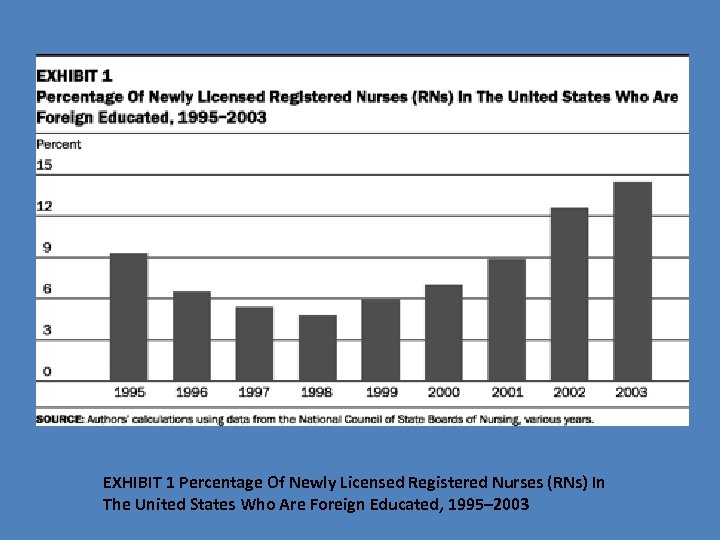 EXHIBIT 1 Percentage Of Newly Licensed Registered Nurses (RNs) In The United States Who Are Foreign Educated, 1995– 2003
 In the March/April 2005 issue of Nursing Economics magazine, researchers reported that more than 75% of Registered Nurses in the US believe the nursing shortage presents a major problem for the quality of their work life, the quality of patient care, and the amount of time nurses can spend with patients. Also, almost all surveyed nurses see the shortage in the future as a catalyst for increasing stress on nurses (98%), lowering patient care quality (93%) and causing nurses to leave the profession (93%). Source:
 Yes, even nurses in the US leave the job! But they usually don’t do so because of the money. We can assure you on that!
 Compensation / Pay for U. S. Nurses
 In 2004 the U. S. Department of Labor reported median annual earnings for Registered Nurses (RNs) in 2002 as $48, 090; in hospitals and nursing homes where foreign nurses worked, earnings averaged $49, 190 and $43, 850, respectively. [But note these figures do not reflect overtime pay] Source: U. S. Department of Labor
 Registered Nurses (RN) can expect a starting base salary of $39, 000; after three years and with working 8 hours a day and five days a week, this could be expected to increase to $47, 000. Nurse Practitioners, who are more credentialed, can expect $57, 000 as base salaries and at least $62, 000 per annum after working in the same position for three years. Source:
 Registered Nurses (RN) can expect a starting base salary of $39, 000; after three years and with working 8 hours a day and five days a week, this could be expected to increase to $47, 000. Nurse Practitioners, who are more credentialed, can expect $57, 000 as base salaries and at least $62, 000 per annum after working in the same position for three years. Source:
 How We Can Help You Get There
 (A) Special Provisions for Nurses Regarding Immigration to the United States To ease the immigration of foreign nurses to the United States in order to address the shortage in that sector, US immigration policy makes a very important concession to nurses:
 Schedule A Pre-certification The United States Congress (House of Representatives and Senate) has taken some very important and concrete steps to address the shortage of nurses and other healthcare professionals in the US. It changed the law to allow the U. S. Department of Labor (DOL) to designate the nursing and physical therapy professions as “Schedule A” occupations. Schedule A Pre-certification is a determination that there are insufficient U. S. nurses who are able, willing, qualified, and available, and that the wages and working conditions of U. S. workers similarly employed will not be adversely affected by the employment of foreign nationals.
 All other foreign workers who seek to work in the US under any other employment or professional designation have to satisfy the criteria or condition underlined above, and in the relevant employment-based Immigration categories. But nurses and physical therapists are exempted. To facilitate the steps taken by the US Congress, an important federal government agency like the US Department of Labor has gone ahead to make adjustments to the normal procedures for Schedule A nurse employment-based immigration applications, by allowing employers to skip the first step of the Immigration process that is still applicable to all other categories of foreign workers seeking to enter the US on an employment-based visa. This is the very important and time-consuming step of the prospective employer in the US filing a Labor Certification with the Department of Labor (DOL). Then the DOL checks the US labour market and determines if there any qualified and available US workers for the position. The above is the first in a three-step process and is very time-consuming. Sometimes, it takes up to two to three years to navigate and complete just this step of filing a Labour Certification with the Department of Labor. But positions for nurses (RNs and above) and physical therapists are exempted from this requirement.

 The next two steps in the US Employment-based immigration process for nurses and other healthcare professionals are as follows: After the necessary certifications, to which we will get to shortly, an employer in the US extends an offer of employment to the foreign-trained nurse and, with the assistance of an attorney, files a Form I-140 (Immigrant Petition for Alien Worker) with the United States Citizenship and Immigration Services (USCIS). After this application is approved, the foreign worker then applies for an immigrant visa if abroad (that allows you to live and work permanently in the US) or adjustment of status (through Form I-485) if already in the US.
 • Visa Options Available to Nurses and Related Healthcare Professionals A) NON-IMMIGRANT VISAS
 (i) H-1 C Non-immigrant visa Created through the 1999 “Nursing Relief for Disadvantaged Areas Act” (NRDAA), which the US Congress reauthorized on December 20, 2006, through December 20, 2009. [See Pub. L. No. 106 -95, 113 Stat. 1312 (Nov. 12 1999) and Pub. L. No. 109 -423, 120 Stat. 2900 (December 20, 2009)]. H-1 C non-immigrant visas allows nurses and other highly-skilled professionals to work for up to three years in designated shortage areas. The H-1 C visa is available to 500 nurses every year (and at least up till the end of 2009, unless the provision is further extended), and each state is limited to 25 H-1 C nurses a year. However, for states with population of 9, 000 persons or more, the state can receive 50 H-1 C visas annually. For example, Illinois and Texas are each allotted 50 H-1 C visas. In the 4 th quarter of every fiscal year, unused visas can go to states that have already reached the 500 -a-year cap.
 However, the big difference between this visa and other categories of immigrant and non-immigrant visas available to nurses and other healthcare professionals is that the facilities in the US interested in applying foreign nurses under this visa category must submit an employer attestation showing their eligibility to employ H-1 C nurses. The facilities must also meet certain conditions or standards: be located in a “Health Professional Shortage Area” as of March 31, 1997; have “at least 190 acute care beds”; at least 35% of the facility’s acute care impatient days should be reimbursed by Medicare; and at least 28% of the facility’s acute care impatient days should be reimbursed by Medicare. However, because of the rather strict restrictions of this visa category, only 14 hospitals in the entire United States can recruit foreign nurses under this visa category! Not many of the 500 visas allocated under this category are approved in any given year.
 H-1 C VISA…
 (ii) The TN Non-Immigrant Visa “TN” stands for “Trade-NAFTA” This employment visa category is made available under the North American Free Trade Agreement (NAFTA) to Canadian and Mexican citizens for a limited group of specialty occupations. Registered Nurses (RNs) applying for a TN visa must provide a permanent state license, a temporary state license, or other temporary authorization to work as a RN. A TN is authorized to work and enter the United States for a maximum period of three years and allowed to receive extensions of stay in increments up to three (3) years. Also, unlike the H-1 B visa category (see discussions below), there is no specific limit on the total period of time a foreign nurse may remain in TN status.
 Canadian nurses can apply by bringing the required documentation to a port of entry to be examined by a Custom and Border Protection (CBP) official. Mexican nurses must first apply for a visa at a US consulate in that country before bringing the required documentation to a port of entry into the US. (iii) H-1 B Non-Immigrant Visa (Form I-129) Usually for those in specialty occupations, especially computer professionals. Is only available for Registered Nurses (RNs) who qualify for “specialty occupation” nurse positions. Prospective employers in the US must demonstrate nurses they plan to recruit under this visa category have a bachelor’s or higher degree and that such qualification is the minimum requirement for entry into the position, or that the degree is common to the industry
 The United States Citizenship and Immigration Services (USCIS) has said that nurses in certain specialized occupations are more likely than typical RNs to be eligible for H-1 B status. The same USCIS provides 4 criteria necessary for a RN to qualify for an H-1 B visa: • a bachelor’s or higher degree (or its equivalent) is normally the minimum requirement for entry into the position; • the degree requirement is common to the industry for parallel nursing positions (that is, employers in the same industry require their employees to hold the degree when they are employed in the same or similar position); • the employer normally requires a degree or its equivalent for the position; and • the nature of the position’s duties is so specialized and complex that the knowledge required to perform the duties is usually associated with the attainment of a bachelor’s or higher degree (or its equivalent).
 Not surprisingly, the vast majority of foreign RNs do not qualify for an H-1 B visa because most of them do not meet the requirements above. A major reason for this is that most employers in the US do not require a bachelor’s degree or its equivalent to fill a RN position. Most of the nurses who do qualify under this category of visa are Advance Practice Registered Nurses. Also, to make a foreign nurse qualify for the visa, a prospective employer in the US may require that the nurse hold advance practice certifications as one of the following: – Clinical nurse specialist (CNS) – Certified registered nurse anesthetist (CRNA) – Certified nurse-midwife (CNM); – Certified nurse practitioner (APRN-certified)
 The USCIS will also approve H-1 B visas for certain administrative nurse positions. Foreign nurses employed as upper level nurse managers in hospital administration positions may work on H-1 B visas since these positions usually require bachelor’s degrees. Nursing Services Administrators should also be able to get these kinds of visas since such positions involve supervisory functions and they typically require a graduate degree in nursing or health administration.
 Contact us if you are qualified in any of the above areas, in order to discuss your options But, please understand that the H-1 B visa process is not a viable way for most foreign nurses to get to work in the US. The few RNs who qualify for an H-1 B visa typically hold a supervisory or very specialized nurse position, both with regards to their country of origin and the position they are being recruited for in the US.
 (B) IMMIGRANT VISAS FOR NURSING AND OTHER HEALTH PROFESSIONALS As seen above, there are usually limitations on non-immigrant visas foreign nurses; thus, the most common method to bring a foreign nurse to the US is by applying for a permanent visa. In this case, even same of those nurses who wish only to work temporarily in the US must apply for a green card (or lawful permanent
 EB-3 Visa Category (Form I-140) (Third-Preference Employment-Based Visa) Since nurses and physical therapists have been designated as Schedule A occupations by the United States Department of Labor (DOL), a prospective employer of a foreign nurse does not need to apply for a Labor Certification with DOL, as is the case with foreign workers in other professions. This is what is referred to as the PERM Application. In 2005, for example, there were 50, 000 EB-3 visas authorized for use with “Schedule A” occupations, which include Registered Nurses and Physical Therapists. So, no labor market test---which is often arduous and very time-consuming---is required.
 For foreign nurses (RN and higher) who are recruited by prospective US employers under this category, the following are the steps to be taken (not including Labor Certification from which nurses and physical therapists are exempted): i. The prospective employer in the US files a Form I 140 (Immigrant Petition for Alien Worker) with the USCIS; ii. USCIS adjudicates Form I-140 to determine if the RN has the minimum requirements to fill the position and is eligible for the visa category (EB-3). iii. If the petition is approved, the RN applies for an immigrant visa at a US. Consulate, which is also often referred to as “consular processing. ”
 • INSTRUCTIONS FOR AND SAMPLE FORM I – 140
 It should be noted that, on the part of foreign nurses or health care professionals who wish to work in the United States, they must prove they have or meet the educational, training or experience requirements for the position. These requirements are measured according to US standards, especially the educational and training requirements. For foreign nurses who wish to work in the US, the only body recognized under US law to evaluate and ensure that foreign certifications approximate to US standards is the “Commission on Graduates of Foreign Nursing Schools” (CGFNS). For foreign physical therapists, the US body that performs this responsibility is the Foreign Credentialing Commission on Physical Therapy (FCCPT). For foreign occupational therapists, the US body that evaluates credentials and eligibility to work is the National Board for Certification in Occupational Therapy (NBCOT). We will now examine the steps involved in each of these credentialing processes.
 STEPS IN THE CERTIFICATION PROCESS NURSES Before a foreign nurse based abroad (and who also has the necessary certifications) can be employed in the US, the following steps must be taken: i. The prospective employer submits a form I-140 to an appropriate USCIS Service Center in the US (the petition); ii. The petition contains a prevailing wage determination from the state workforce agency; and MOST IMPORTANTLY iii. The foreign nurse must have or provide evidence of a certificate from the Council on Graduates of Foreign Nursing Schools (CGFNS) or have passed the NCLEX – RN examination.
 Have many of you here have the CGFNS Certificate or have passed the NCLEX – RN examination? The assistance we are offering to you starts with this last recruitment and ends with your admission into the US to practice your beloved profession. You need a Certificate from the CGFNS or obtained a degree from a US – affiliated school only if you did not graduate from a US Nursing School. If a foreign nurse has already passed the NCLEX – RN exam, they are exempted from
 How Do I Obtain a Certificate from the CGFNS? Section 343 of the Illegal Immigration Reform and Immigrant Responsibility Act (IIRIRA) of 1996 requires that aliens coming to the US to work in nursing and related health care professions are INADMISSIBLE unless they present a certificate relating to their education, qualifications and English Language proficiency. This requirement applies to all nurses coming in under non-immigrant or immigrant visas. The CGFNS is the only health care regulatory body in the US authorized by law to issue the certificate to foreign nurses who obtained their certifications from institutions outside the US. Section 343 of the IIRAIRA specifically requires that before a foreign nurse can be allowed to work in America, he or she must have a certificate either from the Commission on Graduates of Foreign Nursing Schools (“CGFNS”) or a certificate from an equivalent independent credentialing organization approved by the US Attorney General in consultation with the US Secretary of Health and Human Services.
 Such a certification must verify that: The alien’s education, training, license and experience meet all applicable statutory and regulatory requirements for entry into the United States, under the classification specified in the application; The alien’s education, training, license and experience are comparable with that required for an American health-care worker of the same type and are authentic and, in the case of a license, unencumbered; The alien has the level of competence in oral and written English considered by the US Secretary of Health and Human Services, in consultation with the US Secretary of Education, to be appropriate for health care work of the kind in which the alien will be engaged, as shown by an appropriate score on one or more nationally recognized, commercially available, standardized assessment of the applicant’s ability to speak and write. (e. g TOEFL) You need a CGFNS Certification for any category of visa you choose to use to come into the US to work, Immigrant or Non-Immigrant.
 The CGFNS Application Process and How we Can Help CGFNS: “… a three-part program designed to predict an applicant’s likelihood of passing the US NCLEX – RN examination and becoming licensed as a registered nurse in the United States. ” The three parts of the program include: i. Credential review; ii. A Qualifying Exam of nursing knowledge; and iii. An English Language proficiency examination.
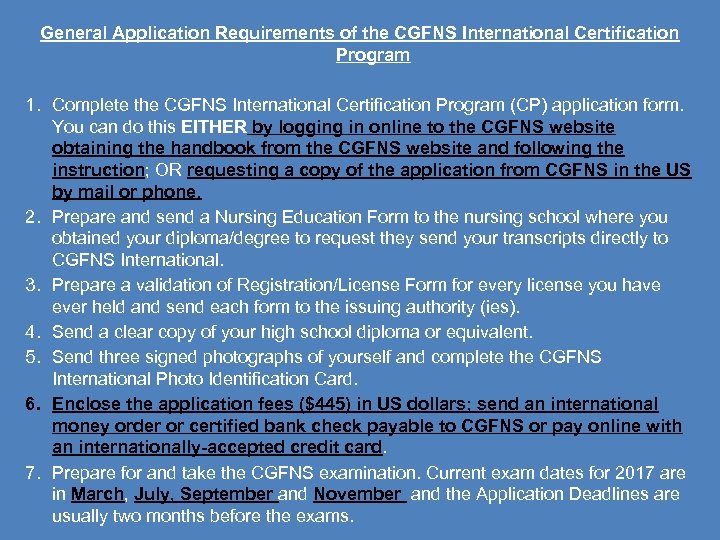 General Application Requirements of the CGFNS International Certification Program 1. Complete the CGFNS International Certification Program (CP) application form. You can do this EITHER by logging in online to the CGFNS website obtaining the handbook from the CGFNS website and following the instruction; OR requesting a copy of the application from CGFNS in the US by mail or phone. 2. Prepare and send a Nursing Education Form to the nursing school where you obtained your diploma/degree to request they send your transcripts directly to CGFNS International. 3. Prepare a validation of Registration/License Form for every license you have ever held and send each form to the issuing authority (ies). 4. Send a clear copy of your high school diploma or equivalent. 5. Send three signed photographs of yourself and complete the CGFNS International Photo Identification Card. 6. Enclose the application fees ($445) in US dollars; send an international money order or certified bank check payable to CGFNS or pay online with an internationally-accepted credit card. 7. Prepare for and take the CGFNS examination. Current exam dates for 2017 are in March, July, September and November and the Application Deadlines are usually two months before the exams.
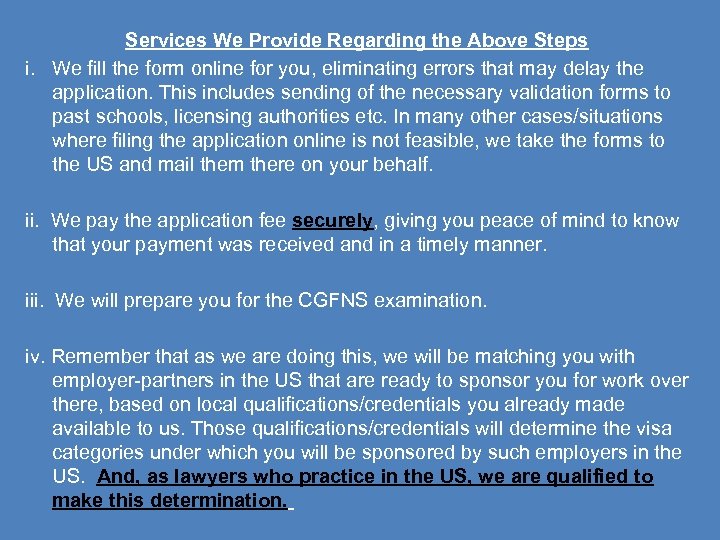 Services We Provide Regarding the Above Steps i. We fill the form online for you, eliminating errors that may delay the application. This includes sending of the necessary validation forms to past schools, licensing authorities etc. In many other cases/situations where filing the application online is not feasible, we take the forms to the US and mail them there on your behalf. ii. We pay the application fee securely, giving you peace of mind to know that your payment was received and in a timely manner. iii. We will prepare you for the CGFNS examination. iv. Remember that as we are doing this, we will be matching you with employer-partners in the US that are ready to sponsor you for work over there, based on local qualifications/credentials you already made available to us. Those qualifications/credentials will determine the visa categories under which you will be sponsored by such employers in the US. And, as lawyers who practice in the US, we are qualified to make this determination.
 • CGFNS ONLINE APPLICATION FORM AND INSTRUCTIONS AND • CGFNS 2017 APPLICANT HANDBOOK
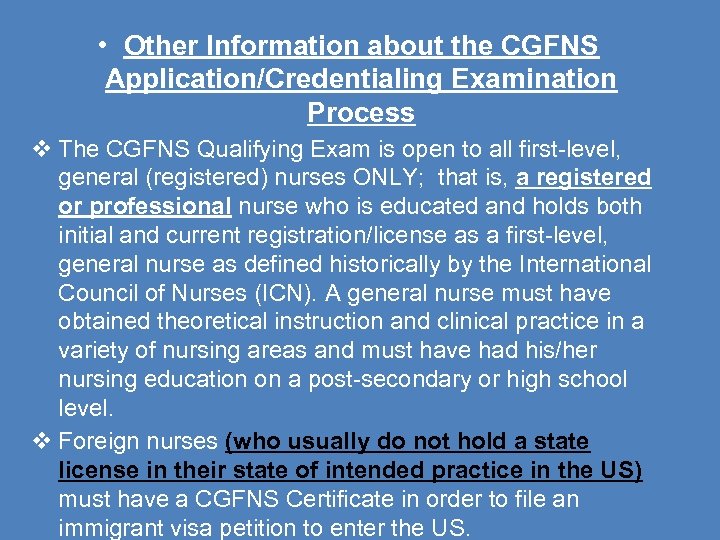 • Other Information about the CGFNS Application/Credentialing Examination Process The CGFNS Qualifying Exam is open to all first-level, general (registered) nurses ONLY; that is, a registered or professional nurse who is educated and holds both initial and current registration/license as a first-level, general nurse as defined historically by the International Council of Nurses (ICN). A general nurse must have obtained theoretical instruction and clinical practice in a variety of nursing areas and must have had his/her nursing education on a post-secondary or high school level. Foreign nurses (who usually do not hold a state license in their state of intended practice in the US) must have a CGFNS Certificate in order to file an immigrant visa petition to enter the US.
 The CGFNS Qualifying Examination is offered about four times a year (2017) in more than fifty locations throughout the world, including Nigeria. Nurses from some English-speaking countries are exempted from the English Proficiency requirement, but not nurses who trained in Nigeria. Such nurses have to obtain a passing score on the TOEFL (Test of English as a Foreign Language) examination or other equivalent examination. You will receive your certification from CGFNS only if you pass the CGFNS Qualifying Exam, the English Proficiency Examination and your foreign (Nigerian) credentials are evaluated and validated. Also, the CGFNS Qualifying Exam and English language exams must be taken within two years of each other for both scores to be valid. All licenses held by a foreign nurse must be validated by the CGFNS, in order to be deemed to have completed the Certification Program Application. All Certification Program applicants must provide validations of their initial and current licenses sent to CGFNS directly from their local licensing authority(ies)
 All persons applying to the CGFNS Certification Program must hold a registration/license in their country of education before becoming eligible to take the CGFNS Qualifying Exam. This condition is waived only when applicants are not permitted to sit for the licensing exam in their country of nursing education because they are not citizens. If a nurse has a job offer from a prospective US employer and obtains a CGFNS Certificate abroad but does not yet have a US State nursing license, he or she may complete consular processing and enter the US as a lawful permanent resident after approval of Form I-140. The nurse must also have a valid Visa. Screen Certificate issued by CGFNS. The CGFNS will often not contact you if they are waiting for documents from a foreign nurse’s former school or state. So it is best to check with CGFNS periodically [or have a paid/retained representative do it on your behalf] to determine whether they need any additional information to process your application.
 • The CGFNS Visa. Screen Certificate This certificate is also a service provider by CGFNS and aids foreign nurse about to commence the consular processing steps of immigrating to the US for employment. The document is needed for consular processing or adjustment of status. The Visa. Screen Certificate is evidence that the holder has completed a required screening a program for healthcare professionals (other than physicians) in order to qualify for certain occupational visas to the United States. Since July 26, 2004, it has been necessary for any non-immigrant nurse seeking admission to the US to obtain a Visa. Screen Certificate.
 Even if a nurse located in a foreign country manages to obtain a nursing qualification from a US-accredited school and also has a nursing license from the state in which he or she intends to practice in the US, he or she will still need to obtain a Visa. Screen Certificate in order to demonstrate that the US Nursing degree and state licensure equate to a US Degree in Nursing. It is usually best to have obtained the Visa. Screen Certificate at the time the Form I-140 petition is filed. Also, an RN who has already passed the NCLEX-RN examination abroad needs the Visa. Screen Certificate because the USCIS will not approve the RN’s Green Card or I-485 application filed concurrently with the I-140. Note that nursing employment agencies in the US, such as the ones we work with, can contract nurses to various medical facilities throughout the United States without knowing exactly where the nurse will be placed at any given time. We only need to file the I-140 petition, which designates the state where the nurse is licensed or will be licensed, as the location where the nurse will work. We need not designate a particular hospital or other healthcare facility that may be unknown at the time of filing the Form I-140 petition.
 Sometimes, a nurse can avoid taking the CGFNS exam and obtain an approval for the I-140. So, a nurse need not take the CGFNS exam if he or she: Has a valid, full and unrestricted nursing license from a state in the US to obtain the I-140 approval OR A certified copy of a letter from the state board of nursing from his/her intended state of employment which confirms that he or she has passed the NCLEX/RN examination and is eligible to be issued a license to practice nursing in that state.
 • How many here have passed the NCLEX/RN examination? • However, in most instances, the nurse will still need a Visa. Screen Certificate issued by the CGFNS in order to obtain permanent residence status and for the USCIS to approve the I-485 application for permanent residency for the nurse, even if she/he passed the NCLEX-RN examination abroad.
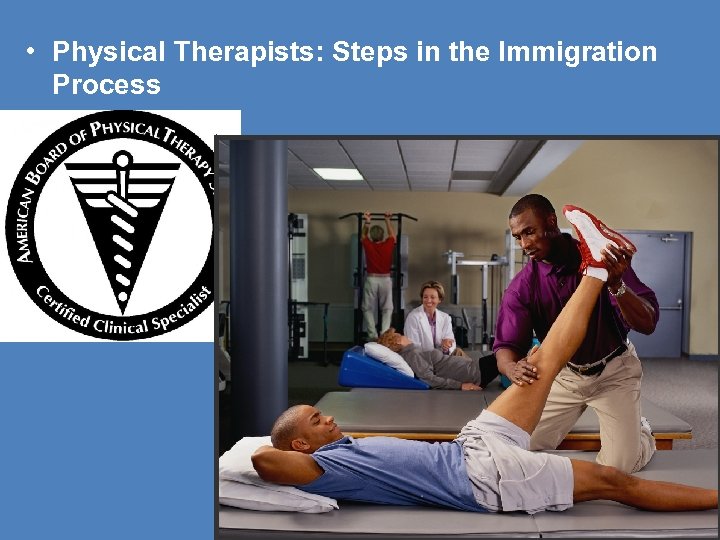 • Physical Therapists: Steps in the Immigration Process
 Physical Therapy is listed as a “Schedule A” occupation by the US Department of Labor; so, foreign physical therapists are exempted from the Labor Certification process, just like nurses. Like nurses, certain US immigrant and non-immigrant visas are available to Physical Therapists. In order to qualify for “Schedule A” processing, a Physical Therapist must: Have a four-year Bachelor’s Degree in Physical Therapy or its equivalent; Be a Physical Therapist with a State License; or Be a Physical Therapist with a letter from the Licensing Authority for the state of intended employment, stating that the Foreign Physical Therapist is qualified to take the state’s written licensing examination for Physical Therapists. No Qualifying Examination from outside the US.
 Therapists are also more eligible for H– 1 B visas and it allows them to work for no longer than three years, with extensions not to exceed a total of six years. Spouses and children can also come with them but are not authorized to work under this category of visa. The Foreign Credentialing Commission on Physical Therapy (FCCPT) offers a service which certifies that a Foreign Physical Therapist is qualified to take a US State’s written licensing examination for Physical Therapists. See www. fccpt. org This certification by the FCCPT allows a Foreign Physical Therapist to obtain a visa from the USCIS under the relevant visa categories allowed for Physical Therapists, including the H-1 B and EB-3 (Form I-140). The Certificate provided by the FCCPT at the end of this credentialing exercise is known as the Type 1 Certificate; it is a Health. Care Worker Certificate required by the USCIS for Physical Therapists who wish to work in the US, especially in the following states: Louisiana, Massachusetts, North Dakota, Tennessee, Texas and Washington, DC. These states and territories require all aspects of the Type 1 Certificate Process. We will assist you with all aspects of the FCCPT Type 1 Certification process.
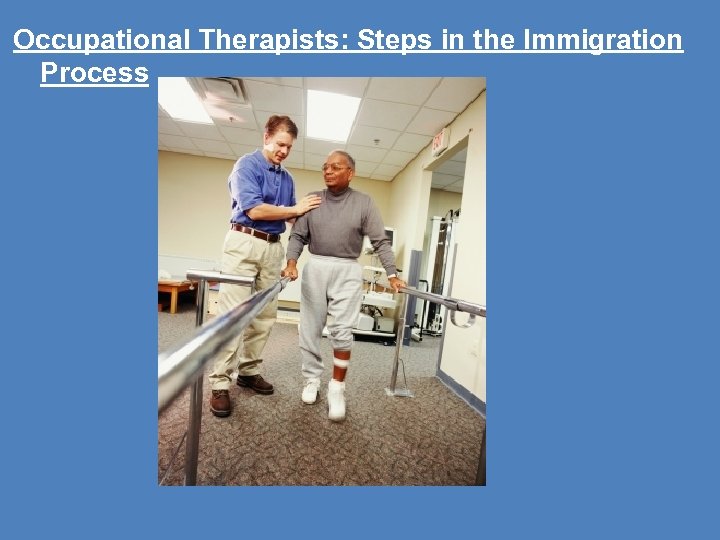 Occupational Therapists: Steps in the Immigration Process
 Occupational Therapist (OT) is NOT listed a “Schedule A” occupation by the US Department of Labor. However, foreign occupational therapists and US graduates with baccalaureate degrees can seek eligibility to take the Certification Examination to become “Occupational Therapist Registered (OTR)”. However, they must first be approved through the Occupational Therapist Eligibility Determination (OTED) program conducted by the National Board for Certification in Occupational Therapy, Inc. based in the US. See www. nbcot. org OTED applicants can be classified as either Category A or Category B, depending on whether they possess an advanced degree in Occupational Therapy and submission of proof that their credentials are equivalent to American occupational therapy education standards.
 Category A applicants must have been awarded a post-baccalaureate degree from an accredited occupational therapy education program recognized by the NBCOT (which can be ACOTE or WFOT) and do not need to present evidence of academic equivalence to American occupational therapy educational standards. There is a certification examination conducted by the NBCOT. Also note that the National Board for Certification in Occupational Therapy, Inc. (NBCOT) has been granted approval by the USCIS to issue healthcare worker certificates (Visa Credential Verification Certificates) to aliens coming to the United States to work as occupational therapists. Note that only Occupational Therapists who have successfully passed the certification examination for Occupational Therapist Registered (OTR) are eligible to apply through the Visa Credentialing Verification Certificate (VCVC). We will assist you in navigating the Immigration options available to foreign occupational therapists, along with the pre-immigration certification process.
 OTHER CATEGORIES OF VISAS • EB-5 (Investor Visa) Under the US Immigration Act of 1990, a foreign individual who makes an investment of at least $500, 000 in a high employment or rural area in the United States (or an investment of $1 million in any other area) is eligible for permanent residency in the US, along with members of his or her family. This is a very good way for immediate family members of successful individuals to relocate to the United States, or to go to school there, without the need to apply always to the US Embassy for a Visitor’s Visa.
 • [Contact us for answers to your questions regarding your eligibility for this category of visas]
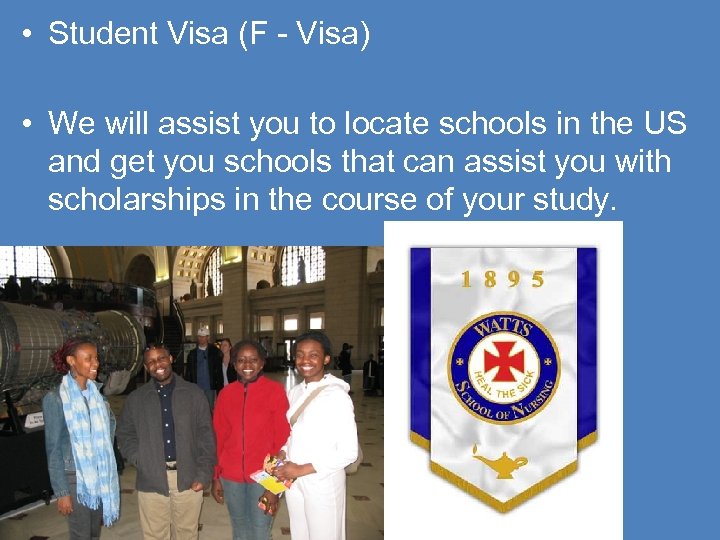 • Student Visa (F - Visa) • We will assist you to locate schools in the US and get you schools that can assist you with scholarships in the course of your study.
 Thanks for attending our seminar