


 Скачать презентацию Short Range Correlations and the EMC Effect Work
7cac80cc1519e92004f08585066c0678.ppt
- Количество слайдов: 32
 Short Range Correlations and the EMC Effect Work done in collaboration with: L. B. Weinstein (ODU) D. Higinbotham, J. Gomez (JLab) O. Hen, R. Shneor (TAU) Eli Piasetzky Tel Aviv University, ISRAEL
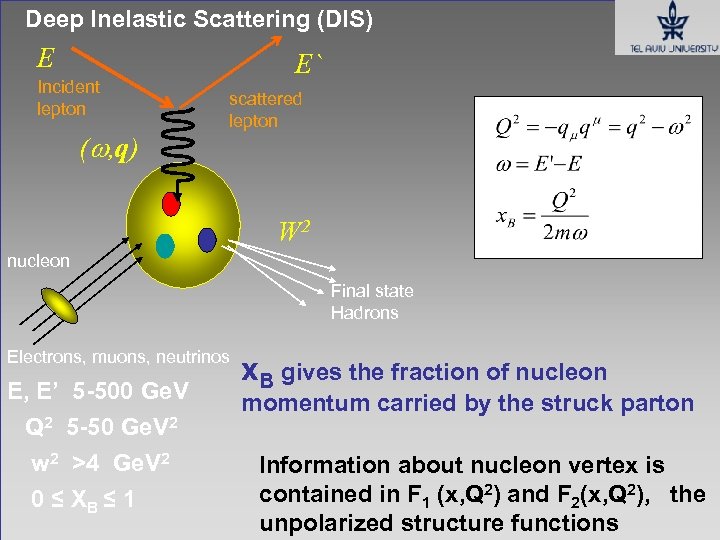 Deep Inelastic Scattering (DIS) E Incident lepton ( , q) E` scattered lepton W 2 nucleon Final state Hadrons Electrons, muons, neutrinos E, E’ 5 -500 Ge. V Q 2 5 -50 Ge. V 2 w 2 >4 Ge. V 2 0 ≤ XB ≤ 1 x. B gives the fraction of nucleon momentum carried by the struck parton Information about nucleon vertex is contained in F 1 (x, Q 2) and F 2(x, Q 2), the unpolarized structure functions
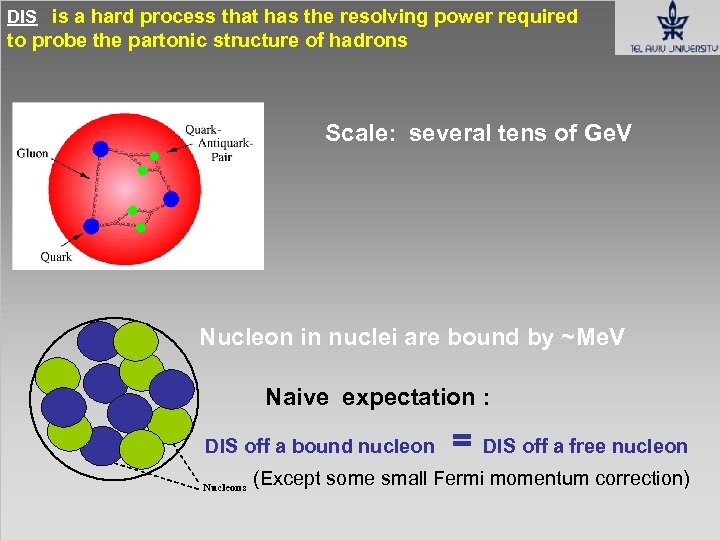 DIS is a hard process that has the resolving power required to probe the partonic structure of hadrons Scale: several tens of Ge. V Nucleon in nuclei are bound by ~Me. V Naive expectation : DIS off a bound nucleon Nucleons = DIS off a free nucleon (Except some small Fermi momentum correction)
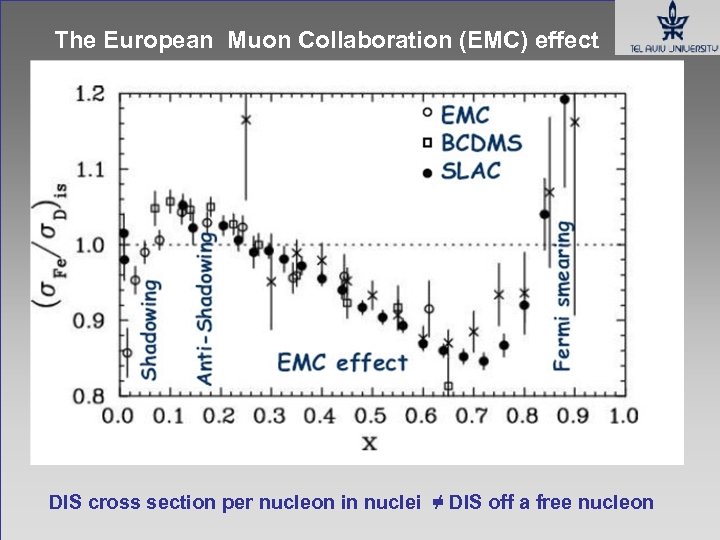 The European Muon Collaboration (EMC) effect DIS cross section per nucleon in nuclei ≠ DIS off a free nucleon
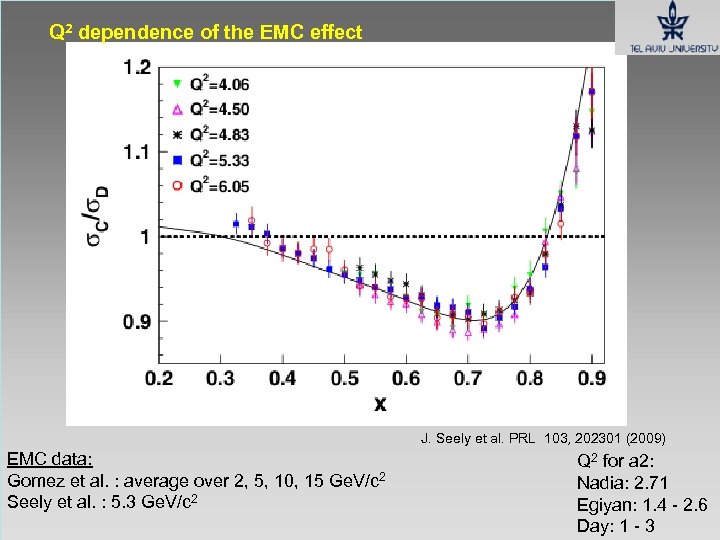
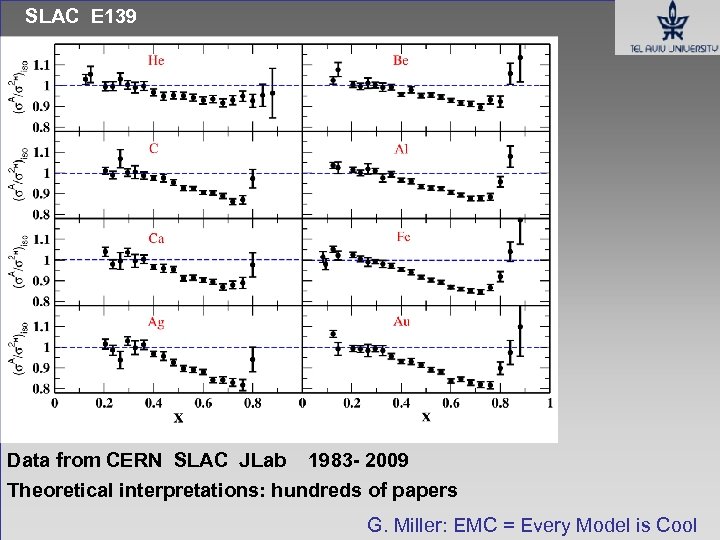 SLAC E 139 Data from CERN SLAC JLab 1983 - 2009 Theoretical interpretations: hundreds of papers G. Miller: EMC = Every Model is Cool
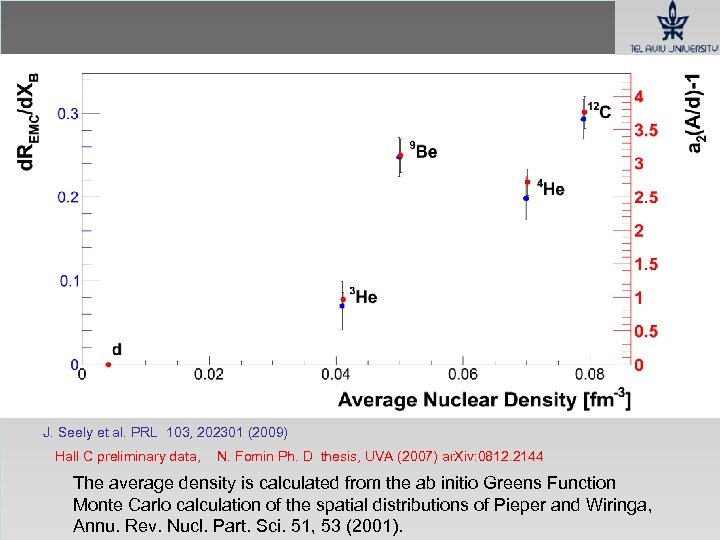
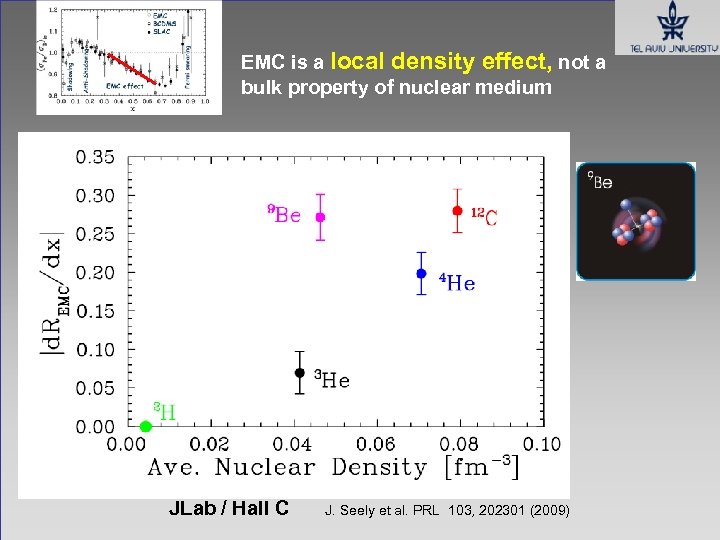 EMC is a local density effect, not a bulk property of nuclear medium JLab / Hall C J. Seely et al. PRL 103, 202301 (2009)
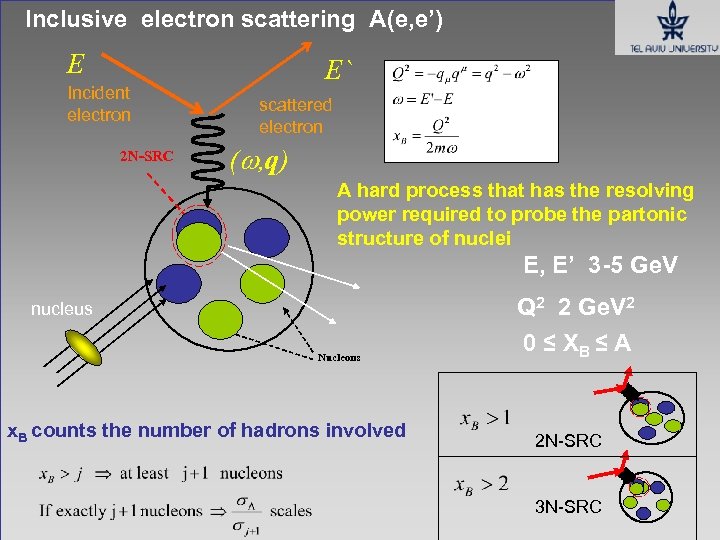 Inclusive electron scattering A(e, e’) E Incident electron 2 N-SRC E` scattered electron ( , q) A hard process that has the resolving power required to probe the partonic structure of nuclei E, E’ 3 -5 Ge. V nucleus Nucleons x. B counts the number of hadrons involved Q 2 2 Ge. V 2 0 ≤ X B ≤ A 2 N-SRC 3 N-SRC
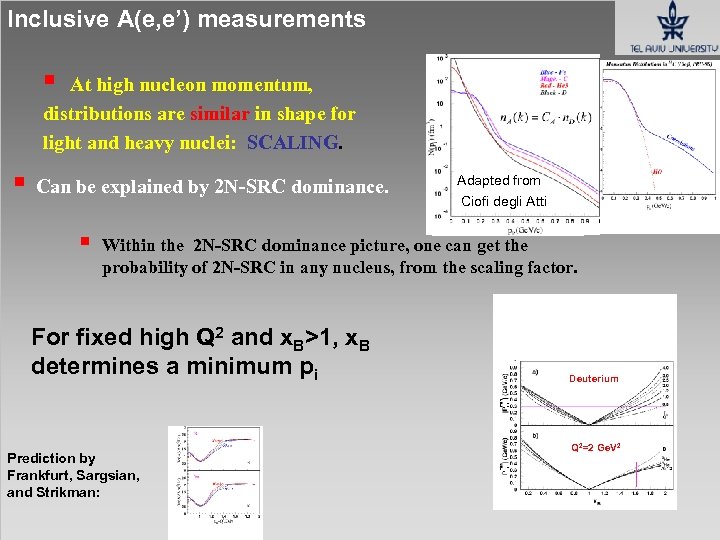 Inclusive A(e, e’) measurements § At high nucleon momentum, distributions are similar in shape for light and heavy nuclei: SCALING. § Can be explained by 2 N-SRC dominance. § Adapted from Ciofi degli Atti Within the 2 N-SRC dominance picture, one can get the probability of 2 N-SRC in any nucleus, from the scaling factor. For fixed high Q 2 and x. B>1, x. B determines a minimum pi Prediction by Frankfurt, Sargsian, and Strikman: Deuterium Q 2=2 Ge. V 2
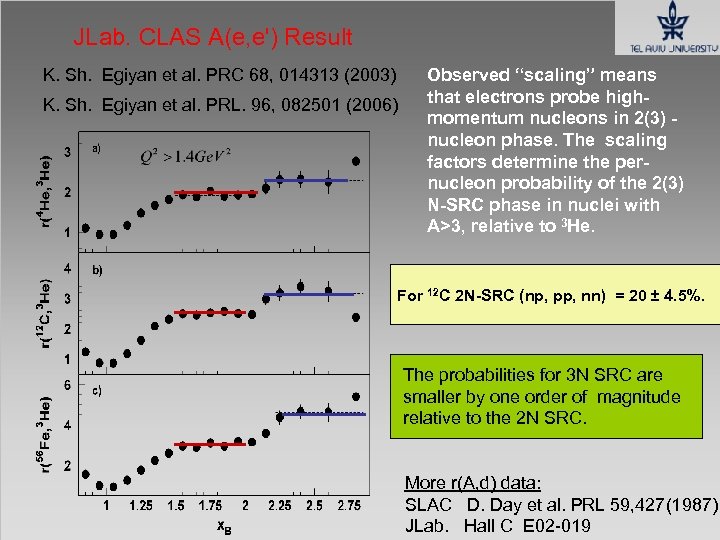 JLab. CLAS A(e, e') Result K. Sh. Egiyan et al. PRC 68, 014313 (2003) K. Sh. Egiyan et al. PRL. 96, 082501 (2006) Observed “scaling” means that electrons probe highmomentum nucleons in 2(3) nucleon phase. The scaling factors determine the pernucleon probability of the 2(3) N-SRC phase in nuclei with A>3, relative to 3 He. For 12 C 2 N-SRC (np, pp, nn) = 20 ± 4. 5%. The probabilities for 3 N SRC are smaller by one order of magnitude relative to the 2 N SRC. More r(A, d) data: SLAC D. Day et al. PRL 59, 427(1987) JLab. Hall C E 02 -019
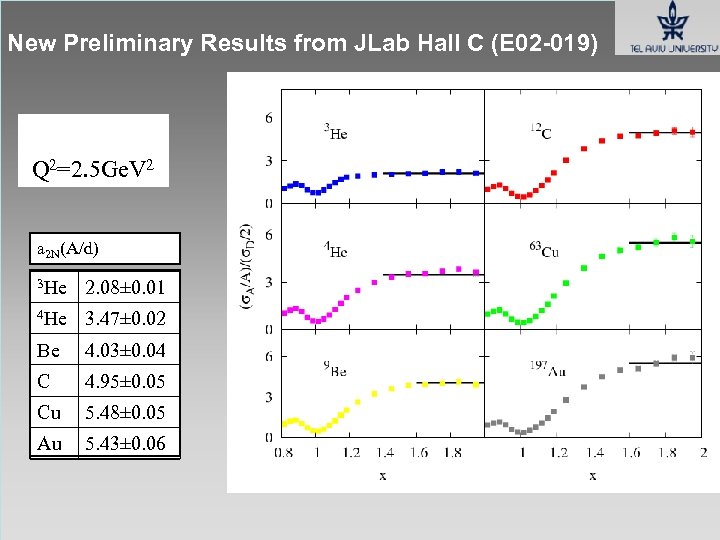 New Preliminary Results from JLab Hall C (E 02 -019) Q 2=2. 5 Ge. V 2 a 2 N(A/d) 3 He 2. 08± 0. 01 4 He 3. 47± 0. 02 Be 4. 03± 0. 04 C 4. 95± 0. 05 Cu 5. 48± 0. 05 Au 5. 43± 0. 06
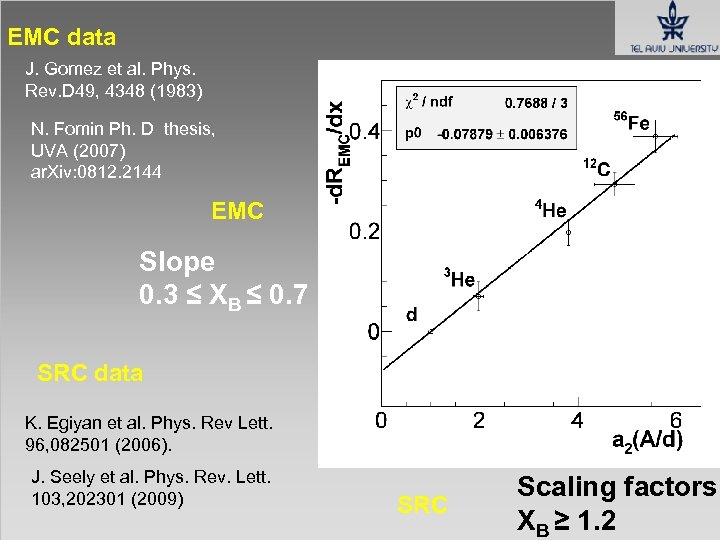
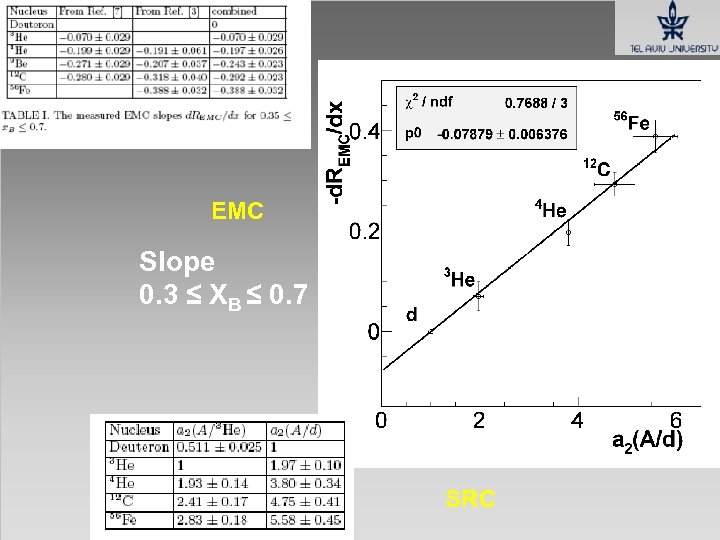
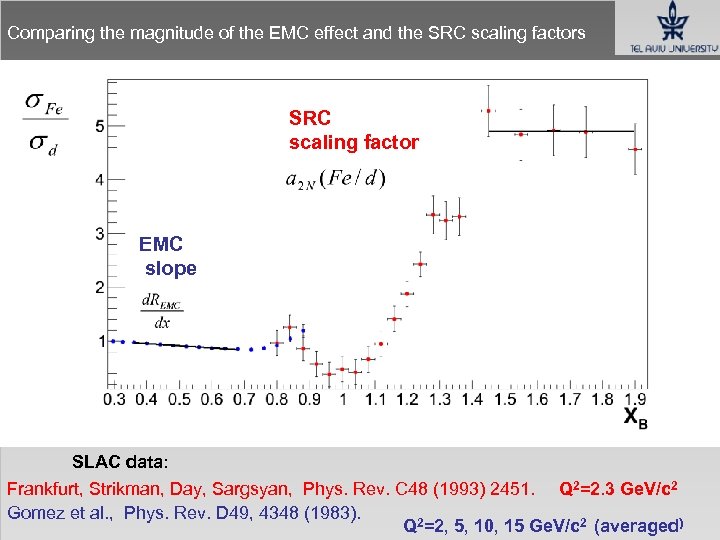 Comparing the magnitude of the EMC effect and the SRC scaling factors SRC scaling factor EMC slope : SLAC data: Frankfurt, Strikman, Day, Sargsyan, Phys. Rev. C 48 (1993) 2451. Q 2=2. 3 Ge. V/c 2 Gomez et al. , Phys. Rev. D 49, 4348 (1983). Q 2=2, 5, 10, 15 Ge. V/c 2 (averaged)
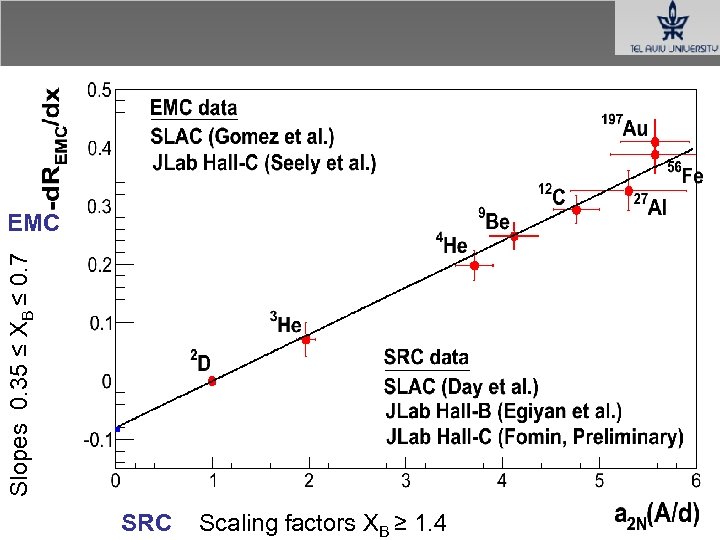 Slopes 0. 35 ≤ XB ≤ 0. 7 EMC SRC Scaling factors XB ≥ 1. 4
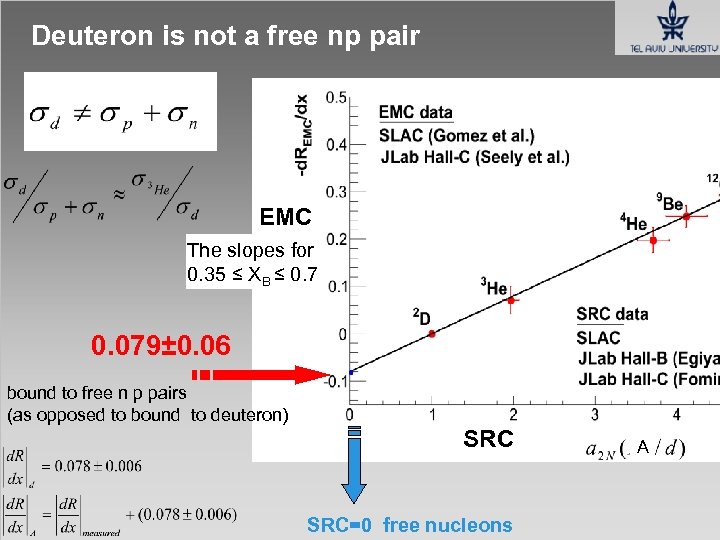 Deuteron is not a free np pair EMC The slopes for 0. 35 ≤ XB ≤ 0. 7 0. 079± 0. 06 bound to free n p pairs (as opposed to bound to deuteron) SRC=0 free nucleons A
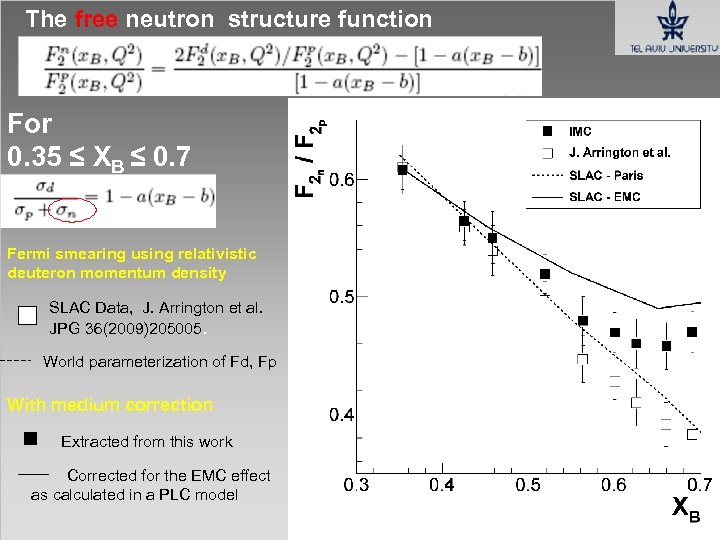 The free neutron structure function For 0. 35 ≤ XB ≤ 0. 7 Fermi smearing using relativistic deuteron momentum density SLAC Data, J. Arrington et al. JPG 36(2009)205005. World parameterization of Fd, Fp With medium correction Extracted from this work Corrected for the EMC effect as calculated in a PLC model
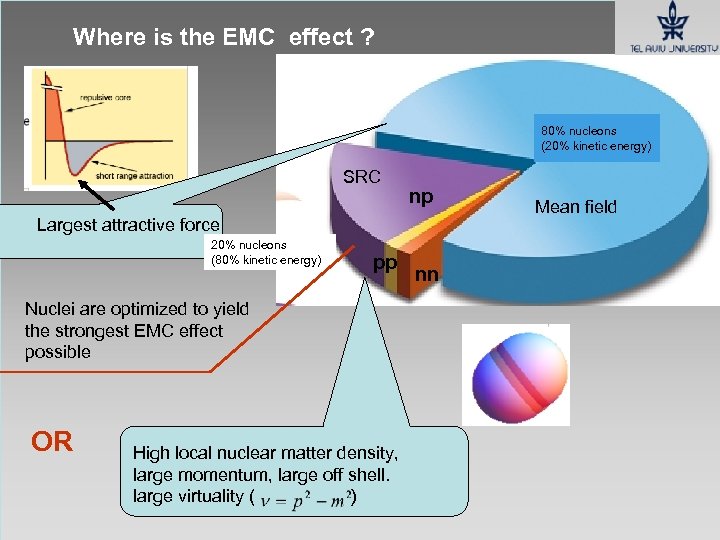 Where is the EMC effect ? 80% nucleons (20% kinetic energy) SRC np Largest attractive force 20% nucleons (80% kinetic energy) pp Nuclei are optimized to yield the strongest EMC effect possible OR High local nuclear matter density, large momentum, large off shell. large virtuality ( ) nn Mean field
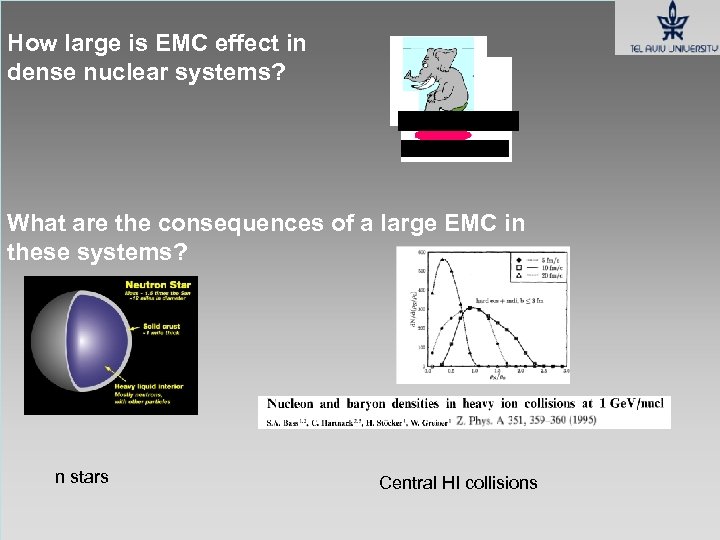 How large is EMC effect in dense nuclear systems? What are the consequences of a large EMC in these systems? n stars Central HI collisions
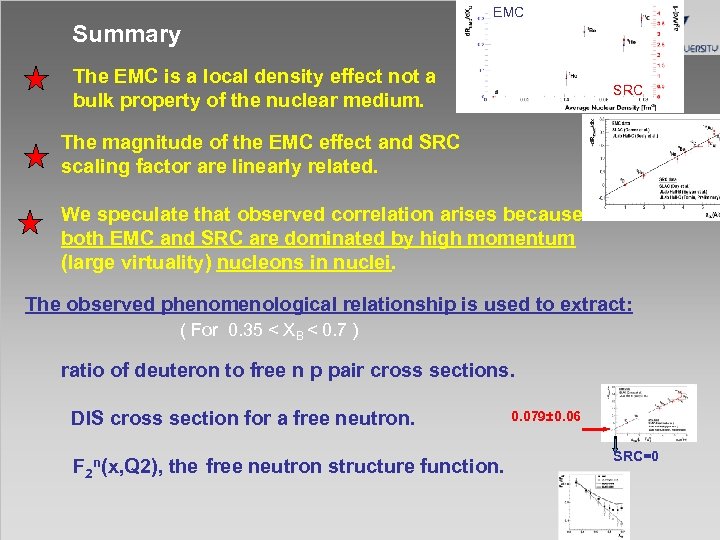 EMC Summary The EMC is a local density effect not a bulk property of the nuclear medium. SRC The magnitude of the EMC effect and SRC scaling factor are linearly related. We speculate that observed correlation arises because both EMC and SRC are dominated by high momentum (large virtuality) nucleons in nuclei. The observed phenomenological relationship is used to extract: ( For 0. 35 < XB < 0. 7 ) ratio of deuteron to free n p pair cross sections. DIS cross section for a free neutron. F 2 n(x, Q 2), the free neutron structure function. 0. 079± 0. 06 SRC=0
![I thanks the organizers for the invitation ar. Xiv: 1009. 5666 [hep-ph]](https://present5.com/presentation/7cac80cc1519e92004f08585066c0678/image-18.jpg "I thanks the organizers for the invitation ar. Xiv: 1009. 5666 [hep-ph]") I thanks the organizers for the invitation ar. Xiv: 1009. 5666 [hep-ph]
I thanks the organizers for the invitation ar. Xiv: 1009. 5666 [hep-ph]


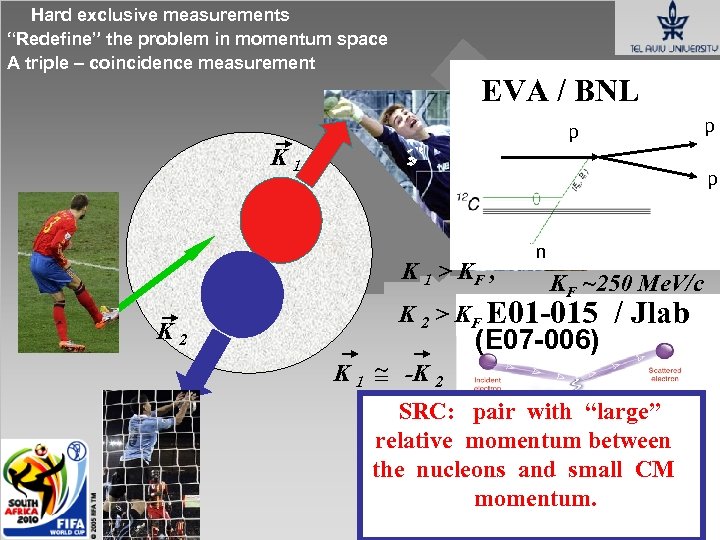 Hard exclusive measurements “Redefine” the problem in momentum space A triple – coincidence measurement EVA / BNL p p K 1 > KF , K 2 n KF ~250 Me. V/c K 2 > KF E 01 -015 (E 07 -006) / Jlab K 1 @ -K 2 SRC: pair with “large” relative momentum between the nucleons and small CM momentum.
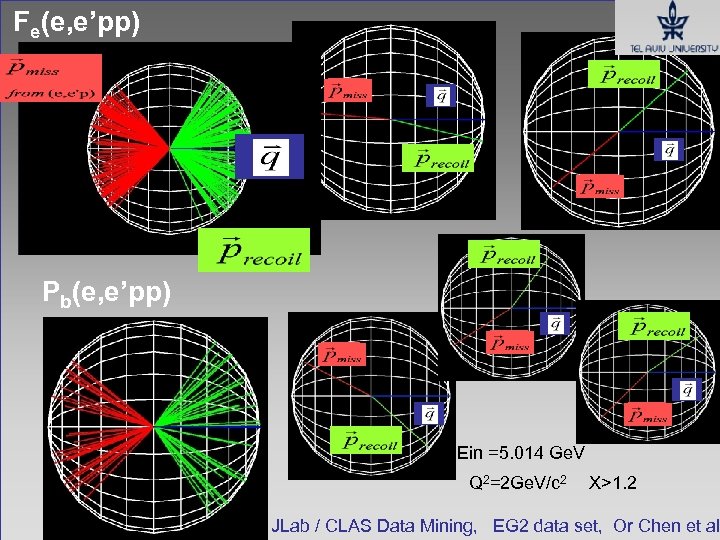 Fe(e, e’pp) Pb(e, e’pp) Ein =5. 014 Ge. V Q 2=2 Ge. V/c 2 X>1. 2 JLab / CLAS Data Mining, EG 2 data set, Or Chen et al.
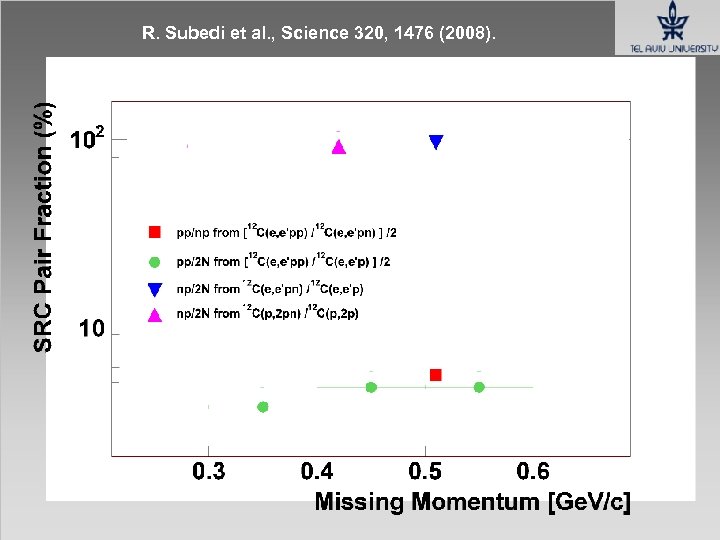 R. Subedi et al. , Science 320, 1476 (2008). BNL / EVA 12 C(e, e’pn) / 12 C(e, e’p) [12 C(e, e’pn) / 12 C(e, e’pp)] / 2 [12 C(e, e’pp) / 12 C(e, e’p)] / 2
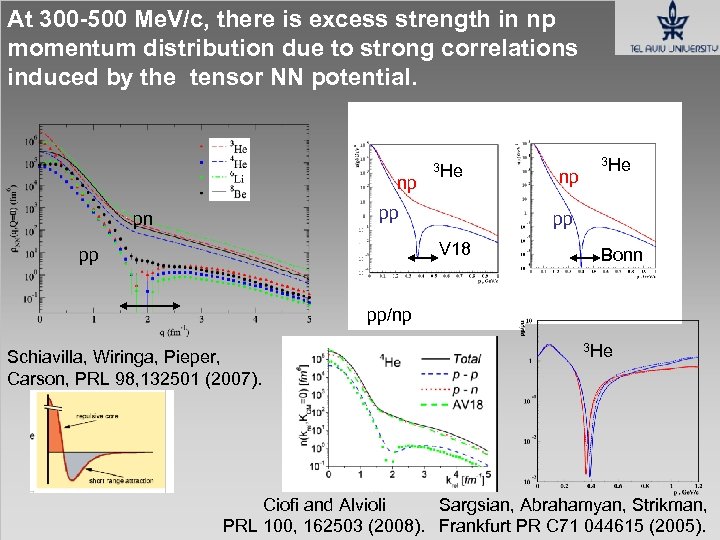 At 300 -500 Me. V/c, there is excess strength in np momentum distribution due to strong correlations induced by the tensor NN potential. np 3 He pp pn pp V 18 pp np 3 He Bonn pp/np Schiavilla, Wiringa, Pieper, Carson, PRL 98, 132501 (2007). 3 He Ciofi and Alvioli Sargsian, Abrahamyan, Strikman, PRL 100, 162503 (2008). Frankfurt PR C 71 044615 (2005).
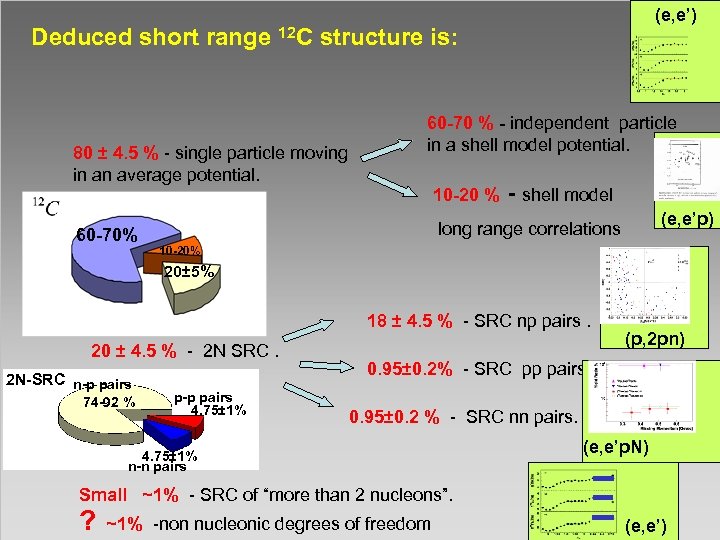 (e, e’) Deduced short range 12 C structure is: 80 ± 4. 5 % - single particle moving in an average potential. 60 -70 % - independent particle in a shell model potential. 10 -20 % 60 -70% - shell model (e, e’p) long range correlations 10 -20% 20± 5% 18 ± 4. 5 % - SRC np pairs. 20 ± 4. 5 % - 2 N SRC. 2 N-SRC n-p pairs 74 -92 % p-p pairs 4. 75± 1% (p, 2 pn) 0. 95± 0. 2% - SRC pp pairs. 0. 95± 0. 2 % - SRC nn pairs. 4. 75± 1% n-n pairs (e, e’p. N) Small ~1% - SRC of “more than 2 nucleons”. ? ~1% -non nucleonic degrees of freedom (e, e’)
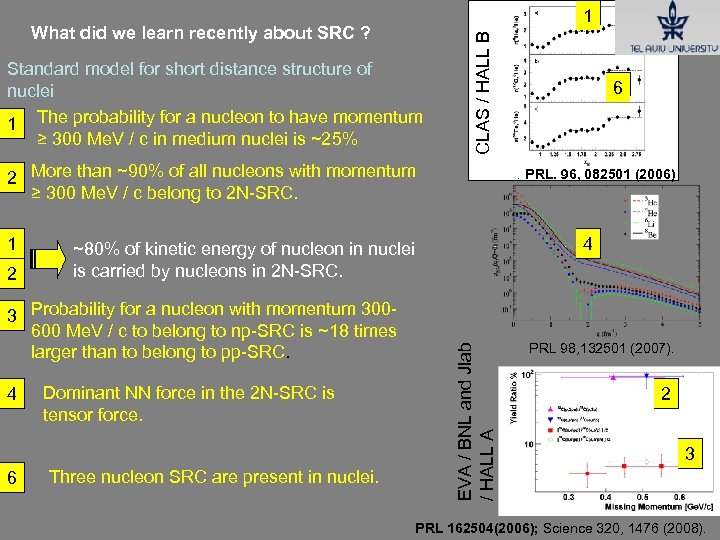 What did we learn recently about SRC ? Standard model for short distance structure of nuclei 1 The probability for a nucleon to have momentum ≥ 300 Me. V / c in medium nuclei is ~25% CLAS / HALL B 1 2 More than ~90% of all nucleons with momentum ≥ 300 Me. V / c belong to 2 N-SRC. 2 6 4 ~80% of kinetic energy of nucleon in nuclei is carried by nucleons in 2 N-SRC. 3 Probability for a nucleon with momentum 300600 Me. V / c to belong to np-SRC is ~18 times larger than to belong to pp-SRC. 4 . PRL. 96, 082501 (2006) Dominant NN force in the 2 N-SRC is tensor force. Three nucleon SRC are present in nuclei. EVA / BNL and Jlab / HALL A 1 6 PRL 98, 132501 (2007). 2 3 PRL 162504(2006); Science 320, 1476 (2008).
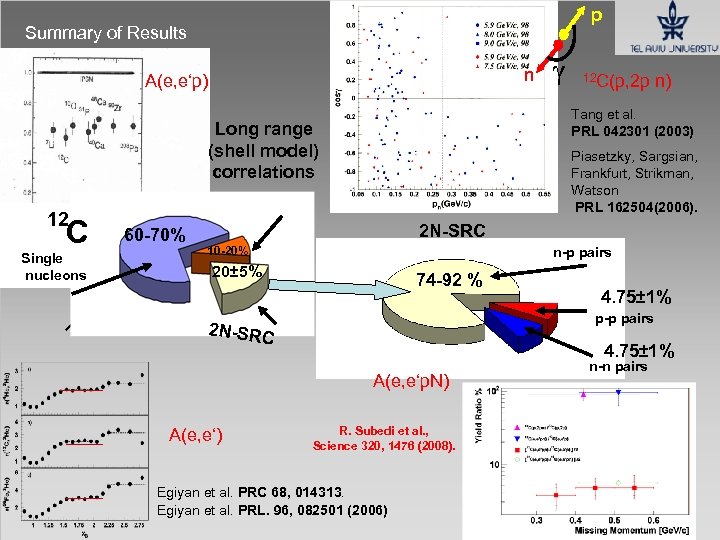 p Summary of Results n A(e, e‘p) C Single nucleons 60 -70% 12 C(p, 2 p n) Tang et al. PRL 042301 (2003) Long range (shell model) correlations 12 γ Piasetzky, Sargsian, Frankfurt, Strikman, Watson PRL 162504(2006). 2 N-SRC 10 -20% n-p pairs 20± 5% 74 -92 % p-p pairs 2 N-SRC 4. 75± 1% A(e, e‘p. N) A(e, e‘) 4. 75± 1% R. Subedi et al. , Science 320, 1476 (2008). Egiyan et al. PRC 68, 014313. Egiyan et al. PRL. 96, 082501 (2006) n-n pairs
 EMC data J. Gomez et al. Phys. Rev. D 49, 4348 (1983) N. Fomin Ph. D thesis, UVA (2007) ar. Xiv: 0812. 2144 EMC Slope 0. 3 ≤ XB ≤ 0. 7 SRC data K. Egiyan et al. Phys. Rev Lett. 96, 082501 (2006). J. Seely et al. Phys. Rev. Lett. 103, 202301 (2009) SRC Scaling factors XB ≥ 1. 2
 EMC Slope 0. 3 ≤ XB ≤ 0. 7 SRC
 Q 2 dependence of the EMC effect J. Seely et al. PRL 103, 202301 (2009) EMC data: Gomez et al. : average over 2, 5, 10, 15 Ge. V/c 2 Seely et al. : 5. 3 Ge. V/c 2 Q 2 for a 2: Nadia: 2. 71 Egiyan: 1. 4 - 2. 6 Day: 1 - 3
 J. Seely et al. PRL 103, 202301 (2009) Hall C preliminary data, N. Fomin Ph. D thesis, UVA (2007) ar. Xiv: 0812. 2144 The average density is calculated from the ab initio Greens Function Monte Carlo calculation of the spatial distributions of Pieper and Wiringa, Annu. Rev. Nucl. Part. Sci. 51, 53 (2001).
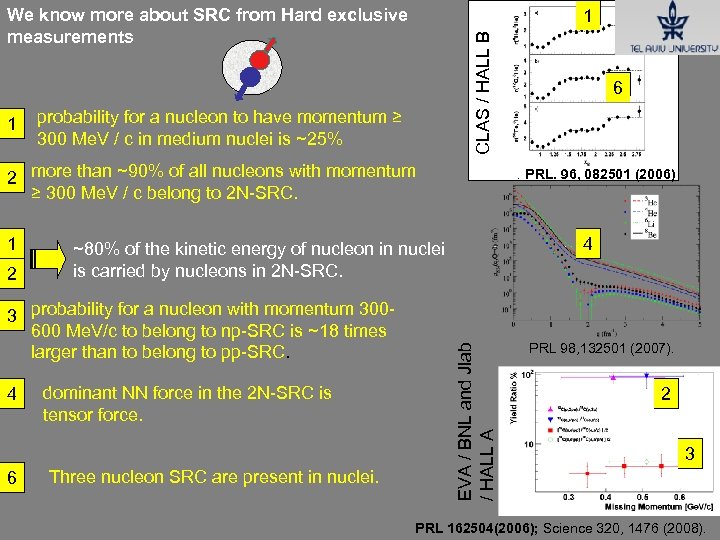 We know more about SRC from Hard exclusive measurements CLAS / HALL B 1 1 probability for a nucleon to have momentum ≥ 300 Me. V / c in medium nuclei is ~25% 2 more than ~90% of all nucleons with momentum ≥ 300 Me. V / c belong to 2 N-SRC. 2 6 4 ~80% of the kinetic energy of nucleon in nuclei is carried by nucleons in 2 N-SRC. 3 probability for a nucleon with momentum 300600 Me. V/c to belong to np-SRC is ~18 times larger than to belong to pp-SRC. 4 . PRL. 96, 082501 (2006) dominant NN force in the 2 N-SRC is tensor force. Three nucleon SRC are present in nuclei. EVA / BNL and Jlab / HALL A 1 6 PRL 98, 132501 (2007). 2 3 PRL 162504(2006); Science 320, 1476 (2008).