


 Скачать презентацию Short presentation of memories IST project n 053500
1943b9b89391ddea8d3d0d3c3601fb64.ppt
- Количество слайдов: 32
 Short presentation of memories IST project n° 053500 Prepared by: Guy Maréchal (Project architect) guy. marechal@memnon. be Eric Lesage (Technical manager) eric. lesage@memnon. be Contacts: Michel Merten (Project coordinator) michel. merten@memnon. be Jean-François Cosandier (Dissemination coordinator) jean-francois. cosandier@rsr. ch
 Structure of the presentation 1. 2. 3. 4. Introduction General context Objectives of the project Consortium
 1. Introduction The MEMORIES project focuses on the SOUND media chain: 1. The improvement of the acquisition processes 2. The improvement of the retrieval processes 3. The definition of an “Open e. Xchange Format” based on standards, mainly the OAIS reference model (ISO 14 721) 4. The evaluation and validation by using a demonstrator fed with a large spectrum of domain of applications.
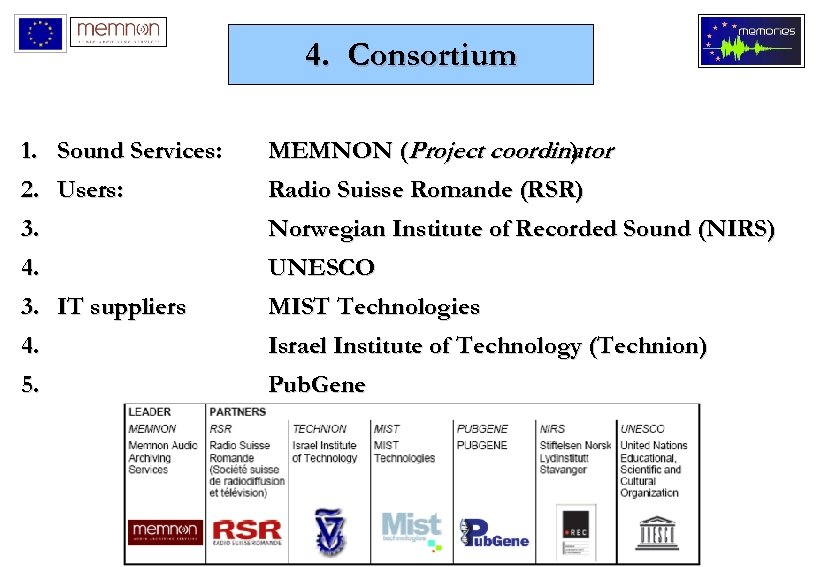
 1. Introduction Partners of the project: • Sound Services: MEMNON (Project coordinator ) • Users: Radio Suisse Romande (RSR) Norwegian Institute of Recorded Sound (NIRS) UNESCO 3. IT suppliers MIST Technologies 4. Israel Institute of Technology (Technion) 5. Pub. Gene
 1. Introduction 2. General context 3. Objectives of the project 4. Consortium
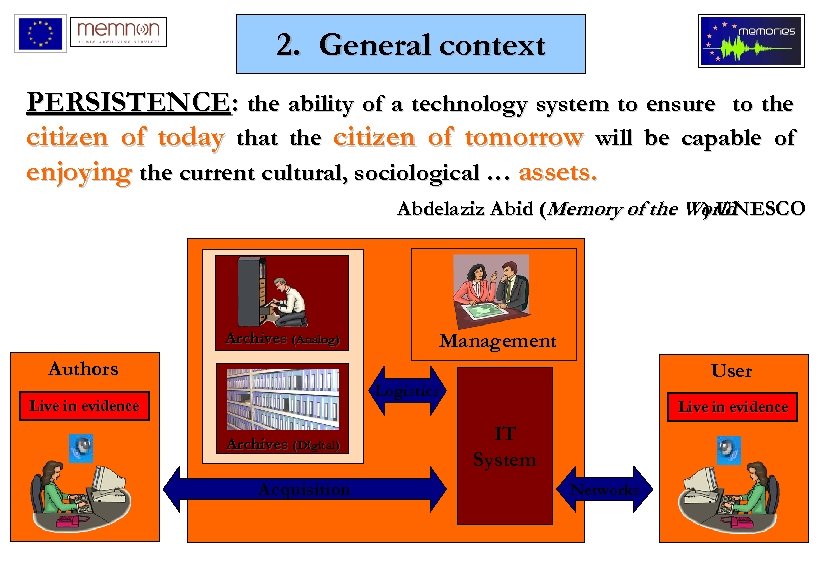 2. General context PERSISTENCE: the ability of a technology system to ensure to the citizen of today that the citizen of tomorrow will be capable of enjoying the current cultural, sociological … assets. Abdelaziz Abid (Memory of the World ) UNESCO Archives (Analog) Authors Management User Logistics Live in evidence Archives (Digital) Acquisition Live in evidence IT System Networks
 2. General context ASSETS Declaration of the existence of an “ASSET” ONTOLOGY Modeling of the “Assets” and of their presentation such as to obtain • Their powerful representation SEMANTIC • Their independence of the moments PERSISTENCE • Their independence of the places NOMADISM • Their independence of the formats EVOLUTION ENRICHMENT …
 2. General context The users want to find interesting media material • That they can see, listen, understand … • With good quality of audio, video, image, text, … • Easy & cheap to access • They can acquire rights to exploit, to enrich, to improve, … • Through a large variety of network channels • With large semantic annotations • With association and synchronization of other content • … Users Live in evidence
 2. General context The Authors want to dispose of powerful authoring systems • Easy to operate … Authors Live in evidence • That the modeling should be staunch … • Cheap to acquire • Ensuring their intellectual rights … • Accessible through a large variety of network channels • With large semantic annotations facilities • With association and synchronization of other content • …
 2. General context The ‘Contents’ are those excerpts of the “social life” which have been selected for acquisition. They are the ‘Original Information Packages’ They require • That they should be captured with the expected quality • That they should be recorded with preservation of their existence, of their identity, of their authenticity, of their integrity, of their accessibility, of their availability… • That they should be documented, indexed, . . . in a fair, competent and ethic way
 2. General context The Archives, as custodians of the social memory, require • That they could easily be accessed and exploited • That they will survive to the progressive physical degradation of their support • That they will survive to the progressive evolution of the formats of representation • That they will survive to the changes of the industrial policies • That they will be semantically understood • That the enrichments will be kept for further exploitations • … Archives (Analog) Archives (Digital)
 2. General context The management team should • Meet the expectations of the User’s and the various User’s communities • Meet the expectations of the Social communities as custodians of the archives By ensuring • The IT system for managing and exploiting the archives • The persistence of the archives at a reasonable cost • A technology watch • … Management of the archives
 2. General context The management of the persistence cannot: • Be captive of “Proprietary Systems” • Pay the price of “Exclusive” suppliers • Suffer the “barriers” and “obstacles” in the flows of their processes • … Management of the archives
 2. General context In that context, the IT supplier’s policy would be that : • Their investments should be firmly protected (patents, copyrights, …) • Their cutomers would be satisfied by the quality of their products, information and services (functionalities, human interfaces, training, warranties, …) • Their product and services should be interoperable in space and time • …
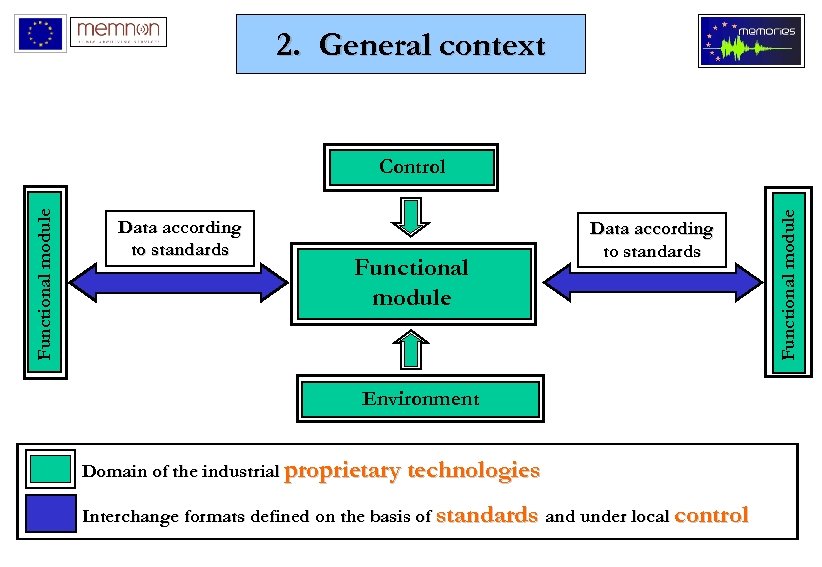 2. General context Data according to standards Functional module Data according to standards Environment Domain of the industrial proprietary technologies Interchange formats defined on the basis of standards and under local control Functional module Control
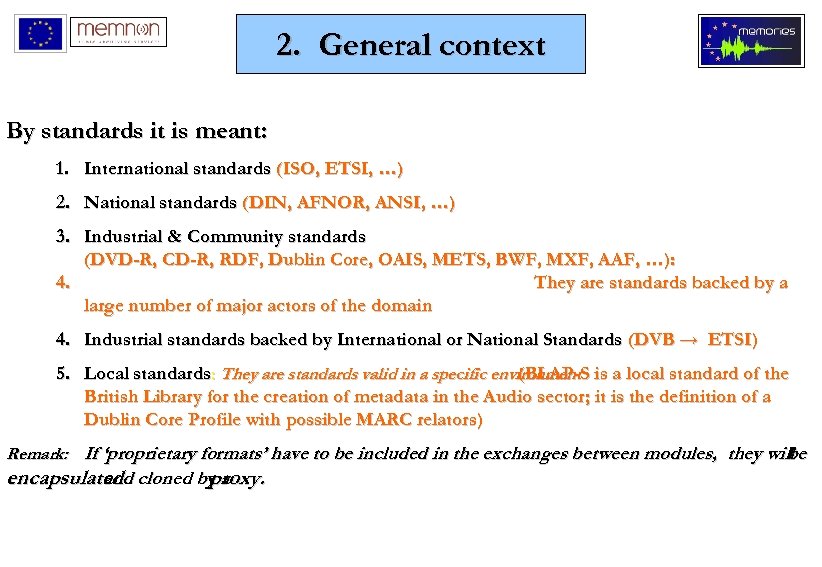 2. General context By standards it is meant: 1. International standards (ISO, ETSI, …) 2. National standards (DIN, AFNOR, ANSI, …) 3. Industrial & Community standards (DVD-R, CD-R, RDF, Dublin Core, OAIS, METS, BWF, MXF, AAF, …): 4. They are standards backed by a large number of major actors of the domain 4. Industrial standards backed by International or National Standards (DVB → ETSI) 5. Local standards: They are standards valid in a specific environment is a local standard of the (BLAP-S British Library for the creation of metadata in the Audio sector; it is the definition of a Dublin Core Profile with possible MARC relators) Remark: If ‘proprietary formats’ have to be included in the exchanges between modules, they will be encapsulated cloned by a and proxy.
 1. Introduction 2. General context 3. Objectives of the project 4. Consortium
 3. Objectives of the project The project span on the whole SOUND media chain with focus on: 1. The improvement of the acquisition processes namely by using a “Single Sensor Source Separation” approach 2. The improvement of the retrieval processes namely by using a “Advance search base on semantic annotations” 3. The definition of an “Open Exchange Format” based on standards by using an approach based on standards, mainly the OAIS (ISO 14 721) 4. The evaluation and validation by using a demonstrator fed with a large spectrum of domain of applications.
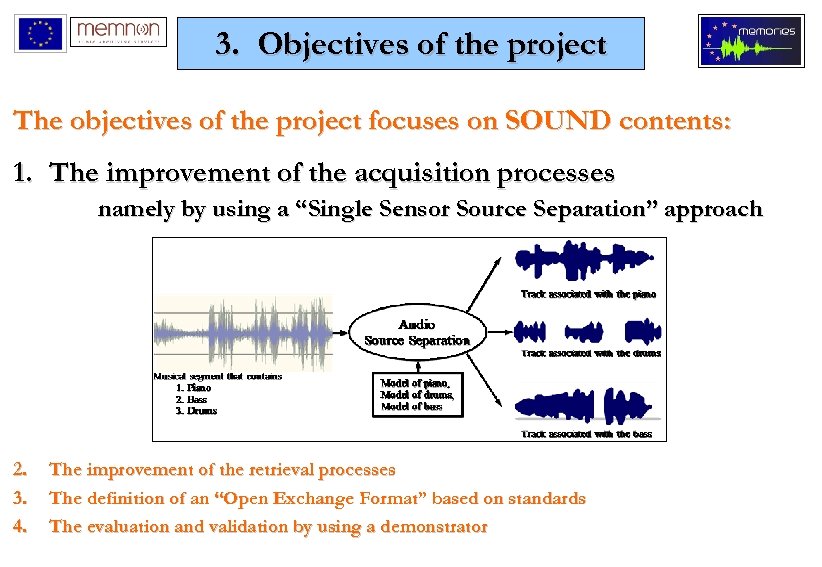 3. Objectives of the project The objectives of the project focuses on SOUND contents: 1. The improvement of the acquisition processes namely by using a “Single Sensor Source Separation” approach 2. 3. 4. The improvement of the retrieval processes The definition of an “Open Exchange Format” based on standards The evaluation and validation by using a demonstrator
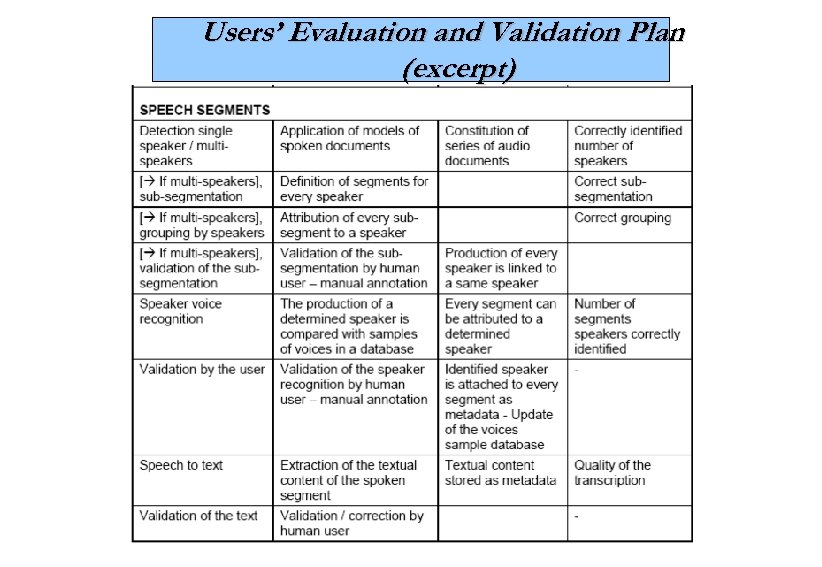 Users’ Evaluation and Validation Plan (excerpt)
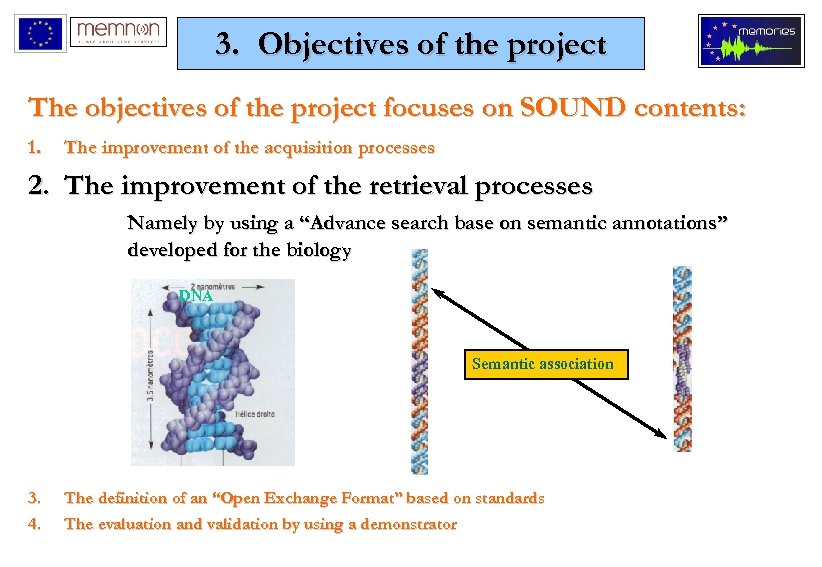 3. Objectives of the project The objectives of the project focuses on SOUND contents: 1. The improvement of the acquisition processes 2. The improvement of the retrieval processes Namely by using a “Advance search base on semantic annotations” developed for the biology DNA Semantic association 3. 4. The definition of an “Open Exchange Format” based on standards The evaluation and validation by using a demonstrator
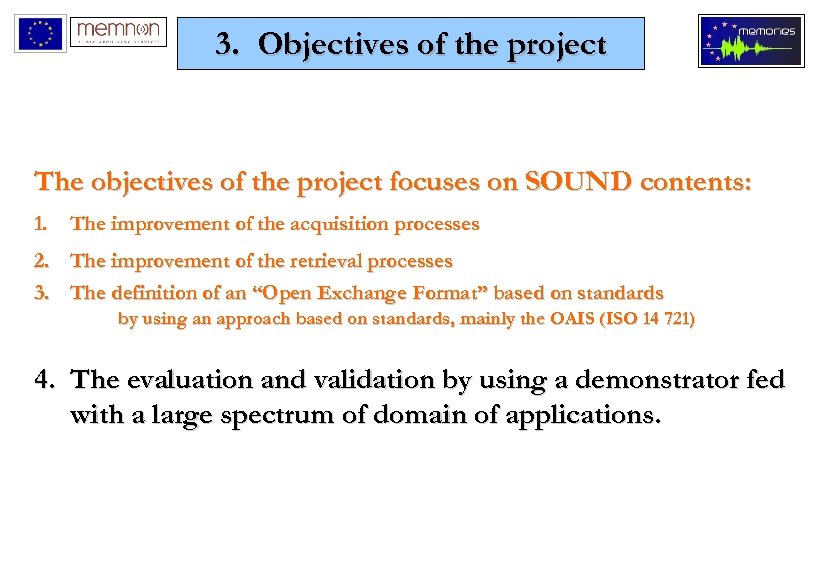
 3. Objectives of the project The objectives of the project focuses on SOUND contents: 1. The improvement of the acquisition processes 2. The improvement of the retrieval processes 3. The definition of an “Open Exchange Format” based on standards by using an approach based on standards, mainly the OAIS (ISO 14 721) 4. The evaluation and validation by using a demonstrator fed with a large spectrum of domain of applications.
 3. Objectives of the project for the “Open Interface” the SIP, AIP architecture of the OAIS model (ISO 14721) Adopt OAIS: SIP: AIP: Open Archival Information System Submission Information Package Archival Information Package
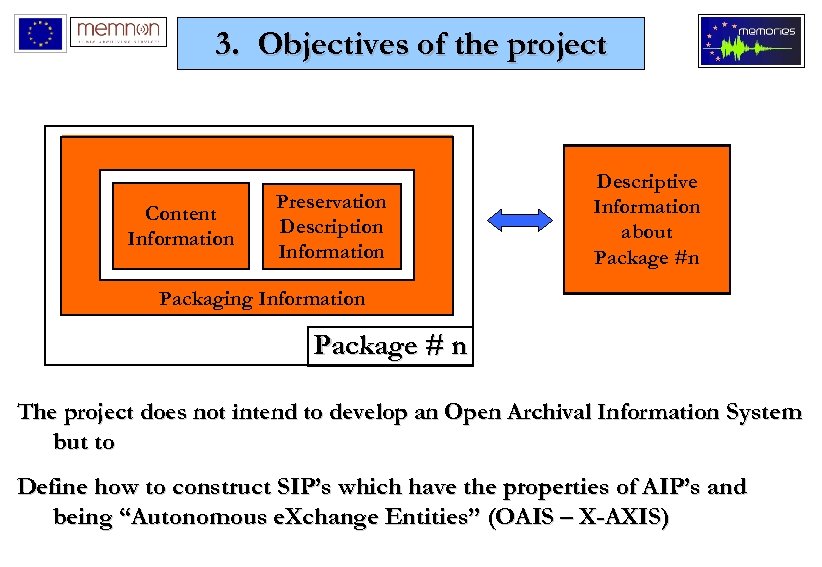 3. Objectives of the project Content Information Preservation Description Information Descriptive Information about Package #n Packaging Information Package # n The project does not intend to develop an Open Archival Information System but to Define how to construct SIP’s which have the properties of AIP’s and being “Autonomous e. Xchange Entities” (OAIS – X-AXIS)
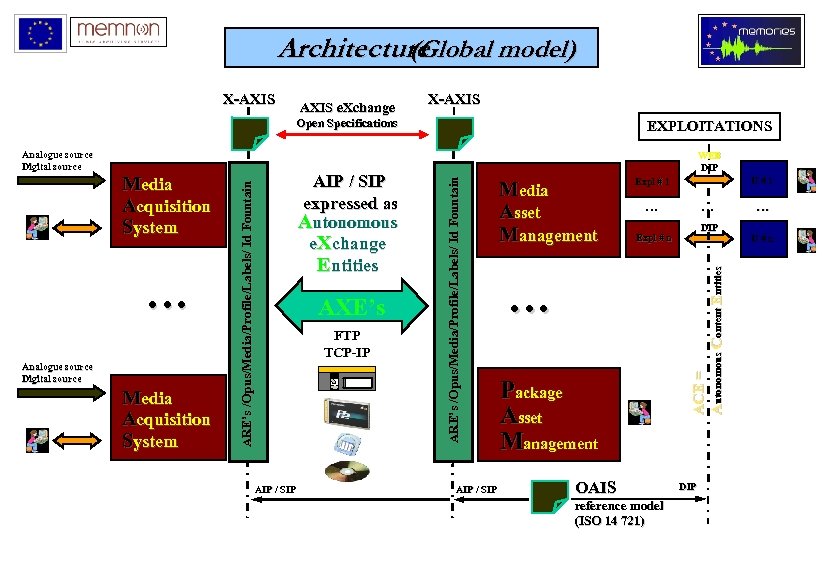 Architecture (Global model) AXIS e. Xchange X-AXIS Open Specifications … Analogue source Digital source Media Acquisition System AIP / SIP expressed as Autonomous e. Xchange Entities AXE’s FTP TCP-IP AIP / SIP WEB DIP ARE’s /Opus/Media/Profile/Labels/ Id Fountain Media Acquisition System ARE’s /Opus/Media/Profile/Labels/ Id Fountain Analogue source Digital source EXPLOITATIONS AIP / SIP Media Asset Management U#1 Expl # 1 … … DIP Expl # n … Package Asset Management OAIS reference model (ISO 14 721) ACE = Autonomous Content Entities X-AXIS DIP … U#n
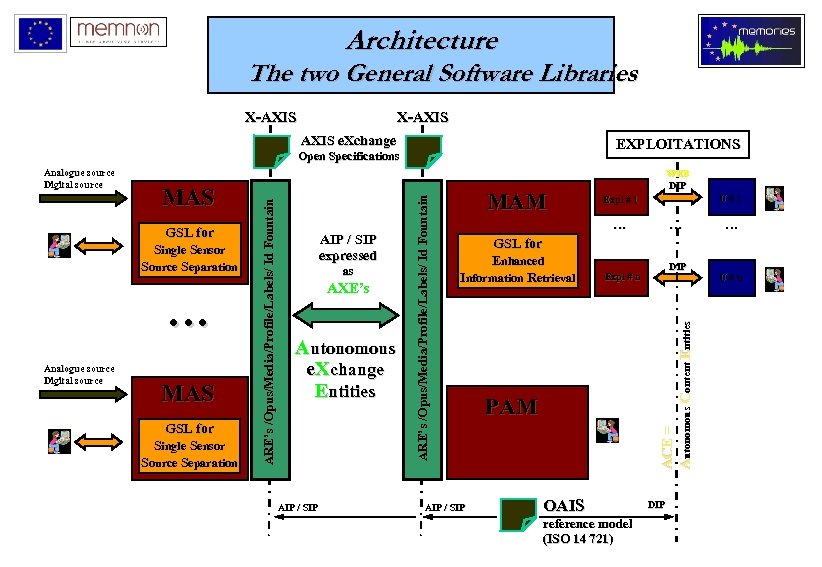 Architecture The two General Software Libraries X-AXIS e. Xchange EXPLOITATIONS GSL for Single Sensor Source Separation … Analogue source Digital source MAS GSL for Single Sensor Source Separation AIP / SIP expressed as AXE’s Autonomous e. Xchange Entities AIP / SIP MAM WEB DIP U#1 Expl # 1 … GSL for Enhanced Information Retrieval AIP / SIP … DIP Expl # n ACE = Autonomous Content Entities MAS ARE’s /Opus/Media/Profile/Labels/ Id Fountain Analogue source Digital source ARE’s /Opus/Media/Profile/Labels/ Id Fountain Open Specifications PAM OAIS reference model (ISO 14 721) DIP … U#n
 3. Objectives of the project The objectives of the project focuses on SOUND contents: 1. The improvement of the acquisition processes 2. The improvement of the retrieval processes 3. The definition of an “Open Exchange Format” based on standards by using an approach based on standards, mainly the OAIS (ISO 14 721) 4. The evaluation and validation by using a demonstrator fed with a large spectrum of domain of applications.
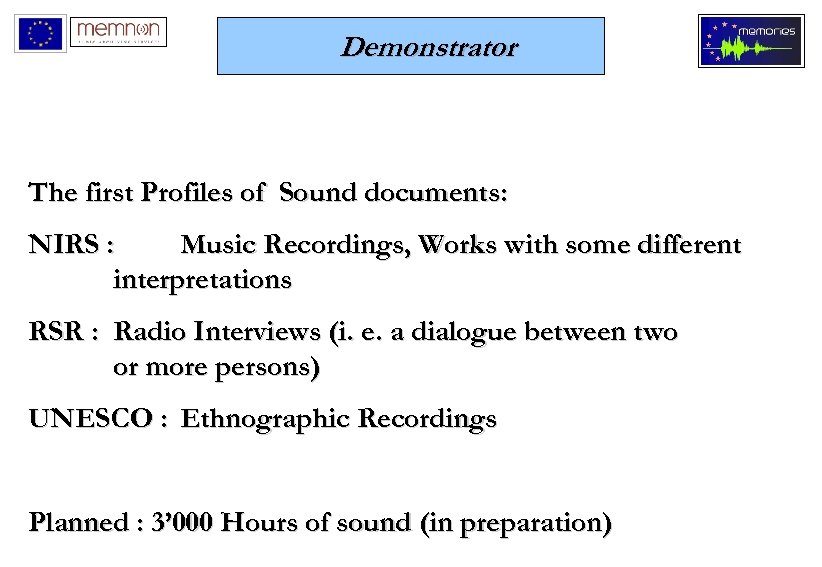 Demonstrator The first Profiles of Sound documents: NIRS : Music Recordings, Works with some different interpretations RSR : Radio Interviews (i. e. a dialogue between two or more persons) UNESCO : Ethnographic Recordings Planned : 3’ 000 Hours of sound (in preparation)
 1. 2. 3. Introduction Context of the project General objectives 4. Consortium
 4. Consortium 1. Sound Services: 2. Users: 3. MEMNON (Project coordinator ) 4. 3. IT suppliers 4. UNESCO 5. Pub. Gene Radio Suisse Romande (RSR) Norwegian Institute of Recorded Sound (NIRS) MIST Technologies Israel Institute of Technology (Technion)
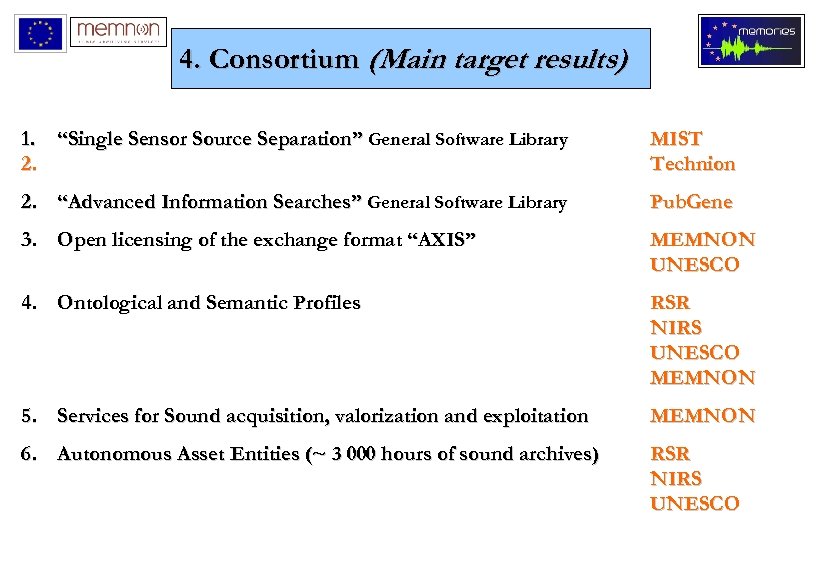 4. Consortium (Main target results) 1. “Single Sensor Source Separation” General Software Library 2. MIST Technion 2. “Advanced Information Searches” General Software Library Pub. Gene 3. Open licensing of the exchange format “AXIS” MEMNON UNESCO 4. Ontological and Semantic Profiles RSR NIRS UNESCO MEMNON 5. Services for Sound acquisition, valorization and exploitation MEMNON 6. Autonomous Asset Entities (~ 3 000 hours of sound archives) RSR NIRS UNESCO
 Short presentation of memories IST project n° 053500 http: //www. memories-project. eu Prepared by: Guy Maréchal (Project architect) Contacts: guy. marechal@memnon. be Michel Merten (Project coordinator) michel. merten@memnon. be Jean-François Cosandier (Dissemination coordinator) jean-francois. cosandier@rsr. ch