


 Скачать презентацию Short-Lived Climate Pollutants SLCP and their role in
1aaaa4e96319476e13670bfb8b27e302.ppt
- Количество слайдов: 36
 Short-Lived Climate Pollutants (SLCP) and their role in climate change and variability A. R. Ravishankara: • • • Importance of SLPCs NOAA’s role Examples of interconnections: Ø with air quality issues. Ø with stratospheric ozone issues James Butler: Short-Lived Non-CO 2 Greenhouse Gases V. Ramaswamy: Quantitative understanding, with uncertainties, of emissions-to-transport-to-lifetimeto-climate (e. g. , temperature, precipitation) using global models, for predictability in the 21 st Century • Role of aerosols in the 20 th C and present-day • Aerosols and climate projections in the 21 st C 1
 Importance of SLPCs and NOAA’s role A. R. Ravishankara NOAA / ESRL / Chemical Sciences Division / Boulder 2
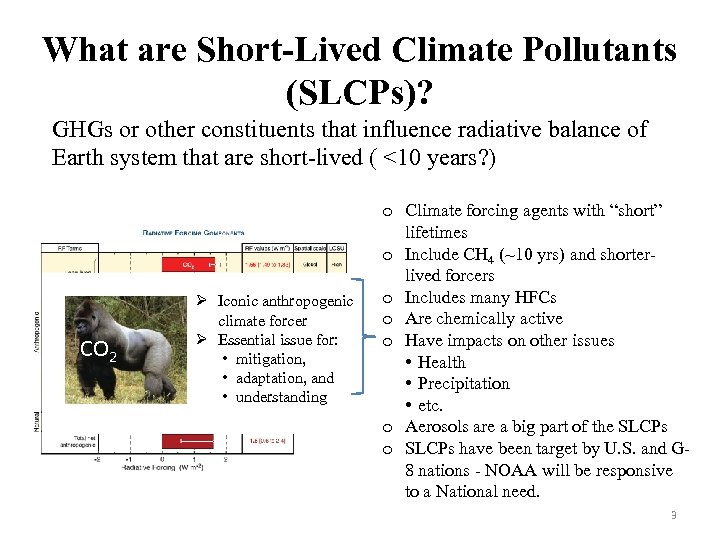 What are Short-Lived Climate Pollutants (SLCPs)? GHGs or other constituents that influence radiative balance of Earth system that are short-lived ( <10 years? ) CO 2 Ø Iconic anthropogenic climate forcer Ø Essential issue for: • mitigation, • adaptation, and • understanding o Climate forcing agents with “short” lifetimes o Include CH 4 (~10 yrs) and shorterlived forcers o Includes many HFCs o Are chemically active o Have impacts on other issues • Health • Precipitation • etc. o Aerosols are a big part of the SLCPs o SLCPs have been target by U. S. and G 8 nations - NOAA will be responsive to a National need. 3
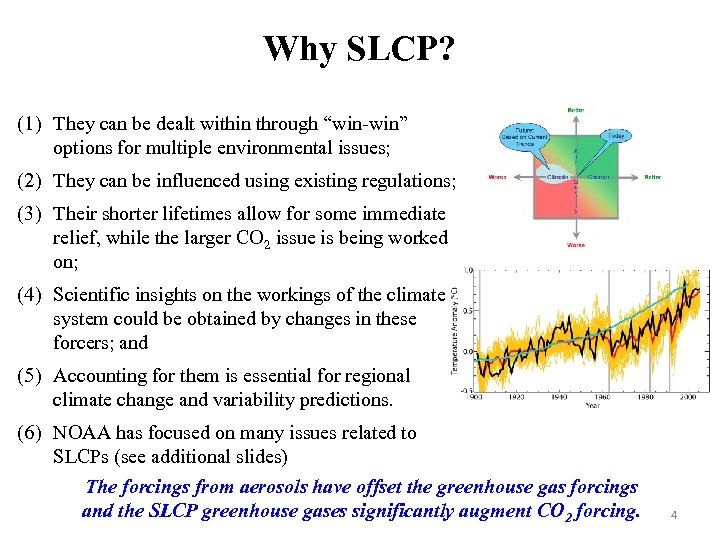 Why SLCP? (1) They can be dealt within through “win-win” options for multiple environmental issues; (2) They can be influenced using existing regulations; (3) Their shorter lifetimes allow for some immediate relief, while the larger CO 2 issue is being worked on; (4) Scientific insights on the workings of the climate system could be obtained by changes in these forcers; and (5) Accounting for them is essential for regional climate change and variability predictions. (6) NOAA has focused on many issues related to SLCPs (see additional slides) The forcings from aerosols have offset the greenhouse gas forcings and the SLCP greenhouse gases significantly augment CO 2 forcing. 4
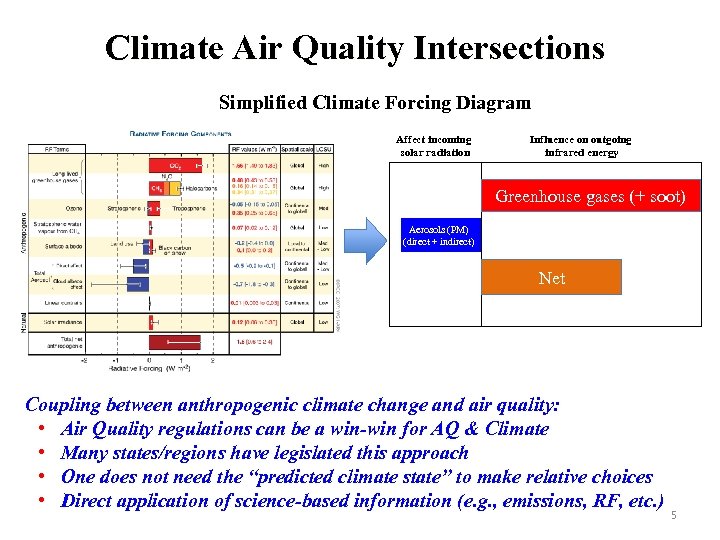 Climate Air Quality Intersections Simplified Climate Forcing Diagram Affect incoming solar radiation Influence on outgoing infrared energy Greenhouse gases (+ soot) Aerosols (PM) (direct + indirect) Net Coupling between anthropogenic climate change and air quality: • Air Quality regulations can be a win-win for AQ & Climate • Many states/regions have legislated this approach • One does not need the “predicted climate state” to make relative choices • Direct application of science-based information (e. g. , emissions, RF, etc. ) 5
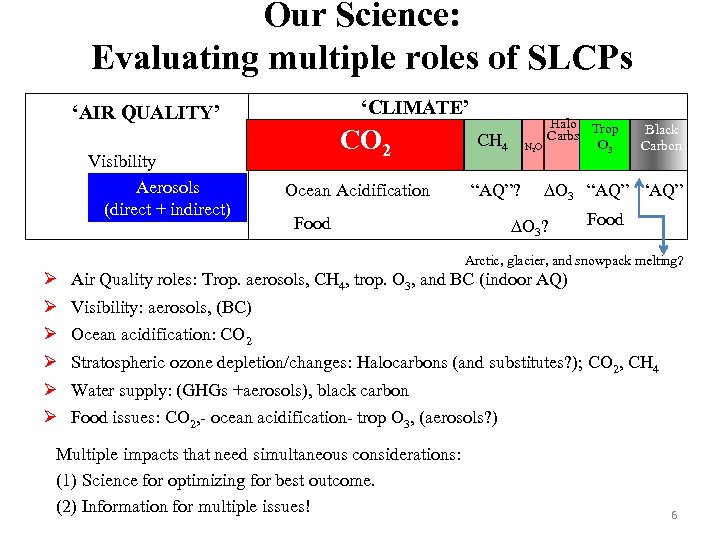 Our Science: Evaluating multiple roles of SLCPs ‘CLIMATE’ ‘AIR QUALITY’ Visibility Aerosols (direct + indirect) CO 2 Ocean Acidification CH 4 N 2 O “AQ”? Food Halo Trop Carbs O 3 Black Carbon DO 3 “AQ” DO 3? Food Arctic, glacier, and snowpack melting? Ø Ø Ø Air Quality roles: Trop. aerosols, CH 4, trop. O 3, and BC (indoor AQ) Visibility: aerosols, (BC) Ocean acidification: CO 2 Stratospheric ozone depletion/changes: Halocarbons (and substitutes? ); CO 2, CH 4 Water supply: (GHGs +aerosols), black carbon Food issues: CO 2, - ocean acidification- trop O 3, (aerosols? ) Multiple impacts that need simultaneous considerations: (1) Science for optimizing for best outcome. (2) Information for multiple issues! 6
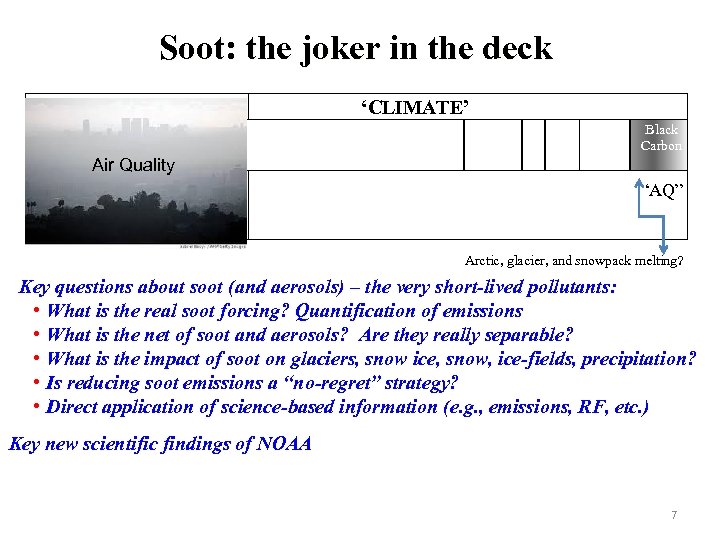 Soot: the joker in the deck ‘AIR QUALITY’ Visibility Air Quality Aerosols (direct + indirect) ‘CLIMATE’ Black Carbon “AQ” Arctic, glacier, and snowpack melting? Key questions about soot (and aerosols) – the very short-lived pollutants: • What is the real soot forcing? Quantification of emissions • What is the net of soot and aerosols? Are they really separable? • What is the impact of soot on glaciers, snow ice, snow, ice-fields, precipitation? • Is reducing soot emissions a “no-regret” strategy? • Direct application of science-based information (e. g. , emissions, RF, etc. ) Key new scientific findings of NOAA 7
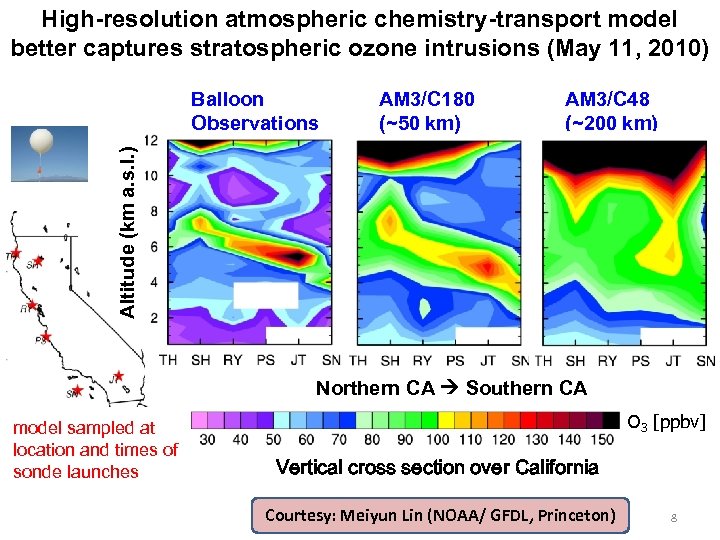 High-resolution atmospheric chemistry-transport model better captures stratospheric ozone intrusions (May 11, 2010) AM 3/C 180 (~50 km) AM 3/C 48 (~200 km) Altitude (km a. s. l. ) Balloon Observations Northern CA Southern CA model sampled at location and times of sonde launches O 3 [ppbv] Vertical cross section over California Courtesy: Meiyun Lin (NOAA/ GFDL, Princeton) 8
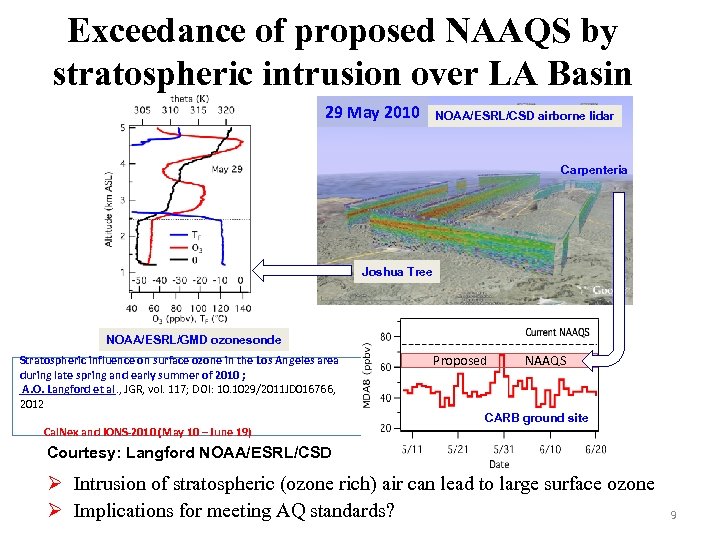 Exceedance of proposed NAAQS by stratospheric intrusion over LA Basin 29 May 2010 NOAA/ESRL/CSD airborne lidar Carpenteria Joshua Tree NOAA/ESRL/GMD ozonesonde Stratospheric influence on surface ozone in the Los Angeles area during late spring and early summer of 2010 ; A. O. Langford et al. , JGR, vol. 117; DOI: 10. 1029/2011 JD 016766, 2012 Proposed NAAQS CARB ground site Cal. Nex and IONS-2010 (May 10 – June 19) Courtesy: Langford NOAA/ESRL/CSD Ø Intrusion of stratospheric (ozone rich) air can lead to large surface ozone Ø Implications for meeting AQ standards? 9
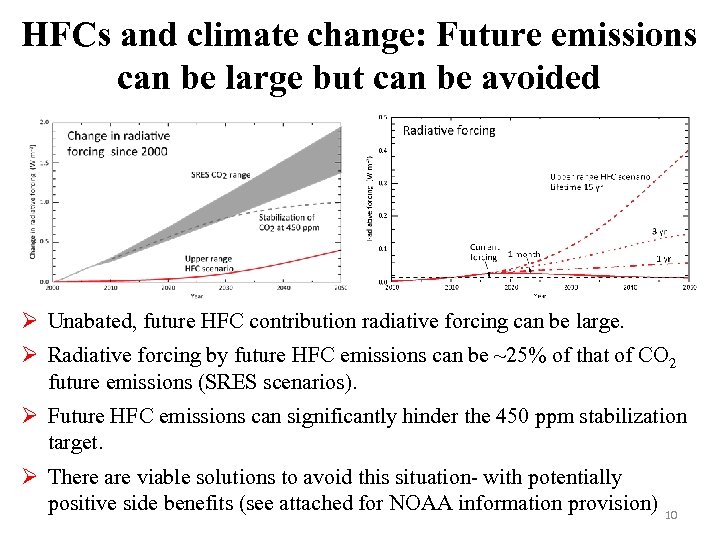 HFCs and climate change: Future emissions can be large but can be avoided Ø Unabated, future HFC contribution radiative forcing can be large. Ø Radiative forcing by future HFC emissions can be ~25% of that of CO 2 future emissions (SRES scenarios). Ø Future HFC emissions can significantly hinder the 450 ppm stabilization target. Ø There are viable solutions to avoid this situation- with potentially positive side benefits (see attached for NOAA information provision) 10
 Short-Lived Non-CO 2 Greenhouse Gases James Butler NOAA / ESRL / Global Monitoring Division / Boulder 11
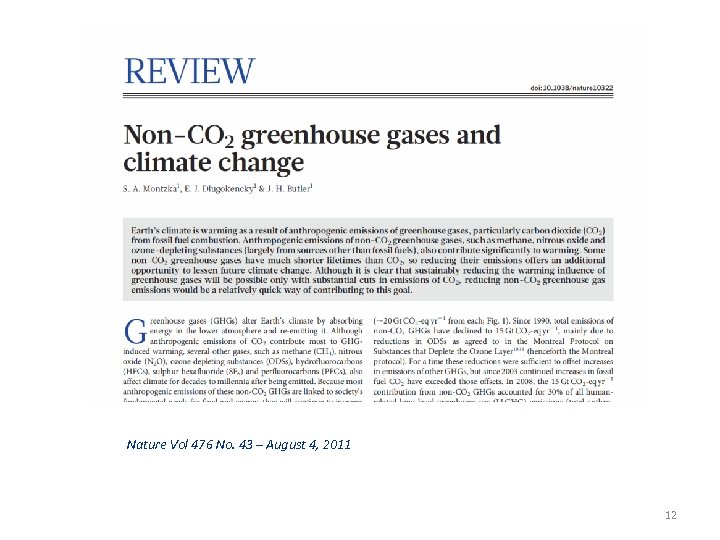 Nature Vol 476 No. 43 – August 4, 2011 12
 Example: Ozone-depleting gases 13
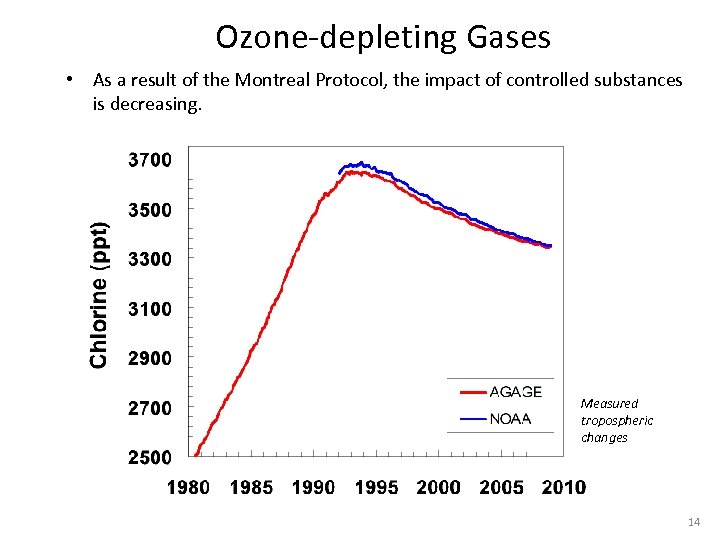 Ozone-depleting Gases • As a result of the Montreal Protocol, the impact of controlled substances is decreasing. Measured tropospheric changes 14
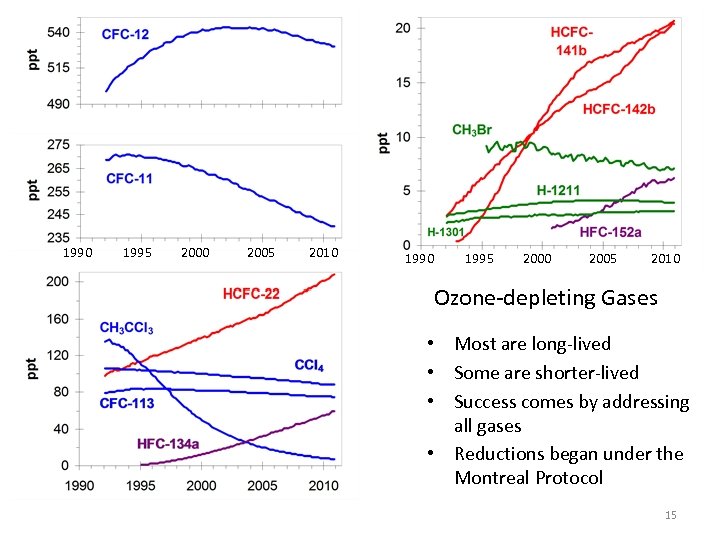 1990 1995 2000 2005 2010 Ozone-depleting Gases • Most are long-lived • Some are shorter-lived • Success comes by addressing all gases • Reductions began under the Montreal Protocol 15
 How much are we emitting in the way of greenhouse gases? 16
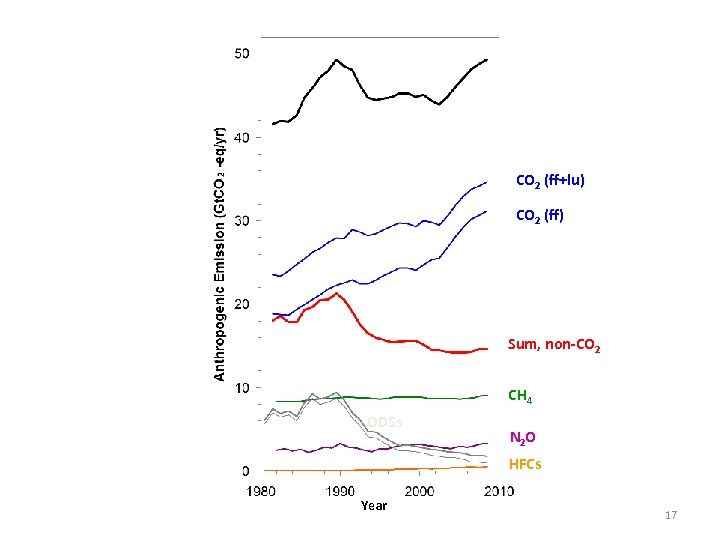 CO 2 (ff+lu) CO 2 (ff) Sum, non-CO 2 CH 4 ODSs N 2 O HFCs Year 17
 How do these changes affect the atmosphere? 18
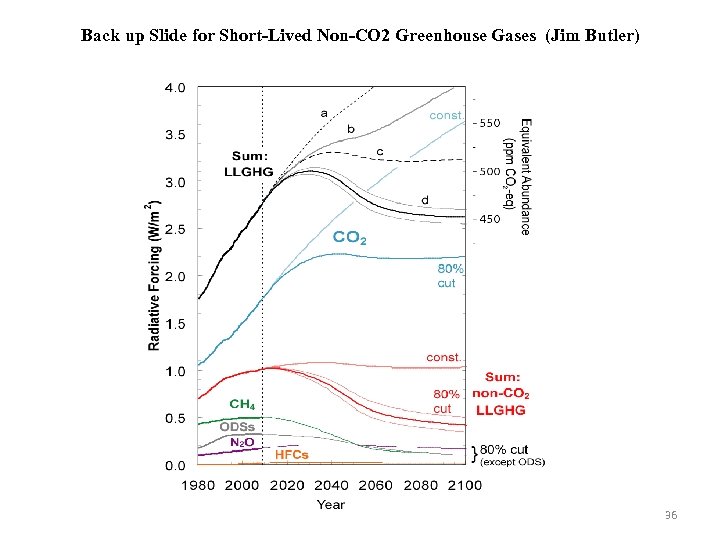
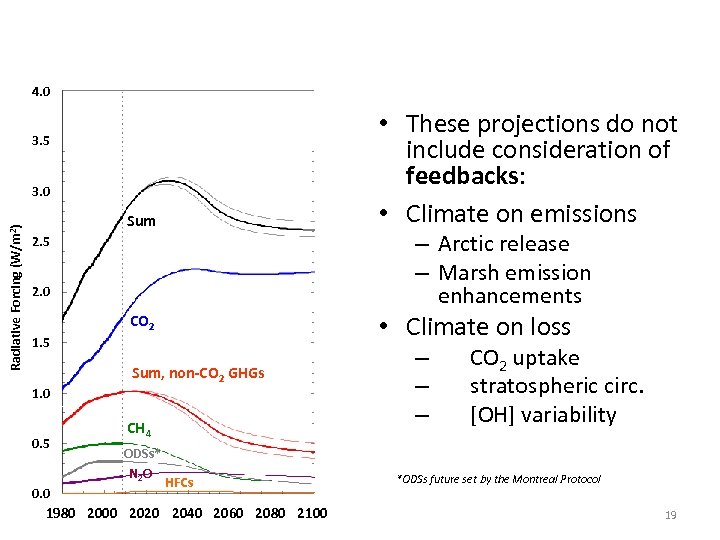 4. 0 • These projections do not include consideration of feedbacks: • Climate on emissions 3. 5 Radiative Forcing (W/m 2) 3. 0 Sum – Arctic release – Marsh emission enhancements 2. 5 2. 0 • Climate on loss CO 2 1. 5 1. 0 0. 5 0. 0 Sum, non-CO 2 GHGs CH 4 ODSs* N 2 O HFCs 1980 2000 2020 2040 2060 2080 2100 – – – CO 2 uptake stratospheric circ. [OH] variability *ODSs future set by the Montreal Protocol 19
 Warming effect of short-lived substances 20
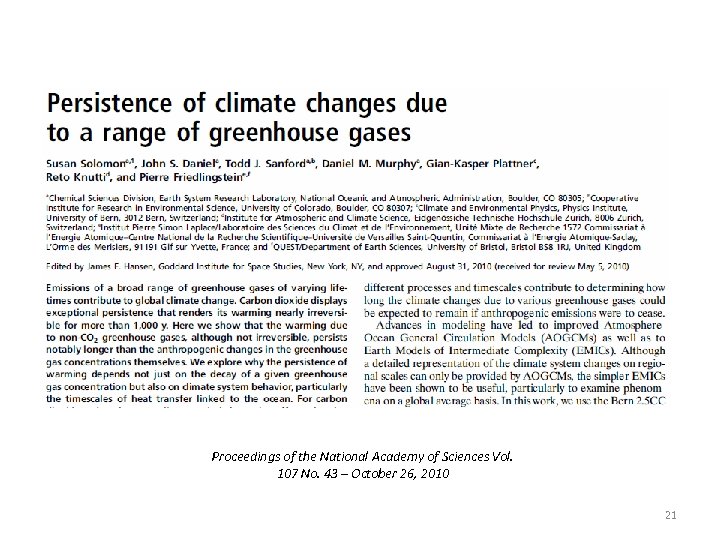 Proceedings of the National Academy of Sciences Vol. 107 No. 43 – October 26, 2010 21
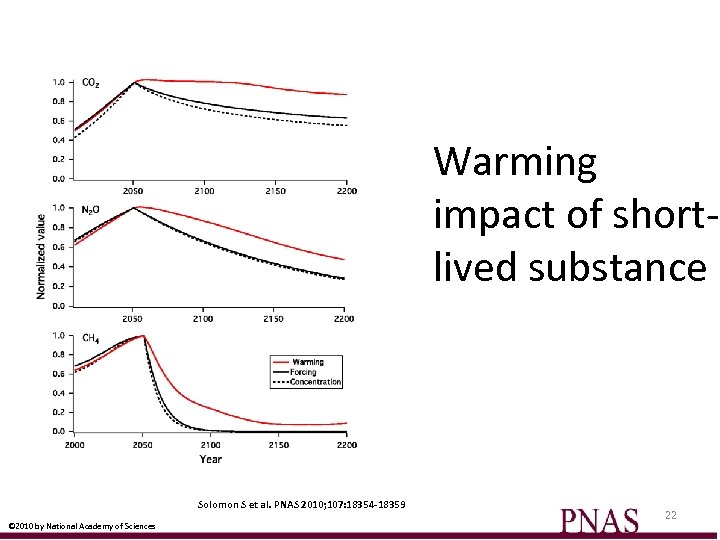 Warming impact of shortlived substance Solomon S et al. PNAS 2010; 107: 18354 -18359 © 2010 by National Academy of Sciences 22
 Aerosols and their role in Climate Change and Variability V. Ramaswamy NOAA/ GFDL, Princeton Quantitative understanding, with uncertainties, of emissions-totransport-to-lifetime-to-climate (e. g. , temperature, precipitation) using global models, for predictability in the 21 st Century • Attribution to GHGs versus aerosols in the 20 th C and present-day • Aerosols and climate projections in the 21 st C 23
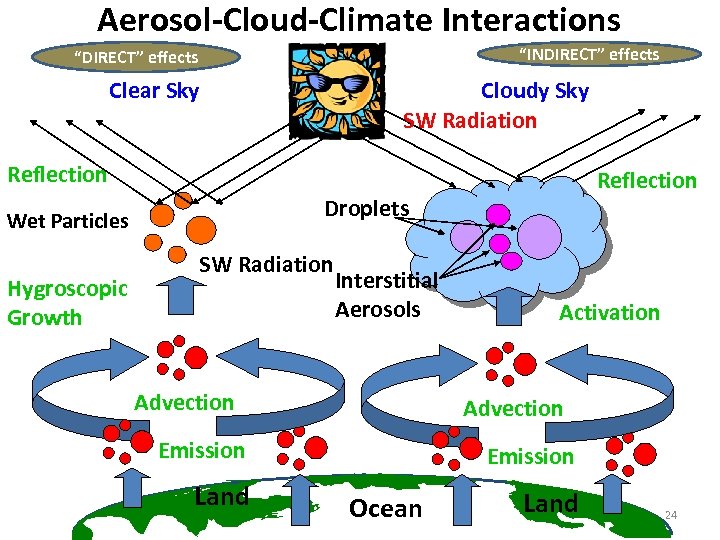 Aerosol-Cloud-Climate Interactions “INDIRECT” effects “DIRECT” effects Clear Sky Cloudy Sky SW Radiation Reflection Droplets Wet Particles Hygroscopic Growth Reflection SW Radiation Interstitial Aerosols Advection Emission Land Activation Emission Ocean Land 24
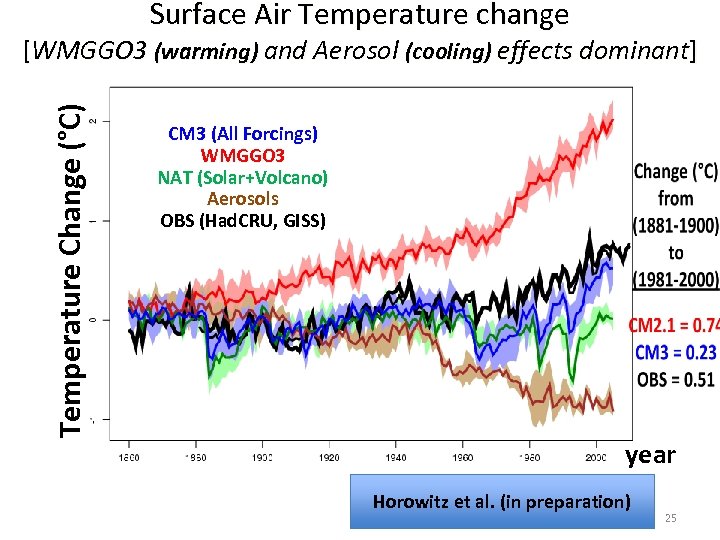 Surface Air Temperature change Temperature Change (°C) [WMGGO 3 (warming) and Aerosol (cooling) effects dominant] CM 3 (All Forcings) WMGGO 3 NAT (Solar+Volcano) Aerosols OBS (Had. CRU, GISS) year Horowitz et al. (in preparation) 25
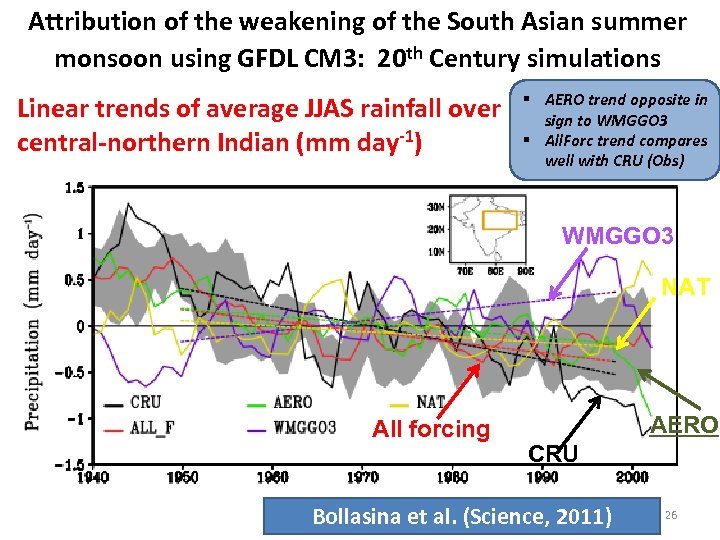 Attribution of the weakening of the South Asian summer monsoon using GFDL CM 3: 20 th Century simulations Linear trends of average JJAS rainfall over central-northern Indian (mm day-1) § AERO trend opposite in sign to WMGGO 3 § All. Forc trend compares well with CRU (Obs) WMGGO 3 NAT All forcing AERO CRU Bollasina et al. (Science, 2011) 26
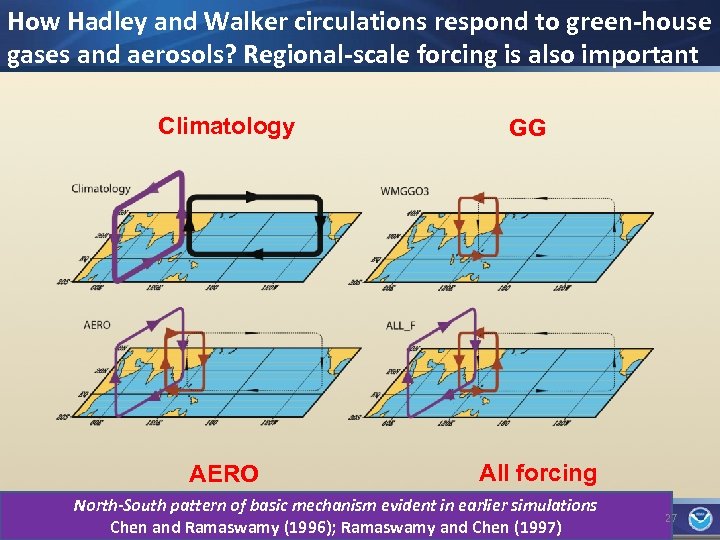 How Hadley and Walker circulations respond to green-house gases and aerosols? Regional-scale forcing is also important Climatology AERO GG All forcing North-South pattern of basic mechanism evident in earlier simulations Chen and Ramaswamy (1996); Ramaswamy and Chen (1997) Geophysical Fluid Dynamics Laboratory 27
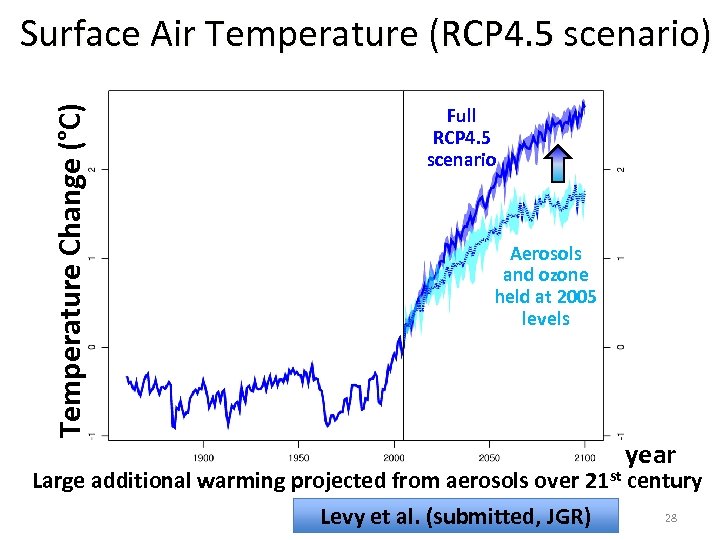 Temperature Change (°C) Surface Air Temperature (RCP 4. 5 scenario) Full RCP 4. 5 scenario Aerosols and ozone held at 2005 levels year Large additional warming projected from aerosols over 21 st century 28 Levy et al. (submitted, JGR)
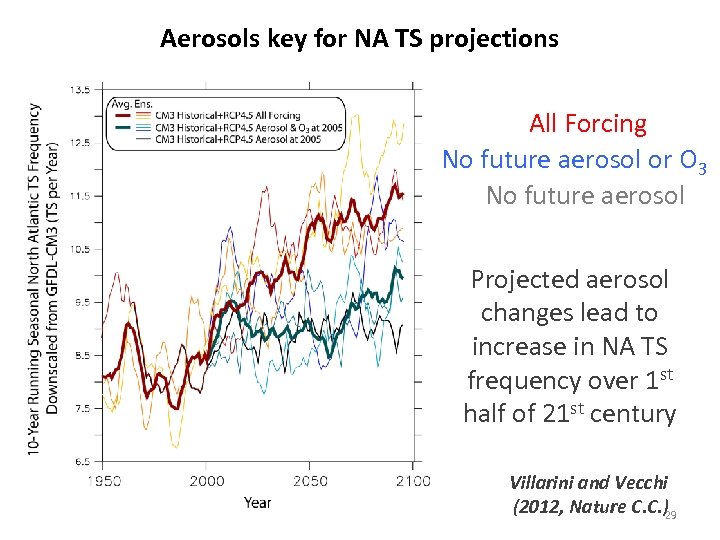 Aerosols key for NA TS projections All Forcing No future aerosol or O 3 No future aerosol Projected aerosol changes lead to increase in NA TS frequency over 1 st half of 21 st century Villarini and Vecchi (2012, Nature C. C. ) 29
 Aerosols and their role in Climate Change and Variability Key Uncertainties Quantitative understanding, with uncertainties, of emissions-totransport-to-lifetime-to-climate (e. g. , temperature, precipitation) using global models, for predictability in the 21 st Century • Spatial distributions of aerosols and their properties Forcing, with uncertainties • Regional climate trends in temperature and precipitation • Atmospheric trends (e. g. , changes in lapse rate) • Relative impacts versus long-lived greenhouse gases Quantifying with uncertainties 30
 Synopsis • There is a great demand for information on SLCPs • NOAA (with its partners) has the expertise and capabilities to fulfill these needs • Have already developed great partnerships with regions, states, and other users (e. g. , State Dept. ) • Have developed long-term collaborations with extramural community to carry out such research • Have NOAA facilities that are well suited for this work and collaborations 31
 The END 32
 Additional Material 33
 SLCP and NOAA’s efforts NOAA has focused on many issues related to SLCPs: • The physical and chemical nature of these species; • How they have forced the climate system; • How they will contribute in the future; • What are the telltale signatures of these forcers; and • What have been and will be the impacts of these changes on climate, air quality, and precipitation 34
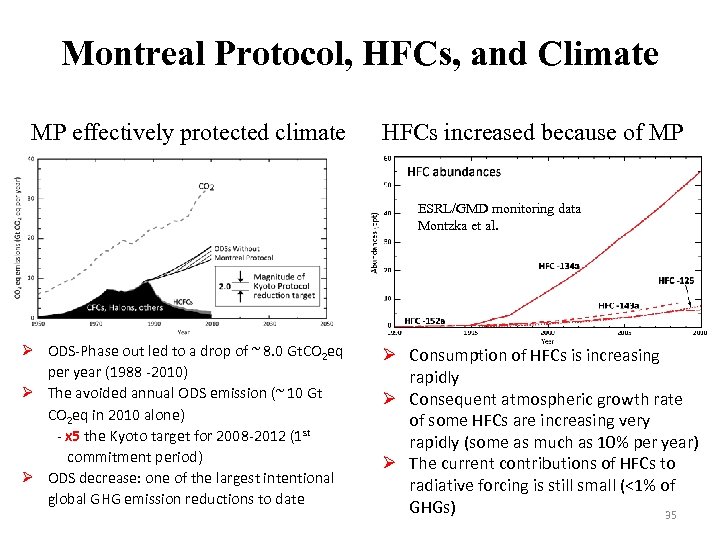 Montreal Protocol, HFCs, and Climate MP effectively protected climate HFCs increased because of MP ESRL/GMD monitoring data Montzka et al. Ø ODS-Phase out led to a drop of ~ 8. 0 Gt. CO 2 eq per year (1988 -2010) Ø The avoided annual ODS emission (~ 10 Gt CO 2 eq in 2010 alone) - x 5 the Kyoto target for 2008 -2012 (1 st commitment period) Ø ODS decrease: one of the largest intentional global GHG emission reductions to date Ø Consumption of HFCs is increasing rapidly Ø Consequent atmospheric growth rate of some HFCs are increasing very rapidly (some as much as 10% per year) Ø The current contributions of HFCs to radiative forcing is still small (<1% of GHGs) 35
 Back up Slide for Short-Lived Non-CO 2 Greenhouse Gases (Jim Butler) 36