


 Скачать презентацию Short free on-line courses Taste e-learning Maria Kocsis
26cab294a423ecf3ca6f1e05b37719c4.ppt
- Количество слайдов: 10
 Short, free on-line courses Taste e-learning! Maria Kocsis Baán University of Miskolc, North Hungarian Regional Distance Education Centre Helsinki, 3 July, 2006
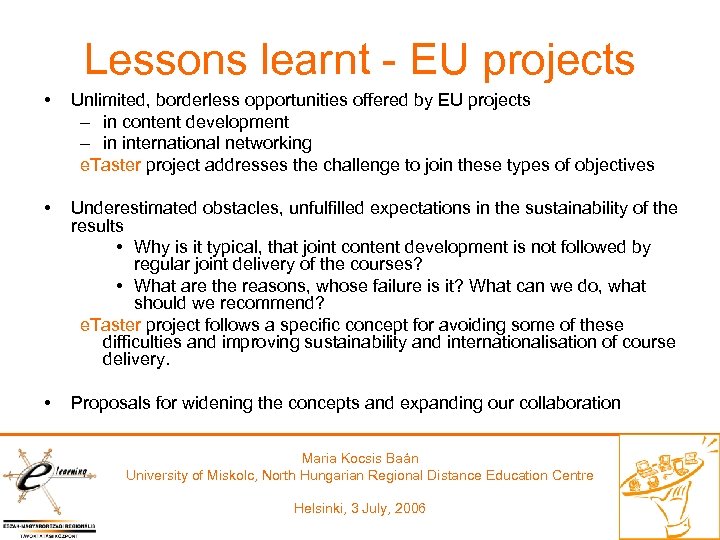 Lessons learnt - EU projects • Unlimited, borderless opportunities offered by EU projects – in content development – in international networking e. Taster project addresses the challenge to join these types of objectives • Underestimated obstacles, unfulfilled expectations in the sustainability of the results • Why is it typical, that joint content development is not followed by regular joint delivery of the courses? • What are the reasons, whose failure is it? What can we do, what should we recommend? e. Taster project follows a specific concept for avoiding some of these difficulties and improving sustainability and internationalisation of course delivery. • Proposals for widening the concepts and expanding our collaboration Maria Kocsis Baán University of Miskolc, North Hungarian Regional Distance Education Centre Helsinki, 3 July, 2006
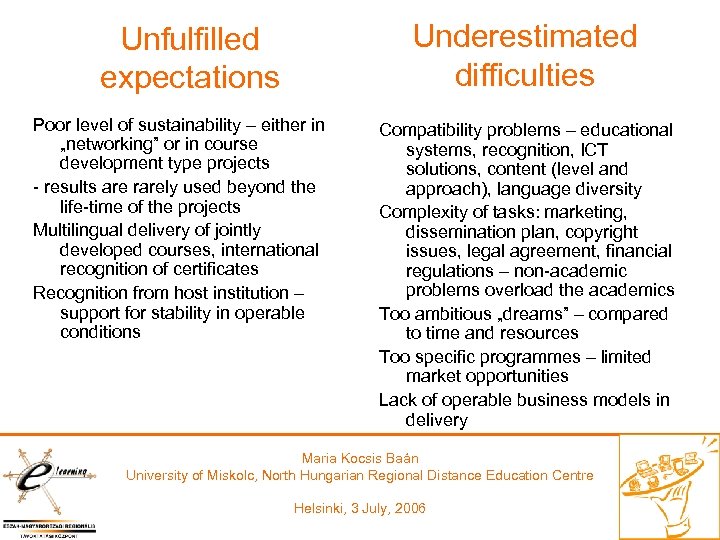 Underestimated difficulties Unfulfilled expectations Poor level of sustainability – either in „networking” or in course development type projects - results are rarely used beyond the life-time of the projects Multilingual delivery of jointly developed courses, international recognition of certificates Recognition from host institution – support for stability in operable conditions Compatibility problems – educational systems, recognition, ICT solutions, content (level and approach), language diversity Complexity of tasks: marketing, dissemination plan, copyright issues, legal agreement, financial regulations – non-academic problems overload the academics Too ambitious „dreams” – compared to time and resources Too specific programmes – limited market opportunities Lack of operable business models in delivery Maria Kocsis Baán University of Miskolc, North Hungarian Regional Distance Education Centre Helsinki, 3 July, 2006
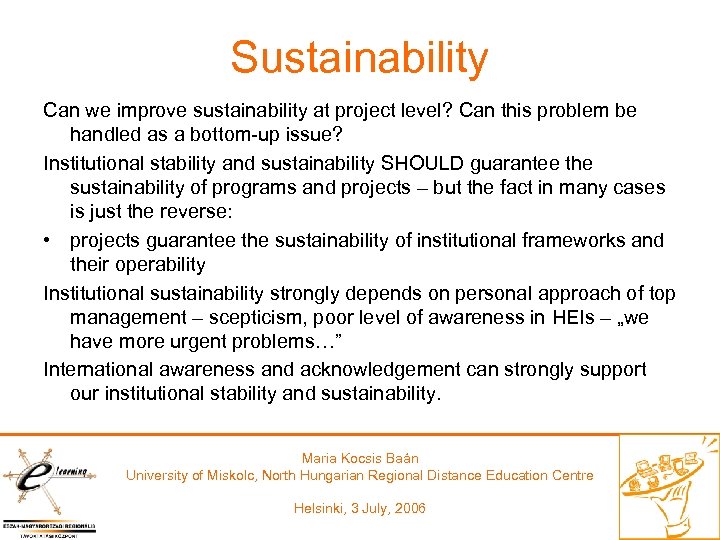 Sustainability Can we improve sustainability at project level? Can this problem be handled as a bottom-up issue? Institutional stability and sustainability SHOULD guarantee the sustainability of programs and projects – but the fact in many cases is just the reverse: • projects guarantee the sustainability of institutional frameworks and their operability Institutional sustainability strongly depends on personal approach of top management – scepticism, poor level of awareness in HEIs – „we have more urgent problems…” International awareness and acknowledgement can strongly support our institutional stability and sustainability. Maria Kocsis Baán University of Miskolc, North Hungarian Regional Distance Education Centre Helsinki, 3 July, 2006
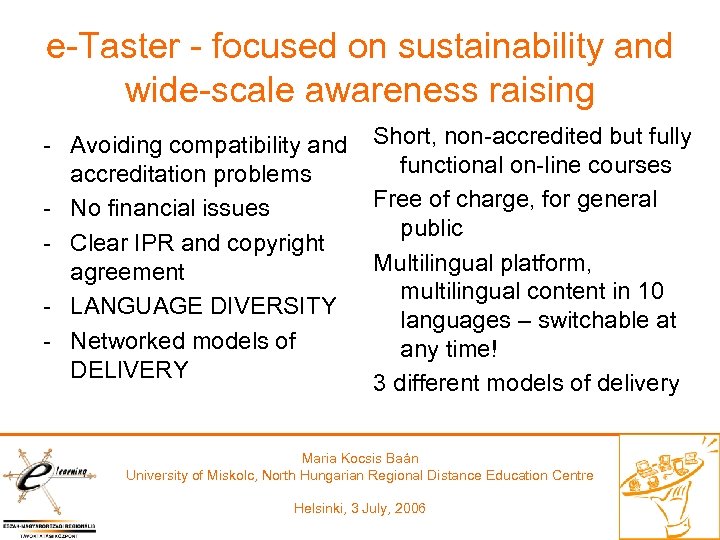 e-Taster - focused on sustainability and wide-scale awareness raising - Avoiding compatibility and accreditation problems - No financial issues - Clear IPR and copyright agreement - LANGUAGE DIVERSITY - Networked models of DELIVERY Short, non-accredited but fully functional on-line courses Free of charge, for general public Multilingual platform, multilingual content in 10 languages – switchable at any time! 3 different models of delivery Maria Kocsis Baán University of Miskolc, North Hungarian Regional Distance Education Centre Helsinki, 3 July, 2006
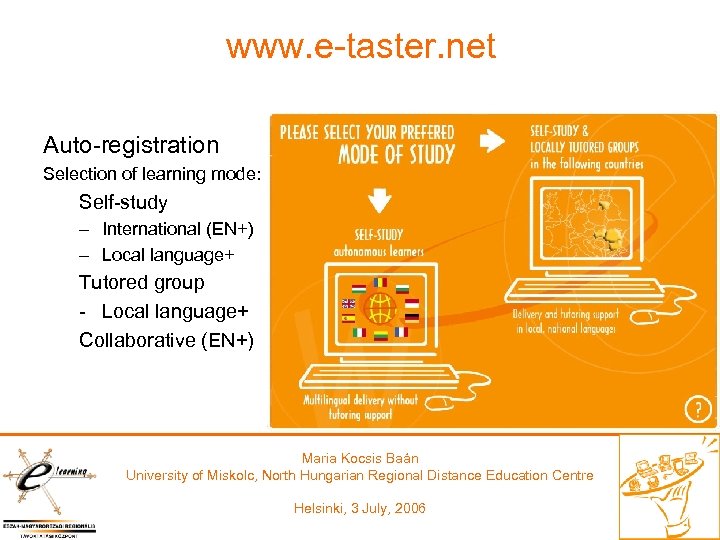 www. e-taster. net Auto-registration Selection of learning mode: Self-study – International (EN+) – Local language+ Tutored group - Local language+ Collaborative (EN+) Maria Kocsis Baán University of Miskolc, North Hungarian Regional Distance Education Centre Helsinki, 3 July, 2006
 Expected long term sustainability Operation of the system beyond the life-time of the project may be expected as • tasters are prepared with special care for being selfstanding, or will need minimised staff-support. • Human resources for tutoring can be solved as – recruited in unusual way, e. g. tutoring of learners groups can be the task of students at related courses, teachers on continuing education programs, etc. – ODL organisations may consider them as valuable marketing and awareness raising tools - worth to keep on operation. Maria Kocsis Baán University of Miskolc, North Hungarian Regional Distance Education Centre Helsinki, 3 July, 2006
 Rules of the game • All taster courses are free for learners, for general public, offered in the languages and in the form, as they are developed by the support of the project. • No profit can be generated by selling these courses on-line • Access provided via the central, e. Taster site, as a guarantee of transparency Third parties may join the initiative, to widen the range of - translated language versions, - languages (beyond the 10 languages), - courses - new content development in the same learning environment Maria Kocsis Baán University of Miskolc, North Hungarian Regional Distance Education Centre Helsinki, 3 July, 2006
 Still under debate … - Reusability of content elements (course content without the platform, in standardised, interoperable format) - Modification of course content - Application of different LMS Maria Kocsis Baán University of Miskolc, North Hungarian Regional Distance Education Centre Helsinki, 3 July, 2006
 Your comments and your joining are warmly welcome! Thank you for your attantion! Maria Kocsis Baán University of Miskolc, North Hungarian Regional Distance Education Centre Helsinki, 3 July, 2006