


 Скачать презентацию SHORT COURSE ON THE EUROPEAN ASYLUM ACQUIS THE
Ekaterinburg - 1 Structure, TP 20160425.pptx
- Количество слайдов: 48
 SHORT COURSE ON THE EUROPEAN ASYLUM ACQUIS THE AREA OF FREEDOM, SECURITY AND JUSTICE General Introduction THE TEMPORARY PROTECTION DIRECTIVE Presented by Boldizsár Nagy, The Urals State Law University, 2016 Ekaterinburg
 PHOTO OF JAVIER BALAUZ
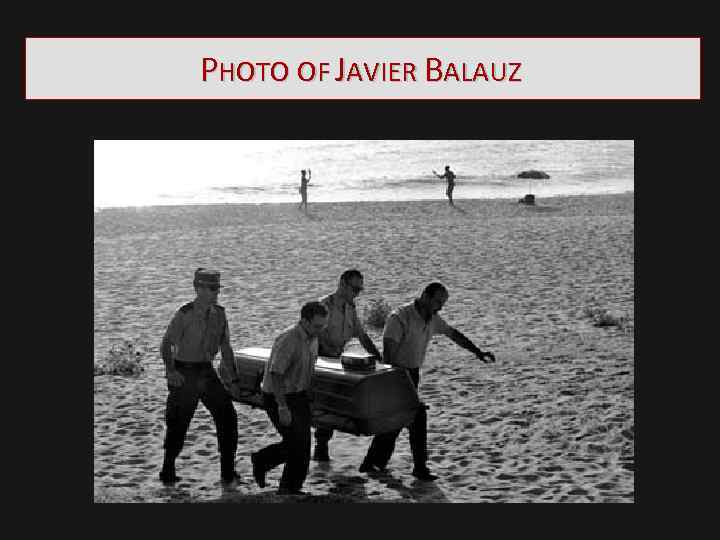 PHOTO OF JAVIER BALAUZ
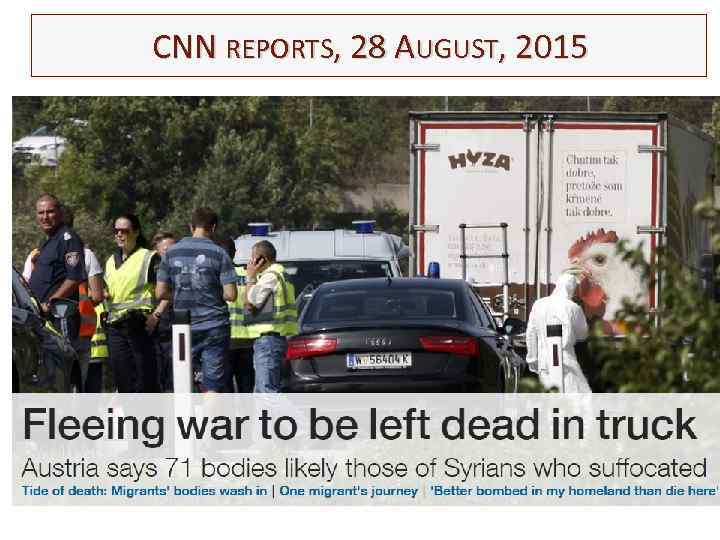 CNN REPORTS, 28 AUGUST, 2015
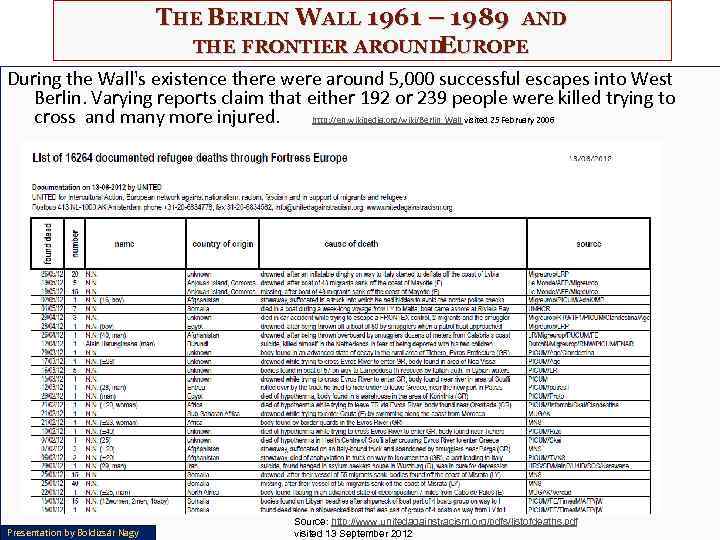 THE BERLIN WALL 1961 – 1989 AND THE FRONTIER AROUND UROPE E During the Wall's existence there were around 5, 000 successful escapes into West Berlin. Varying reports claim that either 192 or 239 people were killed trying to cross and many more injured. http: //en. wikipedia. org/wiki/Berlin_Wall visited 25 February 2006 Presentation by Boldizsár Nagy Source: http: //www. unitedagainstracism. org/pdfs/listofdeaths. pdf visited 13 September 2012
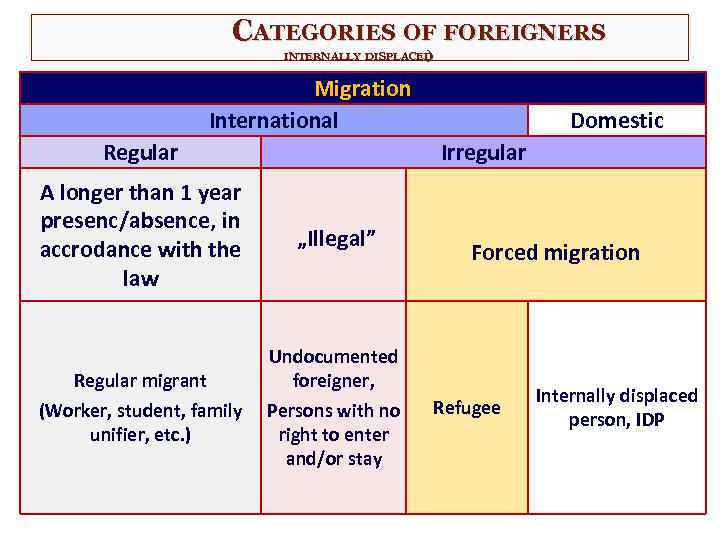 CATEGORIES OF FOREIGNERS INTERNALLY DISPLACED ) Migration International Regular Domestic Irregular A longer than 1 year presenc/absence, in accrodance with the law „Illegal” Regular migrant (Worker, student, family unifier, etc. ) Undocumented foreigner, Persons with no right to enter and/or stay Forced migration Refugee Internally displaced person, IDP
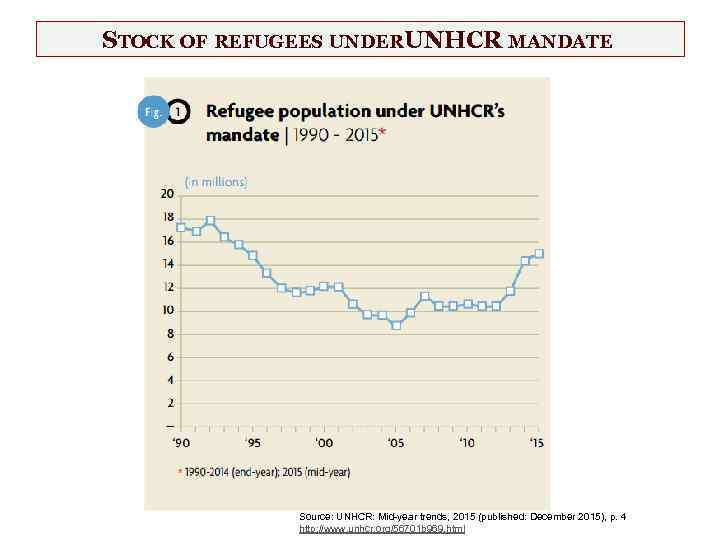 STOCK OF REFUGEES UNDERUNHCR MANDATE Source: UNHCR: Mid-year trends, 2015 (published: December 2015), p. 4 http: //www. unhcr. org/56701 b 969. html
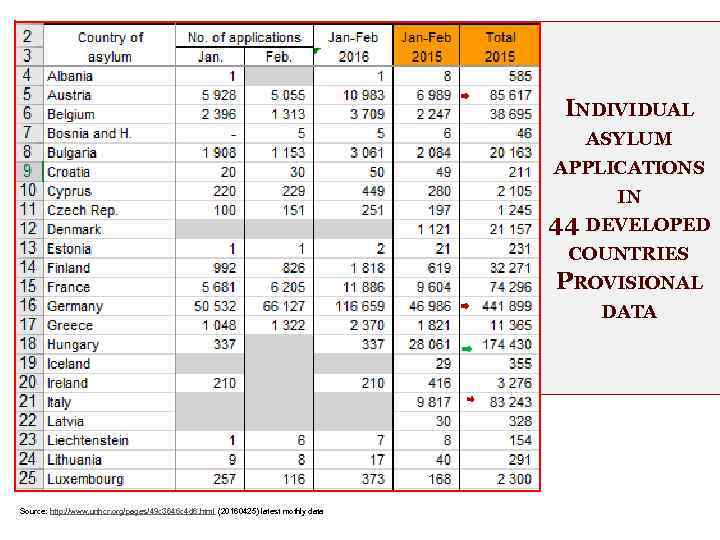 INDIVIDUAL ASYLUM APPLICATIONS IN 44 DEVELOPED COUNTRIES PROVISIONAL DATA Source: http: //www. unhcr. org/pages/49 c 3646 c 4 d 6. html (20160425) latest mothly data
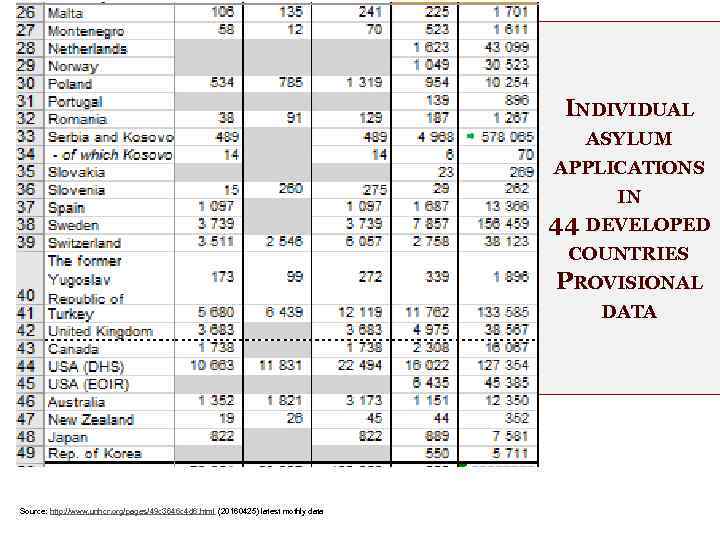 INDIVIDUAL ASYLUM APPLICATIONS IN 44 DEVELOPED COUNTRIES PROVISIONAL DATA Source: http: //www. unhcr. org/pages/49 c 3646 c 4 d 6. html (20160425) latest mothly data
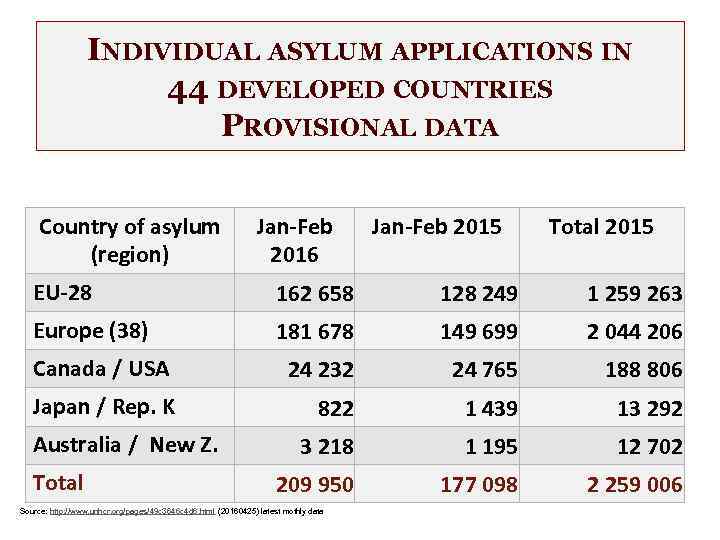 INDIVIDUAL ASYLUM APPLICATIONS IN 44 DEVELOPED COUNTRIES PROVISIONAL DATA Country of asylum (region) Jan-Feb 2016 Jan-Feb 2015 Total 2015 EU-28 162 658 128 249 1 259 263 Europe (38) 181 678 149 699 2 044 206 Canada / USA 24 232 24 765 188 806 Japan / Rep. K 822 1 439 13 292 Australia / New Z. 3 218 1 195 12 702 Total 209 950 177 098 2 259 006 Source: http: //www. unhcr. org/pages/49 c 3646 c 4 d 6. html (20160425) latest mothly data
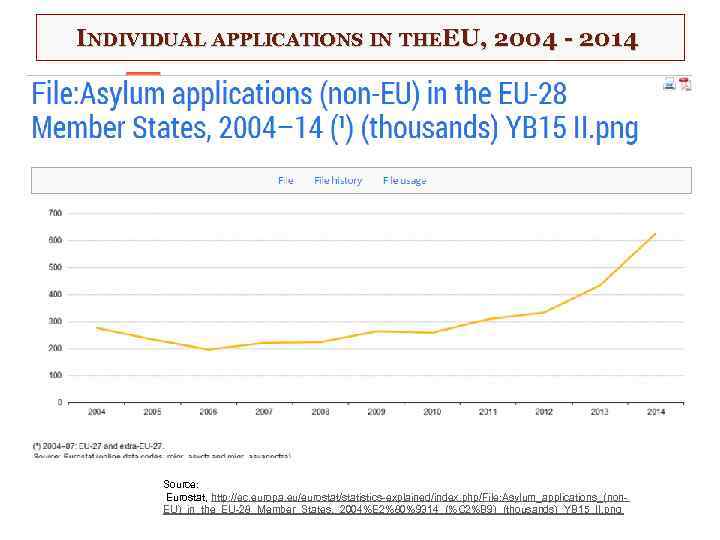 INDIVIDUAL APPLICATIONS IN THEEU, 2004 - 2014 Source: Eurostat, http: //ec. europa. eu/eurostat/statistics-explained/index. php/File: Asylum_applications_(non. EU)_in_the_EU-28_Member_States, _2004%E 2%80%9314_(%C 2%B 9)_(thousands)_YB 15_II. png
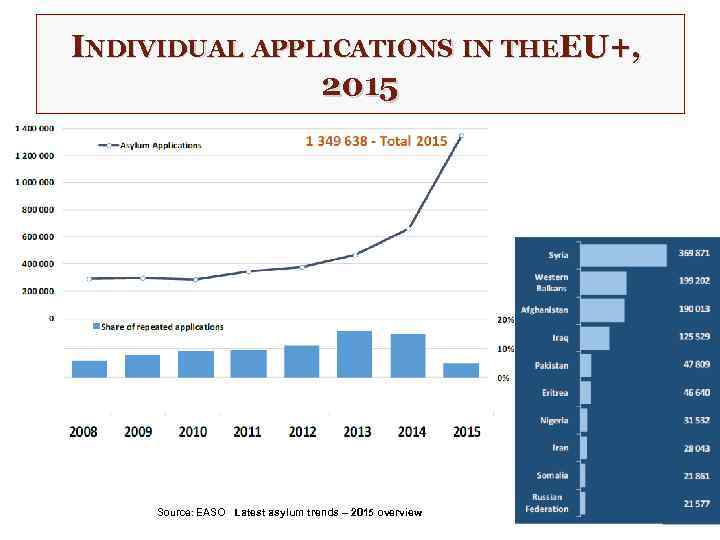 INDIVIDUAL APPLICATIONS IN THEEU+, 2015 Source: EASO Latest asylum trends – 2015 overview
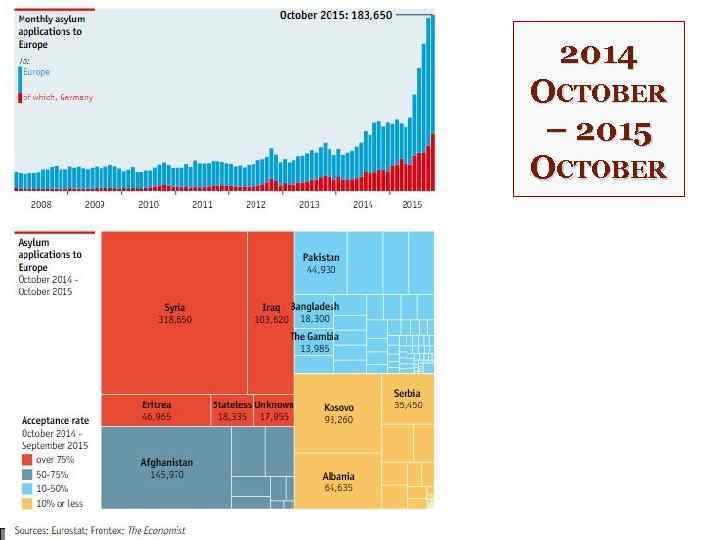 2014 OCTOBER – 2015 OCTOBER Presentation by Boldizsár Nagy
 FROM JUSTICE AND HOME AFFAIRS TO AN AREA OF FREEDOM, SECURITY AND JUSTICE
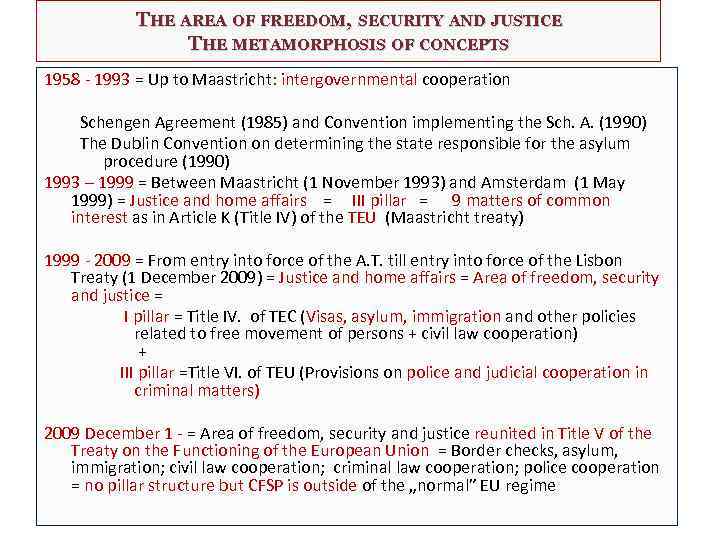 THE AREA OF FREEDOM, SECURITY AND JUSTICE THE METAMORPHOSIS OF CONCEPTS 1958 - 1993 = Up to Maastricht: intergovernmental cooperation Schengen Agreement (1985) and Convention implementing the Sch. A. (1990) The Dublin Convention on determining the state responsible for the asylum procedure (1990) 1993 – 1999 = Between Maastricht (1 November 1993) and Amsterdam (1 May 1999) = Justice and home affairs = III pillar = 9 matters of common interest as in Article K (Title IV) of the TEU (Maastricht treaty) 1999 - 2009 = From entry into force of the A. T. till entry into force of the Lisbon Treaty (1 December 2009) = Justice and home affairs = Area of freedom, security and justice = I pillar = Title IV. of TEC (Visas, asylum, immigration and other policies related to free movement of persons + civil law cooperation) + III pillar =Title VI. of TEU (Provisions on police and judicial cooperation in criminal matters) 2009 December 1 - = Area of freedom, security and justice reunited in Title V of the Treaty on the Functioning of the European Union = Border checks, asylum, immigration; civil law cooperation; criminal law cooperation; police cooperation = no pillar structure but CFSP is outside of the „normal” EU regime
 THE AREA OF FREEDOM, SECURITY AND JUSTICE Freedom = freedom of movement + immigration and asylum+ non-discrimination+ data protection Security = fight against organized crime (including terrorism) and drugs + police cooperation (Europol, Eurojust, Frontex) Justice („Recht”) = cooperation among civil and criminal courts, approximation of procedures, mutual recognition of decisions, simplification of transborder actions (litigation in another member state)
 THE RATIONALE BEHIND DEVELOPING AN EU ACQUIS: SCHENGEN
 SCHENGEN I. The creation of the Agreement (1985) and the Convention, implementing it (1990) C O N V E N T I O N IMPLEMENTING THE SCHENGEN AGREEMENT OF 14 JUNE 1985 BETWEEN THE GOVERNMENTS OF THE STATES OF THE BENELUX ECONOMIC UNION, THE FEDERAL REPUBLIC OF GERMANY AND THE FRENCH REPUBLIC, ON THE GRADUAL ABOLITION OF CHECKS AT THEIR COMMON BORDERS 19 JUNE 1990 (OJ (2000) L 239/19) II. The essence (see next slides)
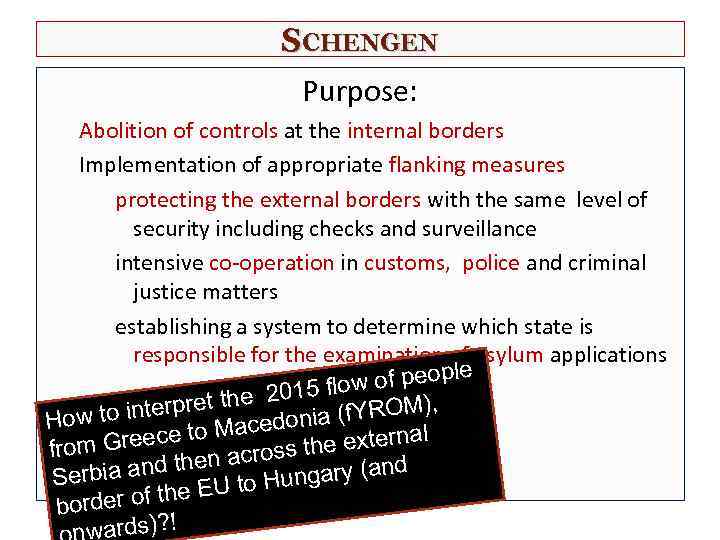 SCHENGEN Purpose: Abolition of controls at the internal borders Implementation of appropriate flanking measures protecting the external borders with the same level of security including checks and surveillance intensive co-operation in customs, police and criminal justice matters establishing a system to determine which state is responsible for the examination of asylum applications le w of peop flo the 2015 t (f. YROM), to interpre nia How o Macedo al et the extern om Greec fr ss then acro d nd Serbia an ungary (a o. H f the EU t border o wards)? !
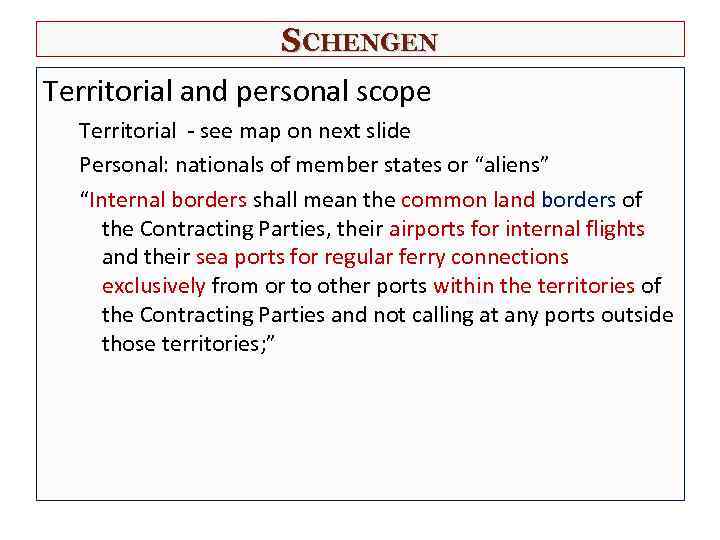 SCHENGEN Territorial and personal scope Territorial - see map on next slide Personal: nationals of member states or “aliens” “Internal borders shall mean the common land borders of the Contracting Parties, their airports for internal flights and their sea ports for regular ferry connections exclusively from or to other ports within the territories of the Contracting Parties and not calling at any ports outside those territories; ”
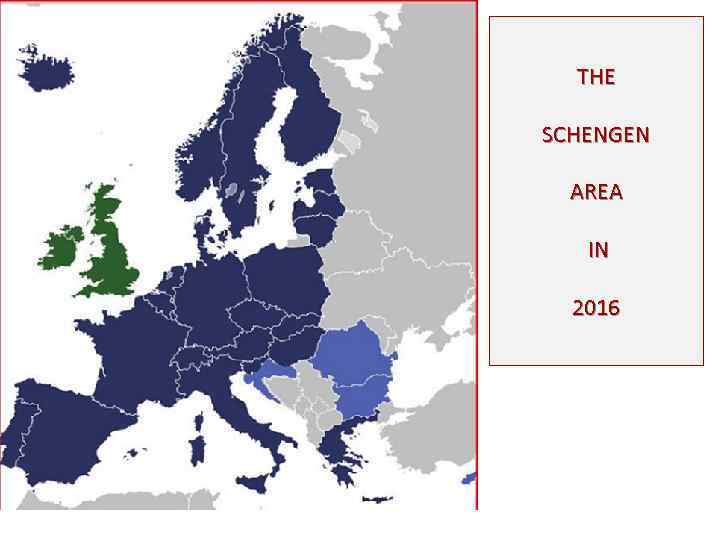 THE SCHENGEN AREA IN 2016
 THE FUNDAMENTAL INSTITUTIONAL STRUCTURE AND THE BASIC NOTIONS
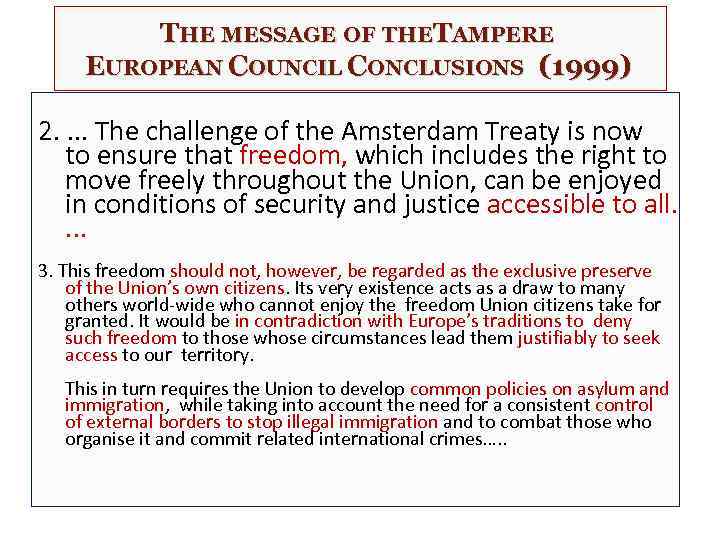 THE MESSAGE OF THETAMPERE EUROPEAN COUNCIL CONCLUSIONS (1999) 2. . The challenge of the Amsterdam Treaty is now to ensure that freedom, which includes the right to move freely throughout the Union, can be enjoyed in conditions of security and justice accessible to all. . . . 3. This freedom should not, however, be regarded as the exclusive preserve of the Union’s own citizens. Its very existence acts as a draw to many others world-wide who cannot enjoy the freedom Union citizens take for granted. It would be in contradiction with Europe’s traditions to deny such freedom to those whose circumstances lead them justifiably to seek access to our territory. This in turn requires the Union to develop common policies on asylum and immigration, while taking into account the need for a consistent control of external borders to stop illegal immigration and to combat those who organise it and commit related international crimes…. .
 THE MESSAGE OF THETAMPERE EUROPEAN COUNCIL CONCLUSIONS (1999) 4. The aim is an open and secure European Union, fully committed to the obligations of the Geneva Refugee Convention and other relevant human rights instruments, and able to respond to humanitarian needs on the basis of solidarity. A common approach must also be developed to ensure the integration into our societies of those third country nationals who are lawfully resident in the Union.
 STRATEGIC GUIDELINES „Strategic Guidelines” In the form of Conclusions of the European Council (26/27 June 2014). „Building on the past programmes, the overall priority now is * to consistently transpose, effectively implement and consolidate the legal instruments and policy measures in place. *Intensifying operational cooperation while using the potential of Information and Communication Technologies' innovations, * enhancing the role of the different EU agencies and ensuring the * strategic use of EU funds will be key. ” (Point 3, stars added -BN) Presentation by Boldizsár Nagy
 STRATEGIC GUIDELINES, 2014 (PARA 7) „ 7. The Union's commitment to international protection requires a strong European asylum policy based on solidarity and responsibility. The full transposition and effective implementation of the Common European Asylum System (CEAS) is an absolute priority. This should result in high common standards and stronger cooperation, creating a level playing field where asylum seekers are given the same procedural guarantees and protection throughout the Union. It should go hand in hand with a reinforced role for the European Asylum 1, of a 5 ter v Support Office (EASO), particularly in promoting the ne har Ge e C uniform application of the acquis. Converging to th ! e nc s or ights practices will enhance mutual trust e er ight l R f re n r nta and allow to move to future No ma me next steps. ” hu nda Fu
 THE RULES IN FORCE AFTER THE ENTRY INTO FORCE OF THE LISBON TREATY
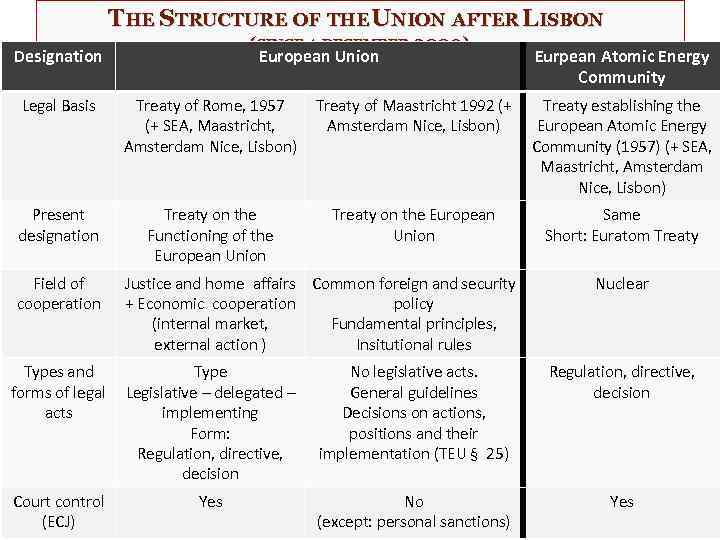 THE STRUCTURE OF THE UNION AFTER LISBON (SINCE 1 DECEMBER 2009) European Union Designation Eurpean Atomic Energy Community Legal Basis Treaty of Rome, 1957 (+ SEA, Maastricht, Amsterdam Nice, Lisbon) Treaty of Maastricht 1992 (+ Amsterdam Nice, Lisbon) Treaty establishing the European Atomic Energy Community (1957) (+ SEA, Maastricht, Amsterdam Nice, Lisbon) Present designation Treaty on the Functioning of the European Union Treaty on the European Union Same Short: Euratom Treaty Field of cooperation Justice and home affairs Common foreign and security + Economic cooperation policy (internal market, Fundamental principles, external action ) Insitutional rules Nuclear Types and Type forms of legal Legislative – delegated – acts implementing Form: Regulation, directive, decision No legislative acts. General guidelines Decisions on actions, positions and their implementation (TEU § 25) Regulation, directive, decision Court control (ECJ) No (except: personal sanctions) Yes
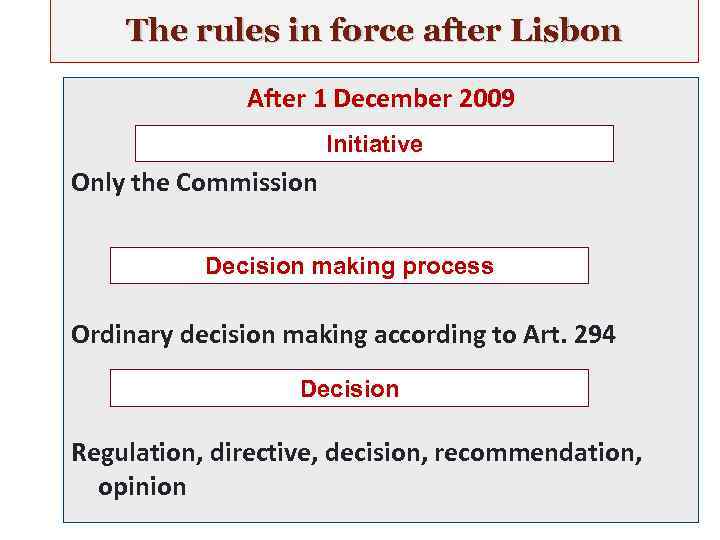 The rules in force after Lisbon After 1 December 2009 Initiative Only the Commission Decision making process Ordinary decision making according to Art. 294 Decision Regulation, directive, decision, recommendation, opinion
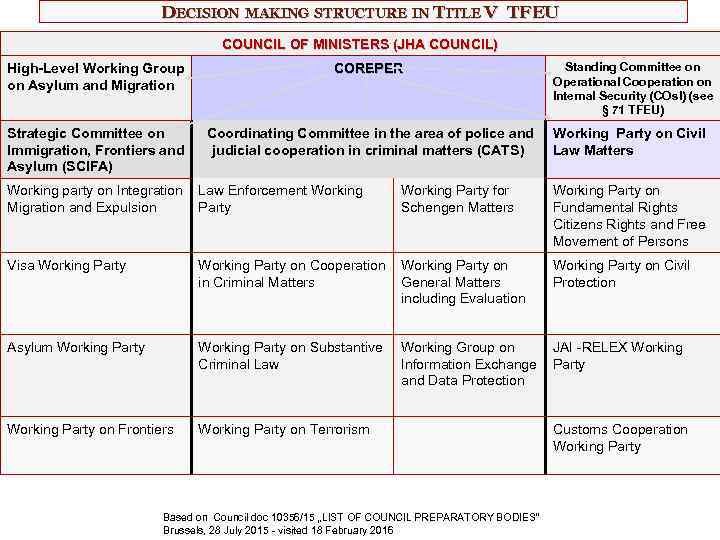 DECISION MAKING STRUCTURE IN TITLE V TFEU COUNCIL OF MINISTERS (JHA COUNCIL) High-Level Working Group on Asylum and Migration COREPER Standing Committee on Operational Cooperation on Internal Security (COs. I) (see § 71 TFEU) Strategic Committee on Immigration, Frontiers and Asylum (SCIFA) Coordinating Committee in the area of police and judicial cooperation in criminal matters (CATS) Working Party on Civil Law Matters Working party on Integration Migration and Expulsion Law Enforcement Working Party for Schengen Matters Working Party on Fundamental Rights Citizens Rights and Free Movement of Persons Visa Working Party on Cooperation in Criminal Matters Working Party on General Matters including Evaluation Working Party on Civil Protection Asylum Working Party on Substantive Criminal Law Working Group on Information Exchange and Data Protection JAI -RELEX Working Party on Frontiers Working Party on Terrorism Based on Council doc 10356/15 „LIST OF COUNCIL PREPARATORY BODIES” Brussels, 28 July 2015 - visited 18 February 2016 Customs Cooperation Working Party
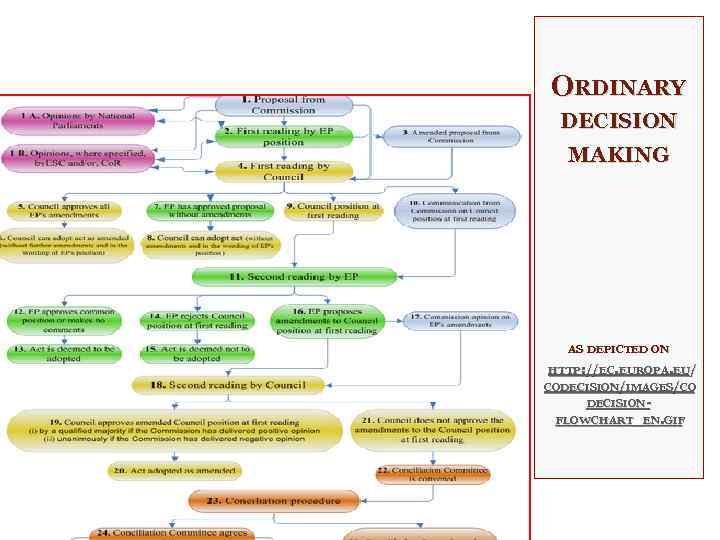 ORDINARY DECISION MAKING AS DEPICTED ON HTTP: //EC. EUROPA. EU/ CODECISION/IMAGES/CO DECISIONFLOWCHART_EN. GIF
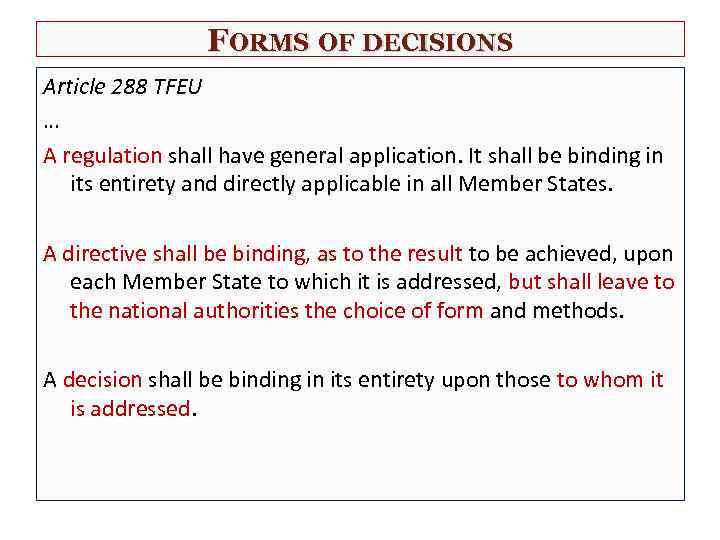 FORMS OF DECISIONS Article 288 TFEU … A regulation shall have general application. It shall be binding in its entirety and directly applicable in all Member States. A directive shall be binding, as to the result to be achieved, upon each Member State to which it is addressed, but shall leave to the national authorities the choice of form and methods. A decision shall be binding in its entirety upon those to whom it is addressed.
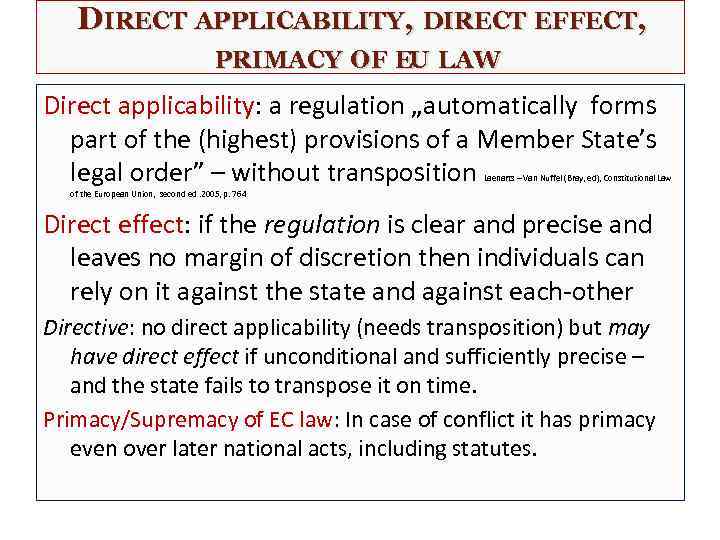 DIRECT APPLICABILITY, DIRECT EFFECT, PRIMACY OF EU LAW Direct applicability: a regulation „automatically forms part of the (highest) provisions of a Member State’s legal order” – without transposition Laenarts – Van Nuffel (Bray, ed), Constitutional Law of the European Union, second ed. 2005, p. 764 Direct effect: if the regulation is clear and precise and leaves no margin of discretion then individuals can rely on it against the state and against each-other Directive: no direct applicability (needs transposition) but may have direct effect if unconditional and sufficiently precise – and the state fails to transpose it on time. Primacy/Supremacy of EC law: In case of conflict it has primacy even over later national acts, including statutes.
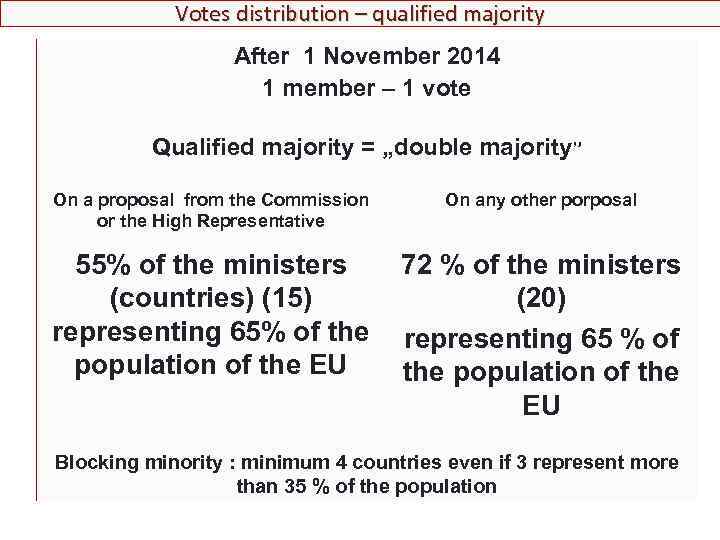 Votes distribution – qualified majority After 1 November 2014 1 member – 1 vote Qualified majority = „double majority” On a proposal from the Commission or the High Representative On any other porposal 55% of the ministers 72 % of the ministers (countries) (15) (20) representing 65% of the representing 65 % of population of the EU the population of the EU Blocking minority : minimum 4 countries even if 3 represent more than 35 % of the population
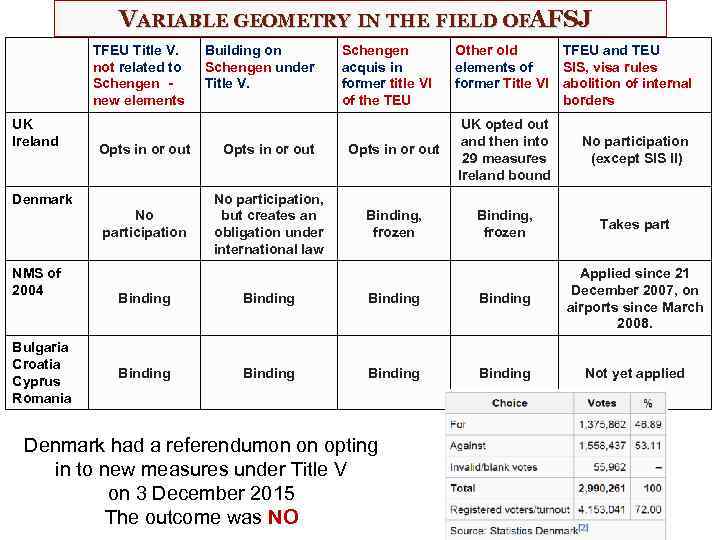 VARIABLE GEOMETRY IN THE FIELD OFAFSJ TFEU Title V. not related to Schengen new elements UK Ireland Building on Schengen under Title V. Schengen acquis in former title VI of the TEU Other old TFEU and TEU elements of SIS, visa rules former Title VI abolition of internal borders Opts in or out UK opted out and then into 29 measures Ireland bound No participation, but creates an obligation under international law Binding, frozen Takes part Denmark NMS of 2004 Bulgaria Croatia Cyprus Romania No participation (except SIS II) Binding Applied since 21 December 2007, on airports since March 2008. Binding Not yet applied Denmark had a referendumon on opting in to new measures under Title V on 3 December 2015 The outcome was NO
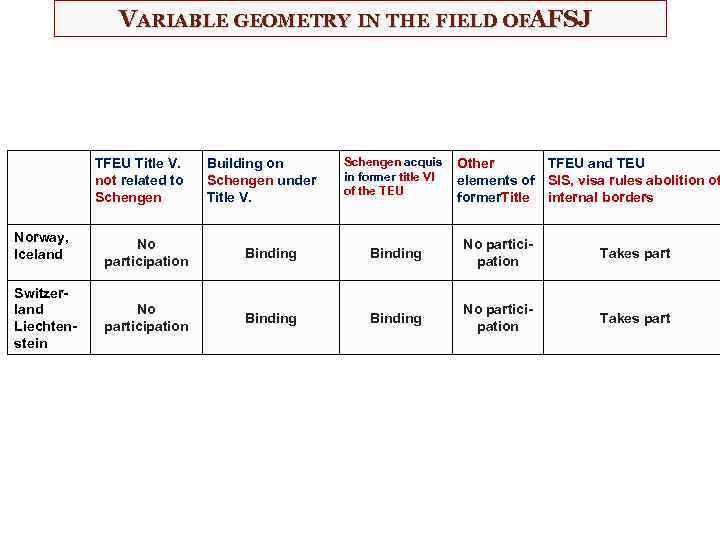 VARIABLE GEOMETRY IN THE FIELD OFAFSJ TFEU Title V. not related to Schengen Norway, Iceland Switzerland Liechtenstein Building on Schengen under Title V. Schengen acquis Other TFEU and TEU in former title VI elements of SIS, visa rules abolition of of the TEU former. Title internal borders No participation Binding No participation Takes part
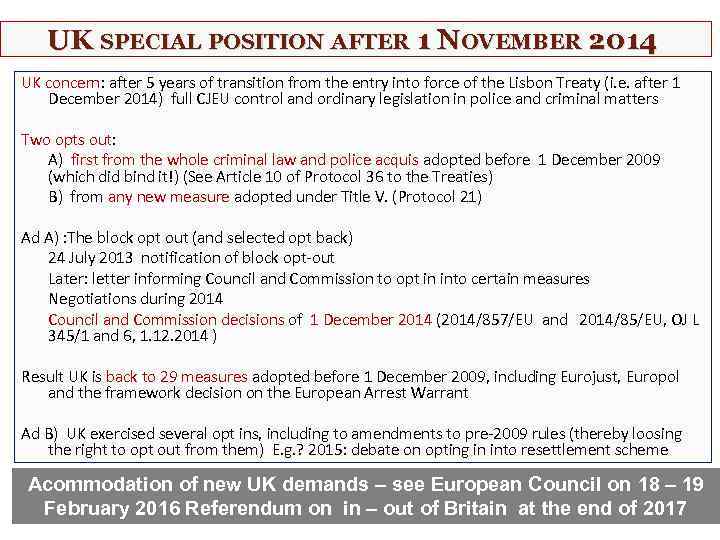 UK SPECIAL POSITION AFTER 1 NOVEMBER 2014 UK concern: after 5 years of transition from the entry into force of the Lisbon Treaty (i. e. after 1 December 2014) full CJEU control and ordinary legislation in police and criminal matters Two opts out: A) first from the whole criminal law and police acquis adopted before 1 December 2009 (which did bind it!) (See Article 10 of Protocol 36 to the Treaties) B) from any new measure adopted under Title V. (Protocol 21) Ad A) : The block opt out (and selected opt back) 24 July 2013 notification of block opt-out Later: letter informing Council and Commission to opt in into certain measures Negotiations during 2014 Council and Commission decisions of 1 December 2014 (2014/857/EU and 2014/85/EU, OJ L 345/1 and 6, 1. 12. 2014 ) Result UK is back to 29 measures adopted before 1 December 2009, including Eurojust, Europol and the framework decision on the European Arrest Warrant Ad B) UK exercised several opt ins, including to amendments to pre-2009 rules (thereby loosing the right to opt out from them) E. g. ? 2015: debate on opting in into resettlement scheme Acommodation of new UK demands – see European Council on 18 – 19 February 2016 Referendum on in – out of Britain at the end of 2017
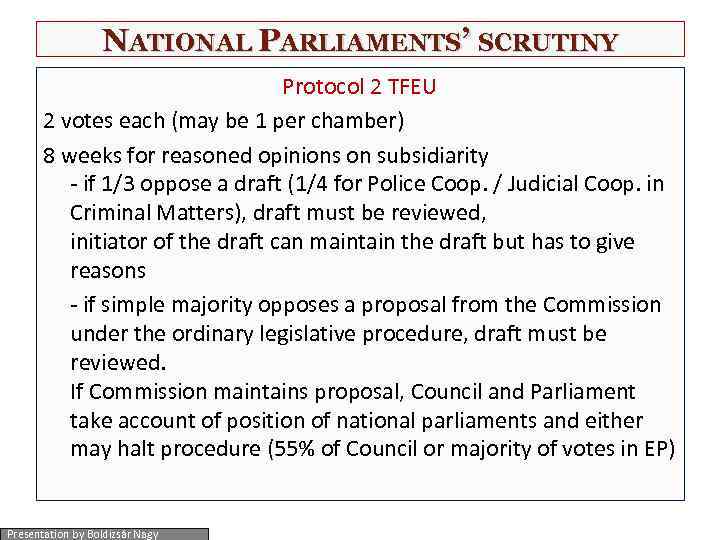 NATIONAL PARLIAMENTS’ SCRUTINY Protocol 2 TFEU 2 votes each (may be 1 per chamber) 8 weeks for reasoned opinions on subsidiarity - if 1/3 oppose a draft (1/4 for Police Coop. / Judicial Coop. in Criminal Matters), draft must be reviewed, initiator of the draft can maintain the draft but has to give reasons - if simple majority opposes a proposal from the Commission under the ordinary legislative procedure, draft must be reviewed. If Commission maintains proposal, Council and Parliament take account of position of national parliaments and either may halt procedure (55% of Council or majority of votes in EP) Presentation by Boldizsár Nagy
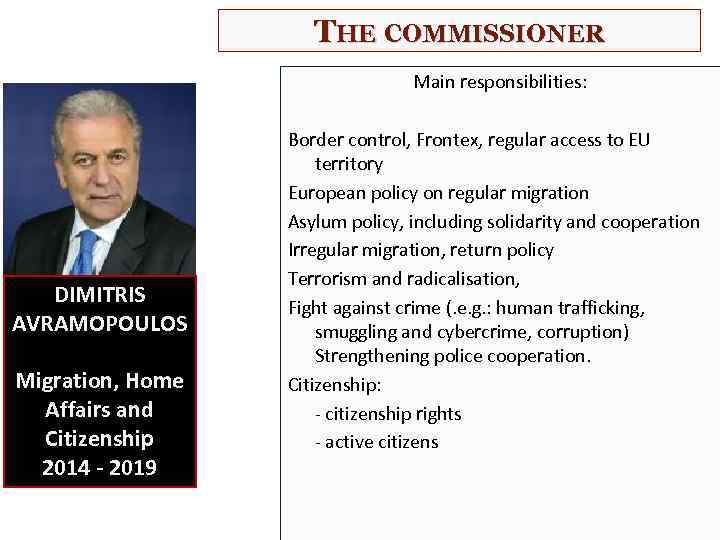 THE COMMISSIONER Main responsibilities: DIMITRIS AVRAMOPOULOS Migration, Home Affairs and Citizenship 2014 - 2019 Border control, Frontex, regular access to EU territory European policy on regular migration Asylum policy, including solidarity and cooperation Irregular migration, return policy Terrorism and radicalisation, Fight against crime (. e. g. : human trafficking, smuggling and cybercrime, corruption) Strengthening police cooperation. Citizenship: - citizenship rights - active citizens
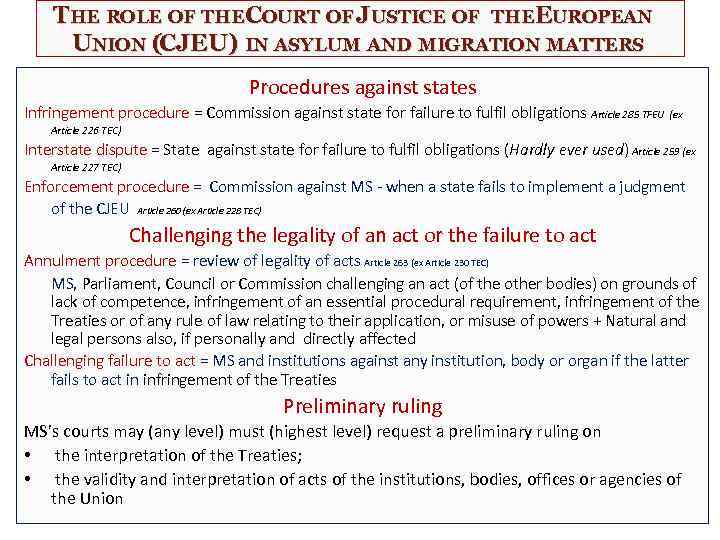 THE ROLE OF THECOURT OF JUSTICE OF THEEUROPEAN UNION (CJEU) IN ASYLUM AND MIGRATION MATTERS Procedures against states Infringement procedure = Commission against state for failure to fulfil obligations Article 285 TFEU (ex Article 226 TEC) Interstate dispute = State against state for failure to fulfil obligations (Hardly ever used) Article 259 (ex Article 227 TEC) Enforcement procedure = Commission against MS - when a state fails to implement a judgment of the CJEU Article 260 (ex Article 228 TEC) Challenging the legality of an act or the failure to act Annulment procedure = review of legality of acts Article 263 (ex Article 230 TEC) MS, Parliament, Council or Commission challenging an act (of the other bodies) on grounds of lack of competence, infringement of an essential procedural requirement, infringement of the Treaties or of any rule of law relating to their application, or misuse of powers + Natural and legal persons also, if personally and directly affected Challenging failure to act = MS and institutions against any institution, body or organ if the latter fails to act in infringement of the Treaties Preliminary ruling MS’s courts may (any level) must (highest level) request a preliminary ruling on • the interpretation of the Treaties; • the validity and interpretation of acts of the institutions, bodies, offices or agencies of the Union
 Temporary Protection Directive, 2001/55 EC Directive on Giving Temporary Protection in the Event of a Mass Influx of Displaced Persons and on Measures Promoting a Balance of Efforts Between Member States in Receiving Such Persons and Bearing the Consequences Thereof 2001 July 20, OJ L 212/12
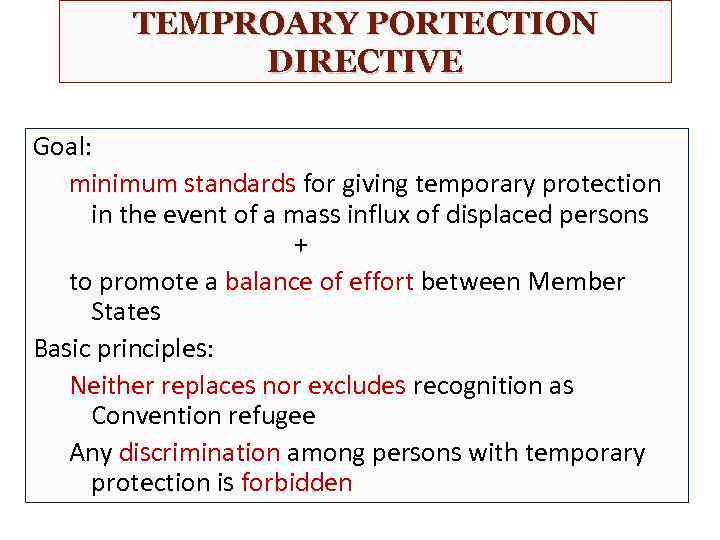 TEMPROARY PORTECTION DIRECTIVE Goal: minimum standards for giving temporary protection in the event of a mass influx of displaced persons + to promote a balance of effort between Member States Basic principles: Neither replaces nor excludes recognition as Convention refugee Any discrimination among persons with temporary protection is forbidden
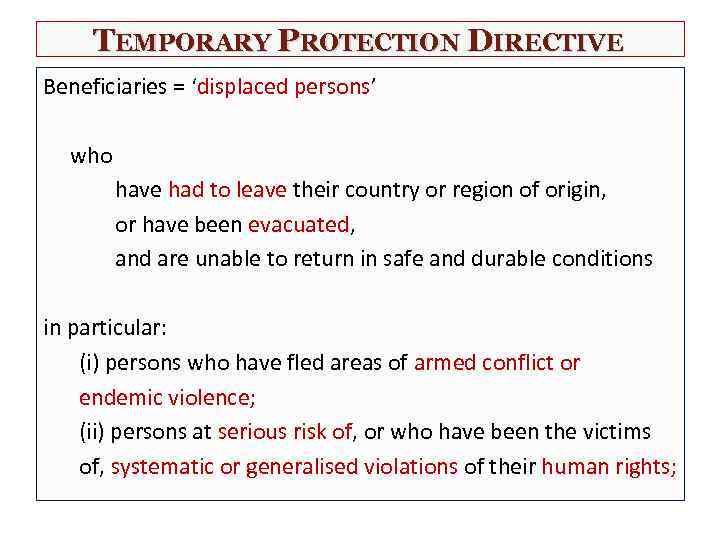 TEMPORARY PROTECTION DIRECTIVE Beneficiaries = ‘displaced persons’ who have had to leave their country or region of origin, or have been evacuated, and are unable to return in safe and durable conditions in particular: (i) persons who have fled areas of armed conflict or endemic violence; (ii) persons at serious risk of, or who have been the victims of, systematic or generalised violations of their human rights;
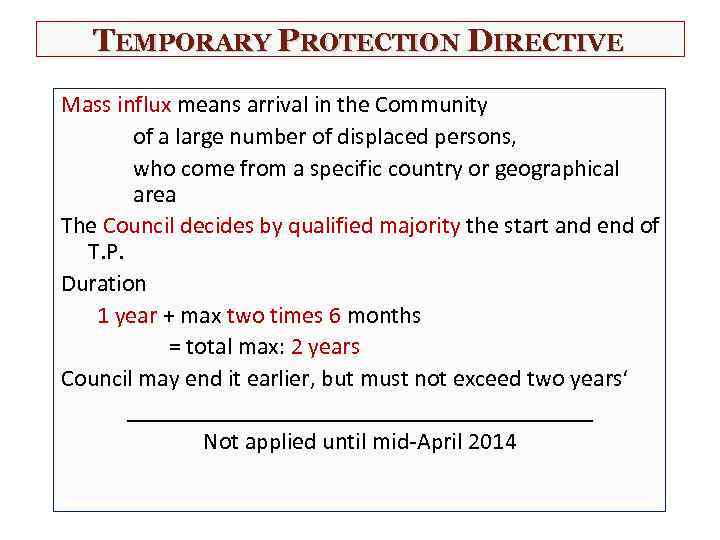 TEMPORARY PROTECTION DIRECTIVE Mass influx means arrival in the Community of a large number of displaced persons, who come from a specific country or geographical area The Council decides by qualified majority the start and end of T. P. Duration 1 year + max two times 6 months = total max: 2 years Council may end it earlier, but must not exceed two years‘ ____________________ Not applied until mid-April 2014
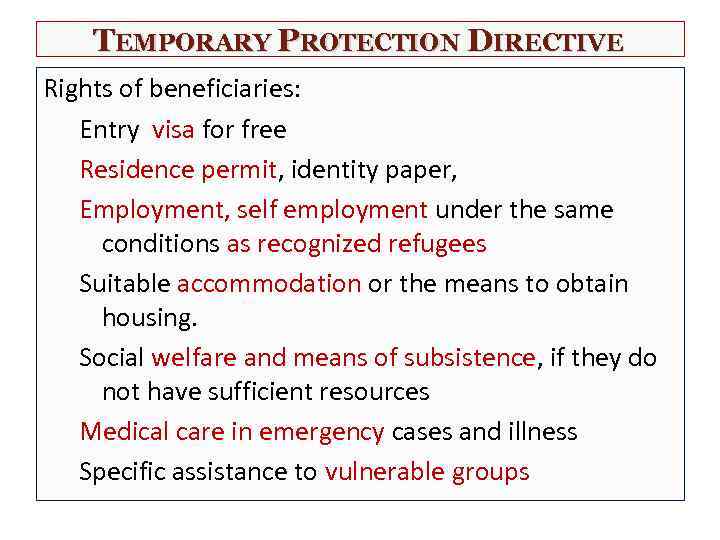 TEMPORARY PROTECTION DIRECTIVE Rights of beneficiaries: Entry visa for free Residence permit, identity paper, Employment, self employment under the same conditions as recognized refugees Suitable accommodation or the means to obtain housing. Social welfare and means of subsistence, if they do not have sufficient resources Medical care in emergency cases and illness Specific assistance to vulnerable groups
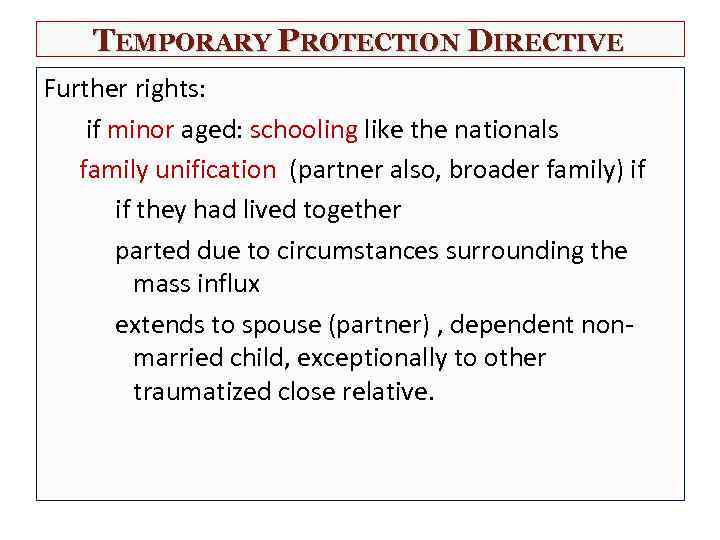 TEMPORARY PROTECTION DIRECTIVE Further rights: if minor aged: schooling like the nationals family unification (partner also, broader family) if if they had lived together parted due to circumstances surrounding the mass influx extends to spouse (partner) , dependent nonmarried child, exceptionally to other traumatized close relative.
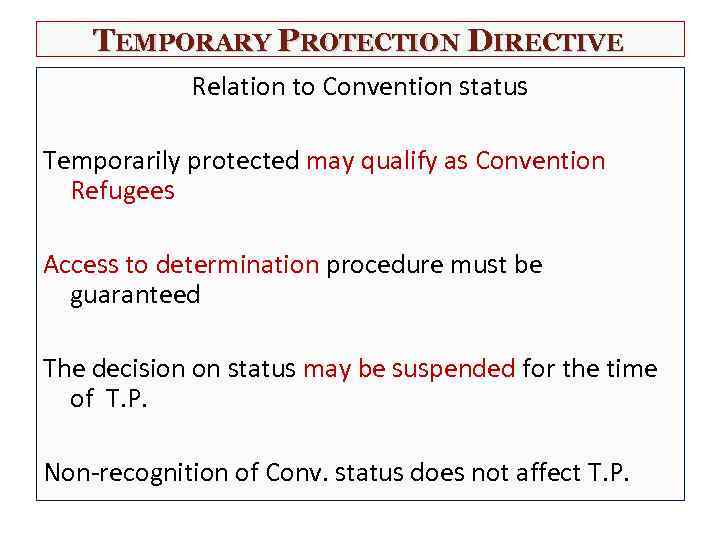 TEMPORARY PROTECTION DIRECTIVE Relation to Convention status Temporarily protected may qualify as Convention Refugees Access to determination procedure must be guaranteed The decision on status may be suspended for the time of T. P. Non-recognition of Conv. status does not affect T. P.
 Thanks! Boldizsár Nagy Central European University Budapest nagyb@ceu. hu www. nagyboldizsar. hu