



 SHOPPING FOR FOOD
 Measures • A kilo of tomatoes/ half a kilo/a quarter-kilo • A pound of apples • pound = фунт (современная мера веса, используемая в англоговорящих странах; = 453, 6 г) • A glass of • A litre of • A slice of • A bottle of • A pint of (0, 57 – English pint)
 Использование 's Когда мы говорим о магазинах, мы часто добавляем 's к концу слова. К примеру, "I'm going to the chemist's / greengrocer's / butcher's / baker's / newsagent's / fishmonger's/ optician's. " (Я собираюсь в аптеку/ овощную лавку/ мясную лавку/ булочную/ газетный киоск /рыбный магазин/ оптику) НО мы не употребляем 's со следующими магазинами: supermarket, hardware store, petrol station, department store.
 SHOPPING FOR FOOD Food safety starts with food shopping. Whether you prefer a farmer's market, a grocery store or a club warehouse store, taking simple precautions can prevent foodborne illness. The order in which you put items in your grocery cart, the items you select and how quickly you get them home all play a part in keeping foods safe to eat.
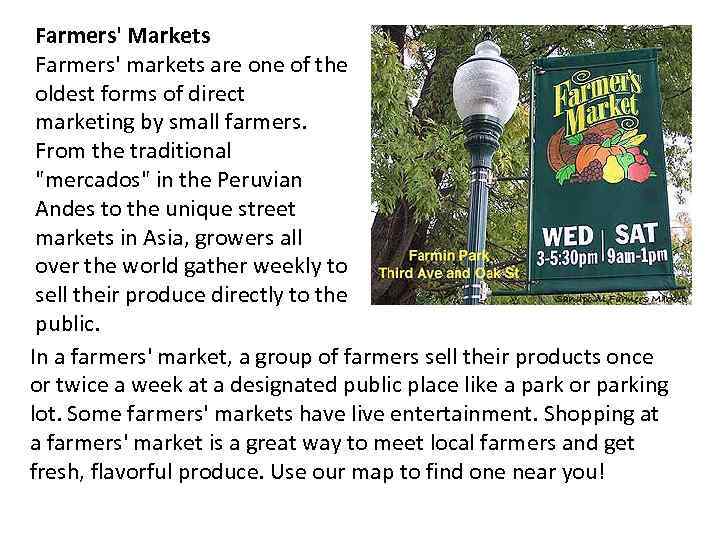 Farmers' Markets Farmers' markets are one of the oldest forms of direct marketing by small farmers. From the traditional "mercados" in the Peruvian Andes to the unique street markets in Asia, growers all over the world gather weekly to sell their produce directly to the public. In a farmers' market, a group of farmers sell their products once or twice a week at a designated public place like a park or parking lot. Some farmers' markets have live entertainment. Shopping at a farmers' market is a great way to meet local farmers and get fresh, flavorful produce. Use our map to find one near you!
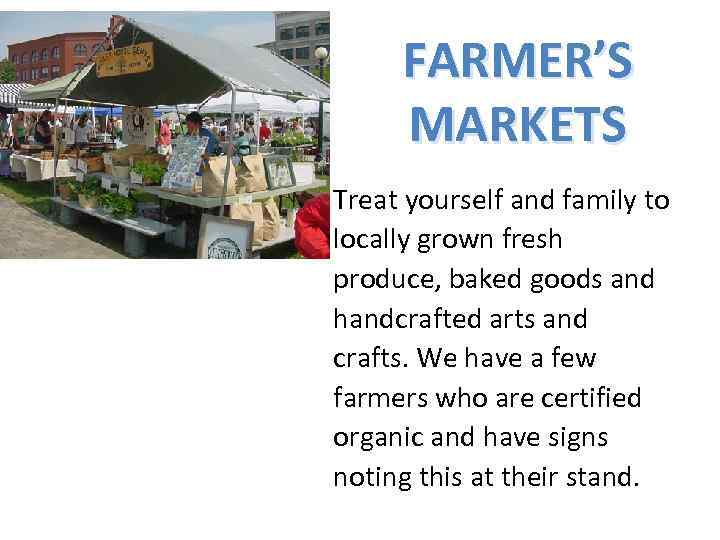 FARMER’S MARKETS Treat yourself and family to locally grown fresh produce, baked goods and handcrafted arts and crafts. We have a few farmers who are certified organic and have signs noting this at their stand.
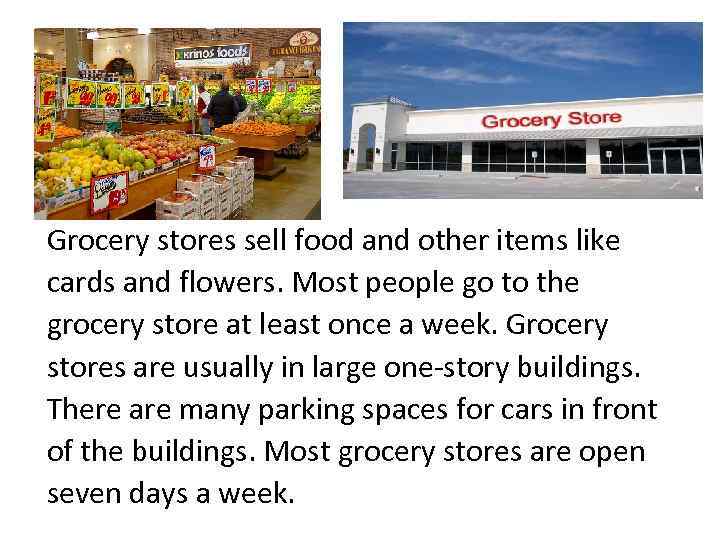 Grocery stores sell food and other items like cards and flowers. Most people go to the grocery store at least once a week. Grocery stores are usually in large one-story buildings. There are many parking spaces for cars in front of the buildings. Most grocery stores are open seven days a week.
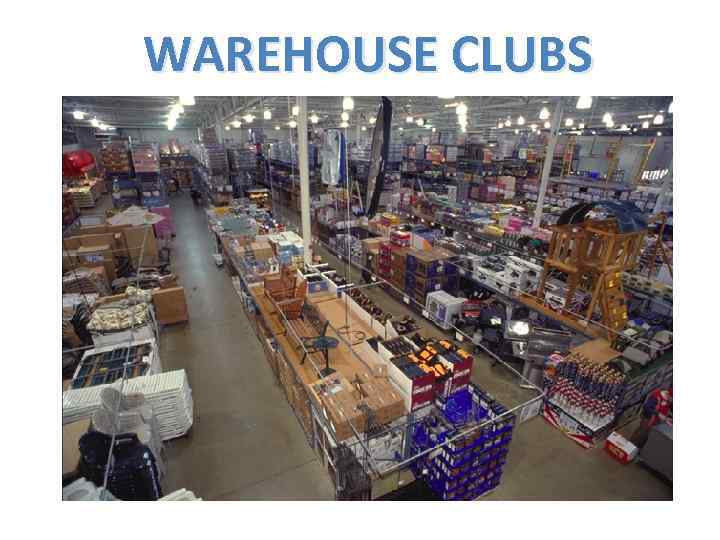 WAREHOUSE CLUBS
 WAREHOUSE CLUBS A warehouse club is a retail store, usually selling a wide variety of merchandise, in which customers are required to buy large, wholesale quantities of the store's products, which makes these clubs attractive to both bargain hunters and small business owners. The clubs are able to keep prices low due to the no-frills format of the stores. In addition, customers may be required to pay annual membership fees in order to shop. The concept is similar to the consumers' cooperative supermarkets found in Europe, though using bigger stores and not co-operatively owned. The use of members' prices without co-operative ownership is also sometimes used in bars and casinos.
 PUBLIC MARKETS
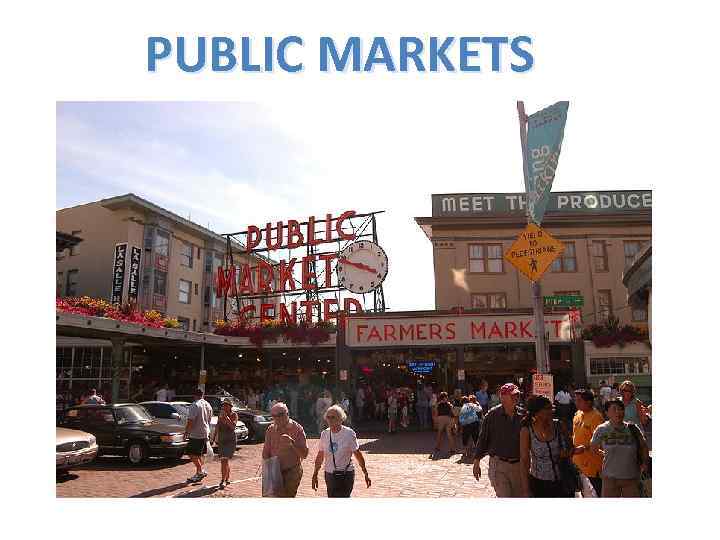
 PUBLIC MARKETS Public markets are markets, in public spaces, where independent merchants can sell their products to the public. Typical products sold at public markets include fresh produce and baked goods, locally raised meats and dairy products, and various other food items and handcrafted goods. Public markets often emphasize foods, clothing, and artisanal products reflective of the ethnicities in their respective regions. They can also serve as popular venues for public events and busking. Public markets are distinct from farmers' markets in that they often feature imported goods.
 STREET FOOD
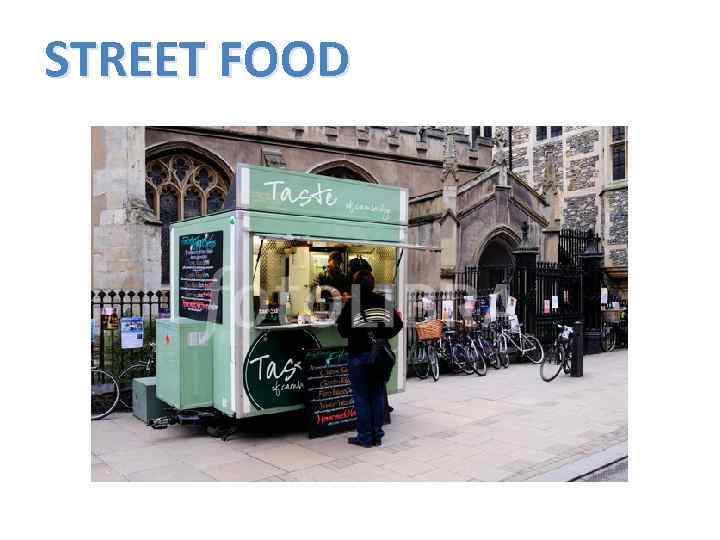
 STREET FOOD • Street food is ready-to-eat food or drink sold in a street or other public place, such as a market or fair, by a hawker or vendor, often from a portable stall. While some street foods are regional, many are not, having spread beyond their region of origin. Most street food are both finger and fast food. Street food costs less than a restaurant meal. According to the Food and Agriculture Organization, 2. 5 billion people eat street food every day. • Street food is intimately connected with take-out, junk food, snacks, and fast food; it is distinguished by its local flavour and by being purchased on the street, without entering any building. Both take-out and fast food are often sold from counters inside buildings.
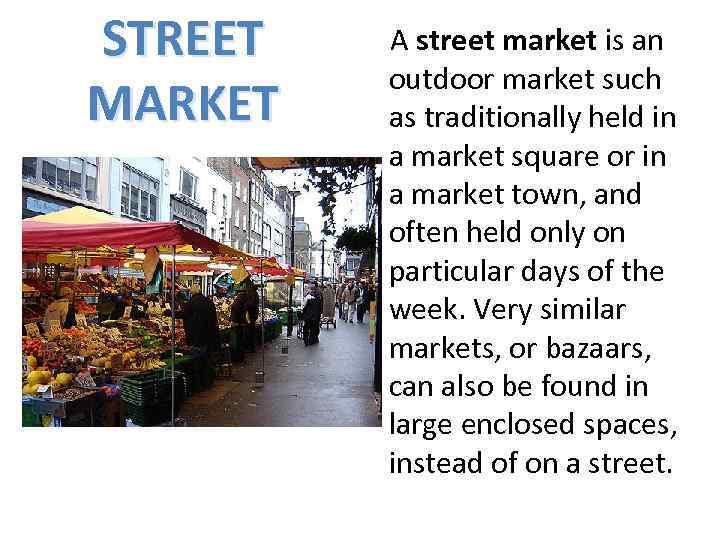 STREET MARKET A street market is an outdoor market such as traditionally held in a market square or in a market town, and often held only on particular days of the week. Very similar markets, or bazaars, can also be found in large enclosed spaces, instead of on a street.
 FAST FOOD Fast food is the term given to food that can be prepared and served very quickly. While any meal with low preparation time can be considered to be fast food, typically the term refers to food sold in a restaurant or store with preheated or precooked ingredients, and served to the customer in a packaged form for takeout/take-away. The term "fast food" was recognized in a dictionary by Merriam–Webster in 1951.
 FAST FOOD Outlets may be stands or kiosks, which may provide no shelter or seating or fast food restaurants (also known as quick service restaurants). Franchise operations which are part of restaurant chains have standardized foodstuffs shipped to each restaurant from central locations.
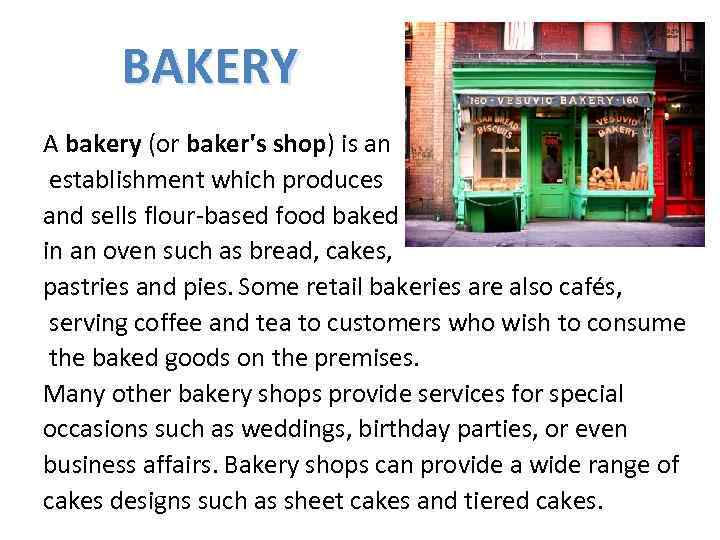 BAKERY A bakery (or baker's shop) is an establishment which produces and sells flour-based food baked in an oven such as bread, cakes, pastries and pies. Some retail bakeries are also cafés, serving coffee and tea to customers who wish to consume the baked goods on the premises. Many other bakery shops provide services for special occasions such as weddings, birthday parties, or even business affairs. Bakery shops can provide a wide range of cakes designs such as sheet cakes and tiered cakes.
 A coffeehouse or coffee shop is an establishment which primarily serves prepared coffee or other hot beverages. It shares some of the characteristics of a bar, and some of the characteristics of a restaurant, but it is different from a cafeteria. As the name suggests, coffeehouses focus on providing coffee and tea as well as light snacks. Many coffee houses in the Middle East, and in West Asian immigrant districts in the Western world, offer shisha (nargile in Turkish and Greek), flavored tobacco smoked through a hookah. From a cultural standpoint, coffeehouses largely serve as centers of social interaction: the coffeehouse provides social members with a place to congregate, talk, write, read, entertain one another, or pass the time, whether individually or in small groups of 2 or 3.
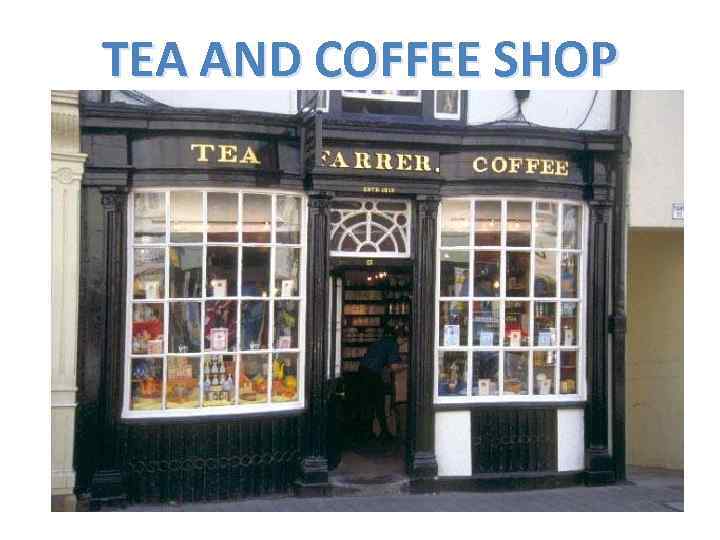 TEA AND COFFEE SHOP
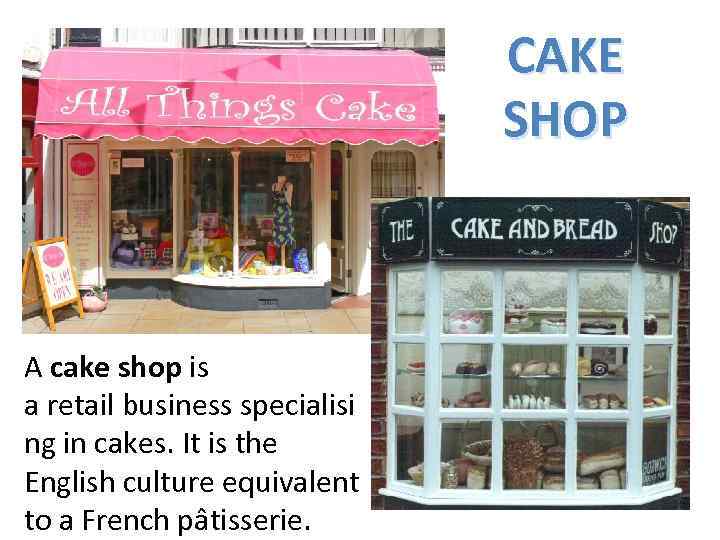 CAKE SHOP A cake shop is a retail business specialisi ng in cakes. It is the English culture equivalent to a French pâtisserie.
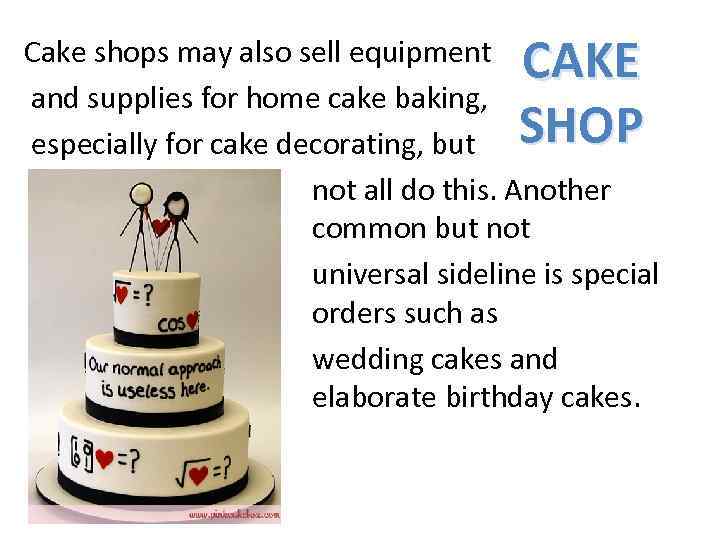 CAKE SHOP Cake shops may also sell equipment and supplies for home cake baking, especially for cake decorating, but not all do this. Another common but not universal sideline is special orders such as wedding cakes and elaborate birthday cakes.
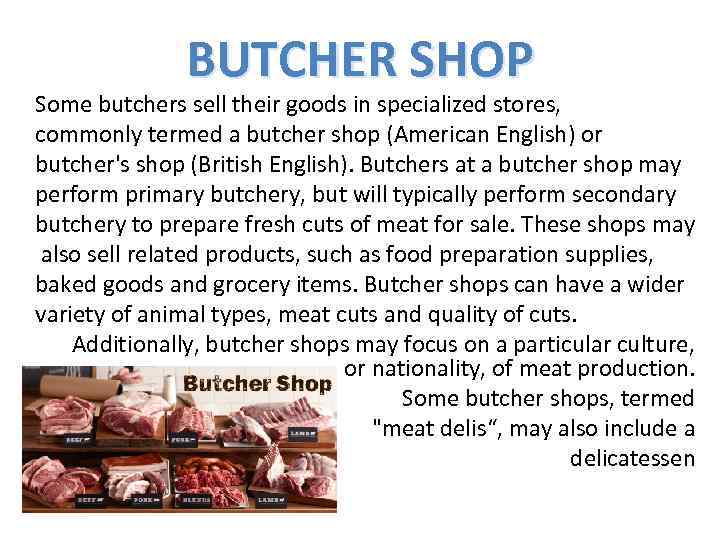 BUTCHER SHOP Some butchers sell their goods in specialized stores, commonly termed a butcher shop (American English) or butcher's shop (British English). Butchers at a butcher shop may perform primary butchery, but will typically perform secondary butchery to prepare fresh cuts of meat for sale. These shops may also sell related products, such as food preparation supplies, baked goods and grocery items. Butcher shops can have a wider variety of animal types, meat cuts and quality of cuts. Additionally, butcher shops may focus on a particular culture, or nationality, of meat production. Some butcher shops, termed "meat delis“, may also include a delicatessen
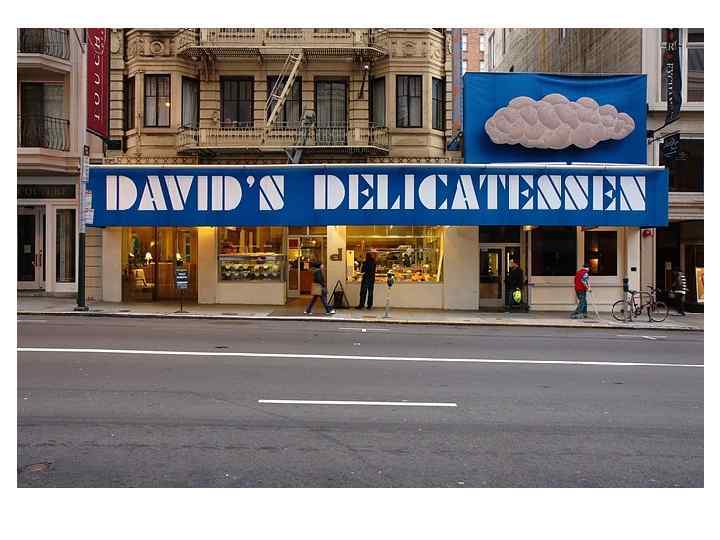
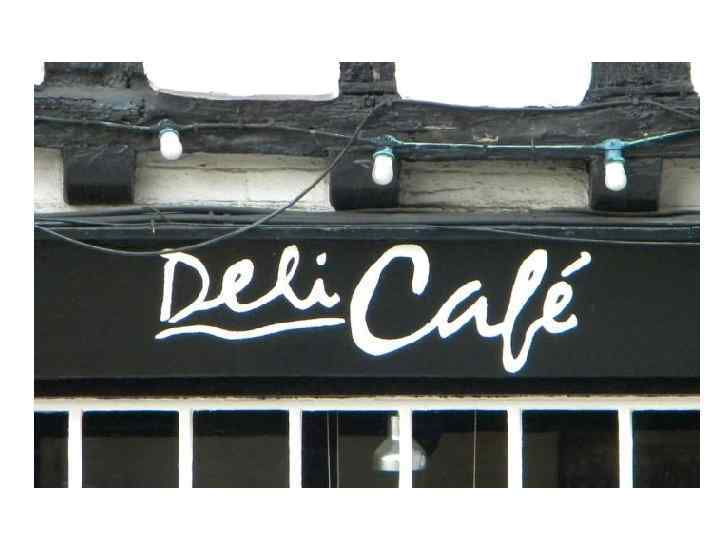
 DELICATESSEN Delicatessen is a term meaning "delicacies" or "fine foods". In English, delicatessen originally meant only this specially -prepared food. In time, thedelicatessen store where this food was sold came to be called a delicatessen, and the new meaning for the word was eventually shortened to deli. [Product base Delicatessens in many parts of the world often sell their foods by weight such as cured meats, head cheese, sausages, ham, liverwurst, salami and other cold cuts, fried chicken, spare ribs, cold salads, pickled vegetables, dips, breads and olives. A supermarket may provide its own "deli" food, or even operate a delicatessen on-site. Like a supermarket, a delicatessen may also offer a selection of shelved food, often of the type that is not likely to be kept for more than a day.
 DELICATESSEN • Large Delicatessen stores or Deli shops sell cold cuts and meats, but the luxury food division includes confectionery, fine spirits, wines, exclusive cheeses, truffled pâté, caviar, foie gras, high quality coffee beans, fruit, spices, herbs, specialty breads, exclusive sweets, cookies, honey, tea and luxury handmade chocolate. • In Europe, "delicatessen" has a different meaning than in the United States as it designates top-quality (and topprice) foodstuffs. In German-speaking countries a common synonym is Feinkost ("fine food"), and the shops that sell them are called Delikatessenläden ("stores for delicacies"). Department stores often have a Delikatessenabteilung ("delicacies department").
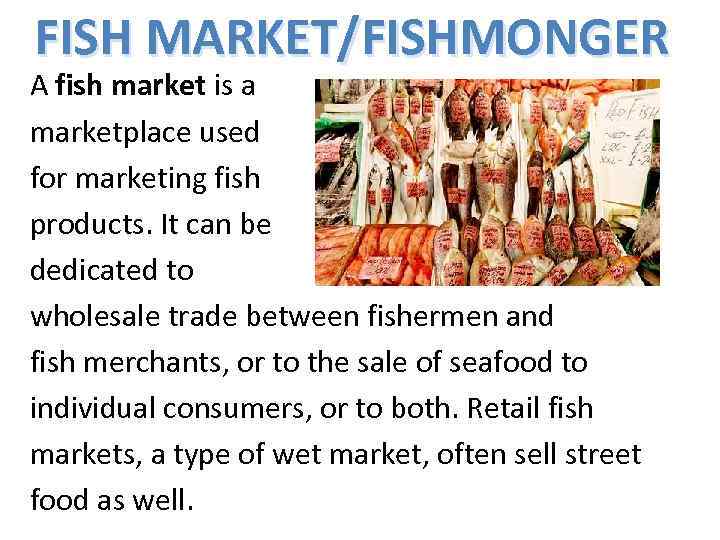 FISH MARKET/FISHMONGER A fish market is a marketplace used for marketing fish products. It can be dedicated to wholesale trade between fishermen and fish merchants, or to the sale of seafood to individual consumers, or to both. Retail fish markets, a type of wet market, often sell street food as well.
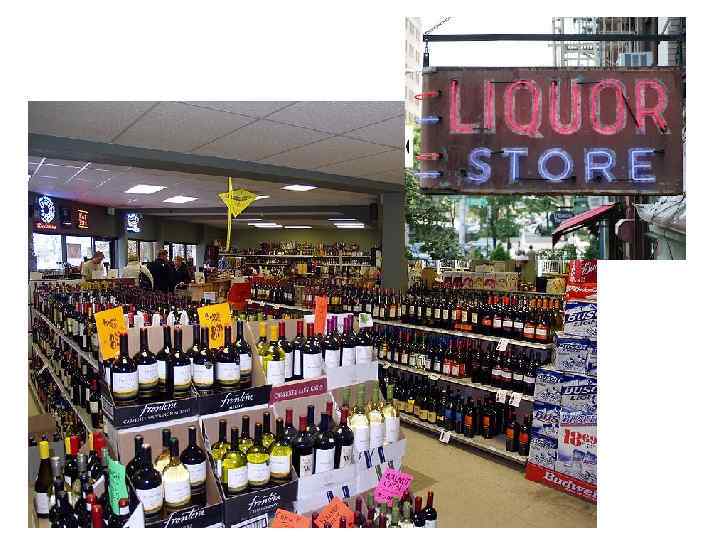
 A LIQUOR STORE In the United States, Canada, and Australia , a liquor store is a type of store that specializes in the sale of alcoholic beverages. In South Africa and Namibia, these stores are generally called bottle stores. In alcoholic beverage control (ABC) states, liquor stores often sell only spirits or sometimes sell spirits and wine but not beer. ABC-run stores may be called ABC stores or state stores. In Alabama, Connecticut, Georgia, and Massachusetts, liquor stores are also technically known as “package stores” because purchased liquor must be packaged in a sealed container or bag when it is taken from the store. In the United Kingdom and Ireland the corresponding term is "off-licence, " or "offie" for short, which refers to the fact that alcohol may be bought on the premises but must be consumed off the premises. Almost all supermarkets, grocery stores, and petrol stations have an off-licence. The price of alcohol in off-licence establishments is substantially lower than its price in on-licence establishments (bars, pubs, and restaurants).
 DAIRIES
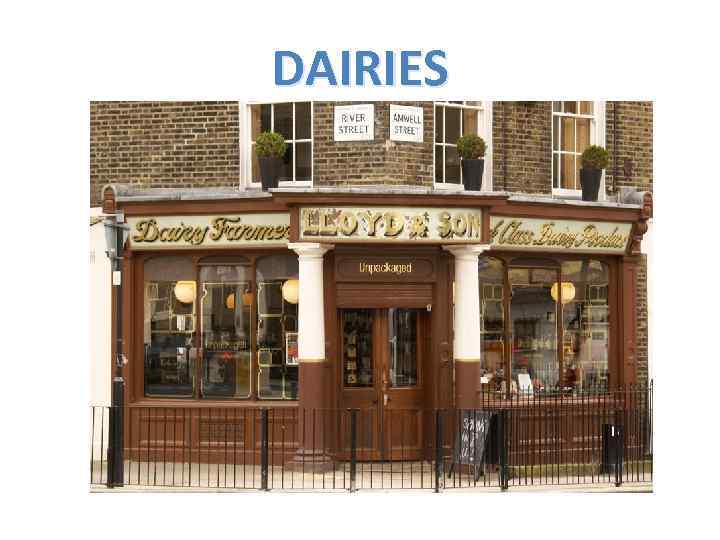
 DAIRIES • This shop is a rare remainder of the Welsh dairies once common throughout London. It's hard to imagine today, but once cows were kept and milked in the heart of the city - one way to ensure fresh milk! • Not that freshness alone guaranteed that milk was good. In his memoir of mid-Victorian life, Alfred Rosling Bennett describes cows being brought through the streets directly to customers and milked then and there. However, • our milkman said that if people could only see the quantity of water "them poor cows" were compelled to drink before starting, they would cease to wonder that the milk was so thin and blue.
 HEALTHY FOOD SHOPPING Food shopping is the first step in providing safe and healthy foods for your family. Knowing how to select produce, dairy, meats and seafood can reduce your chance of foodborne illness. Make sure items go safely from your grocery cart to your kitchen table with the following food shopping guidelines:
 HEALTHY FOOD SHOPPING Shop in Order Gather non-perishable items first. Then, select refrigerated and frozen items. Stop at the deli counter last. Place deli meats near the other cold items in your grocery cart.
 HEALTHY FOOD SHOPPING Check Dairy and Milk Products Check the "sell-by" date on all dairy products. When buying eggs, choose a carton that is cold. Make sure the eggs are clean and aren’t broken or cracked. Buy milk and other dairy products toward the end of your shopping trip. This will lessen the time these items are out of refrigeration.
 HEALTHY FOOD SHOPPING Be Selective with Fish and Seafood Buy fish only from reputable sources like grocery stores and seafood markets. Check for proper refrigeration of fresh fish. Look to see that flesh is shiny and firm, not separating from the bone, and the odor is fresh and mild, rather than overly "fishy. " Make sure packaged seafood is well-packed in ice and that packages are tightly sealed and free of dents and tears. Avoid packages containing ice crystals. This is a sign the seafood has previously thawed. Buy unwrapped cooked seafood such as shrimp, crab or smoked fish only if it is displayed in a separate case or a physically separated section from raw fish. Bacteria on raw fish can contaminate cooked
 HEALTHY FOOD SHOPPING Look Over Meats and Poultry Make sure packaging is tightly sealed and is very cold to the touch. Choose packaged chicken that looks pink, not gray. Check the "sell-by" date. If the date has passed, don't buy it. Always look for the Safe Food Handling label on packages of bacon and fresh sausage. This label means the meat has undergone safe processing and includes handling and cooking tips. Select meats and poultry after shopping for non-perishables. Ask to have meat and poultry bagged separately from other groceries. At Home Promptly refrigerate or freeze perishable items as soon as you get home.
 HEALTHY FOOD SHOPPING Convenience Foods Many people turn to canned foods, frozen foods and prepared salads at dinnertime instead of preparing meals from scratch. Use the following tips when purchasing and storing convenience foods to keep items safe for serving: Prepared Foods Reheat pre-cooked foods such as stuffed chicken breasts and pre-roasted chicken before serving. Eat them on the day of purchase. If selecting food from a salad bar, go early or ask for fresh batches of items. Ask about proper refrigeration (below 40 degrees Fahrenheit) of items like egg salad, macaroni salad and potato salad. Check that containers are well-packed in ice. Deli Meats Consume poultry products from the deli counter within three days of purchase. Use red meat deli products within five to seven days of purchase. Always reheat hot dogs before eating. "At-risk" consumers should consult their medical practitioners for advice on consuming deli meats. People at higher risk of foodborne illness include (pregnant women, older adults, babies and people with weakened immune systems.
 HEALTHY FOOD SHOPPING Canned Foods Avoid buying canned goods that are bulging, dented or leaking. Throw away any cans in your pantry showing these signs. Store canned goods in a cool, dry place, not above the oven or under the sink. Rinse all cans before opening them. Use canned goods by the date on the can or within 12 months of purchasing. Frozen Foods At the grocery store, select frozen foods from the back of the freezer case; items in the back usually remain the coldest and most frozen. At home, keep frozen foods tightly wrapped and write the date on the container. Store them in the freezer at zero degrees Fahrenheit or below. It is safe to refreeze thawed foods without cooking them, but you may notice a loss of taste quality due to moisture that is lost through defrosting. Dried or Cured Meats (Summer Sausages or Jerky) Don't buy hanging dried or cured meat if the package is open. Refrigerate uneaten items after opening. An unopened package of dried meat will keep for up to one year without refrigeration.
 HEALTHY FOOD SHOPPING • There are things you can do while shopping to help prevent food poisoning. • Put raw meat, poultry, eggs, fish, and shellfish in separate bags, and do not mix them with other food items. • Do not buy meat or poultry that has a tear in the package or is leaking. • Pick up your refrigerated and frozen items at the end of your shopping trip, so they are unrefrigerated for a shorter period of time. • Drive directly home after finishing so you can store all foods properly. If you have a long drive, consider getting an ice chest for perishable foods. • Do not buy food past the "sell by" or "use by" dates. • Do not buy canned foods if the cans are dented, leaking, bulging, or rusting.
 INTERESTING FACTS ABOUT LIVING IN LONDON
 INTERESTING FACTS ABOUT LIVING IN LONDON 1. В Лондоне все очень тесное и компактное, квартиры в основном небольшие, как и кафе и рестораны. 2. Из-за этой компактности к вам за столик могут подсадить кого то, если вы сидите за столом для четверых, а вас всего двое. 3. Иногда кажется, что англичане обожают толпу. В пабах бывает столько людей, что кажется, что можно «стоять» только с подсогнутыми ногами. При этом это не останавливает новых посетителей. 4. В местных супермаркетах просто тьма готовой еды на любой вкус, которую надо употребить в течение нескольких дней после покупки. Там можно найти и китайскую, и индийскую, и английскую и черт знает еще какую кухню. 5. В отличие от Москвы, в Лондоне мало суши-баров, но в целом кухня разнообразнее. Очень много индийских ресторанов. 6. Общее количество ресторанов просто огромно
 INTERESTING FACTS ABOUT LIVING IN LONDON 7. Каждые выходные с утра на многих площадях и сквериках образовываются ярмарки фермерской и домашней еды, после 13. 00 их с огнем не сыщешь. 8. Толпа у пабов всегда очень шумная, как там люди различают, кто что говорит, я не знаю. 9. Почти во всех пабах из еды есть только традиционные блюда: картошка с рыбой, пюре с сосисками и в лучшем случае бургеры. 10. Помимо таких гигантов, как Mac. Donald’s, Burger King и KFC, в Великобритании очень распространены местные сети с разными видами сэндвичей и другими продуктами, в основном не подогреваемыми. По моим наблюдениям их даже больше, но кроме Subway в России нет ни одной. 11. Домой можно заказать почти все: еду, алкоголь и даже кальян. 12. Кассиры могут сказать вам спасибо около 4– 7 раз во время одной покупки. 13. Ни один продуктовый магазин не работает после 21 — 22 часов вечера.
 INTERESTING FACTS ABOUT LIVING IN LONDON 14. Почти на любом продукте из супермаркета и фастфуда будет большая надпись — выращено в Великобритании. 15. Если что-то существенное заказываете домой (мебель, ковер, технику), то это просто ад. В новых домах все принимает консьерж. Но если его нет, то никогда не говорят точное время доставки. Обычно что-то вроде с 2 до 9 вечера. Звонят за 30 минут, так что особо далеко из дома не выйдешь. 16. Очень распространены деньги в виде монет. Самая большая достоинством в 2 фунта соответствует 100 рублям у нас. 17. В целом продукты очень свежие и разнообразные. Кроме сметаны, черного хлеба, докторской колбасы и кефира можно найти все. 18. Eсли уж вы совсем соскучились по Родине, то к вашим услугам магазины с русскими продуктами и русские рестораны. Обычно их держат выходцы из России и стран СНГ.
 Questions "Do you have any…? “ "I'm looking for…“ "I wonder if you could help me…? ” "Is this made of leather / silk / plastic…? " "Does this come with a guarantee? " "Is this fully refundable? " "Can I bring this back if it's not the right size? " "Can I bring this back if it doesn't fit? "
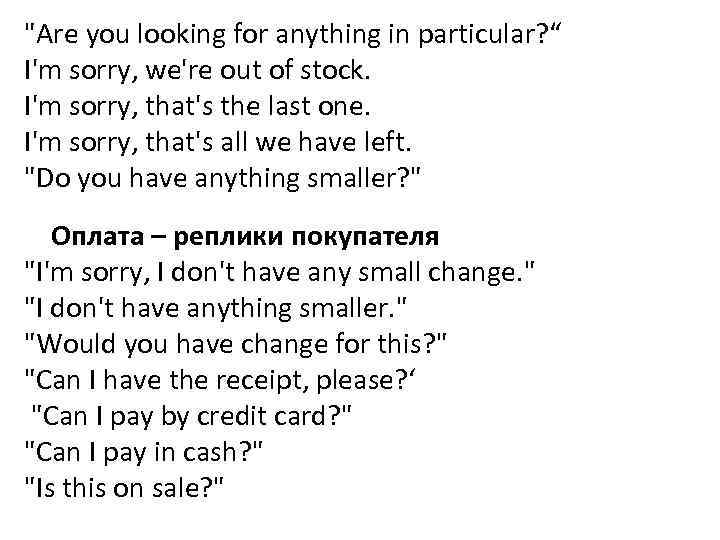 "Are you looking for anything in particular? “ I'm sorry, we're out of stock. I'm sorry, that's the last one. I'm sorry, that's all we have left. "Do you have anything smaller? " Оплата – реплики покупателя "I'm sorry, I don't have any small change. " "I don't have anything smaller. " "Would you have change for this? " "Can I have the receipt, please? ‘ "Can I pay by credit card? " "Can I pay in cash? " "Is this on sale? "