 Скачать презентацию Shocking Issues in Electricity Contracts By Craig Enochs
8e0bca2138154688c5cbc7f71641cc45.ppt
- Количество слайдов: 26



Shocking Issues in Electricity Contracts By: Craig Enochs, Jackson Walker, L. L. P. , Houston, Texas l John R. Werner, Constellation New. Energy, Inc. , Houston, Texas l 1
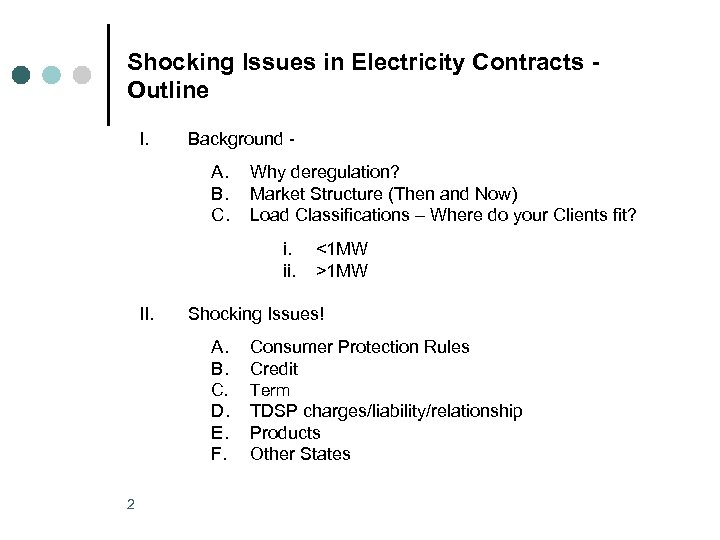
Shocking Issues in Electricity Contracts Outline I. Background - A. B. C. Why deregulation? Market Structure (Then and Now) Load Classifications – Where do your Clients fit? i. ii. II. <1 MW >1 MW Shocking Issues! A. B. C. Term D. E. F. 2 Consumer Protection Rules Credit TDSP charges/liability/relationship Products Other States
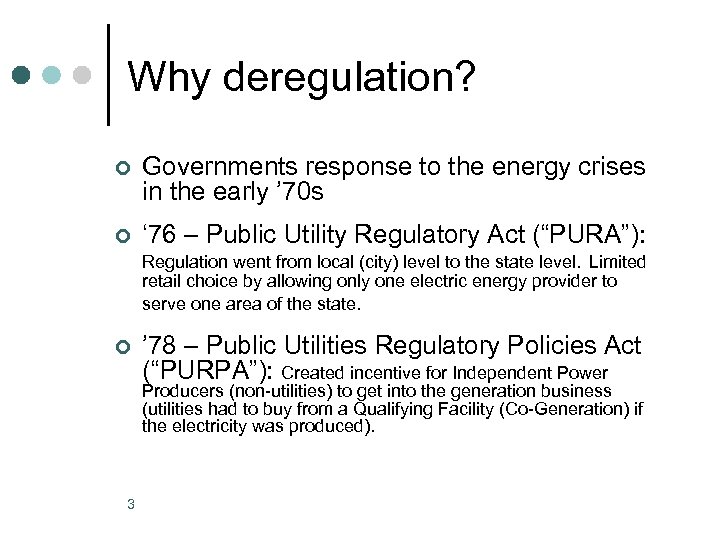
Why deregulation? ¢ Governments response to the energy crises in the early ’ 70 s ¢ ‘ 76 – Public Utility Regulatory Act (“PURA”): Regulation went from local (city) level to the state level. Limited retail choice by allowing only one electric energy provider to serve one area of the state. ¢ ’ 78 – Public Utilities Regulatory Policies Act (“PURPA”): Created incentive for Independent Power Producers (non-utilities) to get into the generation business (utilities had to buy from a Qualifying Facility (Co-Generation) if the electricity was produced). 3
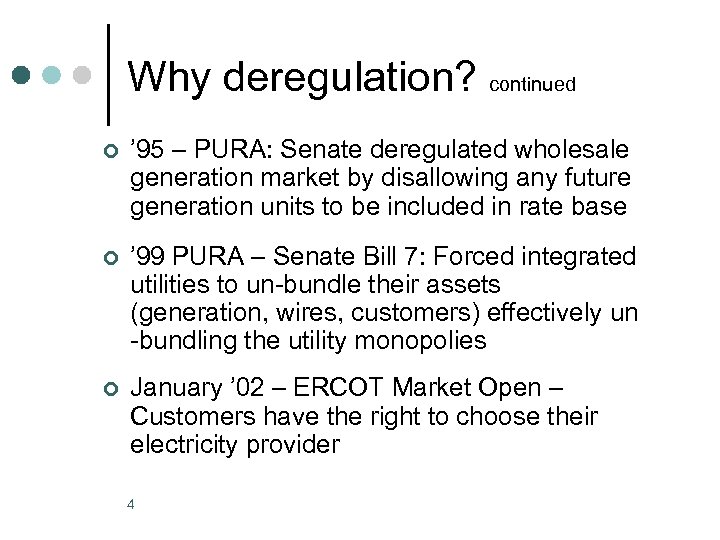
Why deregulation? continued ¢ ’ 95 – PURA: Senate deregulated wholesale generation market by disallowing any future generation units to be included in rate base ¢ ’ 99 PURA – Senate Bill 7: Forced integrated utilities to un-bundle their assets (generation, wires, customers) effectively un -bundling the utility monopolies ¢ January ’ 02 – ERCOT Market Open – Customers have the right to choose their electricity provider 4
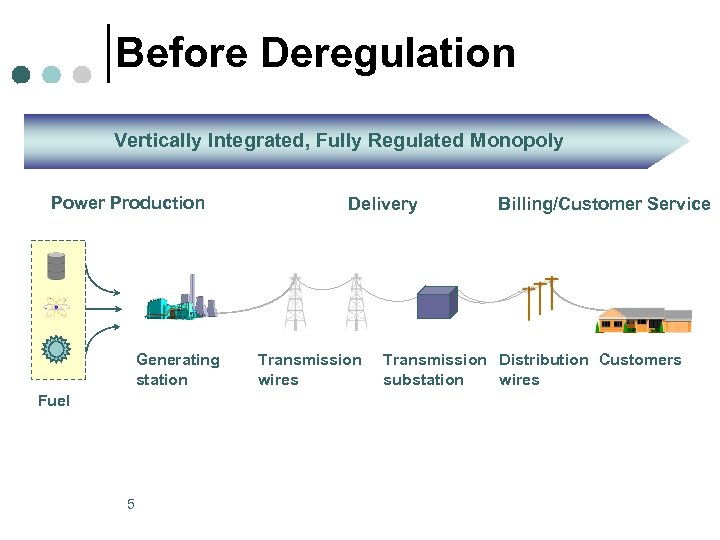
Before Deregulation Vertically Integrated, Fully Regulated Monopoly Power Production Generating station Fuel 5 Delivery Transmission wires Billing/Customer Service Transmission Distribution Customers substation wires
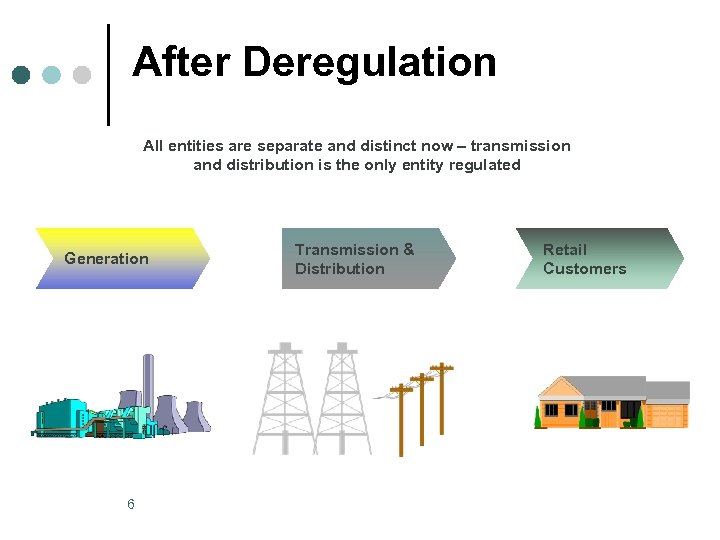
After Deregulation All entities are separate and distinct now – transmission and distribution is the only entity regulated Generation 6 Transmission & Distribution Retail Customers
Load Classifications – Where do your business clients fit in the newly deregulated world? Ø Less than 1 MW – (1 MW = about the size of a Super Wal-Mart®) OR Ø 7 Greater than 1 MW
<1 MW Customers have PTB as an option. What is the PTB? Ø Utilities Rates frozen January 1999 Solely adjusted for the market rate of natural gas Ø Simple Calculation (old rate with natural gas @ $x + increase in natural gas since then) 8
II. Shocking Issues A. 9 Customer Protection Rules “First, you waive all protections the rules offer consumers”
II. Shocking Issues A. Customer Protection Rules B. Credit – “The utility never required collateral” 10
II. Shocking Issues A. Customer Protection Rules B. Credit C. Term 11
II. Shocking Issues A. Customer Protection Rules B. Credit C. Term 1. Old world, termination at will but you were a price taker or longterm deal under a regulated tariff 12
II. Shocking Issues A. Customer Protection Rules B. Credit C. Term 1. Old world, termination at will but you were a price taker or long-term deal under a regulated tariff 2. New world typically less than 2 years, can be month-to-month 13
II. Shocking Issues A. CPR B. Credit C. Term D. TDSP - “If I switch providers, the utility won’t provide the same service it does now. ” 14
II. Shocking Issues A. B. C. D. 15 CPR Credit Term TDSP 1. Charges
II. Shocking Issues A. B. C. D. 16 CPR Credit Term TDSP 1. Charges 2. Liability
II. Shocking Issues A. B. C. D. 17 CPR Credit Term TDSP 1. Charges 2. Liability 3. Relationship
II. Shocking Issues A. B. C. D. E. 18 CPR Credit Term TDSP Products – “What is an index price heat rate baseload plus fixed price trigger product? ”
II. Shocking Issues A. CPR B. Credit C. Term D. TDSP E. Products 1. Pure Index v. Pure Fixed Price 19
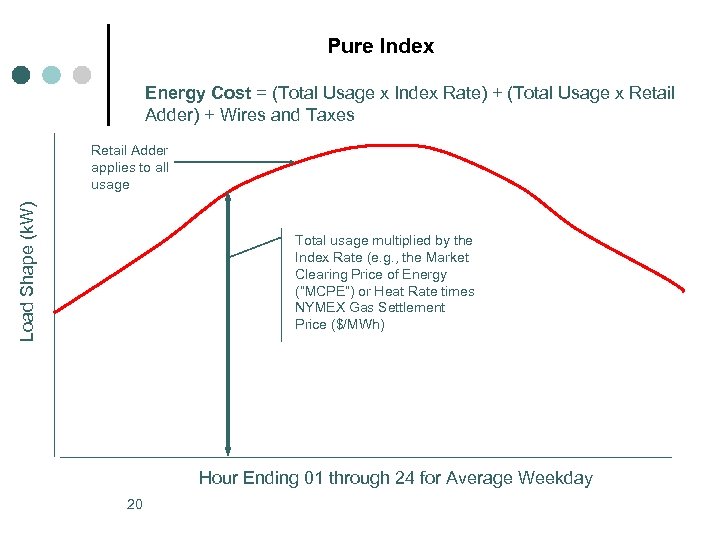
Pure Index Energy Cost = (Total Usage x Index Rate) + (Total Usage x Retail Adder) + Wires and Taxes Load Shape (k. W) Retail Adder applies to all usage Total usage multiplied by the Index Rate (e. g. , the Market Clearing Price of Energy (“MCPE”) or Heat Rate times NYMEX Gas Settlement Price ($/MWh) Hour Ending 01 through 24 for Average Weekday 20
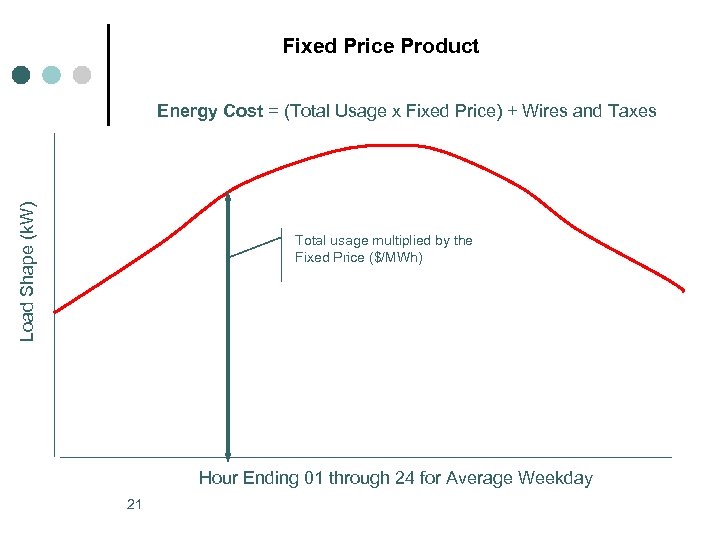
Fixed Price Product Load Shape (k. W) Energy Cost = (Total Usage x Fixed Price) + Wires and Taxes Total usage multiplied by the Fixed Price ($/MWh) Hour Ending 01 through 24 for Average Weekday 21
II. Shocking Issues A. B. C. D. E. 22 CPR Credit Term TDSP Products 1. Pure Index v. Pure Fixed Price 2. Partial Index/Partial Fixed Price
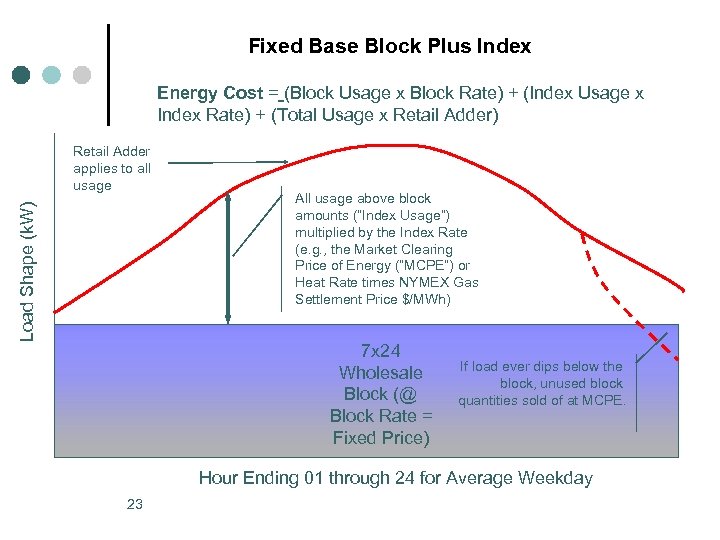
Fixed Base Block Plus Index Energy Cost = (Block Usage x Block Rate) + (Index Usage x Index Rate) + (Total Usage x Retail Adder) Load Shape (k. W) Retail Adder applies to all usage All usage above block amounts (“Index Usage”) multiplied by the Index Rate (e. g. , the Market Clearing Price of Energy (“MCPE”) or Heat Rate times NYMEX Gas Settlement Price $/MWh) 7 x 24 Wholesale Block (@ Block Rate = Fixed Price) If load ever dips below the block, unused block quantities sold of at MCPE. Hour Ending 01 through 24 for Average Weekday 23
II. Shocking Issues A. B. C. D. E. F. 24 CPR Credit Term TDSP Products Other States – “Can you supply my Hawaii location too? ”
II. Shocking Issues A. B. C. D. E. F. CPR Credit Term TDSP Products Other States 1. Each region has different regulations, which may raise different issues. 25
II. Shocking Issues A. B. C. D. E. F. CPR Credit Term TDSP Products Other States 1. Each region has different regulations, which may raise different issues. 2. Texas deregulation only affects parts of Texas and nowhere else. 26
Скачать презентацию Shocking Issues in Electricity Contracts By Craig Enochs
8e0bca2138154688c5cbc7f71641cc45.ppt