 Скачать презентацию Shock Management Erin Burrell ACNP-BC Surgical ICU Nurse
1d77282a38bf2f4f2f2904388e226704.ppt
- Количество слайдов: 43



Shock Management Erin Burrell, ACNP-BC Surgical ICU Nurse Practitioner
Objectives • Understand the definition of the three different types of shock • Be able to recognize the different types of shock in patient scenarios • Understand apply treatment guidelines for the different types of shock
What is Shock? • Shock is the “physiologic state characterized by significant reduction of systemic tissue perfusion, resulting in decreased tissue oxygen delivery. ” – Tissue perfusion is dependent on SVR and CO – Imbalance between oxygen delivery and oxygen consumption which leads to cell death, end organ damage, multi-system organ failure, and death Gaieski et al. 2009 (Online accessed 22 August 2013) URL: http: //lijhs. sandi. net/faculty/rtenenbaum/ap-biology-folder/Links/Shock. utd. pdf
Three Types of Shock • Cardiogenic • Hypovolemic • Distributive – Septic – Anaphylactic – Neurogenic • Combined
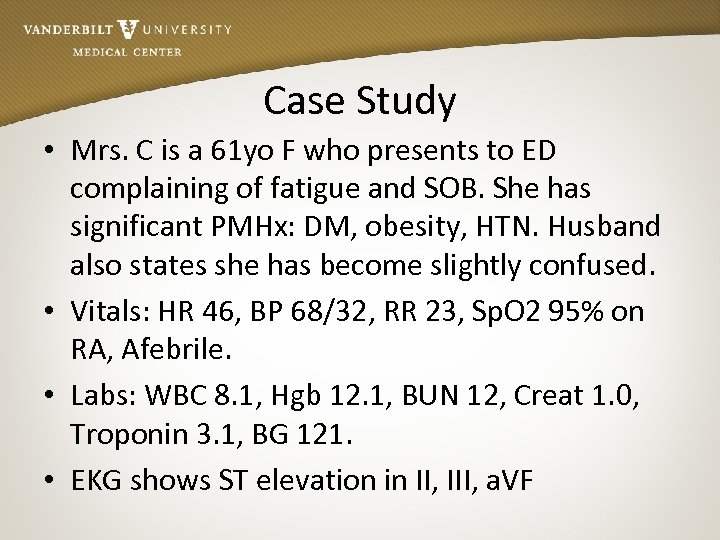
Case Study • Mrs. C is a 61 yo F who presents to ED complaining of fatigue and SOB. She has significant PMHx: DM, obesity, HTN. Husband also states she has become slightly confused. • Vitals: HR 46, BP 68/32, RR 23, Sp. O 2 95% on RA, Afebrile. • Labs: WBC 8. 1, Hgb 12. 1, BUN 12, Creat 1. 0, Troponin 3. 1, BG 121. • EKG shows ST elevation in II, III, a. VF
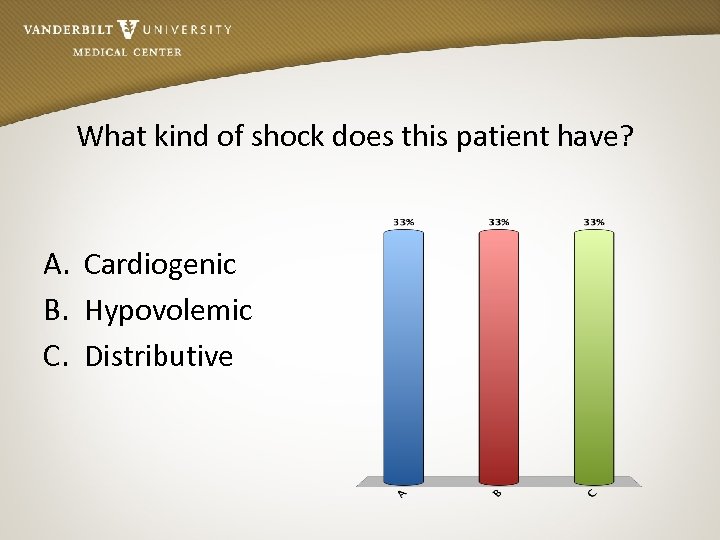
What kind of shock does this patient have? A. Cardiogenic B. Hypovolemic C. Distributive
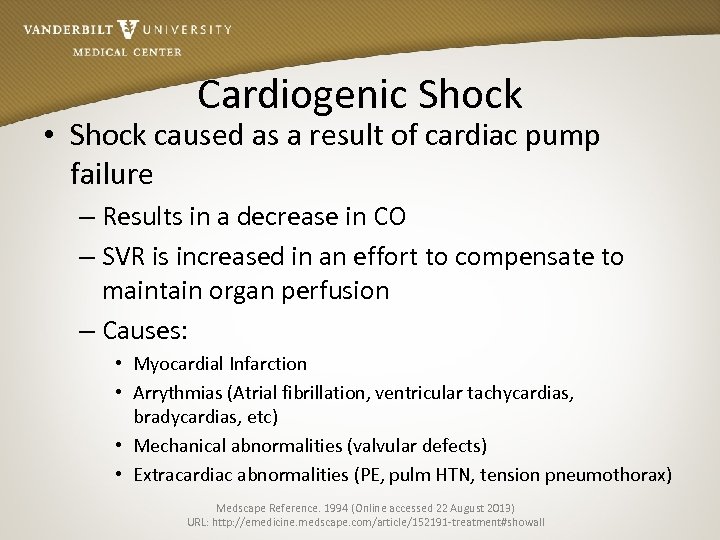
Cardiogenic Shock • Shock caused as a result of cardiac pump failure – Results in a decrease in CO – SVR is increased in an effort to compensate to maintain organ perfusion – Causes: • Myocardial Infarction • Arrythmias (Atrial fibrillation, ventricular tachycardias, bradycardias, etc) • Mechanical abnormalities (valvular defects) • Extracardiac abnormalities (PE, pulm HTN, tension pneumothorax) Medscape Reference. 1994 (Online accessed 22 August 2013) URL: http: //emedicine. medscape. com/article/152191 -treatment#showall
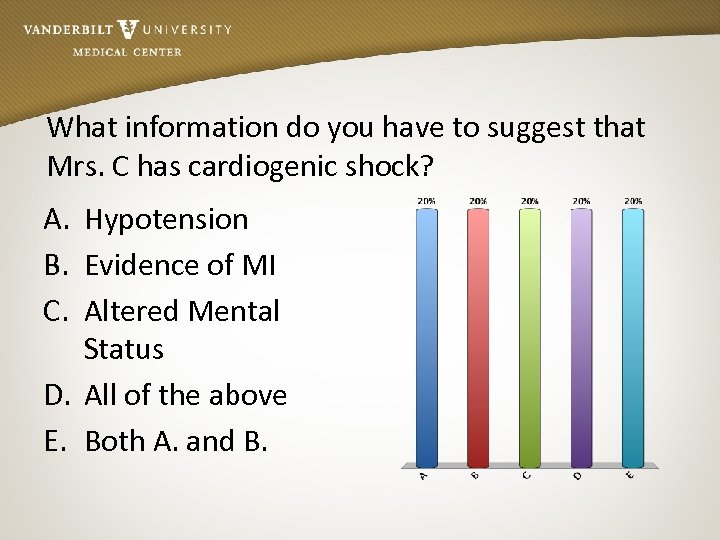
What information do you have to suggest that Mrs. C has cardiogenic shock? A. Hypotension B. Evidence of MI C. Altered Mental Status D. All of the above E. Both A. and B.
Treatment of Cardiogenic Shock • Correct hypotension: – Fluid resuscitation to correct hypovolemia – Inotropic or Vasopressor support: • • • Dobutamine Milrinone Norepinephrine Dopamine Epinephrine Oxygenation If MI – ASA, Heparin, and Revascularization If arrthymia – correct arrthymia If extracardiac abnormality – reverse or treat cause
Case Study • Mr. H is a 18 yo M who presents to ED after suffering a MCC into a tree. He was unhelmeted and has an obvious left femur fx. He was intubated for a GCS of 8 in the field and given 1 L NS en route for hypotension. • Vitals: HR 145, BP 71/38, Intubated with Sp. O 2 100%, Afebrile. • Labs: WBC 12. 3, Hgb 6. 7, Plts 72, INR 2. 1. • Traumagram shows Grade III liver lac.
What kind of shock does this patient have? A. Cardiogenic B. Hypovolemic C. Distributive
Hypovolemic Shock • Shock caused by decreased preload due to intravascular volume loss (1/5 of blood volume) – Results in decreased CO – SVR is typically increased in an effort to compensate – Causes: • Hemorrhagic – trauma, GI bleed, hemorrhagic pancreatitis, fractures • Fluid loss induced – Diarrhea, vomiting, burns Medscape LLC. 2013 (Online access on 22 August 2013) URL: http: //emedicine. medscape. com/article/760145 -treatment#2
What information do you have to suggest that Mr. H has hypovolemic shock? A. B. C. D. E. Recent trauma WBC 12. 3 Hgb 6. 7 All of the above Both A. and C.
Treatment of Hypovolemic Shock • Maximize oxygen delivery • Control further blood loss – Tourniquets – Surgical intervention • Fluid resuscitation – NS fluid boluses – Blood product administration
Case Study • Mr. S is a 59 yo M presents to ED with worsening abdominal pain and N&V • He is POD#8 s/p ex-lap, SBR with primary anastamosis for chronic SBO at OSH • Vitals: HR 128, BP 78/45, RR 28, Sp. O 2 94% on 4 L NC, Fever 103. 1 • Labs: WBC 20. 1, Hgb 9. 5, BUN 34, Creat 2. 1 • CT scan of ABD shows anastamotic leak
What kind of shock does this patient have? A. Cardiogenic B. Hypovolemic C. Distributive
Distributive Shock • Shock as a result of severely diminished SVR – CO is typically increased in an effort to maintain perfusion – Subtypes: • Septic – secondary to an overwhelming infection • Anaphylactic – secondary to a life-threatening allergic reaction • Neurogenic – secondary to a sudden loss of the autonomic nervous system function Gaieski et al. 2009 (Online accessed 22 August 2013) URL: http: //lijhs. sandi. net/faculty/rtenenbaum/ap-biology-folder/Links/Shock. utd. pdf
What information do you have to suggest Mr. S has distributive shock? A. Sp. O 2 94% on 4 L NC B. Anastamotic leak on CT scan C. WBC 20. 1 D. All of the above E. Both B. and C.
Treatment of Septic Shock • Resuscitate – 30 cc/kg of NS bolus • Identify Source – Pan cultures – CT scan – Line removal – Foley removal – Surgical exploration • Antibiotics Dellinger, R et al. Surviving Sepsis Campaign: International Guidelines for Management of Severe Sepsis and Septic Shock: 2012, 41: 580 -637, 2013.
Treatment of Anaphylactic Shock • Remove offending agent • Establish an airway and return circulation • Pharmacologic support: – Epinephrine – reverses peripheral vasodilation, dilates bronchial airways, increases myocardial contractility, and suppresses histamine/ leukotriene release – Antihistamine (benadryl) – may help counter histaminemediated vasodilation and bronchoconstriction – Corticosteroids (hydrocortisone) – may help shorten reaction – Bronchodilators Soar, J et al. 2013 (Online Accessed on 22 August 2013) URL: http: //www. resus. org. uk/pages/reaction. pdf
Treatment of Neurogenic Shock • Establish an airway to maintain adequate oxygenation and ventilation • Fluid resuscitation for MAP>65 mm. Hg • Inotropic support – Dobutamine – Dopamine • Atropine for severe bradycardia • High dose methylprednisolone therapy Emergency Medicine. 2009 (Online Accessed on 22 August 2013) URL: http: //emergencymed. wordpress. com/2009/03/11/neurogenic-shock/
All three types of shock can occur at the same time to have a combined shock picture.
Case Study • Mrs. D is a 71 yo F who presented to ED after a 3 day h/o N&V with inability to tolerate PO intake. She is now POD 0 s/p exlap, pancretectomy for necrotizing pancreatitis. She presents to the Surgical ICU postop. • Vitals: HR 121, BP 82/41, Intubated on 100% Fi. O 2, Fever 102. 8 • Labs: WBC 1. 1, Hgb 8. 4, BUN 61, Creat 2. 82, Lactate 3. 7
Case Study cont. . • The Surgical ICU team places a MAC with PAC to obtain further data about the patient’s hemodynamic status. • PAC numbers: PAP 18/6, CVP 1, PCWP 2, CI 1. 7, SVR 615
What type of shock does this patient have? A. B. C. D. Cardiogenic Hypovolemic Distributive All of the Above
What information leads you to believe Mrs. D has a component of cardiogenic shock? A. B. C. D. BP 82/41 Temp 102. 8 CI 1. 7 L/min Cr 2. 82
What information demonstrates a component of hypovolemic shock? A. CVP 1 mm. Hg B. PCWP 2 mm. Hg C. SVR 615 dynes/sec/cm-5 D. PAP 18/6 mm. Hg E. Both A. B. and D.
What information indicates a degree of distributive shock? A. PCWP 2 mm. Hg B. SVR 615 dynes/sec/cm-5 C. PAP 18. 16 mm. Hg D. WBC 1. 1
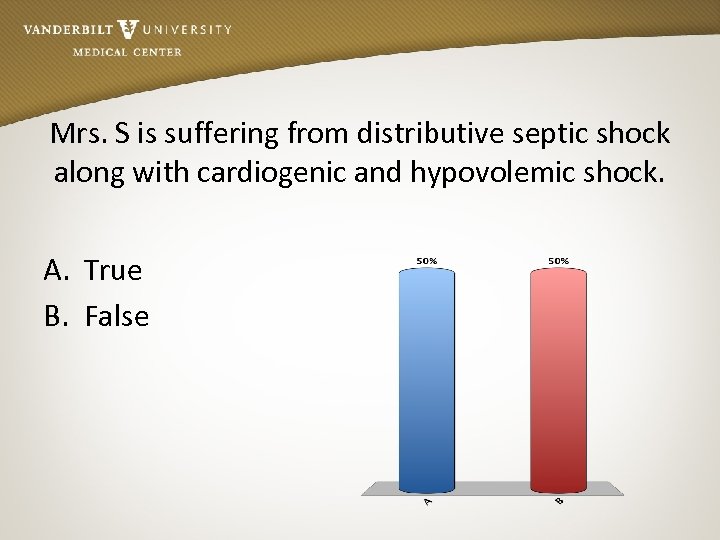
Mrs. S is suffering from distributive septic shock along with cardiogenic and hypovolemic shock. A. True B. False
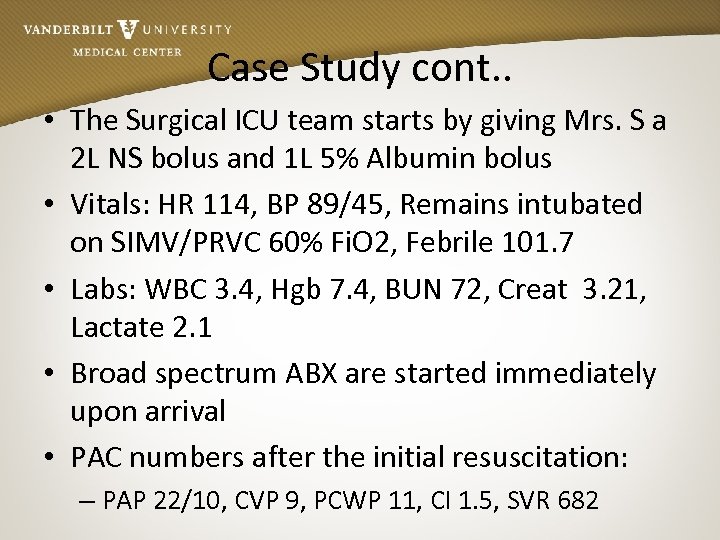
Case Study cont. . • The Surgical ICU team starts by giving Mrs. S a 2 L NS bolus and 1 L 5% Albumin bolus • Vitals: HR 114, BP 89/45, Remains intubated on SIMV/PRVC 60% Fi. O 2, Febrile 101. 7 • Labs: WBC 3. 4, Hgb 7. 4, BUN 72, Creat 3. 21, Lactate 2. 1 • Broad spectrum ABX are started immediately upon arrival • PAC numbers after the initial resuscitation: – PAP 22/10, CVP 9, PCWP 11, CI 1. 5, SVR 682
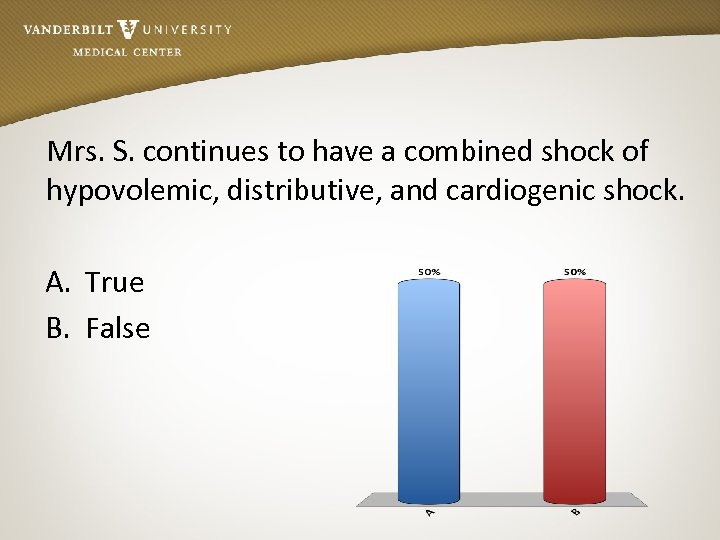
Mrs. S. continues to have a combined shock of hypovolemic, distributive, and cardiogenic shock. A. True B. False
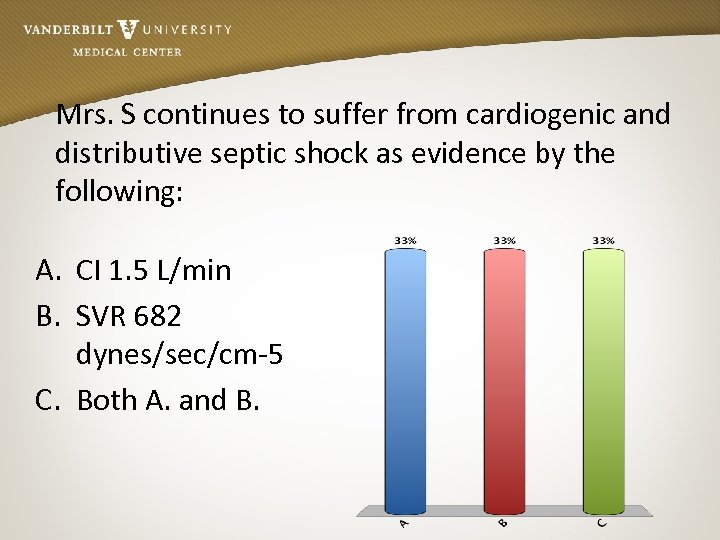
Mrs. S continues to suffer from cardiogenic and distributive septic shock as evidence by the following: A. CI 1. 5 L/min B. SVR 682 dynes/sec/cm-5 C. Both A. and B.
As an intensivist, what treatment should be implemented next? A. More fluid resuscitation B. Initiate vasopressor support C. Initiate inotropic support D. No change in current therapy E. Both B. and C.
Case study cont. . • After initiating milrinone and levophed therapy, Mrs. S improves. • Vitals: HR 93, BP 122/61, Intubated on PS/CPAP 40%, Afebrile. Levophed at 4 mcg/min and Milrinone at 0. 375 mcg/kg/min • PA numbers: PAP 24/10, CVP 12, PCWP 14, CI 3. 6, SVR 1120
Case study cont. . • The Surgical ICU team decides to attempt to wean vasopressor support first. • Mrs. S is successfully weaned off levophed support after approximately 12 hours. • Vitals: HR 87, BP 117/58, Intubated on PS/CPAP 40%, Afebrile. Levophed is off and Milrinone at 0. 375 mcg/kg/min • PA numbers: PAP 22/14, CVP 12, PCWP 14, CI 3. 4, SVR 1068
Case Study cont. . • After an additional 12 hours, Mrs. S is successfully weaned off milrinone support as well. • She is extubated the next day and progressing well. • On HOD 6, Mrs. S is complaining of a HA and would prefer not to take narcotics. • Ibuprofen 200 mg q 6 h PRN is added to HA pain.
Case Study cont. . • After approximately 15 min of her first dose of Ibuprofen, Mrs S starts to complain of difficult breathing, flushing, and airway edema. • The bedside RN notices a new onset of hives around Mrs. S’s neck and mouth. • Vitals: HR 147, BP 54/31, Sp. O 2 91% on 100% NRB, Febrile 102. 6.
What kind of shock is Mrs. S exhibiting? A. Cardiogenic B. Hypovolemic C. Distributive
What would you include in your treatment plan? A. Benadryl 25 mg IV B. Reintubation C. Hydrocortisone 100 mg IV D. Epinephrine 50 mcg IV E. All of the above
Case Study cont. . • Mrs. S is successfully intubated and administered treatment for her anaphylaxis. After approximately 12 hours, her symptoms have resolved. She is again extubated and progressing well. • Mrs. S goes on to rehab and eventually home!
Summary Survival and outcomes improve with early perfusion, adequate oxygenation, and identification with appropriate treatment of the cause of shock.
Questions?
References • Dellinger, R et al. Surviving Sepsis Campaign: International Guidelines for Management of Severe Sepsis and Septic Shock: 2012, 41: 580 -637, 2013. • Emergency Medicine. 2009 (Online Accessed on 22 August 2013) URL: http: //emergencymed. wordpress. com/2009/03/11/neurogenic-shock/ • Gaieski et al. 2009 (Online accessed 22 August 2013) URL: http: //lijhs. sandi. net/faculty/rtenenbaum/ap-biologyfolder/Links/Shock. utd. pdf • Medscape Reference. 1994 (Online accessed 22 August 2013) URL: http: //emedicine. medscape. com/article/152191 -treatment#showall • Medscape LLC. 2013 (Online access on 22 August 2013) URL: http: //emedicine. medscape. com/article/760145 -treatment#2 • Soar, J et al. 2013 (Online Accessed on 22 August 2013) URL: http: //www. resus. org. uk/pages/reaction. pdf
Скачать презентацию Shock Management Erin Burrell ACNP-BC Surgical ICU Nurse
1d77282a38bf2f4f2f2904388e226704.ppt