 Скачать презентацию SHMS Optics and Background Studies Tanja Horn Hall
8cd891deeff1a425a50bb16f72fa312e.ppt
- Количество слайдов: 23



SHMS Optics and Background Studies Tanja Horn Hall C Summer Meeting 5 August 2008
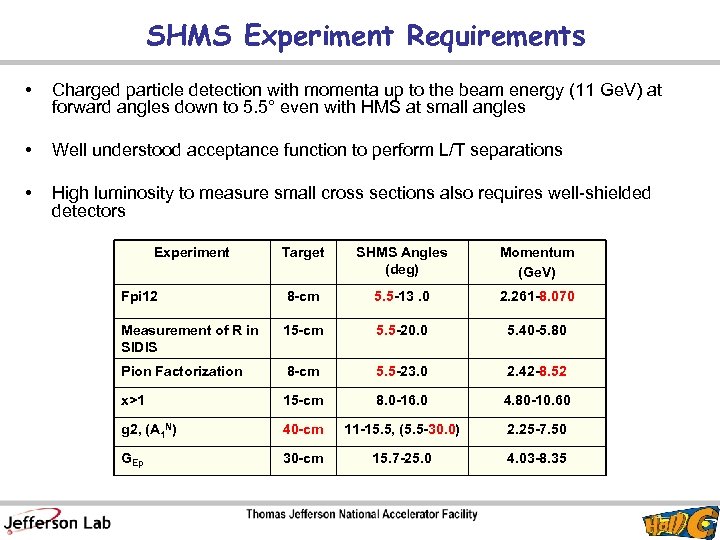
SHMS Experiment Requirements • Charged particle detection with momenta up to the beam energy (11 Ge. V) at forward angles down to 5. 5° even with HMS at small angles • Well understood acceptance function to perform L/T separations • High luminosity to measure small cross sections also requires well-shielded detectors Experiment Target SHMS Angles (deg) Momentum (Ge. V) Fpi 12 8 -cm 5. 5 -13. 0 2. 261 -8. 070 Measurement of R in SIDIS 15 -cm 5. 5 -20. 0 5. 40 -5. 80 Pion Factorization 8 -cm 5. 5 -23. 0 2. 42 -8. 52 x>1 15 -cm 8. 0 -16. 0 4. 80 -10. 60 g 2, (A 1 N) 40 -cm 11 -15. 5, (5. 5 -30. 0) 2. 25 -7. 50 GEp 30 -cm 15. 7 -25. 0 4. 03 -8. 35
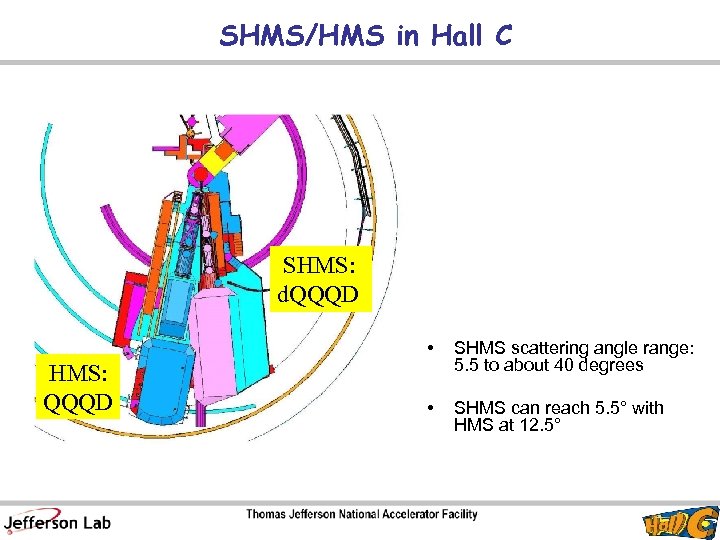
SHMS/HMS in Hall C SHMS: d. QQQD • HMS: QQQD SHMS scattering angle range: 5. 5 to about 40 degrees • SHMS can reach 5. 5° with HMS at 12. 5°
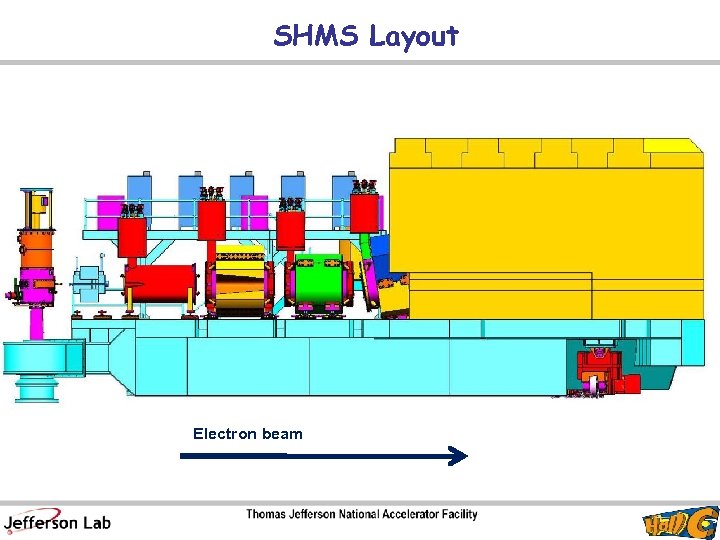
SHMS Layout Electron beam
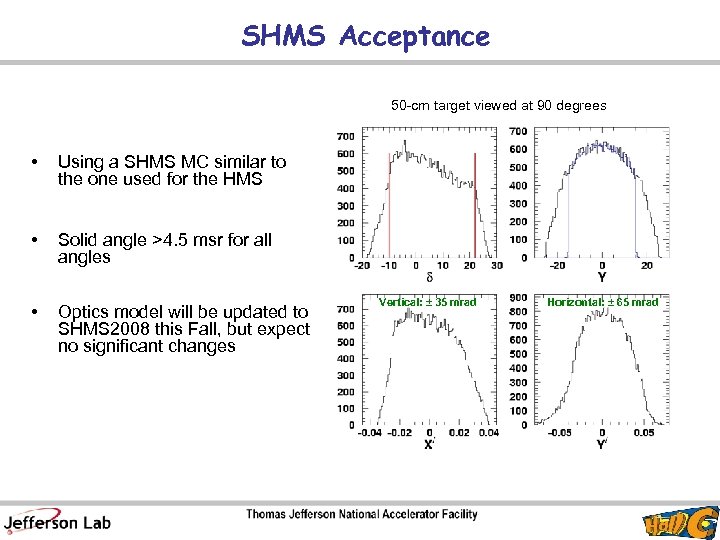
SHMS Acceptance 50 -cm target viewed at 90 degrees • Using a SHMS MC similar to the one used for the HMS • Solid angle >4. 5 msr for all angles • Optics model will be updated to SHMS 2008 this Fall, but expect no significant changes Vertical: ± 35 mrad Horizontal: ± 65 mrad
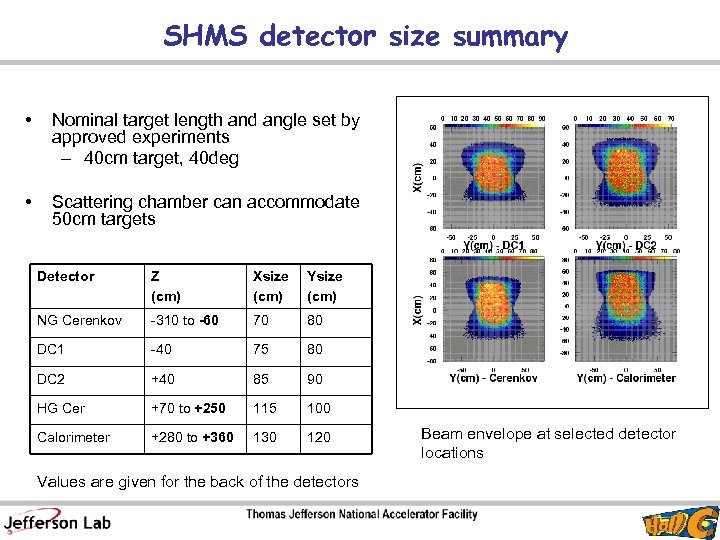
SHMS detector size summary • Nominal target length and angle set by approved experiments – 40 cm target, 40 deg • Scattering chamber can accommodate 50 cm targets Detector Z (cm) Xsize (cm) Ysize (cm) NG Cerenkov -310 to -60 70 80 DC 1 -40 75 80 DC 2 +40 85 90 HG Cer +70 to +250 115 100 Calorimeter +280 to +360 130 120 Values are given for the back of the detectors Beam envelope at selected detector locations
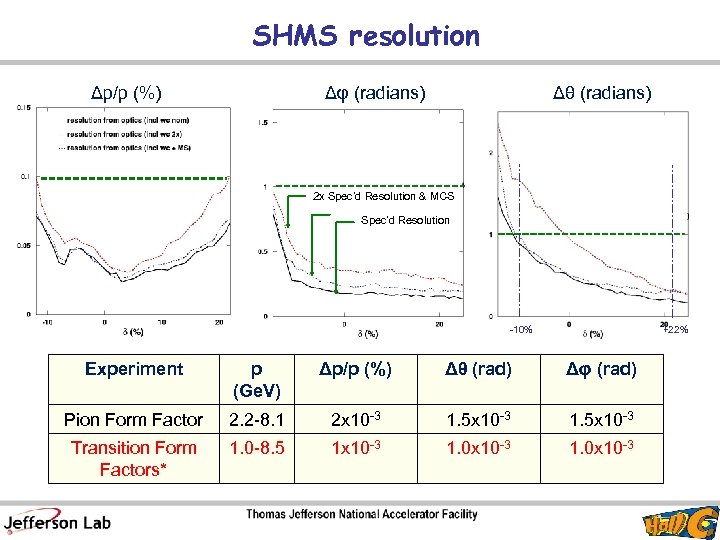
SHMS resolution Δp/p (%) Δφ (radians) Δθ (radians) 2 x Spec’d Resolution & MCS Spec’d Resolution +22% -10% Experiment p (Ge. V) Δp/p (%) Δθ (rad) Δφ (rad) Pion Form Factor 2. 2 -8. 1 2 x 10 -3 1. 5 x 10 -3 Transition Form Factors* 1. 0 -8. 5 1 x 10 -3 1. 0 x 10 -3
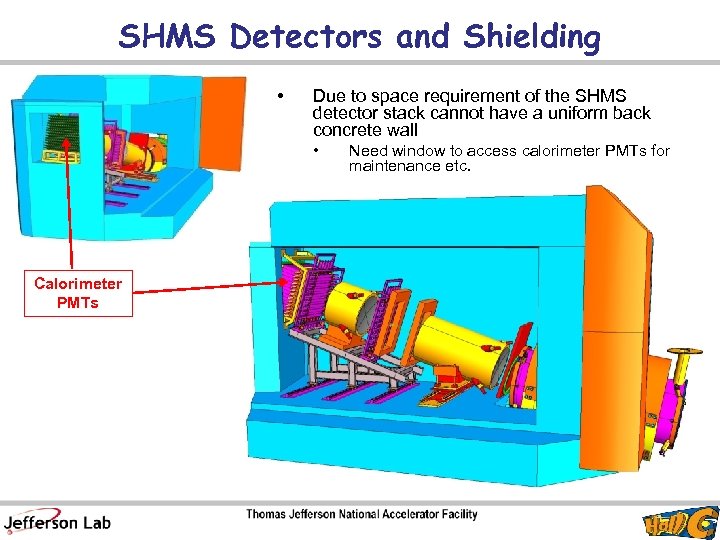
SHMS Detectors and Shielding • Due to space requirement of the SHMS detector stack cannot have a uniform back concrete wall • Calorimeter PMTs Need window to access calorimeter PMTs for maintenance etc.
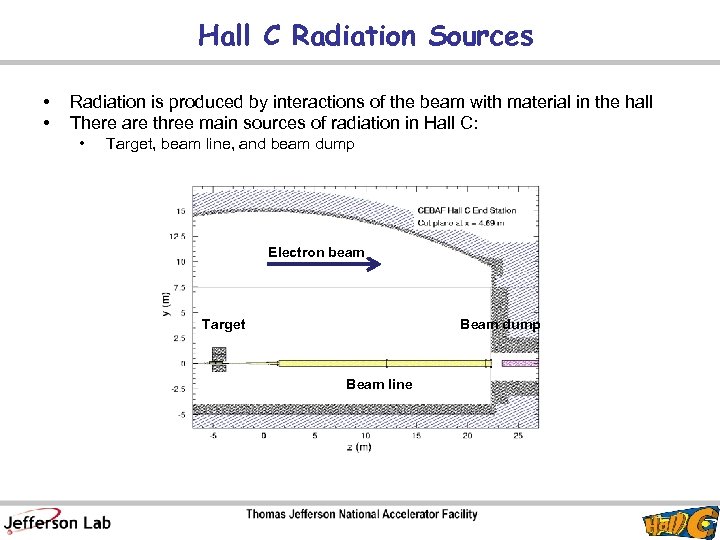
Hall C Radiation Sources • • Radiation is produced by interactions of the beam with material in the hall There are three main sources of radiation in Hall C: • Target, beam line, and beam dump Electron beam Target Beam dump Beam line
Radiation Types • Scattered electrons • Produce radiation • bremsstrahlung is the dominant process except at very low energy • Neutral particles: photons and neutrons • • • Have a higher penetration power than charged particles Are attenuated in intensity as traverse matter, but have no continuous energy loss Thickness of attenuating material vs. penetrating power • • Photons interact primarily with electrons surrounding atoms Neutrons interact with nuclei • Hadrons: protons, pions • • Hadronic cross sections are small 1 m of concrete almost fully stops 1 Ge. V protons
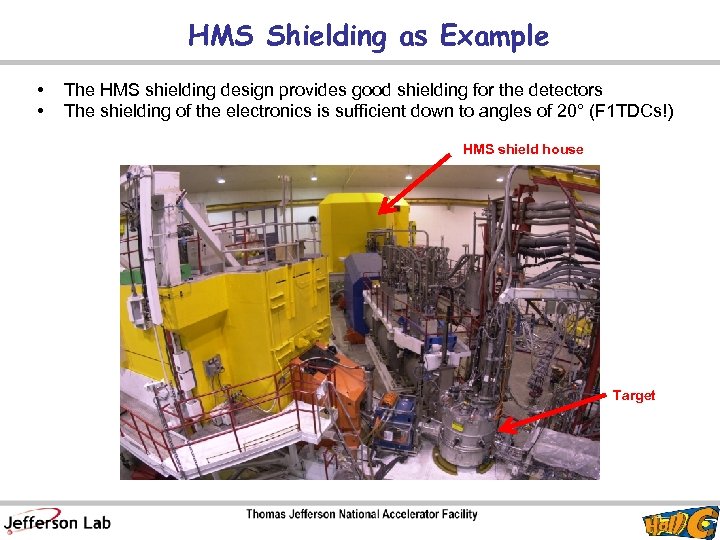
HMS Shielding as Example • • The HMS shielding design provides good shielding for the detectors The shielding of the electronics is sufficient down to angles of 20° (F 1 TDCs!) HMS shield house Target
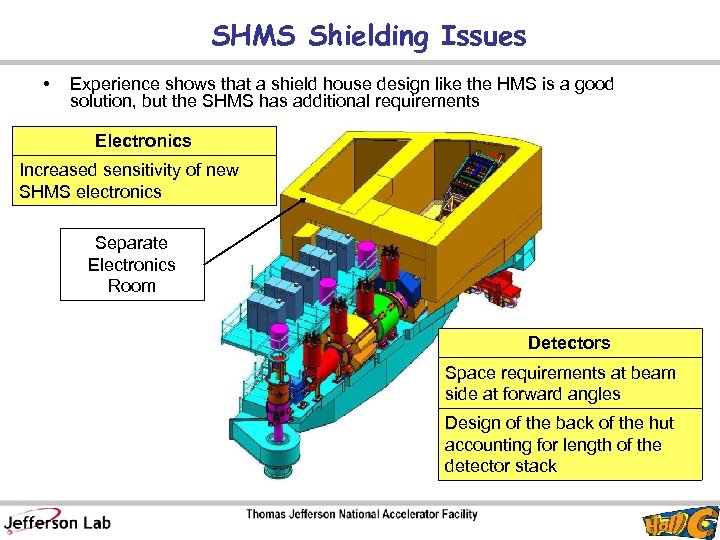
SHMS Shielding Issues • Experience shows that a shield house design like the HMS is a good solution, but the SHMS has additional requirements Electronics Increased sensitivity of new SHMS electronics Separate Electronics Room Detectors Space requirements at beam side at forward angles Design of the back of the hut accounting for length of the detector stack
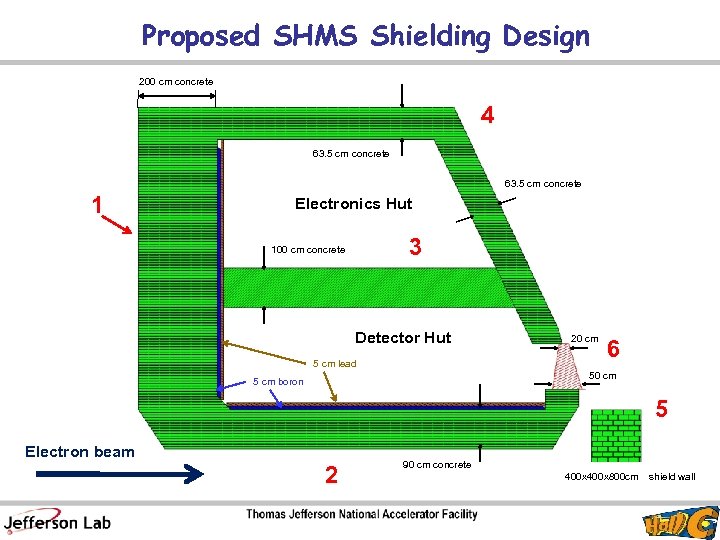
Proposed SHMS Shielding Design 200 cm concrete 4 63. 5 cm concrete 1 Electronics Hut 3 100 cm concrete Detector Hut 5 cm lead 20 cm 6 50 cm 5 cm boron 5 Electron beam 2 90 cm concrete 400 x 800 cm shield wall
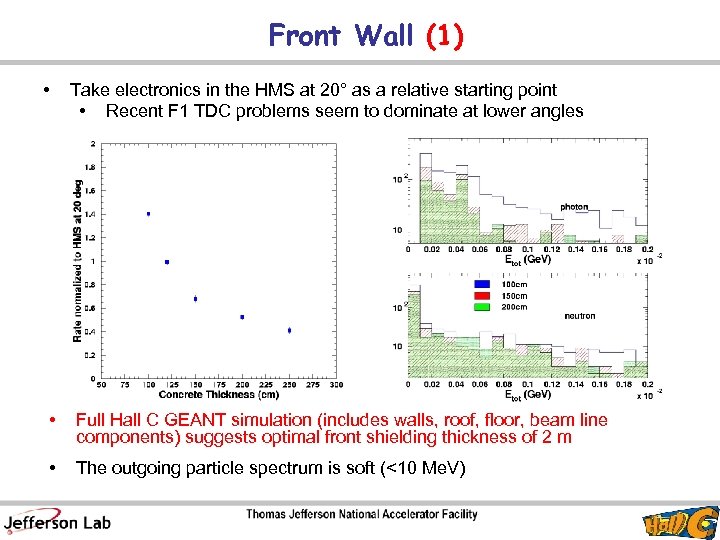
Front Wall (1) • Take electronics in the HMS at 20° as a relative starting point • Recent F 1 TDC problems seem to dominate at lower angles • Full Hall C GEANT simulation (includes walls, roof, floor, beam line components) suggests optimal front shielding thickness of 2 m • The outgoing particle spectrum is soft (<10 Me. V)
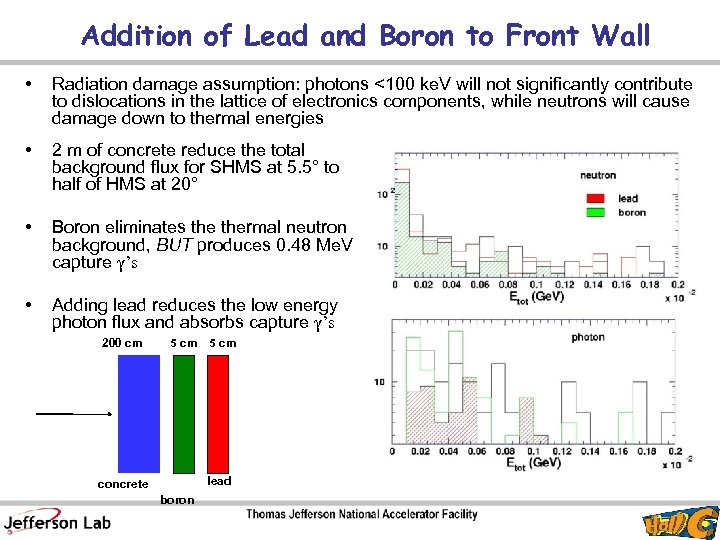
Addition of Lead and Boron to Front Wall • Radiation damage assumption: photons <100 ke. V will not significantly contribute to dislocations in the lattice of electronics components, while neutrons will cause damage down to thermal energies • 2 m of concrete reduce the total background flux for SHMS at 5. 5° to half of HMS at 20° • Boron eliminates thermal neutron background, BUT produces 0. 48 Me. V capture γ’s • Adding lead reduces the low energy photon flux and absorbs capture γ’s 200 cm 5 cm lead concrete boron
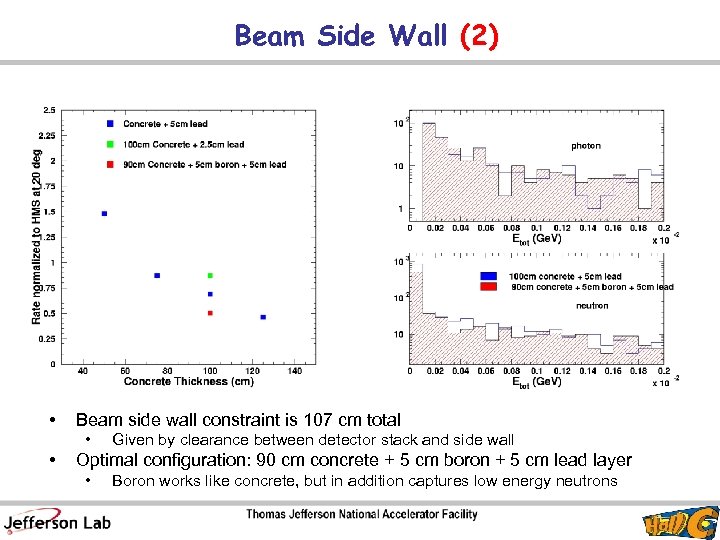
Beam Side Wall (2) • Beam side wall constraint is 107 cm total • • Given by clearance between detector stack and side wall Optimal configuration: 90 cm concrete + 5 cm boron + 5 cm lead layer • Boron works like concrete, but in addition captures low energy neutrons
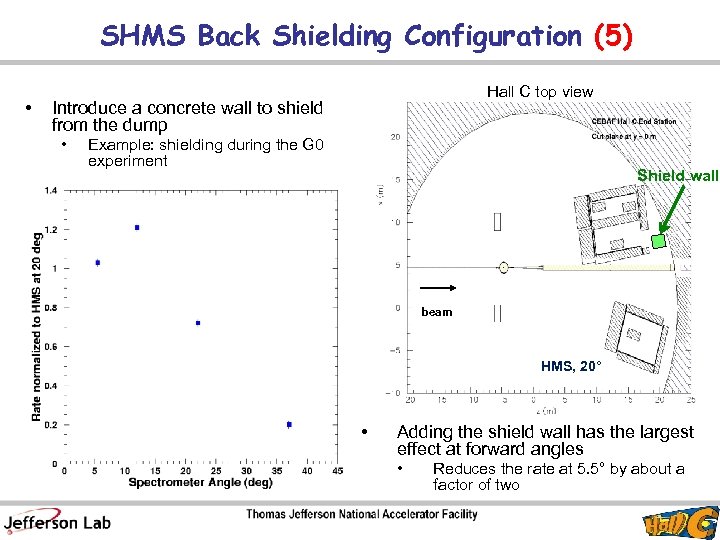
SHMS Back Shielding Configuration (5) • Hall C top view Introduce a concrete wall to shield from the dump • Example: shielding during the G 0 experiment Shield wall beam HMS, 20° • Adding the shield wall has the largest effect at forward angles • Reduces the rate at 5. 5° by about a factor of two
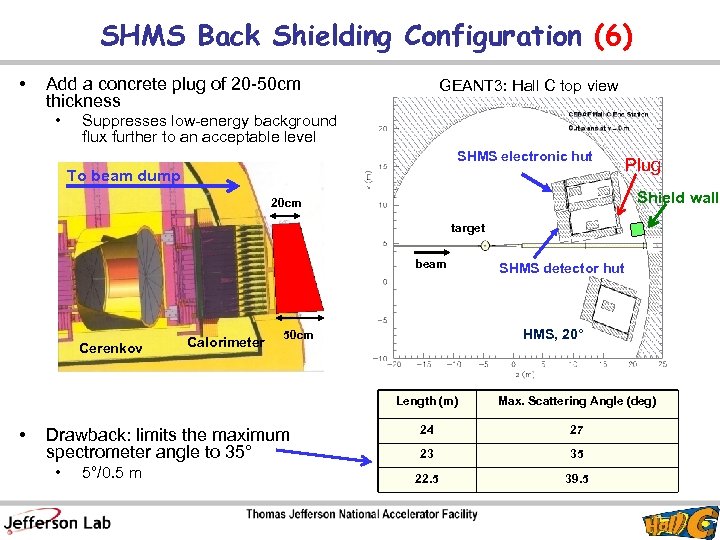
SHMS Back Shielding Configuration (6) • Add a concrete plug of 20 -50 cm thickness • GEANT 3: Hall C top view Suppresses low-energy background flux further to an acceptable level SHMS electronic hut To beam dump Plug Shield wall 20 cm target beam Cerenkov Calorimeter SHMS detector hut HMS, 20° 50 cm Length (m) • Drawback: limits the maximum spectrometer angle to 35° • 5°/0. 5 m Max. Scattering Angle (deg) 24 27 23 35 22. 5 39. 5
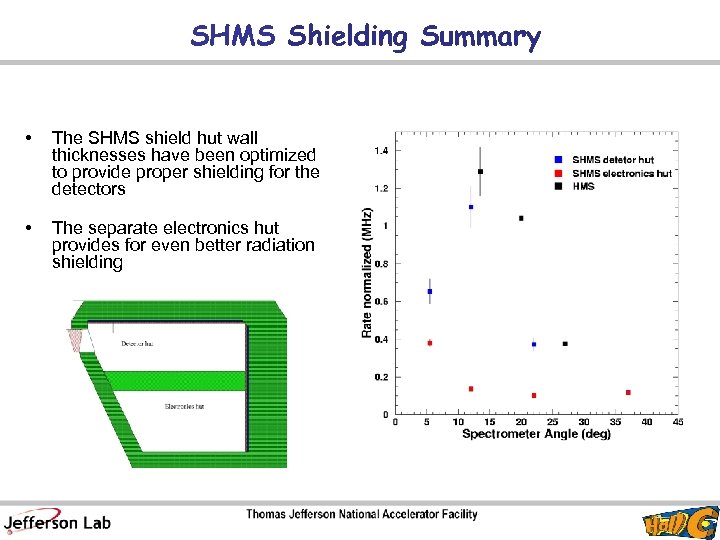
SHMS Shielding Summary • The SHMS shield hut wall thicknesses have been optimized to provide proper shielding for the detectors • The separate electronics hut provides for even better radiation shielding
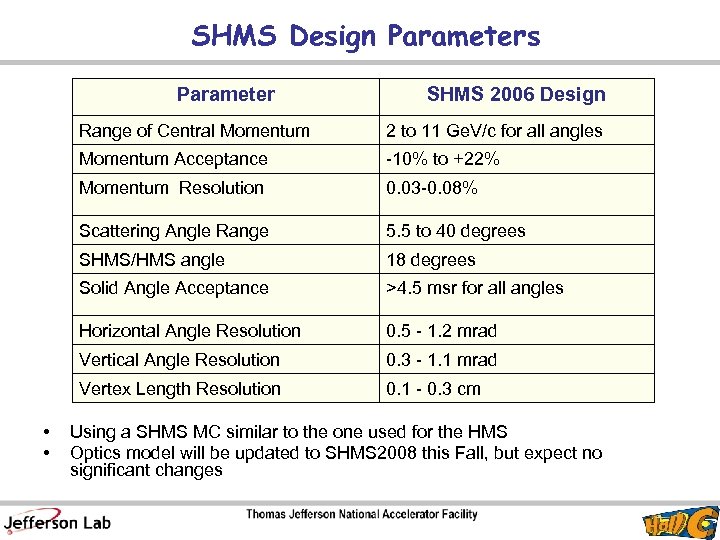
SHMS Design Parameters Parameter SHMS 2006 Design Range of Central Momentum Acceptance -10% to +22% Momentum Resolution 0. 03 -0. 08% Scattering Angle Range 5. 5 to 40 degrees SHMS/HMS angle 18 degrees Solid Angle Acceptance >4. 5 msr for all angles Horizontal Angle Resolution 0. 5 - 1. 2 mrad Vertical Angle Resolution 0. 3 - 1. 1 mrad Vertex Length Resolution • • 2 to 11 Ge. V/c for all angles 0. 1 - 0. 3 cm Using a SHMS MC similar to the one used for the HMS Optics model will be updated to SHMS 2008 this Fall, but expect no significant changes
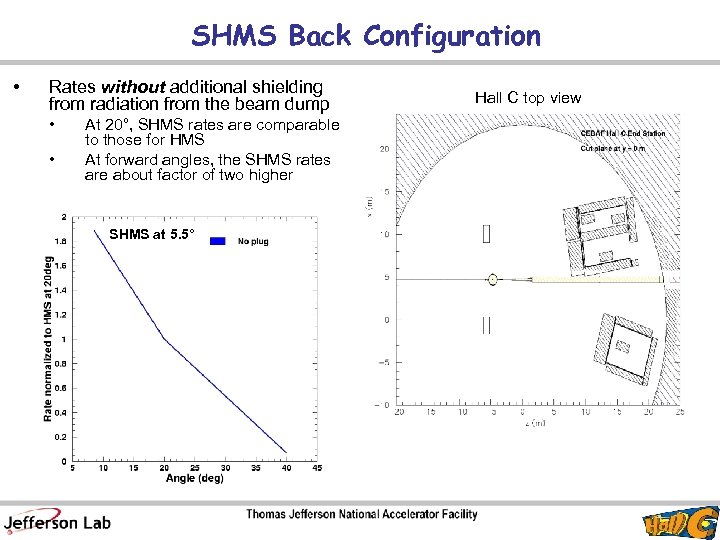
SHMS Back Configuration • Rates without additional shielding from radiation from the beam dump • • At 20°, SHMS rates are comparable to those for HMS At forward angles, the SHMS rates are about factor of two higher SHMS at 5. 5° Hall C top view
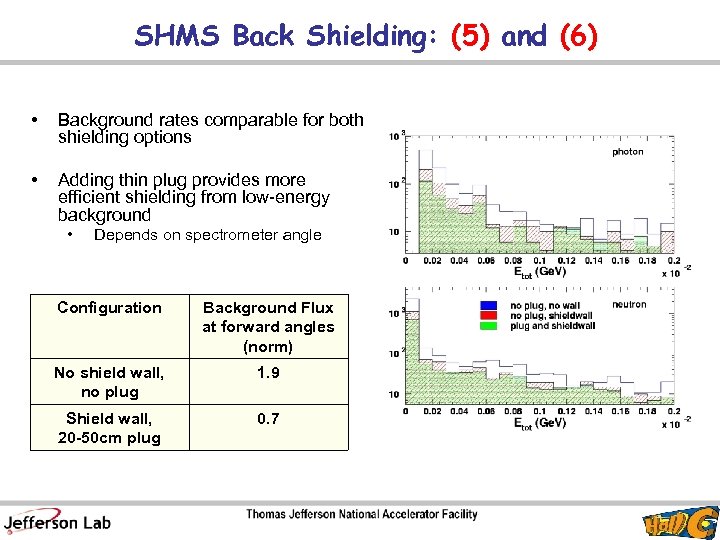
SHMS Back Shielding: (5) and (6) • Background rates comparable for both shielding options • Adding thin plug provides more efficient shielding from low-energy background • Depends on spectrometer angle Configuration Background Flux at forward angles (norm) No shield wall, no plug 1. 9 Shield wall, 20 -50 cm plug 0. 7
Скачать презентацию SHMS Optics and Background Studies Tanja Horn Hall
8cd891deeff1a425a50bb16f72fa312e.ppt