


 Скачать презентацию Shipper meeting 21 April 2004 Sheraton- Amsterdam 21
ebf392f97e0d953781a50446c039cad3.ppt
- Количество слайдов: 68
 Shipper meeting 21 April 2004 Sheraton- Amsterdam 21 -04 -2004 Amsterdam
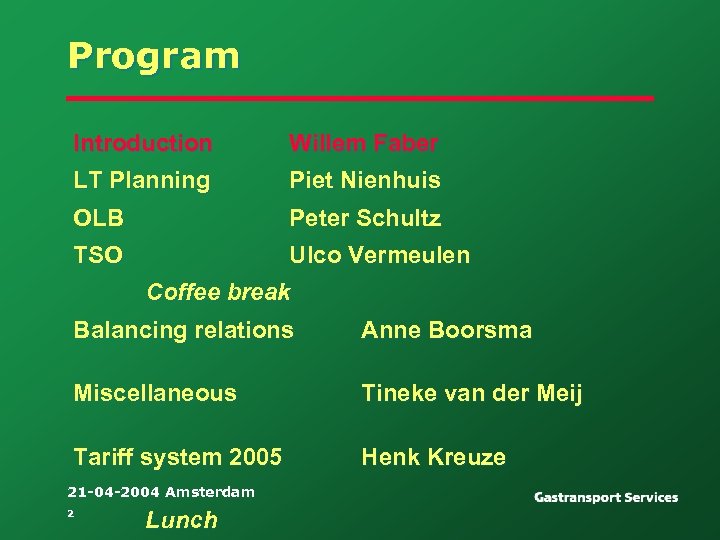 Program Introduction Willem Faber LT Planning Piet Nienhuis OLB Peter Schultz TSO Ulco Vermeulen Coffee break Balancing relations Anne Boorsma Miscellaneous Tineke van der Meij Tariff system 2005 Henk Kreuze 21 -04 -2004 Amsterdam 2 Lunch
 Long Term Planning 21 -04 -2004 Amsterdam 3
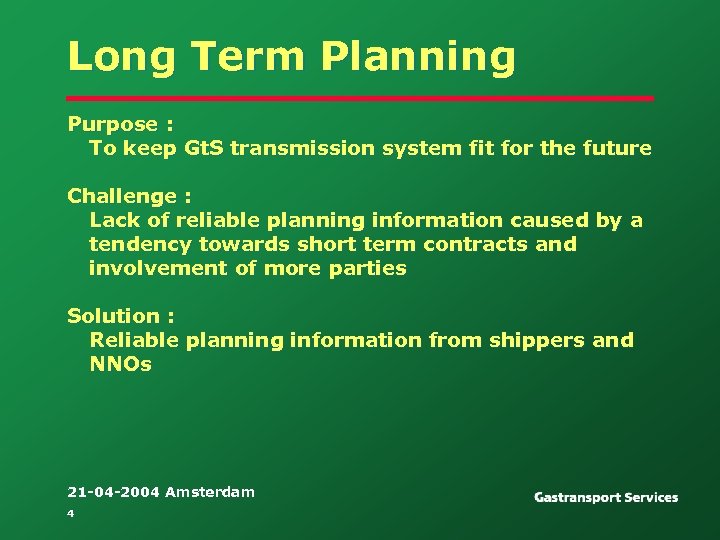 Long Term Planning Purpose : To keep Gt. S transmission system fit for the future Challenge : Lack of reliable planning information caused by a tendency towards short term contracts and involvement of more parties Solution : Reliable planning information from shippers and NNOs 21 -04 -2004 Amsterdam 4
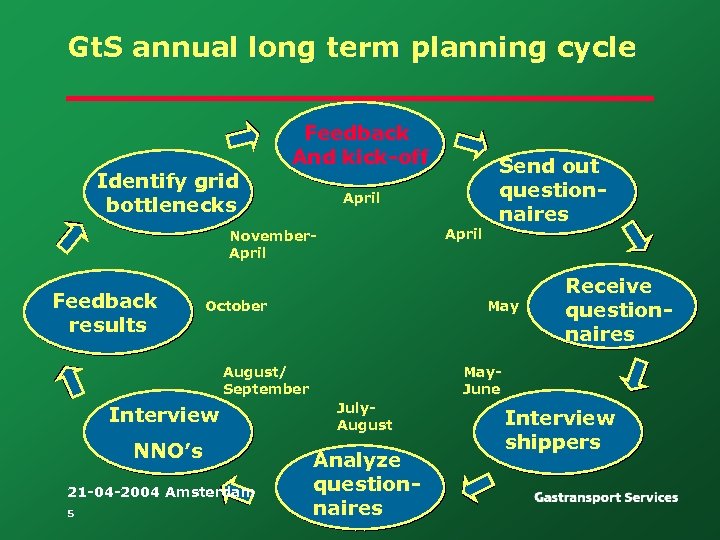 Gt. S annual long term planning cycle Identify grid bottlenecks Feedback And kick-off April November. April Feedback results October May August/ September Interview NNO’s 21 -04 -2004 Amsterdam 5 Send out questionnaires Receive questionnaires May. June July. August Analyze questionnaires Interview shippers
 Gt. S external planning process • Executed for the first time in 2003 with a small group of shippers and NNO’s • Results were presented to these shippers in December 2003 • Gt. S wishes to repeat this process in 2004 • Today : feedback previous cycle and kick-off new cycle 21 -04 -2004 Amsterdam 6
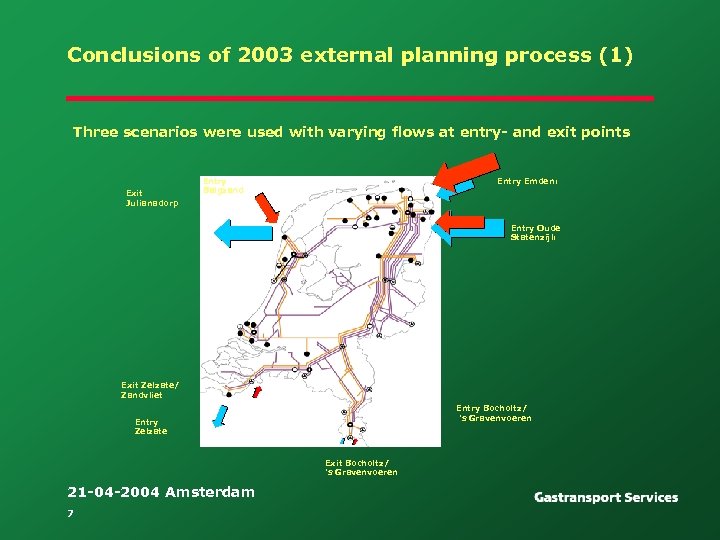 Conclusions of 2003 external planning process (1) Three scenarios were used with varying flows at entry- and exit points Exit Julianadorp Entry Emden: Entry Balgzand Entry Oude Statenzijl: Exit Zelzate/ Zandvliet Entry Bocholtz/ ’s Gravenvoeren Entry Zelzate Exit Bocholtz/ ’s Gravenvoeren 21 -04 -2004 Amsterdam 7
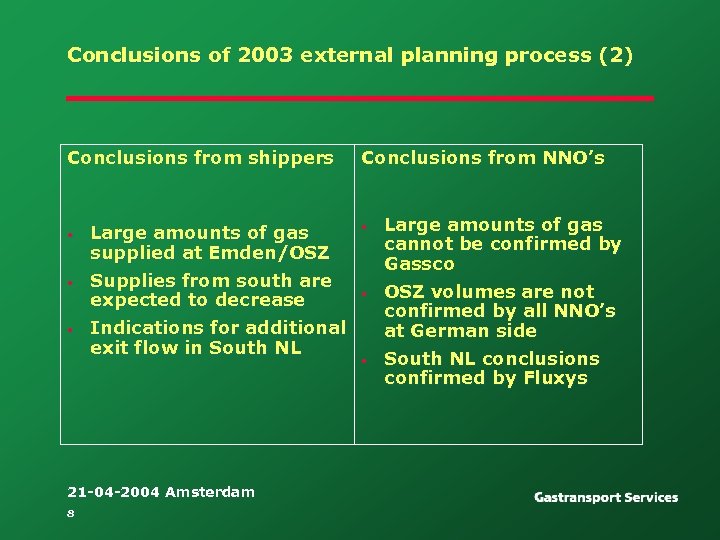 Conclusions of 2003 external planning process (2) Conclusions from shippers • Large amounts of gas supplied at Emden/OSZ • Supplies from south are expected to decrease • Indications for additional exit flow in South NL 21 -04 -2004 Amsterdam 8 Conclusions from NNO’s • Large amounts of gas cannot be confirmed by Gassco • OSZ volumes are not confirmed by all NNO’s at German side • South NL conclusions confirmed by Fluxys
 Conclusions of 2003 external planning process (3) • Information from shippers not consistent with information from NNO’s • Flows indicated by shippers cannot be accommodated at Gt. S entry- and exitpoints • To accommodate these flows, between € 250 and € 500 mln investments are required to increase entryand exitcapacities • Clear need for long term commitments 21 -04 -2004 Amsterdam 9
 Kick-off new planning cycle Main information required • How much : volume, capacity • Where : entry/exit points • When : year, summer/winter • For whom : market segment • Circumstances : two scenarios 21 -04 -2004 Amsterdam 10
 Scenarios in questionnaire • To identify divergent needs for long term investments • To ensure consistent assumptions among shippers • To provide guidance to shippers • Developed around future UK deficit 21 -04 -2004 Amsterdam 11
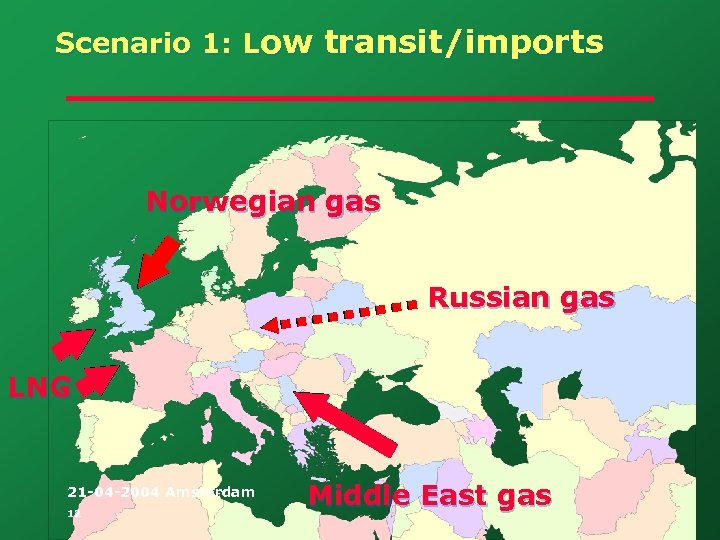 Scenario 1: Low transit/imports Norwegian gas Russian gas LNG 21 -04 -2004 Amsterdam 12 Middle East gas
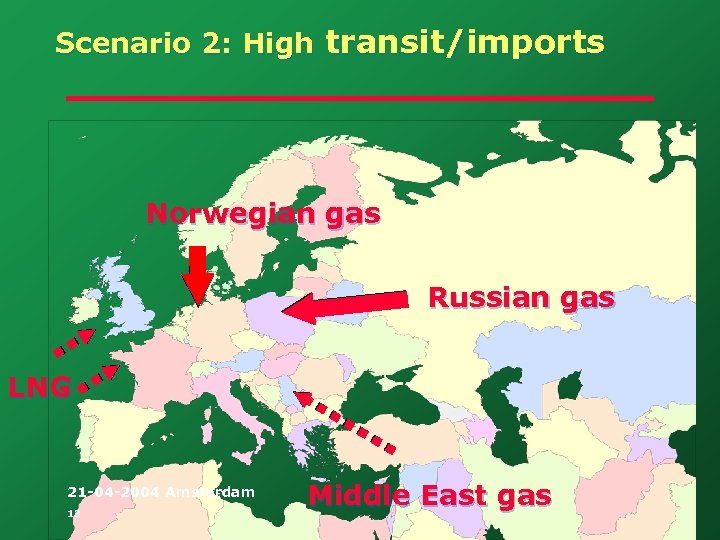 Scenario 2: High transit/imports Norwegian gas Russian gas LNG 21 -04 -2004 Amsterdam 13 Middle East gas
 Available here today for interested parties • Cover letter • Questionnaires • Scenario assumptions • Results previous planning cycle Letter with questionnaire and scenario assumptions will be made available on our web site and will also be sent to shippers 21 -04 -2004 Amsterdam 14
 Your next move • Read the letter • Use the questionnaire • Contact us to set up a meeting Please contact: Piet Nienhuis p. nienhuis@gasunie. nl Phone +31 50 521 2854 21 -04 -2004 Amsterdam 15 Pieter Hartmans p. a. hartmans@gasunie. nl Phone +31 50 521 2372
 Program Introduction Willem Faber LT Planning Piet Nienhuis OLB Peter Schultz TSO Ulco Vermeulen Coffee break Balancing relations Anne Boorsma Miscellaneous Tineke van der Meij Tariff system 2005 Henk Kreuze 21 -04 -2004 Amsterdam 16 Lunch
 Online balancing (OLB) 21 -04 -2004 Amsterdam 17
 Online balancing • New service to reduce imbalance risk • As from 1 April 2004 Gt. S started accepting applications for OLB – – – Main principles Basic mechanism restrictions 21 -04 -2004 Amsterdam 18
 Main principles • Shipper owns or has access to flex source or storage facility with: – – – Enough bandwidth, send in & send out capacity, work volume Sufficient ramp up ramp down capacity ……. . • Shipper signs over control to Gt. S • Shipper supplies online imbalance signal Sum exits – Sum entries 21 -04 -2004 Amsterdam 19
 Main principles • No interruptible entries or exits • No TTF • Only hourly measured entries & exits allowed in OLB portfolio 21 -04 -2004 Amsterdam 20
 Main principles • No imbalance penalties as long as imbalances stay within agreed limits • No need to nominate for the source or storage facility • Regular evaluations, Gt. S may postpone the service in case of: – – Bad performance of source/storage facility (slow, not enough flex, …. . ) Poor quality of imbalance signal, . . 21 -04 -2004 Amsterdam 21
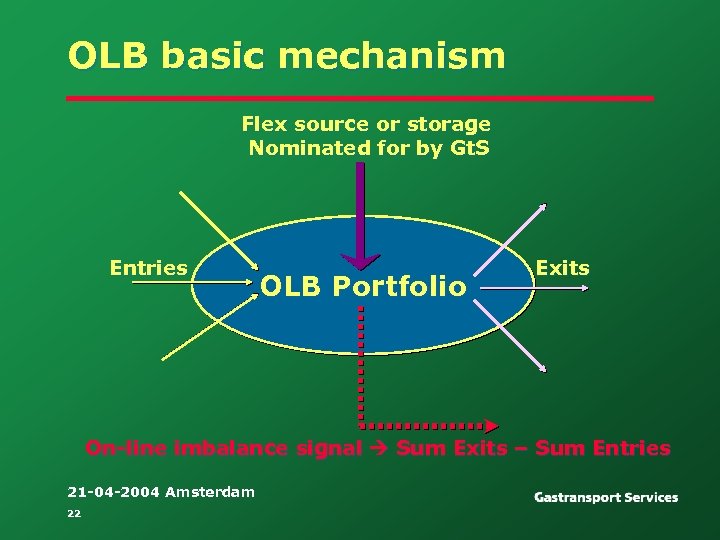 OLB basic mechanism Flex source or storage Nominated for by Gt. S Entries OLB Portfolio Exits On-line imbalance signal Sum Exits – Sum Entries 21 -04 -2004 Amsterdam 22
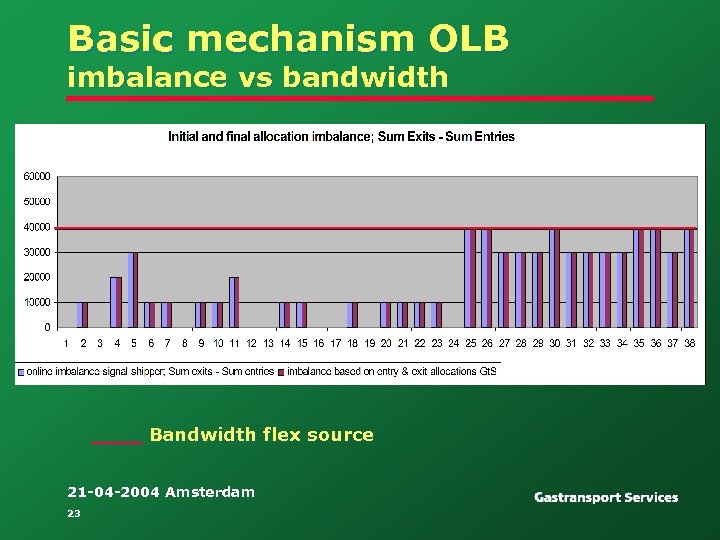 Basic mechanism OLB imbalance vs bandwidth ____ Bandwidth flex source 21 -04 -2004 Amsterdam 23
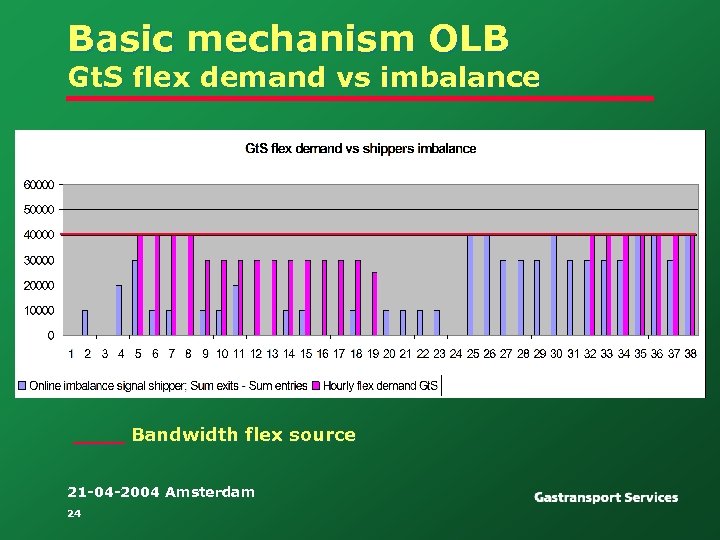 Basic mechanism OLB Gt. S flex demand vs imbalance ____ Bandwidth flex source 21 -04 -2004 Amsterdam 24
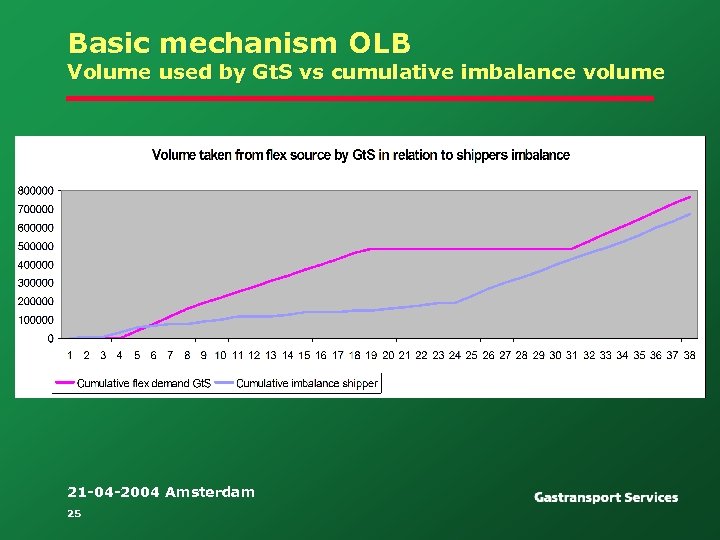 Basic mechanism OLB Volume used by Gt. S vs cumulative imbalance volume 21 -04 -2004 Amsterdam 25
 OLB application • Gt. S will check whether flex source is suitable for the OLB portfolio • Technical check > 10 business days • Every change in OLB portfolio requires new technical check • Gt. S supplies format on-line signal 21 -04 -2004 Amsterdam 26
 How to proceed • Questions: P. Schultz@gasunie. nl - +31 50 521 2176 – • Gt. S will organise information meetings to explain OLB in more detail 21 -04 -2004 Amsterdam 27
 Program Introduction Willem Faber LT Planning Piet Nienhuis OLB Peter Schultz TSO Ulco Vermeulen Coffee break Balancing relations Anne Boorsma Miscellaneous Tineke van der Meij Tariff system 2005 Henk Kreuze 21 -04 -2004 Amsterdam 28 Lunch
 Implementation and Intervention Law The role of the Transmission System Operator 21 -04 -2004 Amsterdam
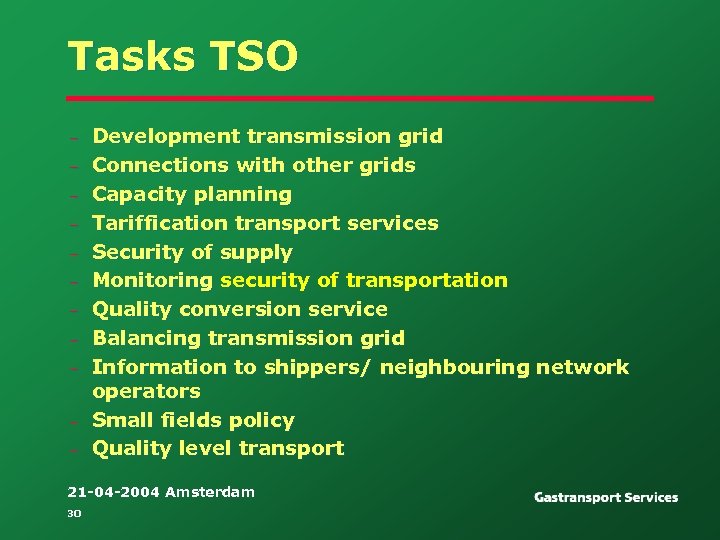 Tasks TSO – – – Development transmission grid Connections with other grids Capacity planning Tariffication transport services Security of supply Monitoring security of transportation Quality conversion service Balancing transmission grid Information to shippers/ neighbouring network operators Small fields policy Quality level transport 21 -04 -2004 Amsterdam 30
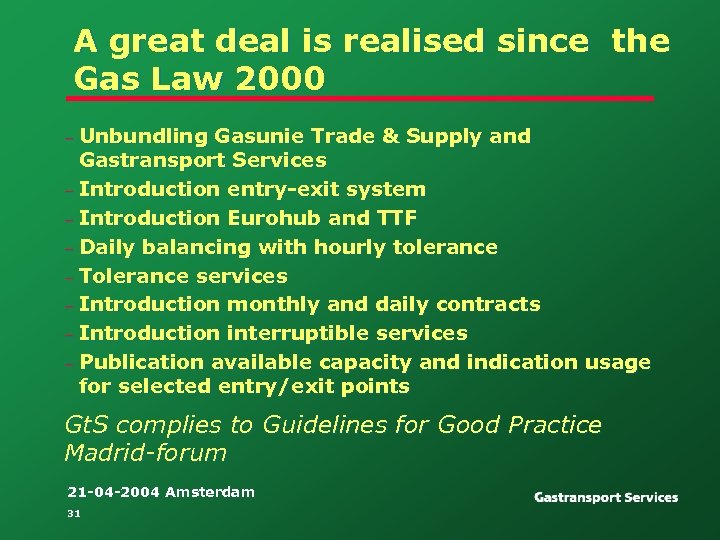 A great deal is realised since the Gas Law 2000 Unbundling Gasunie Trade & Supply and Gastransport Services – Introduction entry-exit system – Introduction Eurohub and TTF – Daily balancing with hourly tolerance – Tolerance services – Introduction monthly and daily contracts – Introduction interruptible services – Publication available capacity and indication usage for selected entry/exit points – Gt. S complies to Guidelines for Good Practice Madrid-forum 21 -04 -2004 Amsterdam 31
 Main topics 2004 / 2005 – Online balancing – “Click and Book” – Information Services 21 -04 -2004 Amsterdam 32
 The TSO as remedy? 21 -04 -2004 Amsterdam 33
 Security of transportation – Sufficient transportation capacity – Public Service Obligation peak supply households – Security of supply other end users is responsibility of these end users 21 -04 -2004 Amsterdam 34
 Investment and Capacity Planning – TSO will invest in Dutch natural gas transport grid: – Extension life span of existing network – Expected growth transit demand – Potential geographic shift of gas source – On economic conditions, i. e. based on rate of return transport activities 21 -04 -2004 Amsterdam 35
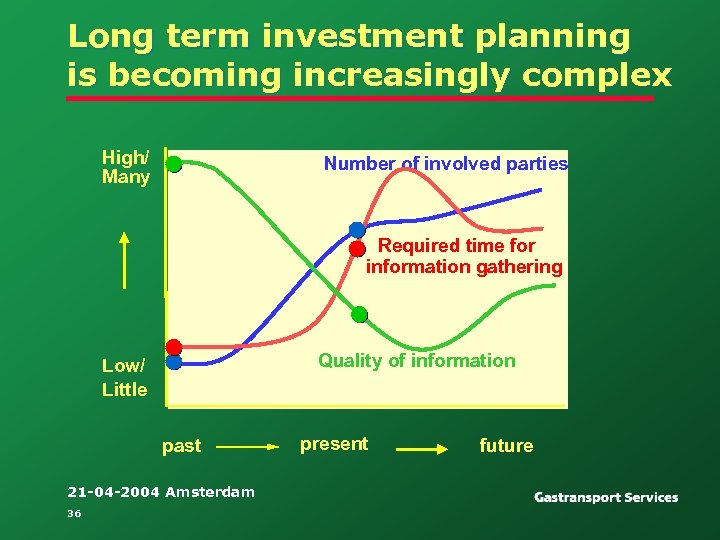 Long term investment planning is becoming increasingly complex High/ Many Number of involved parties Required time for information gathering Quality of information Low/ Little past 21 -04 -2004 Amsterdam 36 present future
 Quality conversion and balancing – – – Need for quality conversion fluctuating Investments in quality conversion on economic basis TSO continues availability line pack and additional tolerance services on market conditions Balancing and flexibility primary to market parties Spot market in preparation 21 -04 -2004 Amsterdam 37
 Coffee break 21 -04 -2004 Amsterdam
 Program Introduction Willem Faber LT Planning Piet Nienhuis OLB Peter Schultz TSO Ulco Vermeulen Coffee break Balancing relations Anne Boorsma Miscellaneous Tineke van der Meij Tariff system Henk Kreuze 21 -04 -2004 Amsterdam 39 Lunch
 Balancing Relations at TTF 21 -04 -2004 Amsterdam
 Content • Background • Extension of TTF nomination facilities • - Balancing Relation • - Own Use • - End User Categories • Summary and invitation 21 -04 -2004 Amsterdam 41
 Need for flex • Third Phase of Liberalisation - all end users up to 1 mln m 3 of gas per year - 6 mln households • Temperature related, low load factor • More need for flexibility in transportfolio 21 -04 -2004 Amsterdam 42
 Need for flex addressed by PVE • Needs and solutions identified, discussed and agreed in PVE – Platform Versnelling Energieliberalisering – Consisting of representatives of shippers, suppliers and network companies – Web site www. energieliberalisering. nl – Reports (in Dutch language) a. o. Allocation Rules Gas and Profile Methods Gas • Result: TTF Balancing Relation • Implemented by Gt. S 21 -04 -2004 Amsterdam 43
 Overview of means to get flex in transportfolio • Tolerance included in transport service – • Tolerance Service – • Gt. S balances shipper’s portfolio with shipper’s own flexible source or storage Extension of TTF nomination facilities (PVE) as of 1 July 2004 – • Gt. S offers flexibility on commercial basis On Line Balancing – è Up to 13% Gt. S facilitates transfer of flexibility for domestic exits from one shipper to an other shipper Future within-day gas spot market at TTF ? 21 -04 -2004 Amsterdam 44
 Zooming in • Existing TTF - Allocated as confirmed (‘Deemed’) • How can a shipper get balance gas for his domestic exits from another shipper ? • What if he already has ‘gas of his own’ and wants balance gas for domestic exits on top of that ? • What if a shipper wants to buy or sell balance gas for a specific group of domestic end users ? 21 -04 -2004 Amsterdam 45
 Zooming in • Existing TTF - Allocated as confirmed (‘Deemed’) • How can a shipper get balance gas for his domestic exits from another shipper ? TTF Balancing Relation – normal TTF fee • What if he already has ‘gas of his own’ and wants balance gas for domestic exits on top of that ? TTF Own Use – free of charge • What if a shipper wants to buy or sell balance gas for a specific group of domestic end users ? End User Categories 21 -04 -2004 Amsterdam 46
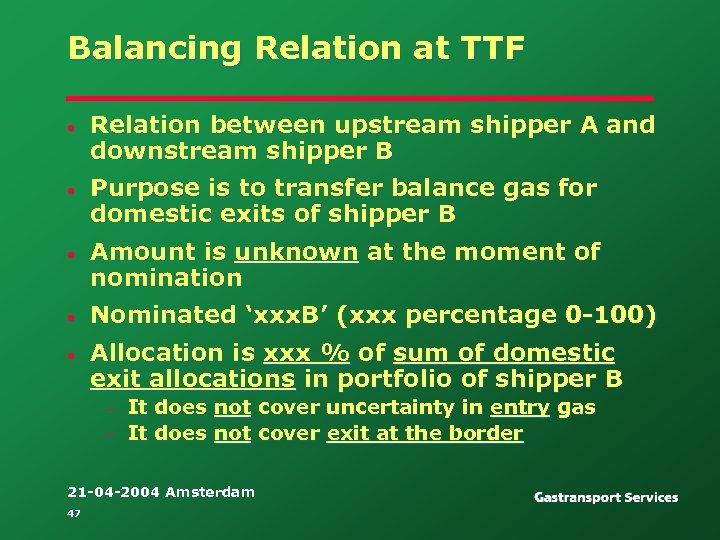 Balancing Relation at TTF • Relation between upstream shipper A and downstream shipper B • Purpose is to transfer balance gas for domestic exits of shipper B • Amount is unknown at the moment of nomination • Nominated ‘xxx. B’ (xxx percentage 0 -100) • Allocation is xxx % of sum of domestic exit allocations in portfolio of shipper B – – It does not cover uncertainty in entry gas It does not cover exit at the border 21 -04 -2004 Amsterdam 47
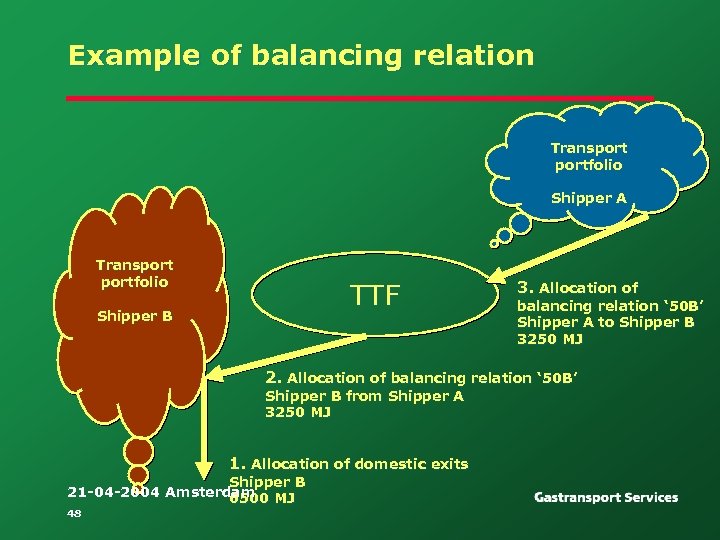 Example of balancing relation Transportfolio Shipper A Transportfolio TTF Shipper B 3. Allocation of balancing relation ‘ 50 B’ Shipper A to Shipper B 3250 MJ 2. Allocation of balancing relation ‘ 50 B’ Shipper B from Shipper A 3250 MJ 1. Allocation of domestic exits Shipper B 21 -04 -2004 Amsterdam MJ 6500 48
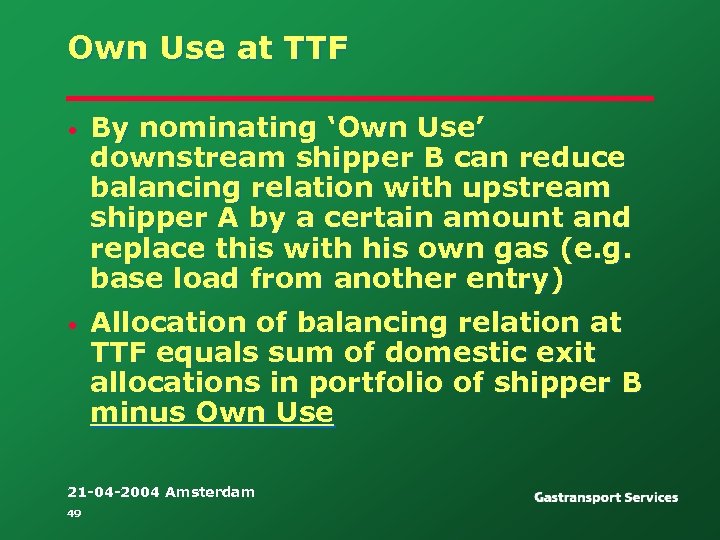 Own Use at TTF • By nominating ‘Own Use’ downstream shipper B can reduce balancing relation with upstream shipper A by a certain amount and replace this with his own gas (e. g. base load from another entry) • Allocation of balancing relation at TTF equals sum of domestic exit allocations in portfolio of shipper B minus Own Use 21 -04 -2004 Amsterdam 49
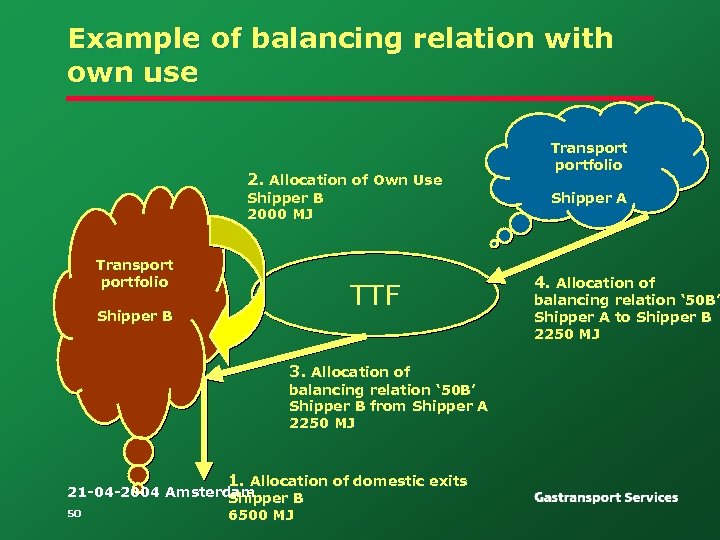 Example of balancing relation with own use 2. Allocation of Own Use Shipper B 2000 MJ Transportfolio Shipper B TTF 3. Allocation of balancing relation ‘ 50 B’ Shipper B from Shipper A 2250 MJ 1. Allocation of domestic exits 21 -04 -2004 Amsterdam Shipper B 50 6500 MJ Transportfolio Shipper A 4. Allocation of balancing relation ‘ 50 B’ Shipper A to Shipper B 2250 MJ
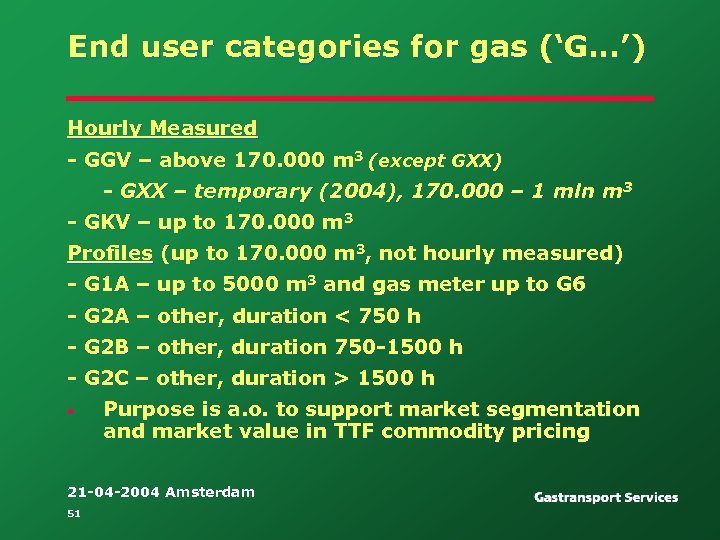 End user categories for gas (‘G…’) Hourly Measured - GGV – above 170. 000 m 3 (except GXX) - GXX – temporary (2004), 170. 000 – 1 mln m 3 - GKV – up to 170. 000 m 3 Profiles (up to 170. 000 m 3, not hourly measured) - G 1 A – up to 5000 m 3 and gas meter up to G 6 - G 2 A – other, duration < 750 h - G 2 B – other, duration 750 -1500 h - G 2 C – other, duration > 1500 h • Purpose is a. o. to support market segmentation and market value in TTF commodity pricing 21 -04 -2004 Amsterdam 51
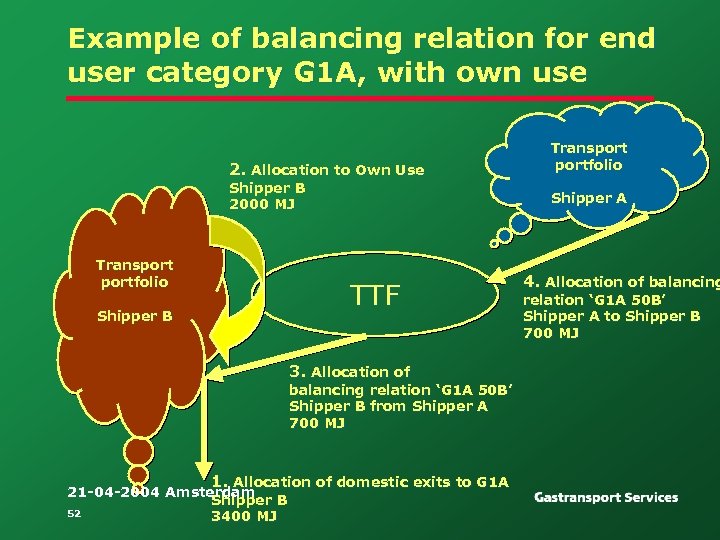 Example of balancing relation for end user category G 1 A, with own use 2. Allocation to Own Use Shipper B 2000 MJ Transportfolio Shipper B Transportfolio Shipper A TTF 3. Allocation of balancing relation ‘G 1 A 50 B’ Shipper B from Shipper A 700 MJ 1. Allocation of domestic exits to G 1 A 21 -04 -2004 Amsterdam Shipper B 52 3400 MJ 4. Allocation of balancing relation ‘G 1 A 50 B’ Shipper A to Shipper B 700 MJ
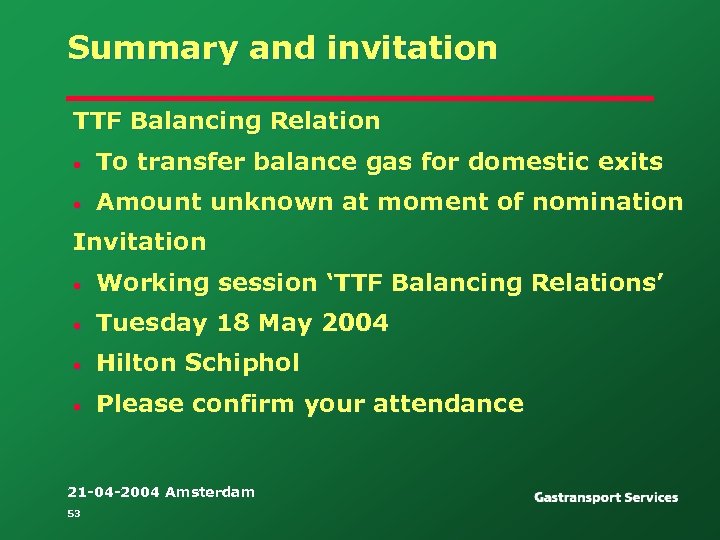 Summary and invitation TTF Balancing Relation • To transfer balance gas for domestic exits • Amount unknown at moment of nomination Invitation • Working session ‘TTF Balancing Relations’ • Tuesday 18 May 2004 • Hilton Schiphol • Please confirm your attendance 21 -04 -2004 Amsterdam 53
 Program Introduction Willem Faber LT Planning Piet Nienhuis OLB Peter Schultz TSO Ulco Vermeulen Coffee break Balancing relations Anne Boorsma Miscellaneous Tineke van der Meij Tariff system 2005 Henk Kreuze 21 -04 -2004 Amsterdam 54 Lunch
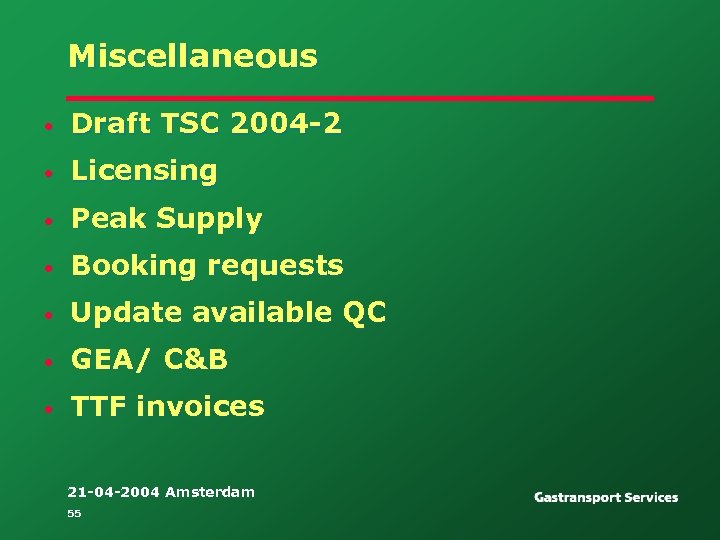 Miscellaneous • Draft TSC 2004 -2 • Licensing • Peak Supply • Booking requests • Update available QC • GEA/ C&B • TTF invoices 21 -04 -2004 Amsterdam 55
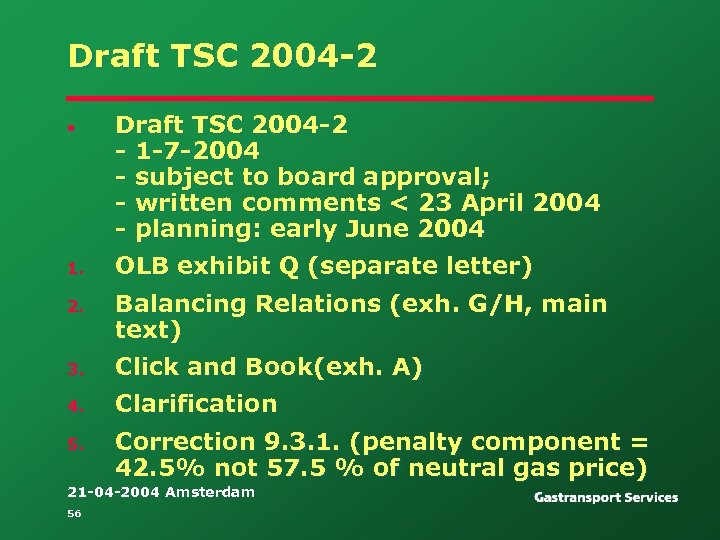 Draft TSC 2004 -2 • 1. 2. Draft TSC 2004 -2 - 1 -7 -2004 - subject to board approval; - written comments < 23 April 2004 - planning: early June 2004 OLB exhibit Q (separate letter) Balancing Relations (exh. G/H, main text) 3. Click and Book(exh. A) 4. Clarification 5. Correction 9. 3. 1. (penalty component = 42. 5% not 57. 5 % of neutral gas price) 21 -04 -2004 Amsterdam 56
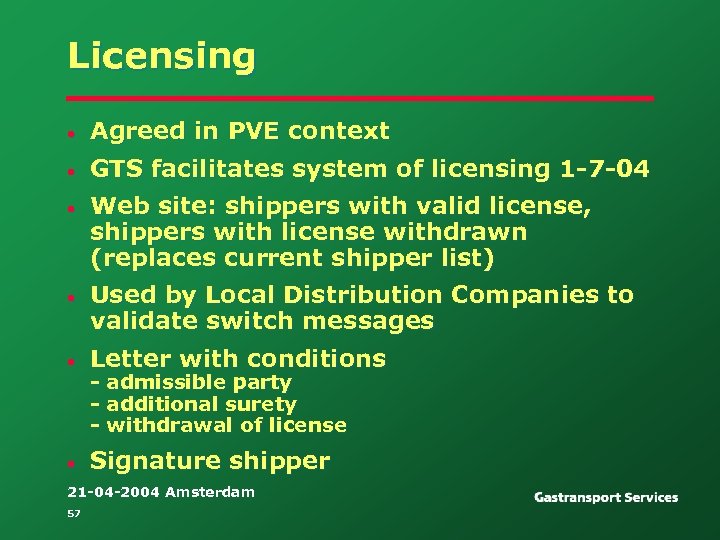 Licensing • Agreed in PVE context • GTS facilitates system of licensing 1 -7 -04 • Web site: shippers with valid license, shippers with license withdrawn (replaces current shipper list) • Used by Local Distribution Companies to validate switch messages • Letter with conditions • Signature shipper - admissible party - additional surety - withdrawal of license 21 -04 -2004 Amsterdam 57
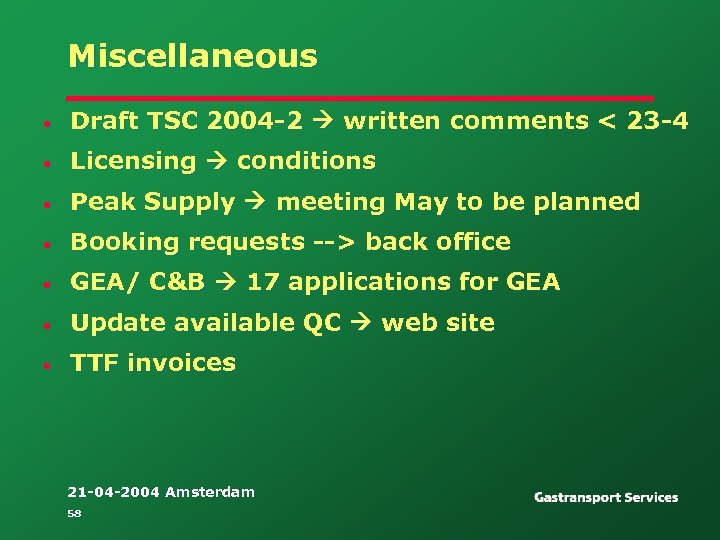 Miscellaneous • Draft TSC 2004 -2 written comments < 23 -4 • Licensing conditions • Peak Supply meeting May to be planned • Booking requests --> back office • GEA/ C&B 17 applications for GEA • Update available QC web site • TTF invoices 21 -04 -2004 Amsterdam 58
 Program Introduction Willem Faber LT Planning Piet Nienhuis OLB Peter Schultz TSO Ulco Vermeulen Coffee break Balancing relations Anne Boorsma Miscellaneous Tineke van der Meij Tariff System 2005 Henk Kreuze 21 -04 -2004 Amsterdam 59 Lunch
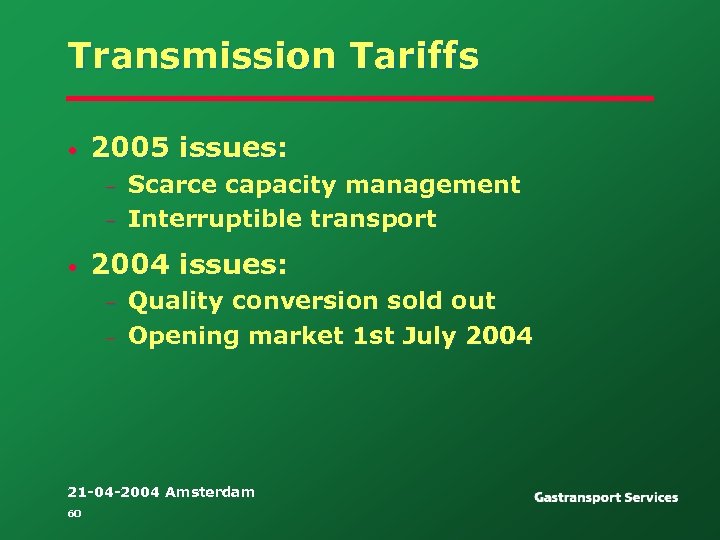 Transmission Tariffs • 2005 issues: – – • Scarce capacity management Interruptible transport 2004 issues: – – Quality conversion sold out Opening market 1 st July 2004 21 -04 -2004 Amsterdam 60
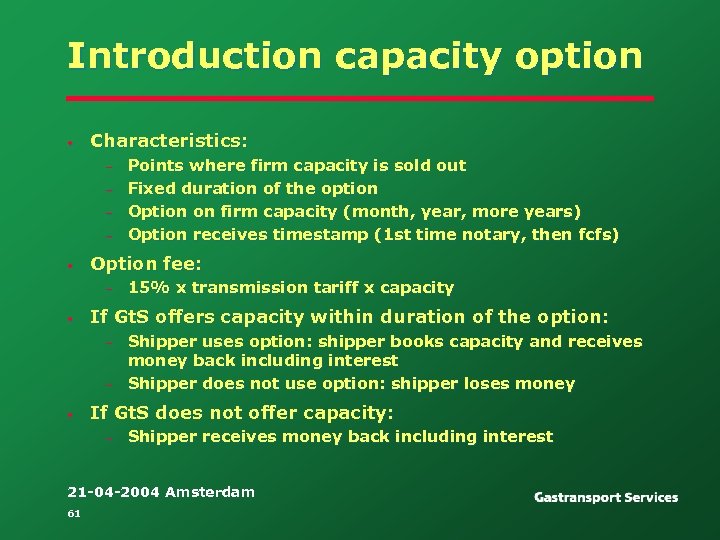 Introduction capacity option • Characteristics: – – • Option fee: – • 15% x transmission tariff x capacity If Gt. S offers capacity within duration of the option: – – • Points where firm capacity is sold out Fixed duration of the option Option on firm capacity (month, year, more years) Option receives timestamp (1 st time notary, then fcfs) Shipper uses option: shipper books capacity and receives money back including interest Shipper does not use option: shipper loses money If Gt. S does not offer capacity: – Shipper receives money back including interest 21 -04 -2004 Amsterdam 61
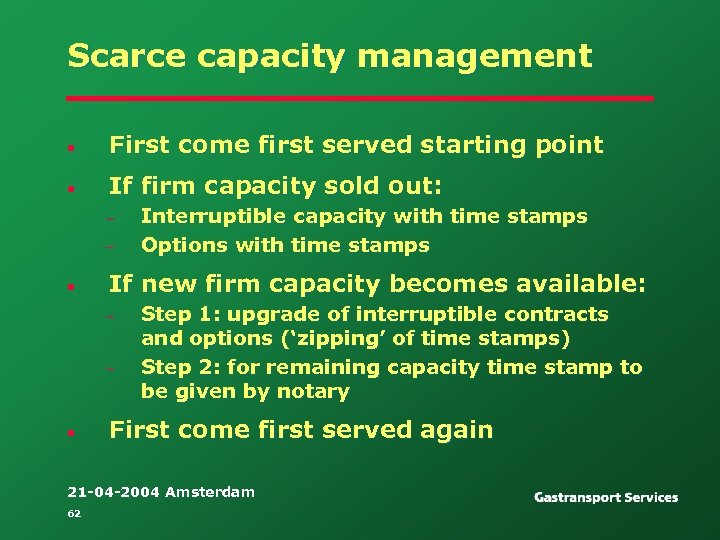 Scarce capacity management • First come first served starting point • If firm capacity sold out: – – • If new firm capacity becomes available: – – • Interruptible capacity with time stamps Options with time stamps Step 1: upgrade of interruptible contracts and options (‘zipping’ of time stamps) Step 2: for remaining capacity time stamp to be given by notary First come first served again 21 -04 -2004 Amsterdam 62
 Interruptible transport 1. 2. 3. 4. 2 -hour grace period If Gt. S interrupts entry, Gt. S will nominate down exit of shipper (custommade) Tariff interruptible capacity related to probability of interruption in advance Temperature related (custom-made) Elements 3 and 4: No refund if interrupted 21 -04 -2004 Amsterdam 63
 Backhaul entry capacity • Basic backhaul: – – • Amount of capacity equals 3 -year monthly minimum Tariff 90% in advance, no refund Additional backhaul capacity is interruptible backhaul: – – Tariff related to probability of interruption No refund if interrupted Note: backhaul is not a firm service 21 -04 -2004 Amsterdam 64
 Quality conversion • Quality conversion is sold out up to and including 2007 • Why sold out • Socializing quality conversion bad idea • Solutions: – – Inventive ideas market parties Interruptible quality conversion by Gt. S 21 -04 -2004 Amsterdam 65
 Opening market 1 st July 2004 • Learning year starting 1 st July 2004 • Distinction to be made between “kleinverbruik” and “grootverbruik” • Gt. S invites market parties expecting to enter the newly liberalised market segment to discuss this issue in more detail mid of May 2004 in Groningen, please contact your account manager 21 -04 -2004 Amsterdam 66
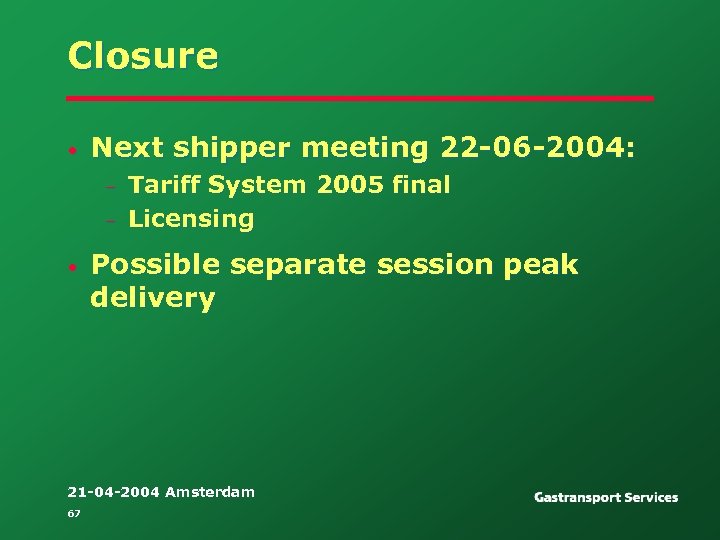 Closure • Next shipper meeting 22 -06 -2004: – – • Tariff System 2005 final Licensing Possible separate session peak delivery 21 -04 -2004 Amsterdam 67
 Shipper meeting 21 April 2004 Sheraton- Amsterdam Thank You for your attention! 21 -04 -2004 Amsterdam