


 Скачать презентацию Shifts of the Demand Curve Chapter 4 Sec
fa4c326bf49da51b4ab96b15ac7f6995.ppt
- Количество слайдов: 12
 Shifts of the Demand Curve Chapter 4, Sec. 2
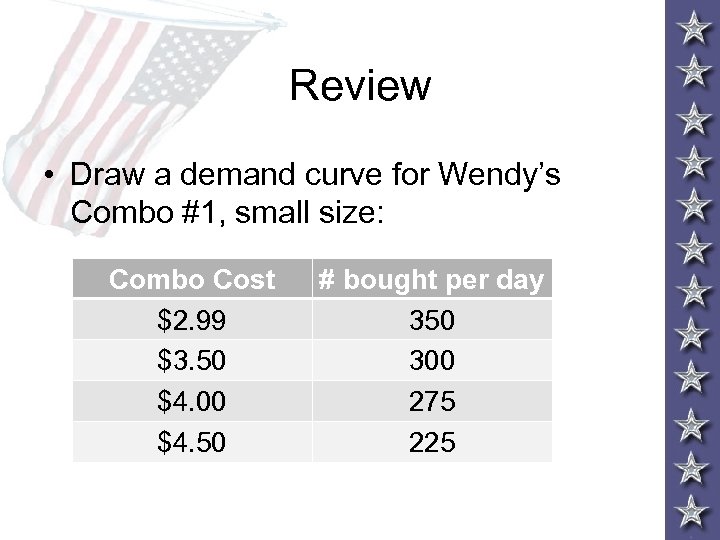 Review • Draw a demand curve for Wendy’s Combo #1, small size: Combo Cost $2. 99 $3. 50 $4. 00 $4. 50 # bought per day 350 300 275 225
 You try it • Think of a consumer good you and your classmates would purchase and create a price schedule for it with at least four different prices. • Interview 10 people and ask them the quantity they would buy at the four different prices. • Draw a demand curve with your data.
 Changes in Demand – A DC is accurate only as long as there are no changes other than price that could affect the consumer’s decision. – In other words, as long as the ceteris paribus assumption is true. – Ceteris paribus – “all other things held constant”
 Dropping the ceteris paribus rule – Allows other factors to change – No longer move ALONG the DC but the entire curve shifts to the right or left. – This means that at EVERY price, consumers buy a different quantify than before. – This shift is referred to as change in demand. – Example: Macon is hit by a heat wave so people no longer feel hungry for BBQ and demand less BBQ at every price.
 What causes a shift? – Income level – an increase in income will cause you to buy MORE of a normal good at every price level (shift to right) and a decrease in income will cause a shift to the left. – AND – an increase in income will cause you to buy LESS of an inferior good (shift to left) and a decrease in income will cause a shift to the right.
 Normal & Inferior Goods – Normal goods – Goods that consumers demand more of when their incomes increase. q Inferior goods – goods that you would buy in smaller quantities, or not at all, if your income were to rise. Example: generic cereals, used cars
 What causes a shift, cont. –Consumer Expectations – the current demand for a good is positively related to its expected future price. –Example: The $199. 00 pair of boots I want to buy are going on sale in two weeks so my demand drops to zero. OR The $199. 00 pair of boots I want to buy on pay day are going up in price tomorrow, so I’m more likely to buy them today.
 What causes a shift, cont. –Population – changes in the size of the population will also affect the demand for most products. –Example: Baby Boomers
 What causes a shift, cont. – Consumer Tastes and Advertising – Changes in tastes and preferences cannot be explained by changes in income or population or worries about future price increases. – Example: fads, fashion, bell bottom jeans, pet rocks, etc. – Advertising IS considered a factor that shifts demand curves because it plays a role in many trends. What are some current trends?
 Prices of Related Goods – Complements – are two goods that are bought and used together. Example: skis & ski boots – Substitutes – goods used in place of one another. Example: ski boards replacing skis
 Classwork (for Romello) • Page 88, 1 -4 and 7 -8 • You do NOT need to copy the question. • You may work with a partner! Uno partner!!!