 Скачать презентацию Shedding light on brain function the event-related optical
b823190ed2196818e55c02ebde3b9df1.ppt
- Количество слайдов: 39



Shedding light on brain function: the event-related optical signal Gratton & Fabiani (2001)
Functional neuroimaging Hemodynamic techniques: PET and f. MRI useful for spatial information about neural activity Electromagnetic techniques: EEG and MEG useful for temporal information about neural activity
Event-Related Optical Signal Hemodynamic techniques lack temporal specificity and electromagnetic techniques lack spatial specificity. EROS provides both, good temporal and spatial information.
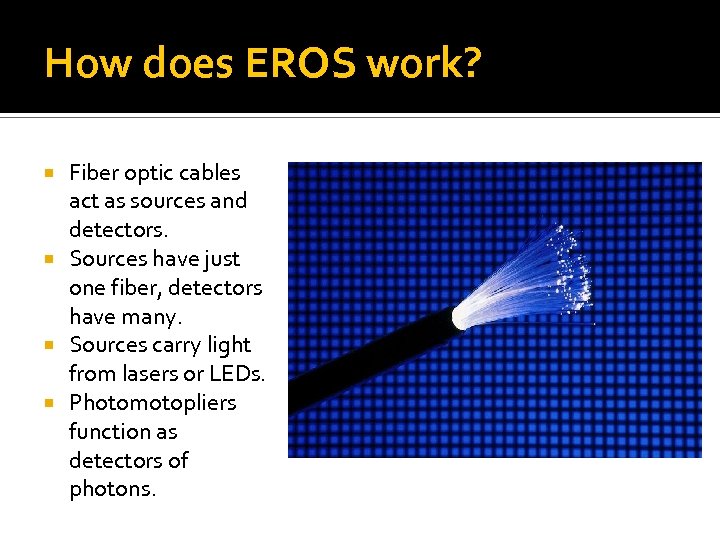
How does EROS work? Fiber optic cables act as sources and detectors. Sources have just one fiber, detectors have many. Sources carry light from lasers or LEDs. Photomotopliers function as detectors of photons.
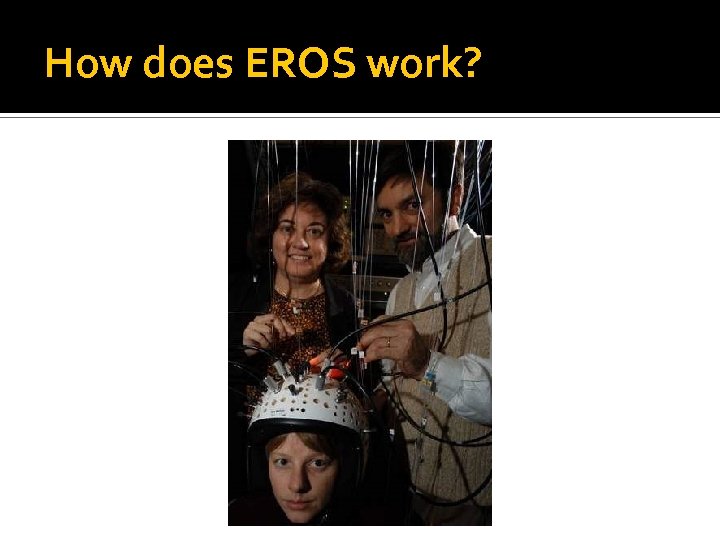
How does EROS work?
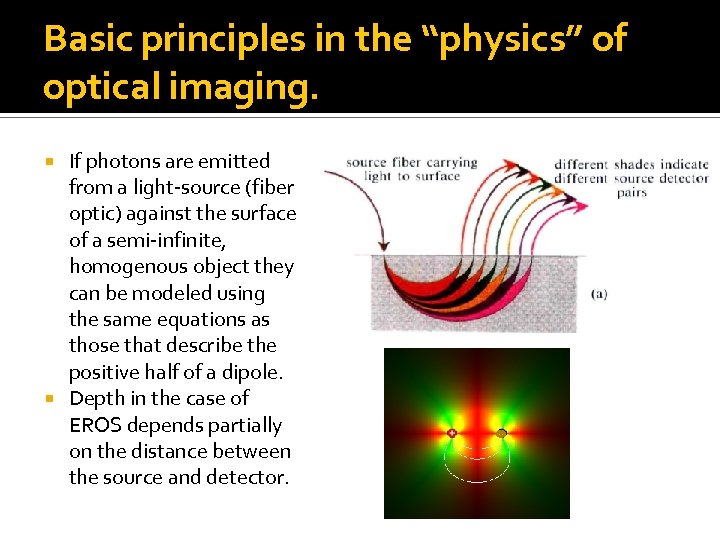
Basic principles in the “physics” of optical imaging. If photons are emitted from a light-source (fiber optic) against the surface of a semi-infinite, homogenous object they can be modeled using the same equations as those that describe the positive half of a dipole. Depth in the case of EROS depends partially on the distance between the source and detector.
How does EROS work? As light propagates from the source it gets scattered and absorbed by brain tissue. Changes in the activity of brain tissue affect the amount of scattering and absorption. Scattering causes the photons to have a longer transit time from source to detector. ▪ Therefore, scattering (activity) can be estimated from the increase in transit time/phase delay.
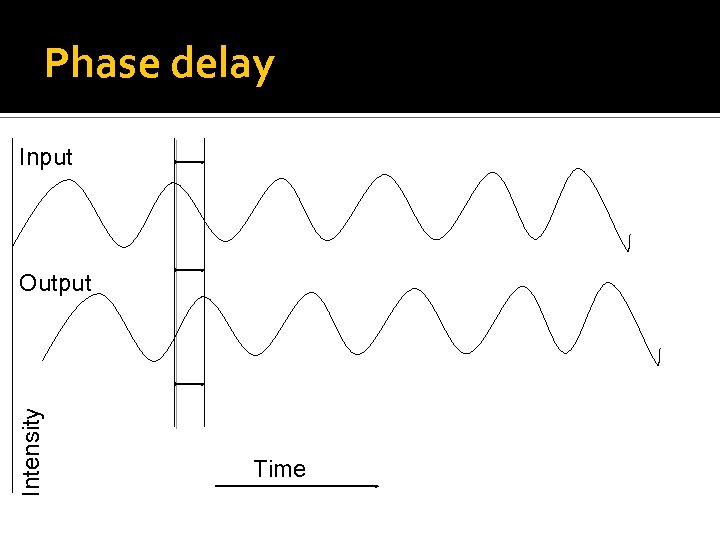
Phase delay Input Intensity Output Time
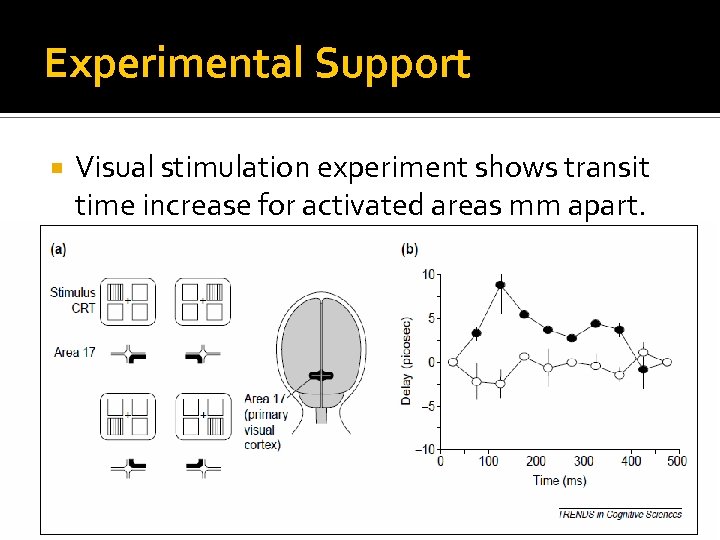
Experimental Support Visual stimulation experiment shows transit time increase for activated areas mm apart.
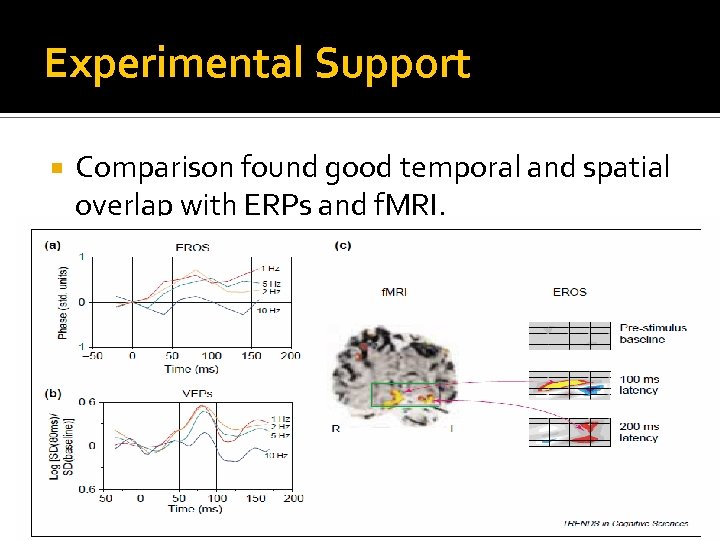
Experimental Support Comparison found good temporal and spatial overlap with ERPs and f. MRI.
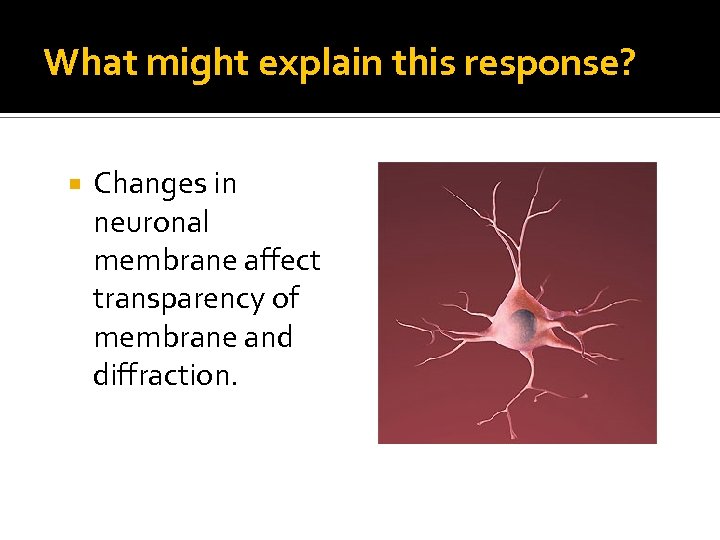
What might explain this response? Changes in neuronal membrane affect transparency of membrane and diffraction.
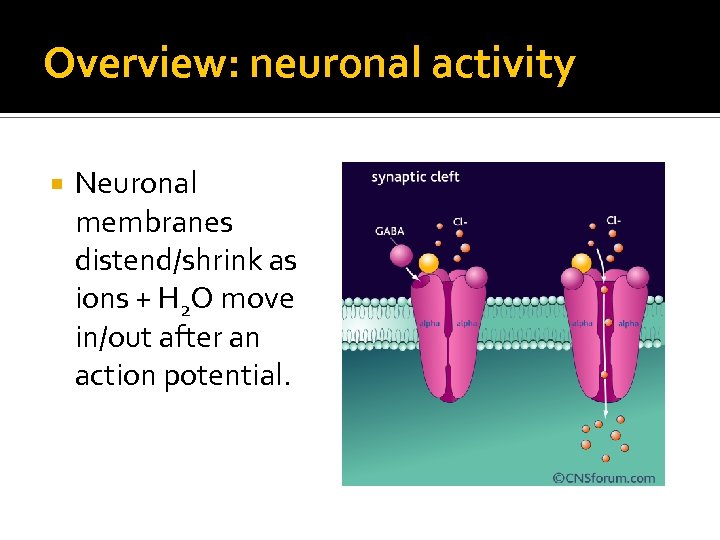
Overview: neuronal activity Neuronal membranes distend/shrink as ions + H 2 O move in/out after an action potential.
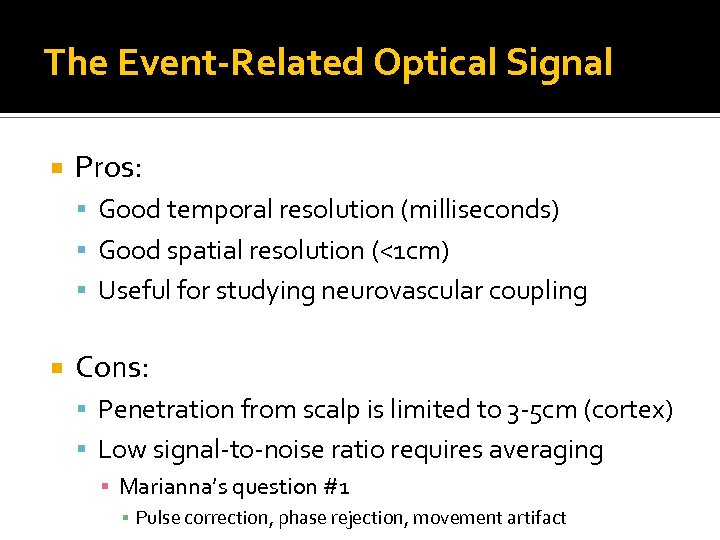
The Event-Related Optical Signal Pros: Good temporal resolution (milliseconds) Good spatial resolution (<1 cm) Useful for studying neurovascular coupling Cons: Penetration from scalp is limited to 3 -5 cm (cortex) Low signal-to-noise ratio requires averaging ▪ Marianna’s question #1 ▪ Pulse correction, phase rejection, movement artifact
CNL EROS Video
Imaging cortical dynamics of language processing with the event-related optical signal Tse, Lee, Sullivan, Garnsey, Dell, Fabiani and Gratton (2007)
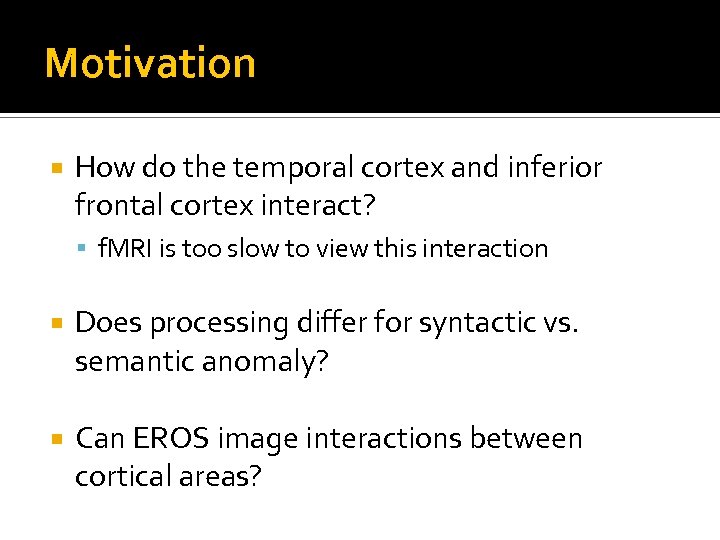
Motivation How do the temporal cortex and inferior frontal cortex interact? f. MRI is too slow to view this interaction Does processing differ for syntactic vs. semantic anomaly? Can EROS image interactions between cortical areas?
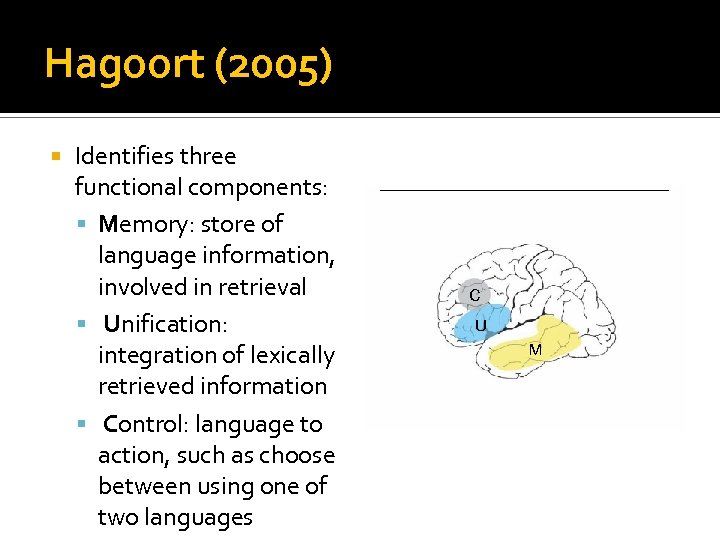
Hagoort (2005) Identifies three functional components: Memory: store of language information, involved in retrieval Unification: integration of lexically retrieved information Control: language to action, such as choose between using one of two languages C U M
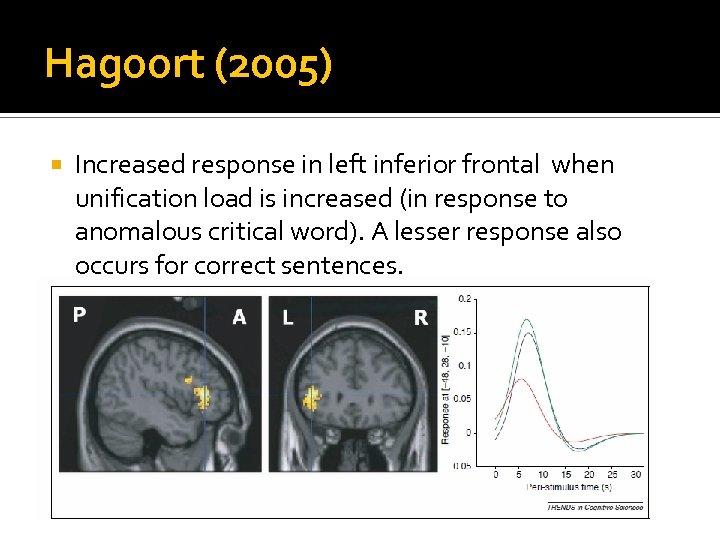
Hagoort (2005) Increased response in left inferior frontal when unification load is increased (in response to anomalous critical word). A lesser response also occurs for correct sentences.
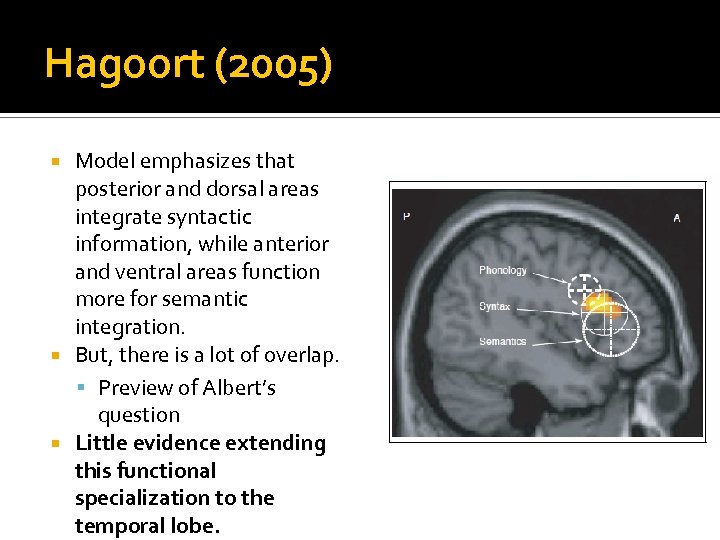
Hagoort (2005) Model emphasizes that posterior and dorsal areas integrate syntactic information, while anterior and ventral areas function more for semantic integration. But, there is a lot of overlap. Preview of Albert’s question Little evidence extending this functional specialization to the temporal lobe.
Methods: Participants 16 participants All right-handed native English speakers 11 females and 5 females, ages 18 -30 Lucy’s question: Why the disproportionate # of females? Control for sinistrality?

Methods: Materials Each participant saw 864 sentences 336 unacceptable sentences ▪ 144 were semantically anomalous at the final word “The hungry child ate the floor. ” ▪ 48 filler sentences contained semantically anomalous words in medial position to prevent expectations that anomalies only occur in the final position ▪ 96 had grammatical violations of subject verb agreement ▪ “If work isn’t done, it pile…” ▪ 48 had grammatically incorrect pronoun case ▪ “My mother promised to buy I…”
Methods: Materials 528 acceptable sentences 144 controls for the semantic sentences 96 for syntactic subject verb agreement 48 for pronoun case anomaly 240 sentences to ensure subjects expect most sentences to be acceptable Length and frequency was accounted for across conditions. Israel’s questions Couldn’t syntactic anomaly be sentence-final? (When it rains, it pour(s)” How long is the experiment? ▪ Approx. 10 hours total broken up into two 5 -hour sessions.
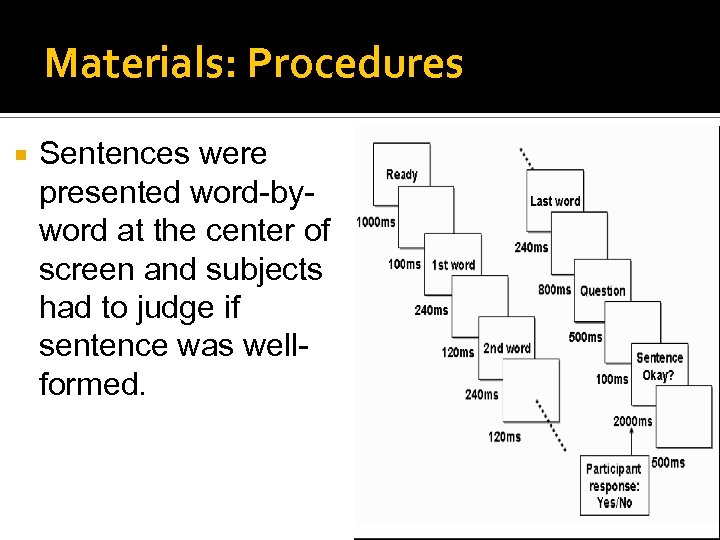
Materials: Procedures Sentences were presented word-byword at the center of screen and subjects had to judge if sentence was wellformed.
ERP recording ERPs were recorded. EEG recording used four scalp electrodes (Fz, Cz, Pz, and right mastoid). ▪ Final bandpass filter of 0. 1 -20 Hz ▪ Sampled at 100 Hz ▪ Time-locked 1500 ms epochs with 200 ms pre-stimulus onset
EROS recording used two montages. ▪ Laser diodes emitted 830 nm light at 220 MHz which was picked up by PMTs modulated at ~220 MHz Sources, detectors, nasion, preauricular points and random points were digitally localized using a Fastrak 3 D digitizer. Coregistration with individual subject’s anatomy provided by MRI.
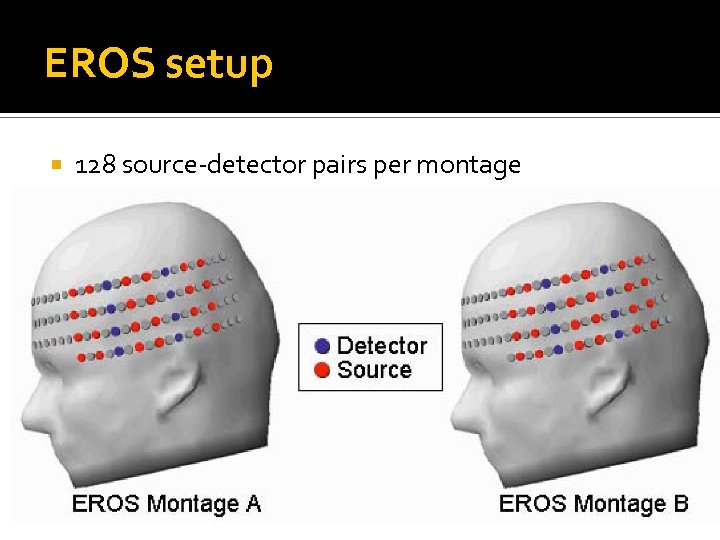
EROS setup 128 source-detector pairs per montage
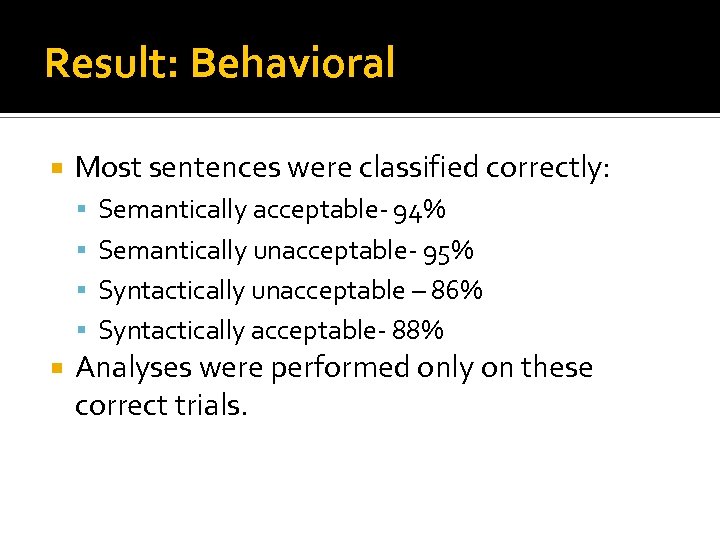
Result: Behavioral Most sentences were classified correctly: Semantically acceptable- 94% Semantically unacceptable- 95% Syntactically unacceptable – 86% Syntactically acceptable- 88% Analyses were performed only on these correct trials.
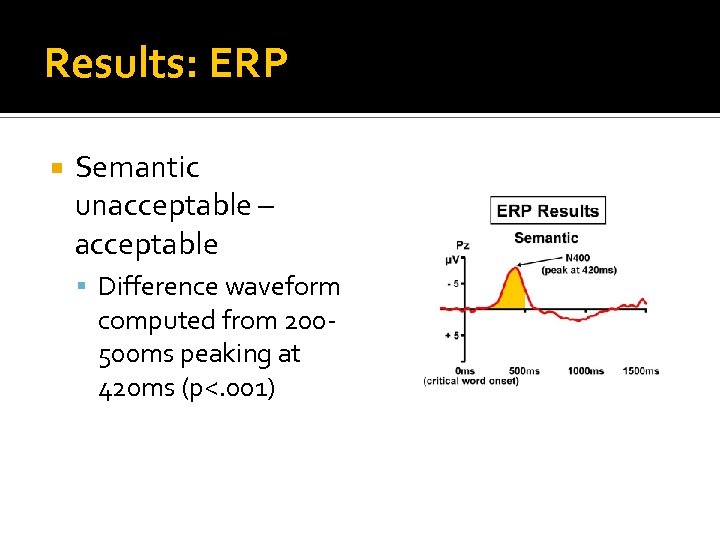
Results: ERP Semantic unacceptable – acceptable Difference waveform computed from 200500 ms peaking at 420 ms (p<. 001)
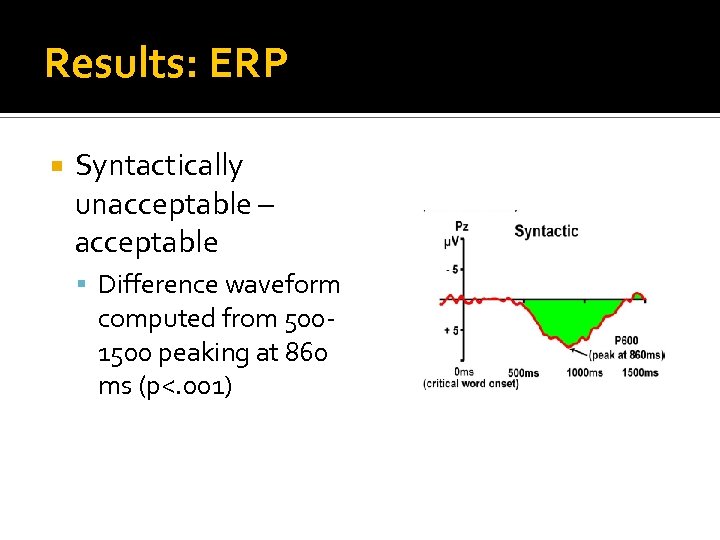
Results: ERP Syntactically unacceptable – acceptable Difference waveform computed from 5001500 peaking at 860 ms (p<. 001)
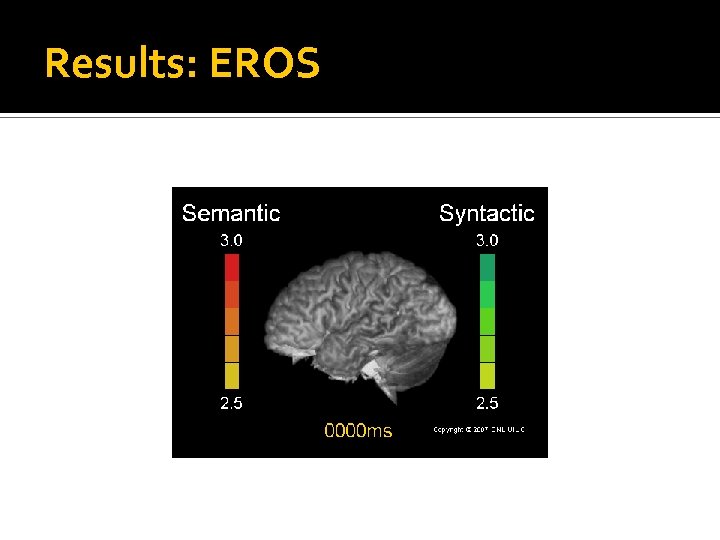
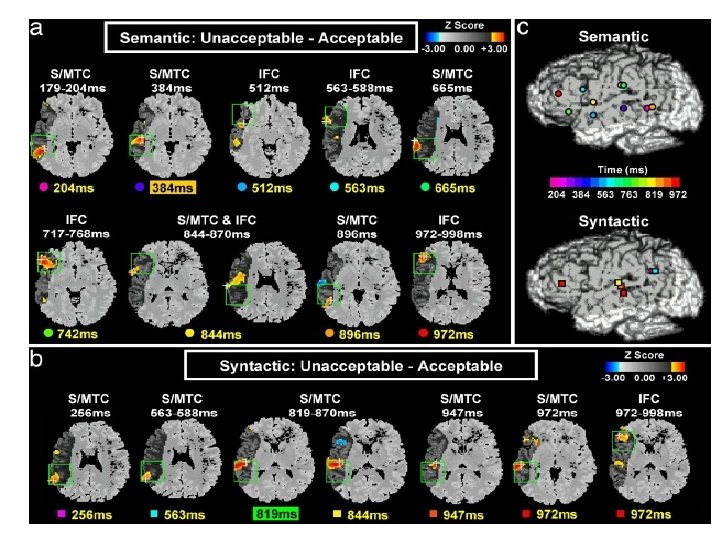
Results: EROS Significant increase in phase delay for anomalous critical words. Both conditions elicited S/MTC activation followed by IFC activation. Pattern occurred a few times for semantic condition suggesting oscillatory behavior. ROIs analyzed independently
Results: EROS
Results: EROS
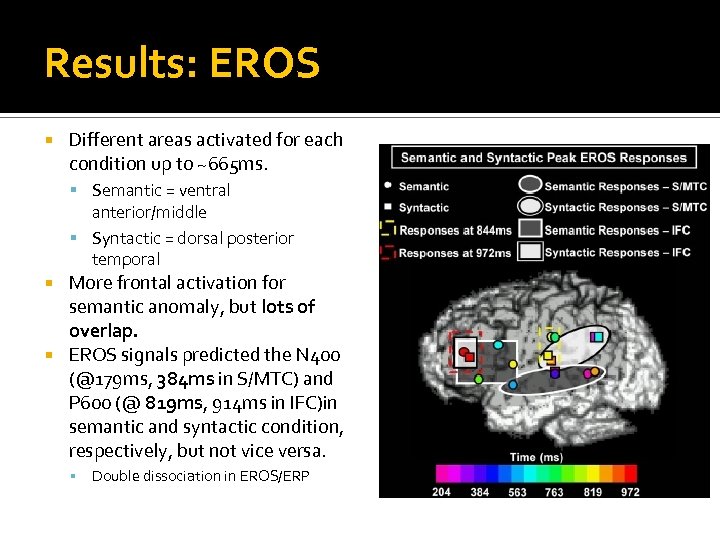
Results: EROS Different areas activated for each condition up to ~665 ms. Semantic = ventral anterior/middle Syntactic = dorsal posterior temporal More frontal activation for semantic anomaly, but lots of overlap. EROS signals predicted the N 400 (@179 ms, 384 ms in S/MTC) and P 600 (@ 819 ms, 914 ms in IFC)in semantic and syntactic condition, respectively, but not vice versa. Double dissociation in EROS/ERP
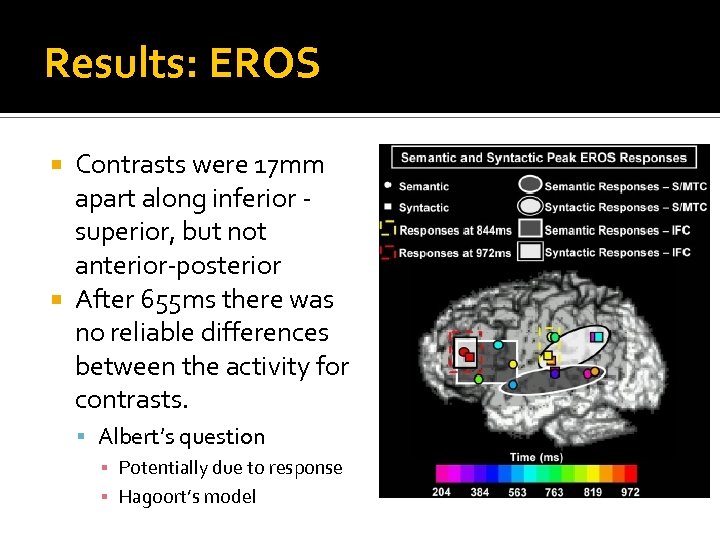
Results: EROS Contrasts were 17 mm apart along inferior superior, but not anterior-posterior After 655 ms there was no reliable differences between the activity for contrasts. Albert’s question ▪ Potentially due to response ▪ Hagoort’s model
Discussion EROS successfully showed interaction between temporal-frontal network involved in language processing. Supports model in which retrieval occurs in the temporal regions and the integration occurs in the frontal regions.
Discussion Might reflect integration process in IFC in which predictions about upcoming words are generated and sent to temporal areas. Marianna’s question # 1 Lucy’s question # 1 & 2 Lynn’s Question Since syntactic anomalies were relatively easy to rectify there was little frontal activity. Semantic anomaly more difficult to correct and hence more back and forth. ▪ More extensive frontal activity ▪ Double checks retrieval? The location of these networks is consistent with previous f. MRI studies.
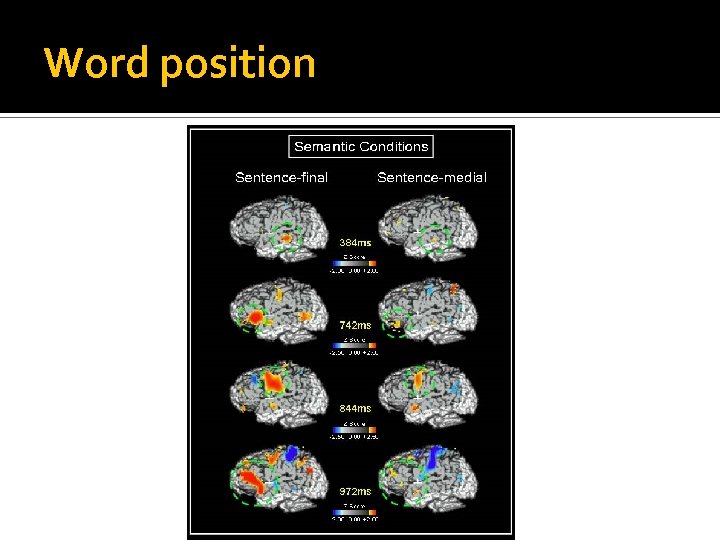
Word position Syntactic words were in medial position while semantic were final. Is activation comparable for sentence medial and sentence final positions?
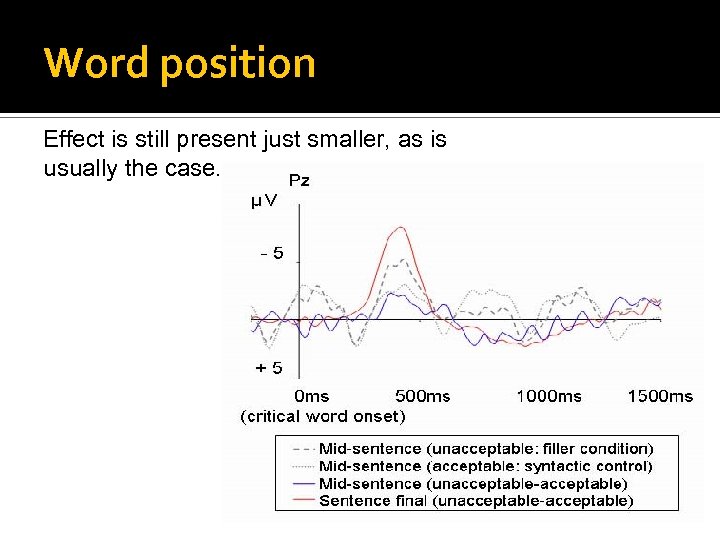
Word position Effect is still present just smaller, as is usually the case.
Word position
Скачать презентацию Shedding light on brain function the event-related optical
b823190ed2196818e55c02ebde3b9df1.ppt