 Скачать презентацию SHB 30215 Certificate III in Make-up SHB 30315
6c437027823fd8e6062a887293e69b2c.ppt
- Количество слайдов: 28



SHB 30215 Certificate III in Make-up SHB 30315 Certificate III in Nail Technology SHB 50115 Diploma of Beauty Therapy WRB 20104 WRBCS 201 B – PROVIDE MANICURE AND PEDICURE SERVICES BSBSMB 406 Manage small business finances LEARNING MATERIAL Initial Impact P/L PO Box 301 Balnarring 3926 © 2016 ABN 37 006 210 920 Initial Impact P/L Student name: . . . . Student ID: . . . Date: . . . Student name: . . . . Student ID: . . . Advise on beauty products and services Date: . . . 1
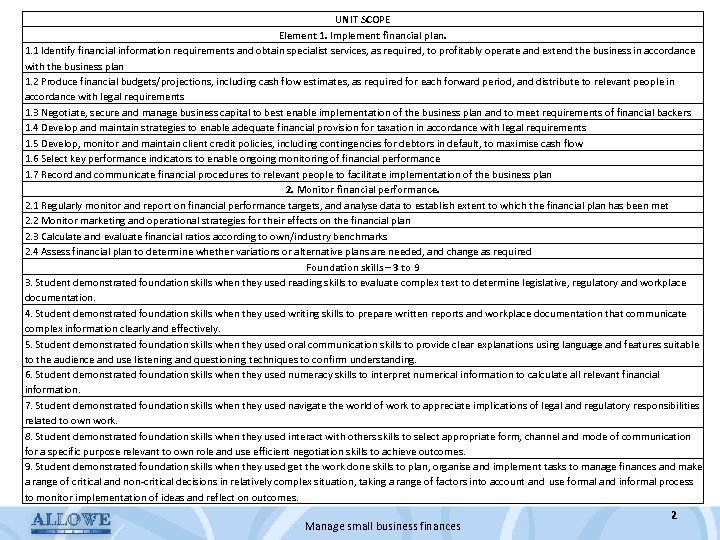
UNIT SCOPE Element 1. Implement financial plan. 1. 1 Identify financial information requirements and obtain specialist services, as required, to profitably operate and extend the business in accordance with the business plan 1. 2 Produce financial budgets/projections, including cash flow estimates, as required for each forward period, and distribute to relevant people in accordance with legal requirements 1. 3 Negotiate, secure and manage business capital to best enable implementation of the business plan and to meet requirements of financial backers 1. 4 Develop and maintain strategies to enable adequate financial provision for taxation in accordance with legal requirements 1. 5 Develop, monitor and maintain client credit policies, including contingencies for debtors in default, to maximise cash flow 1. 6 Select key performance indicators to enable ongoing monitoring of financial performance 1. 7 Record and communicate financial procedures to relevant people to facilitate implementation of the business plan 2. Monitor financial performance. 2. 1 Regularly monitor and report on financial performance targets, and analyse data to establish extent to which the financial plan has been met 2. 2 Monitor marketing and operational strategies for their effects on the financial plan 2. 3 Calculate and evaluate financial ratios according to own/industry benchmarks 2. 4 Assess financial plan to determine whether variations or alternative plans are needed, and change as required Foundation skills – 3 to 9 3. Student demonstrated foundation skills when they used reading skills to evaluate complex text to determine legislative, regulatory and workplace documentation. 4. Student demonstrated foundation skills when they used writing skills to prepare written reports and workplace documentation that communicate complex information clearly and effectively. 5. Student demonstrated foundation skills when they used oral communication skills to provide clear explanations using language and features suitable to the audience and use listening and questioning techniques to confirm understanding. 6. Student demonstrated foundation skills when they used numeracy skills to interpret numerical information to calculate all relevant financial information. 7. Student demonstrated foundation skills when they used navigate the world of work to appreciate implications of legal and regulatory responsibilities related to own work. 8. Student demonstrated foundation skills when they used interact with others skills to select appropriate form, channel and mode of communication for a specific purpose relevant to own role and use efficient negotiation skills to achieve outcomes. 9. Student demonstrated foundation skills when they used get the work done skills to plan, organise and implement tasks to manage finances and make a range of critical and non-critical decisions in relatively complex situation, taking a range of factors into account and use formal and informal process to monitor implementation of ideas and reflect on outcomes. Manage small business finances 2
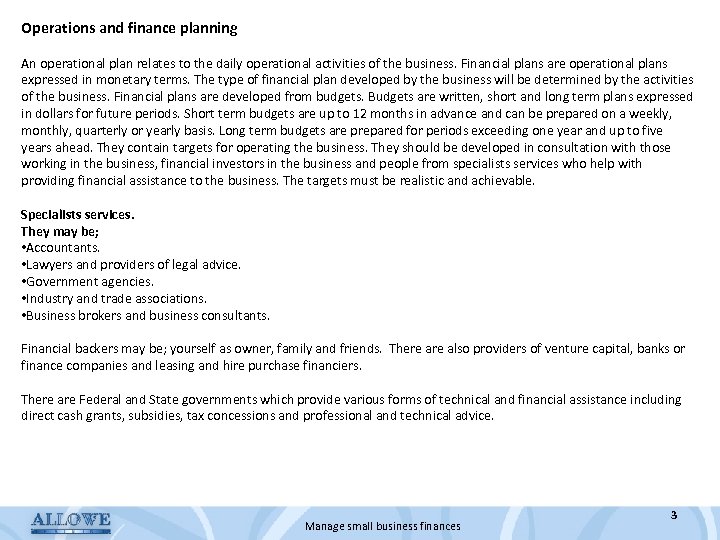
Operations and finance planning An operational plan relates to the daily operational activities of the business. Financial plans are operational plans expressed in monetary terms. The type of financial plan developed by the business will be determined by the activities of the business. Financial plans are developed from budgets. Budgets are written, short and long term plans expressed in dollars for future periods. Short term budgets are up to 12 months in advance and can be prepared on a weekly, monthly, quarterly or yearly basis. Long term budgets are prepared for periods exceeding one year and up to five years ahead. They contain targets for operating the business. They should be developed in consultation with those working in the business, financial investors in the business and people from specialists services who help with providing financial assistance to the business. The targets must be realistic and achievable. Specialists services. They may be; • Accountants. • Lawyers and providers of legal advice. • Government agencies. • Industry and trade associations. • Business brokers and business consultants. Financial backers may be; yourself as owner, family and friends. There also providers of venture capital, banks or finance companies and leasing and hire purchase financiers. There are Federal and State governments which provide various forms of technical and financial assistance including direct cash grants, subsidies, tax concessions and professional and technical advice. Manage small business finances 3
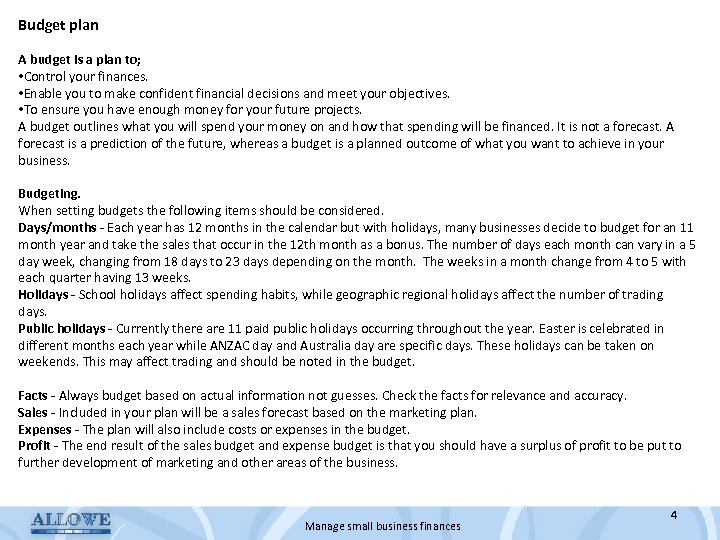
Budget plan A budget is a plan to; • Control your finances. • Enable you to make confident financial decisions and meet your objectives. • To ensure you have enough money for your future projects. A budget outlines what you will spend your money on and how that spending will be financed. It is not a forecast. A forecast is a prediction of the future, whereas a budget is a planned outcome of what you want to achieve in your business. Budgeting. When setting budgets the following items should be considered. Days/months - Each year has 12 months in the calendar but with holidays, many businesses decide to budget for an 11 month year and take the sales that occur in the 12 th month as a bonus. The number of days each month can vary in a 5 day week, changing from 18 days to 23 days depending on the month. The weeks in a month change from 4 to 5 with each quarter having 13 weeks. Holidays - School holidays affect spending habits, while geographic regional holidays affect the number of trading days. Public holidays - Currently there are 11 paid public holidays occurring throughout the year. Easter is celebrated in different months each year while ANZAC day and Australia day are specific days. These holidays can be taken on weekends. This may affect trading and should be noted in the budget. Facts - Always budget based on actual information not guesses. Check the facts for relevance and accuracy. Sales - Included in your plan will be a sales forecast based on the marketing plan. Expenses - The plan will also include costs or expenses in the budget. Profit - The end result of the sales budget and expense budget is that you should have a surplus of profit to be put to further development of marketing and other areas of the business. Manage small business finances 4
Financial budgets These budgets summarise the estimates in the operating and capital budgets of the business. There are; • Budgeted income statement. • Budgeted cash flow statement. • Budgeted balance sheet. There are two main approaches used to prepare budget estimates for a business. • Incremental budgeting is the most common approach. Budget estimates are based on the previous year’s results adjusted for any anticipated environmental changes. • Zero based budgeting is where each budget estimate is determined on no reference to past results or anticipated environmental changes. Budget controls. These involve comparing reported actual results with the anticipated budget results. Relevant records must be established and maintained to enable results to be reported for comparison purposes. Variances are calculated to evaluate performance. The amount of variance is the difference between an actual result and a budget for the same period. • An unfavourable variance is a budgeted income which is greater than the actual income. • A favourable variance is a budgeted income that is less than the actual income. Business costs. A business will typically have three kinds of costs. • One-off capital cost - setting up the business. • Fixed costs - items such as rent, rates, salaries and financing costs. • Variable costs - items such as product purchases and overtime payments for staff. Manage small business finances 5
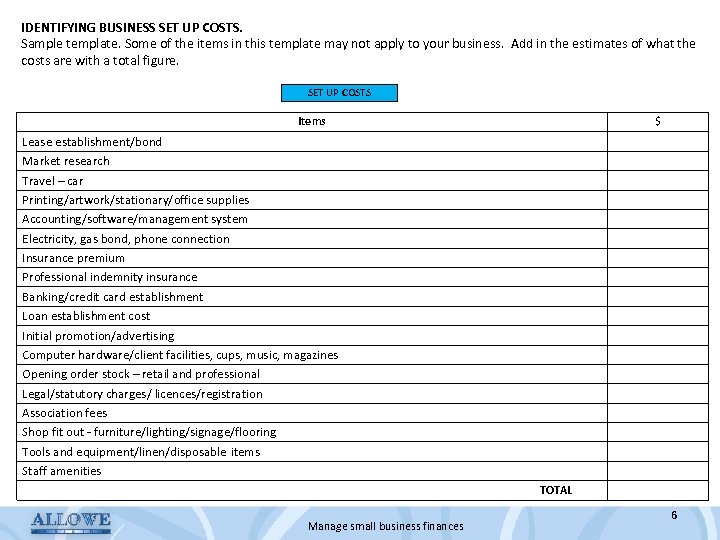
IDENTIFYING BUSINESS SET UP COSTS. Sample template. Some of the items in this template may not apply to your business. Add in the estimates of what the costs are with a total figure. SET UP COSTS Items $ Lease establishment/bond Market research Travel – car Printing/artwork/stationary/office supplies Accounting/software/management system Electricity, gas bond, phone connection Insurance premium Professional indemnity insurance Banking/credit card establishment Loan establishment cost Initial promotion/advertising Computer hardware/client facilities, cups, music, magazines Opening order stock – retail and professional Legal/statutory charges/ licences/registration Association fees Shop fit out - furniture/lighting/signage/flooring Tools and equipment/linen/disposable items Staff amenities TOTAL Manage small business finances 6
Financial statements These are used to provide information on how the business is operating financially. They are used for assessing the financial health of the business and should be produced on a regular basis. Profit and loss statement This is also called an income statement. It is a summary of business income and expenses over a period of time. It is prepared at regular intervals (usually monthly and at financial year end) to show the results of operations for a given period. Economic indicators are statistical metrics used to measure the growth or contraction of the business as a whole or sectors within the business. Technical indicators are used extensively in technical analysis to predict changes in stock trends or price patterns in any traded asset. EXCEL SPREADSHEETS. There are websites where you can download many different types of spreadsheets for FREE. They are related to business finance. ELECTRONIC BOOKKEEPING PACKAGES. There are many electronic software packages that make accounting easier. Manage small business finances 7
Cash flow - profit or loss explanation On the following page there is an example of income and expenses broken down into 12 months of the first year. You need to list relevant expense items to best fit your business. • Some of the fixed and variable costs that you worked out on the previous page will need to be grouped together under the one heading. For example; council rates/water rates, telephone, gas, electricity and water usage would all go under amenities. Your trainer will assist you to group items into categories. • Staff wages also includes the incentive scheme you worked out. • Expenses for setting up is a one off cost before you open the business. Your capital investment is a one off income. This is the money you borrowed and you will have loan repayments in the expenses column. • Estimate how much income you will receive from service and product sales each month. When your income increases so do your expenses in purchasing products and materials plus advertising and printing costs. • The column named ‘other’ is where you can group other expenses that do not fit in with the categories on the chart. • In the totals column for income and expenses add them up each month and at the end of the year. • The profit or loss is the difference in how much you earned and how much you spent. Create your own profit and loss statement following the example on the following page. Develop your own template. Manage small business finances 8
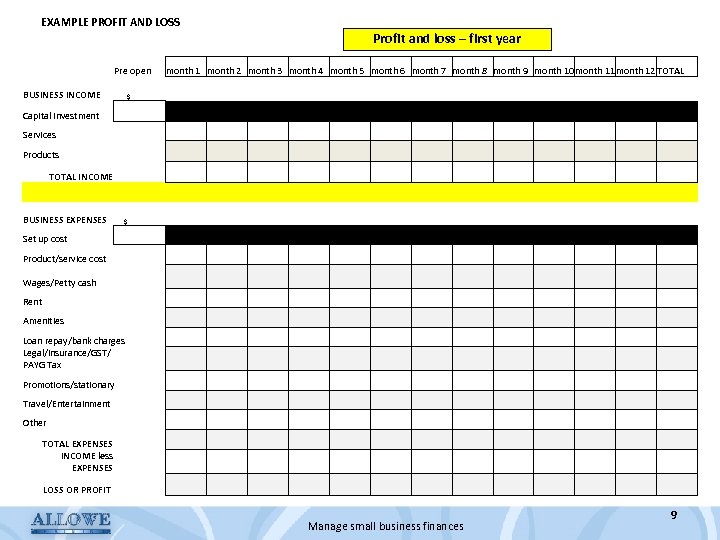
EXAMPLE PROFIT AND LOSS Profit and loss – first year Pre open BUSINESS INCOME $ Capital investment month 1 month 2 month 3 month 4 month 5 month 6 month 7 month 8 month 9 month 10 month 11 month 12 TOTAL Services Products TOTAL INCOME BUSINESS EXPENSES $ Set up cost Product/service cost Wages/Petty cash Rent Amenities Promotions/stationary Travel/Entertainment Other Loan repay/bank charges Legal/insurance/GST/ PAYG Tax TOTAL EXPENSES INCOME less EXPENSES LOSS OR PROFIT Manage small business finances 9
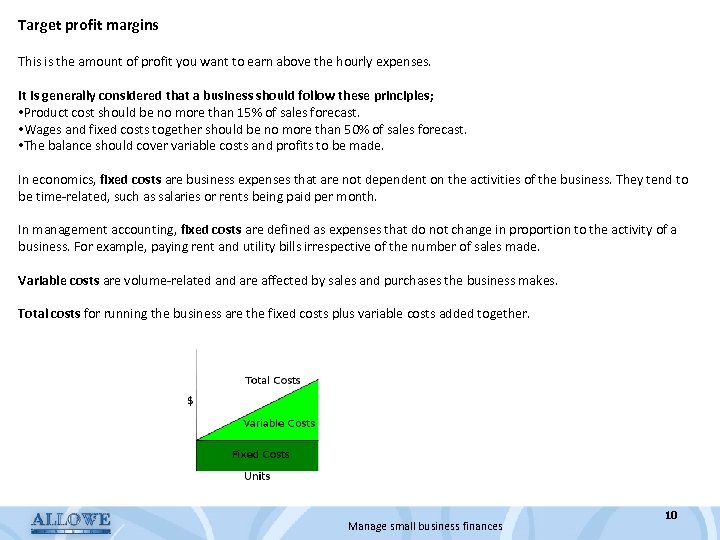
Target profit margins This is the amount of profit you want to earn above the hourly expenses. It is generally considered that a business should follow these principles; • Product cost should be no more than 15% of sales forecast. • Wages and fixed costs together should be no more than 50% of sales forecast. • The balance should cover variable costs and profits to be made. In economics, fixed costs are business expenses that are not dependent on the activities of the business. They tend to be time-related, such as salaries or rents being paid per month. In management accounting, fixed costs are defined as expenses that do not change in proportion to the activity of a business. For example, paying rent and utility bills irrespective of the number of sales made. Variable costs are volume-related and are affected by sales and purchases the business makes. Total costs for running the business are the fixed costs plus variable costs added together. Manage small business finances 10
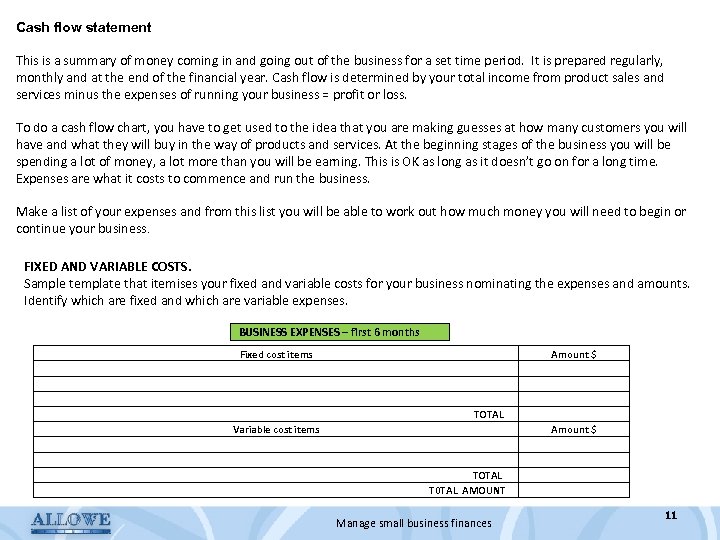
Cash flow statement This is a summary of money coming in and going out of the business for a set time period. It is prepared regularly, monthly and at the end of the financial year. Cash flow is determined by your total income from product sales and services minus the expenses of running your business = profit or loss. To do a cash flow chart, you have to get used to the idea that you are making guesses at how many customers you will have and what they will buy in the way of products and services. At the beginning stages of the business you will be spending a lot of money, a lot more than you will be earning. This is OK as long as it doesn’t go on for a long time. Expenses are what it costs to commence and run the business. Make a list of your expenses and from this list you will be able to work out how much money you will need to begin or continue your business. FIXED AND VARIABLE COSTS. Sample template that itemises your fixed and variable costs for your business nominating the expenses and amounts. Identify which are fixed and which are variable expenses. BUSINESS EXPENSES – first 6 months Fixed cost items TOTAL Variable cost items TOTAL T 0 TAL AMOUNT Manage small business finances Amount $ 11
Cash flow operations Net operating cash flow is the amount of cash that a company gets to keep through running its business after it has paid its bills. However, even if a business has a number of overdue bills, these do not affect the cash flow statement until they are paid in cash. There are three potential warning signs which can indicate the potential for a business to fail are: • Cash receipts are less than cash payments: you are running out of money. • Net operating cash flow is an outflow: cash flow is negative. • Net operating cash flow is less than profit after tax: you are spending more than you earn. Types of cash flow. The cash flow in and out of the business is divided into three categories in the cash flow statement. • Operating activities. These activities are the day-to-day activities, the result of buying and selling of goods and services. • Investing activities. These activities are investments in future business activities, e. g. buying and selling fixed assets. • Financing activities. These activities cover how a business finances itself. Manage small business finances 12
Balance Sheet The balance sheet is a general overview of the financial health of a business usually the end of a month or financial year. It shows the assets of the business and how these assets are financed. A profit and loss statement and cash flow statement is needed to do a balance sheet. Your accountant is probably the best person to prepare a balance sheet. Accounting packages also offer balance sheet reports. Your balance sheet lists in detail the assets the business owns, and what it owes others (its liabilities). The difference between the assets and liabilities is the net worth of the business. The net worth (also called the 'ownership equity') shows how much the business is worth to the owner or owners on the day the balance sheet was prepared. Assets are the items of value the business owns. They include; • Cash and stock on hand ('inventory'). • Land buildings. • Equipment, machinery and furniture. • Patents and trade marks. • Money others owe the business ('debtors' or 'accounts receivable'). Liabilities are what the business owes others outside the business. They include; • Money owed to suppliers. • Money owed to taxation department (GST, PAYE, FBT etc. ). • Bank accounts that are in overdraft (i. e. you owe the bank money) and/or credit card debt • Loans to buy capital assets, e. g. a new vehicle. Manage small business finances 13
Profit margins Understanding the basic concepts of costing and pricing is important in running a business. You need to know the optimum price you can charge for the products or service to cover business overheads and make a profit without pricing yourself out of the market. You need to consider what customers will pay and what your profit margin will be. Your profit margin. There are three different profit margin calculations you need to consider: direct costs margin, break-even pricing and profit pricing. 1. Direct costs margin. This is the amount that remains after paying the costs directly associated with the product or service being sold. Obviously you would want to at least cover your direct costs to continue selling the product or service. 2. Break-even pricing. The break-even analysis sets your overhead costs against how many production hours you will need to cover them. This then determines how much you will need to charge for your product or service in order to cover those overheads. The break-even analysis provides a strong indication of whether your business will make a profit or not. 3. Profit pricing. This is the price at which you’ll finally make a profit. If you can sell your products and services at this price, and still be competitive, you’ve got a business. If you can’t, you can lower your direct costs, fixed costs or desired profit, or sell something else that offers better margins. Manage small business finances 14
Break even analysis. The break-even analysis sets your overhead costs against how many production hours you will need to cover them. This then determines how much you will need to charge for your product or service in order to cover those overheads. The break-even analysis provides a strong indication of whether your business plan is feasible or not. Example of expenses and income potential. For our example we will use 5 working days per week. We will assume that the average daily income is $385. 00 multiplied by 240 working days per year = $92, 400. 00 annual income. For our example we will assume that the annual expenses of running the business are $105, 000. To achieve the daily expenses you divide $105, 000. 00 by 240 working days = $437. 00 expenses per day. Income needs to be $437. 00 per day to break even. If we added a 30% profit margin the daily income would need to be $568. 00 per day. Based on an 8 hour day this means the income needs to be $71. 00 per hour. Seat time is the average number of hours per day, week or month, that the business has clients receiving a service. Use the $71. 00 per hour income example. Assuming the business has an average of 33 hours per week when services are being provided (seat time) out of 44 hours available, the business therefore needs to ensure that service fees charged are greater than $71. 00 per hour to cover the short fall in the number of clients they have per week. Manage small business finances 15
Financing the business There are three considerations when financing the business. 1. New business 2. Existing businesses 3. Undercapitalised businesses New business. There are three main ways to begin a business. Start a business from scratch, buy an existing business or obtain a franchise. Starting a business from scratch Set up costs ( once only) Property, plant and equipment Stock TOTAL $. . . . . Buying an existing business Property, plant and equipment Goodwill Stock at value TOTAL $ …………. . Obtaining a franchise Upfront franchise entry fee Set up costs (once only) Property, plant and equipment Stock TOTAL $ …………. . Existing businesses. These businesses may require, for operating activities, capital expenditure (purchasing materials, stock, premises, plant and equipment for expansion of the business and other resources used in daily operations) and reviewing existing loan to obtain additional funds. Undercapitalised businesses. This is a business with insufficient funds invested in plant, equipment or stock to make it workable. Undercapitalised businesses often end in failure. Manage small business finances 16
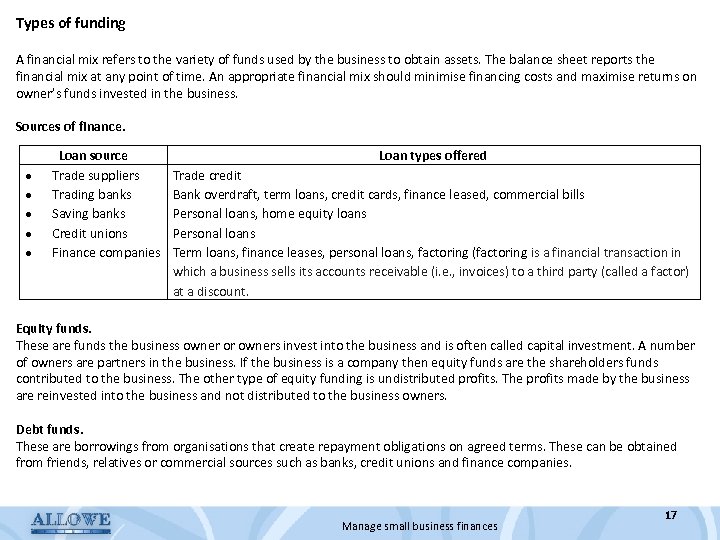
Types of funding A financial mix refers to the variety of funds used by the business to obtain assets. The balance sheet reports the financial mix at any point of time. An appropriate financial mix should minimise financing costs and maximise returns on owner’s funds invested in the business. Sources of finance. Loan source Trade suppliers Trading banks Saving banks Credit unions Finance companies Loan types offered Trade credit Bank overdraft, term loans, credit cards, finance leased, commercial bills Personal loans, home equity loans Personal loans Term loans, finance leases, personal loans, factoring (factoring is a financial transaction in which a business sells its accounts receivable (i. e. , invoices) to a third party (called a factor) at a discount. Equity funds. These are funds the business owner or owners invest into the business and is often called capital investment. A number of owners are partners in the business. If the business is a company then equity funds are the shareholders funds contributed to the business. The other type of equity funding is undistributed profits. The profits made by the business are reinvested into the business and not distributed to the business owners. Debt funds. These are borrowings from organisations that create repayment obligations on agreed terms. These can be obtained from friends, relatives or commercial sources such as banks, credit unions and finance companies. Manage small business finances 17
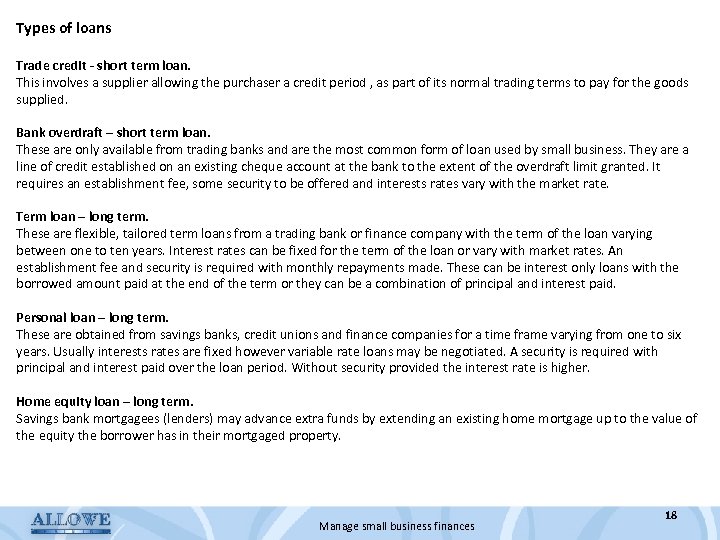
Types of loans Trade credit - short term loan. This involves a supplier allowing the purchaser a credit period , as part of its normal trading terms to pay for the goods supplied. Bank overdraft – short term loan. These are only available from trading banks and are the most common form of loan used by small business. They are a line of credit established on an existing cheque account at the bank to the extent of the overdraft limit granted. It requires an establishment fee, some security to be offered and interests rates vary with the market rate. Term loan – long term. These are flexible, tailored term loans from a trading bank or finance company with the term of the loan varying between one to ten years. Interest rates can be fixed for the term of the loan or vary with market rates. An establishment fee and security is required with monthly repayments made. These can be interest only loans with the borrowed amount paid at the end of the term or they can be a combination of principal and interest paid. Personal loan – long term. These are obtained from savings banks, credit unions and finance companies for a time frame varying from one to six years. Usually interests rates are fixed however variable rate loans may be negotiated. A security is required with principal and interest paid over the loan period. Without security provided the interest rate is higher. Home equity loan – long term. Savings bank mortgagees (lenders) may advance extra funds by extending an existing home mortgage up to the value of the equity the borrower has in their mortgaged property. Manage small business finances 18
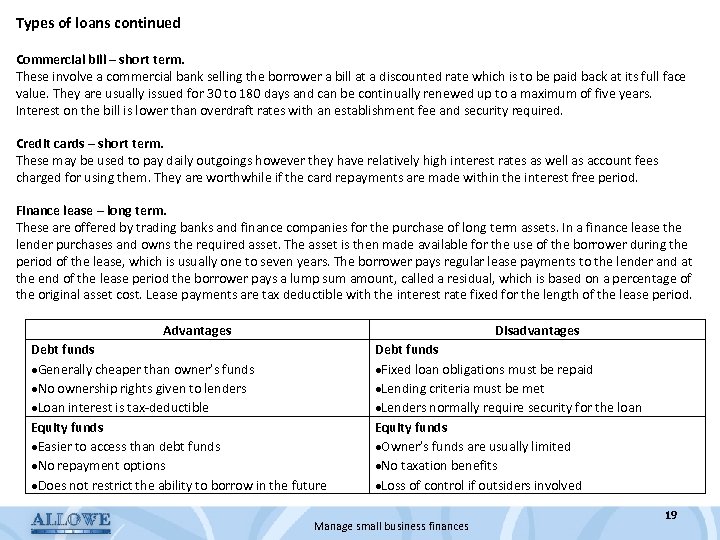
Types of loans continued Commercial bill – short term. These involve a commercial bank selling the borrower a bill at a discounted rate which is to be paid back at its full face value. They are usually issued for 30 to 180 days and can be continually renewed up to a maximum of five years. Interest on the bill is lower than overdraft rates with an establishment fee and security required. Credit cards – short term. These may be used to pay daily outgoings however they have relatively high interest rates as well as account fees charged for using them. They are worthwhile if the card repayments are made within the interest free period. Finance lease – long term. These are offered by trading banks and finance companies for the purchase of long term assets. In a finance lease the lender purchases and owns the required asset. The asset is then made available for the use of the borrower during the period of the lease, which is usually one to seven years. The borrower pays regular lease payments to the lender and at the end of the lease period the borrower pays a lump sum amount, called a residual, which is based on a percentage of the original asset cost. Lease payments are tax deductible with the interest rate fixed for the length of the lease period. Advantages Disadvantages Debt funds Generally cheaper than owner’s funds No ownership rights given to lenders Loan interest is tax-deductible Equity funds Easier to access than debt funds No repayment options Does not restrict the ability to borrow in the future Debt funds Fixed loan obligations must be repaid Lending criteria must be met Lenders normally require security for the loan Equity funds Owner’s funds are usually limited No taxation benefits Loss of control if outsiders involved Manage small business finances 19
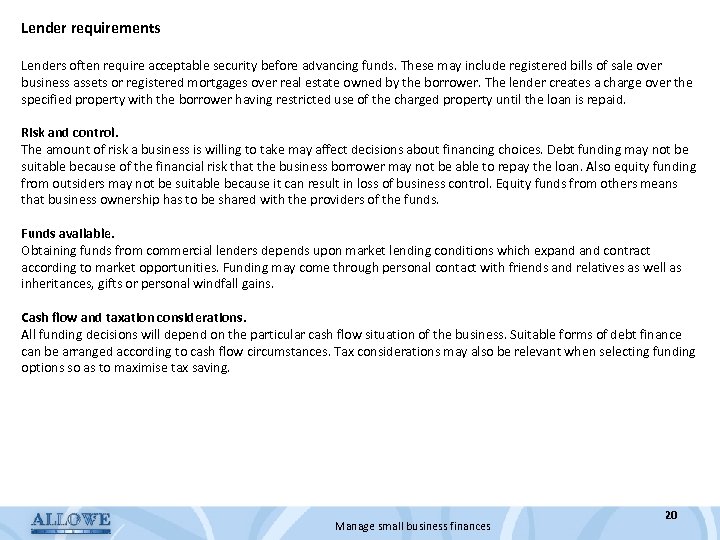
Lender requirements Lenders often require acceptable security before advancing funds. These may include registered bills of sale over business assets or registered mortgages over real estate owned by the borrower. The lender creates a charge over the specified property with the borrower having restricted use of the charged property until the loan is repaid. Risk and control. The amount of risk a business is willing to take may affect decisions about financing choices. Debt funding may not be suitable because of the financial risk that the business borrower may not be able to repay the loan. Also equity funding from outsiders may not be suitable because it can result in loss of business control. Equity funds from others means that business ownership has to be shared with the providers of the funds. Funds available. Obtaining funds from commercial lenders depends upon market lending conditions which expand contract according to market opportunities. Funding may come through personal contact with friends and relatives as well as inheritances, gifts or personal windfall gains. Cash flow and taxation considerations. All funding decisions will depend on the particular cash flow situation of the business. Suitable forms of debt finance can be arranged according to cash flow circumstances. Tax considerations may also be relevant when selecting funding options so as to maximise tax saving. Manage small business finances 20
GST – Goods and services tax The Australian Federal Government levies a value added tax of 10% on the supply of most goods and services by businesses registered for Goods and Services Tax (GST). The revenue from this tax is distributed to the States. State governments do not levy any sales taxes though they do impose stamp duties on a range of transactions. The GST rate of 10% will be charged on most goods and services consumed in Australia. If the business is registered for GST, it needs to include GST in the price it charges to its customers for goods and services they purchase from the business (called sales). The business will be able to claim a credit for the GST it has paid on the business expenses and other inputs (called a GST credit). The business pay the difference between GST charged on sales and GST credits to the Tax Office periodically. There are two types of sales. 1. Suppliers of GST-free goods and services will not have to pay GST when they make a sale but they will be entitled to GST credits. 2. Suppliers of input taxed goods and services do not have to charge GST on sales but they will not be entitled to claim GST credits from their purchases of inputs. An inventory control system is a process for managing and locating objects or materials. Retail stores use stock control systems. Stock control includes tracking and accounting for the items you sell, use or manufacture. The size of the stock control system will depend on the size of your business and the type of stock you have. In some cases stock is also referred to as inventory. Knowing what stock to buy, when to buy it and how much to buy is essential for good stock control. Manage small business finances 21
Credit policies Credit terms. Standard credit terms are usually payments within 7, 14, or 30 days after the invoice date. A business should base their credit term on their cash flow requirements. Any type of payment terms may be acceptable however check the costs involved with credit card transactions. Credit application. A business needs to develop a credit application form or agreement which establishes all the conditions of credit, as well as the rights and obligations of both parties. This form must contain the details of all directors, partners and owners of the business. It should contain space for at least three trade credit references, who are not banks, financial institutions and leasing companies. The business should contact the trade credit references and ask questions about the trading history of the customer. The credit form requires the signature of the applicant as evidence that they have read and understood all the conditions and have agreed to abide by them. A Deed of Indemnity and Guarantee for corporate clients is optional, but it is an excellent safeguard against insolvent clients. It guarantees that the directors of the company are liable for any outstanding debts owed to the business. It’s important to obtain legal advice before including this in your application. The decision to grant credit needs to take into account all the data collected, in particular the references, the length of time that the business has been operating and whether or not the guarantees have been signed. The customer requiring credit needs to be notified in writing of their acceptance or refusal. Late payments. The business credit terms policy document needs to clearly state the consequences of late payment. This may take the form of withholding goods, not processing orders, and in difficult situation legal action. Implement the credit policy with the credit application form and collection procedures. Manage small business finances 22
Key Performance Indicators – KPI’s Key Performance Indicators (KPIs) are measurable factors that can significantly affect customer satisfaction. KPIs vary between businesses, but they must reflect the goals of the business, be measurable and be essential to the businesses success. By tracking KPIs you can quickly judge if you are satisfying customer needs and adjust things as required. Some KPIs that you can use include; • The number of queries received. • The number of complaints received. • How often customers are contacted each month. • Average time taken to complete services. • Percentage of phone calls answered within one hour. • Number of new clients. • Proportion of income generated through return clients. • Sales figures on specific products. • Repeat sales rates. When choosing the KPIs to track, consult with customers and staff for important issues related to the business. Remember that you are measuring how well you are doing against customer expectations, not comparing results against time or existing standards. Staff should be encouraged to take responsibility for increasing sales to their customers. If they achieve increased sales then they should be rewarded for their efforts. This is called an incentive programme. Manage small business finances 23
Financial record keeping For any transaction that has a financial element you must keep; • Copies of invoices and receipts provided for goods sold or services rendered. • Invoices for goods or services purchased or bills paid such as rent, rates, insurance, licence fees etc. • Payments to employees and to other organisations on behalf of employees e. g. super funds, PAYG tax. • Financial statements including profit and loss statement, cash flow forecast and balance sheet. • Tax return information including GST. • Bank account and credit card statements. • End of year stocktake records, assets register etc. Preparing financial management documentation. It is essential that a small business maintains appropriate and accurate records. These involve; • Reports on business financial performance. These provide evidence of the financial transactions of the business. • Reports that comply with relevant legal requirements. These provide evidence for income tax laws and other relative laws. • Reports that can verify business transactions. These provide evidence of debtors and creditors to verify account queries. The financial control process involves; monitoring of business performance identifying unfavourable performance correcting unfavourable performance. The aim of setting up a record system is to produce relevant information for controlling financial performance. A well organised filing cabinet is the best way to keep all your records filed. File by date to help with your tax return as it's logical and easily understood. Manage small business finances 24
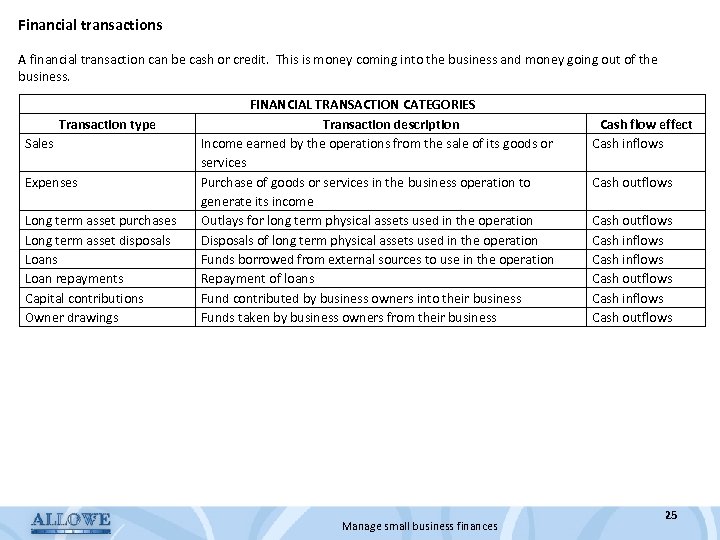
Financial transactions A financial transaction can be cash or credit. This is money coming into the business and money going out of the business. Transaction type Sales Expenses Long term asset purchases Long term asset disposals Loan repayments Capital contributions Owner drawings FINANCIAL TRANSACTION CATEGORIES Transaction description Income earned by the operations from the sale of its goods or services Purchase of goods or services in the business operation to generate its income Outlays for long term physical assets used in the operation Disposals of long term physical assets used in the operation Funds borrowed from external sources to use in the operation Repayment of loans Fund contributed by business owners into their business Funds taken by business owners from their business Manage small business finances Cash flow effect Cash inflows Cash outflows Cash inflows Cash outflows 25
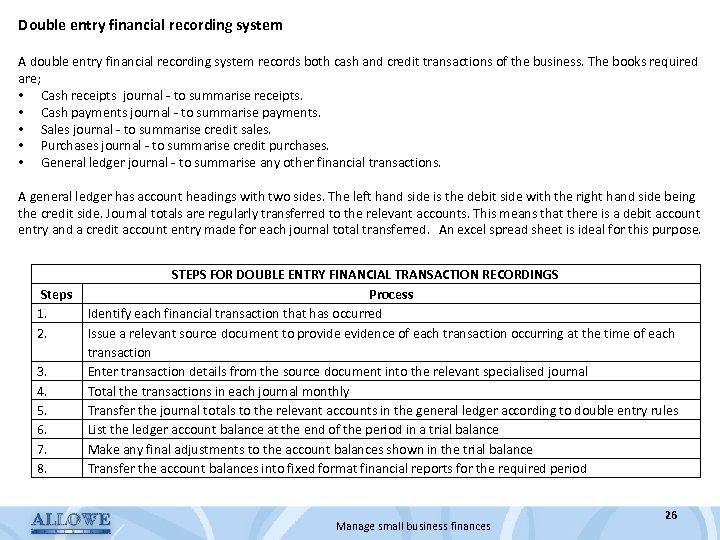
Double entry financial recording system A double entry financial recording system records both cash and credit transactions of the business. The books required are; • Cash receipts journal - to summarise receipts. • Cash payments journal - to summarise payments. • Sales journal - to summarise credit sales. • Purchases journal - to summarise credit purchases. • General ledger journal - to summarise any other financial transactions. A general ledger has account headings with two sides. The left hand side is the debit side with the right hand side being the credit side. Journal totals are regularly transferred to the relevant accounts. This means that there is a debit account entry and a credit account entry made for each journal total transferred. An excel spread sheet is ideal for this purpose. Steps 1. 2. 3. 4. 5. 6. 7. 8. STEPS FOR DOUBLE ENTRY FINANCIAL TRANSACTION RECORDINGS Process Identify each financial transaction that has occurred Issue a relevant source document to provide evidence of each transaction occurring at the time of each transaction Enter transaction details from the source document into the relevant specialised journal Total the transactions in each journal monthly Transfer the journal totals to the relevant accounts in the general ledger according to double entry rules List the ledger account balance at the end of the period in a trial balance Make any final adjustments to the account balances shown in the trial balance Transfer the account balances into fixed format financial reports for the required period Manage small business finances 26
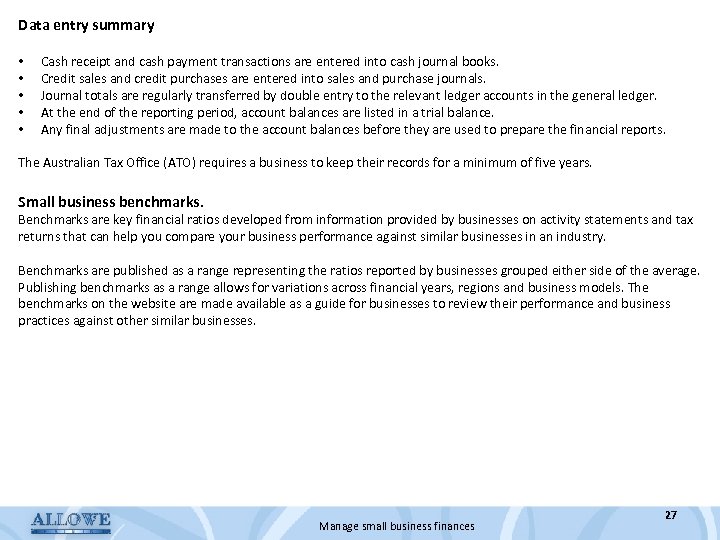
Data entry summary • • • Cash receipt and cash payment transactions are entered into cash journal books. Credit sales and credit purchases are entered into sales and purchase journals. Journal totals are regularly transferred by double entry to the relevant ledger accounts in the general ledger. At the end of the reporting period, account balances are listed in a trial balance. Any final adjustments are made to the account balances before they are used to prepare the financial reports. The Australian Tax Office (ATO) requires a business to keep their records for a minimum of five years. Small business benchmarks. Benchmarks are key financial ratios developed from information provided by businesses on activity statements and tax returns that can help you compare your business performance against similar businesses in an industry. Benchmarks are published as a range representing the ratios reported by businesses grouped either side of the average. Publishing benchmarks as a range allows for variations across financial years, regions and business models. The benchmarks on the website are made available as a guide for businesses to review their performance and business practices against other similar businesses. Manage small business finances 27
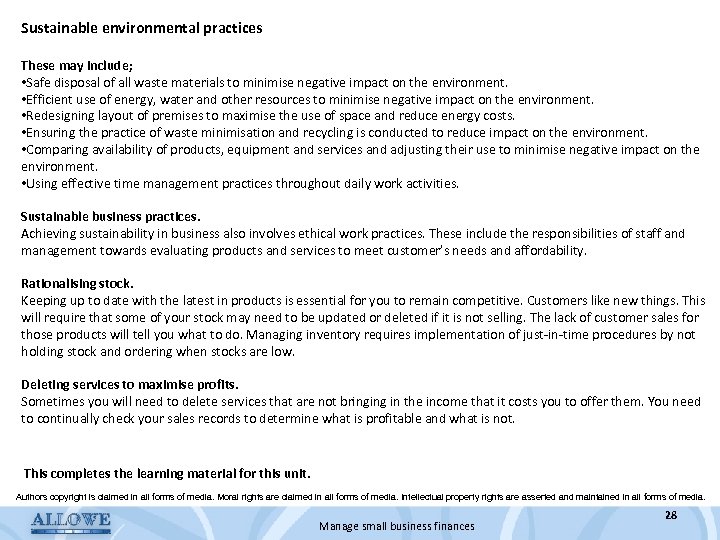
Sustainable environmental practices These may include; • Safe disposal of all waste materials to minimise negative impact on the environment. • Efficient use of energy, water and other resources to minimise negative impact on the environment. • Redesigning layout of premises to maximise the use of space and reduce energy costs. • Ensuring the practice of waste minimisation and recycling is conducted to reduce impact on the environment. • Comparing availability of products, equipment and services and adjusting their use to minimise negative impact on the environment. • Using effective time management practices throughout daily work activities. Sustainable business practices. Achieving sustainability in business also involves ethical work practices. These include the responsibilities of staff and management towards evaluating products and services to meet customer’s needs and affordability. Rationalising stock. Keeping up to date with the latest in products is essential for you to remain competitive. Customers like new things. This will require that some of your stock may need to be updated or deleted if it is not selling. The lack of customer sales for those products will tell you what to do. Managing inventory requires implementation of just-in-time procedures by not holding stock and ordering when stocks are low. Deleting services to maximise profits. Sometimes you will need to delete services that are not bringing in the income that it costs you to offer them. You need to continually check your sales records to determine what is profitable and what is not. This completes the learning material for this unit. Authors copyright is claimed in all forms of media. Moral rights are claimed in all forms of media. Intellectual property rights are asserted and maintained in all forms of media. Manage small business finances 28
Скачать презентацию SHB 30215 Certificate III in Make-up SHB 30315
6c437027823fd8e6062a887293e69b2c.ppt