 Sharing Economy Moriy V. V.
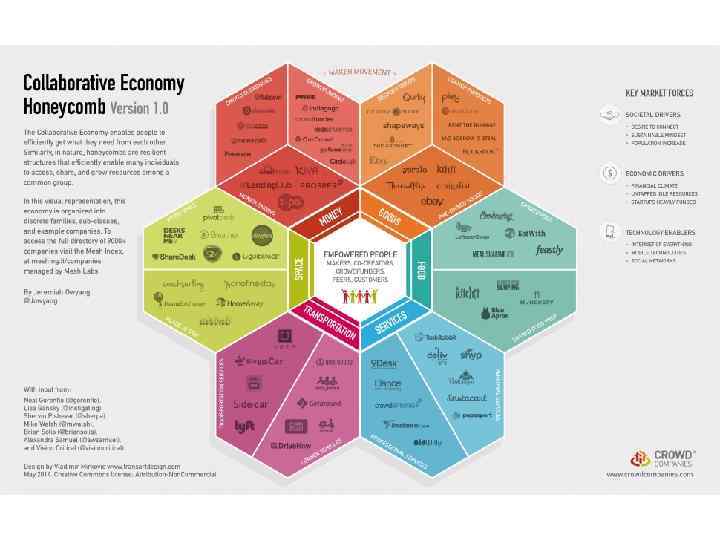
 What is it about • Sharing economy refers to peer-to-peer-based sharing of access to goods and services (coordinated through community-based online services). Sharing economy can take a variety of forms, including using information technology to provide individuals, corporations, non-profits and governments with information that enables the optimization of resources through the redistribution, sharing and reuse of excess capacity in goods and services.
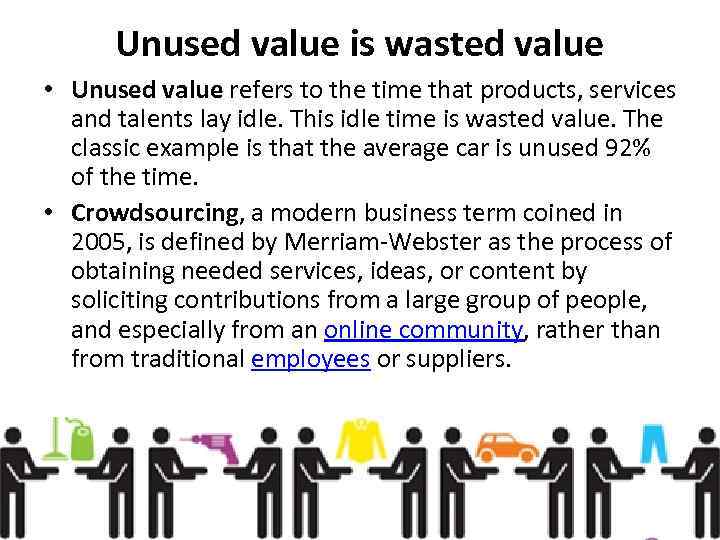 Unused value is wasted value • Unused value refers to the time that products, services and talents lay idle. This idle time is wasted value. The classic example is that the average car is unused 92% of the time. • Crowdsourcing, a modern business term coined in 2005, is defined by Merriam-Webster as the process of obtaining needed services, ideas, or content by soliciting contributions from a large group of people, and especially from an online community, rather than from traditional employees or suppliers.
 Benefits of a sharing economy are said to include the following: • Reducing negative environmental impact (such as reducing the carbon footprint and consumption of resources) • Stronger communities • Saving costs by borrowing and recycling items • Providing people with access to goods who can't afford buying them or have no interest in long-term usage • Increased independence, flexibility and selfreliance by decentralization, the abolition of certain entrybarriers and self-organization • Increased participatory democracy • Accelerating sustainable consumption and production patterns in cities around the globe
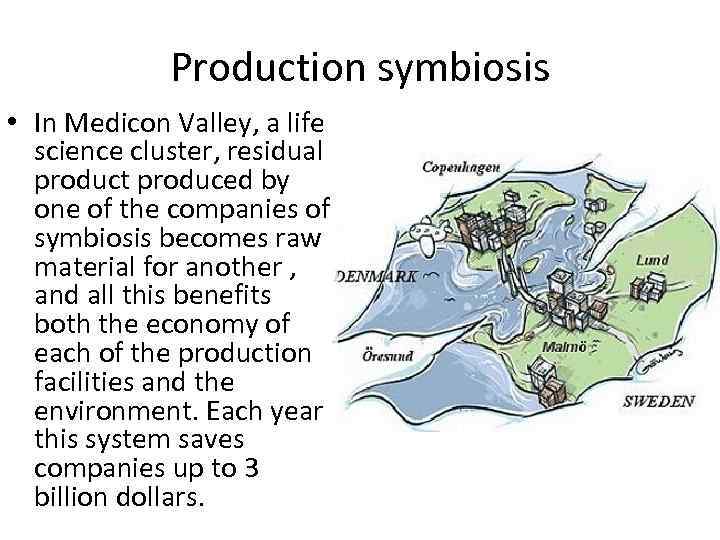 Production symbiosis • In Medicon Valley, a life science cluster, residual product produced by one of the companies of symbiosis becomes raw material for another , and all this benefits both the economy of each of the production facilities and the environment. Each year this system saves companies up to 3 billion dollars.
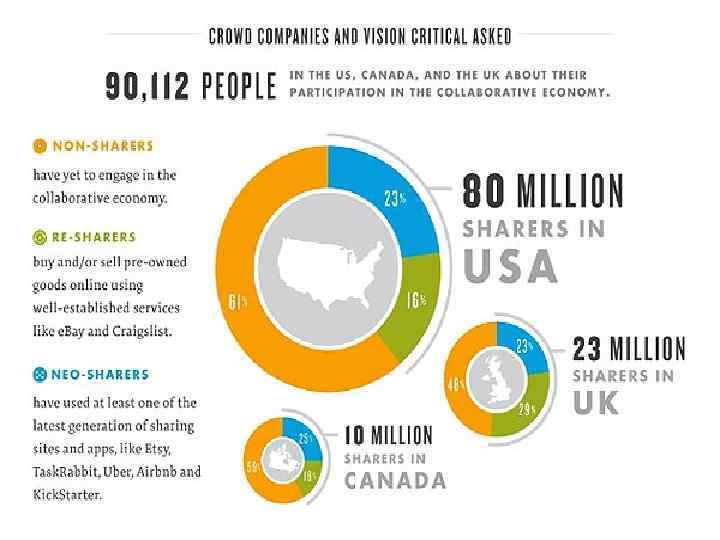
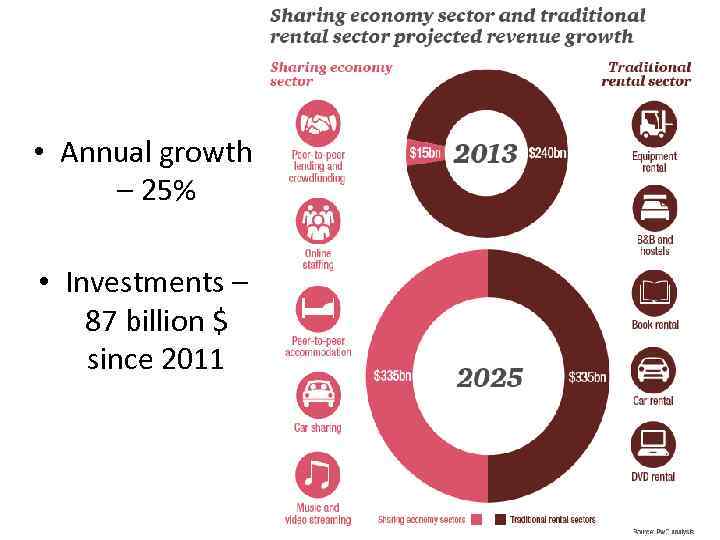 • Annual growth – 25% • Investments – 87 billion $ since 2011
 Organizations advocating and networking sharing economy 1. 2. 3. 4. 5. Uber – An app-based service that lets anyone in need of a ride summon one within minutes. Uber recently raised $1. 2 billion at a valuation of $18 billion, only on peer-to-peer base. Oui. Share: A French-based non-for-profit aiming to connect efforts within the Sharing or Collaborative Economy to create a global network of collaborators. Having started in France in 2012, they have spread to Europe, Latin America and the Middle East. Shareable: "Shareable is a nonprofit news, action and connection hub for the sharing transformation", and the primary global online magazine on the Sharing Economy. Echo (Economy of Hours): [A UK based non-profit providing infrastructure to, and lobbying at national level on behalf of, local time banking projects. Echo develops systems for local projects to become part of national networks, aggregating offers and requests, and a commercial B 2 B model to provide long term sustainability to time banks. Echo has introduced non-profits, businesses and corporates to time banking as a legitimate way of doing business, with the aim of dissolving the distinction between the personal and the professional, resulting in a comprehensive marketplace without money. European Sharing Economy Coalition: The Coalition is the first multi-stakeholder European network created to mature policies, markets and sectors in Europe for the Sharing Economy to become mainstream.