


 Скачать презентацию Sharing a single IPv 4 address among many
4ba711e3afd519309562b465a3f6b586.ppt
- Количество слайдов: 9
 Sharing a single IPv 4 address among many broadband customers Alain_Durand@cable. comcast. com
 Disclaimer • This is still research work and does not necessarily reflect what Comcast is or will be doing.
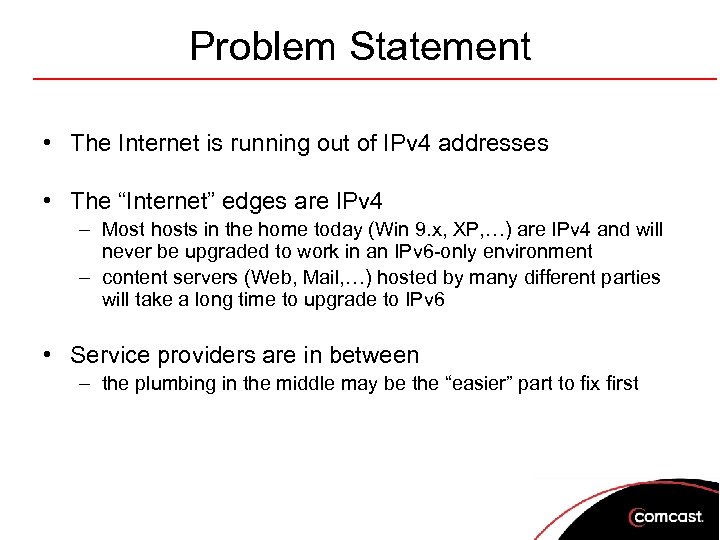 Problem Statement • The Internet is running out of IPv 4 addresses • The “Internet” edges are IPv 4 – Most hosts in the home today (Win 9. x, XP, …) are IPv 4 and will never be upgraded to work in an IPv 6 -only environment – content servers (Web, Mail, …) hosted by many different parties will take a long time to upgrade to IPv 6 • Service providers are in between – the plumbing in the middle may be the “easier” part to fix first
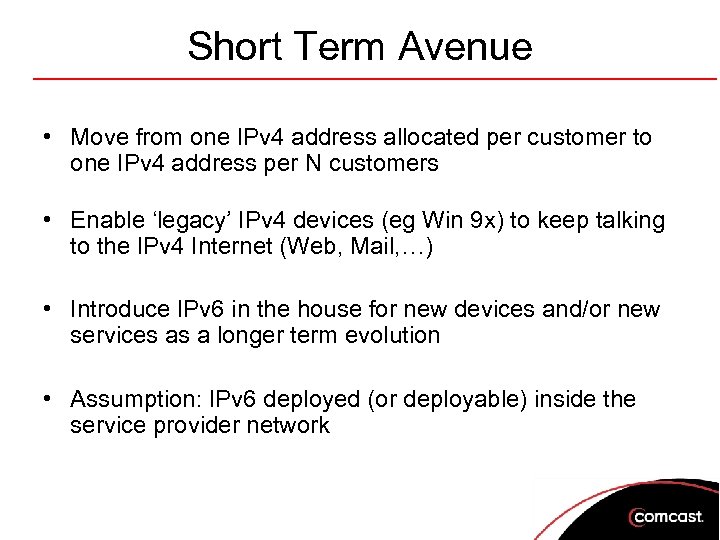 Short Term Avenue • Move from one IPv 4 address allocated per customer to one IPv 4 address per N customers • Enable ‘legacy’ IPv 4 devices (eg Win 9 x) to keep talking to the IPv 4 Internet (Web, Mail, …) • Introduce IPv 6 in the house for new devices and/or new services as a longer term evolution • Assumption: IPv 6 deployed (or deployable) inside the service provider network
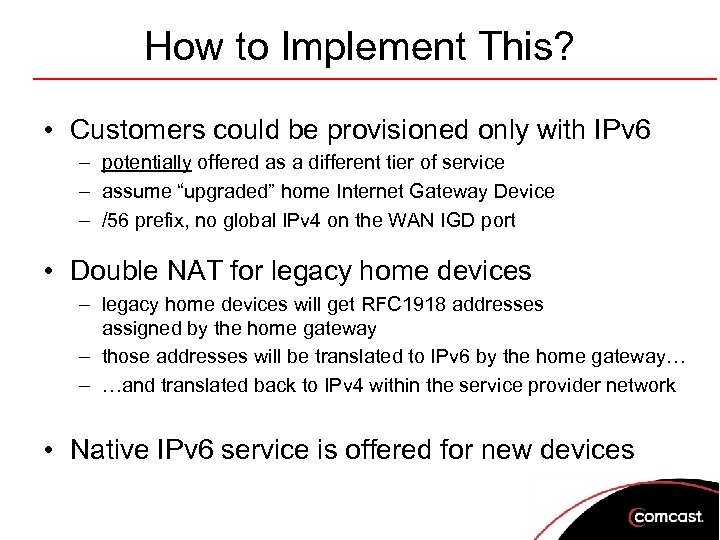 How to Implement This? • Customers could be provisioned only with IPv 6 – potentially offered as a different tier of service – assume “upgraded” home Internet Gateway Device – /56 prefix, no global IPv 4 on the WAN IGD port • Double NAT for legacy home devices – legacy home devices will get RFC 1918 addresses assigned by the home gateway – those addresses will be translated to IPv 6 by the home gateway… – …and translated back to IPv 4 within the service provider network • Native IPv 6 service is offered for new devices
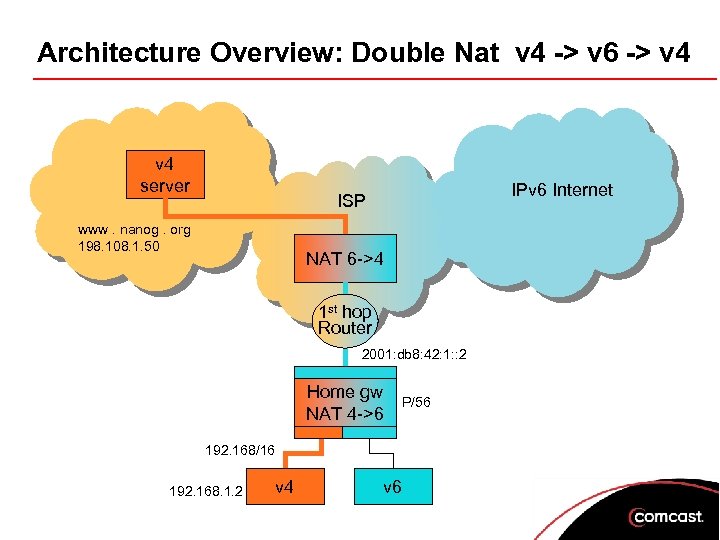 Architecture Overview: Double Nat v 4 -> v 6 -> v 4 server IPv 6 Internet ISP www. nanog. org 198. 108. 1. 50 NAT 6 ->4 1 st hop Router 2001: db 8: 42: 1: : 2 Home gw NAT 4 ->6 P/56 192. 168/16 192. 168. 1. 2 v 4 v 6
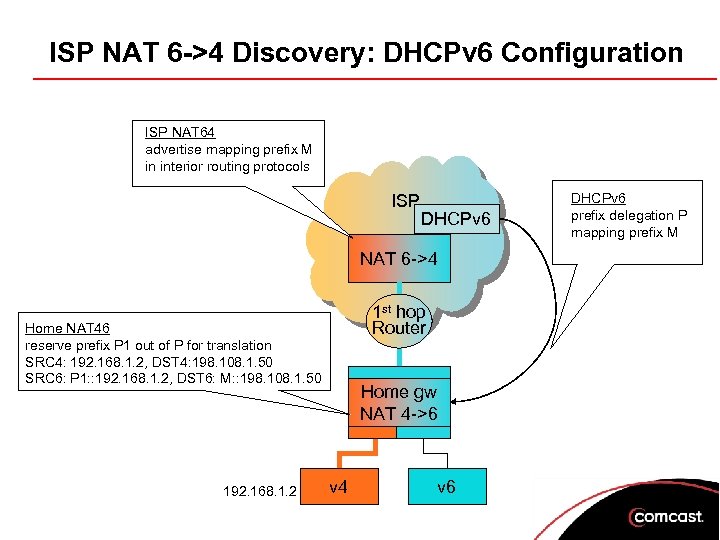 ISP NAT 6 ->4 Discovery: DHCPv 6 Configuration ISP NAT 64 advertise mapping prefix M in interior routing protocols ISP DHCPv 6 NAT 6 ->4 1 st hop Router Home NAT 46 reserve prefix P 1 out of P for translation SRC 4: 192. 168. 1. 2, DST 4: 198. 108. 1. 50 SRC 6: P 1: : 192. 168. 1. 2, DST 6: M: : 198. 108. 1. 50 192. 168. 1. 2 Home gw NAT 4 ->6 v 4 v 6 DHCPv 6 prefix delegation P mapping prefix M
 Special Considerations • DNS – Just like any other apps, will be translated – alternative: DNS proxy within the home gw • MTU adaptation – IPv 4 p. MTUd between NAT 6 ->4 and IPv 4 servers – Force lower MTU on legacy host side • Will NOT work for all apps, but for most • NO worse than regular IPv 4 NAT today
 FAQ • Why not use v 4/v 6 tunneling instead of NAT? – tunneling would require a v 4 address, which we may not have, not even in the 10/8 range • Why not simply use double IPv 4 NAT? – same as above, 10/8 is too small for large deployments • Why not deploy the home v 6 -only and translate directly to v 4 in the home gateway? – Will not help the legacy Win 9 x boxes in the home • What about new v 6 -only host trying to reach the v 4 Internet? – one problem at a time! Such device do not really exist today…. – suggestion: use v 6/v 4 proxies in ISP network