 Скачать презентацию Shared relationships spaces and online information behaviours A
e4890f62f0d53ee5e6888dbc716561af.ppt
- Количество слайдов: 42



Shared relationships, spaces and online information behaviours A social exchange and capital perspective Presented by Dr Hazel Hall Reader in Social Informatics Centre for Social Informatics Edinburgh Napier University Scotland, UK h. hall@napier. ac. uk @hazelh (Twitter)
Research background Project team v Dr Hazel Hall, Edinburgh Napier University, Scotland v Professor Gunilla Widén-Wulff, Åbo Akademi University, Finland v Lorraine Paterson, User Vision, Edinburgh, Scotland v Brian Davison, Edinburgh Napier University, Scotland External funding v Carnegie Trust for the Universities of Scotland
Research question To what extent are online information interactions socially motivated?
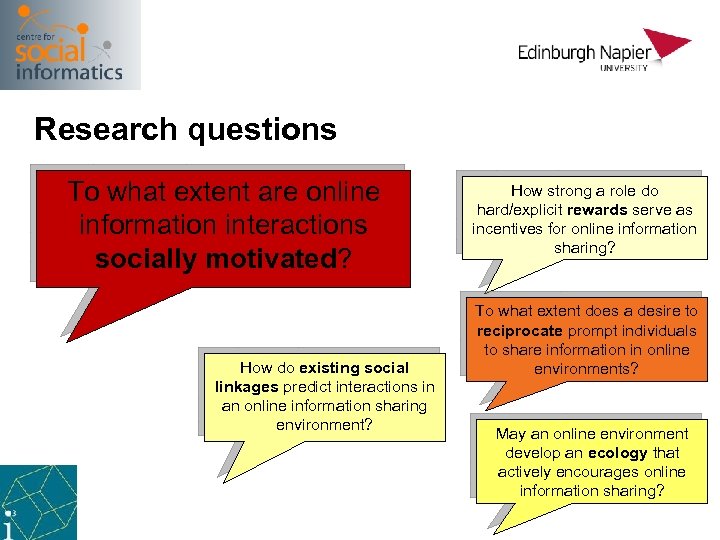
Research questions To what extent are online information interactions socially motivated? How do existing social linkages predict interactions in an online information sharing environment? How strong a role do hard/explicit rewards serve as incentives for online information sharing? To what extent does a desire to reciprocate prompt individuals to share information in online environments? May an online environment develop an ecology that actively encourages online information sharing?
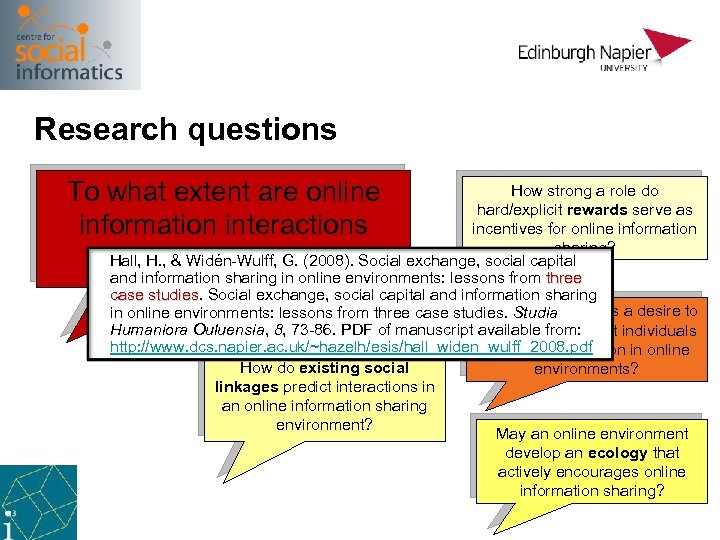
Research questions How strong a role do To what extent are online hard/explicit rewards serve as incentives for online information interactions sharing? Hall, H. , & Widén-Wulff, G. (2008). Social exchange, social capital socially motivated? and information sharing in online environments: lessons from three case studies. Social exchange, social capital and information sharing studies To what extent does a desire to in online environments: lessons from three case studies. Studia Humaniora Ouluensia, 8, 73 -86. PDF of manuscript reciprocate prompt individuals available from: http: //www. dcs. napier. ac. uk/~hazelh/esis/hall_widen_wulff_2008. pdf to share information in online How do existing social environments? linkages predict interactions in an online information sharing environment? May an online environment develop an ecology that actively encourages online information sharing?
Possible explanations for online information sharing behaviours Focus here is on one of the non-corporate environments discussed by Hall and Widén-Wulff (2008) v Edinburgh Napier University v Data from two cohorts (2007 and 2008) v Full paper to position the findings with growing literature base that ties online information sharing with social exchange theory, within a broader context of social capital


Exchange theory From economics v Economic resources are bought and sold v Deals are subject to contractual obligations v Resources are exchanged for currency v Purchaser choices are made from a range of options Ø Best value for lowest cost

Social exchange theory “Flavour” of exchange theory v “Resources” “bought” and “sold”, but mutual obligations are ill-defined v “Deals” not necessarily subject to contractual obligations v “Resources” not necessarily exchanged for currency v “Resources” exchanged may be valued more highly than market cost
Social exchange theory “Flavour” of exchange theory v “Resources” “bought” and “sold”, but mutual obligations are ill-defined v “Deals” not necessarily subject to contractual obligations v “Resources” not necessarily exchanged for currency v “Resources” exchanged may be valued more highly than market cost Actors share social bonds, and high levels of trust, in long-term dependent relationships
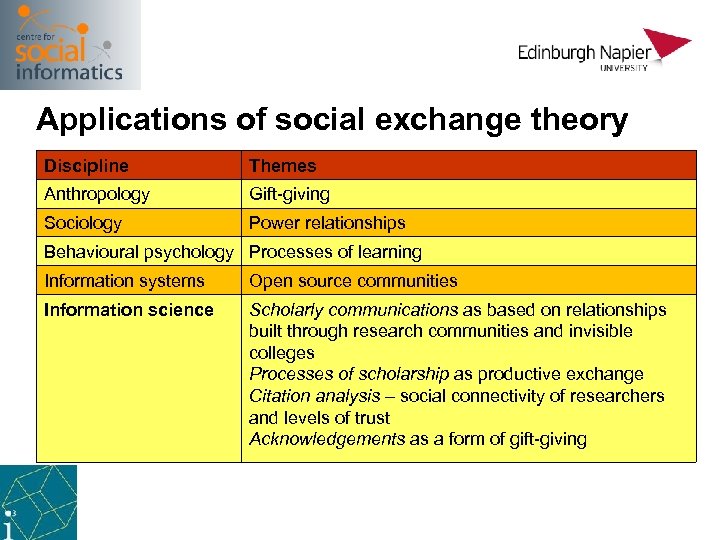
Applications of social exchange theory Discipline Themes Anthropology Gift-giving Sociology Power relationships Behavioural psychology Processes of learning Information systems Open source communities Information science Scholarly communications as based on relationships built through research communities and invisible colleges Processes of scholarship as productive exchange Citation analysis – social connectivity of researchers and levels of trust Acknowledgements as a form of gift-giving
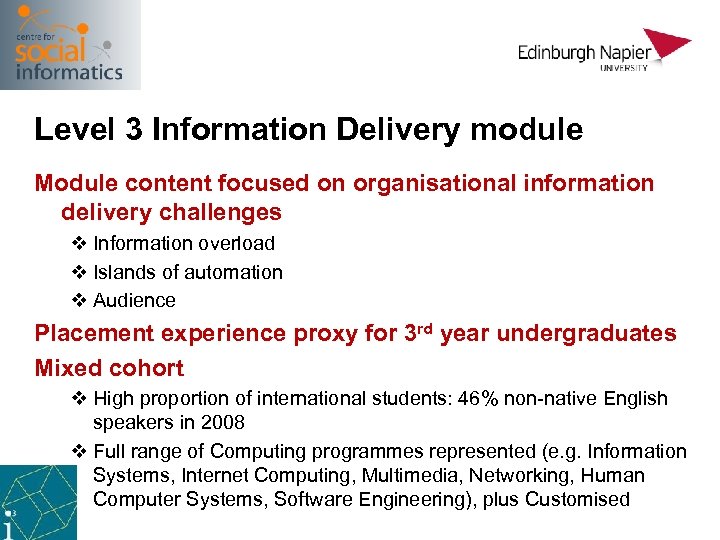
Level 3 Information Delivery module Module content focused on organisational information delivery challenges v Information overload v Islands of automation v Audience Placement experience proxy for 3 rd year undergraduates Mixed cohort v High proportion of international students: 46% non-native English speakers in 2008 v Full range of Computing programmes represented (e. g. Information Systems, Internet Computing, Multimedia, Networking, Human Computer Systems, Software Engineering), plus Customised
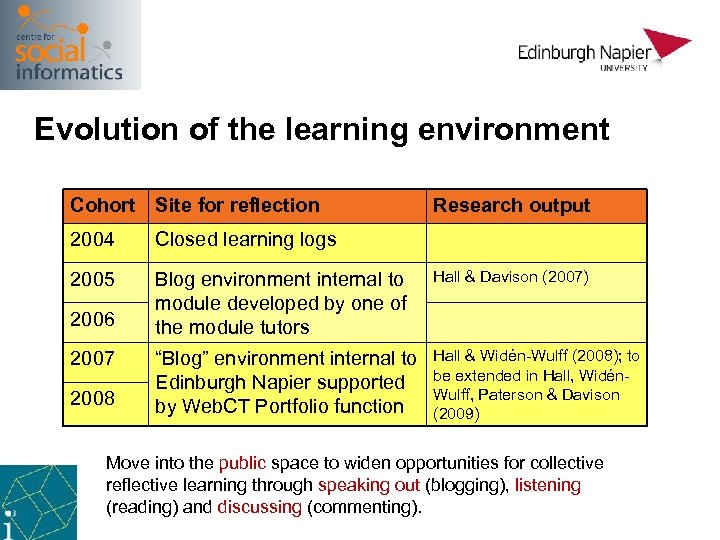
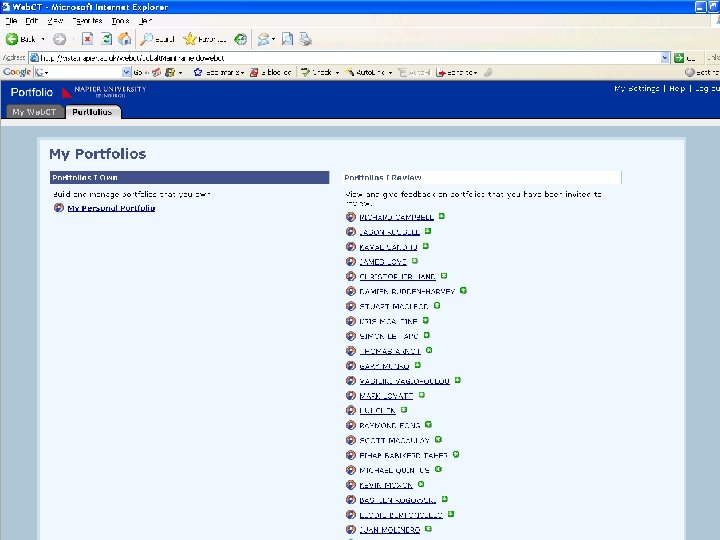
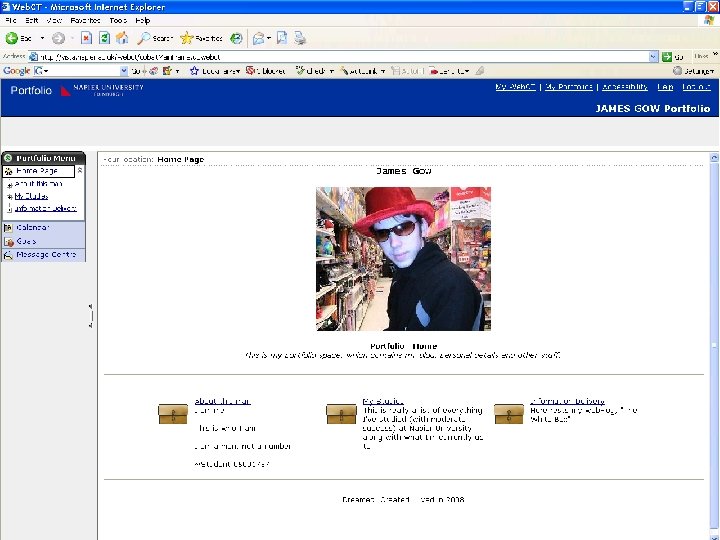
Evolution of the learning environment Cohort Site for reflection Research output 2004 Closed learning logs 2005 Blog environment internal to module developed by one of the module tutors Hall & Davison (2007) “Blog” environment internal to Edinburgh Napier supported by Web. CT Portfolio function Hall & Widén-Wulff (2008); to be extended in Hall, Widén. Wulff, Paterson & Davison (2009) 2006 2007 2008 Move into the public space to widen opportunities for collective reflective learning through speaking out (blogging), listening (reading) and discussing (commenting).
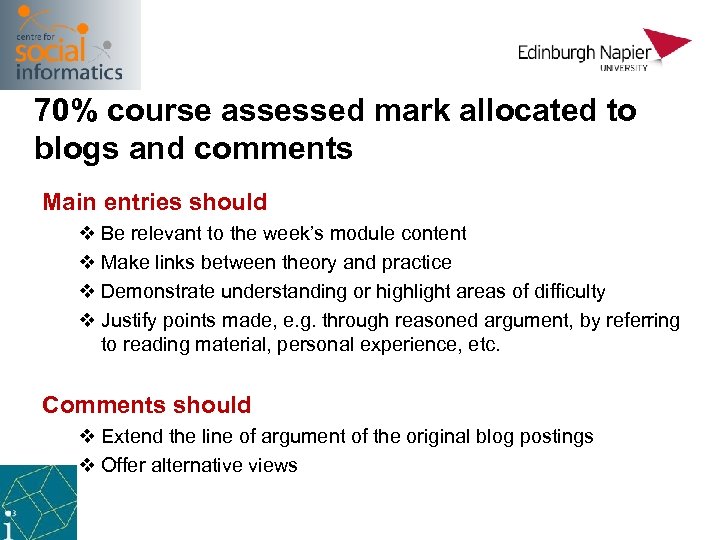
70% course assessed mark allocated to blogs and comments Main entries should v Be relevant to the week’s module content v Make links between theory and practice v Demonstrate understanding or highlight areas of difficulty v Justify points made, e. g. through reasoned argument, by referring to reading material, personal experience, etc. Comments should v Extend the line of argument of the original blog postings v Offer alternative views

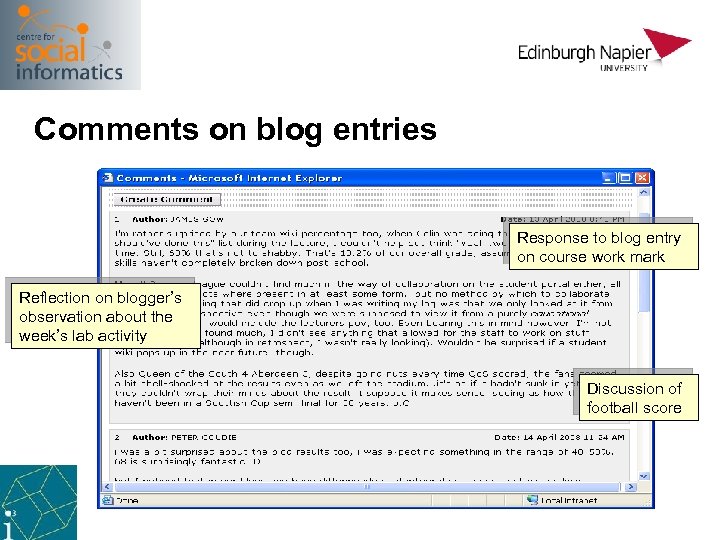
Comments on blog entries Response to blog entry on course work mark Reflection on blogger’s observation about the week’s lab activity Discussion of football score
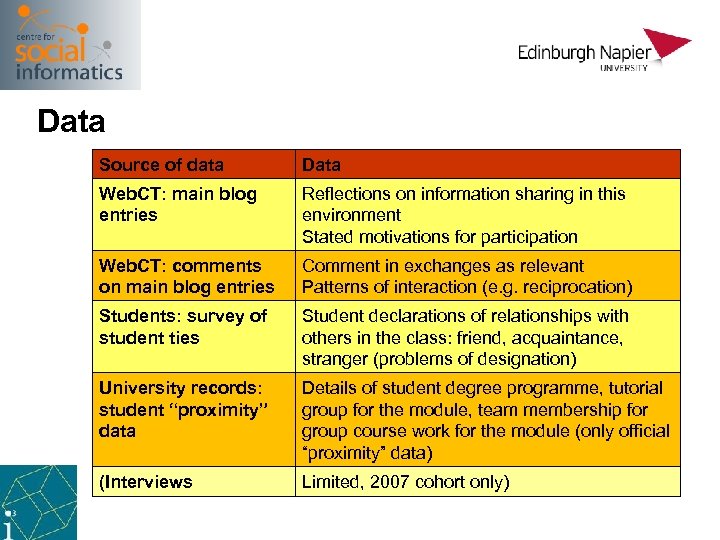
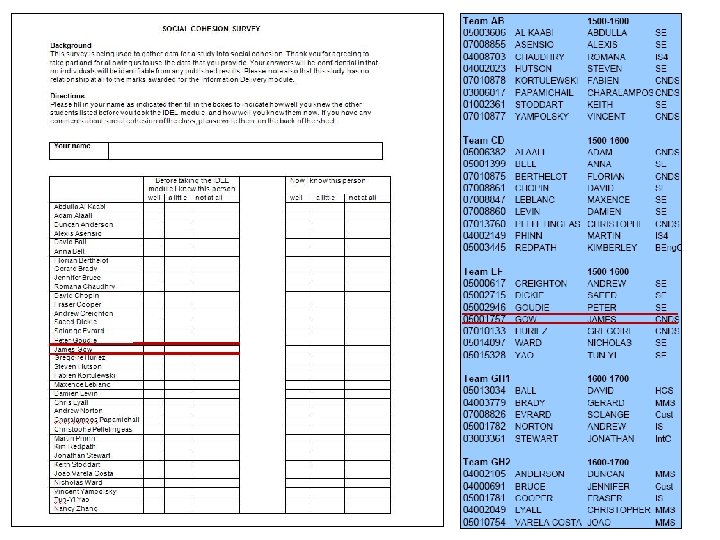
Data Source of data Data Web. CT: main blog entries Reflections on information sharing in this environment Stated motivations for participation Web. CT: comments on main blog entries Comment in exchanges as relevant Patterns of interaction (e. g. reciprocation) Students: survey of student ties Student declarations of relationships with others in the class: friend, acquaintance, stranger (problems of designation) University records: student “proximity” data Details of student degree programme, tutorial group for the module, team membership for group course work for the module (only official “proximity” data) (Interviews Limited, 2007 cohort only)
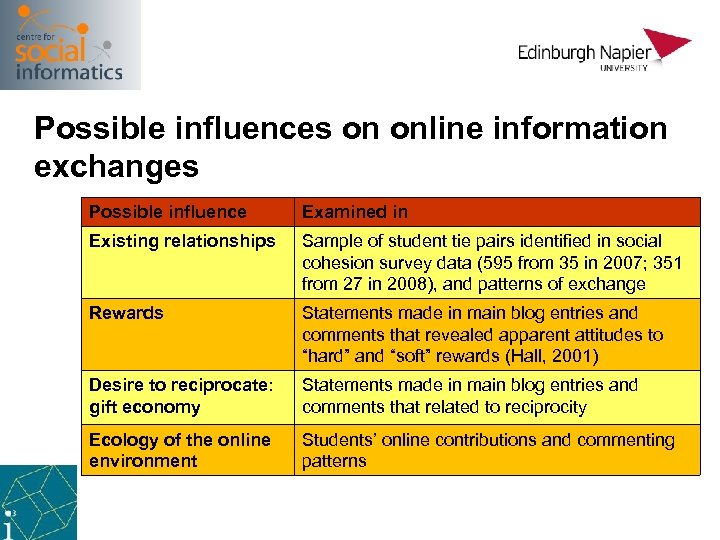
Possible influences on online information exchanges Possible influence Examined in Existing relationships Sample of student tie pairs identified in social cohesion survey data (595 from 35 in 2007; 351 from 27 in 2008), and patterns of exchange Rewards Statements made in main blog entries and comments that revealed apparent attitudes to “hard” and “soft” rewards (Hall, 2001) Desire to reciprocate: gift economy Statements made in main blog entries and comments that related to reciprocity Ecology of the online environment Students’ online contributions and commenting patterns
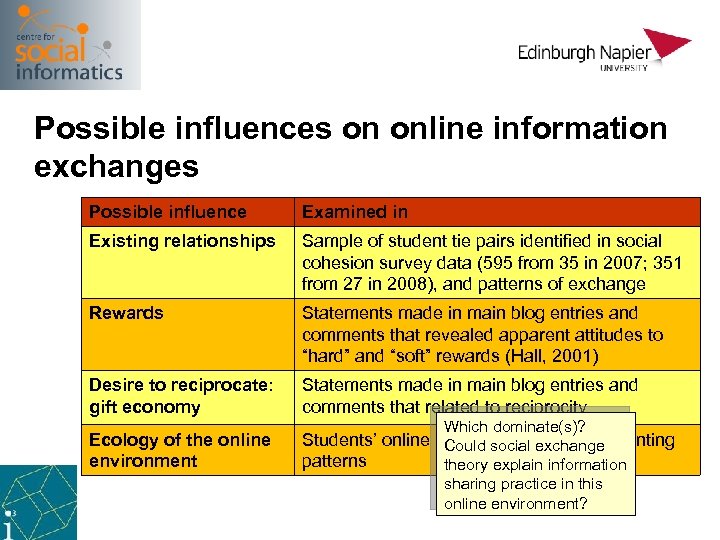
Possible influences on online information exchanges Possible influence Examined in Existing relationships Sample of student tie pairs identified in social cohesion survey data (595 from 35 in 2007; 351 from 27 in 2008), and patterns of exchange Rewards Statements made in main blog entries and comments that revealed apparent attitudes to “hard” and “soft” rewards (Hall, 2001) Desire to reciprocate: gift economy Statements made in main blog entries and comments that related to reciprocity Ecology of the online environment Which dominate(s)? Students’ online contributionsexchange Could social and commenting patterns theory explain information sharing practice in this online environment?
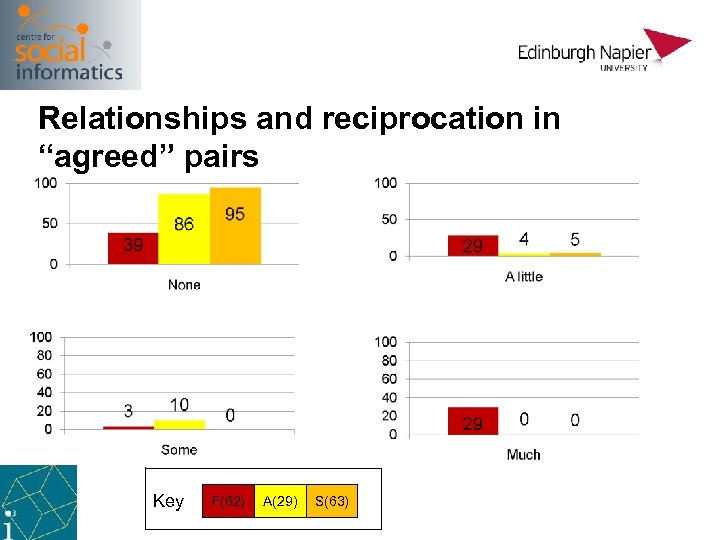
Relationships and reciprocation in “agreed” pairs Key F(62) A(29) S(63)
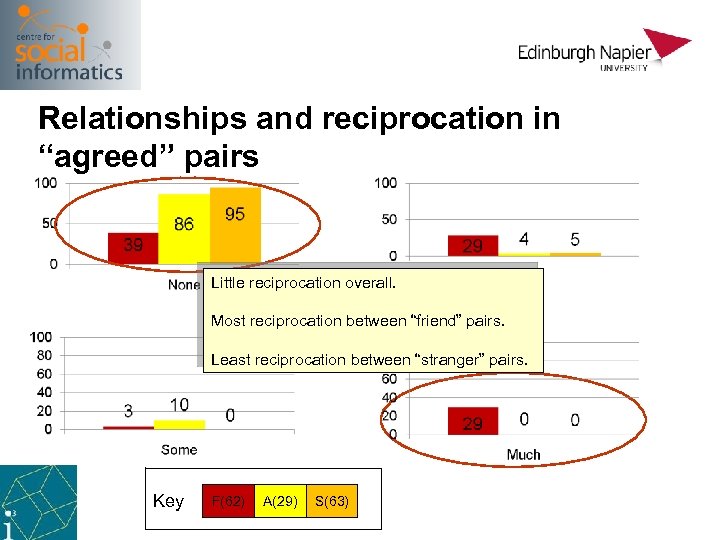
Relationships and reciprocation in “agreed” pairs Little reciprocation overall. Most reciprocation between “friend” pairs. Least reciprocation between “stranger” pairs. Key F(62) A(29) S(63)
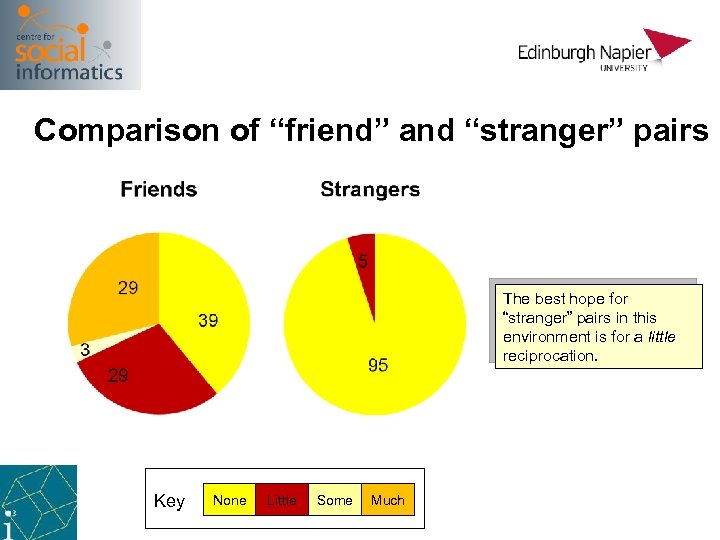
Comparison of “friend” and “stranger” pairs The best hope for “stranger” pairs in this environment is for a little reciprocation. Key None Little Some Much
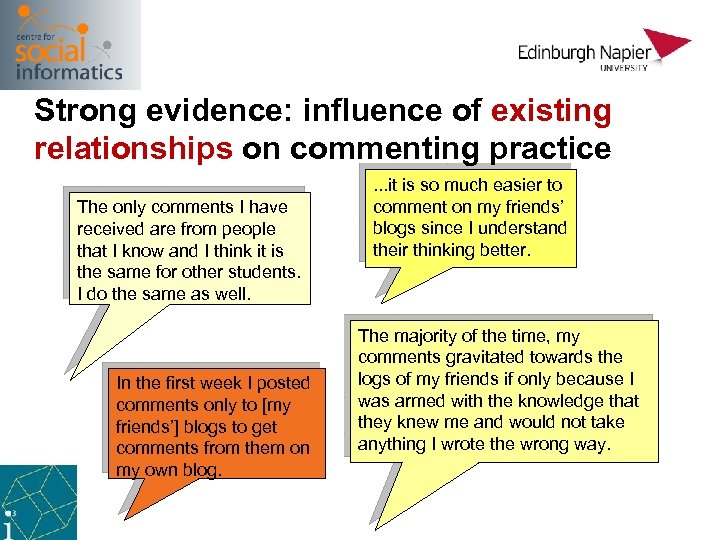
Strong evidence: influence of existing relationships on commenting practice The only comments I have received are from people that I know and I think it is the same for other students. I do the same as well. In the first week I posted comments only to [my friends’] blogs to get comments from them on my own blog. . it is so much easier to comment on my friends’ blogs since I understand their thinking better. The majority of the time, my comments gravitated towards the logs of my friends if only because I was armed with the knowledge that they knew me and would not take anything I wrote the wrong way.
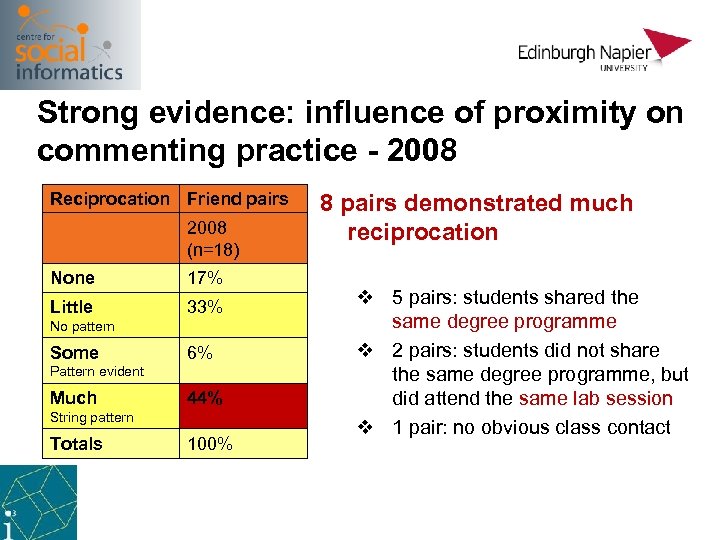
Strong evidence: influence of proximity on commenting practice - 2008 Reciprocation Friend pairs 2008 (n=18) None 17% Little 33% No pattern Some 6% Pattern evident Much 44% String pattern Totals 100% 8 pairs demonstrated much reciprocation v 5 pairs: students shared the same degree programme v 2 pairs: students did not share the same degree programme, but did attend the same lab session v 1 pair: no obvious class contact
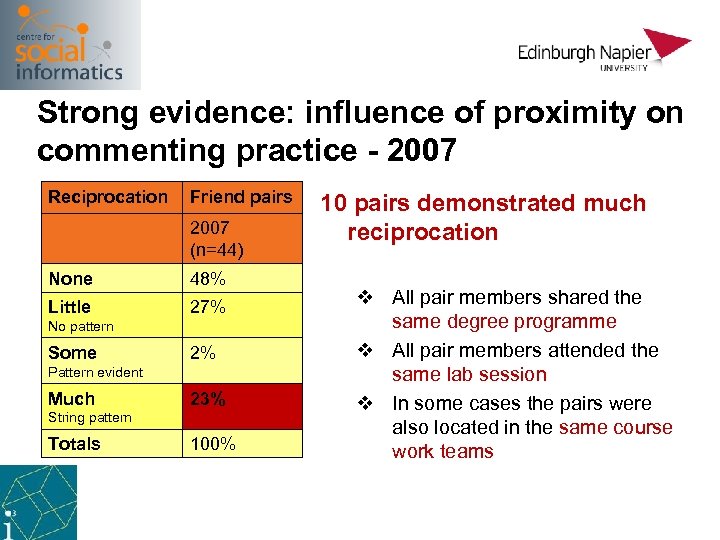
Strong evidence: influence of proximity on commenting practice - 2007 Reciprocation Friend pairs 2007 (n=44) None 48% Little 27% No pattern Some 2% Pattern evident Much 23% String pattern Totals 100% 10 pairs demonstrated much reciprocation v All pair members shared the same degree programme v All pair members attended the same lab session v In some cases the pairs were also located in the same course work teams
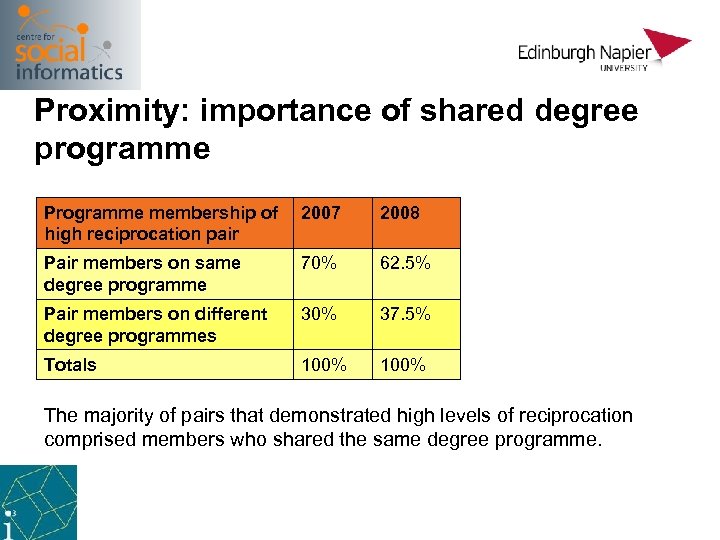
Proximity: importance of shared degree programme Programme membership of high reciprocation pair 2007 2008 Pair members on same degree programme 70% 62. 5% Pair members on different degree programmes 30% 37. 5% Totals 100% The majority of pairs that demonstrated high levels of reciprocation comprised members who shared the same degree programme.
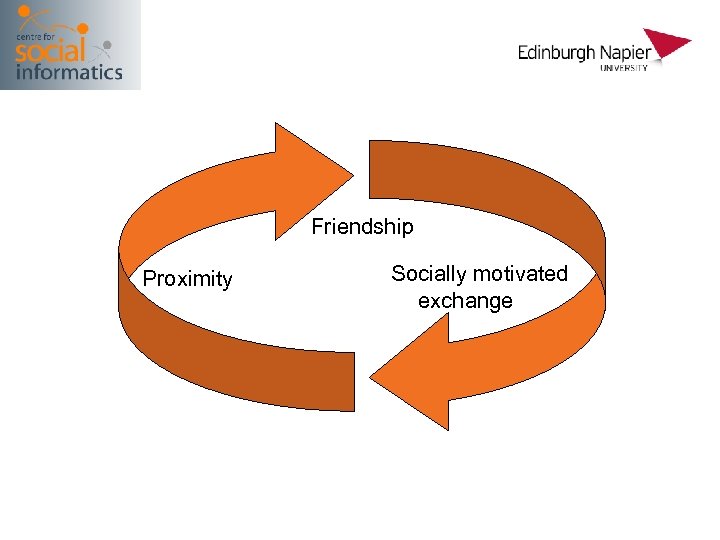
Friendship Proximity Socially motivated exchange
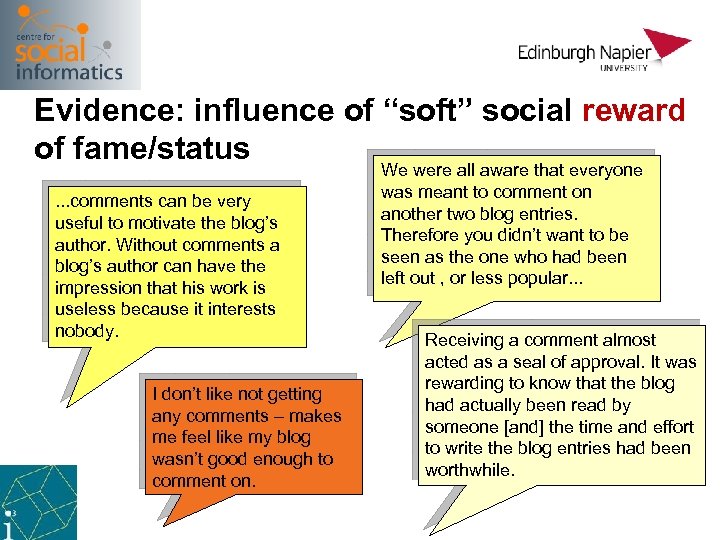
Evidence: influence of “soft” social reward of fame/status. . . comments can be very useful to motivate the blog’s author. Without comments a blog’s author can have the impression that his work is useless because it interests nobody. I don’t like not getting any comments – makes me feel like my blog wasn’t good enough to comment on. We were all aware that everyone was meant to comment on another two blog entries. Therefore you didn’t want to be seen as the one who had been left out , or less popular. . . Receiving a comment almost acted as a seal of approval. It was rewarding to know that the blog had actually been read by someone [and] the time and effort to write the blog entries had been worthwhile.
Social rewards are in the gift of the blogging/commenting community? Main blog entries highlighted by tutor in 2008 v Public acknowledgement by tutor in class appeared to have no pronounced effect on that week’s commenting practice v Social reward from peers more valuable? However. . . v The work of almost half the students was highlighted v Mention for a variety of reasons, including humour and playfulness v Mentions limited to weeks 2 and 3 v Difficult to judge the potential impact of more explicit tutor intervention
Some evidence: influence of “hard” reward of marks Three levels of participation for the grade 1. Students conscious of the mark, yet still making an effort: information exchange in the online environment worth more than the mark alone majority. 2. Reluctant participation: participation with an eye on the level of the mark to be achieved - some. 3. Minimal effort: sole purpose of participation is to gain a mark - few. I definitely don’t think that I would have created the blogs and posted comments had it not been part of the course work specification. What motivated me. . . to be perfectly honest, the fact that I’d fail if I did not do the commenting.
![Evidence: influence of gift economy, and its development [I am] a bit disappointed with](https://present5.com/presentation/e4890f62f0d53ee5e6888dbc716561af/image-35.jpg "Evidence: influence of gift economy, and its development [I am] a bit disappointed with")
Evidence: influence of gift economy, and its development [I am] a bit disappointed with the turn -out of comments on my blog site as I tried to harass people to post comments but I guess it didn’t work. . . If I posted more on other people’s blogs, perhaps I would have gotten more comments. One thing I do feel when someone comments on my blog I feel obliged. . . to comment on theirs. . as I went on, I started to comment on people who had commented on my posts. . .
Evidence: influence of the ecology of the online environment as developing social space I had read a blog or two, started to comment then changed my mind as I was being rather mean. . . Now I wish I had continued writing the comments, maybe softening the blows slightly. . . It could have helped them. I am not sure that [the requirement to debate] was made clear to us early on. . . that disagreeing with someone and having a healthy argument would be acceptable. . . [I thought] that causing friction would be looked on in a negative way with grades being cut off.
Context: social space for learning Blogosphere as scaffold of social infrastructure (Hall & Davison, 2007) 1. Support for discussion, feedback, learning 2. Safe environment to challenge and reflect on “realities” of the subjects studied 3. Community After reading this blog I think I will get some extra help from someone with experience [of the library portal] to avoid any problems that may arise. [Other students’] blogs about the topic help me understand the concepts. Your blog is a prime example of this. Thanks.
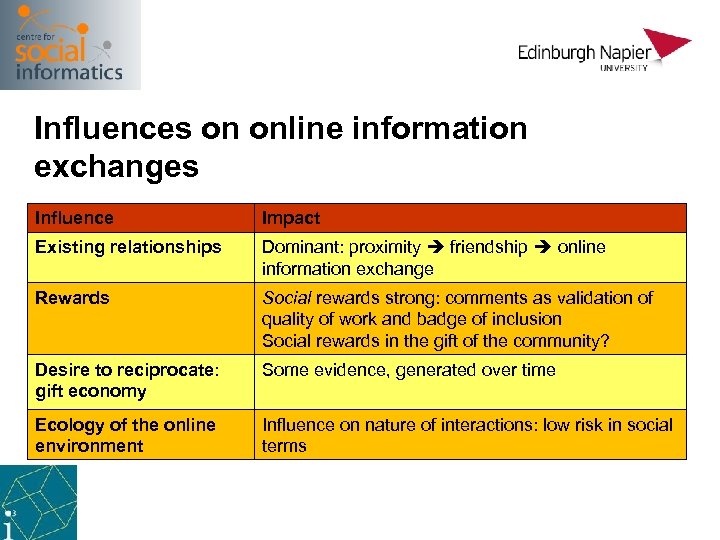
Influences on online information exchanges Influence Impact Existing relationships Dominant: proximity friendship online information exchange Rewards Social rewards strong: comments as validation of quality of work and badge of inclusion Social rewards in the gift of the community? Desire to reciprocate: gift economy Some evidence, generated over time Ecology of the online environment Influence on nature of interactions: low risk in social terms
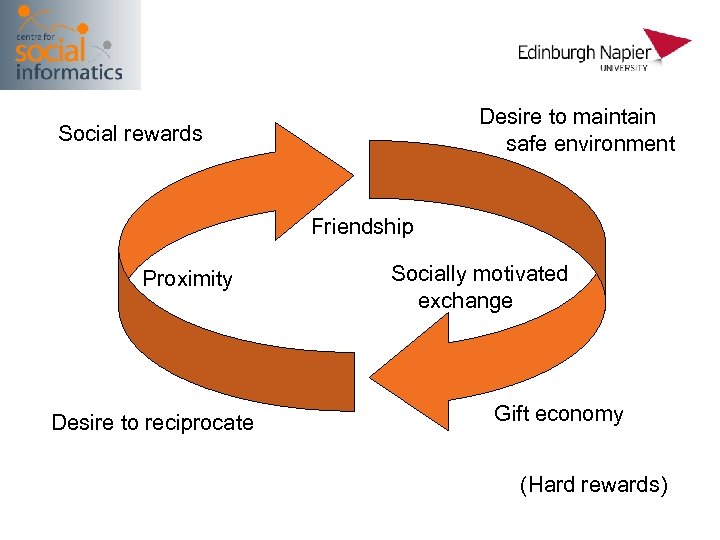
Desire to maintain safe environment Social rewards Friendship Proximity Desire to reciprocate Socially motivated exchange Gift economy (Hard rewards)
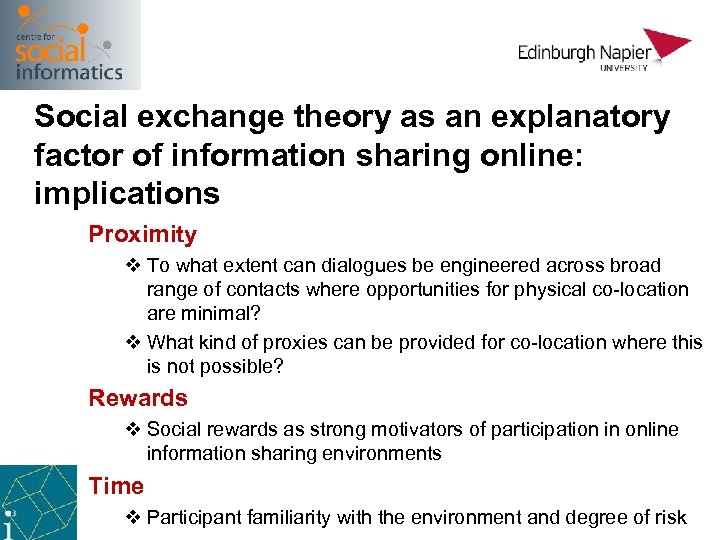
Social exchange theory as an explanatory factor of information sharing online: implications Proximity v To what extent can dialogues be engineered across broad range of contacts where opportunities for physical co-location are minimal? v What kind of proxies can be provided for co-location where this is not possible? Rewards v Social rewards as strong motivators of participation in online information sharing environments Time v Participant familiarity with the environment and degree of risk
References Hall, H. (2001). Input-friendliness: motivating knowledge sharing across intranets. Journal of Information Science 27(3) 139 -146 (DOI 10. 1177/016555150102700303). PDF of full text available from http: //www. knowledgeboard. com/lib/3259 Hall, H. & Davison, B. (2007). Social software as support in hybrid learning environments: the value of the blog as a tool for reflective learning and peer support. Library and Information Science Research, 29(2), 163 -187. (DOI 10. 1016/j. lisr. 2007. 04. 007. ) [Full-text available through Science. Direct. ] PDF of manuscript available from http: //www. dcs. napier. ac. uk/~hazelh/esis/hall_davison_blogs_draft. pdf Hall, H. , & Widén-Wulff, G. (2008). Social exchange, social capital and information sharing in online environments: lessons from three case studies. Studia Humaniora Ouluensia, 8, 73 -86. PDF of manuscript available from: http: //www. dcs. napier. ac. uk/~hazelh/esis/hall_widen_wulff_2008. pdf
Shared relationships, spaces and online information behaviours A social exchange and capital perspective Presented by Dr Hazel Hall Reader in Social Informatics Centre for Social Informatics Edinburgh Napier University Scotland, UK h. hall@napier. ac. uk @hazelh (Twitter)
Скачать презентацию Shared relationships spaces and online information behaviours A
e4890f62f0d53ee5e6888dbc716561af.ppt