


 Скачать презентацию SHAPING THE 21 st CENTURY RESEARCH DEGREE learning
7ff16b1539b2866bac02bab2d596cbfc.ppt
- Количество слайдов: 13
 SHAPING THE 21 st CENTURY RESEARCH DEGREE: learning from international practice Avril Manners Director, SUPA Graduate School
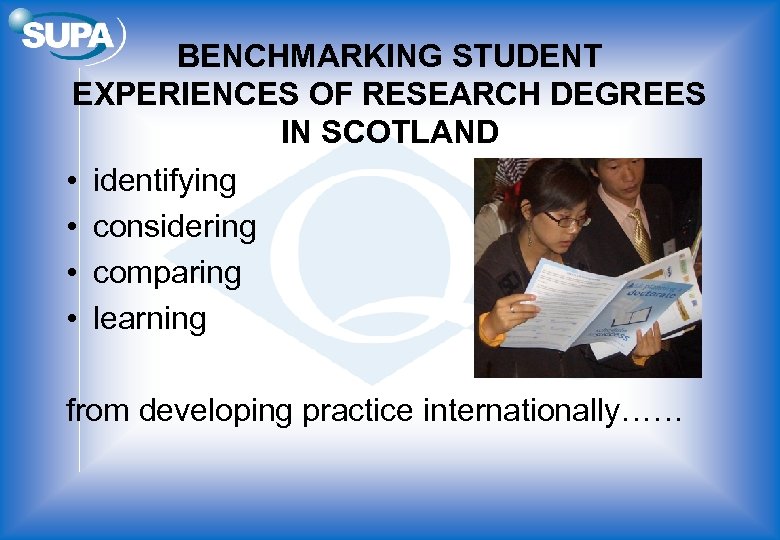 BENCHMARKING STUDENT EXPERIENCES OF RESEARCH DEGREES IN SCOTLAND • identifying • considering • comparing • learning from developing practice internationally……
 Background to Exercise Scottish Higher Education Enhancement Committee (SHEEC) • International Benchmarking Working Group (IBWG) representative of Scottish HEI sector, working with • • Scottish Funding Council (SFC) VITAE Higher Education Academy (HEA) National Union of Students (NUS) Scotland
 21 st Century Research Degree 1 Theory and discussion - Department for Business Innovation and Skills (UK Government) Funding Councils / Research Councils VITAE / QAA / HEA UK Council for Graduate Education (UKCGE) EUA Council for Doctoral Education (EUA-CDE) 2 Practice - Doctorates - Graduate/Research Schools Diversity, richness and standards
 Key Areas Four meetings of the IBWG identified five key areas for benchmarking work : A Student experience – supporting the research degree student International research students. Part-time research students B Standards, quality assurance and reviews Professional Doctorates, examination and external examiners, assessment, supervision and supervisors and the challenges of Joint Degrees
 Key Areas (cont) C Developing and supporting critical mass and critical diversity Collaboration and Graduate Schools, Doctoral Training Centres; Inter- and intra-national graduate schools, variations and models of graduate schools D Supporting the development of postgraduate skills and attributes Postgraduates who teach, public engagement, leadership and management and professional skills E Broadening the postgraduate experience Internationalising the research degree experience entrepreneurship,
 • IBWG Development (6 meetings, 1 conference and 1 workshop on key areas) • Case Studies (Scottish, UK, Europe and world-wide) • Bologna Seminar The 21 st century doctorate – sharing European developments (18 March 2011, Scotland House, Brussels) • Final Conference and findings (3 June 2011)
 Europe – Salzburg Principles Salzburg II Recommendations i The core component of doctoral training is the advancement of knowledge through original research ii. iv. v. Embedding in institutional strategies and policies The importance of diversity Doctoral candidates as early stage researchers The crucial role of supervision and assessment vi. Achieving critical mass vii. Duration viii. The promotion of innovative structures ix. Increasing mobility x. Ensuring appropriate funding
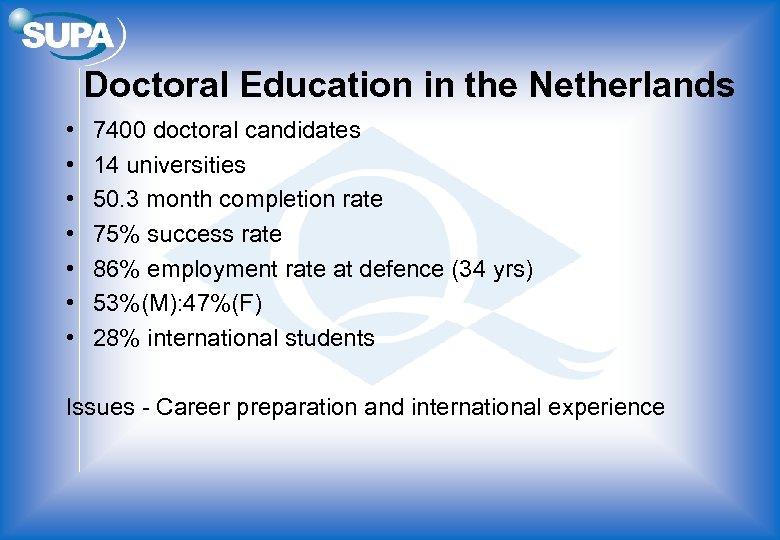 Doctoral Education in the Netherlands • • 7400 doctoral candidates 14 universities 50. 3 month completion rate 75% success rate 86% employment rate at defence (34 yrs) 53%(M): 47%(F) 28% international students Issues - Career preparation and international experience
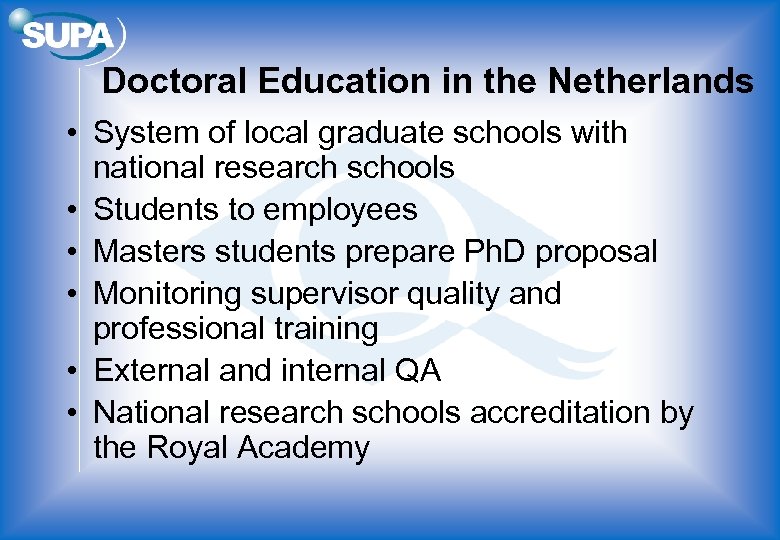 Doctoral Education in the Netherlands • System of local graduate schools with national research schools • Students to employees • Masters students prepare Ph. D proposal • Monitoring supervisor quality and professional training • External and internal QA • National research schools accreditation by the Royal Academy
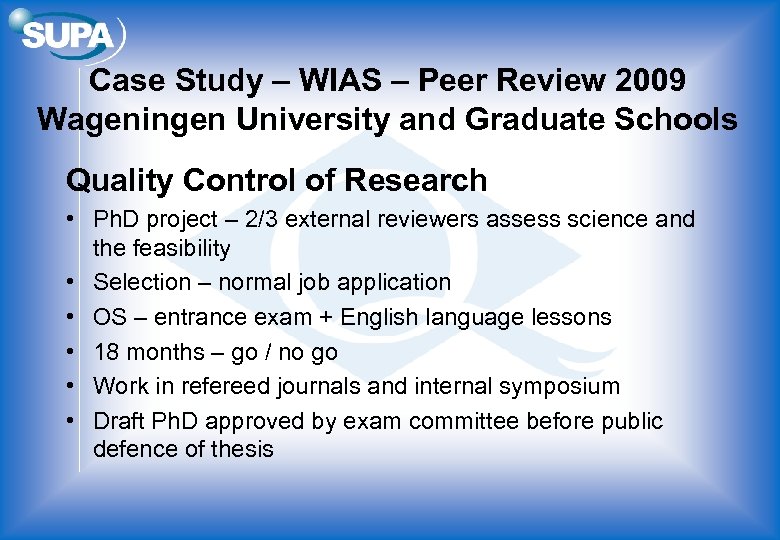 Case Study – WIAS – Peer Review 2009 Wageningen University and Graduate Schools Quality Control of Research • Ph. D project – 2/3 external reviewers assess science and the feasibility • Selection – normal job application • OS – entrance exam + English language lessons • 18 months – go / no go • Work in refereed journals and internal symposium • Draft Ph. D approved by exam committee before public defence of thesis
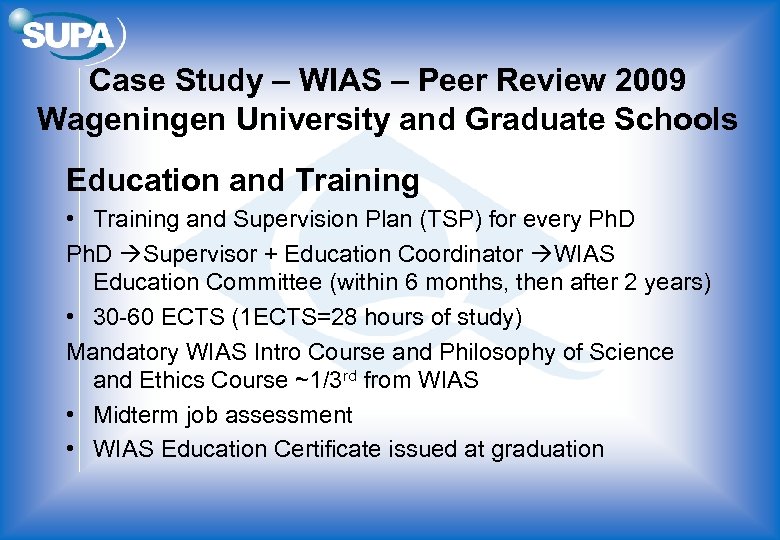 Case Study – WIAS – Peer Review 2009 Wageningen University and Graduate Schools Education and Training • Training and Supervision Plan (TSP) for every Ph. D Supervisor + Education Coordinator WIAS Education Committee (within 6 months, then after 2 years) • 30 -60 ECTS (1 ECTS=28 hours of study) Mandatory WIAS Intro Course and Philosophy of Science and Ethics Course ~1/3 rd from WIAS • Midterm job assessment • WIAS Education Certificate issued at graduation
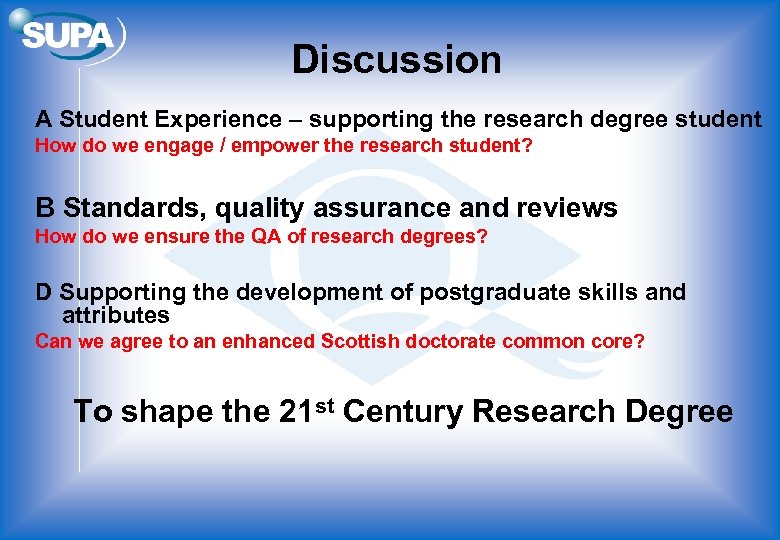 Discussion A Student Experience – supporting the research degree student How do we engage / empower the research student? B Standards, quality assurance and reviews How do we ensure the QA of research degrees? D Supporting the development of postgraduate skills and attributes Can we agree to an enhanced Scottish doctorate common core? To shape the 21 st Century Research Degree