


 Скачать презентацию Shaping Policies that Affect Community Health Centers and
6b373f57db24e5f20ce122972022d630.ppt
- Количество слайдов: 58
 Shaping Policies that Affect Community Health Centers and Their Communities Bill Maas, DDS, MPH Senior Officer, Pew Children’s Dental Campaign Pew Center on the States October 26, 2010 www. pewcenteronthestates. org/dental 0
 Agenda • State and federal policies that affect – – • Overview of Pew Children’s Dental Campaign – – • • Community health centers Their clients Why? What policies? Opportunities of ACA NNOHA initiative to develop capacity to change policy www. pewcenteronthestates. org/dental 1
 Policies that Impact Community Health Centers • Grant ($) to CHC • HRSA Regulations (Personnel, Services, Reporting, etc. ) • Scope of practice of dental team • Medicaid coverage (adults? ) and rates • Others? • Compounded sometimes by federal preemption of state law www. pewcenteronthestates. org/dental 2
 Policies that Impact Clients of CHCs • Justify a FQHC in their community • Funding for a FQHC and its adequacy • FQHC accountability • CHC dental clinic efficiency • Who is covered by Medicaid and CHIP • Support for medical providers to address OH of toddlers • Community water fluoridation • OH components of WIC and Headstart • School-based sealant programs • Food stamps, tobacco control, transportation, others www. pewcenteronthestates. org/dental 3
 Shaping Policies that Impact CHCs and their Clients • NACHC • State and regional primary care associations • National and state medical associations • American Dental Associations • State Dental Associations • Social change advocacy groups • NNOHA www. pewcenteronthestates. org/dental 4
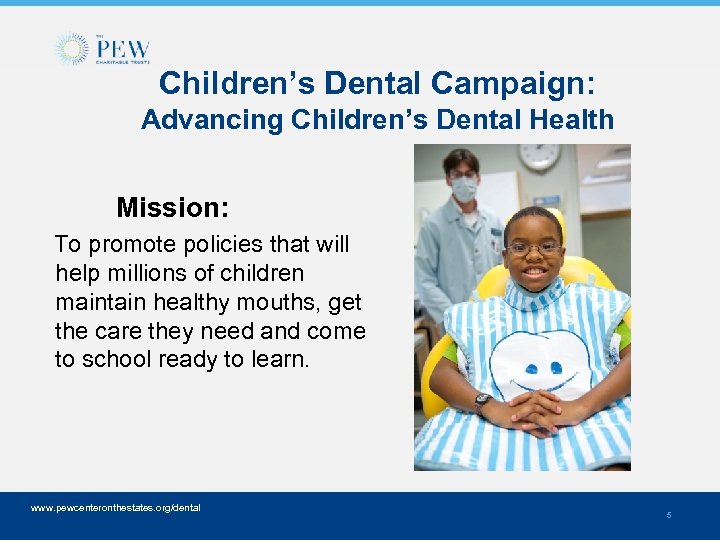 Children’s Dental Campaign: Advancing Children’s Dental Health Mission: To promote policies that will help millions of children maintain healthy mouths, get the care they need and come to school ready to learn. www. pewcenteronthestates. org/dental 5
 About The Pew Center on the States helps build high-performing states that: 1. Work efficiently and effectively to deliver better results. 2. Achieve long term fiscal health through budget discipline. 3. Make smart investments in programs that provide the strongest returns. www. pewcenteronthestates. org/dental 6
 Three Policy Areas—Current Focus Prevention • Community water fluoridation—campaigns • National messaging and strategy development Funding for care • Advocating for appropriations for oral health programs • Medicaid reimbursement for fluoride varnish by MDs and RNs Workforce • Ensuring adequate workforce to care for children • Research on economics of new models www. pewcenteronthestates. org/dental 7
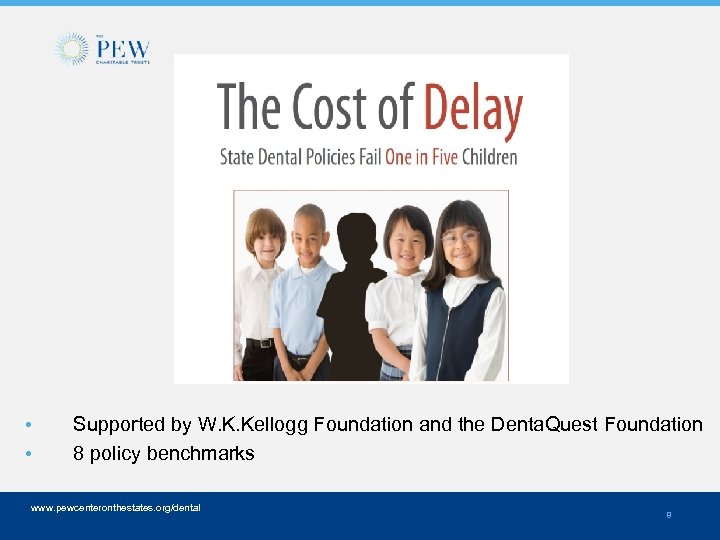 • • Supported by W. K. Kellogg Foundation and the Denta. Quest Foundation 8 policy benchmarks www. pewcenteronthestates. org/dental 8
 The Report Graded 50 states and the District of Columbia on eight measures in these areas: – Cost -effective prevention (school-based sealant programs and community water fluoridation) – Medicaid performance—how states are doing in getting dentists to treat low-income children – New workforce models that expand the number of providers to care for children – More and better information gathering data to measure and improve performance www. pewcenteronthestates. org/dental 9
 The 8 benchmarks: • • At least 75% of water supplies are fluoridated 25% of low income schools have a sealant program Dentists exam not required before hygienists apply sealants Medicaid rates for dentists are higher than cost of providing care 38% or more Medicaid children had a dental visit Medicaid reimburses physicians for fluoride varnish State licenses new primary care dental providers State submits children’s dental health data to NOHSS www. pewcenteronthestates. org/dental 10
 Bad news/good news Bad news: • 17 million children—or one child in five—go without access to dental care • Two thirds of the states are doing a poor job of enacting policies to ensure children’s dental health Good news: • This is fixable with a handful of effective policies • A number of states are leading the way www. pewcenteronthestates. org/dental 11
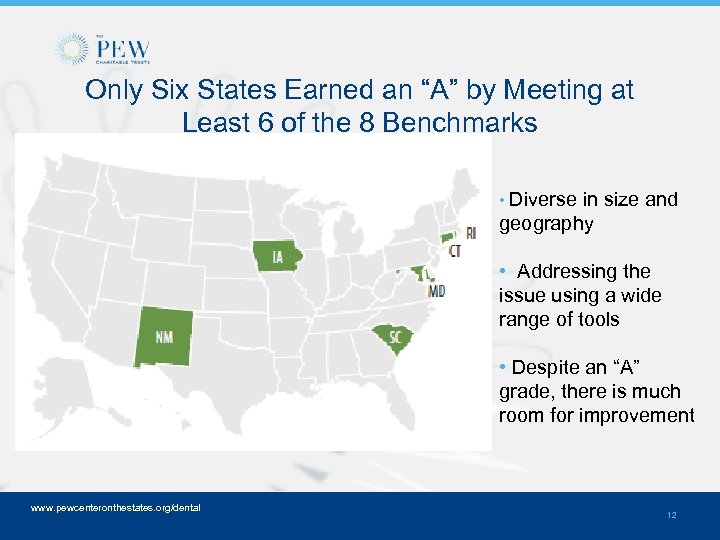 Only Six States Earned an “A” by Meeting at Least 6 of the 8 Benchmarks • Diverse in size and geography • Addressing the issue using a wide range of tools • Despite an “A” grade, there is much room for improvement www. pewcenteronthestates. org/dental 12
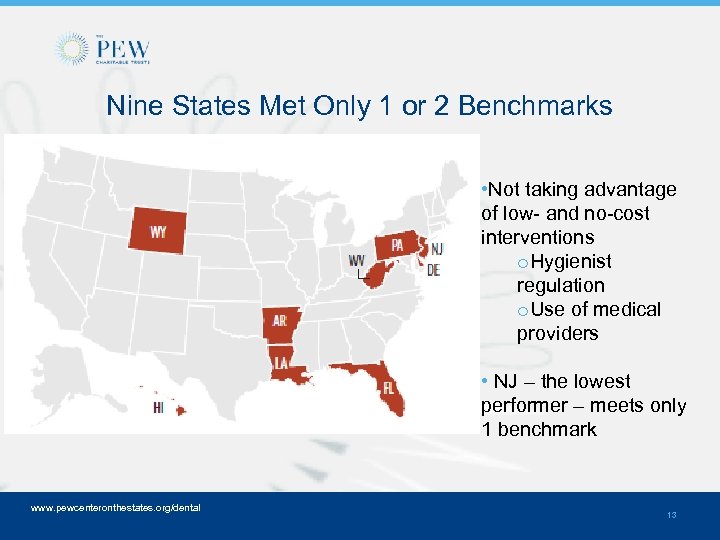 Nine States Met Only 1 or 2 Benchmarks • Not taking advantage of low- and no-cost interventions o. Hygienist regulation o. Use of medical providers • NJ – the lowest performer – meets only 1 benchmark www. pewcenteronthestates. org/dental 13
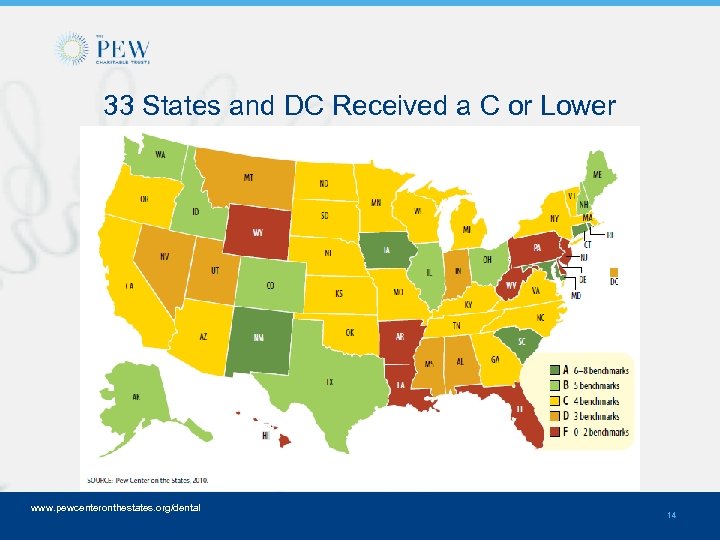 33 States and DC Received a C or Lower www. pewcenteronthestates. org/dental 14
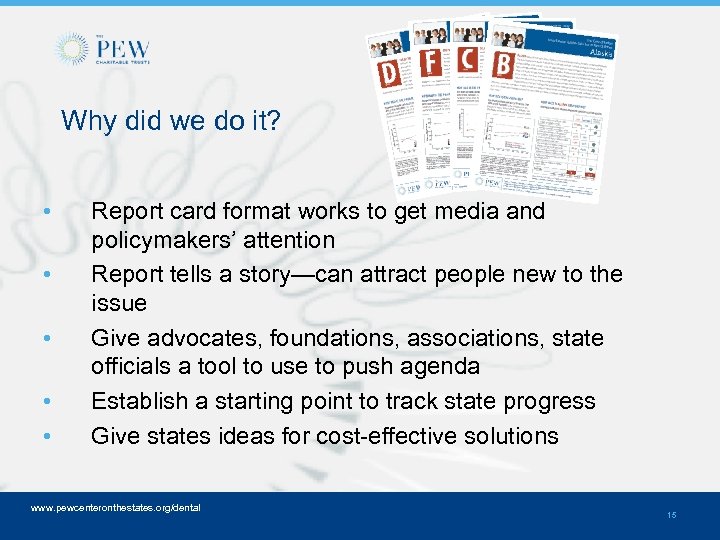 Why did we do it? • • • Report card format works to get media and policymakers’ attention Report tells a story—can attract people new to the issue Give advocates, foundations, associations, state officials a tool to use to push agenda Establish a starting point to track state progress Give states ideas for cost-effective solutions www. pewcenteronthestates. org/dental 15
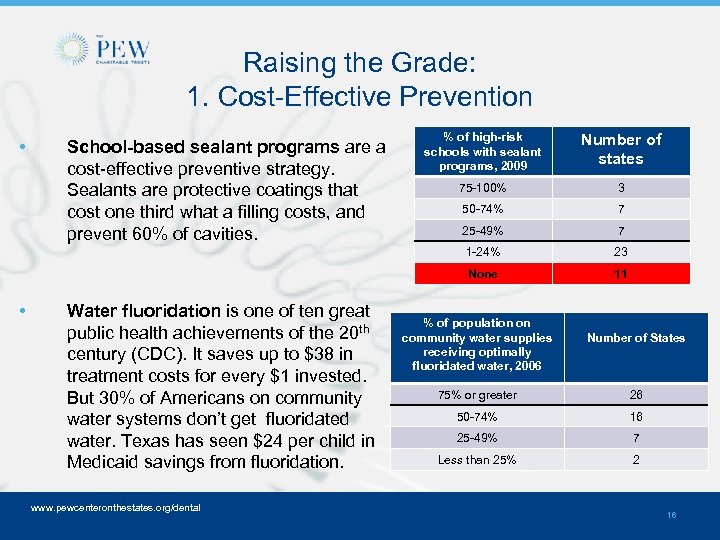 Raising the Grade: 1. Cost-Effective Prevention • Water fluoridation is one of ten great public health achievements of the 20 th century (CDC). It saves up to $38 in treatment costs for every $1 invested. But 30% of Americans on community water systems don’t get fluoridated water. Texas has seen $24 per child in Medicaid savings from fluoridation. www. pewcenteronthestates. org/dental Number of states 75 -100% 3 50 -74% 7 25 -49% 7 23 None School-based sealant programs are a cost-effective preventive strategy. Sealants are protective coatings that cost one third what a filling costs, and prevent 60% of cavities. % of high-risk schools with sealant programs, 2009 1 -24% • 11 % of population on community water supplies receiving optimally fluoridated water, 2006 Number of States 75% or greater 26 50 -74% 16 25 -49% 7 Less than 25% 2 16
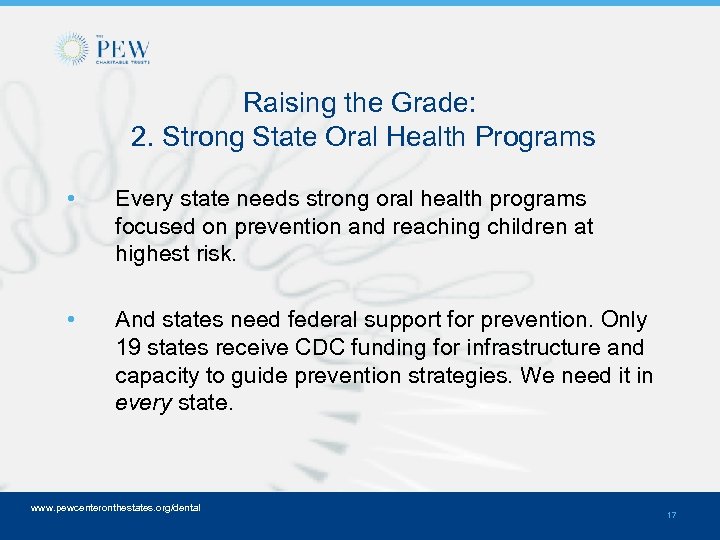 Raising the Grade: 2. Strong State Oral Health Programs • Every state needs strong oral health programs focused on prevention and reaching children at highest risk. • And states need federal support for prevention. Only 19 states receive CDC funding for infrastructure and capacity to guide prevention strategies. We need it in every state. www. pewcenteronthestates. org/dental 17
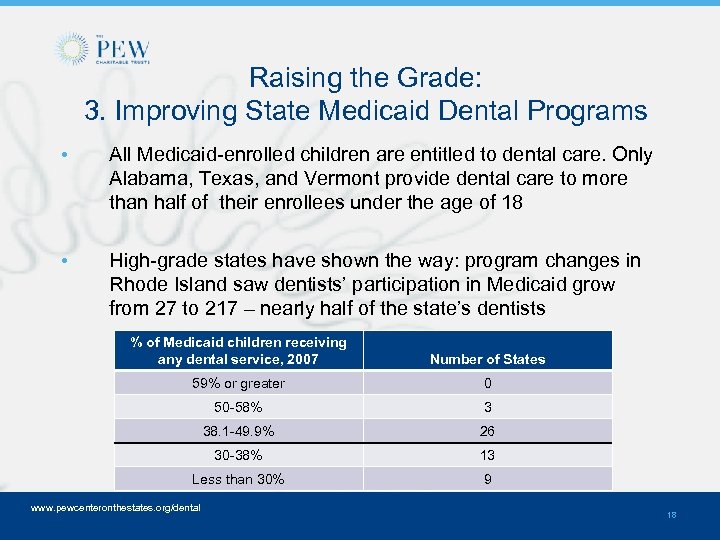 Raising the Grade: 3. Improving State Medicaid Dental Programs • All Medicaid-enrolled children are entitled to dental care. Only Alabama, Texas, and Vermont provide dental care to more than half of their enrollees under the age of 18 • High-grade states have shown the way: program changes in Rhode Island saw dentists’ participation in Medicaid grow from 27 to 217 – nearly half of the state’s dentists % of Medicaid children receiving any dental service, 2007 Number of States 59% or greater 0 50 -58% 3 38. 1 -49. 9% 26 30 -38% 13 Less than 30% 9 www. pewcenteronthestates. org/dental 18
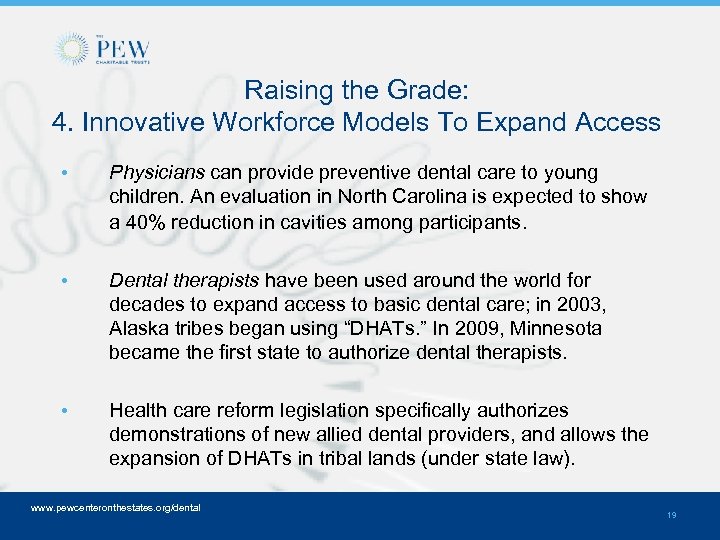 Raising the Grade: 4. Innovative Workforce Models To Expand Access • Physicians can provide preventive dental care to young children. An evaluation in North Carolina is expected to show a 40% reduction in cavities among participants. • Dental therapists have been used around the world for decades to expand access to basic dental care; in 2003, Alaska tribes began using “DHATs. ” In 2009, Minnesota became the first state to authorize dental therapists. • Health care reform legislation specifically authorizes demonstrations of new allied dental providers, and allows the expansion of DHATs in tribal lands (under state law). www. pewcenteronthestates. org/dental 19
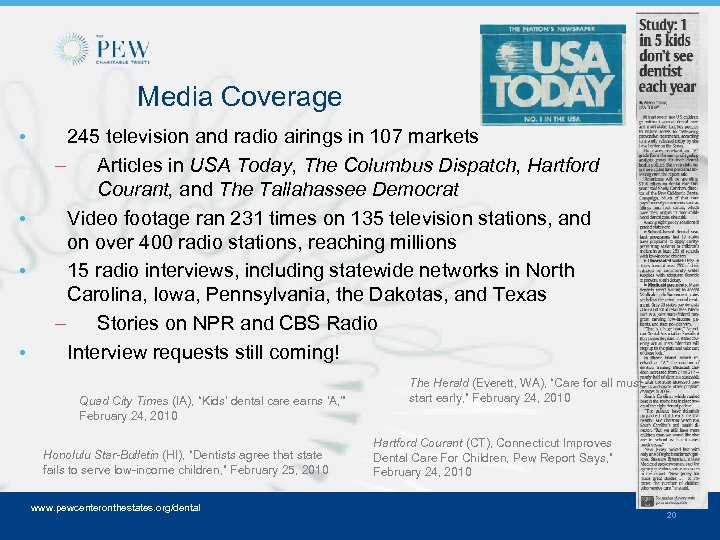 Media Coverage • • 245 television and radio airings in 107 markets – Articles in USA Today, The Columbus Dispatch, Hartford Courant, and The Tallahassee Democrat Video footage ran 231 times on 135 television stations, and on over 400 radio stations, reaching millions 15 radio interviews, including statewide networks in North Carolina, Iowa, Pennsylvania, the Dakotas, and Texas – Stories on NPR and CBS Radio Interview requests still coming! Quad City Times (IA), “Kids' dental care earns 'A, '” February 24, 2010 Honolulu Star-Bulletin (HI), “Dentists agree that state fails to serve low-income children, ” February 25, 2010 www. pewcenteronthestates. org/dental The Herald (Everett, WA), “Care for all must start early, ” February 24, 2010 Hartford Courant (CT), Connecticut Improves Dental Care For Children, Pew Report Says, ” February 24, 2010 20
 Examples of Use by Advocates • • • New York State Oral Health Coalition (NYSOHC) – sent out packet and outlined steps the state needs to take OHAC – action alert announcement by California coalition urging legislative action Harold Net– advocates in Washington State placed an op ed stating “early dental care for all is essential, medically and morally” www. pewcenteronthestates. org/dental 21
 Lessons Learned • • Data and methodology have to be airtight Grading approach works to get media, policymaker attention, but has detractors Work closely with foundations, partners and potential critics to help them use it Do an evaluation (informal or formal) to plan next steps www. pewcenteronthestates. org/dental 22
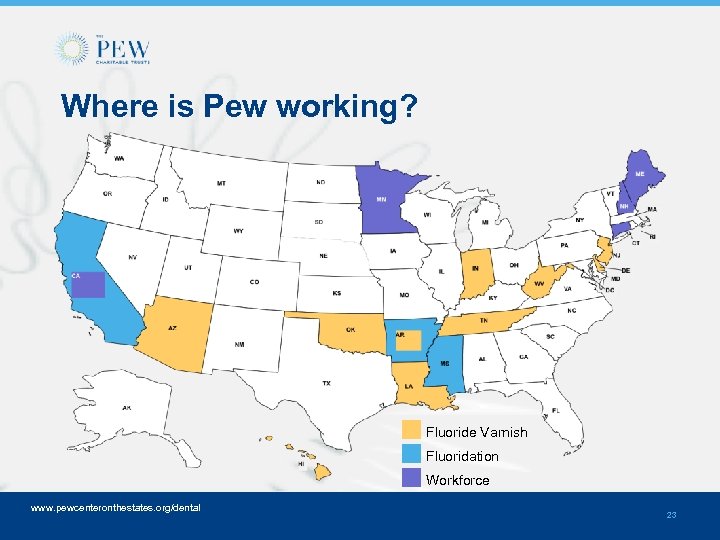 Where is Pew working? Fluoride Varnish Fluoridation Workforce www. pewcenteronthestates. org/dental 23
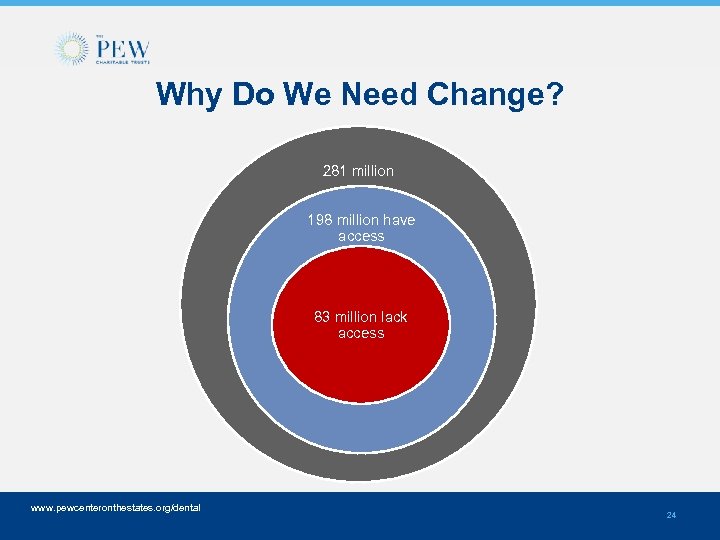 Why Do We Need Change? 281 million 198 million have access 83 million lack access www. pewcenteronthestates. org/dental 24
 The Financial Costs Medicaid spends between $100 million and $400 million each year on children who end up in the operating room with advanced disease. These costs are avoidable. — data from Burton L. Edelstein, DDS, MPH The Cost of Caring: Emergency Oral Health Services Source: Edelstein, Burton L. “The Cost of Caring: Emergency Oral Health Services, ” NCEMCH Policy Brief, May 1998, http: //www. hawaii. edu/hivandaids/The_Cost_Of_Caring__Emergency_Oral_Health_Services. pdf (accessed June 21, 2010). www. pewcenteronthestates. org/dental 25
 The Human Costs: The Driver Story “It took the combined efforts of one mother, one lawyer, one helpline supervisor, and three health care case management professionals to make a dental appointment for a single Medicaid-insured child!” — Laurie Norris, JD; Congressional Testimony www. pewcenteronthestates. org/dental 26
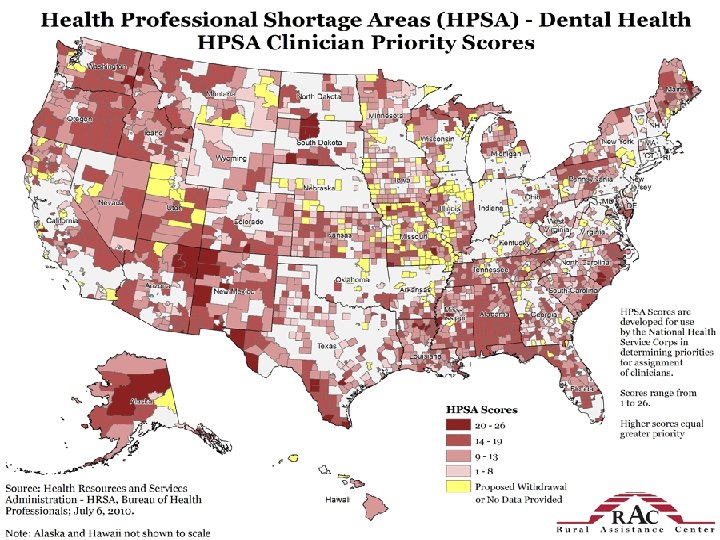
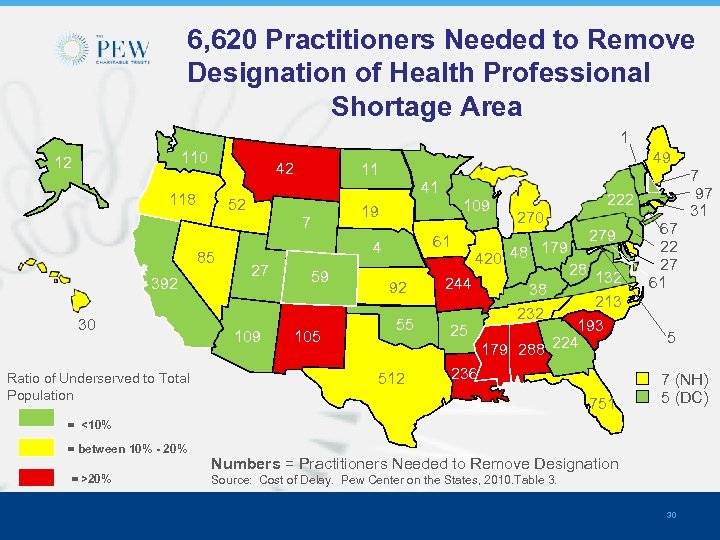
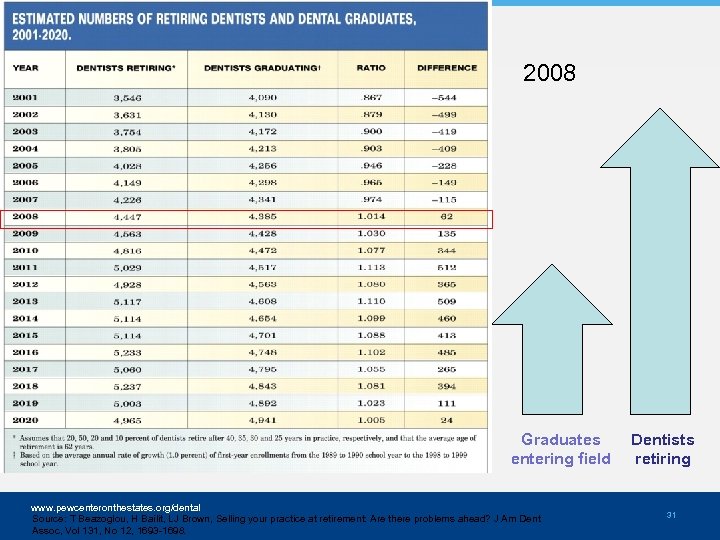
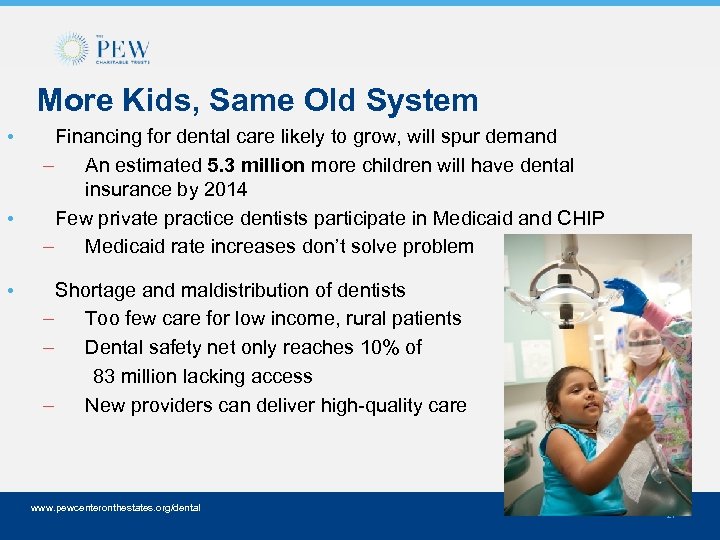 More Kids, Same Old System • • • Financing for dental care likely to grow, will spur demand – An estimated 5. 3 million more children will have dental insurance by 2014 Few private practice dentists participate in Medicaid and CHIP – Medicaid rate increases don’t solve problem Shortage and maldistribution of dentists – Too few care for low income, rural patients – Dental safety net only reaches 10% of 83 million lacking access – New providers can deliver high-quality care www. pewcenteronthestates. org/dental 27
 Barriers to Care for the Underserved • Low health literacy and expectations • Medicaid and CHIP eligibility paperwork • Lack of access to transportation, paid personal/sick days, and childcare www. pewcenteronthestates. org/dental 28
 www. pewcenteronthestates. org/dental May 12, 2010 29
 6, 620 Practitioners Needed to Remove Designation of Health Professional Shortage Area 1 110 12 42 118 41 52 392 30 Ratio of Underserved to Total Population 109 19 7 85 49 11 61 4 27 109 59 105 92 55 512 222 270 179 420 48 279 28 132 213 193 25 179 288 224 236 244 7 97 31 38 232 751 67 22 27 61 5 7 (NH) 5 (DC) = <10% = between 10% - 20% = >20% Numbers = Practitioners Needed to Remove Designation Source: Cost of Delay. Pew Center on the States, 2010. Table 3. 30
 2008 Graduates entering field www. pewcenteronthestates. org/dental Source: T Beazoglou, H Bailit, LJ Brown, Selling your practice at retirement: Are there problems ahead? J Am Dent Assoc, Vol 131, No 12, 1693 -1698. Dentists retiring 31
 The Opportunity: ACA Workforce Provisions www. pewcenteronthestates. org/dental 32
 ACA Support of Dental Workforce Expansion • • • Most of the new dental provisions in ACA are authorized but not appropriated Money appropriated in ACA is not specifically targeted to dental access issues – Community health center funding – Prevention and Public Health Trust Fund Work still remains to be done to adequately fund these provisions (appropriation and allocation) www. pewcenteronthestates. org/dental 33
 ACA Support of Dental Workforce Expansion Demonstrations and evaluation of alternative dental health care providers (Title V, Sec. 5304) Expanded dental training programs (Title V, Sec. 5303) New or expanded primary care residency programs, including dental programs (Title V, Sec. 5508) Funds for Community Health Centers (Title X, Section 10503) www. pewcenteronthestates. org/dental 34
 Pew’s Workforce Portfolio www. pewcenteronthestates. org/dental 35
 Pew’s Workforce Initiatives State Level: • Current: MN, CA, ME • Upcoming: NH, CT Federal Level: • Secured provisions on DHAT in HCR • Advocating for appropriations that support workforce Research • • Publication: “Help Wanted” – decision framework for states Several projects underway www. pewcenteronthestates. org/dental 36
 University of California, San Francisco Center for the Health Professions Lead investigators Elizabeth Mertz, Ph. D, MA, and Catherine Dower, JD Question How can medical collaborative practice models be applied to and affect the dental care delivery system? Release Date December 2010 www. pewcenteronthestates. org/dental 37
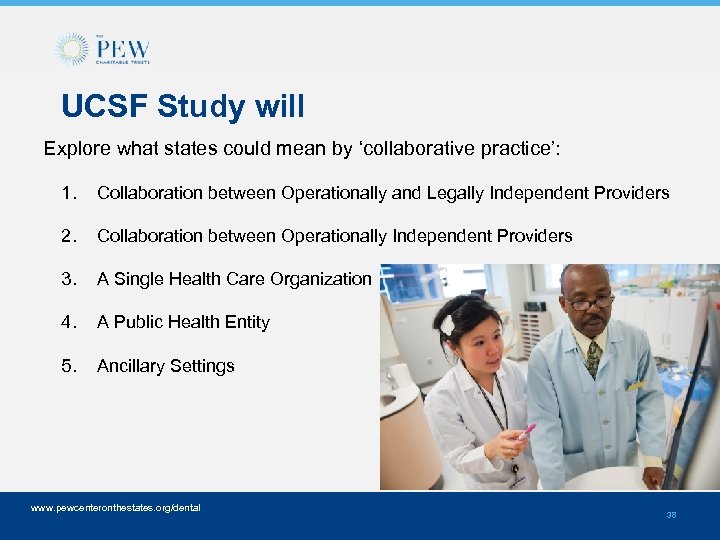 UCSF Study will Explore what states could mean by ‘collaborative practice’: 1. Collaboration between Operationally and Legally Independent Providers 2. Collaboration between Operationally Independent Providers 3. A Single Health Care Organization 4. A Public Health Entity 5. Ancillary Settings www. pewcenteronthestates. org/dental 38
 University of Connecticut Health Center (UCHC) Lead investigators Howard Bailit, D. M. D. , Ph. D. and Tryfon Beazoglou, Ph. D. Question What are the likely effects of new dental care providers on FQHCs, and what is the most effective way to utilize those providers to increase access to care? Release Date Spring 2011 www. pewcenteronthestates. org/dental 39
 UCHC Study will: • • Evaluate data from FQHCs in CA, ME, WI, CT Provide economic model to estimate impact of new providers on FQHC dental clinic productivity and finances under two conditions: (a) new provider training and delivery system organizations (b) Medicaid program design and FQHC payment methods and reimbursement rates. • Test economic model on selected FQHC dental programs www. pewcenteronthestates. org/dental 40
 Scott & Company Lead investigator Mary Kate Scott Question What are the potential economic impacts of hiring new allied dental care providers to a dentist practice? 3 scenarios: solo general practice; pediatric practice; small group practice. Excel “calculator” will be available for download by any user. Release Date Soon Pewcenteronthestates. org/dental www. pewcenteronthestates. org/dental 41
 NNOHA Advocacy and Strategic Partnerships Why is now the time? New opportunities in the Affordable Care Act 42
 Health Care Reform: Oral Health Provisions and the Safety Net Rebecca Alderfer Senior Associate, Government Relations Pew Children’s Dental Campaign June 20, 2010 43
 Pew Campaign Federal Agenda: Supporting State Policy • Increasing federal financial investments in oral health prevention and care; including workforce • Improving federal Medicaid, CHCs, and grant program policies and criteria to ease barriers to care • Showcasing state models for pragmatic, cost-effective reform and recruit national champions • Serving as a resource and liaison to federal policymakers and state campaign advocates www. pewcenteronthestates. org/dental 44
 Dental Coverage in the Affordable Care Act Essential Health Benefits Requirements A pediatric dental benefit is required in the essential benefits package of the new State exchanges Medicaid Expansion for the Lowest Income Populations Mandates that states set their Medicaid income eligibility cap no lower than 133% of FPL. Coverage extended to all citizens meeting the income eligibility standard (childless adults) Extends CHIP through FY 2015 www. pewcenteronthestates. org/dental 45
 Programs with Direct Funding in ACA Community Health Centers Fund Appropriated $11 billion to the CHC program • $9. 5 billion to expand operational capacity and enhance health services, including oral health services • $1. 5 billion for construction and renovation of community health centers National Health Service Corps Fund Appropriated $1. 5 billion to the National Health Service Corps • Placement of estimated 15, 000 primary care providers in shortage areas Grants for the Establishment of School-Based Health Centers Restricted to $ for facilities; cannot be used for operations www. pewcenteronthestates. org/dental 46
 Authorized Discretionary Oral Health Programs in ACA • • 5 -year national, public education campaign focused on oral healthcare prevention and education Demonstration grants to show the effectiveness of research-based dental caries disease management activities Expanded oral health surveillance; national and state specific Expanded cooperative agreements to improve oral health infrastructure of state OH programs www. pewcenteronthestates. org/dental 47
 Authorized Discretionary Oral Health Programs in ACA • Requirement that all states/territories/tribes receive grants for school-based dental sealant programs • Demonstrations and evaluation of alternative dental health care providers To train/employ new types of dental providers to increase access to dental care in rural and other underserved communities. • Expanded dental training programs Grants to establish and improve training programs, provide student financial assistance, and faculty loan repayment. • School-Based Health Center Grants Required basic services include “referrals to, and follow-up for, specialty care and oral health services” www. pewcenteronthestates. org/dental 48
 Discretionary (Annual) Appropriations for OH Programs • Annual appropriations bill funding the Department of Health and Human Services • Funding from the Prevention and Public Health Fund – New Fund via ACA provides for a sustained national investment in prevention and public health programs (over the FY 2008 level) growing annually to $2 billion in FY 2015 and thereafter. – Will support programs authorized by the Public Health Service Act, including prevention research, health screenings and initiatives • How much of $500 million in FY 2010 went to OH? • How much of $750 million in FY 2011 will go to OH? • Thereafter? www. pewcenteronthestates. org/dental 49
 We have our work cut out for us! 1. ) There is no requirement that an authorized discretionary program receives an appropriation. P. L. 111 -148 serves as an authorization bill for the oral health programs. 2. ) The President has requested a 3 -year freeze in discretionary spending along with a deficit commission to realign federal spending. 3. ) The Senate Budget Resolution, passed by Committee, proposes less funding in FY 2011 and FY 2012 for the Function 550 Health programs than found in the FY 2010 budget resolution. 4. ) The House recently passed a one-year budget enforcement bill that is both lower than the President’s budget and the Senate budget resolution. www. pewcenteronthestates. org/dental 50
 What can NNOHA do? Speak up! Congressional Appropriators need to hear from constituents and interest groups that providing funding for the authorized oral health prevention and workforce programs is expected. Action Needed: NNOHA can prepare members to write and call their Representative and Senators • Speak directly to the Health Legislative Assistants (L. A. s) in Congressional offices • Strategically speak on behalf of entire NNOHA • Develop partnerships to broaden advocacy www. pewcenteronthestates. org/dental 51
 Talking Points for Calls & Letters • Who YOU are may be the most important point to make to a policymaker or staff since “all politics is local. ” – Explain the local need: (1) Explain state needs for funding and improved funding for oral public health, the dental safety net, and workforce • Example: Dental professional shortage areas, Waiting lists (2) Explain how these programs support the dental safety net (3) Clearly explain why your state needs to access these newly authorized resources • Example: Recent state budget cuts to dental insurance, public health programs, etc. – if any. Use the context of the recession. www. pewcenteronthestates. org/dental 52
 Talking Points -- Continued • Mirror back to Congress why they enacted Health Care Reform: “The Patient Protection and Affordable Care Act, is based on the belief that comprehensive insurance coverage and sound prevention will reduce the burden of disease and the costs of preventable illness. ” • How to make that real: States can help eliminate the pain, missed school hours and long-term health and economic consequences of untreated dental disease –if they have the option of using new federal funds for targeted investments in effective policy approaches. • The consequences of poor dental health are far worse—and longer lasting—than many policy makers and the public realize; including impacts on early childhood development, school readiness and performance, overall health, and economic opportunity. www. pewcenteronthestates. org/dental 53
 Talking Points -- Continued • The law authorizes funding for new and expanded programs to prevent dental disease and augment the dental workforce so that those most in need of care receive it. • FY 2011 appropriations, including an allocation from the Prevention and Public Health Fund, are necessary to fund the oral health programs contained in the law. www. pewcenteronthestates. org/dental 54
 Summary • New insurance coverage and new resources – Estimate 5. 3 million children could gain dental coverage – Expansion of FQHC operational and facilities grants – Authorized programs supporting prevention and workforce • Action still needed: To secure federal investment in authorized dental programs – Advocating for appropriations in FY 2011 – FY 2011 allocation from Prevention and Public Health Fund – Advocating each year thereafter www. pewcenteronthestates. org/dental 55
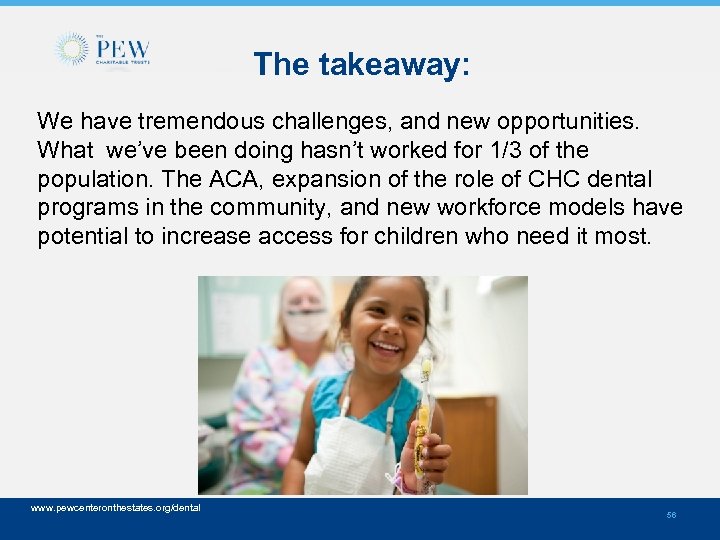 The takeaway: We have tremendous challenges, and new opportunities. What we’ve been doing hasn’t worked for 1/3 of the population. The ACA, expansion of the role of CHC dental programs in the community, and new workforce models have potential to increase access for children who need it most. www. pewcenteronthestates. org/dental 56
 Bill Maas 202. 552. 2183 bmaas@pewtrusts. org www. pewcenteronthestates. com/dental 57