


 Скачать презентацию SHANGHAI COOPERATION ORGANIZATION III rd course IR Zhimahanova
SCO prezentation.pptx
- Количество слайдов: 14
 SHANGHAI COOPERATION ORGANIZATION III rd course, IR Zhimahanova. N KAZNPU named after ABAI.
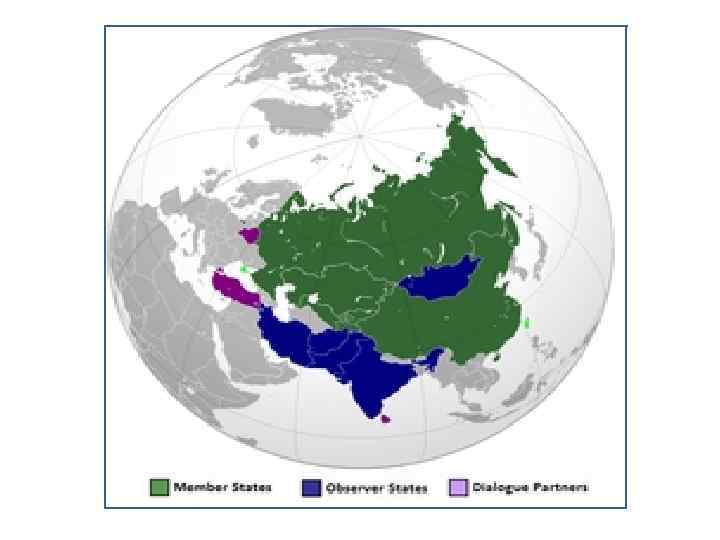
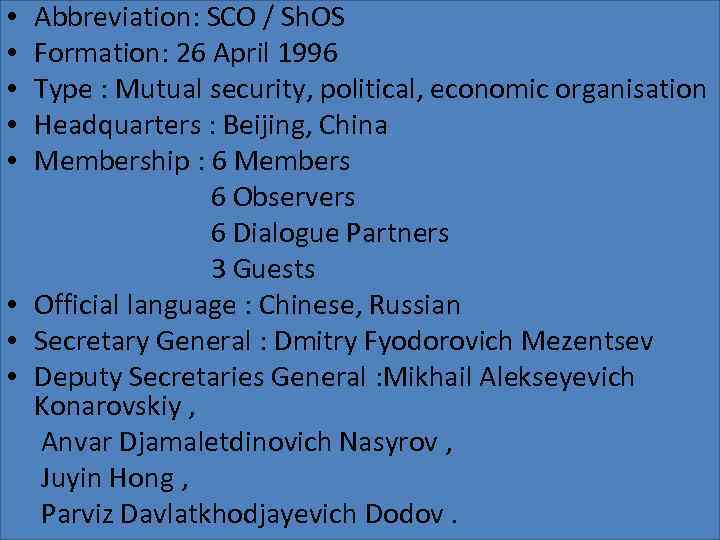 • Abbreviation: SCO / Sh. OS • Formation: 26 April 1996 • Type : Mutual security, political, economic organisation • Headquarters : Beijing, China • Membership : 6 Members 6 Observers 6 Dialogue Partners 3 Guests • Official language : Chinese, Russian • Secretary General : Dmitry Fyodorovich Mezentsev • Deputy Secretaries General : Mikhail Alekseyevich Konarovskiy , Anvar Djamaletdinovich Nasyrov , Juyin Hong , Parviz Davlatkhodjayevich Dodov.
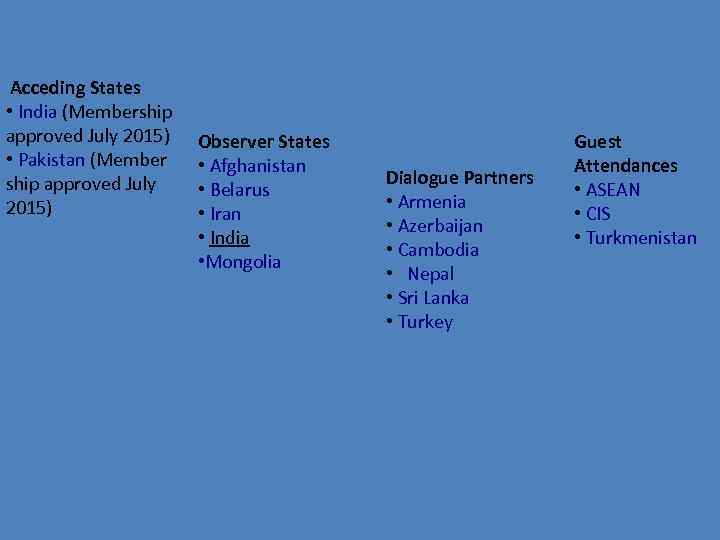 Acceding States • India (Membership approved July 2015) • Pakistan (Member ship approved July 2015) Observer States • Afghanistan • Belarus • Iran • India • Mongolia Dialogue Partners • Armenia • Azerbaijan • Cambodia • Nepal • Sri Lanka • Turkey Guest Attendances • ASEAN • CIS • Turkmenistan
 The Shanghai Cooperation Organisation (SCO; Russian: Шанхайская организация сотрудничества (ШОС), Shankhayskaya organizatsiya sotrudnichestva). is a Eurasian political, economic and military organisation which was founded in 2001 in. Shanghai by the leaders of China, Kazakhstan, Kyrgyzstan, Russia, Tajikistan, and Uzbekistan. These countries, except for Uzbekistan had been members of the Shanghai Five, founded in 1996; after the inclusion of Uzbekistan in 2001, the members renamed the organisation. On July 10, 2015, the SCO decided to admit India and Pakistan as full members, and they are expected to join by 2016. Origins The Shanghai Five grouping was created 26 April 1996 with the signing of the Treaty on Deepening Military Trust in Border Regions in Shanghai by the heads of states of Kazakhstan, the People's Republic of China, Kyrgyzstan, Russia and Tajikistan. According to political scientist Thomas Ambrosio, one aim was to ensure that liberal democracy could not gain ground in these countries. On 24 April 1997, the same countries signed the Treaty on Reduction of Military Forces in Border Regions in a meeting in Moscow. Russian President Vladimir Putin, Kazakh President Nursultan Nazarbayev, Chinese President Jiang Zemin, Kyrgyz President Askar Akayev, and Tajik President Emomali Rakhmonov, at one time the leaders of the Shanghai Five.
 • Purposes and Principles of SCO • According to the SCO Charter and the Declaration on the Establishment of the SCO, the main purposes of SCO are: strengthening mutual trust and good-neighborliness and friendship among member states; developing their effective cooperation in political affairs, the economy and trade, science and technology, culture, education, energy, transportation, environmental protection and other fields; working together to maintain regional peace, security and stability; and promoting the creation of a new international political and economic order featuring democracy, justice and rationality. • The SCO abides by the following basic principles: adherence to the purposes and principles of the Charter of the United Nations; respect for each other's independence, sovereignty and territorial integrity, non-interference in each other's internal affairs, mutual non-use or threat of use of force; equality among all member states; settlement of all questions through consultations; non-alignment and no directing against any other country or organization; opening to the outside world and willingness to carry out all forms of dialogues, exchanges and cooperation with other countries and relevant international or regional organizations.
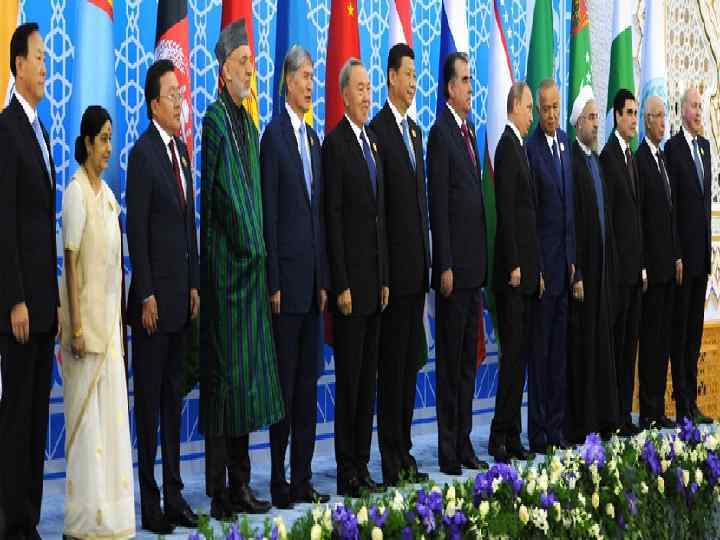
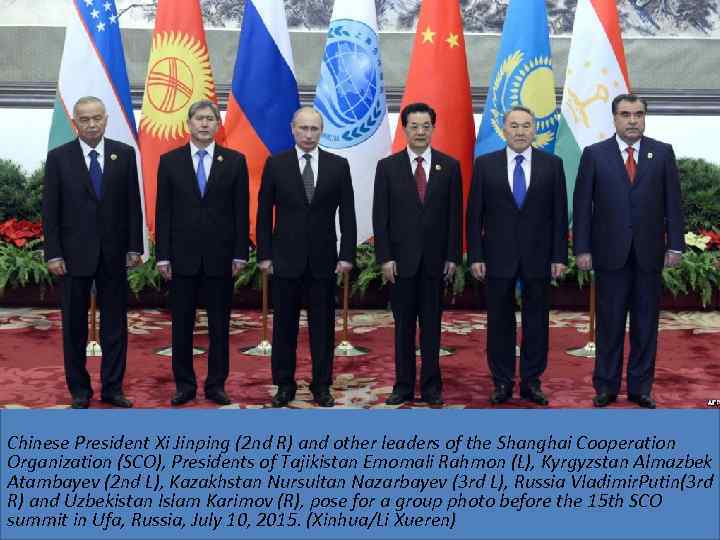 Chinese President Xi Jinping (2 nd R) and other leaders of the Shanghai Cooperation Organization (SCO), Presidents of Tajikistan Emomali Rahmon (L), Kyrgyzstan Almazbek Atambayev (2 nd L), Kazakhstan Nursultan Nazarbayev (3 rd L), Russia Vladimir. Putin(3 rd R) and Uzbekistan Islam Karimov (R), pose for a group photo before the 15 th SCO summit in Ufa, Russia, July 10, 2015. (Xinhua/Li Xueren)
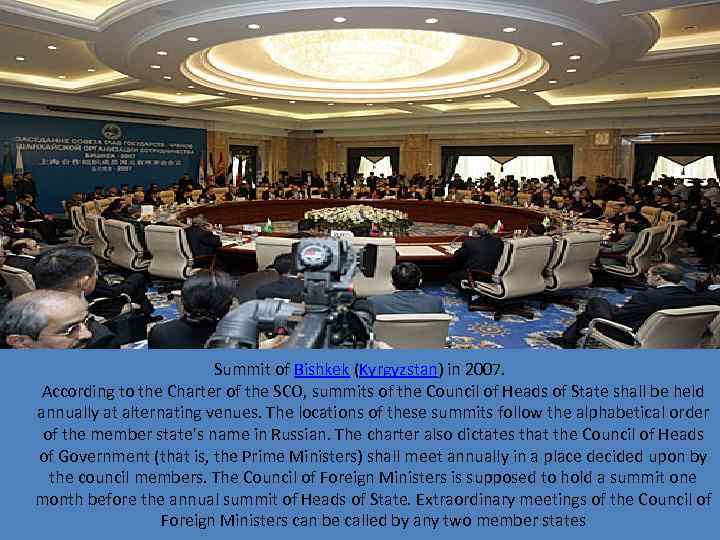 Summit of Bishkek (Kyrgyzstan) in 2007. According to the Charter of the SCO, summits of the Council of Heads of State shall be held annually at alternating venues. The locations of these summits follow the alphabetical order of the member state's name in Russian. The charter also dictates that the Council of Heads of Government (that is, the Prime Ministers) shall meet annually in a place decided upon by the council members. The Council of Foreign Ministers is supposed to hold a summit one month before the annual summit of Heads of State. Extraordinary meetings of the Council of Foreign Ministers can be called by any two member states
 • • Subsequent annual summits of the Shanghai Five group occurred in Almaty (Kazakhstan) in 1998, in Bishkek (Kyrgyzstan) in 1999, and in Dushanbe (Tajikistan) in 2000. At the Dushanbe summit, members agreed to "oppose intervention in other countries' internal affairs on the pretexts of 'humanitarianism' and 'protecting human rights; ' and support the efforts of one another in safeguarding the five countries' national independence, sovereignty, territorial integrity, and social stability. " [9] In 2001, the annual summit returned to Shanghai. There the five member nations first admitted Uzbekistan in the Shanghai Five mechanism (thus transforming it into the Shanghai Six). Then all six heads of state signed on 15 June 2001, the. Declaration of Shanghai Cooperation Organisation, praising the role played thus far by the Shanghai Five mechanism and aiming to transform it to a higher level of cooperation. On 16 July 2001, Russia and the PRC, the organisation's two leading nations, signed the Treaty of Good-Neighbourliness and Friendly Cooperation. In June 2002, the heads of the SCO member states met in Saint Petersburg, Russia. There they signed the SCO Charter which expounded on the organisation's purposes, principles, structures and form of operation, and established it in international law. Its six full members account for 60% of the land mass of Eurasia and its population is a quarter of the world's. With observer states included, its affiliates account for about half of the world's population. In July 2005, at its fifth and watershed summit in Astana, Kazakhstan, with representatives of India, Iran, Mongolia and Pakistan attending an SCO summit for the first time, the president of the host country, Nursultan Nazarbayev, greeted the guests in words that had never before been used in any context: "The leaders of the states sitting at this negotiation table are representatives of half of humanity". [10] By 2007 the SCO had initiated over twenty large-scale projects related to transportation, energy and telecommunications and held regular meetings of security, military, defence, foreign affairs, economic, cultural, banking and other officials from its member states. The SCO has established relations with the United Nations, where it is an observer in the General Assembly, the European Union, Association of Southeast Asian Nations (ASEAN), the Commonwealth of Independent States and the Organisation of Islamic Cooperation.
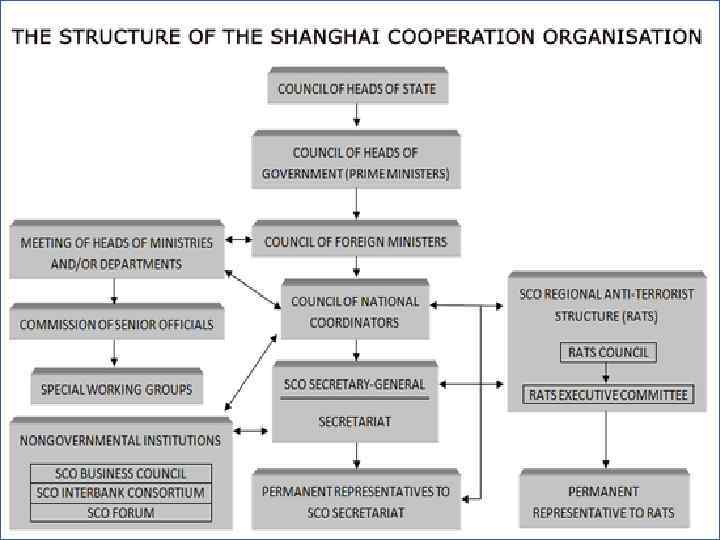
 • The Council of Heads of State is the top decision-making body in the SCO. This council meets at the SCO summits, which are held each year in one of the member states' capital cities. The current Council of Heads of State consists of: • • • Almazbek Atambayev (Kyrgyzstan) Emomalii Rahmon (Tajikistan) Islam Karimov (Uzbekistan) Xi Jinping (China) Nursultan Nazarbayev (Kazakhstan) Vladimir Putin (Russia) • The Council of Heads of Government is the second-highest council in the organisation. This council also holds annual summits, at which time members discuss issues of multilateral cooperation. The council also approves the organisation's budget. • The Council of Foreign Ministers also hold regular meetings, where they discuss the current international situation and the SCO's interaction with other international organisations. [11] The Council of National Coordinators coordinates the multilateral cooperation of member states within the framework of the SCO's charter. • • The Secretariat of the SCO is the primary executive body of the organisation. It serves to implement organisational decisions and decrees, drafts proposed documents (such as declarations and agendas), function as a document depository for the organisation, arranges specific activities within the SCO framework, and promotes and disseminates information about the SCO. It is located in Beijing. The current SCO Secretary-General is Dmitry Fyodorovich Mezentsev of Russia, appointed to the office of Shanghai Cooperation Organisation Secretary-General on 7 June 2012, to hold this position from January 1, 2013 to December 31, 2015. [12] • The Regional Anti-Terrorist Structure (RATS), headquartered in Tashkent, Uzbekistan, is a permanent organ of the SCO which serves to promote cooperation of member states against the three evils of terrorism, separatism and extremism. The Head of RATS is elected to a three-year term. Each member state also sends a permanent representative to RATS. [13]
 • Future membership possibilities. • In June 2010, the SCO approved the procedure of admitting new members, though new members have yet to be admitted. Several states, however, participate as observers, some of whom have expressed interest in becoming full members in the future. The implications of Iran joining the organization has been given much thought academically. In early September 2013 Armenian Prime Minister Tigran Sargsyan said during his meeting with his Chinese counterpart that Armenia would like to obtain an observer status in the SCO. • Except for Afghanistan, the observers are moving towards being accorded full member status. Meanwhile, in 2012 Armenia, Azerbaijan, Bangladesh, Belarus, Nepal and Sri Lanka applied for observer status within the organization. [52] Syria has also submitted an application for observer status, while Egypt, Maldives and Ukraine have applied for dialogue partner status
 Thank you for Your Attention!!!