


 Скачать презентацию SHA-3 for Internet Protocols Quynh Dang Tim
61a35015cc7c2c9a78b8d94eae662c00.ppt
- Количество слайдов: 20
 SHA-3 for Internet Protocols Quynh Dang & Tim Polk Computer Security Division Information Technology Laboratory National Institute of Standards and Technology
 Overview • SHA-3 Competition background and status • SHA-3 (and SHA-2) – Security, Functionality, and Performance • Useful Data Points For Protocol Analysis • Review of Specific Protocols
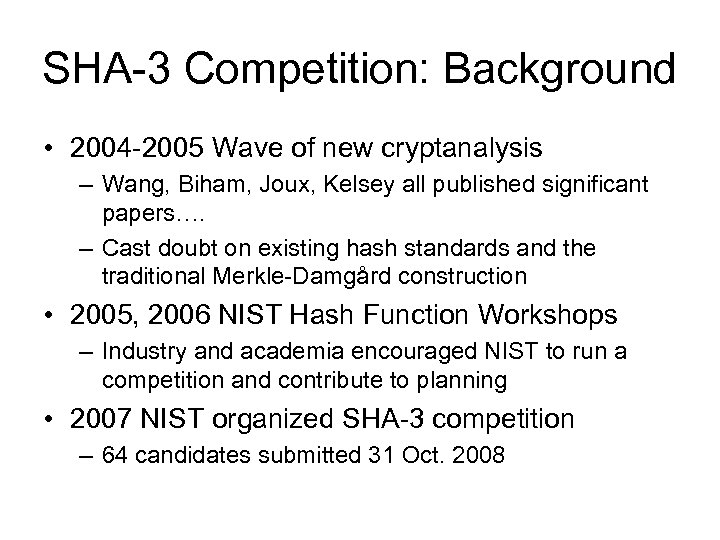 SHA-3 Competition: Background • 2004 -2005 Wave of new cryptanalysis – Wang, Biham, Joux, Kelsey all published significant papers…. – Cast doubt on existing hash standards and the traditional Merkle-Damgård construction • 2005, 2006 NIST Hash Function Workshops – Industry and academia encouraged NIST to run a competition and contribute to planning • 2007 NIST organized SHA-3 competition – 64 candidates submitted 31 Oct. 2008
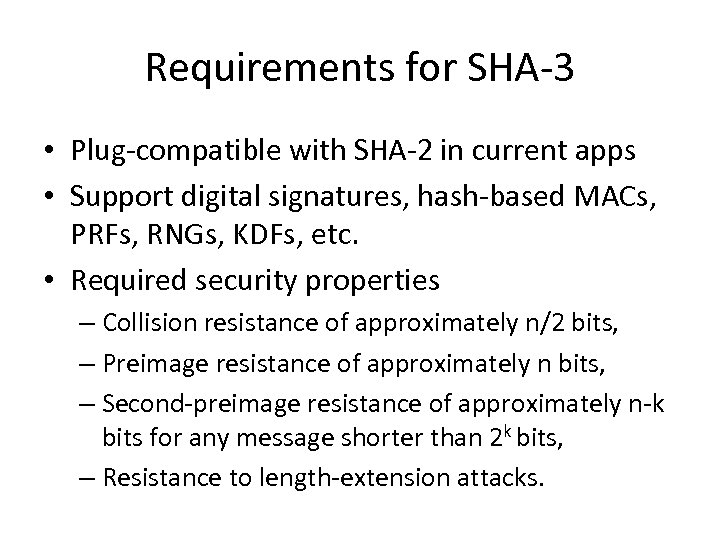 Requirements for SHA-3 • Plug-compatible with SHA-2 in current apps • Support digital signatures, hash-based MACs, PRFs, RNGs, KDFs, etc. • Required security properties – Collision resistance of approximately n/2 bits, – Preimage resistance of approximately n bits, – Second-preimage resistance of approximately n-k bits for any message shorter than 2 k bits, – Resistance to length-extension attacks.
 SHA-3 Competition: Current Status • Five Finalists identified late in 2010. – Blake, Grøstl, JH, Keccak, Skein • Final tweaks submitted January 2011. • Final Workshop held last week (March 2012) in Washington DC • NIST will announce the winning candidate late in 2012 http: //csrc. nist. gov/groups/ST/hash/sha-3/index. html
 SHA-3: Security • Confidence in the security of SHA-3 candidates is very high • SHA-3 candidates are based on new constructions – not vulnerable to well known attacks on Merkle. Damgård construction (e. g. , length extension attack) • However, cryptanalysis since 2005 has actually eased our concerns about SHA-2
 SHA-3: Performance (1 of 3) • There is no free lunch this time: collision resistance takes a lot of computation – We will not replicate the across-the-board performance increase we got with AES (as compared with Triple DES)
 SHA-3: Performance (2 of 3) • SHA-2 is surprisingly efficient and could be faster (or smaller) in some environments than SHA-3, no matter which of the 5 candidates is selected. • SHA-256 is competitive in low-end SW platforms and “constrained” HW • Depending on the selected algorithm, SHA-3 could be faster than SHA-2 in some environments – Skein & Blake faster in software on high end computing platforms – Keccak is fast in hardware in general
 SHA-3: Performance (3 of 3) • However, SHA-3 potentially offers significantly better performance for one important function: hash-based MACs on short messages – Only requires a single pass since we aren’t worried about length extension attacks • In fact, a single pass keyed hash for some candidate algorithms would be faster than a SHA-1 HMAC for short messages
 The (New) Real Question • Which Candidate best complements SHA-2? – SHA-2 is not apparently broken • SHA-2 collision resistance seems fine but SHA-3 candidates have greater security margins – All candidates have much higher multicollision resistance than SHA-2 and fix the other generic limitations of Merkle-Damgård – No candidate has dramatically better performance across the board • Some candidates have much better performance for some kinds of implementations • All will support a single pass keyed MAC – Some candidates offer extras • Wide block cipher, authenticated encryption
 Questions for Protocol Developers • Should NIST emphasize high-end or low-end HW or SW or any combination of these in our selection process? • For low-end HW, should NIST emphasize energy consumption, throughput to area ratio, minimum size, or any combination of these in our selection process? • Should NIST specify a single algorithm for all digest sizes, or two algorithms as in SHA-2 (SHA-256 and SHA-512)?
 Data Points For Protocol Analysis (1/2) • How are hash algorithms used? – Hash, Signature, HMAC, KDF, PRF? • Is SHA-2 already specified for that protocol? • Is the protocol agile in practice? – Is cipher suite negotiation supported? – Do all end points need to be updated before use?
 Data Points for Protocol Analysis, (2/2) • Is SHA-2 widely implemented? used? – If so, SHA-3 would be a straightforward and suitable backup • Would SHA-3 present specific practical advantages? – E. g. , single pass MACs, tree mode? – If so, consider SHA-3 for the Mandatory To Implement cipher suite
 Initial Thoughts on Specific IETF Protocols and SHA-3 • Reviewed about a dozen protocol families • High-level analysis for a few – TCP-AO – Constrained Devices (core, roll, 6 lowpan) – Mature X. 509 protocols (PKIX, S/MIME, TLS) • Defer more detailed analysis once the selection has been made
 Quick Example: TCP-AO • TCP-AO uses hash functions to derive keys and generate HMACs – SHA-1 HMACs are truncated to 96 bits – No support for SHA-2 • Has algorithm agility, so it would be easy to specify • Assuming use of a single pass MAC, SHA-3 would provide a better alternative than SHA-256 – Performance would be comparable to current SHA-1 based implementations • No strong justification for mandatory to implement – No real security motivation (96 bit tag!)
 Constrained Devices • Core, roll, and 6 lowpan – Devices may have limited resources (e. g. , processing power, memory, or battery power) – Common “solution” in this market sector is weak security • Single pass hmacs consumes less power – SHA-3 candidates which provides additional functionality (e. g. , authenticated encryption) would enable memory/area savings
 PKIX • Hashes primarily support digital signatures on “messages” ranging from 1 kbyte to tens of megabytes, but … • Review of ASN. 1 in RFC 5912 shows hash algs also used in nearly every plausible mode • SHA-2 support well specified, but migration process has been painful • For general purpose certs, infrastructure can’t issue until “all” end systems are ready
 S/MIME • Hashes primarily support digital signatures on “messages” ranging from a few kbytes to tens of megabytes and certificate handling • SHA-2 support well specified in RFC 5754, and starting to be deployed, but not widely used • Security of SHA-1 (which is widely used) is inadequate • SMIMECapabilities conveys sender’s set of supported crypto algorithms, but we still have a bootstrap issue
 TLS • Uses hash algorithms extensively – e. g. , PRF, hmac, and certificate handling • SHA-256 well specified in most recent protocol specs • Messages can be relatively large, so the incremental performance improvement from single pass MAC may be limited • Ciphersuites are negotiated so incremental deployment might be practical
 Questions?