


 Скачать презентацию Sexuality Counseling Therapy Foundations for Practice
53cb9d4cb30690fe61f1249335e61b90.ppt
- Количество слайдов: 134
 Sexuality Counseling & Therapy Foundations for Practice
 2012 AAMFT Conference, Charlotte, North Carolina Thursday, September 13, 2012 Stephen Southern Dawn Ellison & Kate Hilton Mississippi College
 For additional information: Stephen Southern 361 -876 -2030 stephensouthern@msn. com The material included in this professional presentation does not present the views or positions of Mississippi College.
 How I love all of you! Do you feel me wrap you Up with myself and my warmth, like a flame round the wick? …I spread over you! How lovely your round head, your arms, Your breasts, your knees and feet! I feel that we Are a bonfire of oneness, me flame flung leaping round you, You the core of the fire, crept into me. D. H. Lawrence, Wedlock
 The Journey of a Sex Therapist l Behavior Therapy versus Psychoanalysis l Masters & Johnson Institute l American Association of Sexuality Educators, Counselors & Therapists (AASECT) l Whither Sex Education l Sexy Seniors l Sexual Medicine Institute l The Man Who Feared His Buttons l The Couple and Their Homework l Perversion, Paraphila & Sexual Addiction l Penile Plethysmography l Trauma-Based Disorders l Cybersex Addiction: The New Tea Room l Viagra Defeats Sex Therapy l The “New View” Rediscovers Intimacy
 Sexy Seniors: He’s coming home …He’s coming home for lunch. I hear his footsteps on the porch. I cooked him his favorite meal…I remember the smell of the orange blossoms…He’s coming in the door. He sees me and smiles. That dog, he’s got something besides lunch on his mind. He comes up and hugs me. He kisses my neck. I can smell his honest sweat. He was a good, hard working man (coming home for lunch from the orange grove where he worked).
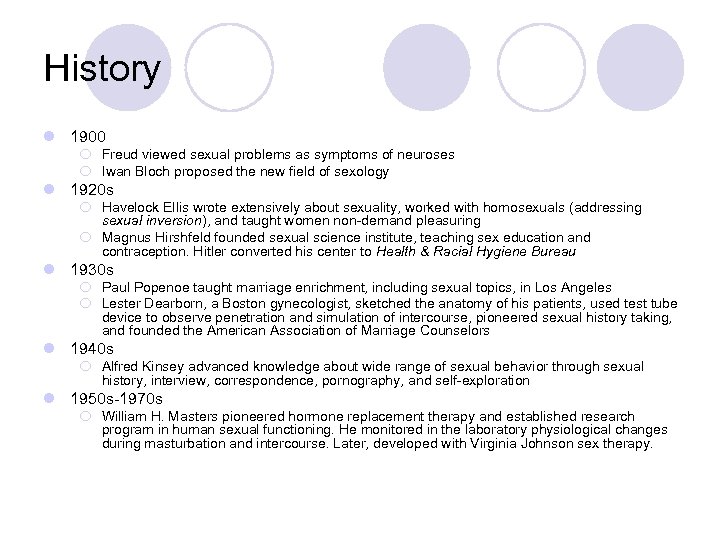 History l 1900 ¡ Freud viewed sexual problems as symptoms of neuroses ¡ Iwan Bloch proposed the new field of sexology l 1920 s ¡ Havelock Ellis wrote extensively about sexuality, worked with homosexuals (addressing sexual inversion), and taught women non-demand pleasuring ¡ Magnus Hirshfeld founded sexual science institute, teaching sex education and contraception. Hitler converted his center to Health & Racial Hygiene Bureau l 1930 s ¡ Paul Popenoe taught marriage enrichment, including sexual topics, in Los Angeles ¡ Lester Dearborn, a Boston gynecologist, sketched the anatomy of his patients, used test tube device to observe penetration and simulation of intercourse, pioneered sexual history taking, and founded the American Association of Marriage Counselors l 1940 s ¡ Alfred Kinsey advanced knowledge about wide range of sexual behavior through sexual history, interview, correspondence, pornography, and self-exploration l 1950 s-1970 s ¡ William H. Masters pioneered hormone replacement therapy and established research program in human sexual functioning. He monitored in the laboratory physiological changes during masturbation and intercourse. Later, developed with Virginia Johnson sex therapy.
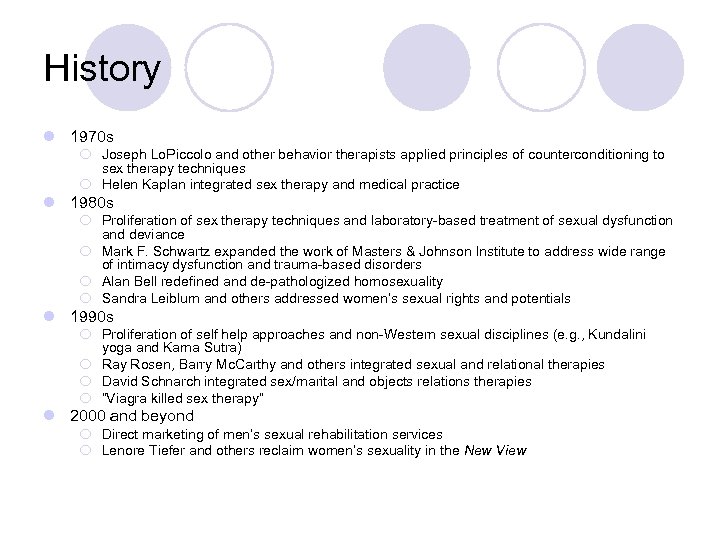 History l 1970 s ¡ Joseph Lo. Piccolo and other behavior therapists applied principles of counterconditioning to sex therapy techniques ¡ Helen Kaplan integrated sex therapy and medical practice l 1980 s ¡ Proliferation of sex therapy techniques and laboratory-based treatment of sexual dysfunction and deviance ¡ Mark F. Schwartz expanded the work of Masters & Johnson Institute to address wide range of intimacy dysfunction and trauma-based disorders ¡ Alan Bell redefined and de-pathologized homosexuality ¡ Sandra Leiblum and others addressed women’s sexual rights and potentials l 1990 s ¡ Proliferation of self help approaches and non-Western sexual disciplines (e. g. , Kundalini yoga and Kama Sutra) ¡ Ray Rosen, Barry Mc. Carthy and others integrated sexual and relational therapies ¡ David Schnarch integrated sex/marital and objects relations therapies ¡ “Viagra killed sex therapy” l 2000 and beyond ¡ Direct marketing of men’s sexual rehabilitation services ¡ Lenore Tiefer and others reclaim women’s sexuality in the New View
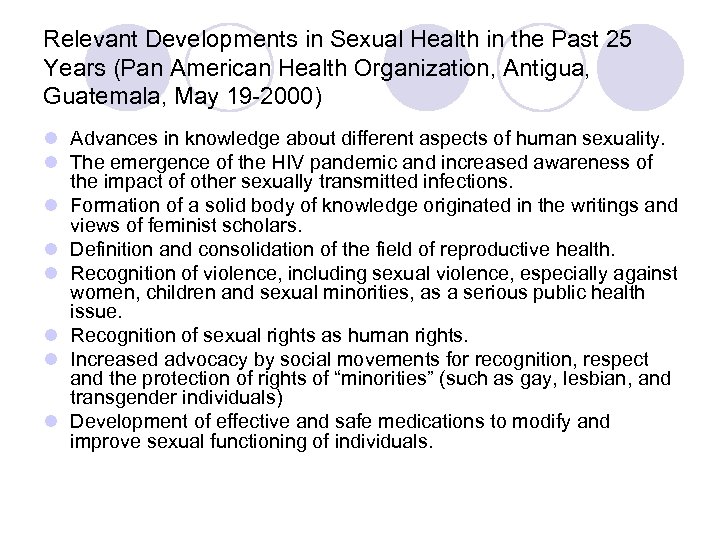 Relevant Developments in Sexual Health in the Past 25 Years (Pan American Health Organization, Antigua, Guatemala, May 19 -2000) l Advances in knowledge about different aspects of human sexuality. l The emergence of the HIV pandemic and increased awareness of the impact of other sexually transmitted infections. l Formation of a solid body of knowledge originated in the writings and views of feminist scholars. l Definition and consolidation of the field of reproductive health. l Recognition of violence, including sexual violence, especially against women, children and sexual minorities, as a serious public health issue. l Recognition of sexual rights as human rights. l Increased advocacy by social movements for recognition, respect and the protection of rights of “minorities” (such as gay, lesbian, and transgender individuals) l Development of effective and safe medications to modify and improve sexual functioning of individuals.
 The Beginning l “Sex is a natural function” (Masters & Johnson, 1966, 1970) l In sexuality, we find the life energy (eros) associated with all bonding or attachment. l Each individual will discover his or her capacity for sexual intimacy as roadblocks are removed
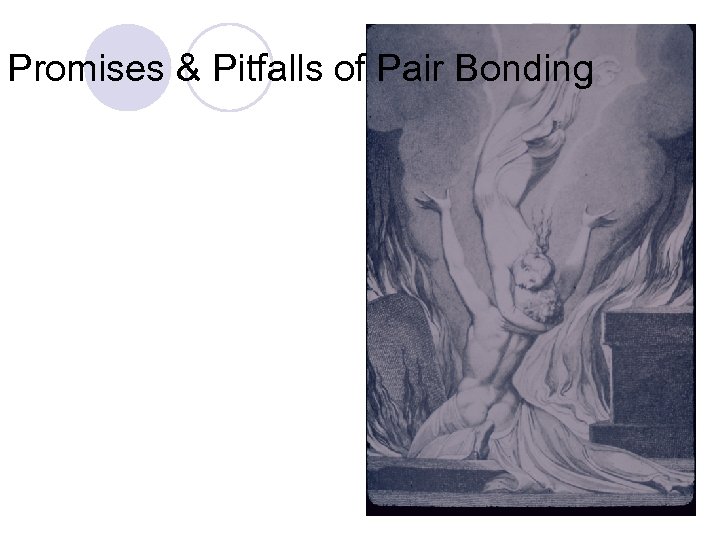 Promises & Pitfalls of Pair Bonding
 Intimacy l Characterized by the capacity for emotional and physical closeness in various domains in life l Begins with the capacity for good object relations in childhood l Elaborated by healthy (nutritious) life experiences l Expressed between open and honest partners in a committed relationship
 Characteristics of an Intimate Couple l Express love verbally on a daily basis l Physically affectionate: hugging, kissing, touching l Express love sexually within an exclusive, committed relationship l Express admiration for one another in private and social settings l Engage in mutual self-disclosure: sharing thoughts, feelings, hopes, and dreams l Permit one another to be autonomous and active in the world outside the relationship l Encourage self-awareness and self-discovery for each person l Offer to each other an emotional support system and respite from the demands of daily life l Express love materially by giving gifts and sharing the work and rewards of the relationship l Accept demands and tolerate shortcomings, giving unconditional positive regard with a minimum of expectations and projections l Create time to be alone together to practice the relationship without distraction or intrusion l Share a reason or purpose in staying together, identifying a mission for the relationship
 Sexuality is a central aspect of being human throughout life and encompasses sex, gender identities and roles, sexual orientation, eroticism, pleasure, intimacy and reproduction. Sexuality is experienced and expressed in thoughts, fantasies, desires, beliefs, attitudes, values, behaviours, practices, roles, and relationships…Sexuality is influenced by the interaction of biological, psychological, social, economic, political, cultural, legal, historical, religious, and spiritual factors. World Health Organization conference on sexual health, January 2002.
 Life Behaviors of a Sexually Healthy Adult (SIECUS) l Appreciate one’s own body l Affirms that sexual development may or may not include reproduction or genital sexual experience l Interact with both genders in respectful and appropriate ways l Affirm one’s own sexual orientation and respect the sexual orientation of others l Express love and intimacy in appropriate ways l Develop and maintain meaningful relationships l Avoid exploitative and manipulative relationships l Make informed choices about family options and lifestyles l Exhibit skills that enhance personal relationships l Discriminate between life enhancing sexual behaviors and those that are harmful to self and/or others l Express one’s sexuality while respecting the sexual rights of others l Express one’s sexuality in ways congruent with one’s values
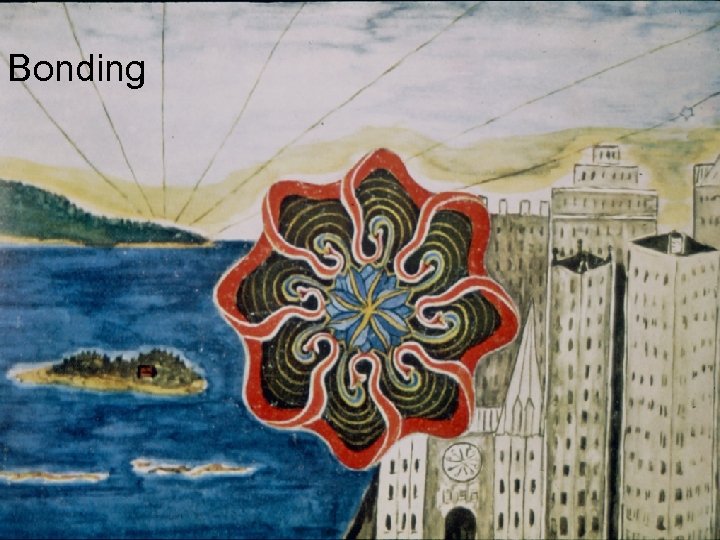 Bonding
 Roadblocks to Intimacy l Life trauma, especially physical and sexual abuse l Sex negative environments l Lack of accurate sex and relationship information l Lack of experience l Punishment for sexual exploration l Shame associated with closeness
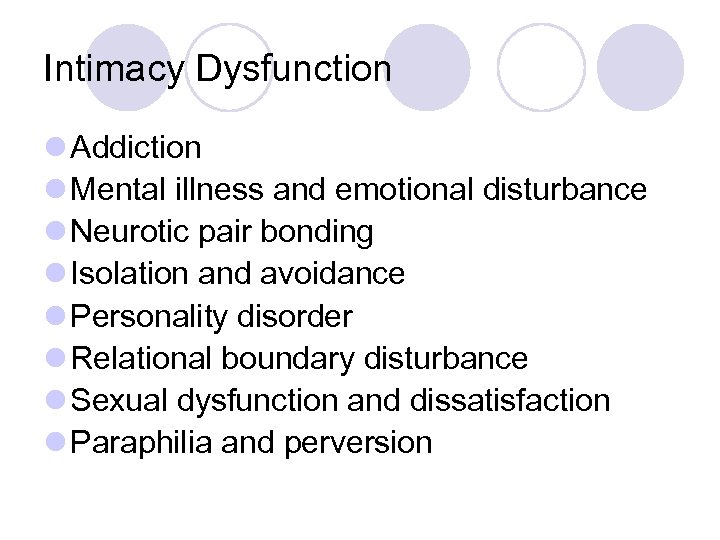 Intimacy Dysfunction l Addiction l Mental illness and emotional disturbance l Neurotic pair bonding l Isolation and avoidance l Personality disorder l Relational boundary disturbance l Sexual dysfunction and dissatisfaction l Paraphilia and perversion
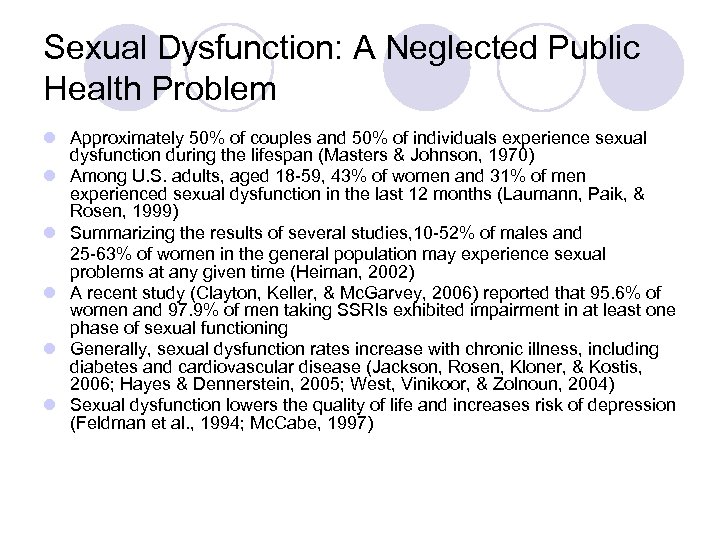 Sexual Dysfunction: A Neglected Public Health Problem l Approximately 50% of couples and 50% of individuals experience sexual dysfunction during the lifespan (Masters & Johnson, 1970) l Among U. S. adults, aged 18 -59, 43% of women and 31% of men experienced sexual dysfunction in the last 12 months (Laumann, Paik, & Rosen, 1999) l Summarizing the results of several studies, 10 -52% of males and 25 -63% of women in the general population may experience sexual problems at any given time (Heiman, 2002) l A recent study (Clayton, Keller, & Mc. Garvey, 2006) reported that 95. 6% of women and 97. 9% of men taking SSRIs exhibited impairment in at least one phase of sexual functioning l Generally, sexual dysfunction rates increase with chronic illness, including diabetes and cardiovascular disease (Jackson, Rosen, Kloner, & Kostis, 2006; Hayes & Dennerstein, 2005; West, Vinikoor, & Zolnoun, 2004) l Sexual dysfunction lowers the quality of life and increases risk of depression (Feldman et al. , 1994; Mc. Cabe, 1997)
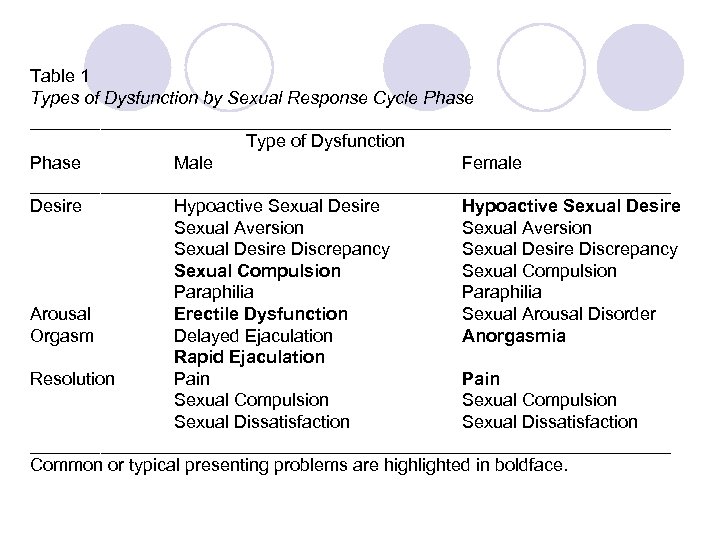 Table 1 Types of Dysfunction by Sexual Response Cycle Phase ________________________________ Type of Dysfunction Phase Male Female ________________________________ Desire Hypoactive Sexual Desire Sexual Aversion Sexual Desire Discrepancy Sexual Compulsion Paraphilia Arousal Erectile Dysfunction Sexual Arousal Disorder Orgasm Delayed Ejaculation Anorgasmia Rapid Ejaculation Resolution Pain Sexual Compulsion Sexual Dissatisfaction ________________________________ Common or typical presenting problems are highlighted in boldface.
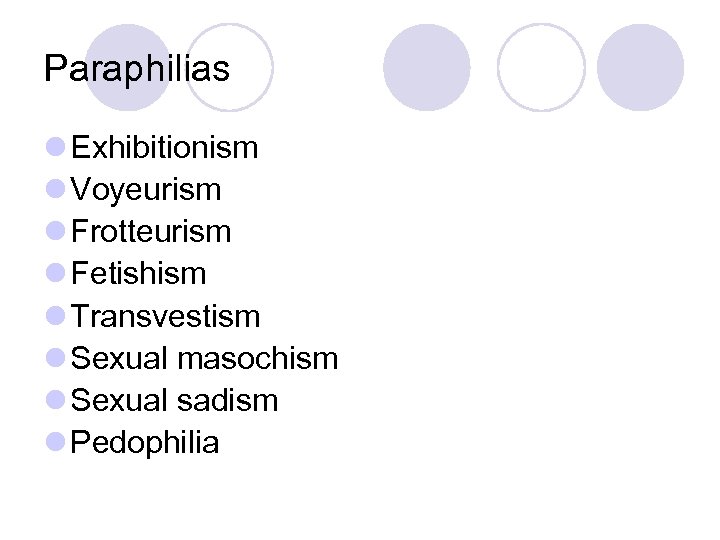 Paraphilias l Exhibitionism l Voyeurism l Frotteurism l Fetishism l Transvestism l Sexual masochism l Sexual sadism l Pedophilia
 Compulsive Sexual Behavior l Cruising and preoccupation l Multiple partners l Anonymous partners l Fixation on unattainable partner l Compulsive masturbation or autoeroticism l Compulsive extramarital affairs l Compulsive cybersex
 Compulsive Cybersex l More than half of Americans (172 million persons) regularly use the Internet with as many as one third going online for sexual purposes (Cooper, 2004) l 60 percent of all visits and commerce on the Internet were associated with sexual activities (Schneider & Weiss, 2001) l Internet sex was the third largest economic sector on the Web generating annually one billion dollars of revenue (Carnes, Delmonico, & Griffin, 2001) l Cooper (1997) observed that the sexual revolution of the Internet was fueled by the “Triple A Engine” of accessibility, affordability, and anonymity l Problematic cybersex has been associated with heavy Internet use (20 or more hours online per week) (Cooper, Scherer, Boies, & Gordon, 1999). l Schwartz and Southern (2000) described compulsive cybersex as the “new tea room” in which cruising can lead to easy anonymous, impersonal sex. l Treatment of compulsive cybersex involves individual, couple, and group counseling with particular components to address the functions of the addictive behavior pattern
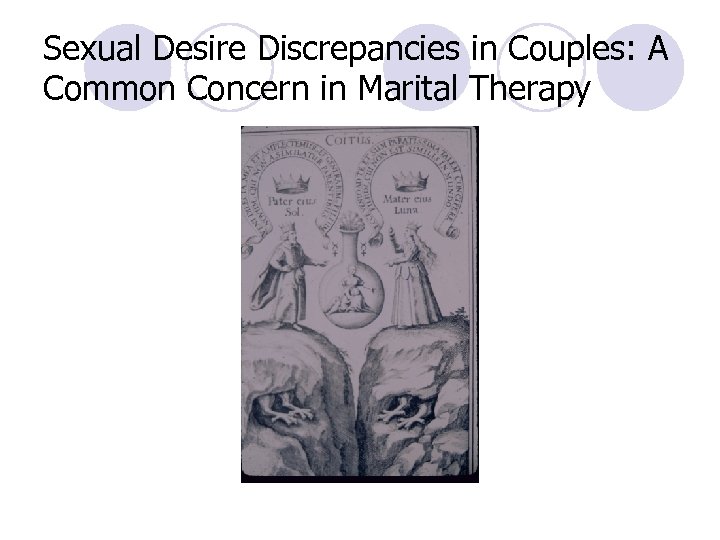 Sexual Desire Discrepancies in Couples: A Common Concern in Marital Therapy
 Sexual Desire l Interest l Motivation l Appetite
 Cues for Sexual Desire l Emotional bonding l Visual/proximity prompts l Self observation l Implicit romantic scripts l Erotic and explicit dimensions l Linear versus cyclical processes
 Sources of Sexual Desire l Mutual vulnerability l Closeness and intimacy l Spirituality l Sensual awareness l Romantic love l Boundary disturbance l Dominance and power l Anger and aggression l Displacement, omission and substitution l Objectification
 Varieties of Sexual Desire l Asexuality or celibacy l Hypoactive sexual desire l Hyperactive sexual desire l Balanced or attuned sexual desire l Discrepant sexual desire
 Hypoactive Sexual Desire l Relatively common in women (20 -45%) l Poorly defined l Multiple causation l Persistent or recurring deficiency of sexual fantasies, thoughts, and receptivity to sexual outlet l Personal distress or relationship difficulty resulting from absolute or relative avoidance
 Causes of Hyperactive Sexual Desire l History of sexual or physical abuse l Sex negative parenting l Sexual shame or guilt l Variant sexual preference l Cognitive, emotional or behavioral dissociations l Depression and anxiety l Lifestyle disorders (e. g. , addiction) l Pornography l Relationship discord and dissatisfaction
 Sexual Desire Discrepancies l Intrinsically relational in nature l Greater the discrepancy, less sexual satisfaction in men and women l Greater the discrepancy, lower level of relationship satisfaction in women l Men’s perceptions of relationship adjustment affected by his estimation of desire discrepancy
 Gender Issues & Desire Discrepancies l Adult levels of sexual desire influenced by parenting and family of origin issues l Desire discrepancies fueled by problems with identification and Oedipal conflicts l Socialization process in gender roles and persistence of double standard l Gender roles associated with proception in men and acception in women l Putative biological differences and evolutionary imperatives
 Gender Polarization l Short-term mating (masculine) versus long -term partnership (femininity) l Sexual desire decreases over time with women (not in men generally) l Desire for tenderness increases in women and decreases in men l Sexual satisfaction tends to decline in both l Interest in sexual variety increases, especially in men
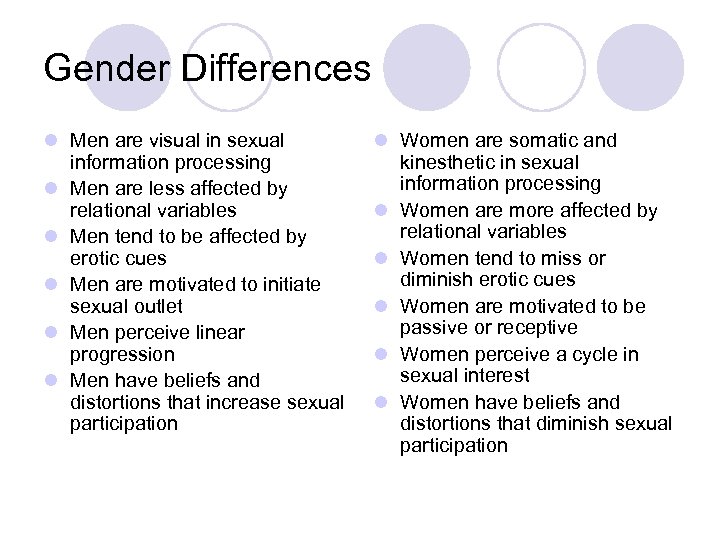 Gender Differences l Men are visual in sexual information processing l Men are less affected by relational variables l Men tend to be affected by erotic cues l Men are motivated to initiate sexual outlet l Men perceive linear progression l Men have beliefs and distortions that increase sexual participation l Women are somatic and kinesthetic in sexual information processing l Women are more affected by relational variables l Women tend to miss or diminish erotic cues l Women are motivated to be passive or receptive l Women perceive a cycle in sexual interest l Women have beliefs and distortions that diminish sexual participation
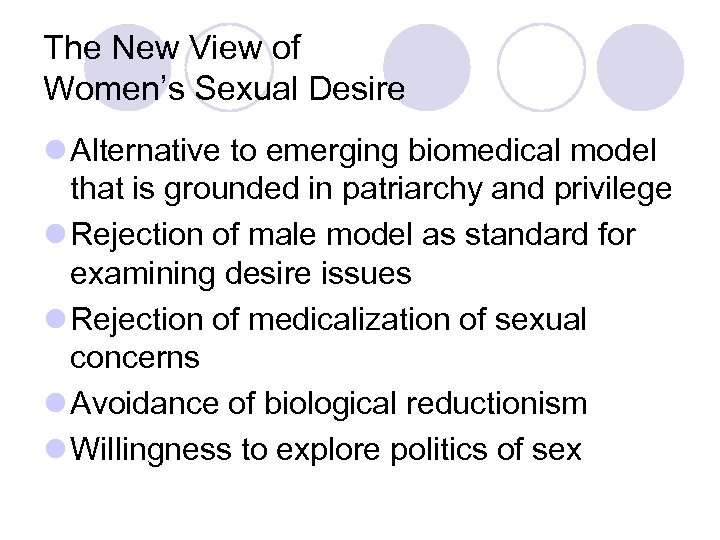 The New View of Women’s Sexual Desire l Alternative to emerging biomedical model that is grounded in patriarchy and privilege l Rejection of male model as standard for examining desire issues l Rejection of medicalization of sexual concerns l Avoidance of biological reductionism l Willingness to explore politics of sex
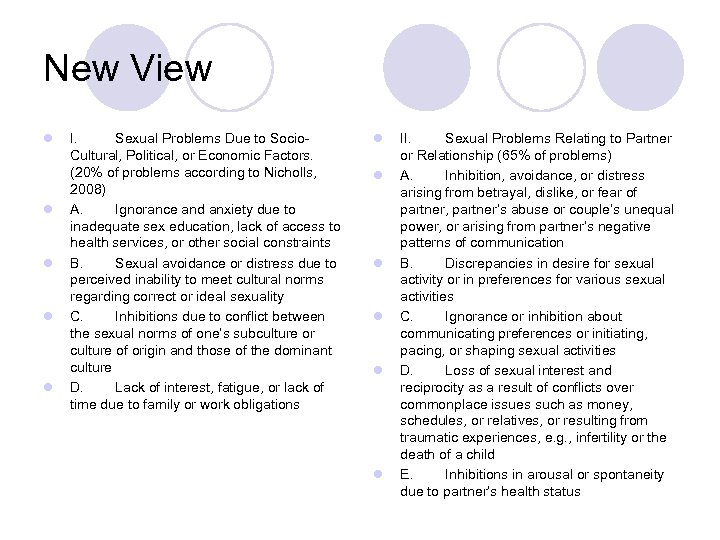 New View l l l I. Sexual Problems Due to Socio. Cultural, Political, or Economic Factors. (20% of problems according to Nicholls, 2008) A. Ignorance and anxiety due to inadequate sex education, lack of access to health services, or other social constraints B. Sexual avoidance or distress due to perceived inability to meet cultural norms regarding correct or ideal sexuality C. Inhibitions due to conflict between the sexual norms of one’s subculture or culture of origin and those of the dominant culture D. Lack of interest, fatigue, or lack of time due to family or work obligations l l l II. Sexual Problems Relating to Partner or Relationship (65% of problems) A. Inhibition, avoidance, or distress arising from betrayal, dislike, or fear of partner, partner’s abuse or couple’s unequal power, or arising from partner’s negative patterns of communication B. Discrepancies in desire for sexual activity or in preferences for various sexual activities C. Ignorance or inhibition about communicating preferences or initiating, pacing, or shaping sexual activities D. Loss of sexual interest and reciprocity as a result of conflicts over commonplace issues such as money, schedules, or relatives, or resulting from traumatic experiences, e. g. , infertility or the death of a child E. Inhibitions in arousal or spontaneity due to partner’s health status
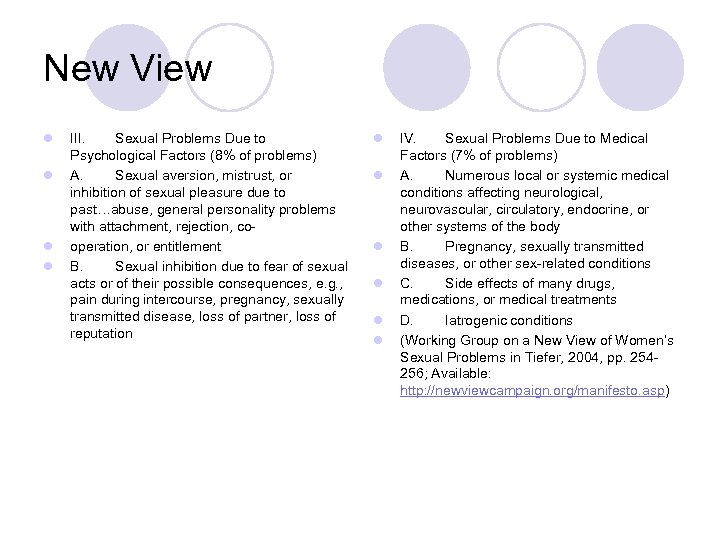 New View l l III. Sexual Problems Due to Psychological Factors (8% of problems) A. Sexual aversion, mistrust, or inhibition of sexual pleasure due to past…abuse, general personality problems with attachment, rejection, cooperation, or entitlement B. Sexual inhibition due to fear of sexual acts or of their possible consequences, e. g. , pain during intercourse, pregnancy, sexually transmitted disease, loss of partner, loss of reputation l l l IV. Sexual Problems Due to Medical Factors (7% of problems) A. Numerous local or systemic medical conditions affecting neurological, neurovascular, circulatory, endocrine, or other systems of the body B. Pregnancy, sexually transmitted diseases, or other sex-related conditions C. Side effects of many drugs, medications, or medical treatments D. Iatrogenic conditions (Working Group on a New View of Women’s Sexual Problems in Tiefer, 2004, pp. 254256; Available: http: //newviewcampaign. org/manifesto. asp)
 Couple Issues & Sexual Desire l Sexual satisfaction accounts for 15 -20% of pair bond l Lack of sexual satisfaction associated with 50 -75% of relational discord l Sexual dissatisfaction associated with diminished sexual desire, avoidance, and relationship erosion l Relationship satisfaction associated with increased desire and outlet
 Contradictions in Sexual Desire l Romantic love and sexual desire not always linked l Intimacy and sexual desire can be negatively related l Relationship erosion introduces desire for novel activities and new partners l Long term relationships introduce more demands for adjustment (work and family) l Health issues and aging complicate sexual expression l Sexual desire is a balancing act
 Treatment of Sexual Desire Issues l Relational l Psychological l Hormonal l Psychopharmacological
 Goals of Treatment l Expand sexual scripts or schemas to tolerate change and embrace innovation l Advance sexual desire resilience (positive anticipation, pleasure orientation, appreciation of cycle) l Play (leisure, love play, sex play) l Exploration of sexual fantasies and preferences l Expression of desires
 Peace
Peace
 Sexual and Relational Healing l Premarital counseling l Couples counseling l Object relations therapy l Trauma resolution therapy l Bodywork l Spiritual recovery l Sexual counseling and therapy
 What is sexual health? “Sexual health is the integration of the somatic, emotional, intellectual, and social aspects of sexual well-being, in ways that are positively enriching and that enhance personality, communication, and love” World Health Organization in Firestone, Firestone & Catlett (2006, p. 11)
 Life Behaviors of a Sexually Healthy Adult (SIECUS) l Appreciate one’s own body l Affirms that sexual development may or may not include reproduction or genital sexual experience l Interact with both genders in respectful and appropriate ways l Affirm one’s own sexual orientation and respect the sexual orientation of others l Express love and intimacy in appropriate ways l Develop and maintain meaningful relationships l Avoid exploitative and manipulative relationships l Make informed choices about family options and lifestyles l Exhibit skills that enhance personal relationships l Discriminate between life enhancing sexual behaviors and those that are harmful to self and/or others l Express one’s sexuality while respecting the sexual rights of others l Express one’s sexuality in ways congruent with one’s values
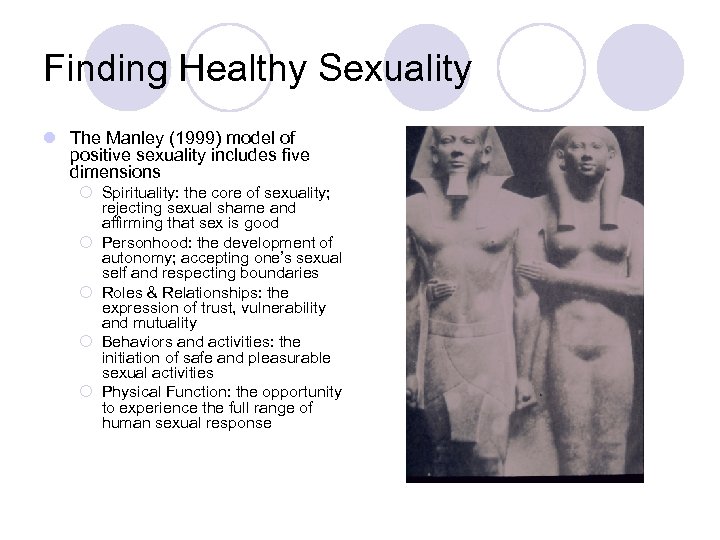 Finding Healthy Sexuality l The Manley (1999) model of positive sexuality includes five dimensions ¡ Spirituality: the core of sexuality; rejecting sexual shame and affirming that sex is good ¡ Personhood: the development of autonomy; accepting one’s sexual self and respecting boundaries ¡ Roles & Relationships: the expression of trust, vulnerability and mutuality ¡ Behaviors and activities: the initiation of safe and pleasurable sexual activities ¡ Physical Function: the opportunity to experience the full range of human sexual response
 Voices that Interfere with Sexual Fulfillment l Inner “voices” before, during and after sex interfere with sexual functioning and satisfaction (Firestone, Firestone & Catlett, 2006, pp. 229 -262) ¡ ¡ ¡ Why would he want to be in a relationship with you? She is trying to control me. Your penis is too small. Your breasts are not like other women’s. Don’t have oral sex, he’ll be repulsed. You won’t be able to satisfy her. He’ll think you are a slut. You’re hurting her. She’s too needy. He’s unreliable. You always give in; you have no dignity. How do you know she had an orgasm?
 Quieting the Voices ¡ Each partner formulates the problem that he or she believes is limiting the sexual relationship. ¡ Partners give voice to self-critical and negative partner perceptions. ¡ They must contain (typically with the help of a therapist) the anger or sadness associated with verbalizing the inner voice. ¡ Now the couple is free to explore the origins of negative cognitions, correcting early mistakes and distorted beliefs. ¡ They plan together ways to change behaviors and communications in order to counteract the old dictates of their voices and to move toward mutually acceptable goals. ¡ They may change contexts and circumstances associated with maintaining the voices ¡ The couple can expect some strong “voice attacks” as they move toward sexual fulfillment ¡ (Firestone, & Catlett, 2006, pp. 235 -237)
 Archetypes and Individuation l According to Carl Jung’s model of growth, archetypes from the collective unconscious imbue the personal unconscious with psychic energy needed to progress toward higher levels of individuation or selfhood l Archetypes are integrated along the way ¡ Awareness of the persona permits insight into roles ¡ Coming to terms with the shadow reduces blaming, projection, and scapegoating of others ¡ Integrating the contrasexual (anima/animus) makes meaning from sex differences and increases flexibility ¡ Recognizing the “wise old man” and “the great mother” facilitates insight and wisdom ¡ Making contact with the Self creates a new center for wholeness l (Clift, 1988)
 Sexuality Counseling & Therapy
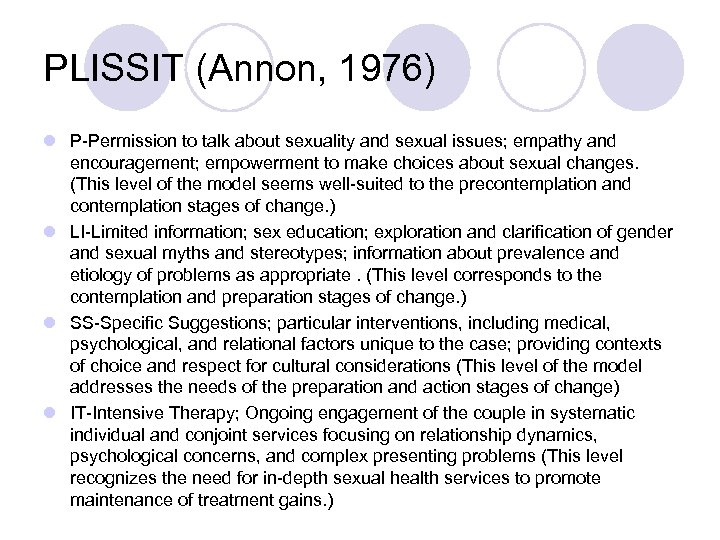 PLISSIT (Annon, 1976) l P-Permission to talk about sexuality and sexual issues; empathy and encouragement; empowerment to make choices about sexual changes. (This level of the model seems well-suited to the precontemplation and contemplation stages of change. ) l LI-Limited information; sex education; exploration and clarification of gender and sexual myths and stereotypes; information about prevalence and etiology of problems as appropriate. (This level corresponds to the contemplation and preparation stages of change. ) l SS-Specific Suggestions; particular interventions, including medical, psychological, and relational factors unique to the case; providing contexts of choice and respect for cultural considerations (This level of the model addresses the needs of the preparation and action stages of change) l IT-Intensive Therapy; Ongoing engagement of the couple in systematic individual and conjoint services focusing on relationship dynamics, psychological concerns, and complex presenting problems (This level recognizes the need for in-depth sexual health services to promote maintenance of treatment gains. )
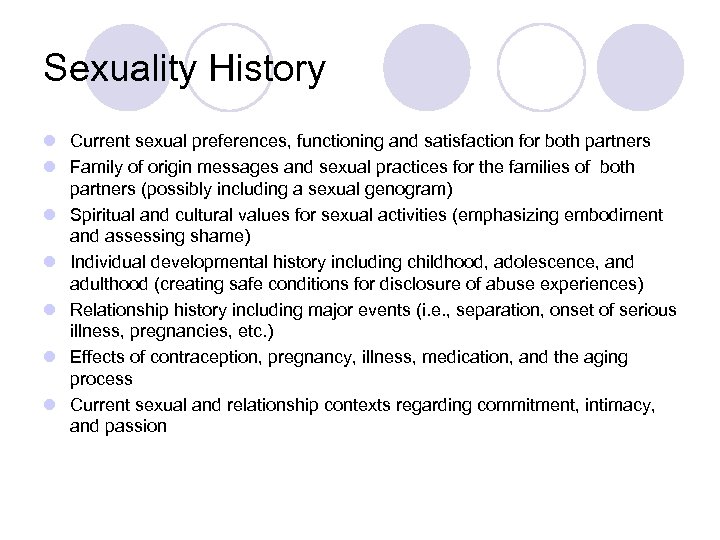 Sexuality History l Current sexual preferences, functioning and satisfaction for both partners l Family of origin messages and sexual practices for the families of both partners (possibly including a sexual genogram) l Spiritual and cultural values for sexual activities (emphasizing embodiment and assessing shame) l Individual developmental history including childhood, adolescence, and adulthood (creating safe conditions for disclosure of abuse experiences) l Relationship history including major events (i. e. , separation, onset of serious illness, pregnancies, etc. ) l Effects of contraception, pregnancy, illness, medication, and the aging process l Current sexual and relationship contexts regarding commitment, intimacy, and passion
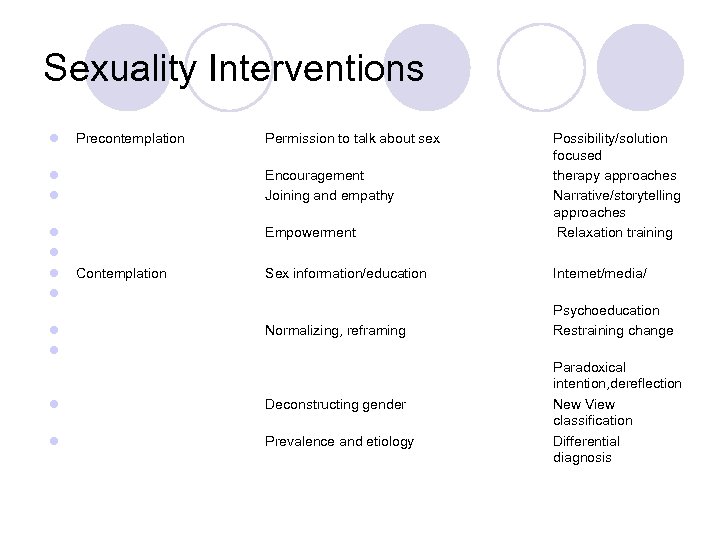 Sexuality Interventions l l l Encouragement Joining and empathy l l Empowerment Possibility/solution focused therapy approaches Narrative/storytelling approaches Relaxation training Sex information/education Internet/media/ Normalizing, reframing Psychoeducation Restraining change l l Precontemplation Contemplation Permission to talk about sex l Deconstructing gender l Prevalence and etiology Paradoxical intention, dereflection New View classification Differential diagnosis
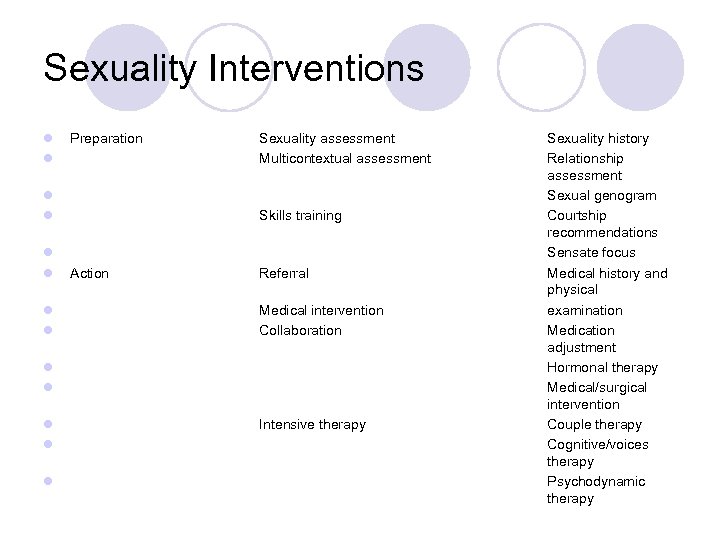 Sexuality Interventions l l Preparation l l l Sexuality assessment Multicontextual assessment Skills training Action Referral Medical intervention Collaboration l l l Intensive therapy Sexuality history Relationship assessment Sexual genogram Courtship recommendations Sensate focus Medical history and physical examination Medication adjustment Hormonal therapy Medical/surgical intervention Couple therapy Cognitive/voices therapy Psychodynamic therapy
 Sexuality Interventions l l l Maintenance Retention Generalization Termination Celebration Follow-up Relapse prevention Intimacy enhancement Optimal sexual health Ritual enactment Booster sessions
 Sensate Focus l Authoritative pronouncement l Selfish touching l Sexual self-responsibility
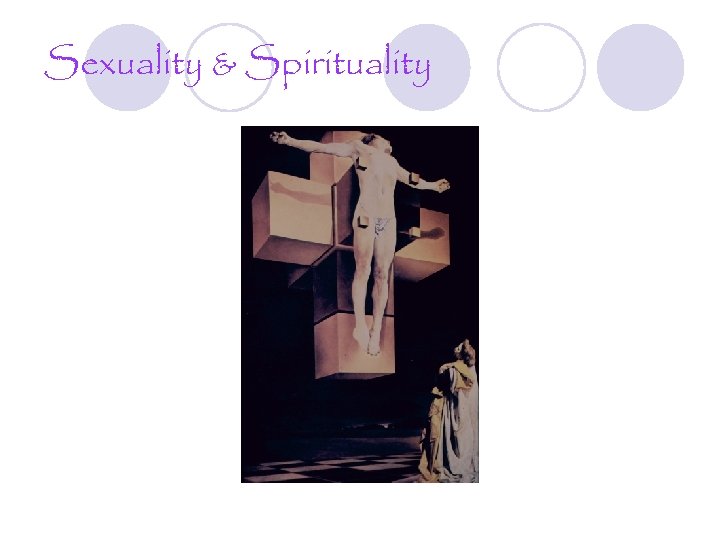 Sexuality & Spirituality
 Let him kiss me with the kisses of his mouth: for thy love is better than wine.
 Calling for the complement l “My beloved one is tanned and handsome, better than ten thousand others! His head is purest gold, and he has wavy, raven hair. His eyes are like doves beside the water brooks, deep and quiet. His cheeks are like sweetly scented beds of spices. His lips are perfumed lilies, his breath like myrrh. His arms are round bars of gold set with topaz; his body is bright ivory encrusted with jewels. His legs are as pillars of marble set in sockets of the finest gold, like cedars of Lebanon; none can rival him. His mouth is altogether sweet, lovable in every way. Such, O women of Jerusalem, is my beloved, my friend!” The Maiden (Song of Songs 5: 10 -16, TLB) l “How beautiful your tripping feet, O queenly maiden. Your rounded thighs are like jewels, the work of the most skilled of craftsmen. Your navel is lovely as a goblet filled with wine. Your waist is like a heap of wheat set about with lilies. Your two breasts are like two fawns, yes, lovely twins. Your neck is stately as an ivory tower, your eyes as limpid pools in Heshbon by the gate of Bathrabbim. Your nose is shapely like the tower of Lebanon overlooking Damascus. As Mount Carmel crowns the mountains, so your hair is your crown. The king is held captive in your queenly tresses. ” The King (Song of Songs 7: 1 -5, TLB)
 Embracing the garden “Oh, how delightful you are; how pleasant, O love for utter delight! You are tall and slim like a palm tree, and your breasts are like its clusters of dates. I said, I will climb up into the palm tree and take hold of its branches. Now may your breasts be like grape clusters, and the scent of your breath like apples, and your kisses as exciting as the best of wine, smooth and sweet, causing the lips of those who are asleep to speak’ (Song of Songs 7: 6 -9, TLB)
 Sexual Love in the Song of Songs l Eroticism: awakening the senses l Courtship: calling the complement; reuniting with what was formerly lost or missing l Wedding: the two become one l Sexual union: bliss of symbiosis or wholeness
 Spiritual Love in the Song of Songs l God’s love for Israel l Christ’s bond with the church (i. e. , the body of Christ) (e. g. , Origen) l Universal love of Jesus for every believer l “The faithful soul inflamed with the desire of Christ, whom she loves” (1599 Geneva Bible note) l Mystical (re)union of the soul and Creator (e. g. , Gregory of Nyssa) l Vision of paradise and the wedding feast to come (St. John of the Cross)
 The Interior Castle “I began to think of the soul as if it were a castle made of a single diamond or of a very clear crystal, in which there are many rooms, just as in Heaven there are many mansions. Now if we think carefully over this, sisters, the soul of the righteous man is nothing but a paradise, in which, as God tells us, He takes his delight. For what do you think a room will be like which is the delight of a King so mighty, so wise, so pure and so full of all that is good? ” St. Teresa of Avila (Peers, 1989, p. 28)
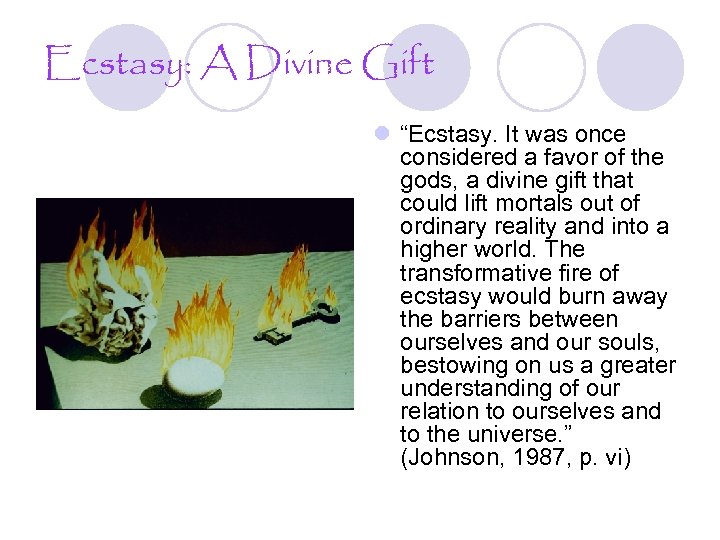 Ecstasy: A Divine Gift l “Ecstasy. It was once considered a favor of the gods, a divine gift that could lift mortals out of ordinary reality and into a higher world. The transformative fire of ecstasy would burn away the barriers between ourselves and our souls, bestowing on us a greater understanding of our relation to ourselves and to the universe. ” (Johnson, 1987, p. vi)
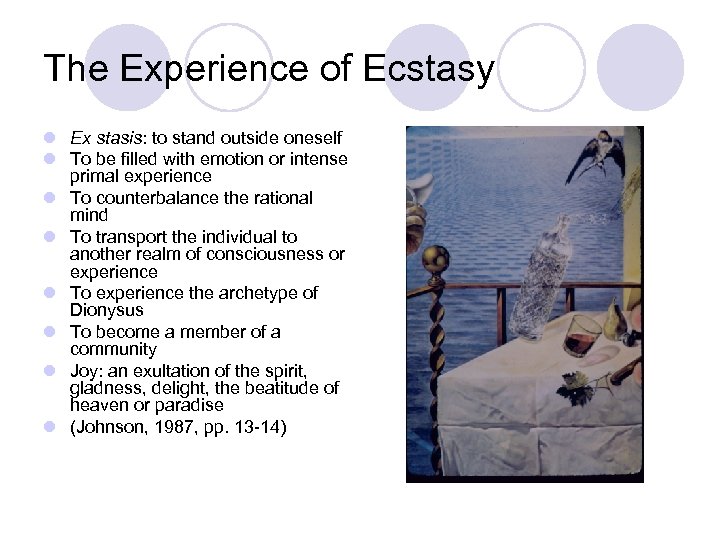 The Experience of Ecstasy l Ex stasis: to stand outside oneself l To be filled with emotion or intense primal experience l To counterbalance the rational mind l To transport the individual to another realm of consciousness or experience l To experience the archetype of Dionysus l To become a member of a community l Joy: an exultation of the spirit, gladness, delight, the beatitude of heaven or paradise l (Johnson, 1987, pp. 13 -14)
 Loss of Ecstasy l “It is the great tragedy of contemporary Western society that we have virtually lost the ability to experience the transformative power of ecstasy and joy. This loss affects every aspect of our lives. We seek ecstasy everywhere, and for a moment we may think we have found it. But, on a very deep level, we remain unfulfilled. ” (Johnson, 1987, p. vi) l “Our spirits need nourishment as much as ever. But, having excluded the inner experience of divine ecstasy from our lives, we can only look for its physical equivalent. And no matter how hard we look, or how many low grade ecstatic experiences we accumulate, we crave more. ” (p. vi)
 Craving & Addiction l “This craving has led to the most characteristic symptom of our time: addictive behavior. ” (Johnson, 1987, p. vi) l “Addiction is the negative side of spiritual seeking. We are looking for the exultation of the spirit; but instead of fulfillment we get a shortlived physical thrill that can never satisfy the chronic, gnawing emptiness with which we are beset. ” (p. vii) l “To fill this emptiness, we need to reconnect with the capacity for ecstasy that lies dormant within us. ” (p. vii)
 Enter the Pleasure Garden
 The Pleasure Garden “Think of the pleasure zone not as a place but as a process. It’s an active way of focusing your attention that centers you in the present moment, releases enormous stores of vitality and optimism, and makes whatever you’re doing considerably more enjoyable. ” (Resnick, 1997, p. xiii)
 Eight Core Pleasures l Fundamental Pleasures ¡ Primal pleasure: Sweet surrender ¡ Pain relief: Soothing, releasing, resolving and acquiring wisdom from pain l Elemental Pleasures ¡ Play: Seeking and finding creativity ¡ Laughter: Belly laugh ¡ Energetic movement: Physical mastery ¡ Sounding out: Whooping and moaning l Psychological Pleasures ¡ Mental pleasure: Envisioning and constructing positive stories ¡ Emotional pleasure: Disclosing and accepting one’s feelings and vulnerabilities l Resnick (1997)
 Full Pleasure Potentials l Sensual pleasure: Receiving the world through one’s senses l Sexual pleasure: Eroticism, passion, lust, and orgasm l Spiritual pleasure: Back to the beginning; enjoying a buoyant spirit l Resnick (1997)
 Personal Pleasure Experiments l Write in your journal. “Pen in hand—if only we are wiling to be sincere—we regain all the powers of youth, we reexperience these powers as they used to be, in their naïve assurance, with their rapid, linear, sure joys. ” (Bachelard, 1987, p. 101). l Initially, respond to some leading questions. ¡ What are your earliest memories of pleasures? ¡ Which pleasures have you favored over the years? ¡ Which pleasures have you lost along the way? ¡ How would your life be different if your childlike pleasures were fulfilled? ¡ Resnick (1997, p. 73)
 Personal Pleasure Experiments l Learn to breathe. ¡ Surrender to conscious breathing for two minutes before other experiments (Resnick, 1997, p. 95) ¡ Take the deep cleansing breaths (e. g. , in through the nose to count of 8, out through the mouth to count of 12, move your torso like a bellows) ¡ Make a deep sigh (take three deep breaths then exhale a “hah” sound through your open mouth; like you are steaming up a glass in front of you) ¡ Build excitement through the charging breath (after a deep breath, pant out quickly with the sound of “hah, ” repeat a few times, then breathe slowly in and out through your nose) l Float in a pool or tub of warm water. ¡ Feel the enveloping calm
 Personal Pleasure Experiments l Write in your journal. ¡ When am I mostly free of pain? What is happening at those times? ¡ If I were miraculously cured of mental or physical pain overnight, how would I know it the next morning? How would my lover or closest friend know that I have been released from pain? ¡ What painful experience have I endured that made me wise? ¡ (Resnick, 1997, p. 117)
 Personal Pleasure Experiments l Draw a picture. ¡Use crayons or felt-tip markers ¡Colors can convey how you feel ¡Draw a picture of your body as you see yourself right now ¡Draw a picture of your lover’s body ¡Draw the genitals of a man and a woman ¡(Resnick, 1997, p. 134)
 Personal Pleasure Experiments l Read and respond to a myth or ancient story. ¡ Find a historical or mythical character that somehow appeals to you ¡ What are the characteristics of this figure that stand out for you? ¡ What would this character be doing in your life now. ¡ How could you express or develop some of these characteristics? ¡ (e. g. , Arrien, 2000; Feinstein & Krippner, 1988; Pearson, 1991) l Read and discuss some of the first love stories. ¡ Explore the archetypal love stories: Isis & Osiris, Inanna & Dumuzi, Shiva & Sati, King Solomon & the Maiden, Psyche & Eros, Layla & Majnun, Tristan & Iseult ¡ How is your love relationship similar to one of these prototypical stories ¡ (Wolkstein, 1992)
 Personal Pleasure Experiments l Record dream images. ¡ Record in your journal images and symbols ¡ Use dreams, daydreams, reveries, and peak experiences ¡ Focus on sensations and feelings ¡ Draw or sketch some feature of the dream ¡ Share your dream images with your lover l Practice imagery and visualization. ¡ Picture in your mind’s eye a particularly meaningful time with your love ¡ Practice deep breathing as you pay attention to the fine details of the experience in all sensory modalities ¡ Repeat the experiment by focusing on a satisfying occasion of lovemaking ¡ How can you bring the meaning and satisfaction together?
 Personal Pleasure Experiments l Exercise three times a week. ¡ ¡ ¡ ¡ ¡ Sweat, stretch, and feel the range of motion in your body Walk for 30 minutes, preferably in a beautiful or natural setting Engage in productive work in your home or yard Build a house for someone in need (e. g. , Habitat for Humanity) or help someone with repairs Return to a sport or activity you enjoyed in your youth Choose a new physical discipline (e. g. , yoga) Develop your personal sense of mastery or attainment of personal goals Avoid competition Share your physical activities with your partner l Explore your leisure interests. ¡ ¡ Return to a hobby or play activity from your youth Collect something of personal meaning or value Develop a skill or craft making things for others Share a romantic evening (theater, concert, dinner, etc. )
 Personal Pleasure Experiments l Practice reciprocity. ¡ “Love is the active concern for the life and the growth of that which we love. ” (Fromm, 1956/2000) ¡ “Give to get” ¡ Dedicate yourself to supporting a need, want or preference of your partner ¡ Practice charity and agape in which you give freely to your partner, family members, friends, and the community l Take time to talk and listen. ¡ Invest 20 minutes each day to encouraging your partner to talk while you just listen ¡ Maintain eye contact and ideally hold hands or touch knees ¡ Talk about feelings, hopes and dreams ¡ Reverse roles ¡ Failing to invest time in this fundamental form of bonding builds a relationship deficit
 Personal Pleasure Experiments l Renew your spirituality. ¡ Pray or meditate in the morning when you rise and before you retire for sleep ¡ Seek conscious contact with God by opening your heart and sharing during the day ¡ Write a letter of gratitude to someone you respect or a person who has helped you ¡ Practice charity by sharing your gifts with others in need ¡ Record in your journal your vision of a meaningful afterlife ¡ (Resnick, 1997, pp. 285 -286)
 Personal Pleasure Experiments l Awaken sensuality. ¡ Reconnect with nature (beach, woods, mountains) ¡ Go shopping with your partner, try on clothes, feel the fabrics, and praise your partner’s new look ¡ Listen together to beautiful and inspiring music, sharing the images you envision ¡ Explore different scents or perfumes, experience them on a partner’s body ¡ Bake or cook something new, preferably from another culture ¡ Get massages for the two of you ¡ Hug and kiss in a hot tub ¡ Dance together in your home
 Personal Pleasure Experiments l Cultivate healthy sexuality. ¡ In a relaxed atmosphere, practice sensate focus in which you take turns touching all over the body (with the breasts and genitals initially off limits) ¡ Engage in selfish touching without trying to do anything to or for your partner ¡ Use nonverbal guidance with the hand to let your partner know what feels good or what you prefer on a moment to moment basis ¡ In general, take turns initiating touching opportunities that could lead to some mutually acceptable form of sexual outlet ¡ During a playful moment, practice a “role play” orgasm in which one exaggerates the muscle tensions and movements, as well as the joyous sounds, of orgasm ¡ Explore sexual preferences and fantasies in the context of a stable, committed relationship in which personal boundaries are respected
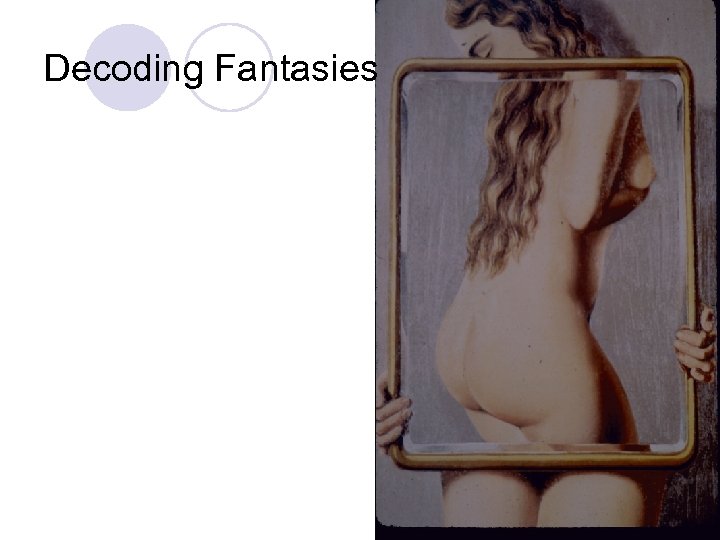 Decoding Fantasies
 Functions of Sexual Fantasy l Sexual fantasy and involvement in eroticism make humans differ from animals l Sex is not only for procreation or display of dominance/violence l Sexual fantasies express individuality and help in overcoming the fear of death l Erotic acts cultivate sensuality l Erotic acts paradoxically express individuality and subordinate individuality l Sexuality and spirituality are related; sex and mysticism share ecstasy (ex stasis: standing out from) l Bataille (1957/1986)
 Themes in Sexual Fantasies l First time and surprise encounters l Idyllic situation or partner l Extension or restriction of time l Multiple partners l Fantasy partners l Longing and anticipation l Violating prohibitions (“forbidden fruit”) l Powerlessness l Dominance and violence l Morin (1995)
 Sex Therapy Views on Sexual Fantasies l Men are primarily visual in their sexual information processing—anything they can see or imagine can become arousing l Women are predominantly kinesthetic or somatic in their sexual information processing—touch or fantasizing about touch is arousing l Other sensory modalities may contribute to fantasies or preferences: hearing, smelling, tasting, moving
 Views on Sexual Fantasies l Women’s sexual schemata (mental templates for organizing incoming information and making choices) are shaped frequently by sex-negative attitudes of home and society (e. g. , “Don’t touch down there”) and restrictive gender role socialization (“Nice girls don’t…) l Women are treated as objects and possessions l Some of their fantasies represent gaining mastery through exaggerated stereotypical behavior: being desired or wanted, being put on display, being dominated or seduced
 Views on Sexual Fantasies l Men’s sexual schemata reflect masculine roles of power, dominance, being able to function or perform, and winning through competition l Men condition sexual preferences and fantasies through masturbatory experiences l Male fantasies may be very explicit or incorporate typically nonsexual objects or functions (e. g. , haircutting fetish) l Many men believe rape myths such as, “A woman may say ‘No, ’ but it’s a man’s role to get her to say ‘Yes’” (justifying coercion)
 Views on Sexual Fantasies l Either gender may fantasize about past lovers, “the one who got away, ” celebrities, or ideals l Either gender may fantasize about sadomasochism: bondage, discipline, humiliation, pain l Either gender may be interested in exhibitionism, voyeurism, cross-dressing, and other paraphilias
 Views on Sexual Fantasies l Sexual fantasies, especially those involving role playing, tend to enact disowned or unrecognized parts of one’s personality l Sexual fantasies and preferences often contain developmental codes of past experiences l Fantasies are compensatory: making up for something that is lost or missing
 Views on Sexual Fantasies may represent efforts to change the past (by gaining mastery): turning childhood tragedy to triumph l Fantasies may represent attempts at stress reduction: overcoming burdensome aspects of selfhood l Fantasies may be meaningless or distressing if enacted
 Views on Sexual Fantasies l Enacting fantasies can become addictive l Enacting fantasies may lead to impairment of normal sexual functioning l Enacting fantasies with one’s partner can be fun and exciting or distressing and abusive
 Harmony
 Talking About Sex l Talk about sex early in the relationship, ideally before you choose to become sexual, before there are conflicts or problems l The novelty and intensity of early sexual relationships tend to obscure meaningful issues and preferences
 Talking About Sex l Start by discussing names for genitals and sex acts l Consider the freedom of disclosure: ¡ From “I don’t want him to know that about me” (shamebased secrecy) ¡ To “What if he knew that about me? ” (curiosity) ¡ To “It might be exciting (or helpful, etc. ) if he knew about me” (readiness, openness) l Respect individual rights: privacy is not the same as secrecy
 Talking About Sex l Talk about simple nonthreatening concerns or preferences, focusing on positives: “I like it when you kiss my neck that way” l Be direct and clear about sexual boundaries or limits to prevent abuse, unwanted sex, and unprotected sex l If it’s difficult to talk about one’s sexuality, talk about sexy books, movies, etc. : what you liked about them
 Talking About Sex l Consider showing erotica that doesn’t violate one’s boundaries or values, focusing on what interests you l Treat sexual preferences (role play, fetish, etc. ) as “coming out” process in which you express your individuality l Introduce related topics (e. g. , gay marriage) to safe friends and family members, later offer specifics with one’s partner or family member
 Talking About Sex l You must be able to say “No, ” in any sexual scenario in order to say “Yes” l When trying out new preferences identify a code or safe word to indicate discomfort or a desire to stop (e. g. , “I’m thinking about lemons right now”) l Use a hand riding technique from sex therapy to redirect or give guidance
 Talking About Sex l Use “I Language” assertion: ¡I feel ______ (feelings first) ¡When ______ (specifying or pinpointing) ¡I understand ______ (empathy) ¡I prefer (want, like, etc. ) ______ (assertion) l While variety is the spice of life, enacting some fantasies can be damaging or addictive and may interfere with capacity for intimacy
 Relationship Contracting (Sager, 1976) l Understanding individual schemas and preferences l Examining unconscious motives l Overcoming projective identification and neurotic pair-bonding l Developing a shared relationship contract ¡ Three wants, needs or preferences in 15 life domains (sex, money, parenting, inlaws, friends) ¡ Needs may be expressed, known, or vaguely felt l Contracting encourages equity and harmony
 Sexual Counseling & Therapy Ethical & Professional Issues
 Countertransference Issues
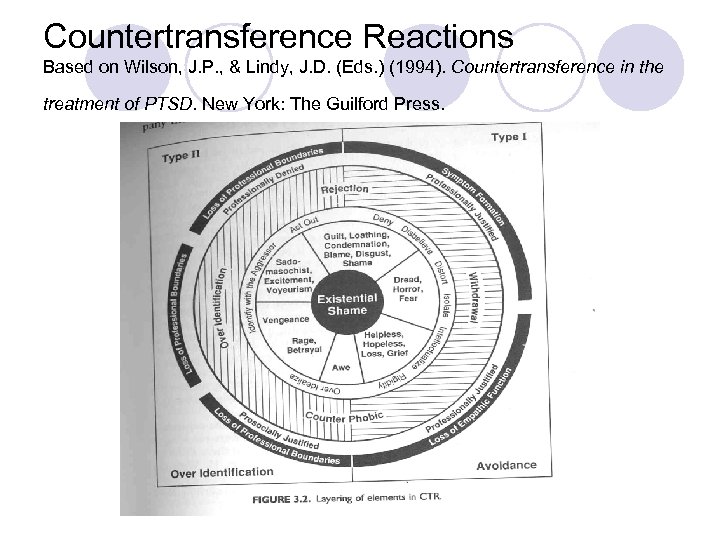 Countertransference Reactions Based on Wilson, J. P. , & Lindy, J. D. (Eds. ) (1994). Countertransference in the treatment of PTSD. New York: The Guilford Press.
 Basic Reactions to a Client’s Story l Objective ¡The normative responses to the person’s trauma or conflict l Subjective ¡Personalized reactions reflecting unfinished business in therapist’s life
 Types of Countertransference Reactions l Type I ¡ Avoidance ¡ Counterphobia ¡ Distancing ¡ Detachment l Type II ¡ Overidentification ¡ Overidealization ¡ Enmeshment ¡ Excessive advocacy
 Modes of Empathic Strain l Empathic withdrawal ¡Blank screen façade ¡Intellectualization ¡Misperception of dynamics l Empathic repression ¡Denial ¡Distancing ¡Idiosyncratic reactions
 Modes of Empathic Strain l Empathic enmeshment ¡Loss of boundaries ¡Overinvolvement ¡Reciprocal dependency l Empathic disequilibrium ¡Uncertainty ¡Vulnerability ¡Unmodulated affect
 Countertransference Reactions and Treatment Outcomes l Cessation of treatment ¡Premature termination ¡Unnecessary or inappropriate referral l Fixation within a phase of recovery l Intensification of trauma-specific transference l Regression l Acting out behavior
 Intersubjectivity l The subjective reactions of the client, therapist, and supervisor to one another reflect the unfinished business and personality of each member of the triad l Countertransference reactions of therapist represent a tool for understanding the client l Parallel processes arising in the client-therapist dyad and therapist-supervisor dyad provide golden opportunities for addressing undisclosed material and working through emotional hurts and conflicts
 Intersubjectivity l The client’s largely unconscious observations of therapist’s functioning are communicated in the client’s disclosure l The therapist’s selective consideration of the client’s material in supervision reveals therapist’s issues and the transference reactions of the client l Inexperienced therapists are afraid to be vulnerable in supervision. They are susceptible to unrecognized countertransference reactions that interfere with treatment
 Attunement in Supervision l Maintaining and strengthening therapeutic alliance l Constructing supervision as a holding environment l Exploring the triadic intersubjective matrix in supervision l Cultivating opportunities for working through countertransference reactions in service to the client’s healing process
 Basic Principles l Establishing vulnerability as the core of supervision l Appreciating therapeutic encounter of supervision l Focusing upon the intersubjective nature of relationships l Embracing the difficult l Working through the pain and shame of the past
 Working Through: A Creative Resolution l Instigation l Imagery l Word Association l Reflection and Affective Association l First Memory l Choice l Evolution of Self
 Working Through: A Creative Resolution l Sharing with Others l Secrets l Self Secrets l Knowledge of Survivors l Identity Issues l Professional Issues l Therapeutic Orientation l Training Issues
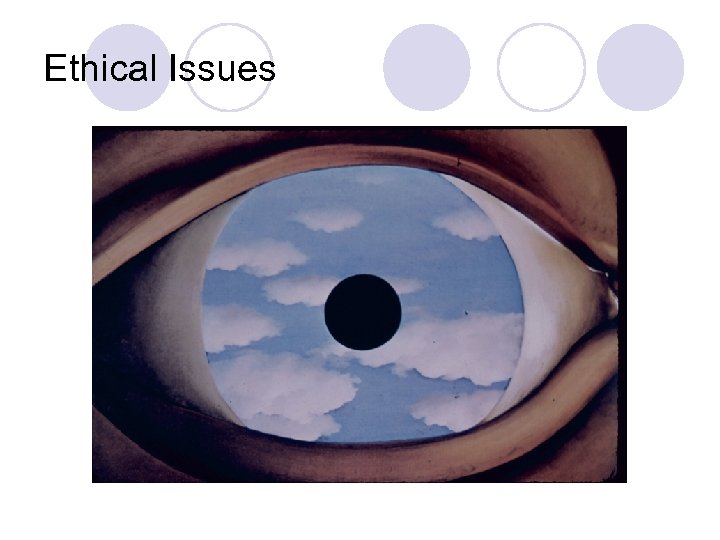 Ethical Issues
 Perspectives on Ethics (Sperry, 2005) l Professional practice disconnected from ethics: view work as job; focus on codes and statutes; goal to avoid risk or censure l Professional practice is informed by ethics; focus on continuing education; goal of competence in career l Professional practice is viewed as integrally linked to ethics: view work as vocational calling; focus on best practices and aspirations; goal of integrating personal values and professional development in public service
 Ethical Issues l Who is the client? (individual versus couple treatment) l Therapist lack of competence (little or no training or supervision) l Confidentiality and disclosure l Respecting client values l Use of pornography/erotica l Work with sex surrogates
 No Such Thing as Couples and Family Counseling According to Arnold Lazarus (Christensen, 2001) l Work with various individuals and combinations of clients in family toward therapeutic goals l No unified couple and family therapy l Therapy involves particular methods not vague models l Dual relationship boundaries are too restrictive and could be harmful l Crossing boundaries with a purpose (e. g. , going to family wedding) could be therapeutic l Divorce need not be harmful to children l Therapists must transcend their training to reclaim natural skills and intuition l Romance and marriage require different skills
 Diagnosis in Marriage and Family Counseling (Crews & Hill, 2005; Hill & Crews, 2005) l Third-party payments may shape counselors toward individual rather than relational diagnoses l Marriage and family counselors may not be competent to make psychiatric diagnoses l Psychiatric diagnoses may not reflect the clinical reality and may not lead to effective treatment l The medical model and systemic approaches are in conflict l Diagnoses obscure cultural issues and may oppress some groups l Misdiagnosis may be stigmatizing, harmful, or fraudulent l The DSM does not fit marriage and family counseling l Are diagnoses ethical compromises?
 Disclosing Family Secrets (Brendel & Nelson, 1999; Fall & Lyons, 2003) l A family without secrets is like a two-year old without tantrums: a rarity (Fall & Lyons, 2003, p. 281) l There are different types of secrets: ¡ Shared family secrets ¡ Internal family secrets ¡ Individual secrets ¡ Conventional secrets ¡ Family rule violations ¡ Taboo topics l Although related, secrecy, privacy, and confidentiality are separate constructs l Generally, the more the secret relates to violation of family rules or the more extreme the taboo, the greater is the need for disclosure l How the couple and family counselor handles secrets is the issue l Counselors should avoid triangulation and other alignments that perpetuate family problems l Clients have the right to informed consent regarding how disclosures will be handled l Counselors should not harm a client system through the process of disclosure l Codes of ethics are biased in favor of reviewing disclosure from the perspective of an individual client’s right to confidentiality l Disclosure is a process not a discrete event
 Addressing Gender Issues (Cottone, 2001; Steigerwald & Forrest, 2004) l Gender issues affect stereotypes and values in counselor and client interactions l Ethical conduct requires careful reflection and examination of sources of biases l Value conflicts arise when helping couples l Gender issues should be addressed in effective work with couples l A clash of values could be resolved by applying social constructivism: “…a philosophical framework that proposes that reality is the creation of individuals in interaction-a socially, consensually agreed-on definition of what is real” (Cottone, 2001, p. 454) l Consensualizing could involve ¡ Obtain information from those involved ¡ Assess the nature of the relationships operating at that moment in time ¡ Consult valued colleagues and professional expert opinion (including ethical codes and literature) ¡ Negotiate when there is a disagreement ¡ Respond in a way that allows a reasonable consensus as to what should happen or what really occurred
 Spiritual and Religious Issues in Counseling: Ethical Considerations (Frame, 2000) l Competence of counselor to explore religious and theological issues l Role confusion: blurring religious and professional roles l Imposing one’s religious or spiritual values on the client(s) l Violating work setting boundaries and expectations by incorporating religious or spiritual practices l Usurping religious authority by performing spiritual disciplines or rituals l (Violating church setting boundaries by introducing professional counseling functions or services, particularly if lacking in training-Southern’s observation)
 Ethical Issues in Psychopharmacology (Murray & Murray, 2007) l Some tension between couple and family counselors and other mental health professionals regarding whether medication is a primary treatment or inappropriate or hazardous l Family counselors should be knowledgeable about psychotropic medications, as well as the roles and functions of other disciplines l Counselors may provide information that could help clients with decision making, informed consent, and compliance l Counselors may view problems in systemic context without becoming involved in “splitting” with another care provider
 Unique Issues in Work with Rural Couples (Weigel & Baker, 2002) l Lack of referral sources l Lack of opportunity for supervision, consultation, and collaboration l Personal and professional isolation l Need to incorporate indigenous practices and resources, as well as paraprofessionals in the counseling process l Inevitability of dual relationships l Need for safeguards to protect client confidentiality
 Sexual Rights (WHO, January 2002) l the highest attainable standard of sexual health, including access to sexual and reproductive health care services l seek, receive and impart information related to sexuality l sexuality education l respect for body integrity l choose their partner l decide to be sexually active or not l consensual sexual relations l consensual marriage l decide whether or not, and when, to have children l pursue a satisfying, safe, and pleasurable sexual life
 Legal and Ethical Implications of Refusing to Counsel Homosexual Clients (Hermann & Herlihy, 2006) l Bruff v. North Mississippi Health Services (2001) l Bruff refused to counsel Jane Doe on how to improve her homosexual relationship because of her religious beliefs l She eventually sued the company when they could not accommodate her beliefs and provide another position l Obligated by virtue of EAP contract to serve all clients l Failure to counsel homosexual clients may constitute harm, even when counselor argues lack of competence
 The Healer
 I am so glad there is always you beyond my scope, Something that stands over, Something I shall never be, That I shall always wonder over, and wait for, Look for like the breath of life as long as I live, Still waiting for you, however old you are, and I am, I shall always wonder over you and look for you. And you will always be with me. I shall never cease to be filled with newness, Having you near me. D. H. Lawrence, Wedlock
 Selected Resources l Arrien, A. (2000). The nine muses: A mythological path to creativity. New York: J. P. Tarcher. l Bachelard, G. (1987). On poetic imagination and reverie. (C. Gaudin, Trans. ). Dallas, TX: Spring Publications. l Barbach, L. (2001). Loving together: Sexual enrichment program. Bristol, PA: Brunner/Mazel. l Bataille, G. (1957/1986). Erotism: Death and sensuality (M. Dalwood, trans. ). San l Francisco, CA: City Lights Books. l Brendel, J. M. , & Nelson, K. W. (1999). The stream of family secrets: Navigating the islands of confidentiality and triangulation involving family therapists. The Family Journal, 7, 112 -117. l Broderick, C. B. , & Schrader, S. S. (1981). The history of marriage and family therapy. In A. S. Gurman & D. P. Kniskern (Eds. ), Handbook of family therapy. New York: Brunner/Mazel. l Carnes, P. , Delmonico, D. L. , & Griffin, E. (2001). In the shadows of the net: Breaking l free of compulsive online sexual behavior. Center City, MN: Hazelden. l Christensen, T. M. (2001). A bold perspective on counseling couples and families: An interview with Arnold A. Lazarus. The Family Journal, 9, 343 -349. l Clayton, A. , Keller, A. , & Mc. Garvey, E. L. (2006). Burden of phase-specific sexual dysfunction with SSRIs. Journal of Affective Disorders, 91, 27 -32. l Clift, W. B. (1982). Jung and Christianity: The challenge of reconciliation. New York: Crossroad.
 Selected Resources l Cooper, A. (1997). The Internet and sexuality: Into the new millennium. Journal of Sex Education and Therapy, 22, 5 -6. l Cooper, A. (2004). Online sexual activity in the new millennium. Contemporary l Sexuality, 38(3), i-vii. l Cooper, A. , Scherer, C. R. , Boies, S. C. , & Gordon, B. L. (1999). Sexuality on the internet: From sexual exploration to pathological expression. Professional Psychology: Research and Practice, 30, 154 -164. l Cottone, R. R. (2001). A social constructivist model of ethical decision making in counseling. Journal of Counseling and Development, 79, 39 -45. l Crews, J. A. , & Hill, N. R. (2005). Diagnosis in marriage and family counseling: An ethical double bind. The Family Journal, 13, 63 -66. l Del Sola Pinto, V. , & Roberts, F. W. (1978). D. H. Lawrence: The complete poems. New York: Penguin Books. l Fall, K. A. , & Lyons, C. (2003). Ethical considerations of family secret disclosure and post-session safety management. The Family Journal, 11, 281 -285. l Feinstein, D. , & Krippner, S. (1988). Personal mythology: The psychology of your evolving self. Los Angeles, CA: J. P. Tarcher. l Feldman, H. A. , Goldstein, I. , Hatzichristou, D. G. , Krane, R. J. , & Mc. Kinlay, J. B. (1994). Impotence and its medical and psychological correlates: Results of the Massachusetts Male Aging Study. Journal of Urology, 151, 54 -61. l Firestone, R. W. , Firestone, L. A. , & Catlett, J. (2006). Sex and love in intimate relationships. Washington, DC: American Psychological Association.
 Selected Resources l Frame, M. W. (2000). Spiritual and religious issues in counseling: Ethical considerations. The Family Journal, 8, 72 -74. l Fromm, E. (2000). The art of loving. New York: Harper. Perennial. (Original work published 1956). l Hayes, R. , & Dennerstein, L. (2005). The impact of aging on sexual function and sexual dysfunction in women: A review of population-based studies. Journal of Sexual Medicine, 2, 317 -330. l Heiman, J. R. (2002 b). Sexual dysfunction: Overview of prevalence, etiological factors, and treatments. Journal of Sex Research, 39, 73 -78. l Hermann, M. A. , & Herlihy, B. R. (2006). Legal and ethical implications of refusing to counsel homosexual clients. Journal of Counseling & Development, 84, 4414 -418. l Hill, N. R. , & Crews, J. A. (2005). The application of an ethical lens to the issue of diagnosis in marriage and family counseling. The Family Journal, 13, 176 -180. l Jackson, G. , Rosen, R. C. , Kloner, R. A. , & Kostis, J. B. (2006). The second Princeton consensus on sexual dysfunction and cardiac risk: New guidelines for sexual medicine. Journal of Sexual Medicine, 3, 28 -36. l Johnson, R. A. (1987). Ecstasy: Understanding the psychology of joy. San Francisco: Harper. Collins. l Kaplan, H. S. (1974). The new sex therapy. New York: Brunner/Mazel. l Kaplan, H. S. (1983). The evaluation of sexual disorders: Psychological and medical aspects. New York: Brunner/Mazel.
 Selected Resources l Laumann, E. O. , Paik, A. , & Rosen, R. C. (1999). Sexual dysfunction in the United States: Prevalence and predictors. JAMA: Journal of the American Medical Association, 281, 537 -544. l Leiblum, S. R. , & Rosen, R. (2000). Principles and practice of sex therapy (3 rd ed. ). New York: Guilford. l Manley, G. (1999). Treating chronic sexual dysfunction in couples recovering from sex addiction and sex coaddiction. Sexual Addiction & Compulsivity, 6, 111 -124. l Masters, W. H. , & Johnson, V. E. (1966). Human sexual response. Boston, MA: Little, Brown & Co. l Masters, W. H. , & Johnson, V. E. (1970). Human sexual inadequacy. Boston, MA: Little, Brown & Co. l Mc. Cabe, M. P. (1997). Intimacy and quality of life among sexually dysfunctional men and women. Journal of Sex and Marital Therapy, 23, 276 -290. l Mc. Carthy, B. W. , & Mc. Carthy, E. J. (2003). Rekindling desire: A step-by-step program to help low sex and no sex marriages. New York: Brunner Routledge. l Morin, J. (1995). The erotic mind: Unlocking the inner sources of sexual passion and l fulfillment. New York: Harper. Collins. l Murray, C. E. , & Murray, T. L. (2007). The family pharm: An ethical consideration of psychopharmacology in couple and family counseling. The Family Journal, 15, 65 -71.
 Selected Resources l Pan American Health Organization. (May 19, 2000). Recent developments in sexual health in the past 25 years. Retrieved October 16, 2007 from http: //www 2. huberlin. de/sexology/GESUND/ARCHIV/PSH. HTM l Pearson, C. S. (1991). Awakening the heroes within: Twelve archetypes to help us find ourselves and transform our world. San Francisco, CA: Harper. San. Francisco. l Peers, E. A. (Trans. & Ed. ). (1989). Interior castle: St. Teresa of Avila. New York: Doubleday. (Original published 1588) l Resnick, S. (1997). Pleasure zone: Why we resist good feelings & how to let go and be happy. Berkeley, CA: Conari Press. l Sager, C. J. (1976). Marriage contracts and couple therapy: Hidden forces in intimate relationships. New York: Brunner/Mazel. l Schneider, J. , & Weiss, R. (2001). Cybersex exposed: Simple fantasy or obsession. Center City, MN: Hazelden. l Schwartz, M. F. , & Southern, S. (2000). Compulsive cybersex: The new tea room. In A. Cooper (Ed. ), Cybersex: The dark side of the force: A special issue of the journal Sexual Addiction & Compulsivity (pp. 127 -144). New York: Routledge. l Sexuality Information and Education Council of the United States. (n. d. ). Making the connection: Sexuality and reproductive health: Life behaviors of a sexually healthy adult. Retrieved October 16, 2007 from http: //www. siecus. com/pubs/cnct 0002. html
 Selected Resources l Sperry, L. (2005). Health counseling with individuals, couples, and families: Three perspectives on ethical and professional practice. The Family Journal, 13, 328 -331. l Steigerwald, F. , & Forrest, A. (2004). An examination of gender and ethics in family counseling-Part 2: A case study approach using a social constructivism model of ethical decision making. The Family Journal, 12, 278 -281. l Tiefer, L. (2001). Arriving at the “New View” of women’s sexual problems: Background, theory, and activism. Women & Therapy, 24, 63 -98. l Weigel, D. J. , & Baker, B. G. (2002). Unique issues in rural couple and family counseling. The Family Journal, 10, 61 -69. l West, S. L. , Vinikoor, L. C. , & Zolnoun, D. (2004). A systematic review of the l literature on female sexual dysfunction prevalence and predictors. Annual Review of Sex Research, 15, 40 -172. l Wilson, J. P. , & Lindy, J. D. (1994). Empathic strain and countertransference (pp. 5 -30). In J. P. Wilson & J. D. Lindy (Eds. ), Countertransference in the treatment of PTSD. New York: The Guilford Press. l World Health Organization. (January 2002). Retrieved October 16, 2007 from http: //www 2. hu-berlin. de/sexology/GESUND/ARCHIV/PSH. HTM l Wolkstein, D. (1992). The first love stories: From Isis and Osiris to Tristan and Iseult. New York: Harper. Perennial. l Zilbergeld, B. (1999). The new male sexuality. New York: Bantam Books.