

Sexuality and Ethics Sources: Mac. Kinnon, Chapters 10

 Скачать презентацию Sexuality and Ethics Sources: Mac. Kinnon, Chapters 10
sexuality_and_ethics.ppt
- Количество слайдов: 24
Sexuality and Ethics Sources: MacKinnon, Chapters 10 and 11 Thiroux and Krasemann, Chapters 13 and 15 Hinman, University of San Diego
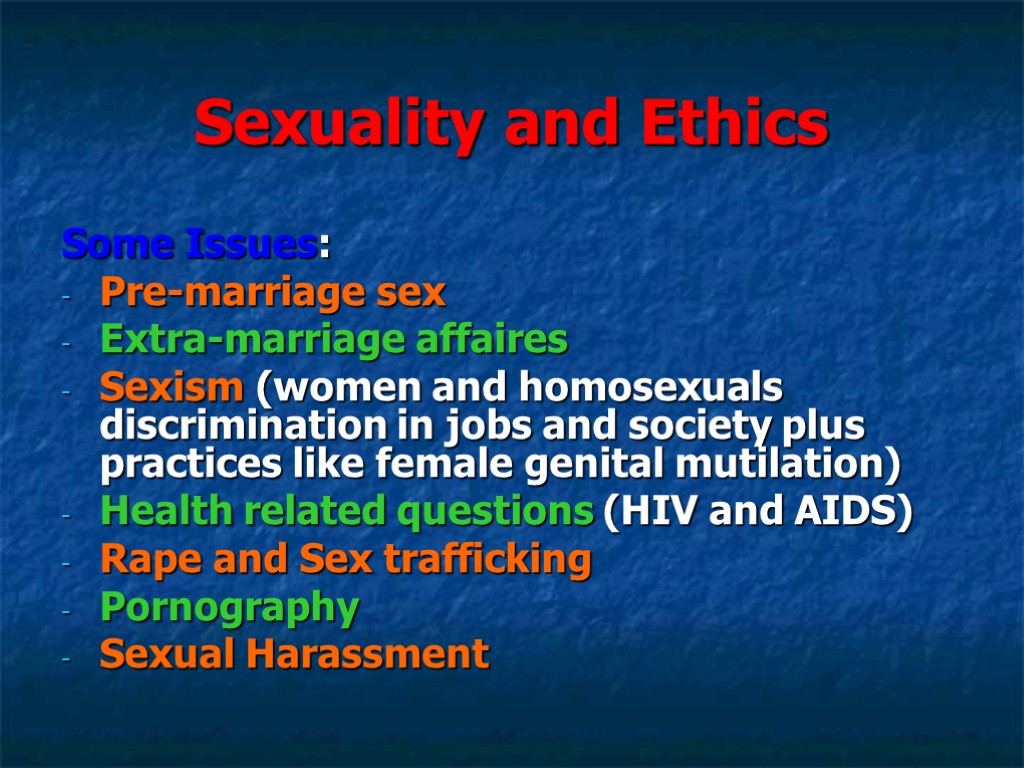
Sexuality and Ethics Some Issues: Pre-marriage sex Extra-marriage affaires Sexism (women and homosexuals discrimination in jobs and society plus practices like female genital mutilation) Health related questions (HIV and AIDS) Rape and Sex trafficking Pornography Sexual Harassment
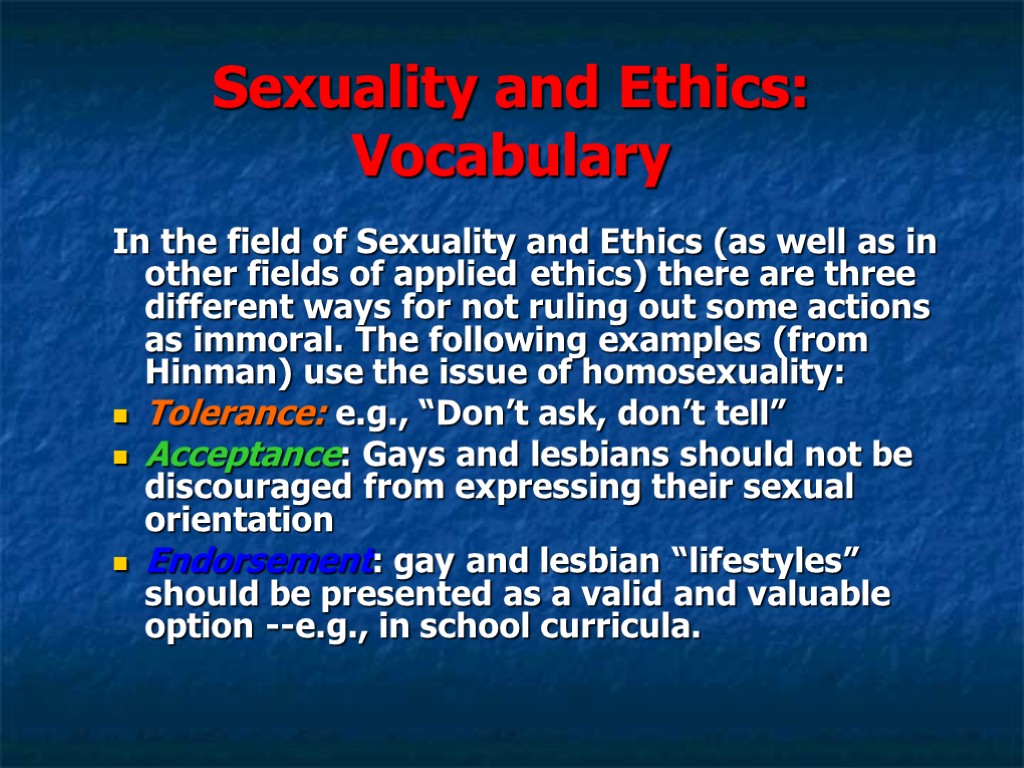
Sexuality and Ethics: Vocabulary In the field of Sexuality and Ethics (as well as in other fields of applied ethics) there are three different ways for not ruling out some actions as immoral. The following examples (from Hinman) use the issue of homosexuality: Tolerance: e.g., “Don’t ask, don’t tell” Acceptance: Gays and lesbians should not be discouraged from expressing their sexual orientation Endorsement: gay and lesbian “lifestyles” should be presented as a valid and valuable option --e.g., in school curricula.
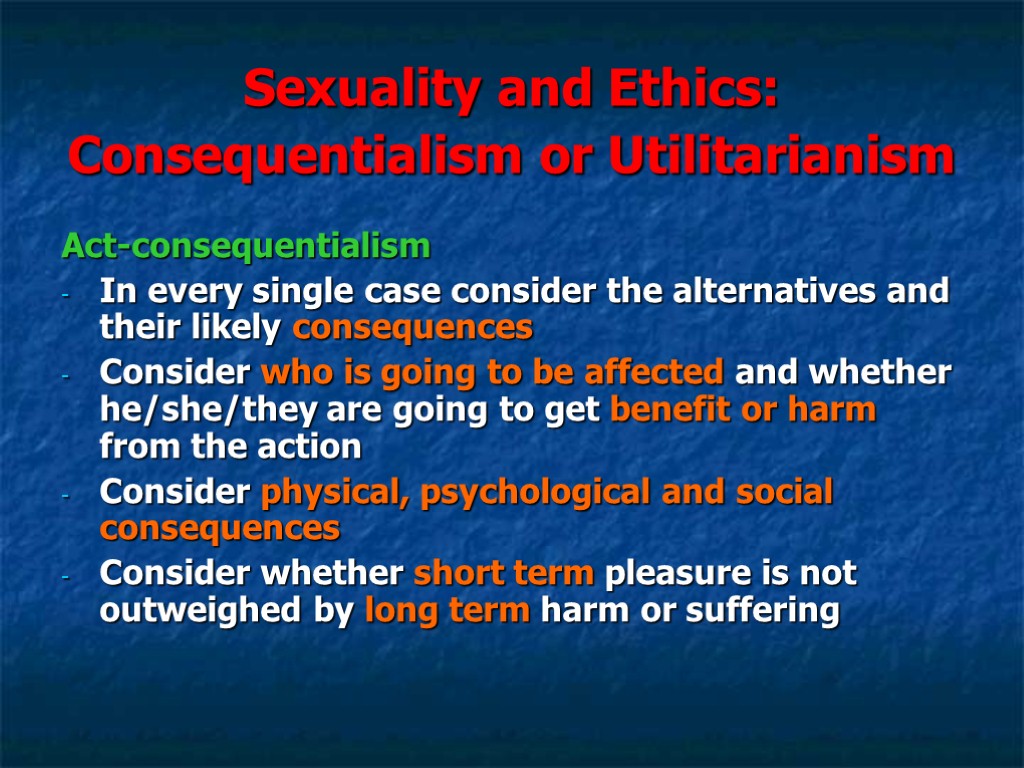
Sexuality and Ethics: Consequentialism or Utilitarianism Act-consequentialism In every single case consider the alternatives and their likely consequences Consider who is going to be affected and whether he/she/they are going to get benefit or harm from the action Consider physical, psychological and social consequences Consider whether short term pleasure is not outweighed by long term harm or suffering
Sexuality and Ethics: Consequentialism or Utilitarianism An Incomplete List of Possible Negative Consequences: Physical harms (for example, sexually transmitted diseases) Psychological harms (for example, being deceived or ‘used’; trauma of forced sex) Social harms (for example, underestimating women’s contribution)
Sexuality and Ethics: Consequentialism or Utilitarianism An Incomplete List of Possible Positive Consequences: Pleasure itself Determining or rebuilding our identities
Sexuality and Ethics: Non-Consequentialism or Kantianism Look at what seems acceptable Consider the other person point of view Free and informed (not lying) relationships: no coercion (unless desired and controlled, for example masochism) therefore ruling out the abuses of children, rape, sexual harassment… (what about things like threatening your partner to break the relationship if he/she refuses some sexual practice?)
Sexuality and Ethics: Nature? Is a sexual relationship natural only when is it consumed between a man and a woman for reproduction? What about contraception? And masturbation? And homosexuality? Or a sexual relationship is natural only insofar as it produces pleasure? What is perversion?
Sexuality and Ethics: Premarital Sex Arguments against: Undermining of traditional morality and family values (family as the pillar of society) Encouragement of promiscuity (‘one-night-stands’ against stability) Social disease and AIDS (versus abstinence) The fostering of guilt and ostracism Having children Compatibility and experience fallacy
Sexuality and Ethics: Premarital Sex Arguments Pro premarital sex Obsolescence of old traditions Social diseases and AIDS (precautions against abstinence) Promiscuity fallacy (many relationship are long-lasting and sometimes lead to marriage; and whose business is this?) The guilt and ostracism fallacy (people are simply not so much concerned about these matters anymore) Contraception and responsibility (and even in case of pregnancy, it is always possible to marry afterwards, if it is desirable) Sexual experience and compatibility (premarital sex is according to this position positively influencing this aspect of our lives) Sexual Pleasure A private, not a public, matter
Sexuality and Ethics: Pornography The difficulty of defining pornography as displaying obscenity (US legislation), where the word obscenity refers to something morally offensive –according to the general and prevailing standards of morality in a particular culture, society or group – and lacking any ‘serious literary, artistic, political or scientific value’ (LAPS test). Is it really clear what is obscene? Or is it a matter of taste?
Sexuality and Ethics: Pornography Arguments Against: It is degrading to humans It has and can further escalate to a greater level of criminality (involving children, for example) It is degrading family values It is degrading women (exploitation and domination) It encourages sex trafficking, rape, homosexuality (?), child molestation, prostitution and all kinds of sexual ‘perversions’
Sexuality and Ethics: Pornography Arguments Pro: Tastes and opinions are a matter of individual discretion: freedom of expression There is no proof that it will degrade our societies (for example, eliminating sexual repression) If it involves actual sexual crimes (child molestation) it is possible to enforce existing laws in these cases
Sexuality and Ethics: Pornography Rephrasing and re-contextualizing: we are not wondering whether pornography is praiseworthy, but whether people should be free or be prevented by law Liberty-limiting principles
John Stuart Mill: ON LIBERTY Three reasons for restricting liberty: A’s restriction of B’s liberty is paternalistic if it is done for B’s own benefit A’s restriction of B’s liberty is moralistic if it is done to ensure that B acts morally or immorally A’s restriction of B’s liberty is an application of the harm principle if A restricts B’s liberty in order to prevent harm to someone other than B
John Stuart Mill: ON LIBERTY One simple principle (applying both to the use of physical force in applying legal penalties and to the moral coercion of public opinion): Liberty can be restricted only in order to PREVENT HARM TO OTHERS “That the sole end for which mankind are warranted, individually or collectively in interfering with the liberty of action of any of their number, is self-protection. That the only purpose for which power can be rightfully exercised over any member of a civilized community, against his will, is to prevent harm to others.”
John Stuart Mill: ON LIBERTY ANTI-PATERNALISM: “His own good, either physical or moral, is not a sufficient warrant. He cannot rightfully be compelled to do or forbear because it will be better for him to do so, because it will make him happier, because, in the opinions of others, to do so would be wise, or even right. […] The only part of the conduct of any one, for which he is amenable to society, is that which concerns others. In the part which merely concerns himself, his independence is, of right, absolute. Over himself, over his own body and mind, the individual is sovereign.”
John Stuart Mill: ON LIBERTY Example: the Unsafe Bridge “If either a public officer or any one else saw a person attempting to cross a bridge which had been ascertained to be unsafe, and there were no time to warn him of his danger, they might seize him and turn him back without any real infringement of his liberty; for liberty consists in doing what one desires, and he does not desire to fall into the river. Nevertheless, when there is not a certainty, but only a danger of mischief, no one but the person himself can judge of the sufficiency of the motive which may prompt him to incur the risk: in this case, therefore, (unless he is a child, or delirious, or in some state of excitement or absorption incompatible with the full use of the reflecting faculty,) he ought, I conceive, to be only warned of the danger; not forcibly prevented from exposing himself to it.”
Sexuality and Ethics: Pornography and the Harm Principle The Harm Principle states that the law might rightly restrict a person from doing what he/she wants only if this action will harm other persons. (Children are excluded, and therefore can be guided in what is the best for them, since they still are unable to understand what is good for themselves) But what is harm? Physical harm Psychological harm (Offense Principle) And when is the harm serious enough for society to intervene?
Sexuality and Ethics: Pornography and the Harm Principle - How does the harm principle relate to pornography? Are there proofs that pornography leads to violent behavior? Balancing the interests of some who can be negatively affected with the effects for some other who can benefit? What about freedom of speech?
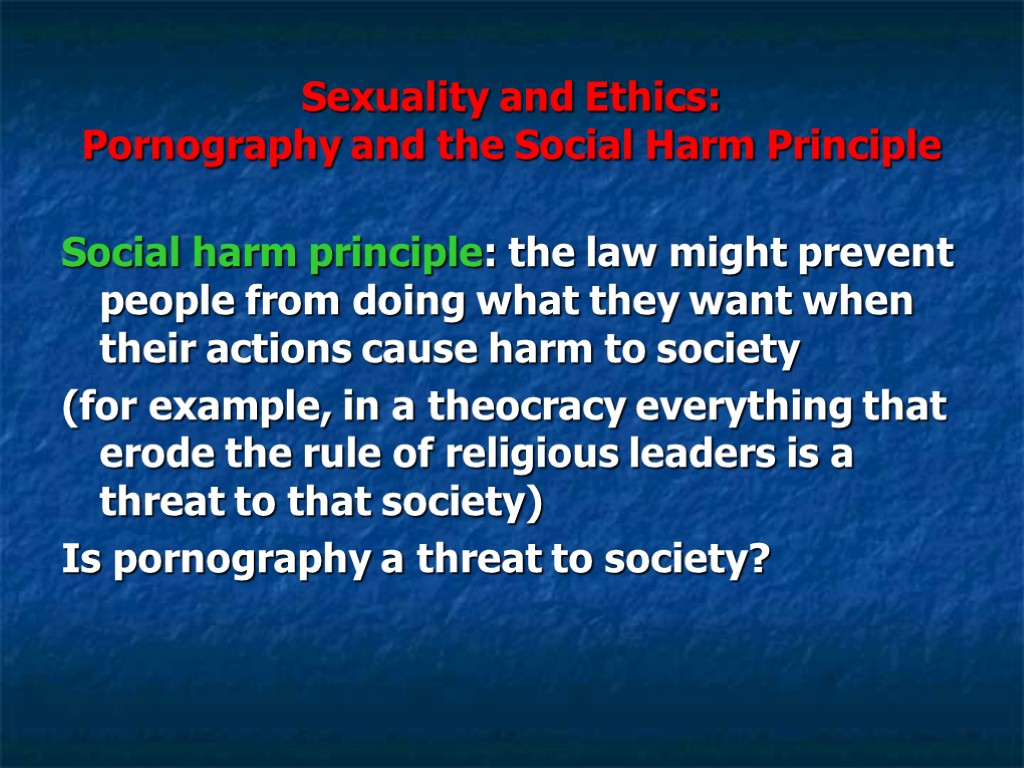
Sexuality and Ethics: Pornography and the Social Harm Principle Social harm principle: the law might prevent people from doing what they want when their actions cause harm to society (for example, in a theocracy everything that erode the rule of religious leaders is a threat to that society) Is pornography a threat to society?
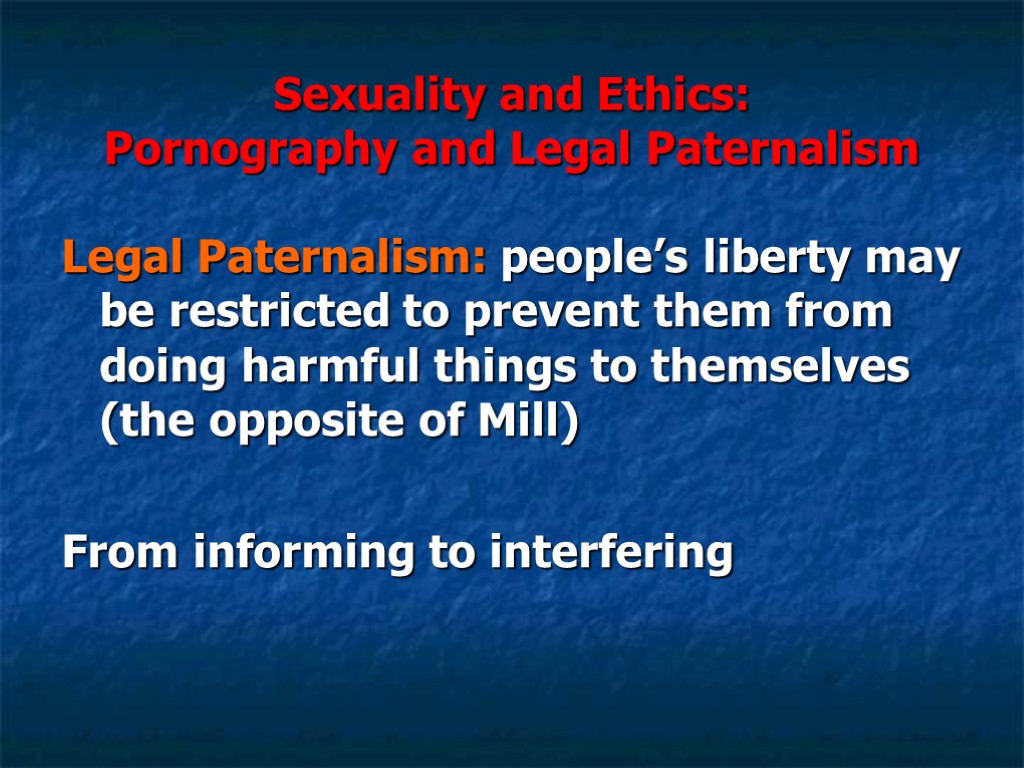
Sexuality and Ethics: Pornography and Legal Paternalism Legal Paternalism: people’s liberty may be restricted to prevent them from doing harmful things to themselves (the opposite of Mill) From informing to interfering
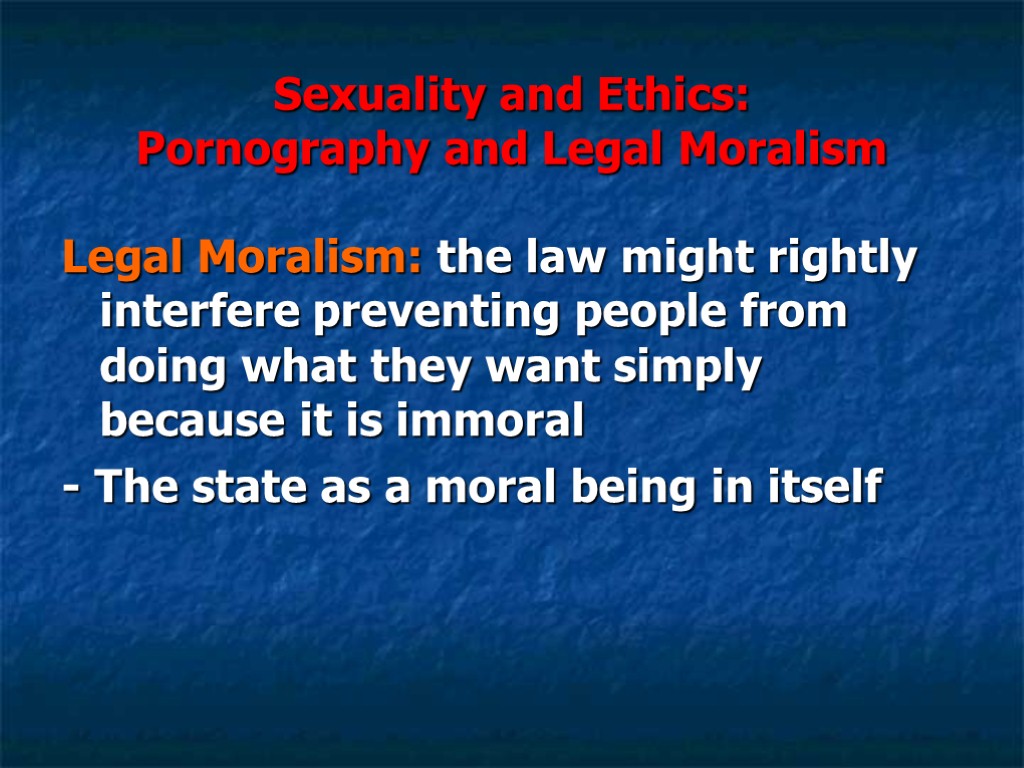
Sexuality and Ethics: Pornography and Legal Moralism Legal Moralism: the law might rightly interfere preventing people from doing what they want simply because it is immoral - The state as a moral being in itself
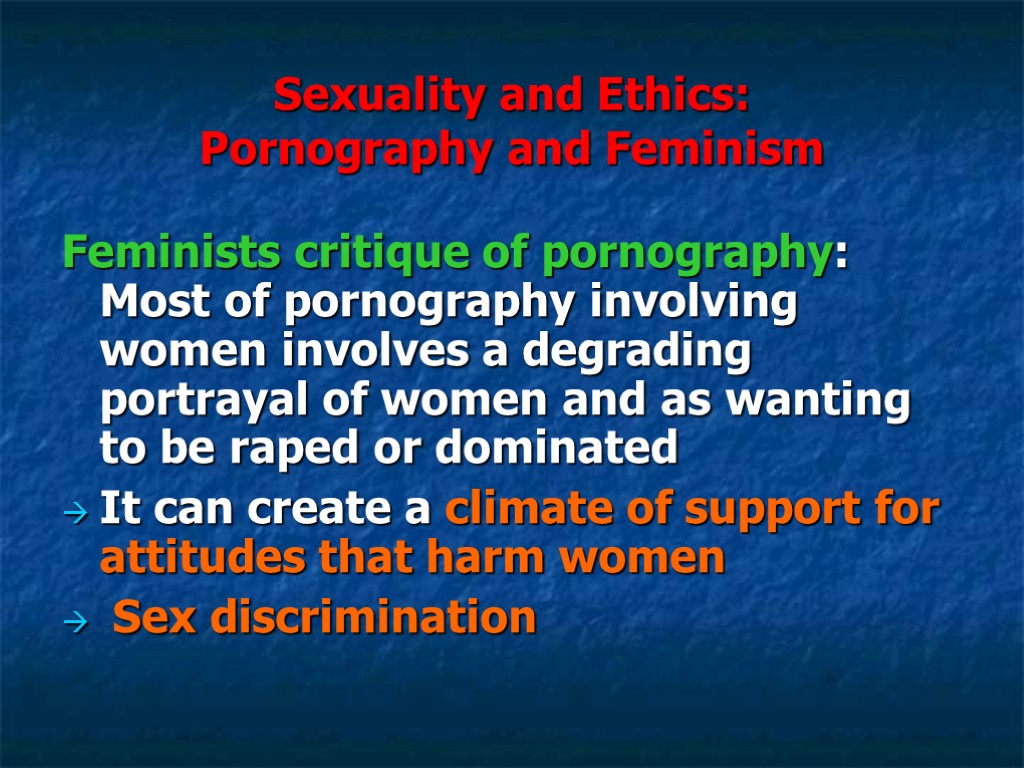
Sexuality and Ethics: Pornography and Feminism Feminists critique of pornography: Most of pornography involving women involves a degrading portrayal of women and as wanting to be raped or dominated It can create a climate of support for attitudes that harm women Sex discrimination