


 Скачать презентацию Sexual Victimization of Children and Adolescents An Overview
c8c5134f8758940912cb9c4bbd381365.ppt
- Количество слайдов: 33
 Sexual Victimization of Children and Adolescents: An Overview Marilyn Kaufhold, MD, FAAP
 Learning Objectives The participant will be able to: • Describe the disclosure process of a young child sexual abuse victim. • List features that distinguish sexual abuse of a young child from that of an adolescent. • Explain societal attitudes that discourage and complicate victimization reporting by adolescents.
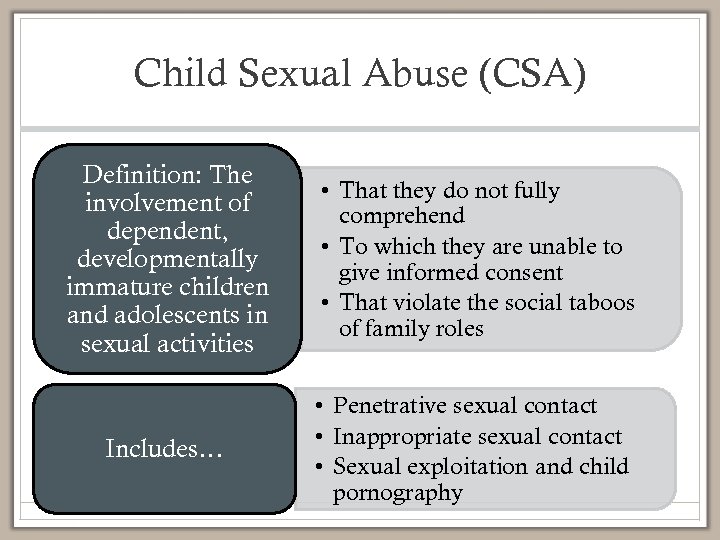 Child Sexual Abuse (CSA) Definition: The involvement of dependent, developmentally immature children and adolescents in sexual activities • That they do not fully comprehend • To which they are unable to give informed consent • That violate the social taboos of family roles Includes… • Penetrative sexual contact • Inappropriate sexual contact • Sexual exploitation and child pornography
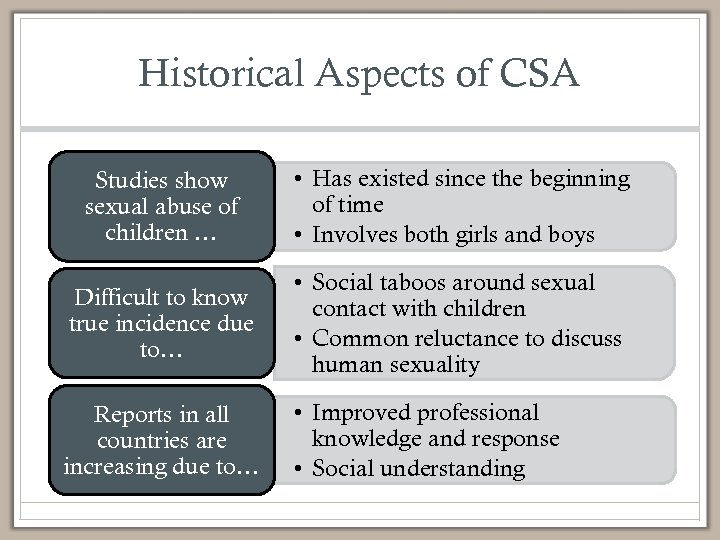 Historical Aspects of CSA Studies show sexual abuse of children … • Has existed since the beginning of time • Involves both girls and boys Difficult to know true incidence due to… • Social taboos around sexual contact with children • Common reluctance to discuss human sexuality Reports in all countries are increasing due to… • Improved professional knowledge and response • Social understanding
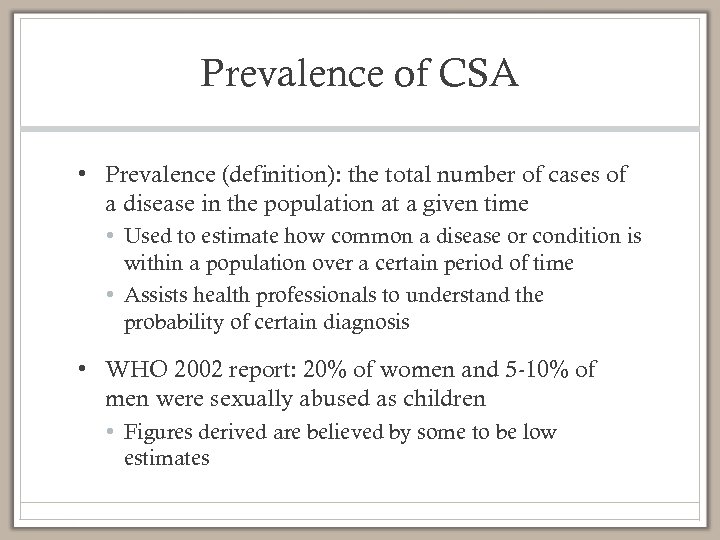 Prevalence of CSA • Prevalence (definition): the total number of cases of a disease in the population at a given time • Used to estimate how common a disease or condition is within a population over a certain period of time • Assists health professionals to understand the probability of certain diagnosis • WHO 2002 report: 20% of women and 5 -10% of men were sexually abused as children • Figures derived are believed by some to be low estimates
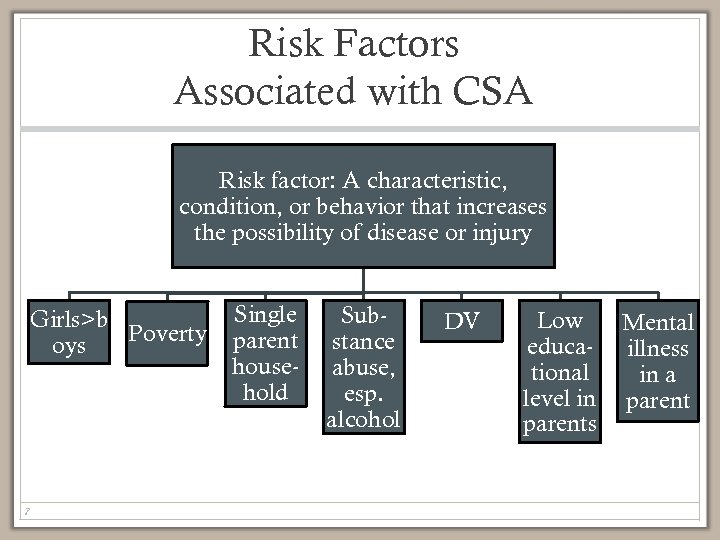 Risk Factors Associated with CSA Risk factor: A characteristic, condition, or behavior that increases the possibility of disease or injury Girls>b Poverty oys 7 Single parent household Substance abuse, esp. alcohol DV Low educational level in parents Mental illness in a parent
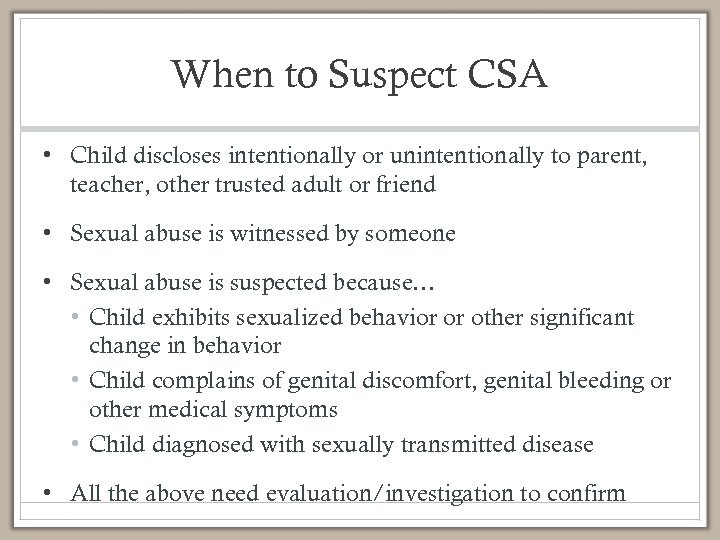 When to Suspect CSA • Child discloses intentionally or unintentionally to parent, teacher, other trusted adult or friend • Sexual abuse is witnessed by someone • Sexual abuse is suspected because… • Child exhibits sexualized behavior or other significant change in behavior • Child complains of genital discomfort, genital bleeding or other medical symptoms • Child diagnosed with sexually transmitted disease • All the above need evaluation/investigation to confirm
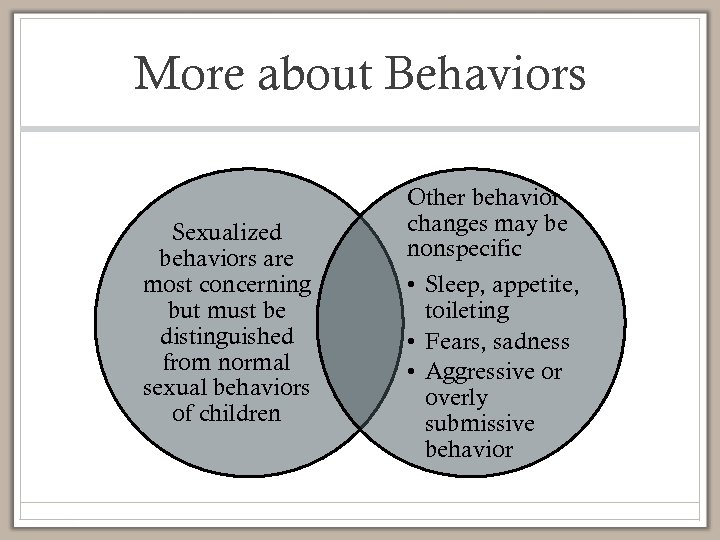 More about Behaviors Sexualized behaviors are most concerning but must be distinguished from normal sexual behaviors of children Other behavior changes may be nonspecific • Sleep, appetite, toileting • Fears, sadness • Aggressive or overly submissive behavior
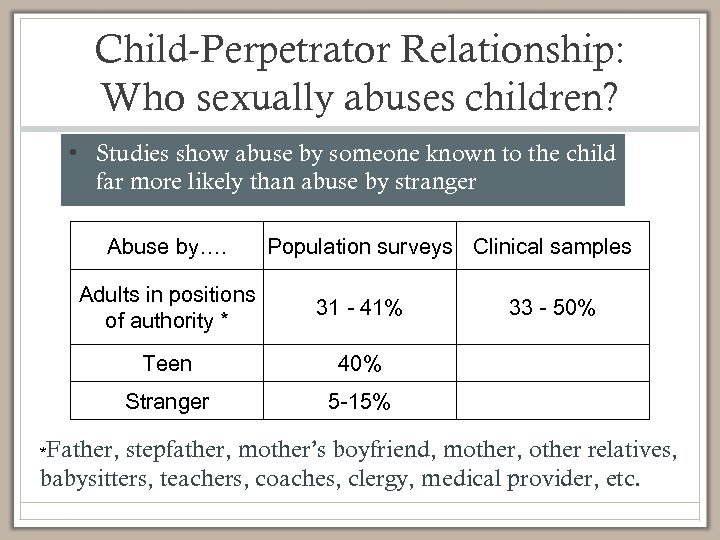 Child-Perpetrator Relationship: Who sexually abuses children? • Studies show abuse by someone known to the child far more likely than abuse by stranger Abuse by…. Population surveys Clinical samples Adults in positions of authority * 31 - 41% Teen 40% Stranger 5 -15% 33 - 50% Father, stepfather, mother’s boyfriend, mother, other relatives, babysitters, teachers, coaches, clergy, medical provider, etc. *
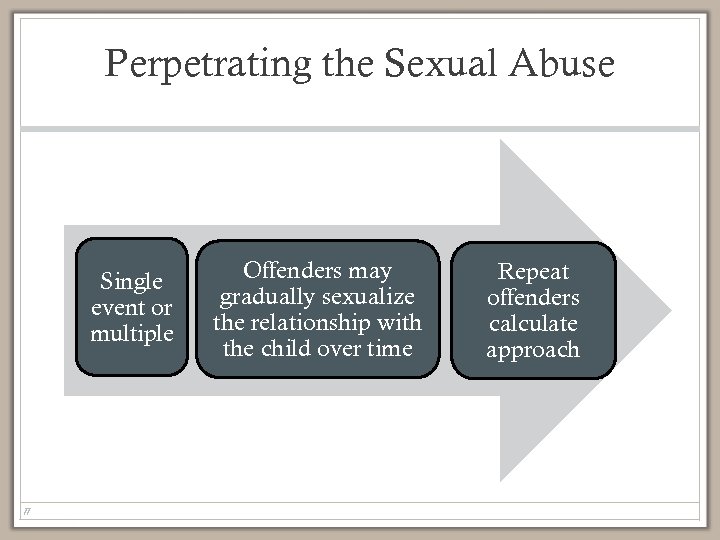 Perpetrating the Sexual Abuse Single event or multiple 11 Offenders may gradually sexualize the relationship with the child over time Repeat offenders calculate approach
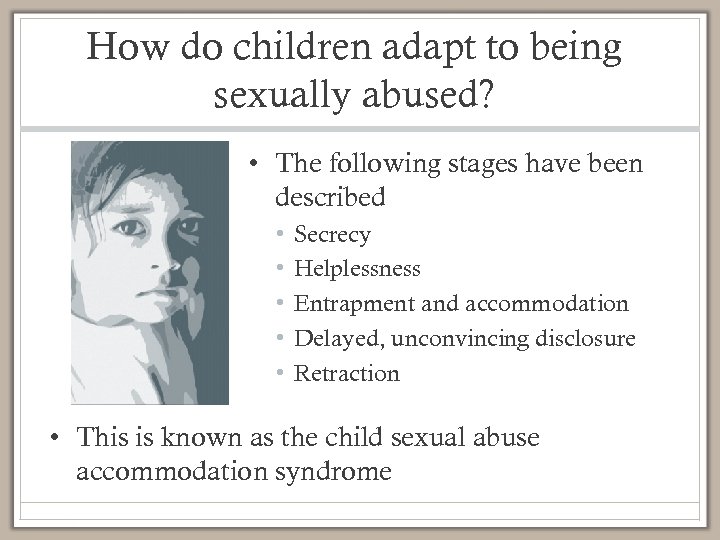 How do children adapt to being sexually abused? • The following stages have been described • • • Secrecy Helplessness Entrapment and accommodation Delayed, unconvincing disclosure Retraction • This is known as the child sexual abuse accommodation syndrome
 Case Discussion • Mother brings her 6 -year-old daughter for a medical examination because she is worried that her daughter is being sexually abused by an uncle. This child goes to the home of the uncle and aunt every day after school because mother works until 6 PM. The aunt and uncle have 3 children around the same age.
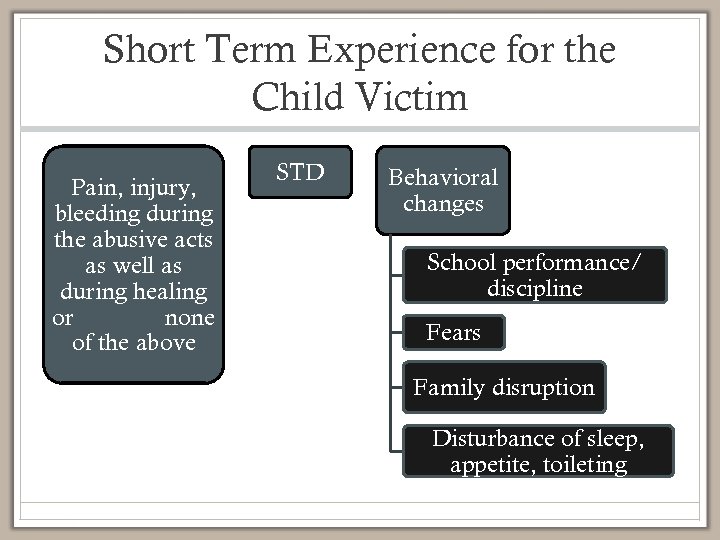 Short Term Experience for the Child Victim Pain, injury, bleeding during the abusive acts as well as during healing or none of the above STD Behavioral changes School performance/ discipline Fears Family disruption Disturbance of sleep, appetite, toileting
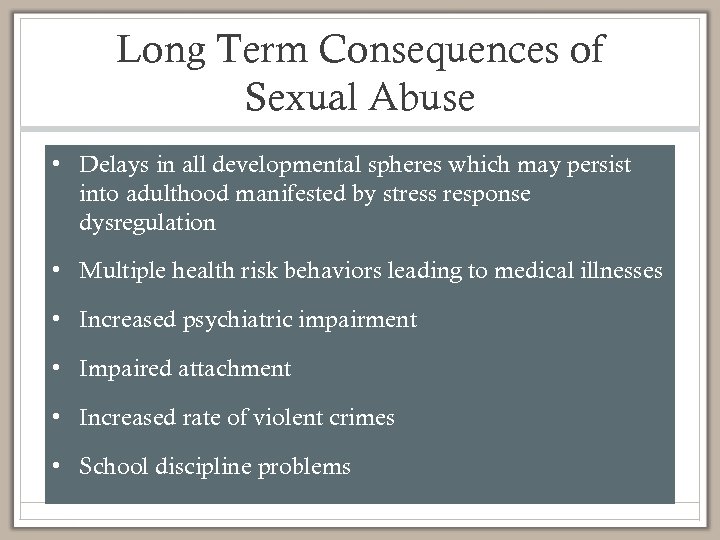 Long Term Consequences of Sexual Abuse • Delays in all developmental spheres which may persist into adulthood manifested by stress response dysregulation • Multiple health risk behaviors leading to medical illnesses • Increased psychiatric impairment • Impaired attachment • Increased rate of violent crimes • School discipline problems
 Young Children v. Adolescents • Both young children and teens can be victims but there are important differences in… • Dynamics – • Perpetrator relationship • Risk factors • Anatomy – sexual immaturity vs. maturity • Injuries – incidence and healing • Medical care – STDs, trauma symptoms 16
 Adolescence: a Paradigm of Chronologic Age Interacting with Biologic Change • Individuals in the developmental phase between childhood and adulthood marked by rapid changes in growth: • Physical • Moral • Psychosocial • Cognitive
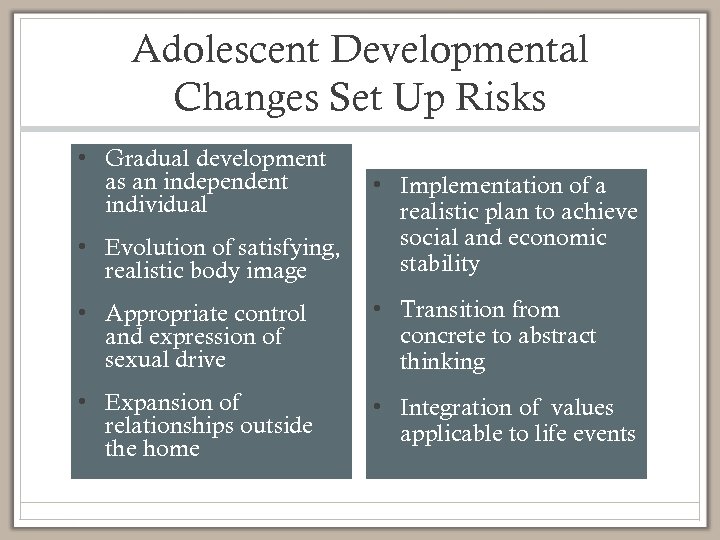 Adolescent Developmental Changes Set Up Risks • Gradual development as an independent individual • Evolution of satisfying, realistic body image • Implementation of a realistic plan to achieve social and economic stability • Appropriate control and expression of sexual drive • Transition from concrete to abstract thinking • Expansion of relationships outside the home • Integration of values applicable to life events
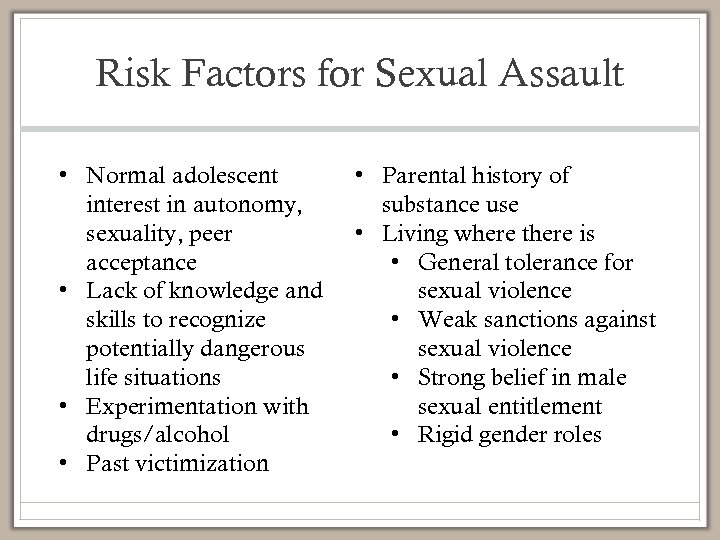 Risk Factors for Sexual Assault • Normal adolescent interest in autonomy, sexuality, peer acceptance • Lack of knowledge and skills to recognize potentially dangerous life situations • Experimentation with drugs/alcohol • Past victimization • Parental history of substance use • Living where there is • General tolerance for sexual violence • Weak sanctions against sexual violence • Strong belief in male sexual entitlement • Rigid gender roles
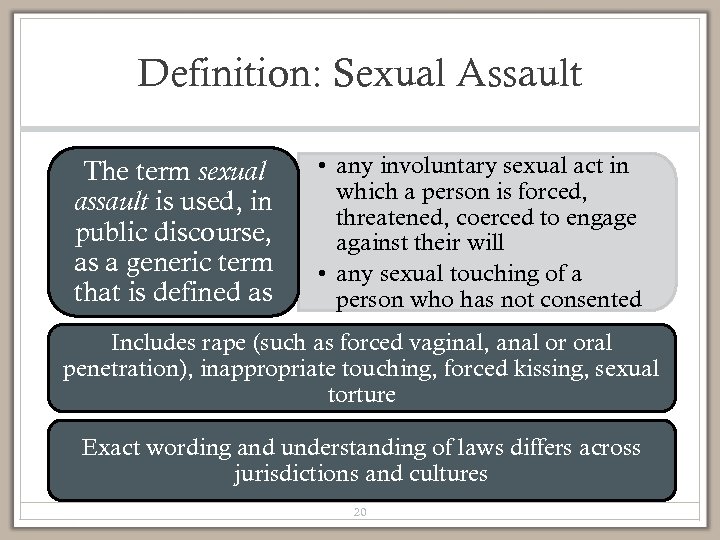 Definition: Sexual Assault The term sexual assault is used, in public discourse, as a generic term that is defined as • any involuntary sexual act in which a person is forced, threatened, coerced to engage against their will • any sexual touching of a person who has not consented Includes rape (such as forced vaginal, anal or oral penetration), inappropriate touching, forced kissing, sexual torture Exact wording and understanding of laws differs across jurisdictions and cultures 20
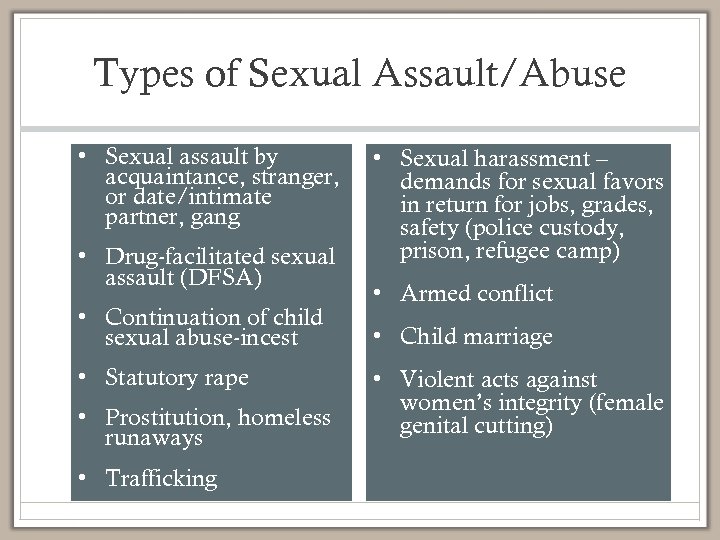 Types of Sexual Assault/Abuse • Sexual assault by acquaintance, stranger, or date/intimate partner, gang • Drug-facilitated sexual assault (DFSA) • Continuation of child sexual abuse-incest • Statutory rape • Prostitution, homeless runaways • Trafficking • Sexual harassment – demands for sexual favors in return for jobs, grades, safety (police custody, prison, refugee camp) • Armed conflict • Child marriage • Violent acts against women’s integrity (female genital cutting)
 How Common is Sexual Assault? WHO 2002 Report • Common • One-third of adolescents report their first sexual experience was forced • Worldwide, hundreds of thousands of women are trafficked annually, most are <25 yr. , many <18 yr. • Between one-third and two-thirds of all victims of sexual assault are

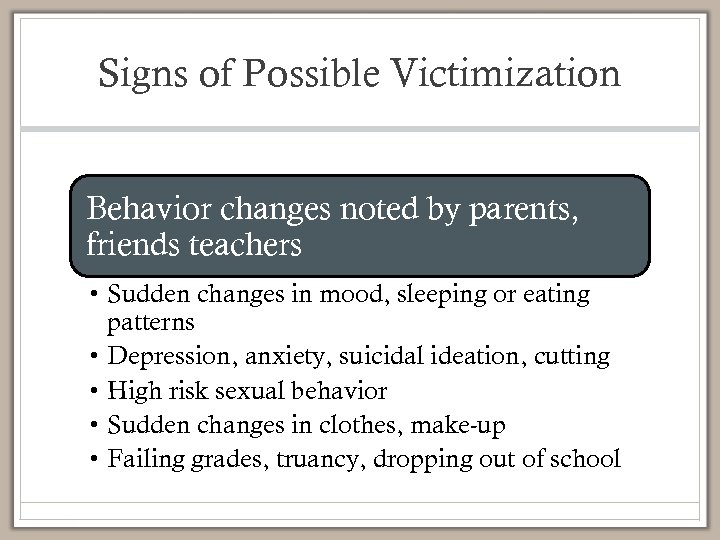 Signs of Possible Victimization Behavior changes noted by parents, friends teachers • Sudden changes in mood, sleeping or eating patterns • Depression, anxiety, suicidal ideation, cutting • High risk sexual behavior • Sudden changes in clothes, make-up • Failing grades, truancy, dropping out of school
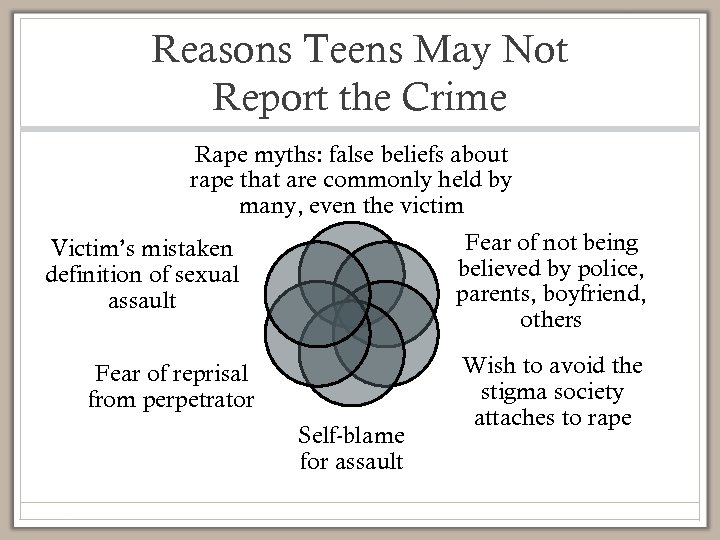 Reasons Teens May Not Report the Crime Rape myths: false beliefs about rape that are commonly held by many, even the victim Fear of not being believed by police, parents, boyfriend, others Victim’s mistaken definition of sexual assault Fear of reprisal from perpetrator Self-blame for assault Wish to avoid the stigma society attaches to rape
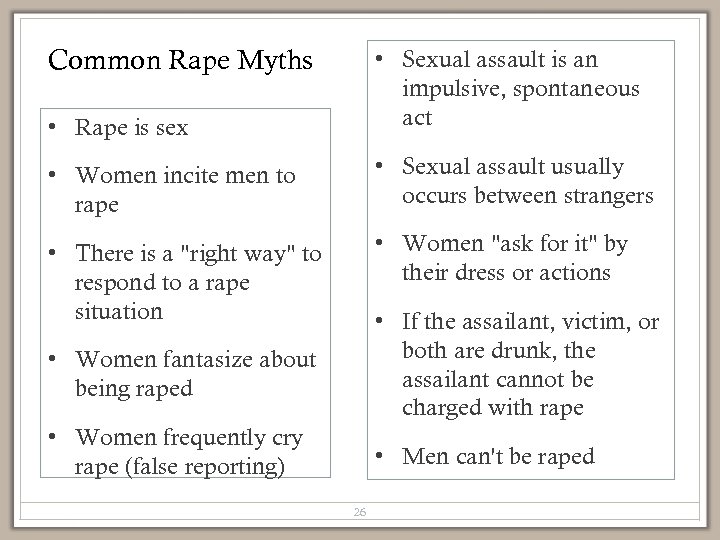 Common Rape Myths • Rape is sex • Sexual assault is an impulsive, spontaneous act • Women incite men to rape • Sexual assault usually occurs between strangers • There is a "right way" to respond to a rape situation • Women "ask for it" by their dress or actions • Women fantasize about being raped • If the assailant, victim, or both are drunk, the assailant cannot be charged with rape • Women frequently cry rape (false reporting) • Men can't be raped 26
 Case Discussion • 15 -year-old girl went with a 17 year-old boy she liked after school to his house in a different neighborhood. They had not dated before. At his house, they talked for a while. He proposed having sex. She said no. He held her down and forced sex. He kept her with him until after she was due home. Then he took her home and told her not to tell anyone.
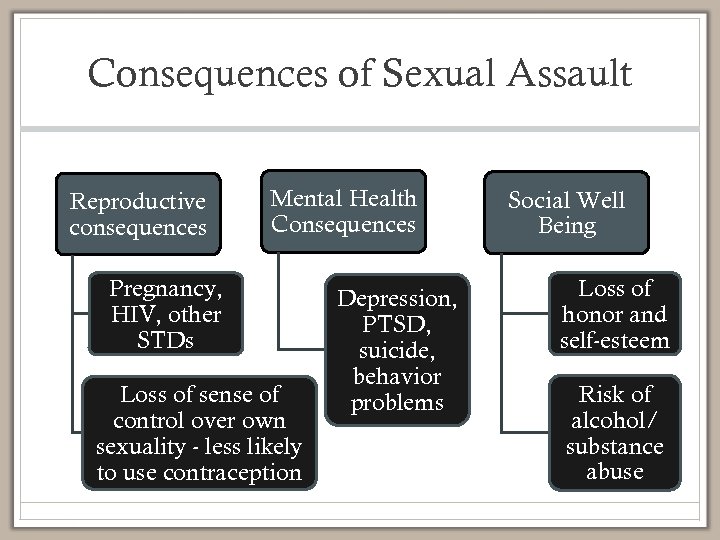 Consequences of Sexual Assault Reproductive consequences Mental Health Consequences Pregnancy, HIV, other STDs Loss of sense of control over own sexuality - less likely to use contraception Depression, PTSD, suicide, behavior problems Social Well Being Loss of honor and self-esteem Risk of alcohol/ substance abuse
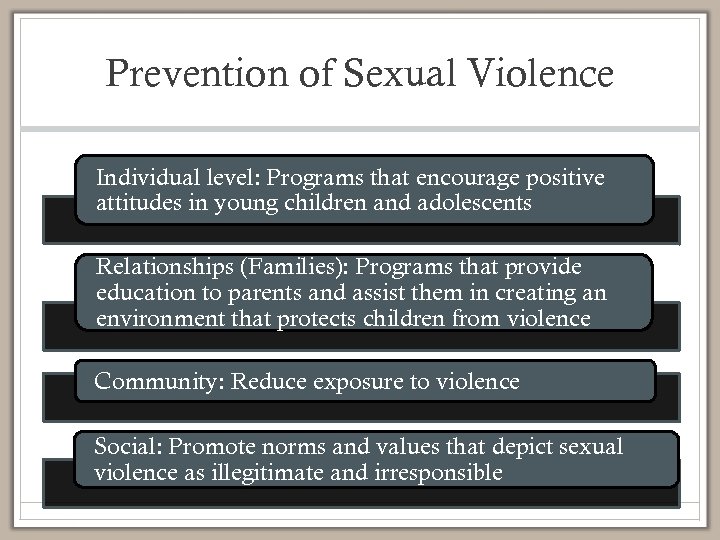 Prevention of Sexual Violence Individual level: Programs that encourage positive attitudes in young children and adolescents Relationships (Families): Programs that provide education to parents and assist them in creating an environment that protects children from violence Community: Reduce exposure to violence Social: Promote norms and values that depict sexual violence as illegitimate and irresponsible
 Questions?
 References • Berliner, L. and D. M. Elliott (1996). Sexual abuse of children. The APSAC Handbook on Child Maltreatment. J. Briere, L. Berliner, J. Bulkley, C. Jenny and T. Reid. Thousand Oaks, CA, Sage Publications: 51 -71. • Bureau of Justice Statistics National Crime Victimization Survey 2010: http: //bjs. ojp. usdoj. gov/index. cfm? ty=pbdetail&iid=4393 • De Bellis, M. , E. Spratt, et al. (2011). "Neurodevelopmental biology associated with childhood sexual abuse. " Journal of Child Sexual Abuse 20: 548 -587.
 • Finkelhor, D. and A. Browne (1985). "The traumatic impact of child sexual abuse: a conceptualization. " Am J Orthopsychiatry 55(4): 530 -541. • Finkelhor, D. (2007). "Prevention of sexual abuse through educational programs directed toward children. " Pediatrics 120(3): 640 -645. • Friedrich, W. N. , J. L. Fisher, et al. (2001). "Child Sexual Behavior Inventory: normative, psychiatric, and sexual abuse comparisons. " Child Maltreat 6(1): 37 -49.
 • Summit, R. (1983). "The child sexual abuse accommodation syndrome. " Child Abuse and Neglect 7: 177 -193. • WHO World Report on Violence and Health 2002: http: //www. who. int/violence_injury_prevention/vi olence/world_report/en/