


 Скачать презентацию Sexual Reproduction and Genetics Chapter 10 p
735ca3388884249259be07a0816fd602.ppt
- Количество слайдов: 43
 Sexual Reproduction and Genetics Chapter 10
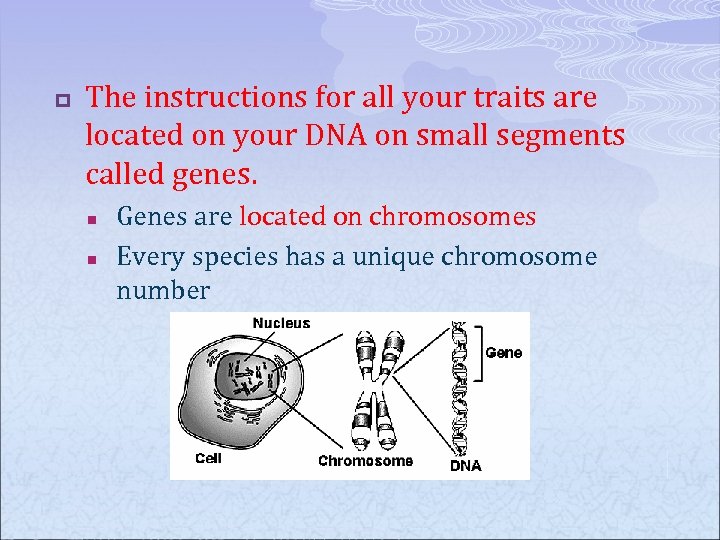 p The instructions for all your traits are located on your DNA on small segments called genes. n n Genes are located on chromosomes Every species has a unique chromosome number
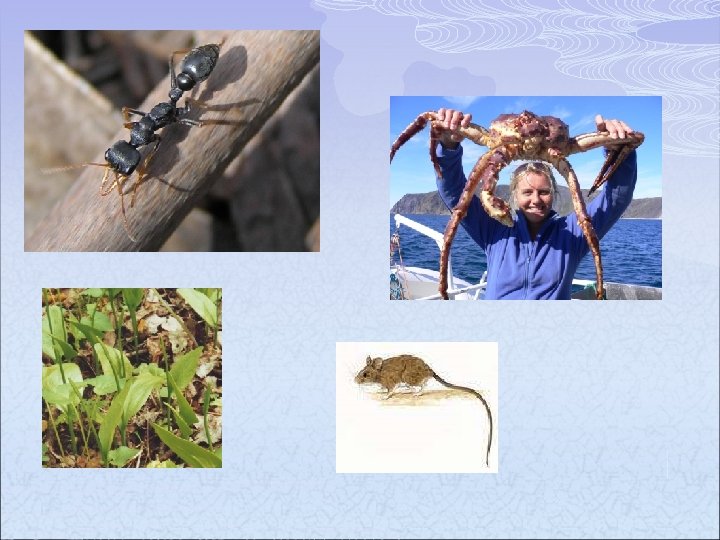
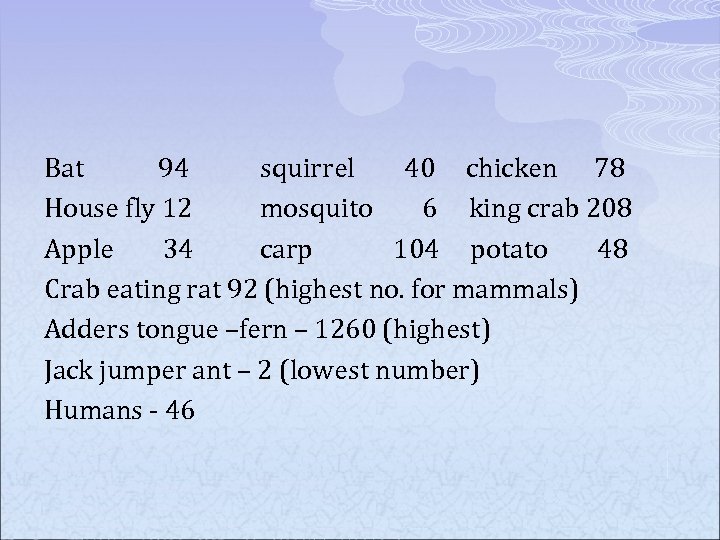 Bat 94 squirrel 40 chicken 78 House fly 12 mosquito 6 king crab 208 Apple 34 carp 104 potato 48 Crab eating rat 92 (highest no. for mammals) Adders tongue –fern – 1260 (highest) Jack jumper ant – 2 (lowest number) Humans - 46
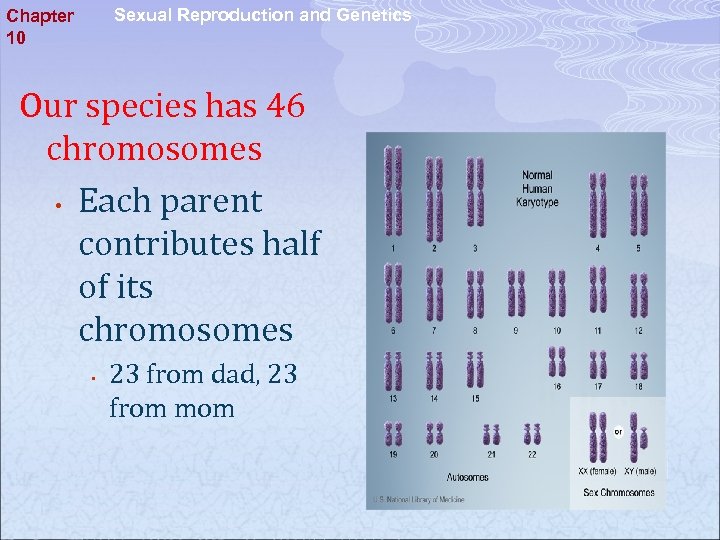 Sexual Reproduction and Genetics Chapter 10 Our species has 46 chromosomes • Each parent contributes half of its chromosomes • 23 from dad, 23 from mom
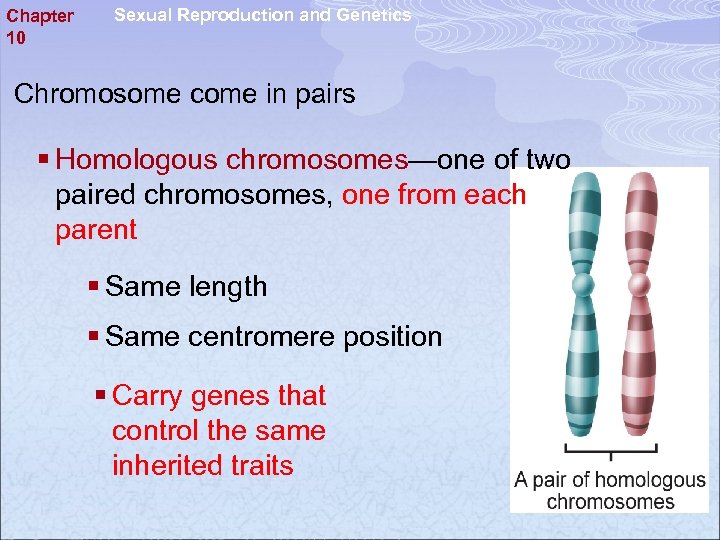 Chapter 10 Sexual Reproduction and Genetics Chromosome come in pairs § Homologous chromosomes—one of two paired chromosomes, one from each parent § Same length § Same centromere position § Carry genes that control the same inherited traits
 Chapter 10 Sexual Reproduction and Genetics Haploid and Diploid Cells An organism produces gametes (sex Cells) to maintain the same number of chromosomes from generation to generation. § Human gametes contain 23 chromosomes. § A cell (sex cells) with n chromosomes is called a haploid cell. § A cell (body cells) that contains 2 n chromosomes is called a diploid cell.
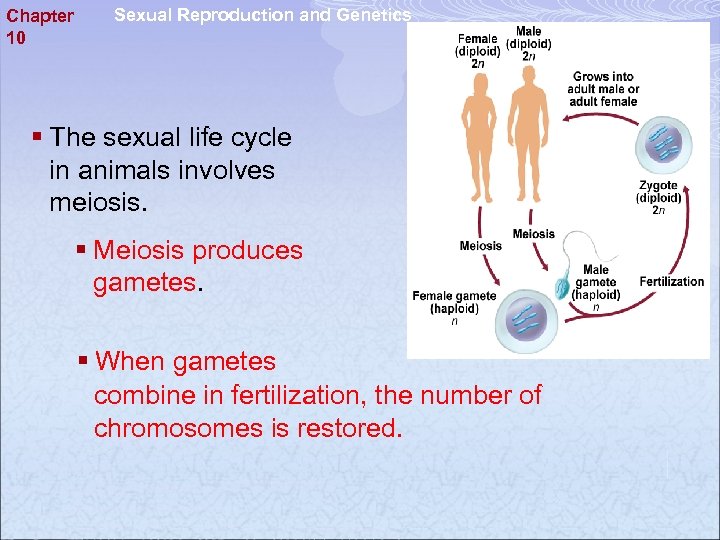 Chapter 10 Sexual Reproduction and Genetics § The sexual life cycle in animals involves meiosis. § Meiosis produces gametes. § When gametes combine in fertilization, the number of chromosomes is restored.
 p What process produces gametes?
 Chapter 10 Sexual Reproduction and Genetics 10. 1 Meiosis § Reduces the chromosome number by half through the separation of homologous chromosomes § Involves two consecutive cell divisions called meiosis I and meiosis II
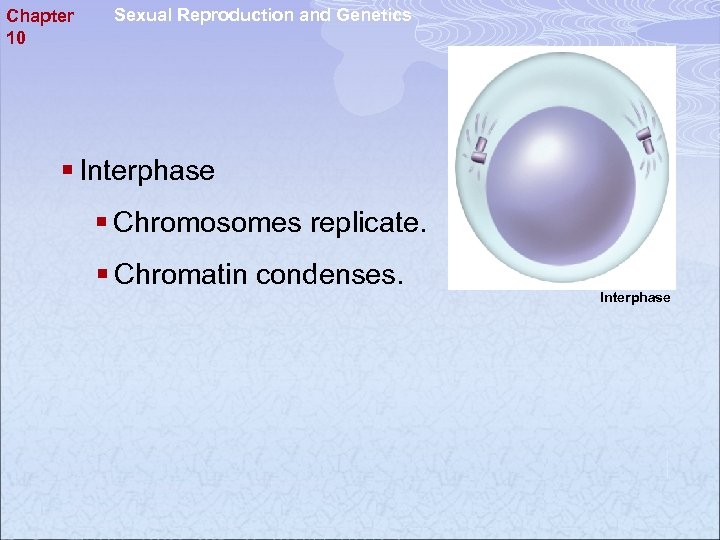 Chapter 10 Sexual Reproduction and Genetics § Interphase § Chromosomes replicate. § Chromatin condenses. Interphase
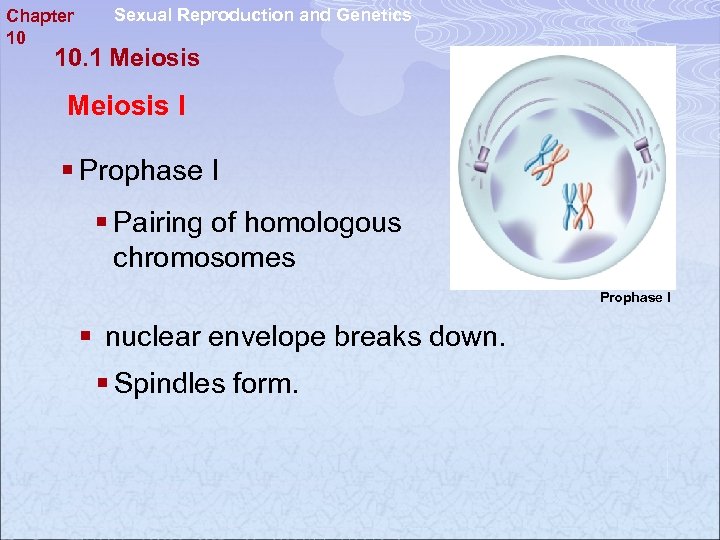 Chapter 10 Sexual Reproduction and Genetics 10. 1 Meiosis I § Prophase I § Pairing of homologous chromosomes Prophase I § nuclear envelope breaks down. § Spindles form.
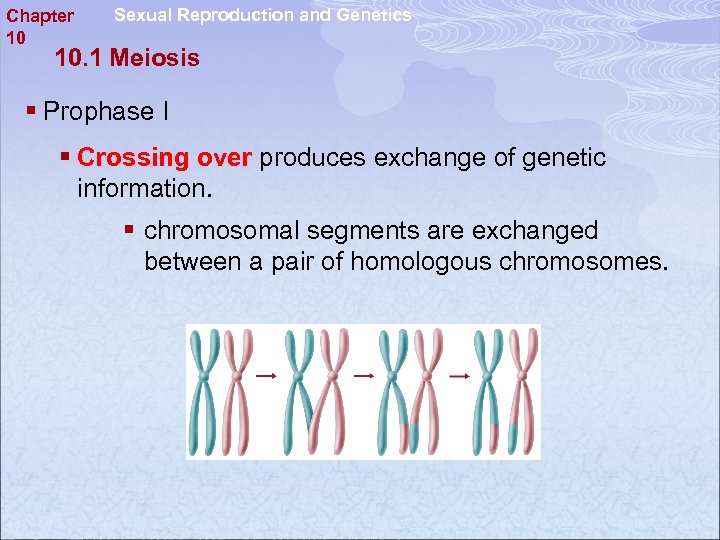 Chapter 10 Sexual Reproduction and Genetics 10. 1 Meiosis § Prophase I § Crossing over produces exchange of genetic information. § chromosomal segments are exchanged between a pair of homologous chromosomes.
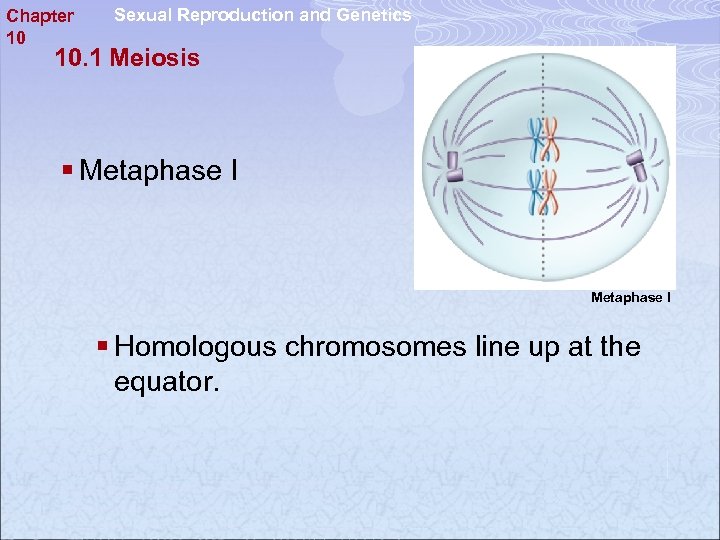 Chapter 10 Sexual Reproduction and Genetics 10. 1 Meiosis § Metaphase I § Homologous chromosomes line up at the equator.
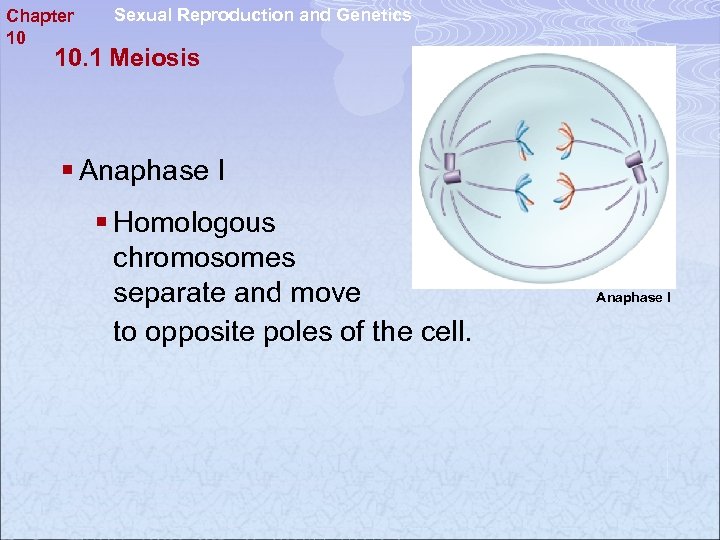 Chapter 10 Sexual Reproduction and Genetics 10. 1 Meiosis § Anaphase I § Homologous chromosomes separate and move to opposite poles of the cell. Anaphase I
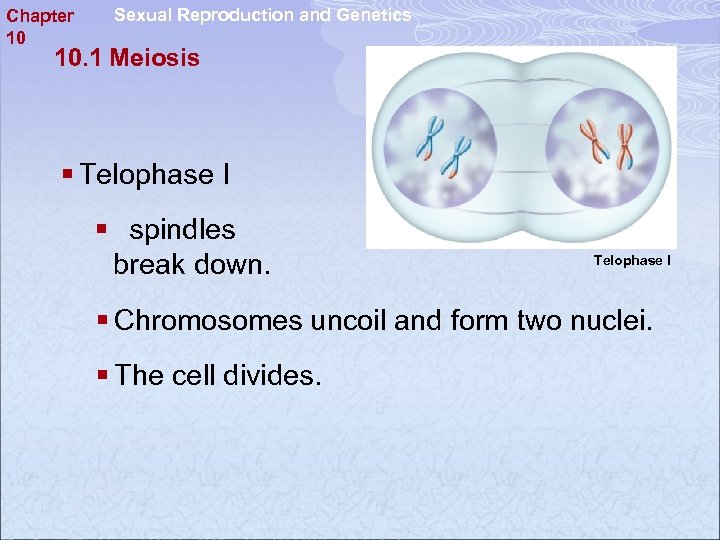 Chapter 10 Sexual Reproduction and Genetics 10. 1 Meiosis § Telophase I § spindles break down. Telophase I § Chromosomes uncoil and form two nuclei. § The cell divides.
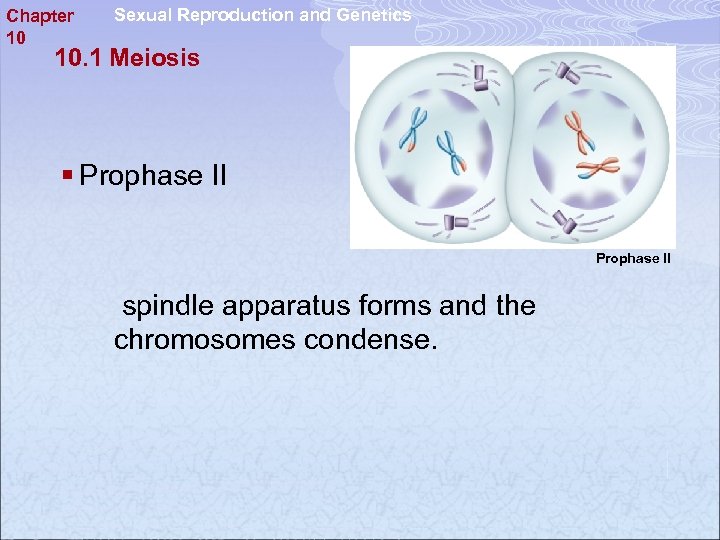 Chapter 10 Sexual Reproduction and Genetics 10. 1 Meiosis § Prophase II spindle apparatus forms and the chromosomes condense.
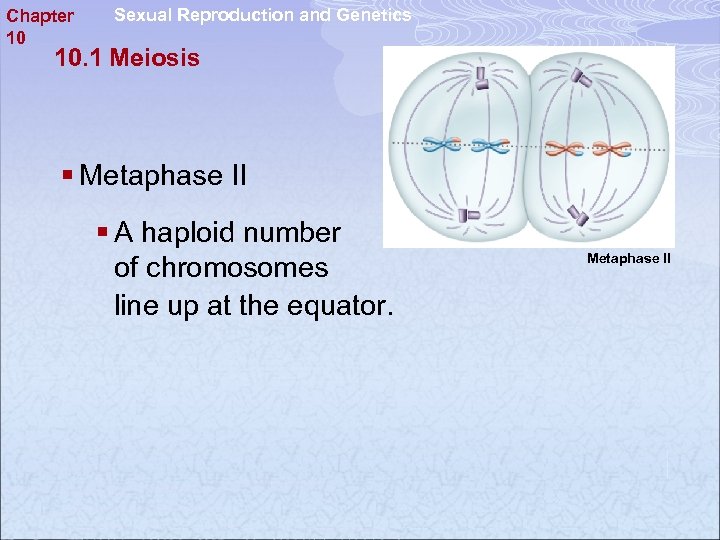 Chapter 10 Sexual Reproduction and Genetics 10. 1 Meiosis § Metaphase II § A haploid number of chromosomes line up at the equator. Metaphase II
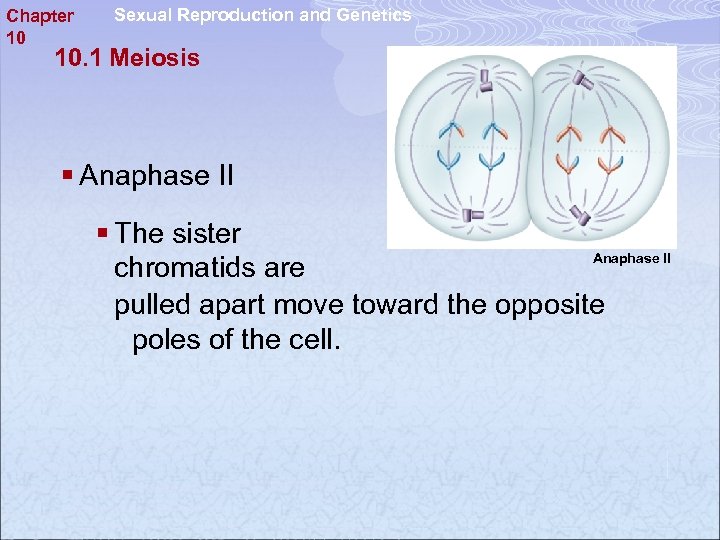 Chapter 10 Sexual Reproduction and Genetics 10. 1 Meiosis § Anaphase II § The sister Anaphase II chromatids are pulled apart move toward the opposite poles of the cell.
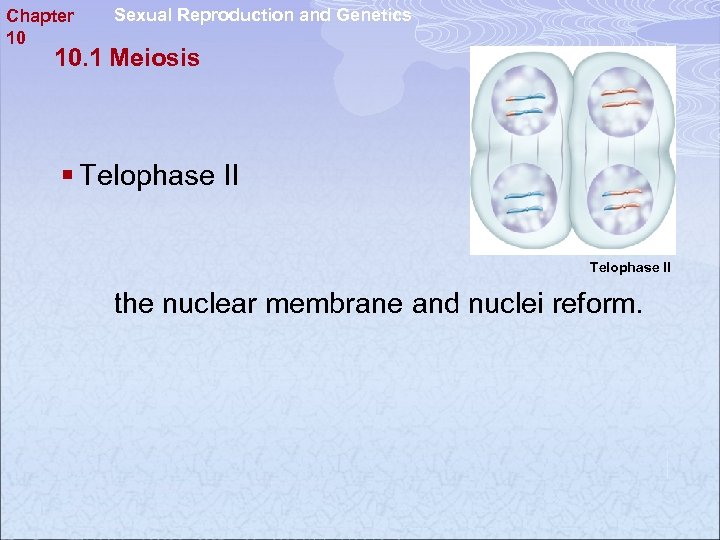 Chapter 10 Sexual Reproduction and Genetics 10. 1 Meiosis § Telophase II the nuclear membrane and nuclei reform.
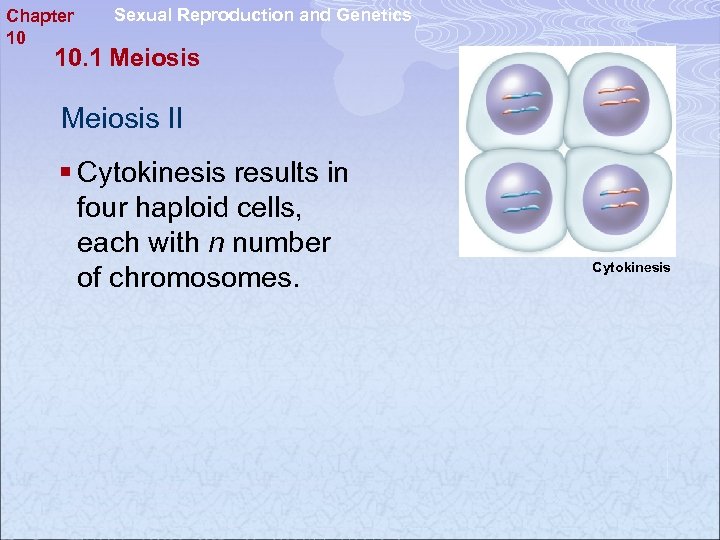 Chapter 10 Sexual Reproduction and Genetics 10. 1 Meiosis II § Cytokinesis results in four haploid cells, each with n number of chromosomes. Cytokinesis
 Meiosis overview
 Chapter 10 Sexual Reproduction and Genetics 10. 2 Mendelian Genetics How Genetics Began § The passing of traits to the next generation is called inheritance, or heredity.
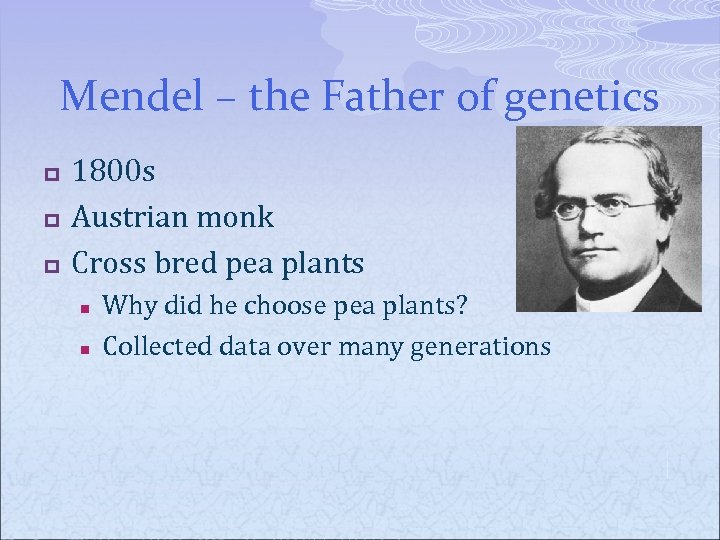 Mendel – the Father of genetics p p p 1800 s Austrian monk Cross bred pea plants n n Why did he choose pea plants? Collected data over many generations
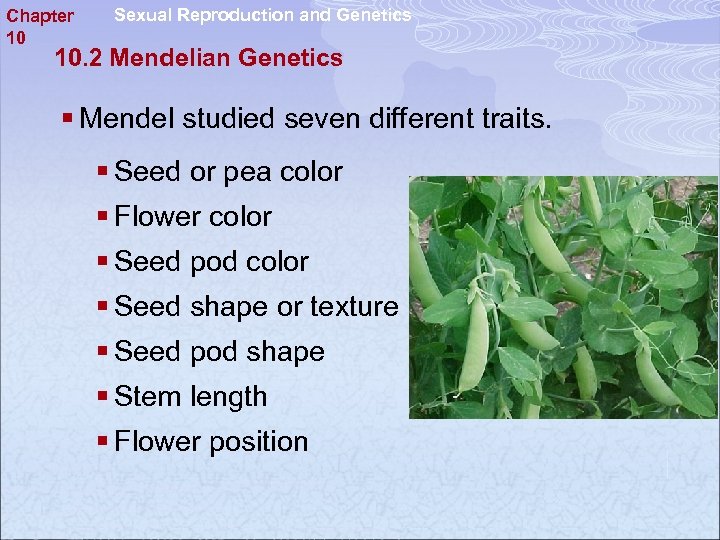 Chapter 10 Sexual Reproduction and Genetics 10. 2 Mendelian Genetics § Mendel studied seven different traits. § Seed or pea color § Flower color § Seed pod color § Seed shape or texture § Seed pod shape § Stem length § Flower position
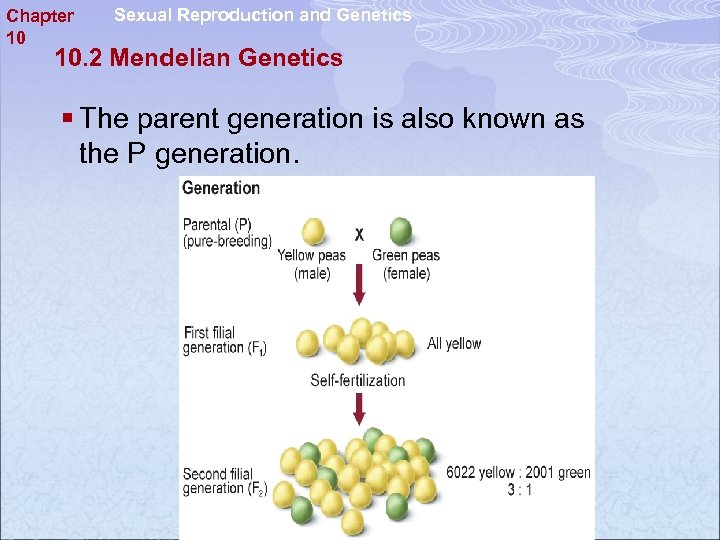 Chapter 10 Sexual Reproduction and Genetics 10. 2 Mendelian Genetics § The parent generation is also known as the P generation.
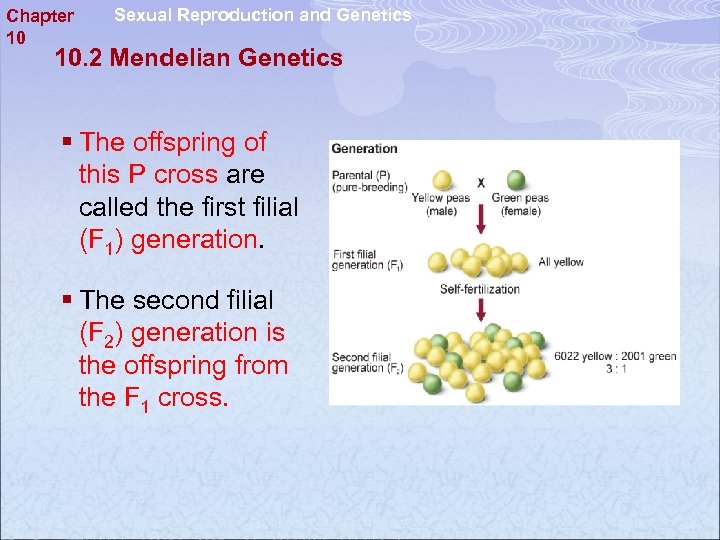 Chapter 10 Sexual Reproduction and Genetics 10. 2 Mendelian Genetics § The offspring of this P cross are called the first filial (F 1) generation. § The second filial (F 2) generation is the offspring from the F 1 cross.
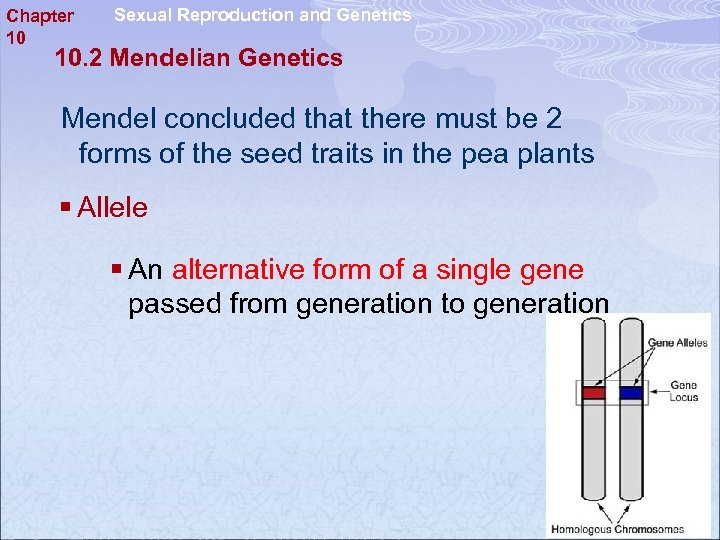 Chapter 10 Sexual Reproduction and Genetics 10. 2 Mendelian Genetics Mendel concluded that there must be 2 forms of the seed traits in the pea plants § Allele § An alternative form of a single gene passed from generation to generation
 p He also concluded that the 3: 1 ratio observed during his experiments could be explained if alleles were paired in each of the plants § Dominant- trait that is expressed in the F 1 generation § Recessive- trait that is masked in the F 2 generation
 Chapter 10 Sexual Reproduction and Genetics 10. 2 Mendelian Genetics Dominance § An organism with two of the same alleles for a particular trait is homozygous § Written as BB or bb § An organism with two different alleles for a particular trait is heterozygous § Written as Bb
 Chapter 10 Sexual Reproduction and Genetics 10. 2 Mendelian Genetics Genotype and Phenotype § An organism’s allele pairs are called its genotype. § The observable characteristic or outward expression of an allele pair is called the phenotype.
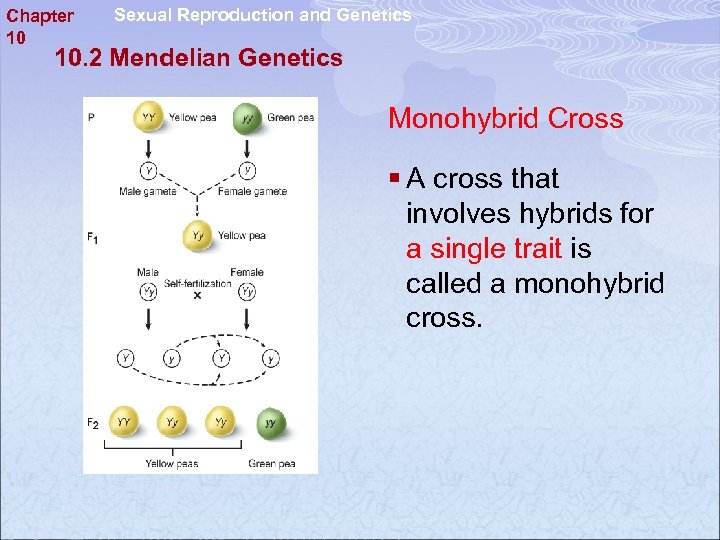 Chapter 10 Sexual Reproduction and Genetics 10. 2 Mendelian Genetics Monohybrid Cross § A cross that involves hybrids for a single trait is called a monohybrid cross.
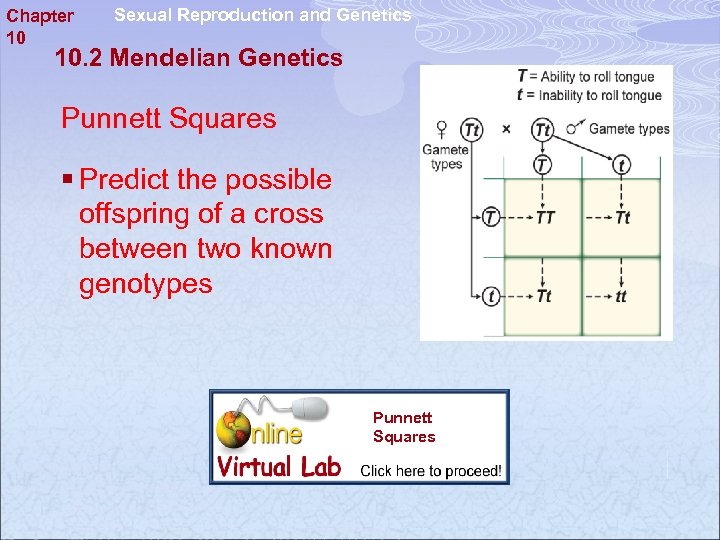 Chapter 10 Sexual Reproduction and Genetics 10. 2 Mendelian Genetics Punnett Squares § Predict the possible offspring of a cross between two known genotypes Punnett Squares

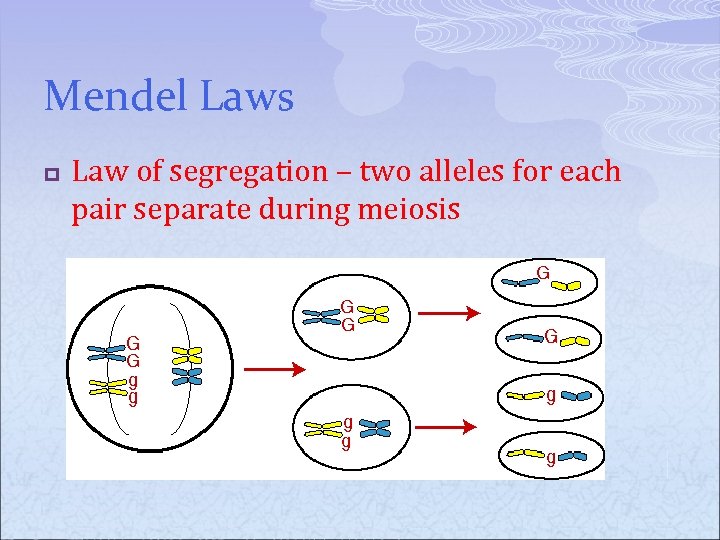 Mendel Laws p Law of segregation – two alleles for each pair separate during meiosis
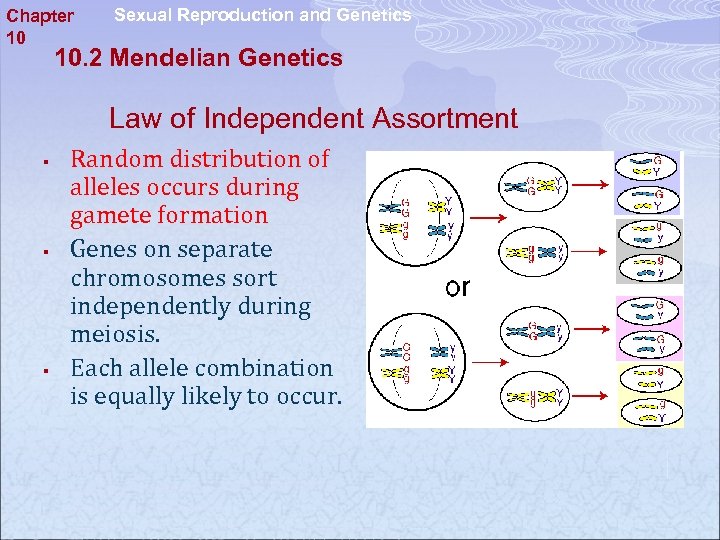 Chapter 10 Sexual Reproduction and Genetics 10. 2 Mendelian Genetics Law of Independent Assortment § § § Random distribution of alleles occurs during gamete formation Genes on separate chromosomes sort independently during meiosis. Each allele combination is equally likely to occur.
 Chapter 10 Sexual Reproduction and Genetics Punnett Square— Dihybrid Cross p. Cross involving 2 traits p Four types of alleles from the male gametes and four types of alleles from the female gametes can be produced. § The resulting phenotypic ratio is 9: 3: 3: 1.
 Chapter 10 Sexual Reproduction and Genetics 10. 2 Mendelian Genetics Dihybrid Cross § The simultaneous inheritance of two or more traits in the same plant is a dihybrid cross. § Dihybrids are heterozygous for both traits.

 Have you ever had some say they saw your “twin” or have you seen someone that looked just like you? Is this ever possible if they are not related to you? ? ?
 Chapter 10 Sexual Reproduction and Genetics 10. 3 Gene Linkage and Polyploidy Genetic Recombination § The new combination of genes produced by crossing over and independent assortment § Combinations of genes due to independent assortment can be calculated using the formula 2 n, where n is the number of chromosome pairs. § For us that would be 223 times 2 23 (after fertilization) or over 70 trillion possible combinations!!
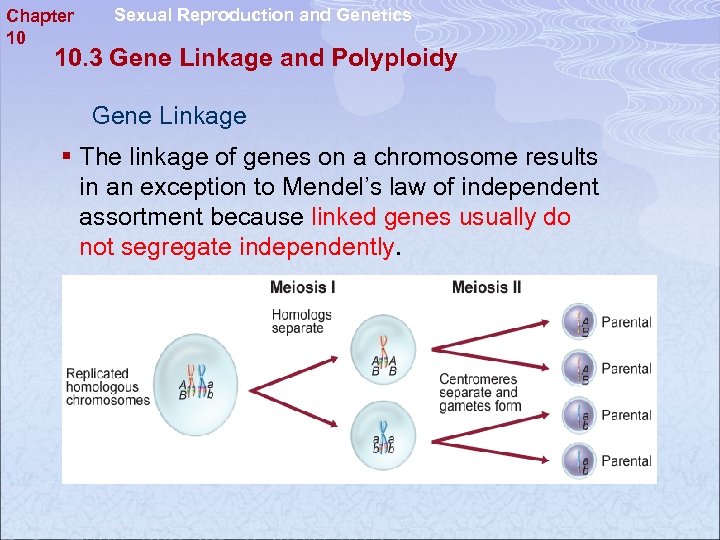 Chapter 10 Sexual Reproduction and Genetics 10. 3 Gene Linkage and Polyploidy Gene Linkage § The linkage of genes on a chromosome results in an exception to Mendel’s law of independent assortment because linked genes usually do not segregate independently.
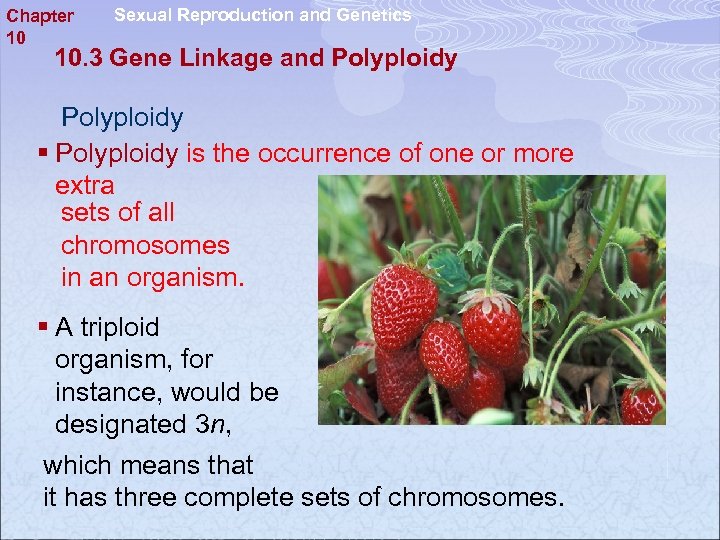 Chapter 10 Sexual Reproduction and Genetics 10. 3 Gene Linkage and Polyploidy § Polyploidy is the occurrence of one or more extra sets of all chromosomes in an organism. § A triploid organism, for instance, would be designated 3 n, which means that it has three complete sets of chromosomes.