 Скачать презентацию Severin de Wit Out of the Box IP
9665791f290a3d6d0d4617215d642d1b.ppt
- Количество слайдов: 15



Severin de Wit Out of the Box IP Strategies for Europe
Use of Publication 18 Month Patent Applications n In 2004, the director of Japan’s External Trade Organization’s Intellectual Property Rights Office in Beijing visited a leading Chinese company. The head of that corporation’s IPdivision showed him a room with several dozen computers whose exclusive purpose was to search the patent applications put up on the Internet by the USPTO and its equivalent in Japan and Europe. The Chinese executive explained it was easier and far less expensive to pull information from foreign patent applications than to do their own research. n When informed of this, the Japanese Patent Office began monitoring the number of hits patent application files on the Net were getting. They counted 17, 000 hits per day from China and 55, 000 per day from South Korea. 2 / Live. Link number
From the World’s Workshop to IP Powerhouse n Why is IP always on the top of US diplomatic agendas? n Being the World’s Cheapest Workshop is Not Enough – costs of manufacturing ++ – US & EU vast knowledge based economy – US & EU R&D output transformed in IP – causes Chinese companies to buy in IP from US & Europe – Competitive effects on China’s entering the EU market n Lessons learned from Korea & Japan recent IP experiences 3 / Live. Link number
IP on the US & EU top agenda, why? n Two views – “Make Belief” theory: IP to combat counterfeit to protect western industries from being robbed of their IP (trademarks, copyrights)? – Competition Theory: find ways for US & EU R&D outputs to be paid for by Chinese companies (if we can’t beat them in manufacture, let them pay for Western developed R&D) n By doing so, raising the competitiveness of Western companies against lower cost Chinese and Indian manufacture 4 / Live. Link number
Being the World’s Cheapest Workshop is Not Enough n To compete on the EU & US market Chinese companies have to pay “world market prices”, consisting of – manufacturing price – price for hitting IP by US & EU companies on world market – forcing Chinese companies to take licenses in – raising the costs of selling of manufactured products – loosing competitive edge 5 / Live. Link number
Raising the Numbers Will Not Do n Does it help to increase the number of patent applications both in and outside China? n No, as – Filings outside China by Japan, Korea, US & EU at USPTO, EPO, KRO and JPO increase as well – Filings inside China at Chinese Patent Office also increase, both by Residents and Non-Residents n Focusing on publication of 18 month applications won’t help either (example) 6 / Live. Link number
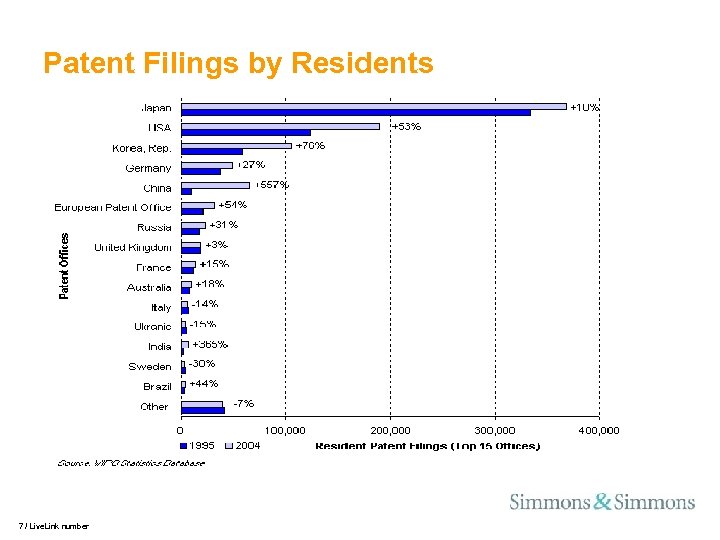
Patent Filings by Residents 7 / Live. Link number
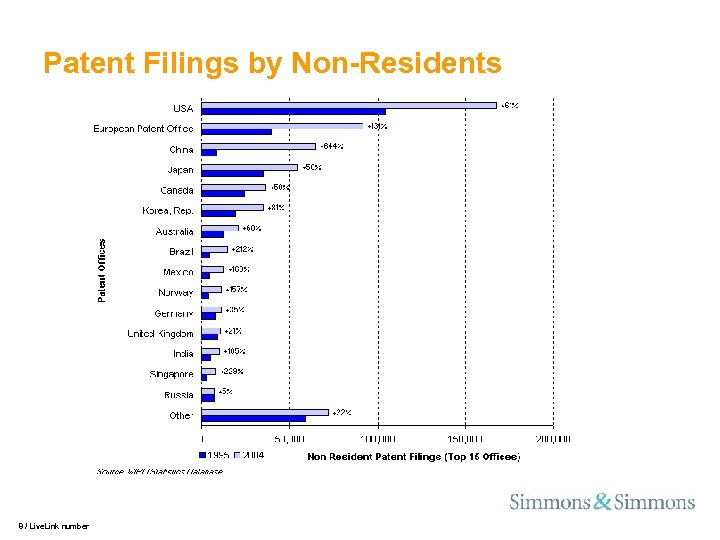
Patent Filings by Non-Residents 8 / Live. Link number
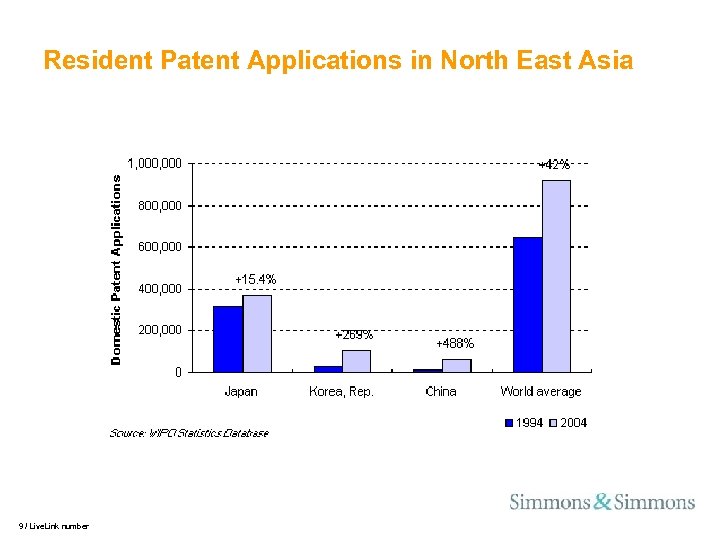
Resident Patent Applications in North East Asia 9 / Live. Link number
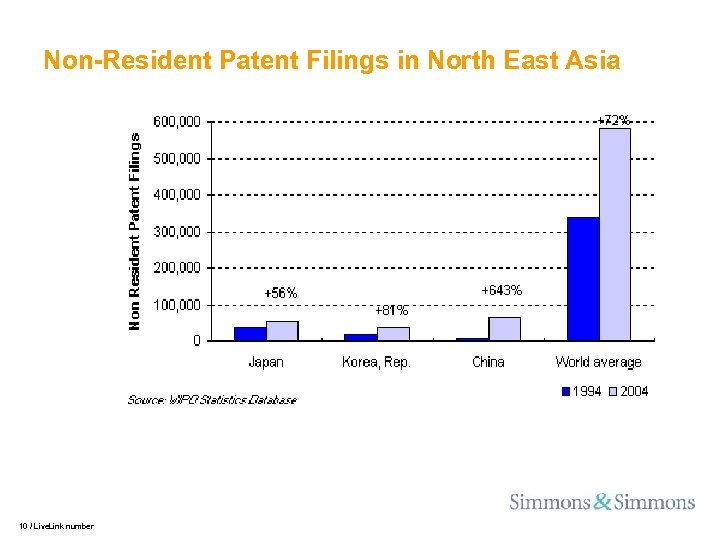
Non-Resident Patent Filings in North East Asia 10 / Live. Link number
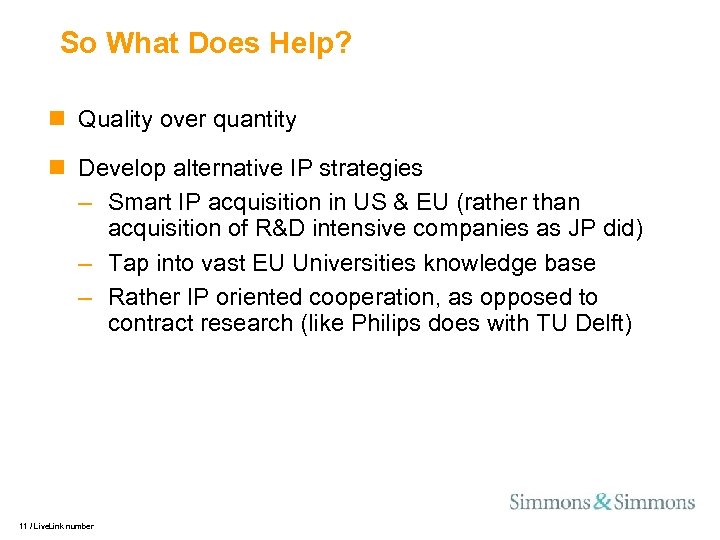
So What Does Help? n Quality over quantity n Develop alternative IP strategies – Smart IP acquisition in US & EU (rather than acquisition of R&D intensive companies as JP did) – Tap into vast EU Universities knowledge base – Rather IP oriented cooperation, as opposed to contract research (like Philips does with TU Delft) 11 / Live. Link number
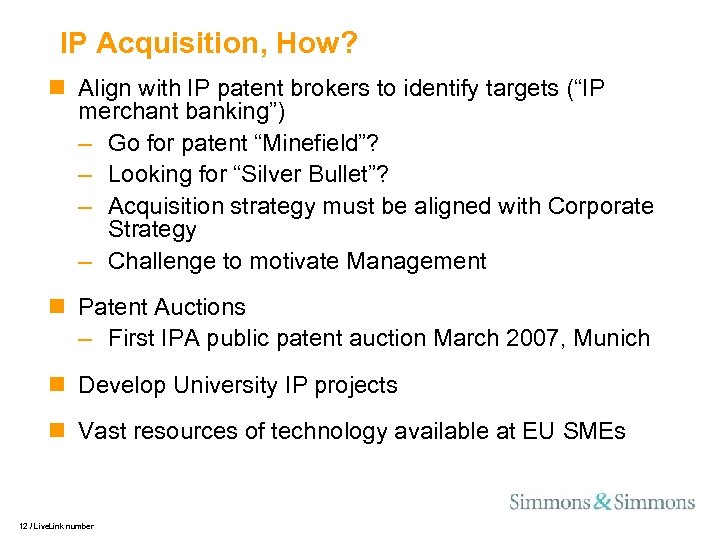
IP Acquisition, How? n Align with IP patent brokers to identify targets (“IP merchant banking”) – Go for patent “Minefield”? – Looking for “Silver Bullet”? – Acquisition strategy must be aligned with Corporate Strategy – Challenge to motivate Management n Patent Auctions – First IPA public patent auction March 2007, Munich n Develop University IP projects n Vast resources of technology available at EU SMEs 12 / Live. Link number
Acquisition Require Special Skills n Access to significant technology & engineering network n Vast IP experience n Ability to work together with multidisciplinary teams – University Professors and Engineering Talent for Identification – Patent attorneys for Evaluation – Lawyers for Verification – Patent Valuation Experts (e. g. IPA, Munich) 13 / Live. Link number
The Korean & Japanese Experience n Japan – Japan sought access to overseas technology as the price foreign firms doing business in Japan or purchased technology by acquiring U. S. companies. – Active Governmental Policies to Force US & EU companies to share IP by raising the bar of entry in Japanese market – Keep tight control of Japan’s key production technologies – Force Japanese companies to share rather than block innovative technologies n Korea – Korean companies faces huge “licensing-in” problem, hurting their competiveness 14 / Live. Link number
What Does it Take to Implement? n Acquisition Strategy is Not an Overnight Solution n It needs to be complemented by a smart EU strategies for: – Prosecution (where to file patent applications? ) – Enforcement – Product Distribution 15 / Live. Link number
Скачать презентацию Severin de Wit Out of the Box IP
9665791f290a3d6d0d4617215d642d1b.ppt