


 Скачать презентацию Sevastopol Sevastopol is a city of special
sevastopol ТРАНСЛИТ.ppt
- Количество слайдов: 19
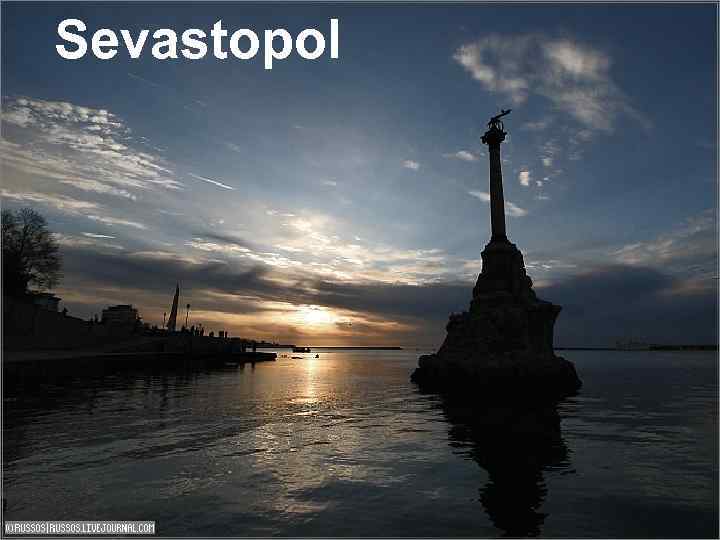 Sevastopol
 Sevastopol is a city of special administrative status, a large sea port, industrial, scientific and cultural center of South Ukraine, washed by the Black Sea. The city was founded by order of Empress Catherine II in 1783. The unique geographic location and navigation conditions of the city’s harbours make Sevastopol a strategically important naval point. Also it is a popular seaside resort and tourist destination. In Sevastopol situated naval base of Ukrainian Navy and naval base of Russian Federation.
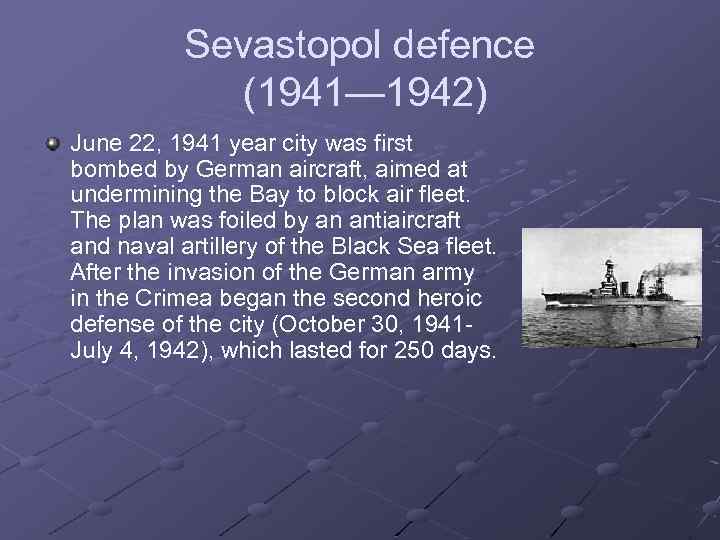 Sevastopol defence (1941— 1942) June 22, 1941 year city was first bombed by German aircraft, aimed at undermining the Bay to block air fleet. The plan was foiled by an antiaircraft and naval artillery of the Black Sea fleet. After the invasion of the German army in the Crimea began the second heroic defense of the city (October 30, 1941 July 4, 1942), which lasted for 250 days.
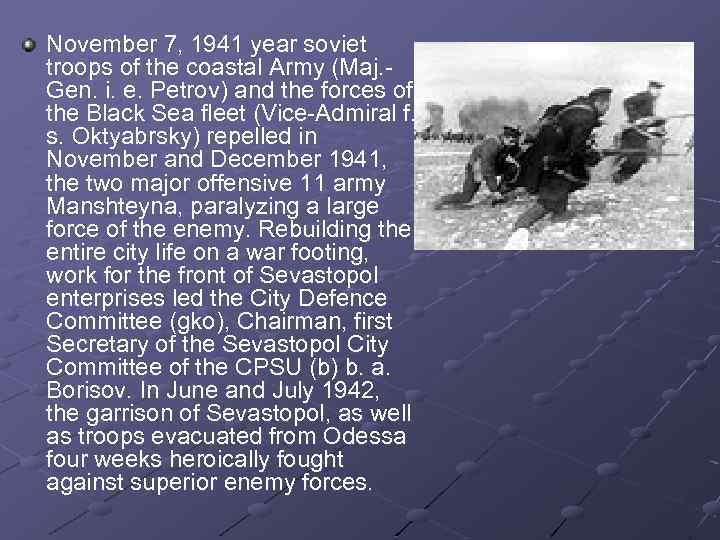 November 7, 1941 year soviet troops of the coastal Army (Maj. Gen. i. e. Petrov) and the forces of the Black Sea fleet (Vice-Admiral f. s. Oktyabrsky) repelled in November and December 1941, the two major offensive 11 army Manshteyna, paralyzing a large force of the enemy. Rebuilding the entire city life on a war footing, work for the front of Sevastopol enterprises led the City Defence Committee (gko), Chairman, first Secretary of the Sevastopol City Committee of the CPSU (b) b. a. Borisov. In June and July 1942, the garrison of Sevastopol, as well as troops evacuated from Odessa four weeks heroically fought against superior enemy forces.
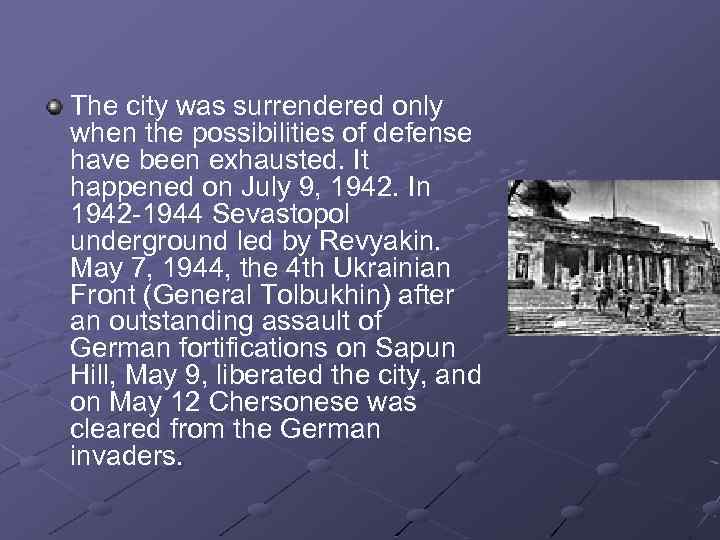 The city was surrendered only when the possibilities of defense have been exhausted. It happened on July 9, 1942. In 1942 -1944 Sevastopol underground led by Revyakin. May 7, 1944, the 4 th Ukrainian Front (General Tolbukhin) after an outstanding assault of German fortifications on Sapun Hill, May 9, liberated the city, and on May 12 Chersonese was cleared from the German invaders.
 Prehistory By the end of September 1941, German troops captured Smolensk and Kiev, blockaded Leningrad. In the southwest enemy has also made significant progress: in the Battle of Uman and Kiev were broken main forces of the Southwestern Front of the Red Army, large part of Ukraine was occupied. In mid-September german troops reached Crimea had strategic importance as a way to oil-bearing regions of the Caucasus (the Kerch and Taman). In addition, the Crimea was important as a base for aviation. With the loss of the Crimean Soviet Air Force would lose the possibility of attacks on the oil fields of Romania, and the Germans would be able to strike targets in the Caucasus. The Soviet command understood the importance of keeping the peninsula and focus on that abandoning the defense of Odessa.
 The position of troops before the operation The only land route to the Crimea was through Perekop isthmus. In general, the defense rested on the peninsula formed in August, reporting directly to the Stavka 51 th separate army under the command of Colonel F. Kuznetsov. Northern area covered three rifle divisions: 276 -I (Room Major General Igor Savinov) - Chongarsky Arabat Peninsula and arrow, 156 -I (Major General PV Chernyaev) - Perekopskyi position, 106 - I (A. polk. Pervushin) stretched for 70 kilometers along the south bank Sivash. Three cavalry divisions - 48 th (Major General Averkin DI), 42 th (polk. VV verb) and 40 th (polk. Kudyurov FF), and 271 -I Infantry Division (polk. MA Titov) had antilanding problem. Four divisions formed in Crimea - 172 -I (IG polk. Toroptsev), 184 th (polk. VN Abramov), 320 th (polk. M. Vinogradov), 321 -I (regiment. IM Aliev) coast guard
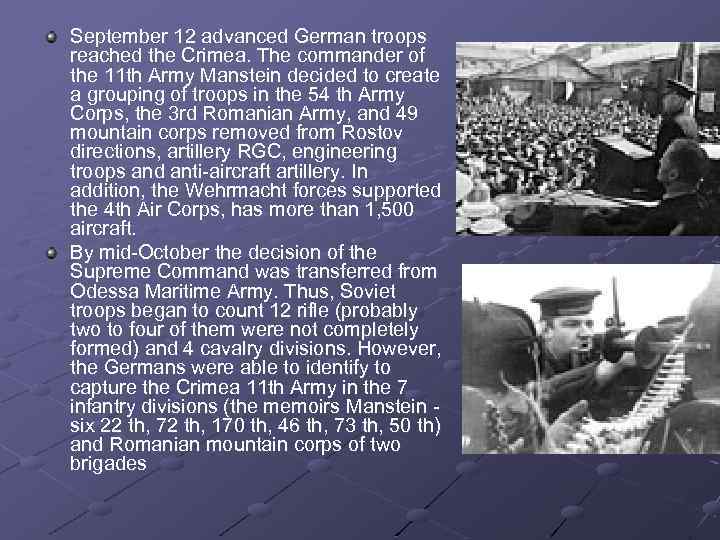 September 12 advanced German troops reached the Crimea. The commander of the 11 th Army Manstein decided to create a grouping of troops in the 54 th Army Corps, the 3 rd Romanian Army, and 49 mountain corps removed from Rostov directions, artillery RGC, engineering troops and anti-aircraft artillery. In addition, the Wehrmacht forces supported the 4 th Air Corps, has more than 1, 500 aircraft. By mid-October the decision of the Supreme Command was transferred from Odessa Maritime Army. Thus, Soviet troops began to count 12 rifle (probably two to four of them were not completely formed) and 4 cavalry divisions. However, the Germans were able to identify to capture the Crimea 11 th Army in the 7 infantry divisions (the memoirs Manstein - six 22 th, 72 th, 170 th, 46 th, 73 th, 50 th) and Romanian mountain corps of two brigades
 Hero-City Sevastopol In the first hours of the war Hitler invaders tried to deliver a powerful air attack on Sevastopol and the Black Sea Fleet. Nazi air attack was successfully repulsed. Eighteen months Nazis trampled on the Perekop Isthmus and Ishun positions. During this time, was considerably strengthened the defense of Sevastopol from the land. October 29, 1941 in Sevastopol was state of siege.
 Order of the Supreme Command was formed Sevastopol defensive area, headed Black Sea Fleet Commander Admiral FS October. In the Military Council of the defense area included Divisional Commissioner NM Kulakov, deputy commander for land defense, Major General IE Petrov, Aviation, Major General N. A. Ostryakov and coastal defense, Major General M. G. Morgunov. Created at the direction of the city committee of the CPSU Central Committee, chaired by the Defence Secretary of Party Committee, BA Borisov turned to the defenders of Sevastopol, and workers with a call to show firmness in the defense of his native city, to fight hard until the last drop of blood.
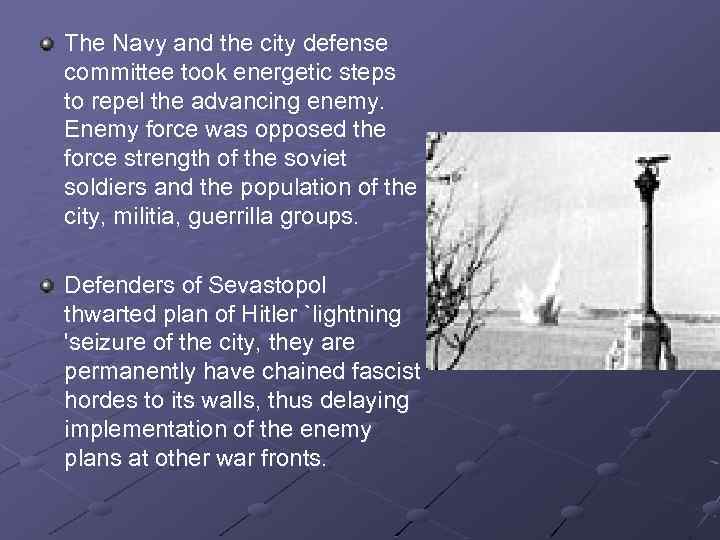 The Navy and the city defense committee took energetic steps to repel the advancing enemy. Enemy force was opposed the force strength of the soviet soldiers and the population of the city, militia, guerrilla groups. Defenders of Sevastopol thwarted plan of Hitler `lightning 'seizure of the city, they are permanently have chained fascist hordes to its walls, thus delaying implementation of the enemy plans at other war fronts.
 Oct. 30 broke out fierce fighting in distant outskirts Sevastopol. Nazis hoped to take the city on the move. 54 th Battery Lieutenant I. Zaika first opened fire at the enemy for three days repulsed fierce attacks of the enemy tanks and infantry. She destroyed more than 30 tanks and armored cars, lot vehicles guns and mortars few hundred Germans. On such enemy resistance encountered everywhere. `Not a step back! 'become the motto of Sevastopol people. In the spring of 1944 the Soviet Army broke through Nazi defenses at Perekop and the Kerch Peninsula. At near Sevastopol has settled 120 thousandth grouping of Nazi troops. Nazis set up strong fortifications around the town. They considered their unassailable defense at Sevastopol they called it the `front stone’
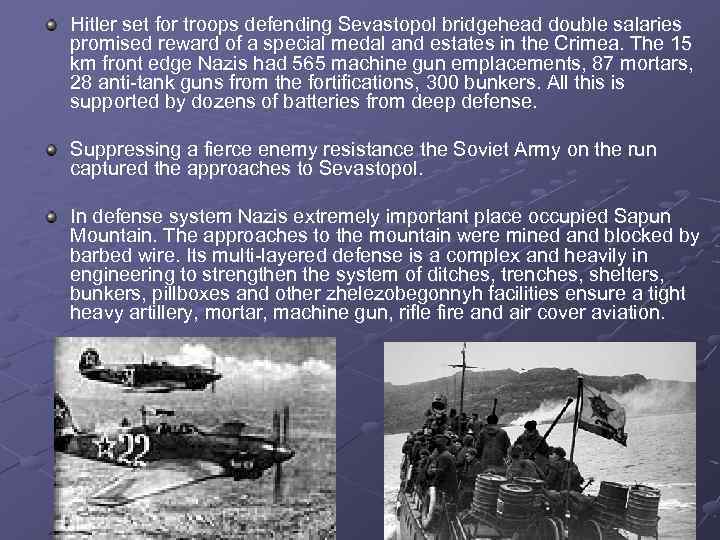 Hitler set for troops defending Sevastopol bridgehead double salaries promised reward of a special medal and estates in the Crimea. The 15 km front edge Nazis had 565 machine gun emplacements, 87 mortars, 28 anti-tank guns from the fortifications, 300 bunkers. All this is supported by dozens of batteries from deep defense. Suppressing a fierce enemy resistance the Soviet Army on the run captured the approaches to Sevastopol. In defense system Nazis extremely important place occupied Sapun Mountain. The approaches to the mountain were mined and blocked by barbed wire. Its multi-layered defense is a complex and heavily in engineering to strengthen the system of ditches, trenches, shelters, bunkers, pillboxes and other zhelezobegonnyh facilities ensure a tight heavy artillery, mortar, machine gun, rifle fire and air cover aviation.
 If the Germans besieged Sevastopol 250 days, Soviet troops crushed the Nazi defense in three days. Sevastopol, Black Sea sailors returned to the cityhero. Before them opened pogryasayushaya panorama ruined and lifeless Sevastopol. Restoration of the city was truly heroic epic and was included in its history as the third feat of Sevastopol. Its revival began immediately after the liberation. The city was completely destroyed. Material damage caused by the Nazis, was 2. 5 billion rubles. Were destroyed city communications, transportation, communications, more than 90% of floor space. Of the 6402 residential buildings have been destroyed 5379, in the city center have 7 dilapidated houses. Destroyed all institutions and enterprises, schools, landmarks, cultural centers. In the city there about three thousand people.
 October 25, 1948 at the Council of Ministers organized a special control to restore Sevastopol. In late 1953, the city was completely rebuilt. Revived from the ruins and ashes white stone Sevastopol became a worthy monument to his reducers and immortalized their memory. Sevastopol was awarded the Order of Lenin and medal "Gold Star"
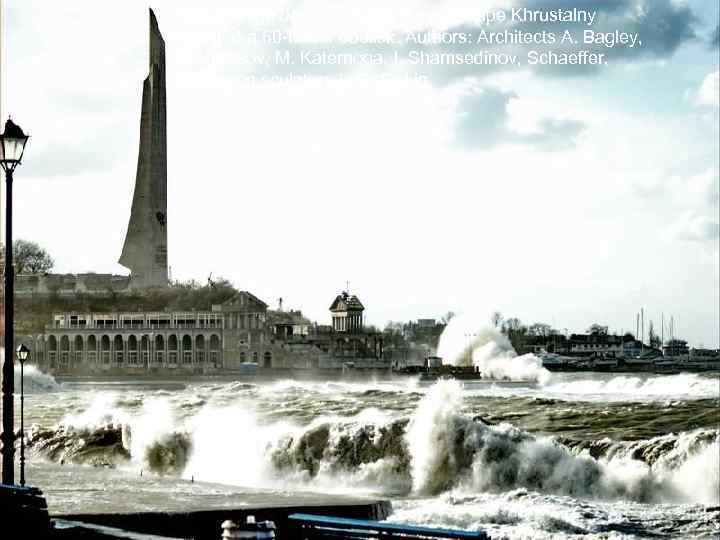 On the high banks of North Bay, at Cape Khrustalny created a 60 -meter obelisk. Authors: Architects A. Bagley, E. Veresov, M. Katernoga, I. Shamsedinov, Schaeffer, Makogon sculptors I. , S. Siskin
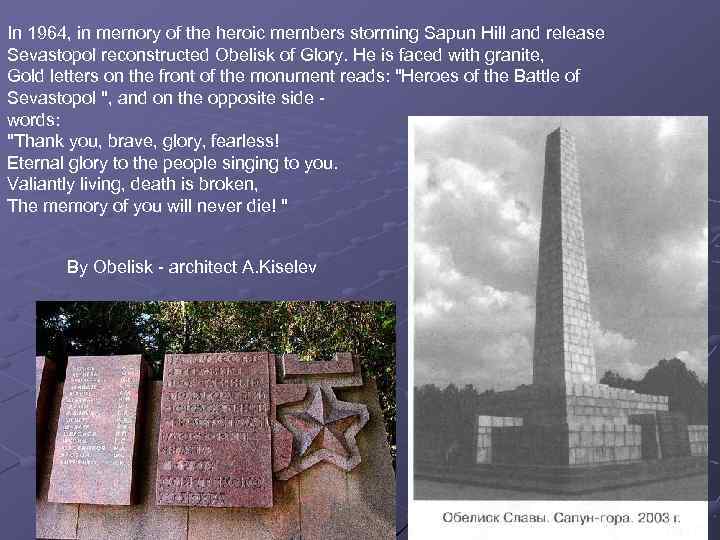 In 1964, in memory of the heroic members storming Sapun Hill and release Sevastopol reconstructed Obelisk of Glory. He is faced with granite, Gold letters on the front of the monument reads: "Heroes of the Battle of Sevastopol ", and on the opposite side words: "Thank you, brave, glory, fearless! Eternal glory to the people singing to you. Valiantly living, death is broken, The memory of you will never die! " By Obelisk - architect A. Kiselev
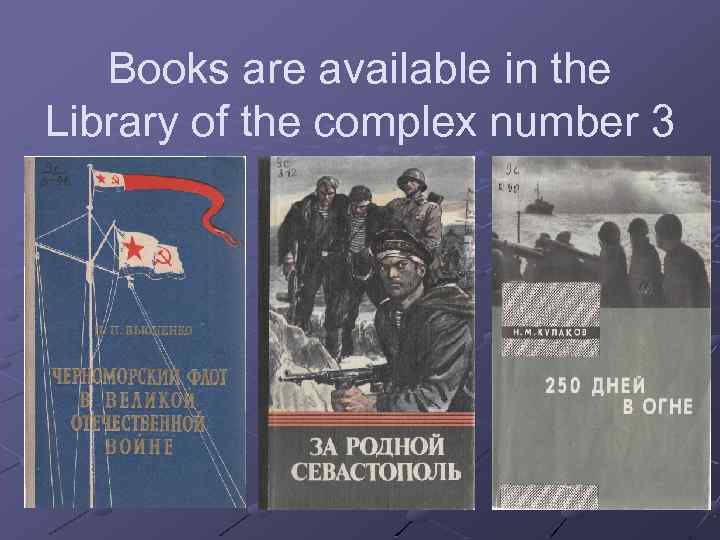 Books are available in the Library of the complex number 3