 Скачать презентацию Settling of Small Particles in Homogeneous Turbulence Settling
c4c116ab8d708102a9c2cda03abe5ace.ppt
- Количество слайдов: 33



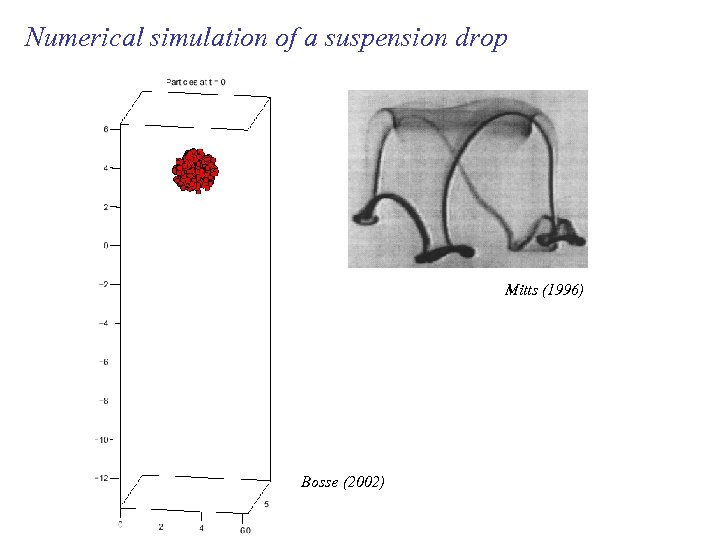
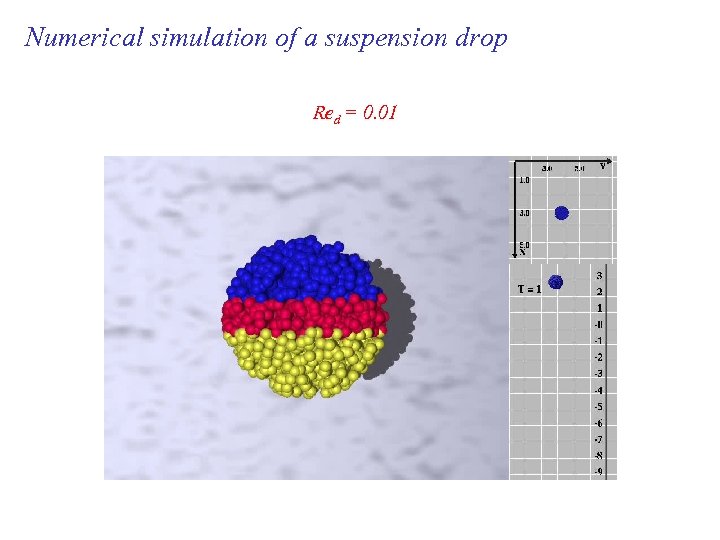
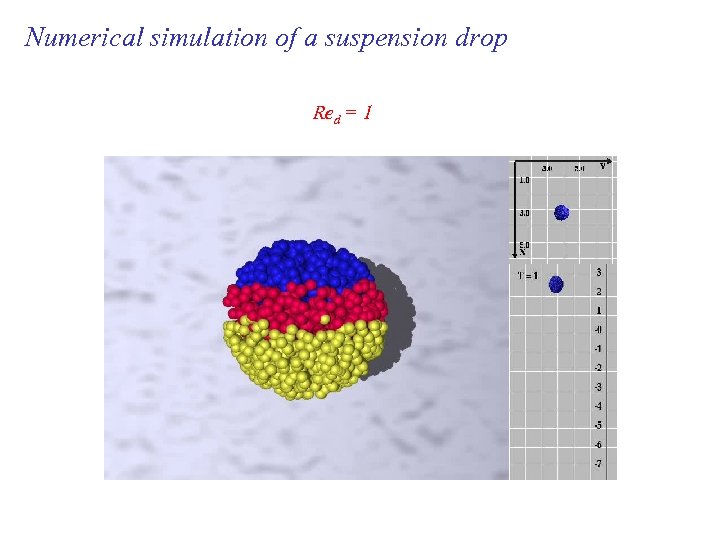
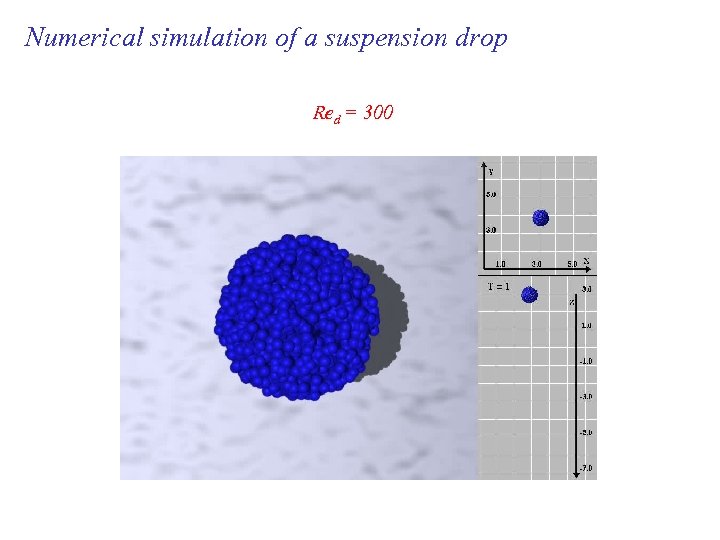
Settling of Small Particles in Homogeneous Turbulence: Settling Velocity Enhancement by Two-Way Coupling T. Bosse, L. Kleiser (ETHZ), E. Meiburg (UCSB) • Motivation • One-way coupled flows - particle-laden mixing layer • Two-way coupled flows - particles settling in homogeneous turbulence - dynamics of a suspension drop • Summary
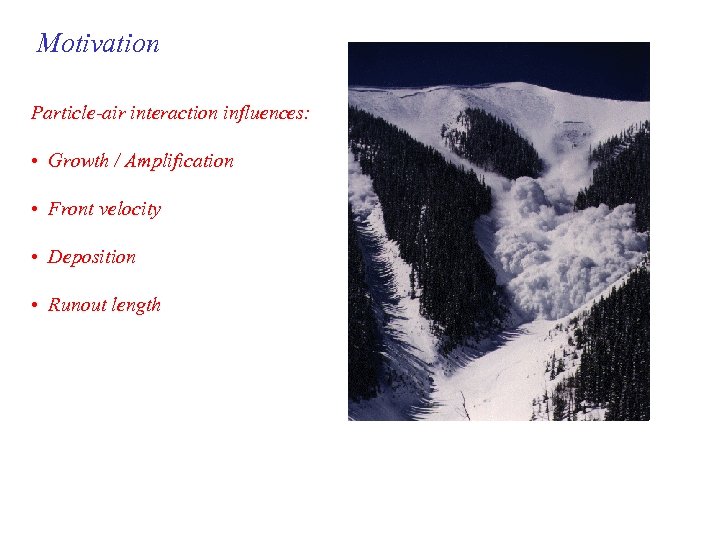
Motivation Particle-air interaction influences: • Growth / Amplification • Front velocity • Deposition • Runout length
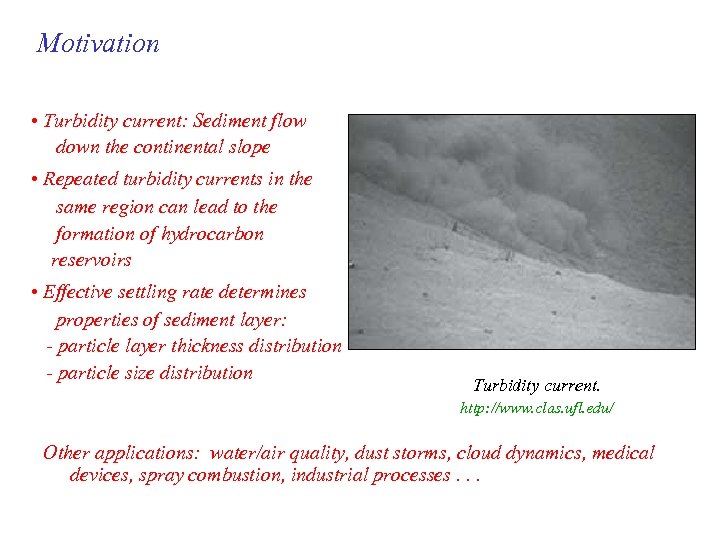
Motivation • Turbidity current: Sediment flow down the continental slope • Repeated turbidity currents in the same region can lead to the formation of hydrocarbon reservoirs • Effective settling rate determines properties of sediment layer: - particle layer thickness distribution - particle size distribution Turbidity current. http: //www. clas. ufl. edu/ Other applications: water/air quality, dust storms, cloud dynamics, medical devices, spray combustion, industrial processes. . .
Dilute flows Volume fraction of particles of O(10 -3): • particle radius « particle separation • particle radius « characteristic length scale of flow • coupling of fluid and particle motion primarily through momentum exchange, not through volumetric effects • effects of particles on fluid continuity equation negligible
Very dilute flows: One-way coupling Small mass fraction of heavy particles (dusty gas, dilute spray): • particles move independently of each other • particles have negligible effect on the fluid motion • can first solve for fluid motion, afterwards for particle dynamics Particle dynamics is governed by balance of : • • particle inertia viscous drag force gravity added mass, lift forces, pressure gradients in the fluid, and Basset history term can be neglected
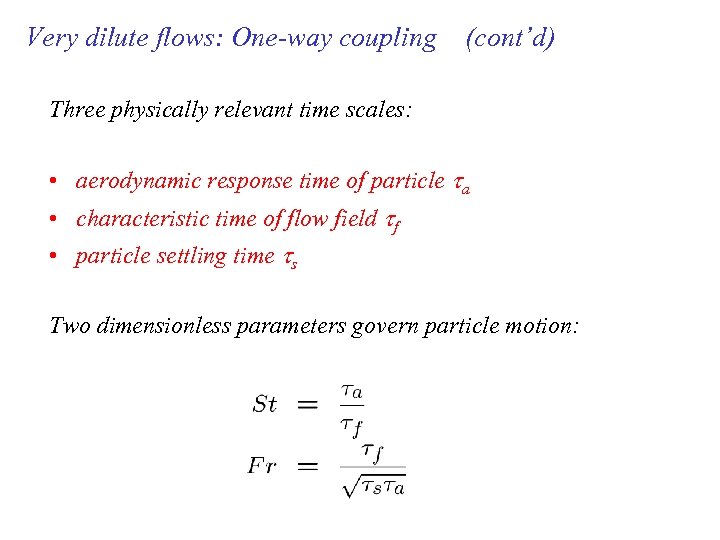
Very dilute flows: One-way coupling (cont’d) Three physically relevant time scales: • aerodynamic response time of particle ta • characteristic time of flow field tf • particle settling time ts Two dimensionless parameters govern particle motion:
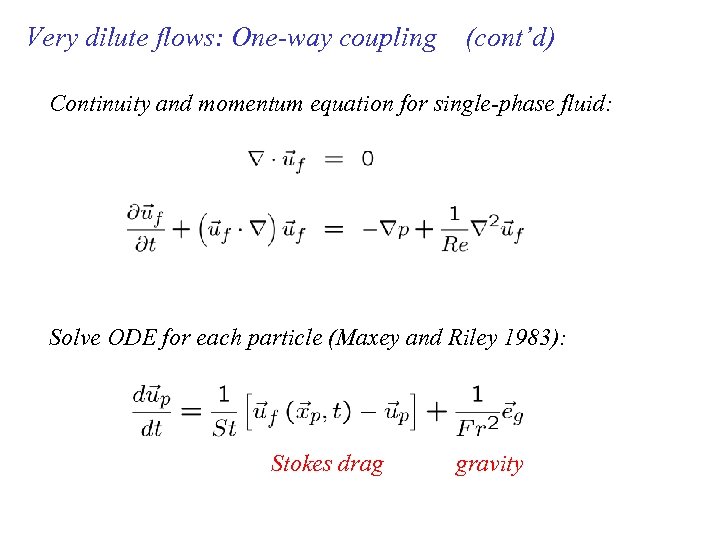
Very dilute flows: One-way coupling (cont’d) Continuity and momentum equation for single-phase fluid: Solve ODE for each particle (Maxey and Riley 1983): Stokes drag gravity
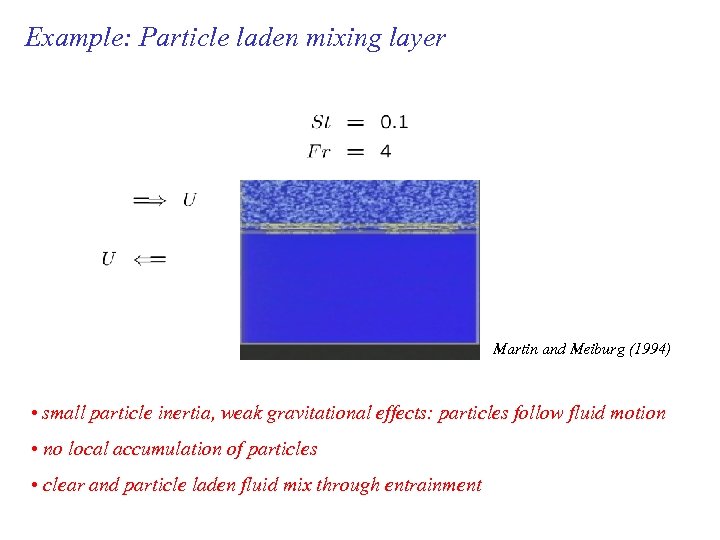
Example: Particle laden mixing layer Martin and Meiburg (1994) • small particle inertia, weak gravitational effects: particles follow fluid motion • no local accumulation of particles • clear and particle laden fluid mix through entrainment
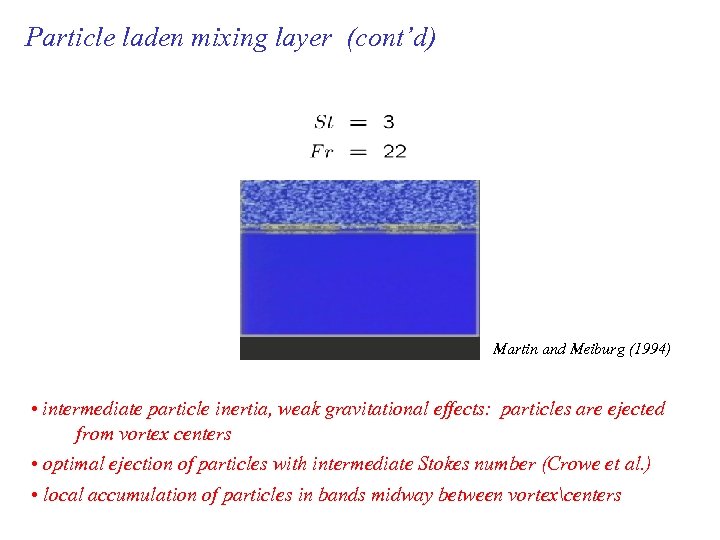
Particle laden mixing layer (cont’d) Martin and Meiburg (1994) • intermediate particle inertia, weak gravitational effects: particles are ejected from vortex centers • optimal ejection of particles with intermediate Stokes number (Crowe et al. ) • local accumulation of particles in bands midway between vortexcenters
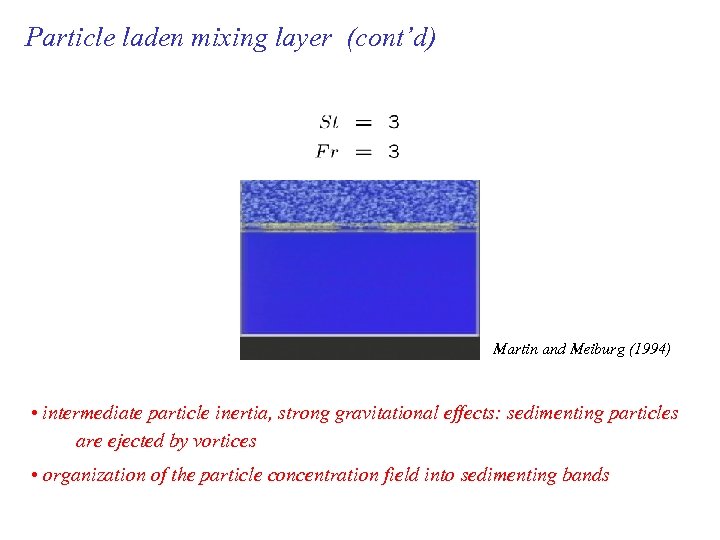
Particle laden mixing layer (cont’d) Martin and Meiburg (1994) • intermediate particle inertia, strong gravitational effects: sedimenting particles are ejected by vortices • organization of the particle concentration field into sedimenting bands
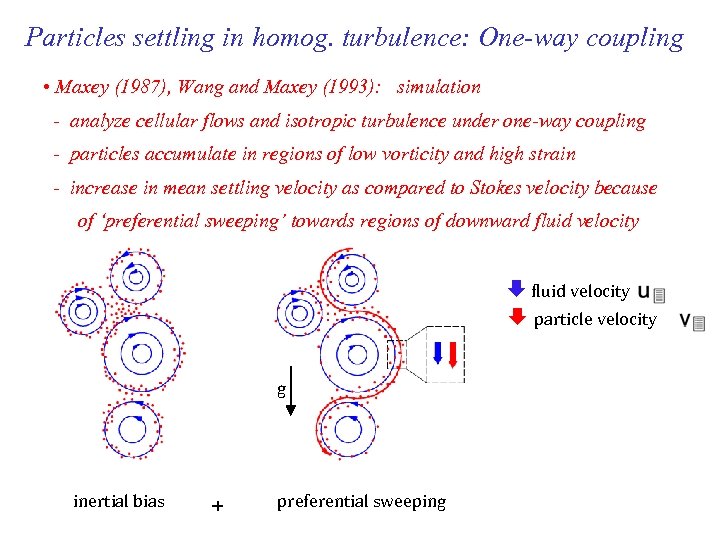
Particles settling in homog. turbulence: One-way coupling • Maxey (1987), Wang and Maxey (1993): simulation - analyze cellular flows and isotropic turbulence under one-way coupling - particles accumulate in regions of low vorticity and high strain - increase in mean settling velocity as compared to Stokes velocity because of ‘preferential sweeping’ towards regions of downward fluid velocity particle velocity g inertial bias + preferential sweeping
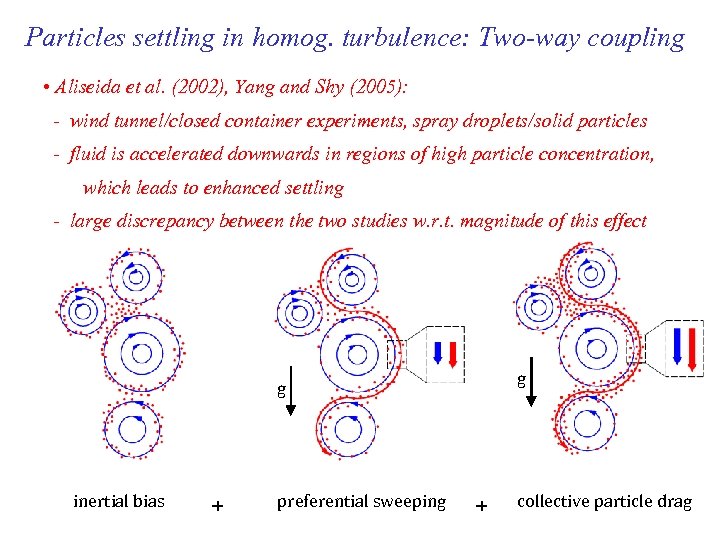
Particles settling in homog. turbulence: Two-way coupling • Aliseida et al. (2002), Yang and Shy (2005): - wind tunnel/closed container experiments, spray droplets/solid particles - fluid is accelerated downwards in regions of high particle concentration, which leads to enhanced settling - large discrepancy between the two studies w. r. t. magnitude of this effect g g inertial bias + preferential sweeping + collective particle drag
Dilute, two-way coupled flows Suspended particles occupy small volume fraction, but have O(1) mass fraction, strong particle inertia: • each particle locally exerts force on the fluid (equal and opposite to the fluid force acting on the particle) • volume coupling can still be neglected Suspension dynamics can be described by: • incompressible continuity equation • Navier-Stokes equation plus additional force term • set of ODE’s for each particle’s location, velocity
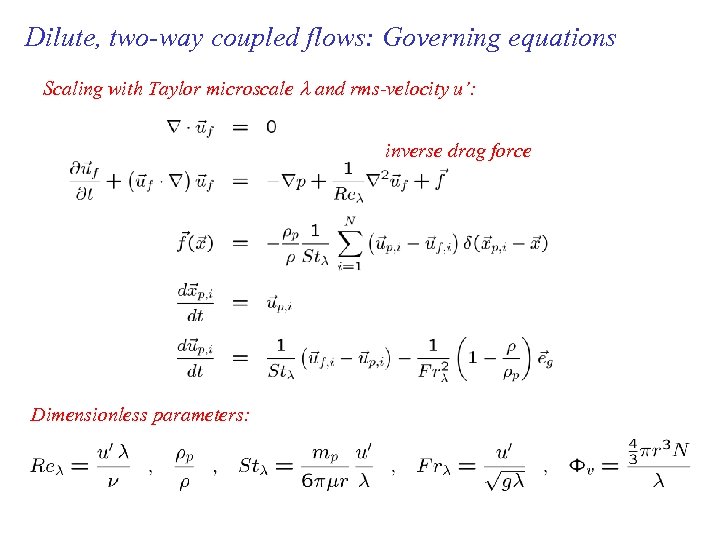
Dilute, two-way coupled flows: Governing equations Scaling with Taylor microscale l and rms-velocity u’: inverse drag force Dimensionless parameters:
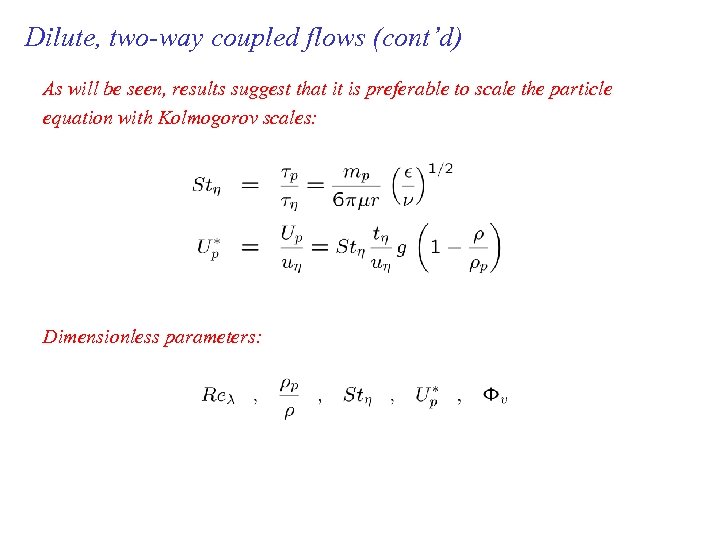
Dilute, two-way coupled flows (cont’d) As will be seen, results suggest that it is preferable to scale the particle equation with Kolmogorov scales: Dimensionless parameters:
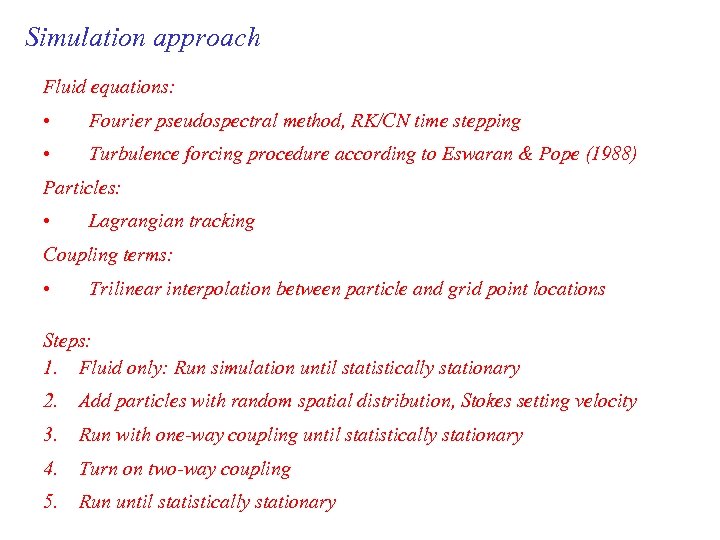
Simulation approach Fluid equations: • Fourier pseudospectral method, RK/CN time stepping • Turbulence forcing procedure according to Eswaran & Pope (1988) Particles: • Lagrangian tracking Coupling terms: • Trilinear interpolation between particle and grid point locations Steps: 1. Fluid only: Run simulation until statistically stationary 2. Add particles with random spatial distribution, Stokes setting velocity 3. Run with one-way coupling until statistically stationary 4. Turn on two-way coupling 5. Run until statistically stationary
Simulation approach: Related work For dilute flows with many particles, several variations of force coupling: • Lagrangian-based Navier-Stokes approaches (Elghobashi et al. , Eaton et al. , Walther and Koumoutsakos, Lohse et al. , etc…. ) • Stokeslet-based simulations (Nitsche and Batchelor ’ 97, Machu et al. ’ 01) • Multipole expansions (Maxey and Patel ’ 01) For O(10 -100) particles: • DNS (Joseph, Glowinski et al. ) • Force coupling method (Maxey and Dent ’ 98) For dense particle loading: • Two-fluid simulations (Drew ’ 83, Crowe et al. ’ 96) closure assumptions needed
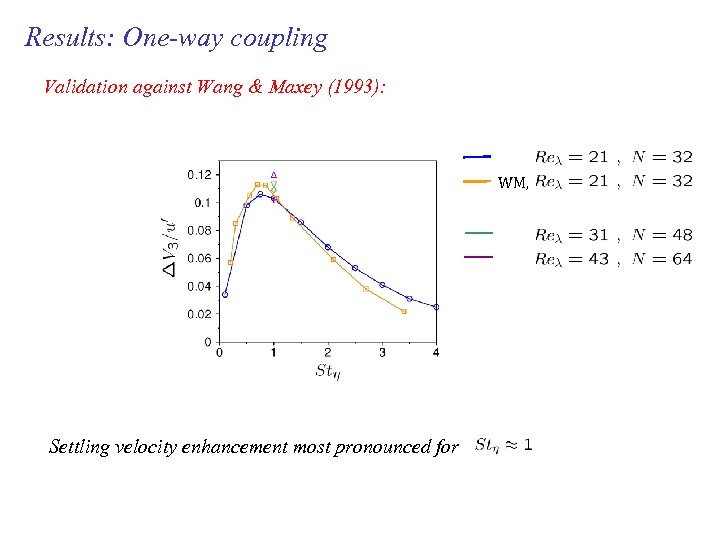
Results: One-way coupling Validation against Wang & Maxey (1993): WM, Settling velocity enhancement most pronounced for
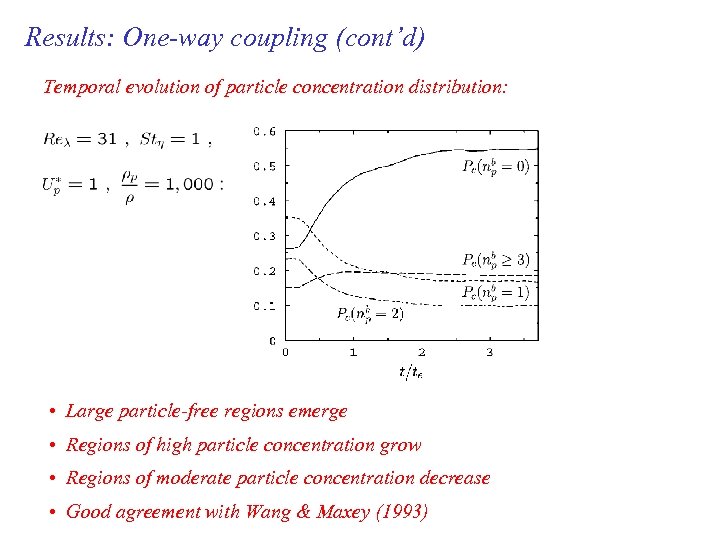
Results: One-way coupling (cont’d) Temporal evolution of particle concentration distribution: • Large particle-free regions emerge • Regions of high particle concentration grow • Regions of moderate particle concentration decrease • Good agreement with Wang & Maxey (1993)
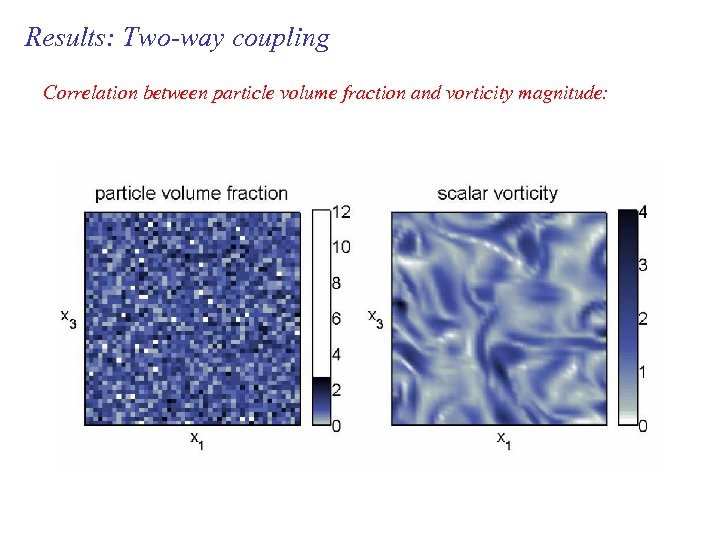
Results: Two-way coupling Correlation between particle volume fraction and vorticity magnitude:
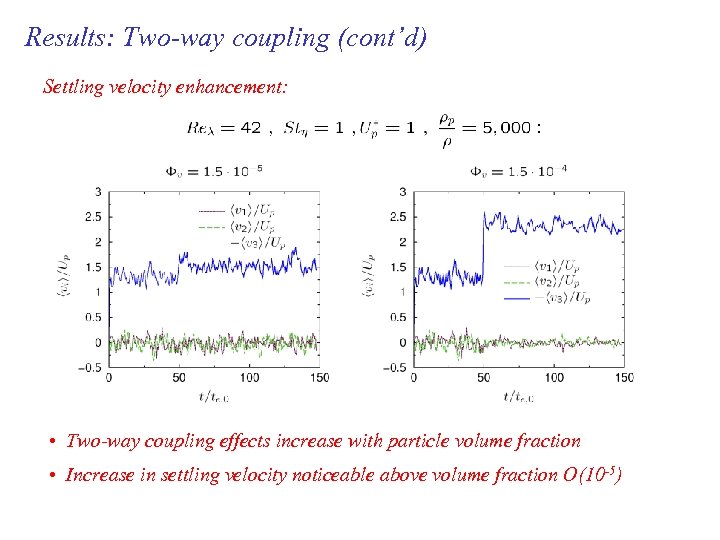
Results: Two-way coupling (cont’d) Settling velocity enhancement: • Two-way coupling effects increase with particle volume fraction • Increase in settling velocity noticeable above volume fraction O(10 -5)
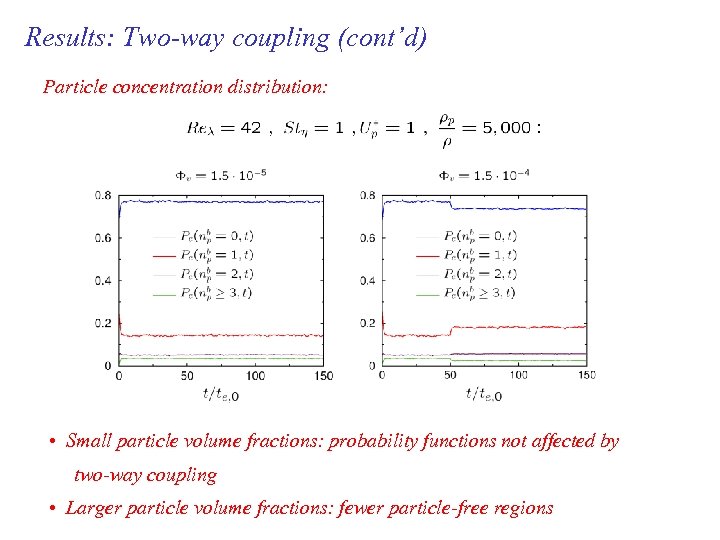
Results: Two-way coupling (cont’d) Particle concentration distribution: • Small particle volume fractions: probability functions not affected by two-way coupling • Larger particle volume fractions: fewer particle-free regions
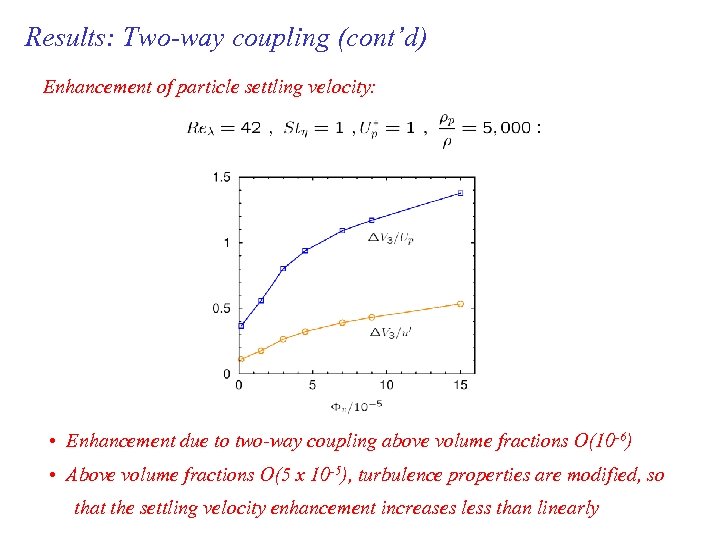
Results: Two-way coupling (cont’d) Enhancement of particle settling velocity: • Enhancement due to two-way coupling above volume fractions O(10 -6) • Above volume fractions O(5 x 10 -5), turbulence properties are modified, so that the settling velocity enhancement increases less than linearly
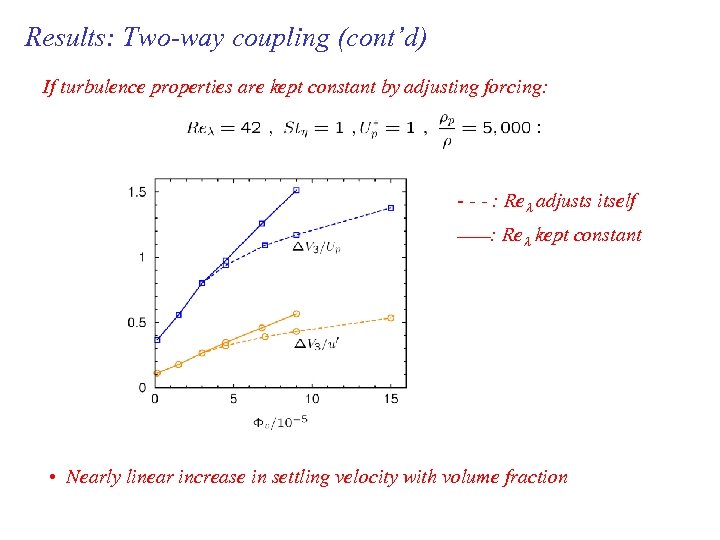
Results: Two-way coupling (cont’d) If turbulence properties are kept constant by adjusting forcing: - - - : Rel adjusts itself _____: Rel kept constant • Nearly linear increase in settling velocity with volume fraction
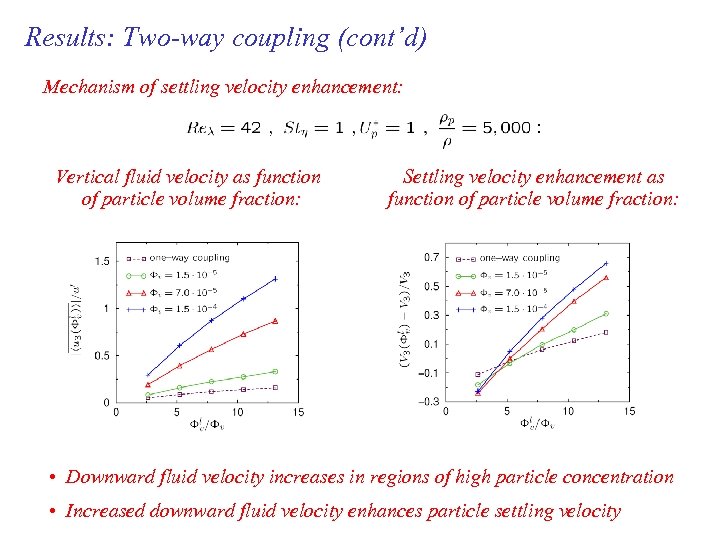
Results: Two-way coupling (cont’d) Mechanism of settling velocity enhancement: Vertical fluid velocity as function of particle volume fraction: Settling velocity enhancement as function of particle volume fraction: • Downward fluid velocity increases in regions of high particle concentration • Increased downward fluid velocity enhances particle settling velocity
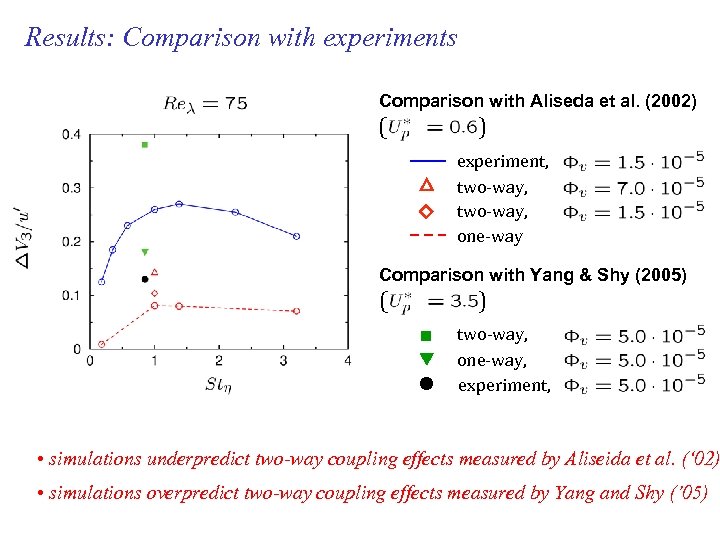
Results: Comparison with experiments Comparison with Aliseda et al. (2002) ( ) experiment, two-way, one-way Comparison with Yang & Shy (2005) ( ) two-way, one-way, experiment, • simulations underpredict two-way coupling effects measured by Aliseida et al. (‘ 02) • simulations overpredict two-way coupling effects measured by Yang and Shy (’ 05)
Results: Comparison with experiments Potential reasons for discrepancies: • experiments: particle size distribution, simulation: monodisperse particles • simulations: - match turbulence Re number, but other turbulence parameters may be somewhat different - low order interpolation may cause some errors, but a few per cent at most • experiments: - particles may induce mean downward fluid motion in the windtunnel test section
Summary • One-way coupling: – Successful validation against Wang & Maxey, JFM (1993) – Strongest particle-fluid interaction for Stokes numbers around unity – Large inhomogeneities in particle distribution, correlation between vorticity and particle concentration • Two-way coupling – Particle settling velocity enhancement found for – Monotonic increase of with particle volume fraction, relation roughly linear if microscale Reynolds number kept constant • – Turbulence modification sets in for : particles have dissipative effect on turbulent carrier fluid – Collective particle drag responsible for additional settling velocity enhancement compared to one-way coupling Comparison with experiment – Still significant differences between numerical and experimental results – Further research necessary
Numerical simulation of a suspension drop Mitts (1996) Bosse (2002)
Numerical simulation of a suspension drop Red = 0. 01
Numerical simulation of a suspension drop Red = 1
Numerical simulation of a suspension drop Red = 300
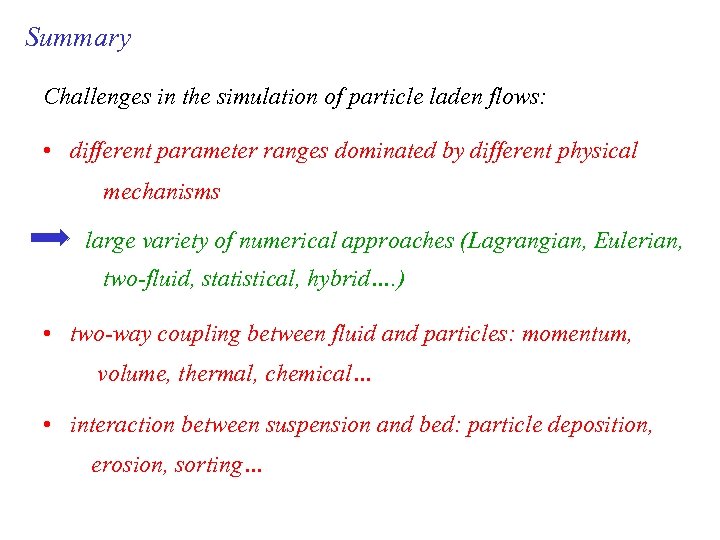
Summary Challenges in the simulation of particle laden flows: • different parameter ranges dominated by different physical mechanisms large variety of numerical approaches (Lagrangian, Eulerian, two-fluid, statistical, hybrid…. ) • two-way coupling between fluid and particles: momentum, volume, thermal, chemical… • interaction between suspension and bed: particle deposition, erosion, sorting…
Скачать презентацию Settling of Small Particles in Homogeneous Turbulence Settling
c4c116ab8d708102a9c2cda03abe5ace.ppt