


 Скачать презентацию Setting Product Strategy What is a Product
095d3ec388551e0e8cc3a4d78f93f860.ppt
- Количество слайдов: 59
 Setting Product Strategy
 What is a Product? l l Anything that can be offered to a market for attention, acquisition, use, or consumption and that might satisfy a want or need. Includes: physical product, service, information, experience, person, place, organization, ideas, or mixes of these entities.
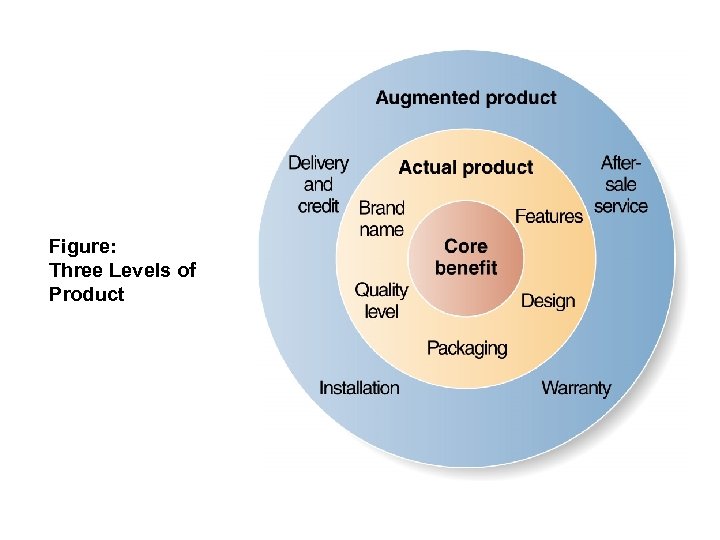 Figure: Three Levels of Product
 Example: Hotel l Core benefit: rest and sleep. Actual product: bed, bathroom, towels, desk, closet, or food. Augmented product: restaurant, gym, man’s suit, or remembering customers’ special needs.
 Example: Sony Camcorder l l l Core benefit: a convenient, high-quality way to capture important moments. Actual product: Sony Camcorder. Augmented product: warranty, instructions, quick, repair service, or toll-free telephone number.
 When Do a Firm Advertise the Core Benefit? l l Innovated product Chaos stage l l E. g. The war of hamburger among Mc. Donald’s, Burger King and Wendy: Where is the beef ? 打回核心的第一家廠商,雖然會引起別人跟進, 但讓人印象最深。
 Product Classifications l Durability l l l Nondurable goods → many locations, small markup, and heavily advertise. Durable goods → more personal selling and service, higher margin, and more seller guarantees. Timing of quality identification l l l Search goods Experience goods Credence goods
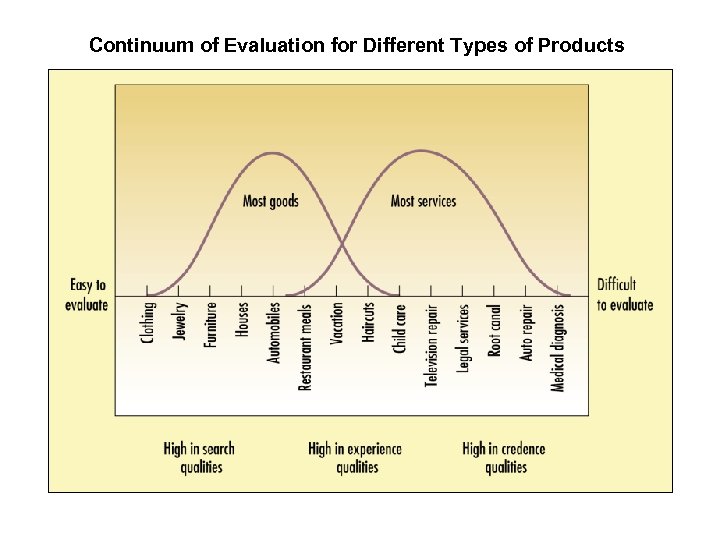 Continuum of Evaluation for Different Types of Products
 Consequence of High in Experience and Credence Qualities l l l Service consumers generally rely on word of mouth rather than advertising. Consumers rely heavily on price, personnel, and physical cues to judge quality. Consumers are highly loyal to service providers who satisfy them.
 In one-shot relationships, may a high price signal a high quality? Is it possible that a low price may signal a high quality?
 Product Classifications l Consumer-goods classification l l l Convenience goods – staples, impulse goods and emergency goods. Shopping goods Specialty goods Unsought goods Marketing considerations for consumer products Drift principle
 Individual Product Decisions l Product attributes l l l l Product quality – performance & conformance Product features Product style and design Branding Packaging Labeling Product support services
 Packaging l l Primary container, secondary package, and shipping package. Functions: contain and protect the product, describe the product, attract attention, and create instant consumer recognition of the company or brand.
 Packaging l l l In an average supermarket, which stocks 15, 000 to 17, 000 items, the typical shoppers passes by some 300 items per minute. More than 60% of all purchases are made on impulse. The package may be the seller’s last chance to influence consumers.
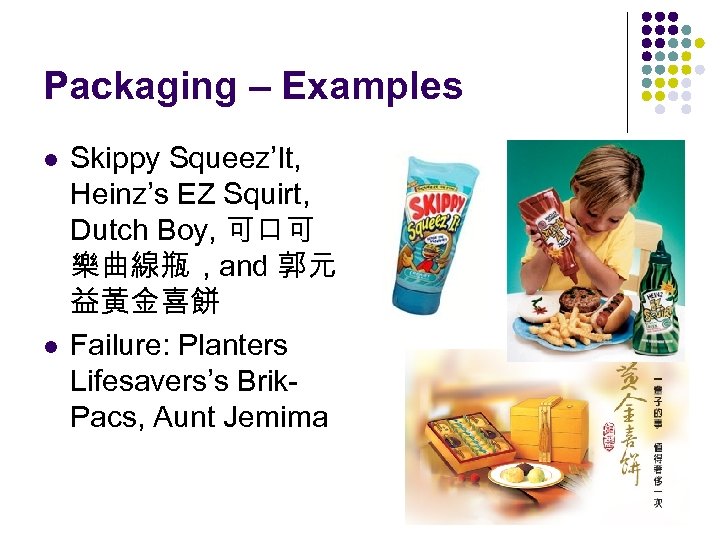 Packaging – Examples l l Skippy Squeez’It, Heinz’s EZ Squirt, Dutch Boy, 可口可 樂曲線瓶 , and 郭元 益黃金喜餅 Failure: Planters Lifesavers’s Brik. Pacs, Aunt Jemima
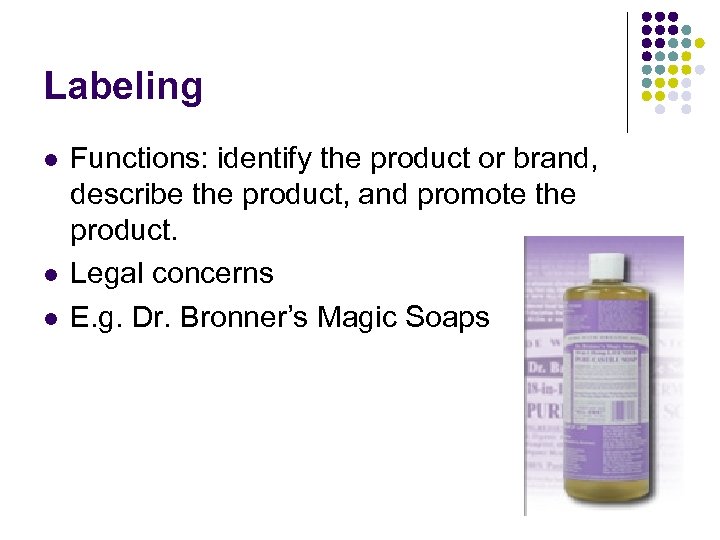 Labeling l l l Functions: identify the product or brand, describe the product, and promote the product. Legal concerns E. g. Dr. Bronner’s Magic Soaps
 Product Mix l l l Width: how many different product lines the company carries. Length: the total number of items in the mix. Depth: how many variants are offered of each product in the line. Consistency: how closely related the various product lines are in end use, product requirements, distribution channels, or some other way. Example: P&G, 花王.
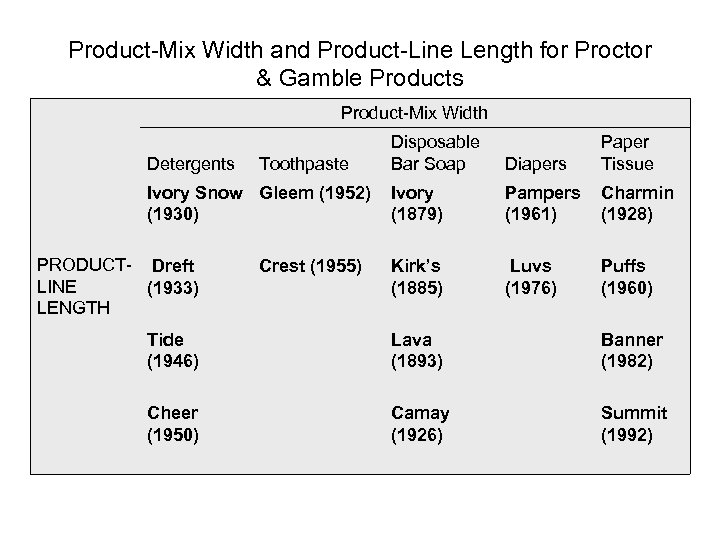 Product-Mix Width and Product-Line Length for Proctor & Gamble Products Product-Mix Width Detergents Toothpaste Ivory Snow Gleem (1952) (1930) PRODUCT- Dreft LINE (1933) LENGTH Crest (1955) Disposable Bar Soap Diapers Paper Tissue Ivory (1879) Pampers (1961) Charmin (1928) Kirk’s (1885) Luvs (1976) Puffs (1960) Tide (1946) Lava (1893) Banner (1982) Cheer (1950) Camay (1926) Summit (1992)
 Product Line Decisions l l l Product-line analysis Product line length is influenced by company objectives and resources, e. g. up-selling, crossselling, or protecting against economic swings. Vertical differentiation → Line stretching: downmarket stretch, upmarket stretch, or two-way stretch Horizontal differentiation → Line filling Line modernization, featuring and pruning
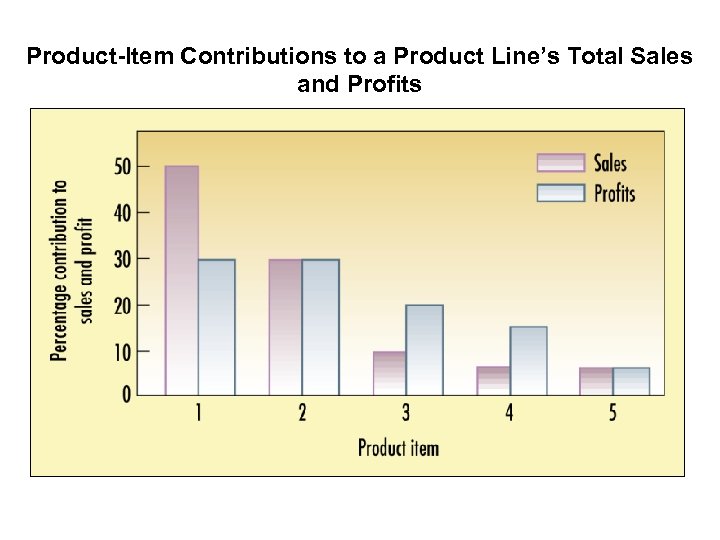 Product-Item Contributions to a Product Line’s Total Sales and Profits
 Is it a good idea to drop the 5 th product in the last slide? If not, what may be the reasons?
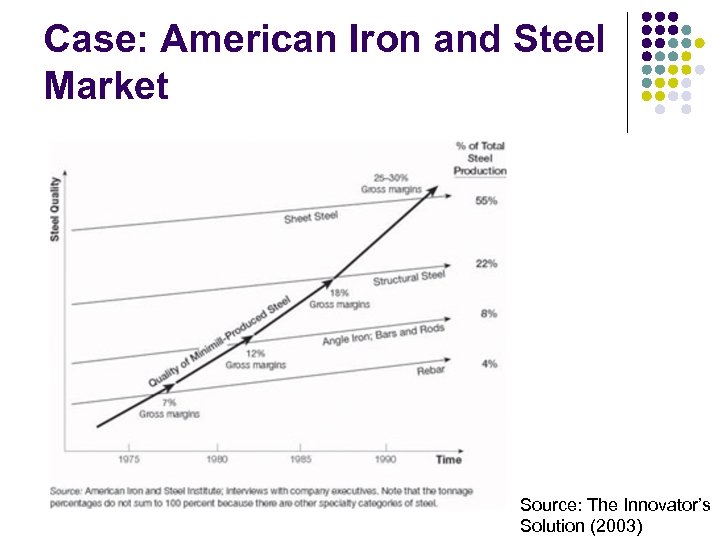 Case: American Iron and Steel Market Source: The Innovator’s Solution (2003)
 Downmarket Stretch l l Examples: Rolex’s Tudor, Benz’s Smart. Reasons: growth opportunity, tie up lowerend competitors, or the middle market is stagnating or declining. Branding: individual name, blanket family name, or separate family names for all products. Risk of Cannibalization
 Upmarket Stretch l l l Reasons: more growth, higher margins or fullline manufacturers. Examples: Toyata’s Lexus, Nissan’s Infiniti, and Honda’s Acura. The examples above invented entirely new names rather than using or including their own names.
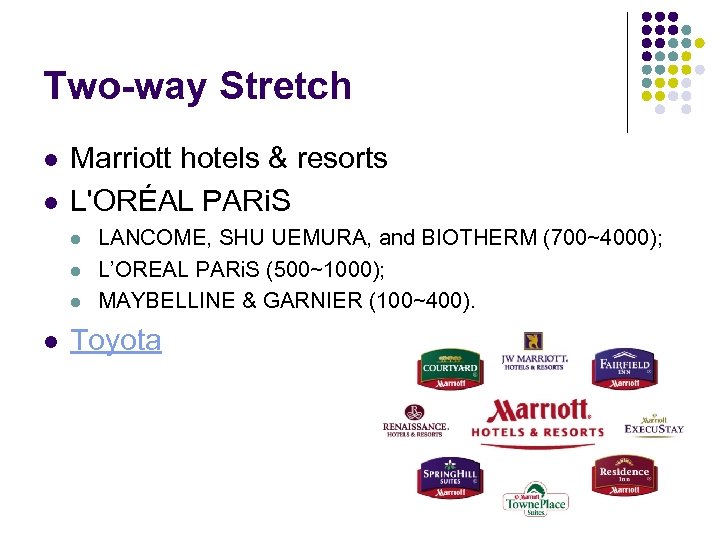 Two-way Stretch l l Marriott hotels & resorts L'ORÉAL PARi. S l l LANCOME, SHU UEMURA, and BIOTHERM (700~4000); L’OREAL PARi. S (500~1000); MAYBELLINE & GARNIER (100~400). Toyota
 Cannibalization l l l Consumers have two segments, H & L. Given quality q, H’s valuation is 5 q, L’s valuation is 2 q, and the unit cost is q 2/2. What are the efficient quality levels for H and L respectively? Is it optimal for the firm to provide the twoitem product line with efficient quality levels? Is it always optimal for the firm to provide a product line?
 Case: Pampers & Luvs l l 1980年代,Pampers & Luvs分占全美紙尿布 銷售排名第一與第三。 1993年,P&G為因應通路自有品牌的挑戰, 重新定位 Luvs為打手品牌 (fighter brand)。 Luvs的改變:降價 16%、縮減研發和產品創 新、減少電視廣告和促銷支援、取消包裝上 的提帶等。 P&G集中更多管理和財物資源,投入 Pampers的行銷,而且改進它的特色。 節錄自哈佛商業評論 全球繁體中文版 (p. 49, October 2009)
 Line Filling l l l Add more items within the present range of the line. Motives: incremental profits, satisfying dealers, excess capacity, full-line company, and keep out competitors. Sony’s walkman – solar-powered and waterproof, Mini. Disc, CD, or Memory Stick. Weber’s Law: just-noticeable difference. Risk of cannibalization
 Line Modernization, Featuring and Pruning l l 人潮創造者 & 旗艦產品。 Line pruning l E. g. Unilever: 1600 → 970 → 400; Hyundai’s Kia: 30→ 20; P&G.
 Brand l l Definition: a name, term, sign, symbol, design, or a combination of them, intended to identify the goods or services of one seller or group of sellers and to differentiate them from those of competitors. (AMA) Six levels of meaning: attribute, benefits, values, culture, personality, and user.
 Brand Equity l l The positive differential effect that knowing the brand name has on customer response to the product or service. Measure: the extent to which customers are willing to pay more for the brand. Tide, Heinz → 100%; Coca Cola → 50%; Volvo → 40%. Brand valuation: Apple – $98 billion; Google – $93 billion; Coca Cola – $79 billion.
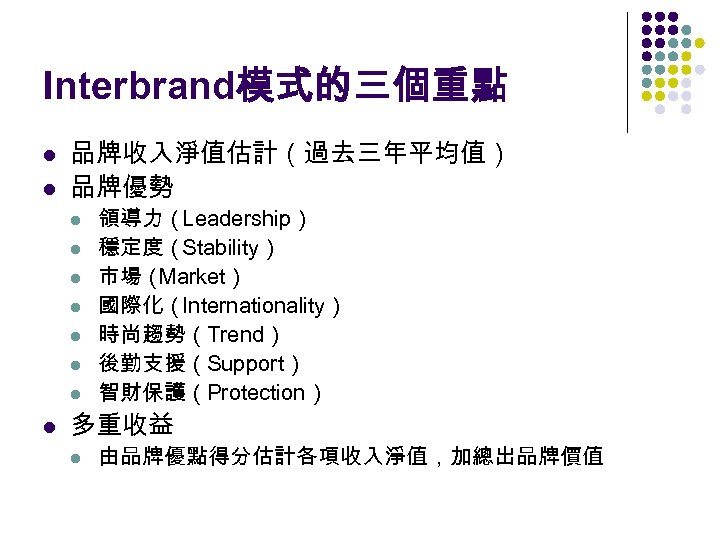 Interbrand模式的三個重點 l l 品牌收入淨值估計(過去三年平均值) 品牌優勢 l l l l 領導力(Leadership) 穩定度(Stability) 市場( Market) 國際化(Internationality) 時尚趨勢(Trend) 後勤支援(Support) 智財保護(Protection) 多重收益 l 由品牌優點得分估計各項收入淨值,加總出品牌價值
 Branding Decisions 1. 2. 3. 4. 5. 6. Brand or No brand Brand-sponsor decision Brand-name decision Brand positioning Brand-strategy decision Brand-management decision
 Brand or No Brand? l l Advantages of branding: processing orders and track down problems, legal protection, loyal customers, segmenting markets, and the corporate image. Advantages of no branding: cheap (national brand: 20~40% off, store brand: 10~20% off).
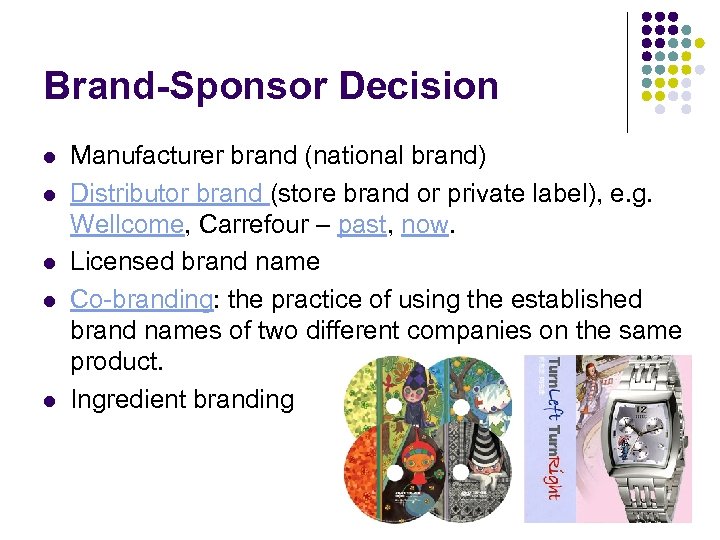 Brand-Sponsor Decision l l l Manufacturer brand (national brand) Distributor brand (store brand or private label), e. g. Wellcome, Carrefour – past, now. Licensed brand name Co-branding: the practice of using the established brand names of two different companies on the same product. Ingredient branding
 If a store brand is not profitable, are there other reasons for the retailer to develop the store brand?
 If you have owned a national brand in the market, will you produce the same product for a retailer’s store brand?
 Brand-Name Decision l l Individual names (個別品牌 ), e. g. P&G, Toyota. Blanket family names (家族品牌 ), e. g. Sony, Hitachi, and Panasonic. Separate family names for all products (單一家族品 牌 ), e. g. 黑松公司:碳酸飲料 → 黑松 , 果汁 → 綠 洲 , 咖啡 → 韋恩. Corporate name combined with individual product names (公司名稱結合個別產品名稱 ), e. g. 統一純 喫茶 , 統一茶裏王 ; Sony Bravia, Sony Walkman, Sony Vaio, Sony Play. Station.
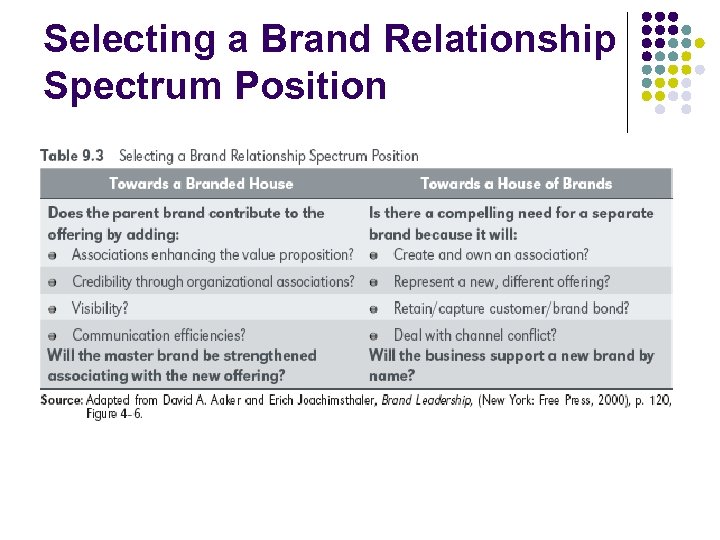 Selecting a Brand Relationship Spectrum Position
 Brand-Name Selection l l l Suggest something about the product’s benefits and qualities, e. g. OFF! bug spray. Easy to pronounce, recognize, and remember, e. g. Tide, Qoo. Distinctive, e. g. Kodak, Oracle. Extendable, e. g. Amazon. Translate easily into foreign languages, e. g. Exxon. Capable of registration and legal protection
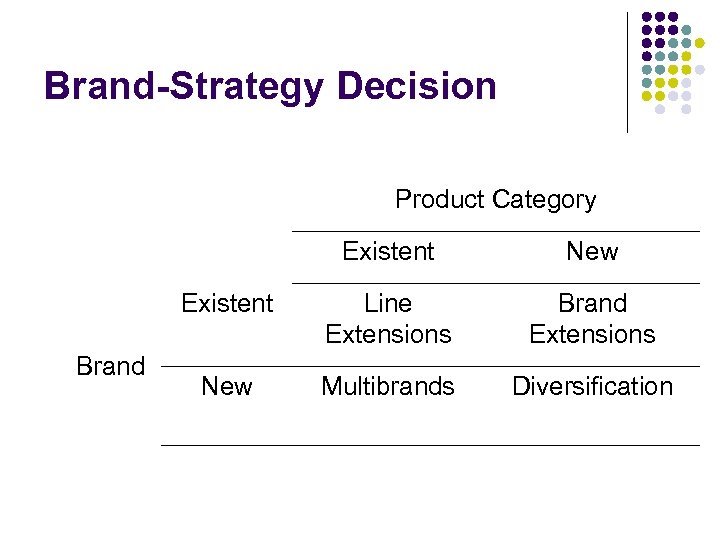 Brand-Strategy Decision Product Category Existent Brand New Line Extensions Brand Extensions New Multibrands Diversification
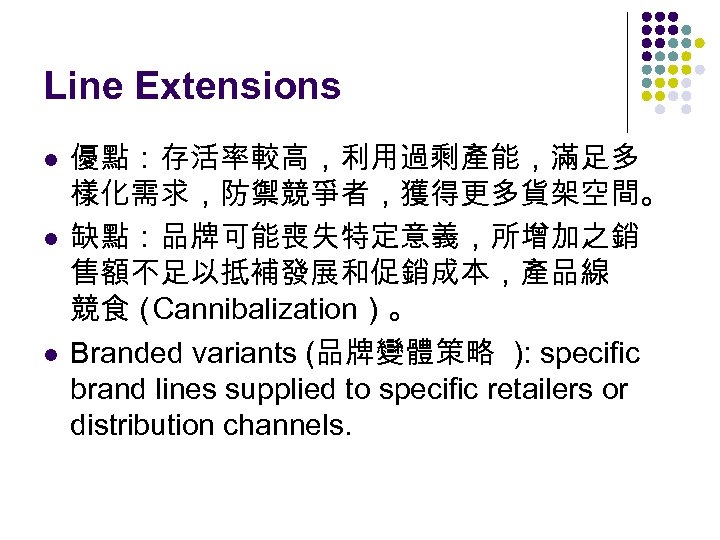 Line Extensions l l l 優點:存活率較高,利用過剩產能,滿足多 樣化需求,防禦競爭者,獲得更多貨架空間。 缺點:品牌可能喪失特定意義,所增加之銷 售額不足以抵補發展和促銷成本,產品線 競食( Cannibalization)。 Branded variants (品牌變體策略 ): specific brand lines supplied to specific retailers or distribution channels.
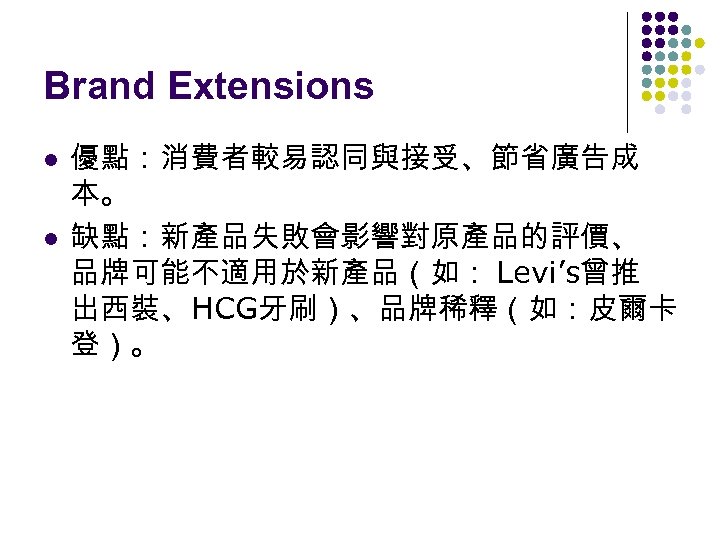 Brand Extensions l l 優點:消費者較易認同與接受、節省廣告成 本。 缺點:新產品失敗會影響對原產品的評價、 品牌可能不適用於新產品(如: Levi’s曾推 出西裝、HCG牙刷)、品牌稀釋(如:皮爾卡 登)。
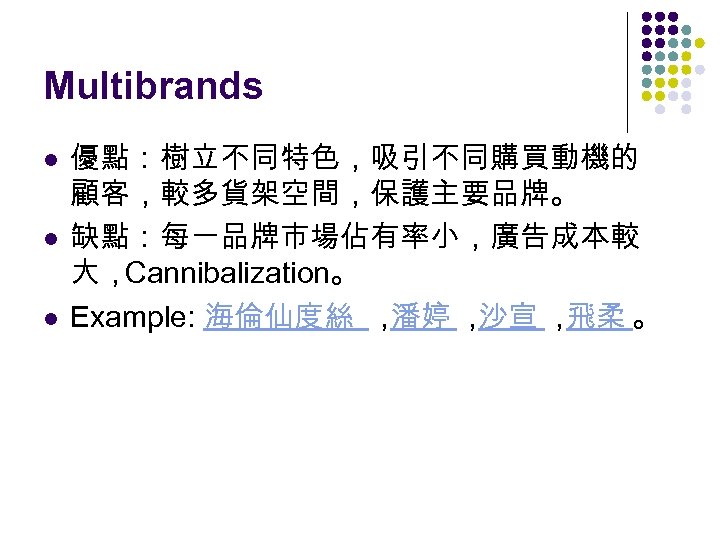 Multibrands l l l 優點:樹立不同特色,吸引不同購買動機的 顧客,較多貨架空間,保護主要品牌。 缺點:每一品牌市場佔有率小,廣告成本較 大,Cannibalization。 Example: 海倫仙度絲 , 潘婷 , 沙宣 , 飛柔 。
 Peter Lynch’s Comment on Diversification l l Over-Diversification → Diworseification Examples l l l Mobil Oil(美孚石油) purchased Marcor Inc. (retail industry). 吉列曾收購藥廠、電子錶廠。 通用食品曾擁有中國餐館、玩具公司、旅行社、 大賣廠、鞋類產品等。
 The Product Life Cycle l l l Product development Introduction Growth Maturity Decline
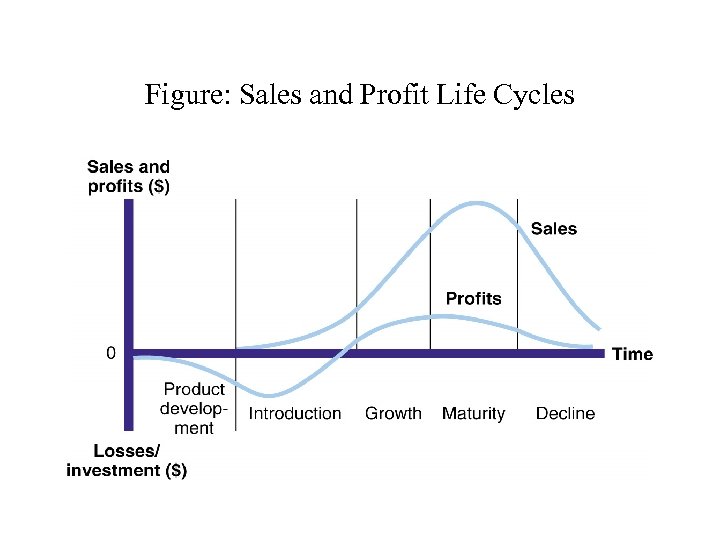 Figure: Sales and Profit Life Cycles
 Introduction Stage of PLC l l l l Sales: low Costs: high cost per customer Profits: negative Marketing Objective: create product awareness and trial Product: offer a basic product Price: use cost-plus formula Distribution: build selective distribution Promotion: heavy to entice product trial
 Growth Stage of PLC l l l l Sales: rapidly rising Costs: average cost per customer Profits: rising Marketing Objective: maximize market share Product: offer extension, service, warranty Price: penetration strategy Distribution: build intensive distribution Promotion: reduce to take advantage of demand
 Maturity Stage of PLC l l l l Sales: peak Costs: low cost per customer Profits: high Marketing Objective: maximize profits while defending market share Product: diversify brand models Price: match or best competitors Distribution: build more intensive distribution Promotion: Increase to encourage brand switching
 Maturity Stage of the PLC l l Modifying the Market: Increase the consumption of the current product. How? l l l Look for new users and market segments, e. g. Johnson & Johnson. Reposition the brand to appeal to larger or fastergrowing segment Look for ways to increase usage among present customers, e. g. Campbell, Amazon.
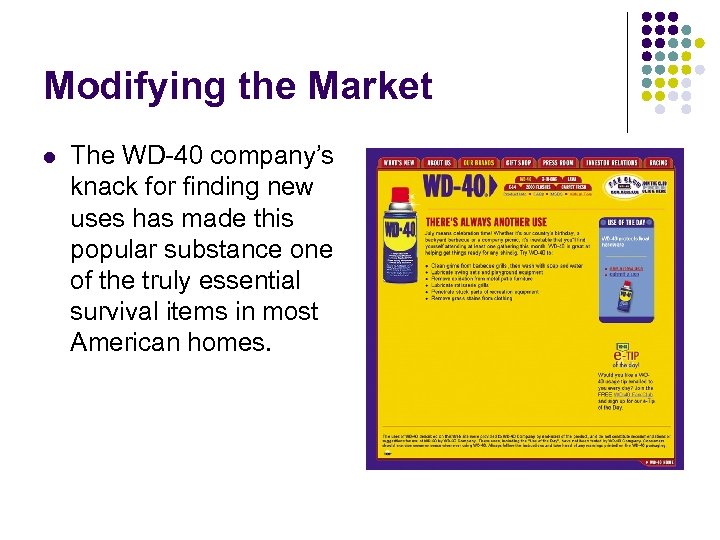 Modifying the Market l The WD-40 company’s knack for finding new uses has made this popular substance one of the truly essential survival items in most American homes.
 Maturity Stage of the PLC l l Modifying the Product: Changing characteristics such as quality, features, or style to attract new users and to inspire more usage. How? l l Improve durability, reliability, speed, taste Improve styling and attractiveness Add new features Expand usefulness, safety, convenience
 Case: Yamaha Piano l l l 當山葉 (Yamaha)控制 40%的全球鋼琴市場 時,總需求每年下降了 10%。 山葉發現大多數的鋼琴都閒置,並成為家 中最大沾灰塵的家具,且都未曾調音。似乎 許多人擁有鋼琴,但很少彈奏。人們並不想 投資時間來彈奏鋼琴。 因此,山葉決定增加市場上數百萬台鋼琴 的價值,開發複雜的數位與光學科技,可在 鋼琴上彈奏出專業鋼琴師的演奏。數位鋼 琴的出現,活化了鋼琴產業,也增加鋼琴維 修的市場。
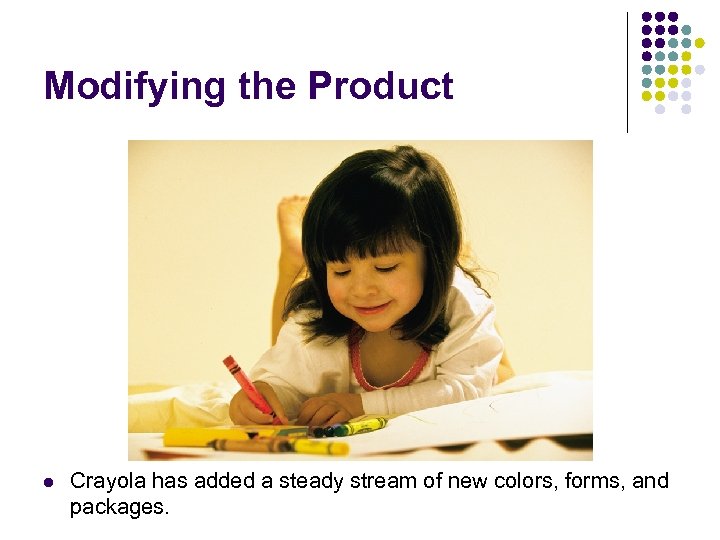 Modifying the Product l Crayola has added a steady stream of new colors, forms, and packages.
 Maturity Stage of the PLC l l Modifying the Marketing Mix: Improving sales by changing one or more marketing mix elements. How? l l Cut prices Launch a better ad campaign Move into larger market channels Offer new or improved services to buyers
 Decline Stage of PLC l l l l Sales: declining Costs: low cost per customer Profits: declining Marketing Objective: reduce expenditures and milk the brand (harvesting or divesting) Product: phase out weak items Price: cut price Distribution: selective--phase out unprofitable outlets Promotion: reduce to minimal level
 Product Life Cycles l l The PLC concept can be used to analyze a product category, a product form, a product, or a brand. Not all products exhibit a bell-shaped PLC. l l Growth-slump-maturity pattern Cycle-recycle pattern Scalloped pattern Style, Fashion, Fad
 Practical Problems of PLC l l l Hard to identify which stage of the PLC the product is in. Hard to pinpoint when the product moves to the next stage. Hard to identify factors that affect product’s movement through stages. Hard to forecast sales level, length of each stage, and shape of PLC. Strategy is both a cause and result of the PLC.