


 Скачать презентацию Setting and Adjusting Performance Goal Targets American Recovery
77e9df4d4b264aff7ccea7f2a8487a5b.ppt
- Количество слайдов: 30
 Setting and Adjusting Performance Goal Targets American Recovery and Reinvestment Act Performance Accountability Summit Randall W. Eberts W. E. Upjohn Institute for Employment Research December 9, 2009
 Background • Office of Management and Budget (OMB) requires revisions to the Government Performance and Results (GPRA) performance goals. • Goals established using prior year’s results with an incremental increase to demonstrate continuous improvement • Early 2008, ETA conducted an analysis on average earnings • Late 2008, ETA negotiated additional time to set new “common measures” targets for the Fiscal Year 2010 Budget due to the economic downturn 2
 Effects of the Economic Recession • ETA did not have any data to understand the implications of the recession on program performance • ETA initiated a study with the W. E. Upjohn Institute to identify a methodology that would look at effects of unemployment on past program performance • Purpose of the study was to estimate the cyclical effects of the business cycle on program performance • Use the estimates of the effect of unemployment rates on performance to adjust performance targets for the common measures of entered employment, retention and earnings outcomes 3
 GPRA Performance Goals for PY 2008/FY 2009 • The W. E. Upjohn Institute developed a regression model for the “Common Measures. ” • Analysis conducted for WIA (Adult, Dislocated Worker, and Youth), Wagner-Peyser, and Trade Adjustment Assistance. • ETA received approval to apply the coefficients to SCESP, NEG, NFJP, INA, WIGs, Youth. Build, Apprenticeship, and Re-integration of Ex-offenders • TEGL 09 -08, Change 1, issued June 3, 2009, explains the methodology and describes efforts to expand the regression model 4
 Purpose of the Methodology • Offers a systematic, objective and transparent framework for: – Setting performance targets – Focusing on the value-added of WIA – Diagnosing WIA performance • Accounts for factors outside the control of state and local programs – “Outside the control, ” means factors that affect performance outcomes but are not related to the services provided by the programs – Local labor market conditions (unemployment rates) – Personal characteristics of participants (prior work history, educational attainment, barriers to employment) • Focuses on the value-added of WIA services – Adjusted targets credit service providers for performance not for favorable factors – Helps to level the “playing field” • Diagnoses performance by understanding factors affecting outcomes 5
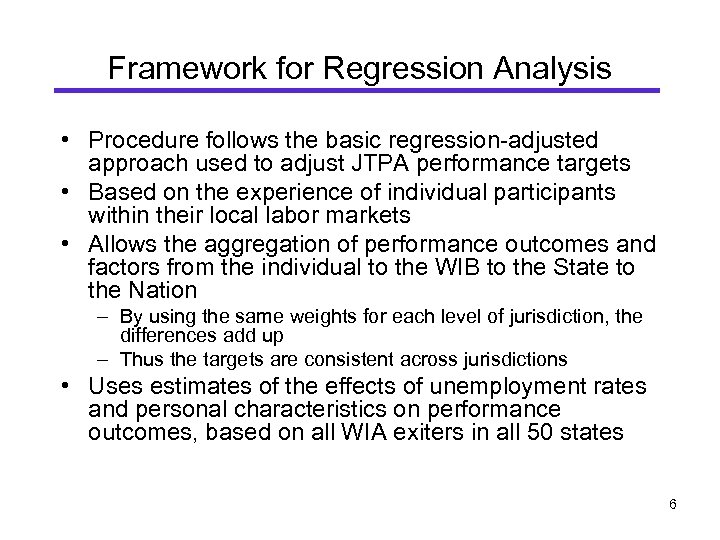 Framework for Regression Analysis • Procedure follows the basic regression-adjusted approach used to adjust JTPA performance targets • Based on the experience of individual participants within their local labor markets • Allows the aggregation of performance outcomes and factors from the individual to the WIB to the State to the Nation – By using the same weights for each level of jurisdiction, the differences add up – Thus the targets are consistent across jurisdictions • Uses estimates of the effects of unemployment rates and personal characteristics on performance outcomes, based on all WIA exiters in all 50 states 6
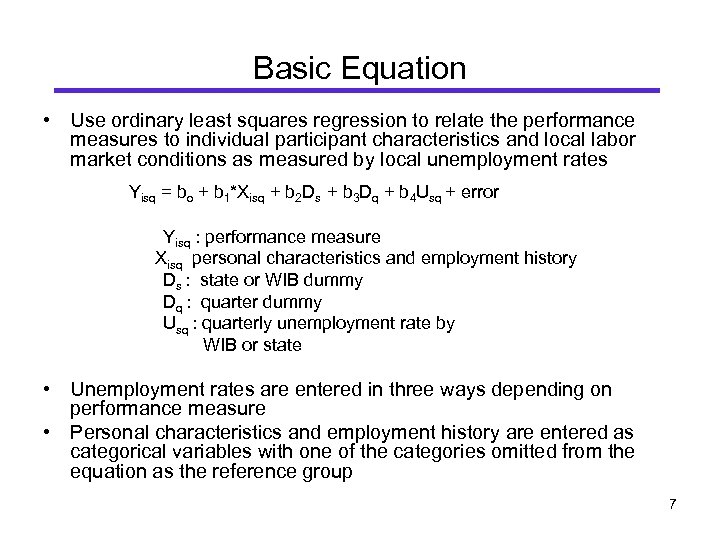 Basic Equation • Use ordinary least squares regression to relate the performance measures to individual participant characteristics and local labor market conditions as measured by local unemployment rates Yisq = bo + b 1*Xisq + b 2 Ds + b 3 Dq + b 4 Usq + error Yisq : performance measure Xisq personal characteristics and employment history Ds : state or WIB dummy Dq : quarter dummy Usq : quarterly unemployment rate by WIB or state • Unemployment rates are entered in three ways depending on performance measure • Personal characteristics and employment history are entered as categorical variables with one of the categories omitted from the equation as the reference group 7
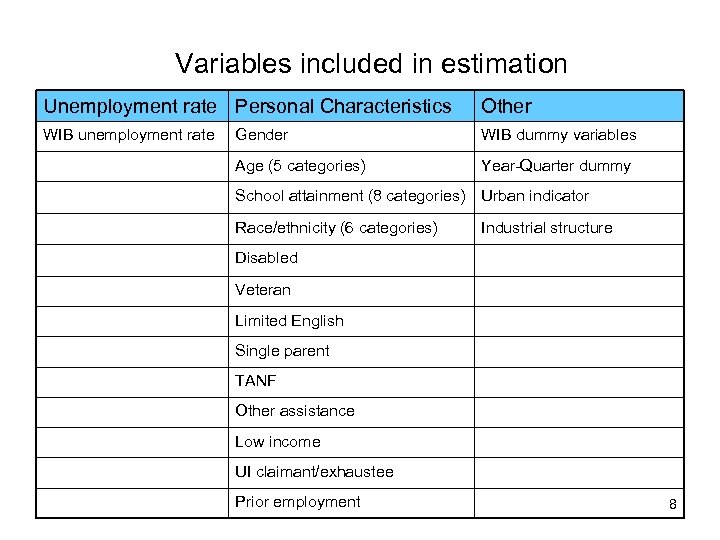 Variables included in estimation Unemployment rate Personal Characteristics Other WIB unemployment rate Gender WIB dummy variables Age (5 categories) Year-Quarter dummy School attainment (8 categories) Urban indicator Race/ethnicity (6 categories) Industrial structure Disabled Veteran Limited English Single parent TANF Other assistance Low income UI claimant/exhaustee Prior employment 8
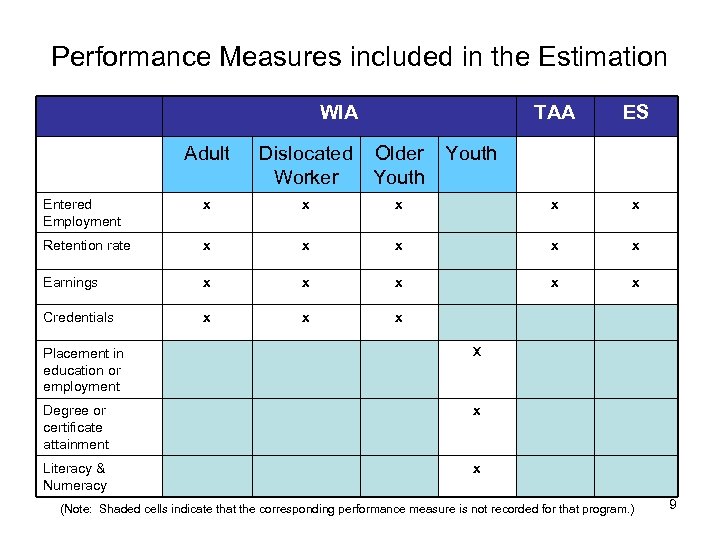 Performance Measures included in the Estimation WIA TAA ES Adult Dislocated Worker Older Youth Entered Employment x x x Retention rate x x x Earnings x x x Credentials x x x Placement in education or employment X Degree or certificate attainment x Literacy & Numeracy x (Note: Shaded cells indicate that the corresponding performance measure is not recorded for that program. ) 9
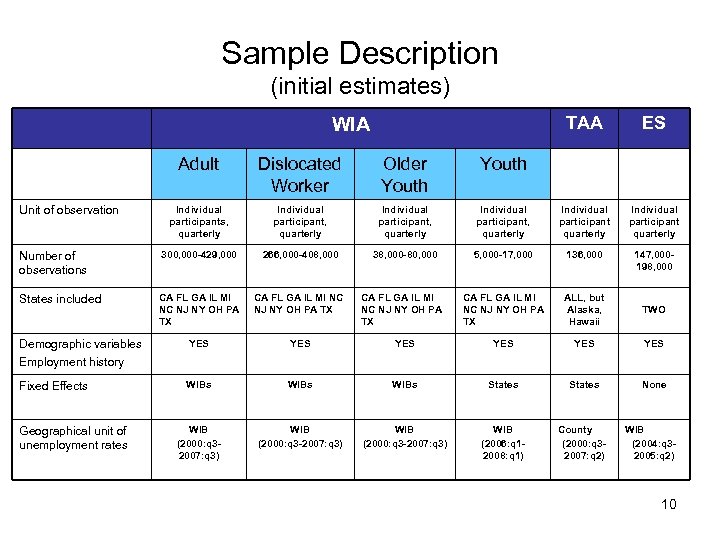 Sample Description (initial estimates) TAA WIA ES Adult Dislocated Worker Older Youth Individual participants, quarterly Individual participant, quarterly Individual participant quarterly Number of observations 300, 000 -429, 000 266, 000 -408, 000 38, 000 -80, 000 5, 000 -17, 000 136, 000 147, 000198, 000 States included CA FL GA IL MI NC NJ NY OH PA TX ALL, but Alaska, Hawaii TWO Demographic variables Employment history YES YES YES Fixed Effects WIBs States None WIB (2000: q 32007: q 3) WIB (2000: q 3 -2007: q 3) WIB (2006: q 12008: q 1) County (2000: q 32007: q 2) Unit of observation Geographical unit of unemployment rates CA FL GA IL MI NC NJ NY OH PA TX WIB (2004: q 32005: q 2) 10
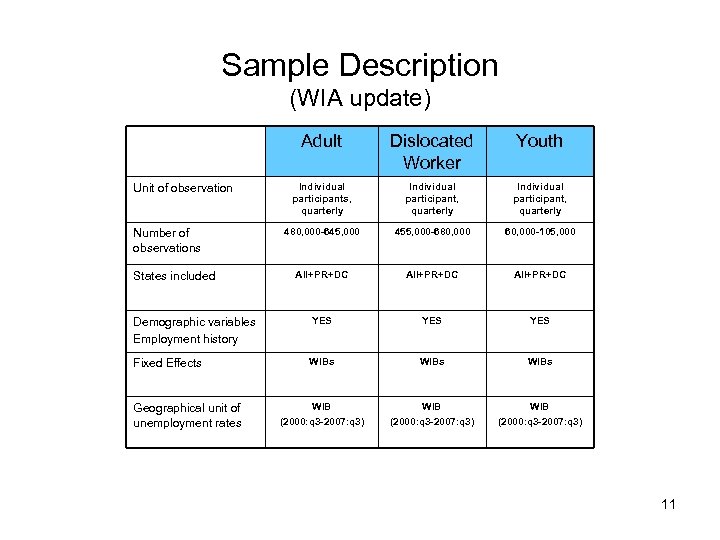 Sample Description (WIA update) Adult Dislocated Worker Youth Individual participants, quarterly Individual participant, quarterly 480, 000 -645, 000 455, 000 -680, 000 60, 000 -105, 000 All+PR+DC Demographic variables Employment history YES YES Fixed Effects WIBs WIB (2000: q 3 -2007: q 3) Unit of observation Number of observations States included Geographical unit of unemployment rates 11
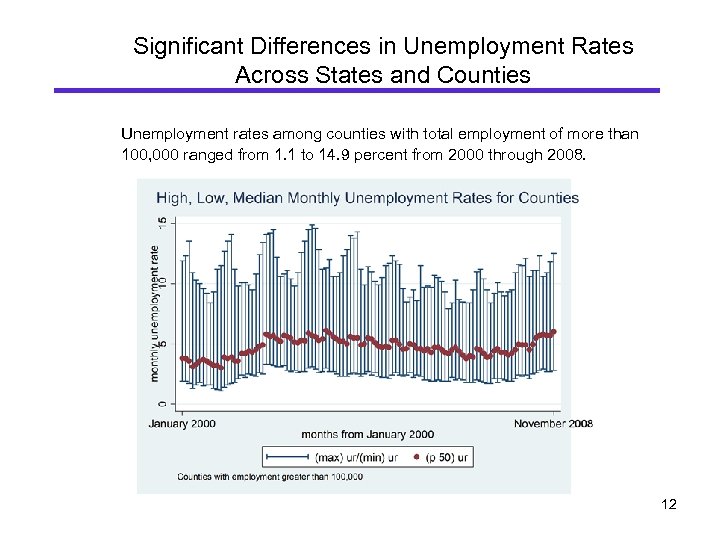 Significant Differences in Unemployment Rates Across States and Counties Unemployment rates among counties with total employment of more than 100, 000 ranged from 1. 1 to 14. 9 percent from 2000 through 2008. 12
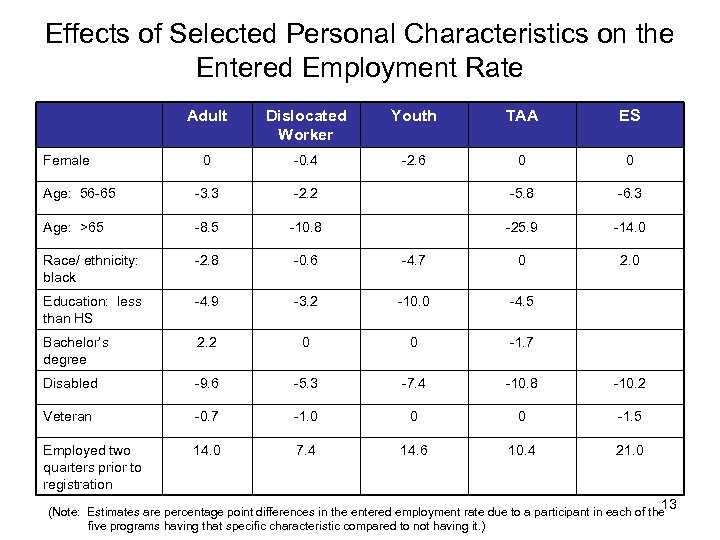 Effects of Selected Personal Characteristics on the Entered Employment Rate Adult Dislocated Worker Youth TAA ES 0 -0. 4 -2. 6 0 0 Age: 56 -65 -3. 3 -2. 2 -5. 8 -6. 3 Age: >65 -8. 5 -10. 8 -25. 9 -14. 0 Race/ ethnicity: black -2. 8 -0. 6 -4. 7 0 2. 0 Education: less than HS -4. 9 -3. 2 -10. 0 -4. 5 Bachelor’s degree 2. 2 0 0 -1. 7 Disabled -9. 6 -5. 3 -7. 4 -10. 8 -10. 2 Veteran -0. 7 -1. 0 0 0 -1. 5 Employed two quarters prior to registration 14. 0 7. 4 14. 6 10. 4 21. 0 Female 13 (Note: Estimates are percentage point differences in the entered employment rate due to a participant in each of the five programs having that specific characteristic compared to not having it. )
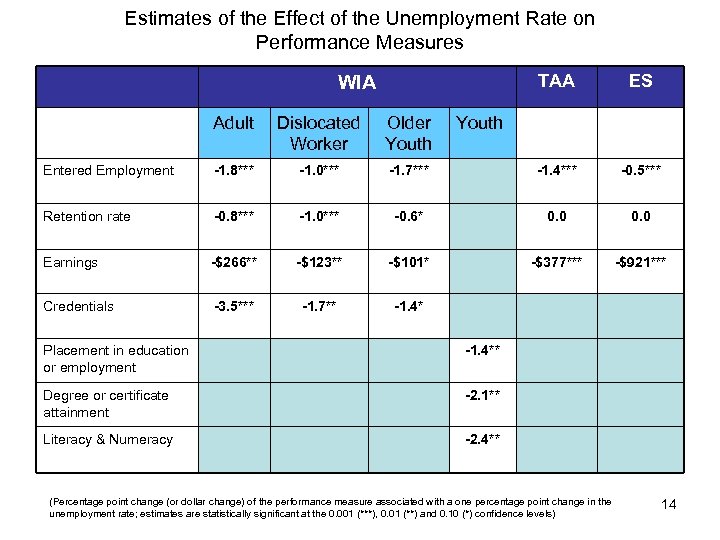 Estimates of the Effect of the Unemployment Rate on Performance Measures TAA WIA ES Adult Dislocated Worker Older Youth Entered Employment -1. 8*** -1. 0*** -1. 7*** -1. 4*** -0. 5*** Retention rate -0. 8*** -1. 0*** -0. 6* 0. 0 Earnings -$266** -$123** -$101* -$377*** -$921*** Credentials -3. 5*** -1. 7** -1. 4* Placement in education or employment -1. 4** Degree or certificate attainment -2. 1** Literacy & Numeracy -2. 4** (Percentage point change (or dollar change) of the performance measure associated with a one percentage point change in the unemployment rate; estimates are statistically significant at the 0. 001 (***), 0. 01 (**) and 0. 10 (*) confidence levels) 14
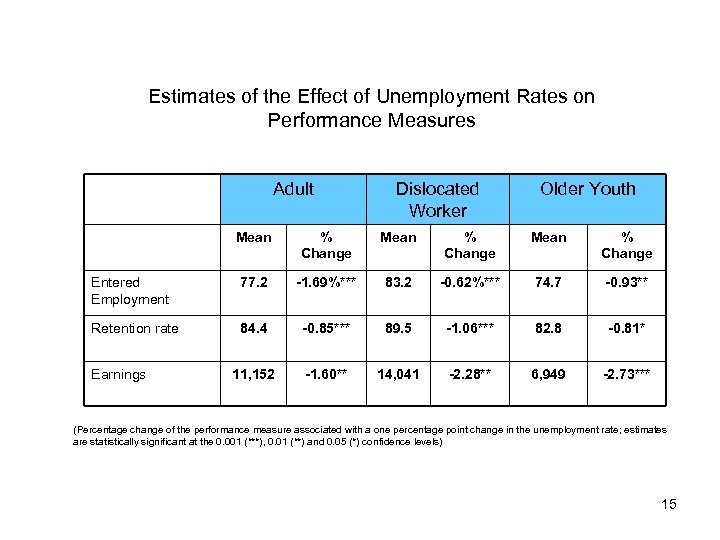 Estimates of the Effect of Unemployment Rates on Performance Measures Adult Dislocated Worker Older Youth Mean % Change Entered Employment 77. 2 -1. 69%*** 83. 2 -0. 62%*** 74. 7 -0. 93** Retention rate 84. 4 -0. 85*** 89. 5 -1. 06*** 82. 8 -0. 81* 11, 152 -1. 60** 14, 041 -2. 28** 6, 949 -2. 73*** Earnings (Percentage change of the performance measure associated with a one percentage point change in the unemployment rate; estimates are statistically significant at the 0. 001 (***), 0. 01 (**) and 0. 05 (*) confidence levels) 15
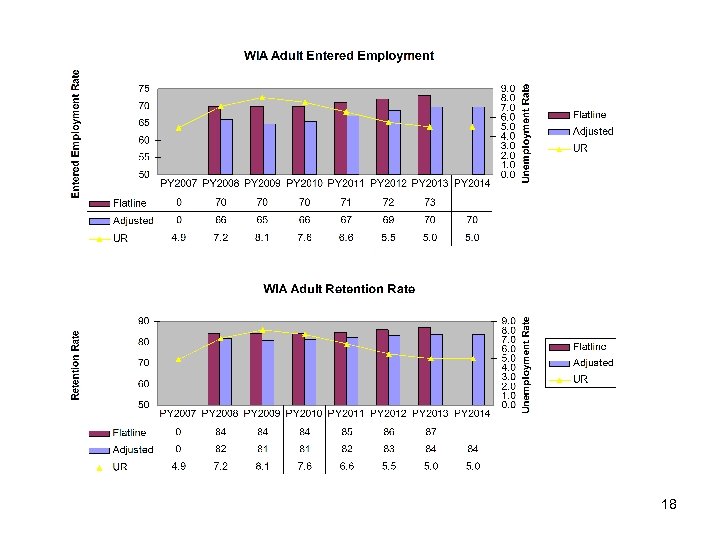
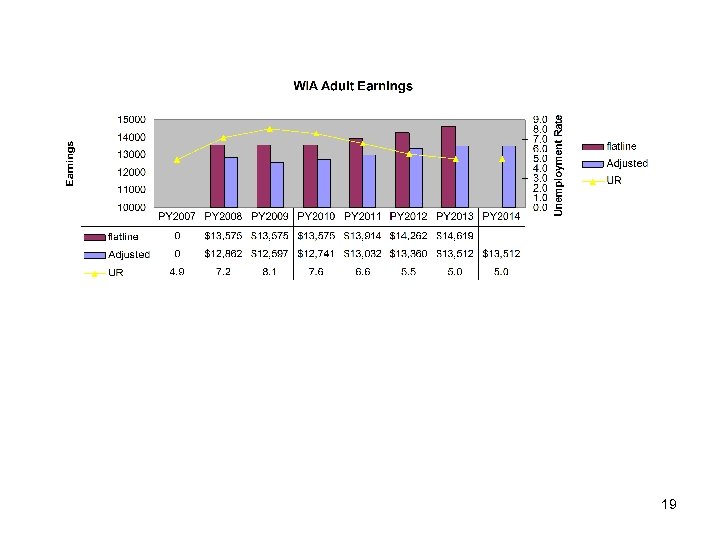
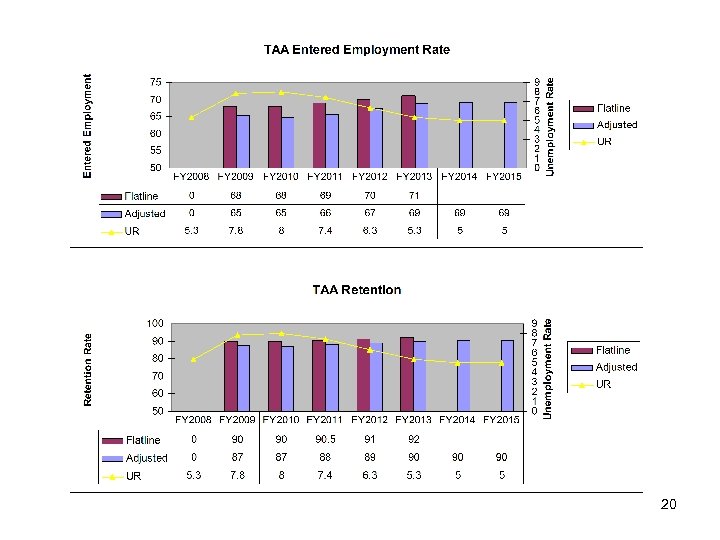
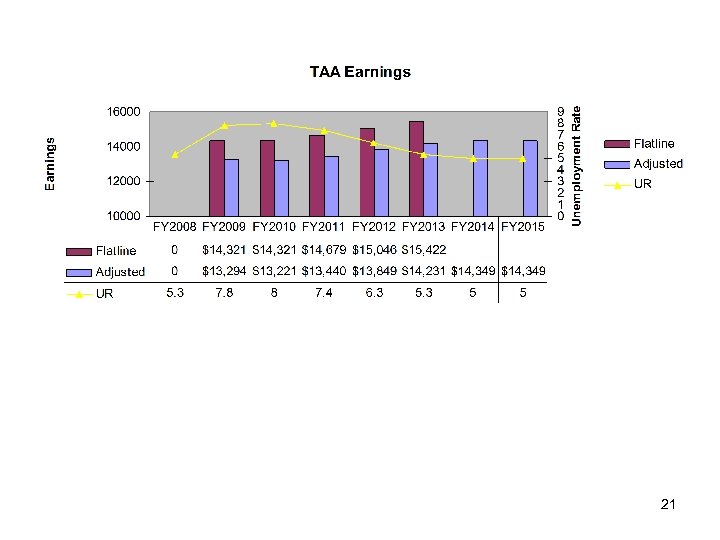
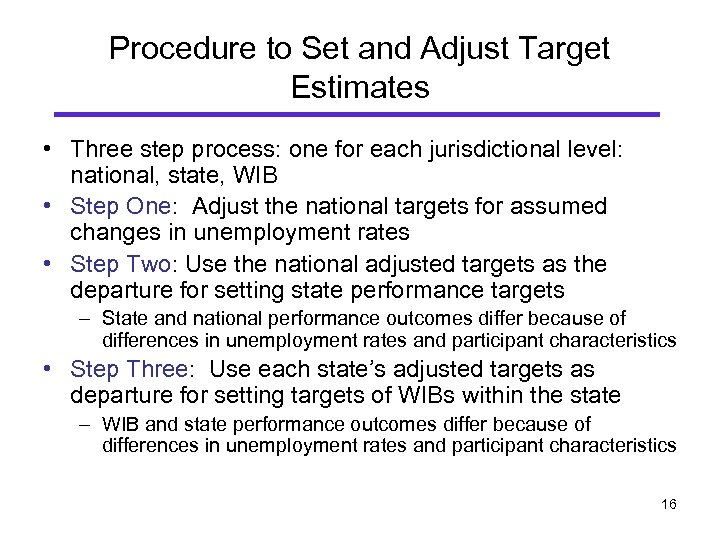 Procedure to Set and Adjust Target Estimates • Three step process: one for each jurisdictional level: national, state, WIB • Step One: Adjust the national targets for assumed changes in unemployment rates • Step Two: Use the national adjusted targets as the departure for setting state performance targets – State and national performance outcomes differ because of differences in unemployment rates and participant characteristics • Step Three: Use each state’s adjusted targets as departure for setting targets of WIBs within the state – WIB and state performance outcomes differ because of differences in unemployment rates and participant characteristics 16
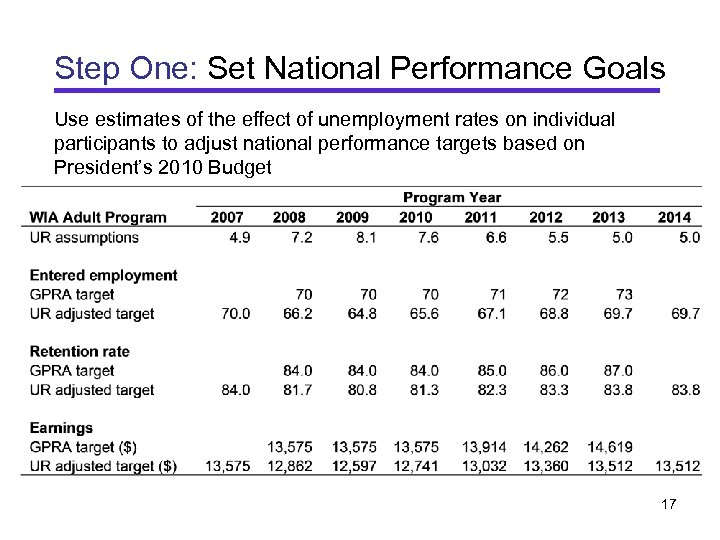 Step One: Set National Performance Goals Use estimates of the effect of unemployment rates on individual participants to adjust national performance targets based on President’s 2010 Budget 17
 18
18
 19
19
 20
20
 21
21
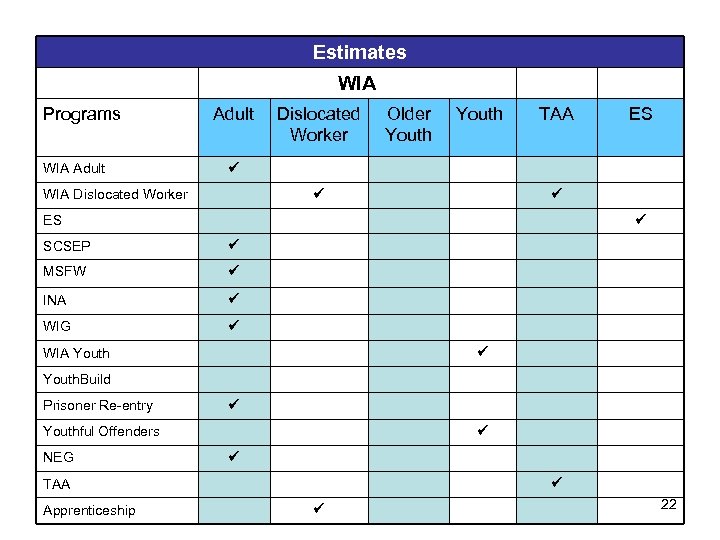 Estimates WIA Programs WIA Adult Dislocated Worker Older Youth TAA ES WIA Dislocated Worker ES SCSEP MSFW INA WIG WIA Youth. Build Prisoner Re-entry Youthful Offenders NEG TAA Apprenticeship 22
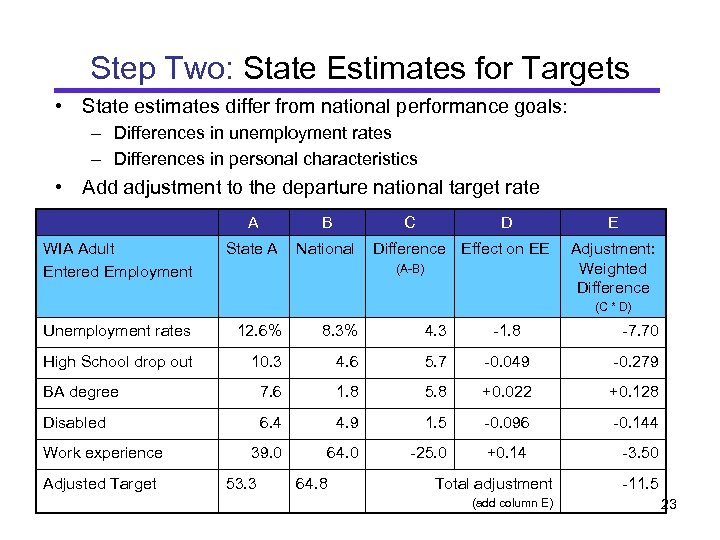 Step Two: State Estimates for Targets • State estimates differ from national performance goals: – Differences in unemployment rates – Differences in personal characteristics • Add adjustment to the departure national target rate A WIA Adult Entered Employment B C State A National D Difference Effect on EE (A-B) E Adjustment: Weighted Difference (C * D) Unemployment rates 12. 6% 8. 3% 4. 3 -1. 8 -7. 70 High School drop out 10. 3 4. 6 5. 7 -0. 049 -0. 279 BA degree 7. 6 1. 8 5. 8 +0. 022 +0. 128 Disabled 6. 4 4. 9 1. 5 -0. 096 -0. 144 39. 0 64. 0 -25. 0 +0. 14 -3. 50 Work experience Adjusted Target 53. 3 64. 8 Total adjustment (add column E) -11. 5 23
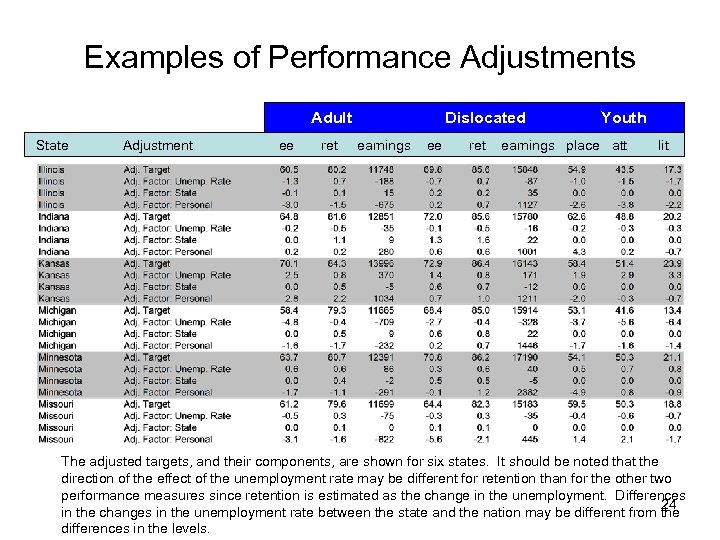 Examples of Performance Adjustments Adult State Adjustment ee ret Dislocated earnings ee ret Youth earnings place att lit The adjusted targets, and their components, are shown for six states. It should be noted that the direction of the effect of the unemployment rate may be different for retention than for the other two performance measures since retention is estimated as the change in the unemployment. Differences 24 in the changes in the unemployment rate between the state and the nation may be different from the differences in the levels.
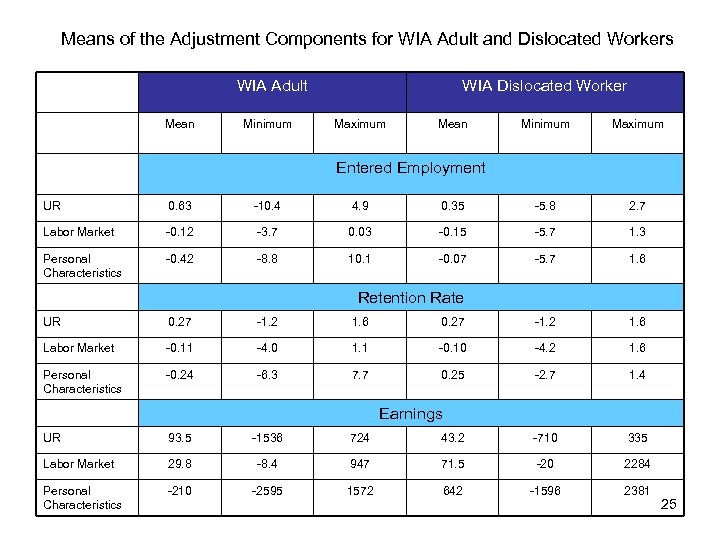 Means of the Adjustment Components for WIA Adult and Dislocated Workers WIA Adult Mean Minimum WIA Dislocated Worker Maximum Mean Minimum Maximum Entered Employment UR 0. 63 -10. 4 4. 9 0. 35 -5. 8 2. 7 Labor Market -0. 12 -3. 7 0. 03 -0. 15 -5. 7 1. 3 Personal Characteristics -0. 42 -8. 8 10. 1 -0. 07 -5. 7 1. 6 Retention Rate UR 0. 27 -1. 2 1. 6 Labor Market -0. 11 -4. 0 1. 1 -0. 10 -4. 2 1. 6 Personal Characteristics -0. 24 -6. 3 7. 7 0. 25 -2. 7 1. 4 Earnings UR 93. 5 -1536 724 43. 2 -710 335 Labor Market 29. 8 -8. 4 947 71. 5 -20 2284 Personal Characteristics -210 -2595 1572 642 -1596 2381 25
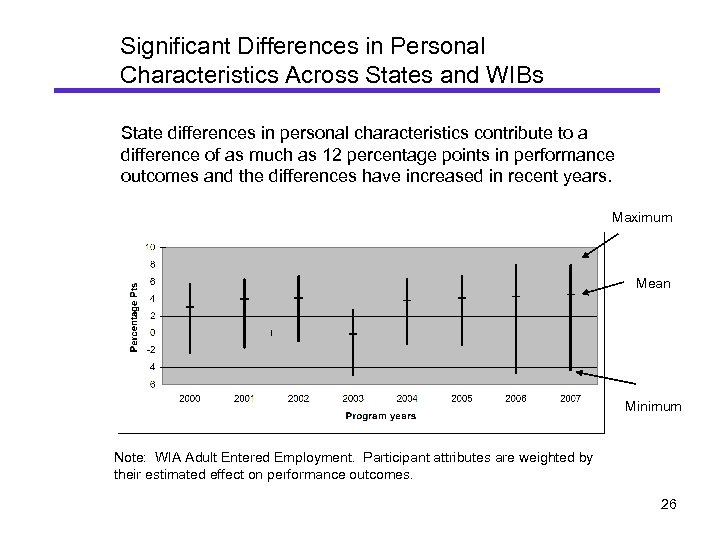 Significant Differences in Personal Characteristics Across States and WIBs State differences in personal characteristics contribute to a difference of as much as 12 percentage points in performance outcomes and the differences have increased in recent years. Maximum Mean Minimum Note: WIA Adult Entered Employment. Participant attributes are weighted by their estimated effect on performance outcomes. 26
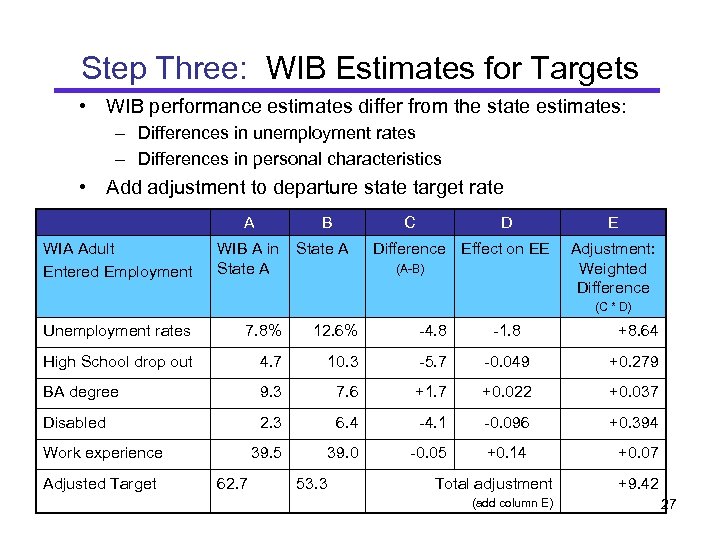 Step Three: WIB Estimates for Targets • WIB performance estimates differ from the state estimates: – Differences in unemployment rates – Differences in personal characteristics • Add adjustment to departure state target rate A WIA Adult Entered Employment B WIB A in State A C State A D Difference Effect on EE (A-B) E Adjustment: Weighted Difference (C * D) Unemployment rates 7. 8% 12. 6% -4. 8 -1. 8 +8. 64 High School drop out 4. 7 10. 3 -5. 7 -0. 049 +0. 279 BA degree 9. 3 7. 6 +1. 7 +0. 022 +0. 037 Disabled 2. 3 6. 4 -4. 1 -0. 096 +0. 394 39. 5 39. 0 -0. 05 +0. 14 +0. 07 Work experience Adjusted Target 62. 7 53. 3 Total adjustment (add column E) +9. 42 27
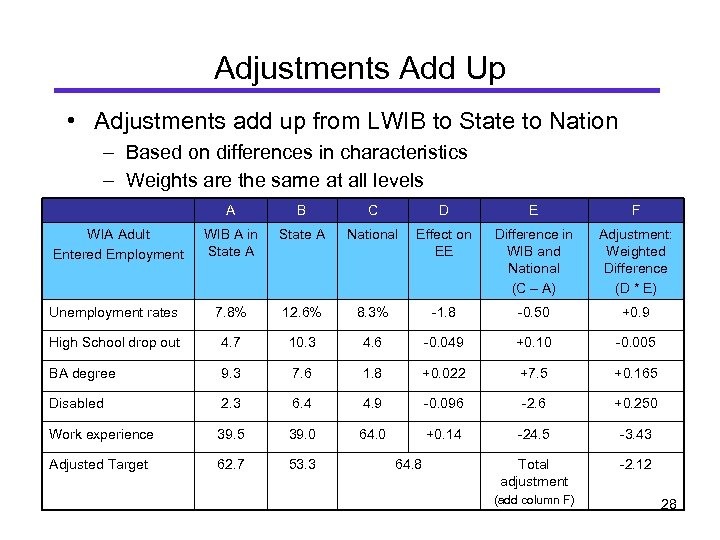 Adjustments Add Up • Adjustments add up from LWIB to State to Nation – Based on differences in characteristics – Weights are the same at all levels A B C D E F WIB A in State A National Effect on EE Difference in WIB and National (C – A) Adjustment: Weighted Difference (D * E) Unemployment rates 7. 8% 12. 6% 8. 3% -1. 8 -0. 50 +0. 9 High School drop out 4. 7 10. 3 4. 6 -0. 049 +0. 10 -0. 005 BA degree 9. 3 7. 6 1. 8 +0. 022 +7. 5 +0. 165 Disabled 2. 3 6. 4 4. 9 -0. 096 -2. 6 +0. 250 Work experience 39. 5 39. 0 64. 0 +0. 14 -24. 5 -3. 43 Adjusted Target 62. 7 53. 3 Total adjustment -2. 12 WIA Adult Entered Employment 64. 8 (add column F) 28
 Summary • Target adjustment procedure provides a systematic, transparent, and objective way to set national, state, and WIB performance targets for WIA programs • Adjustment factors, since they are related to factors that are familiar to administrators, can be easily scrutinized to better understand diagnose programs – Also familiar since state adjustment procedure is similar to the JTPA method and WIB adjustment similar to Michigan’s VAPIS • With the analysis of factors already completed and WIASRD data available, the necessary ingredients are currently available to calculate the targets for states and WIBs 29
 Contact Information Stephen Wandner Gloria Salas-Kos Office of Performance and Technology Employment and Training Administration 202 -693 -3596 salas-kos. gloria@dol. gov Randall Eberts Timothy Bartik W. E. Upjohn Institute for Employment Research 269 -343 -5541 eberts@upjohn. org 30