


 Скачать презентацию Set Operations CS APMA 202 Spring 2005 Rosen section
ec5da1e91e1c0a3391b1aab556308eaf.ppt
- Количество слайдов: 44
 Set Operations CS/APMA 202, Spring 2005 Rosen, section 1. 7 Aaron Bloomfield 1
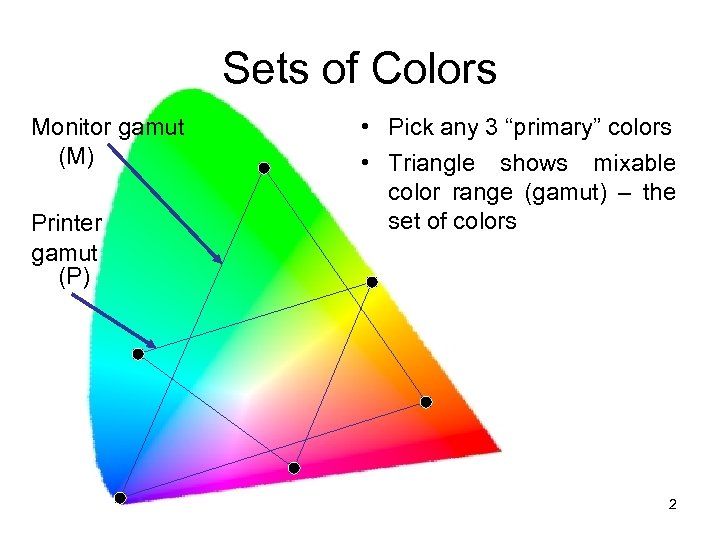 Sets of Colors Monitor gamut (M) Printer gamut (P) • Pick any 3 “primary” colors • Triangle shows mixable color range (gamut) – the set of colors 2
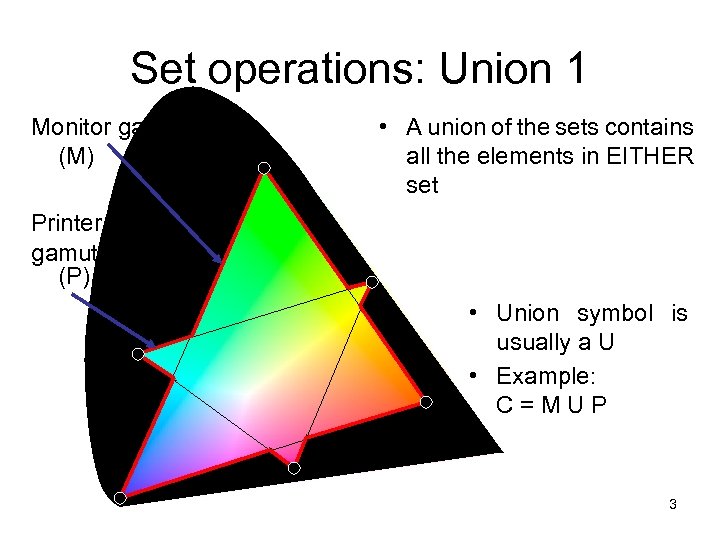 Set operations: Union 1 Monitor gamut (M) • A union of the sets contains all the elements in EITHER set Printer gamut (P) • Union symbol is usually a U • Example: C=MUP 3
 Set operations: Union 2 AUB U A B 4
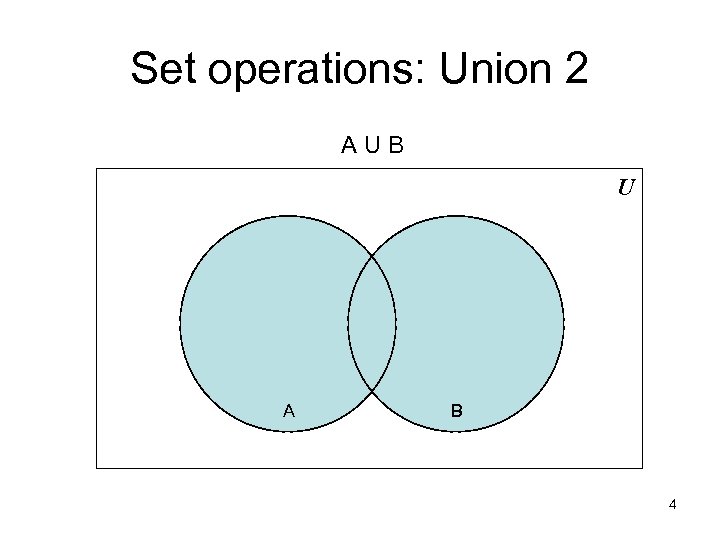
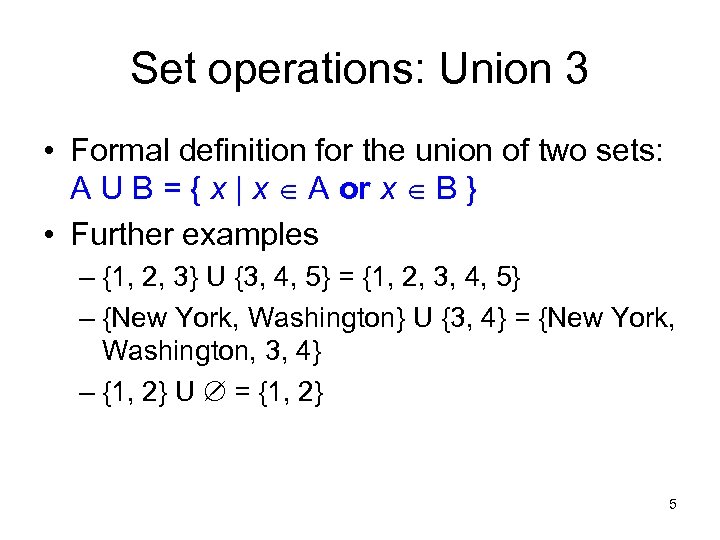 Set operations: Union 3 • Formal definition for the union of two sets: A U B = { x | x A or x B } • Further examples – {1, 2, 3} U {3, 4, 5} = {1, 2, 3, 4, 5} – {New York, Washington} U {3, 4} = {New York, Washington, 3, 4} – {1, 2} U = {1, 2} 5
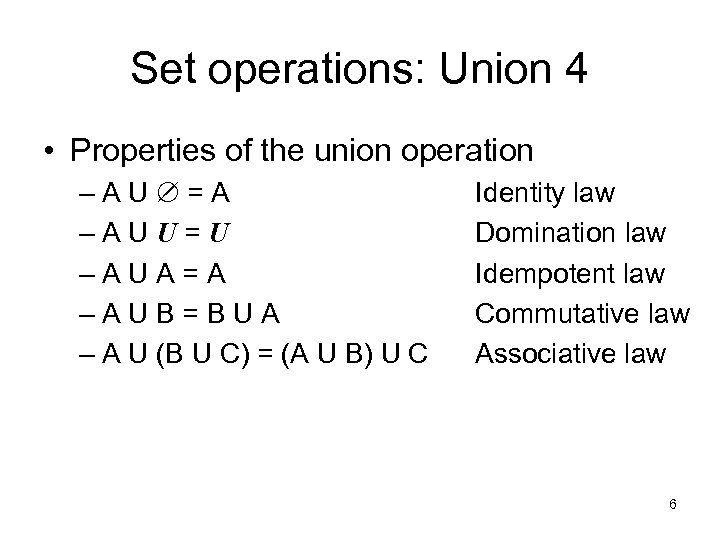 Set operations: Union 4 • Properties of the union operation –AU =A –AUU=U –AUA=A –AUB=BUA – A U (B U C) = (A U B) U C Identity law Domination law Idempotent law Commutative law Associative law 6
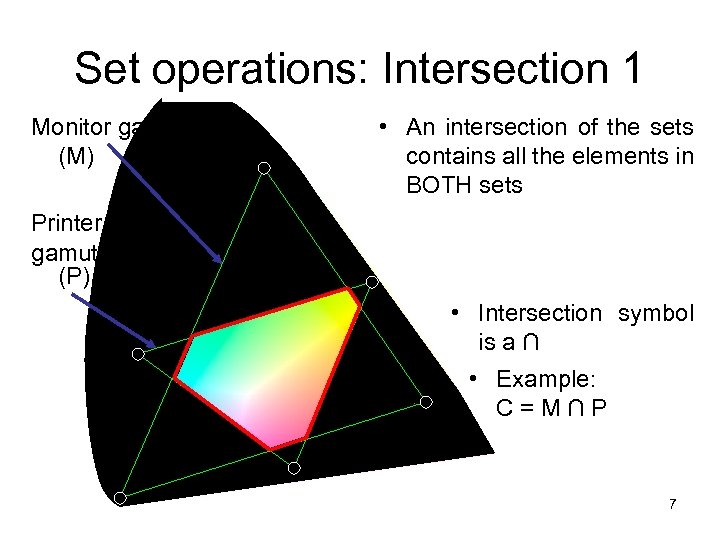 Set operations: Intersection 1 Monitor gamut (M) • An intersection of the sets contains all the elements in BOTH sets Printer gamut (P) • Intersection symbol is a ∩ • Example: C=M∩P 7
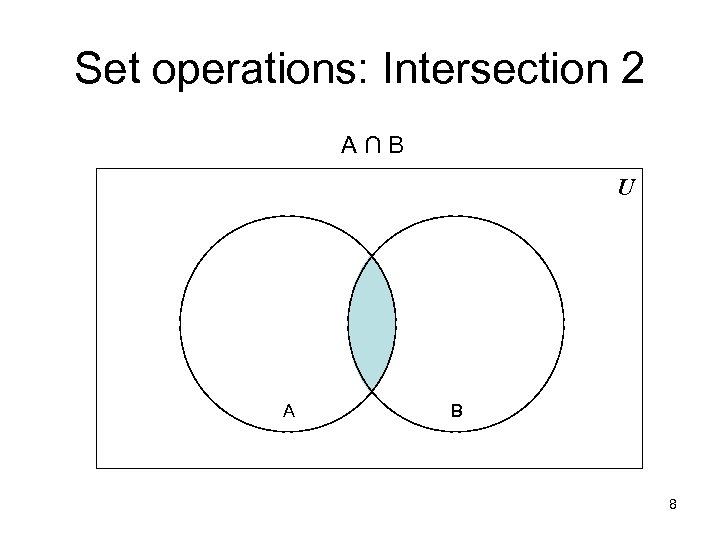 Set operations: Intersection 2 A∩B U A B 8
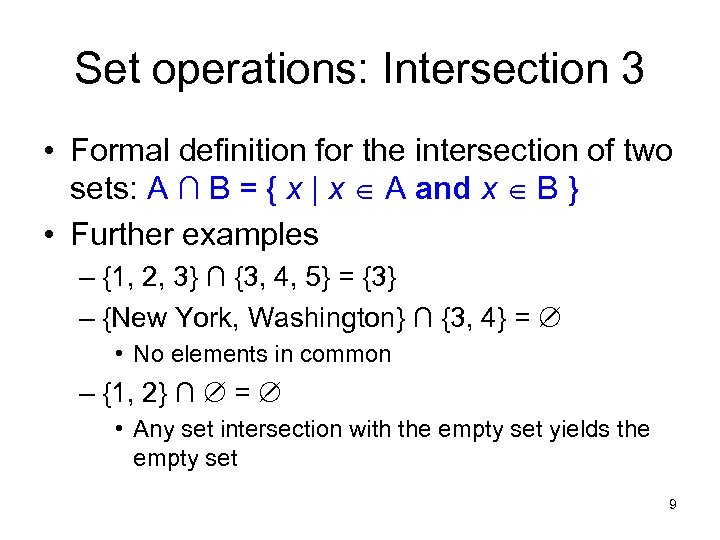 Set operations: Intersection 3 • Formal definition for the intersection of two sets: A ∩ B = { x | x A and x B } • Further examples – {1, 2, 3} ∩ {3, 4, 5} = {3} – {New York, Washington} ∩ {3, 4} = • No elements in common – {1, 2} ∩ = • Any set intersection with the empty set yields the empty set 9
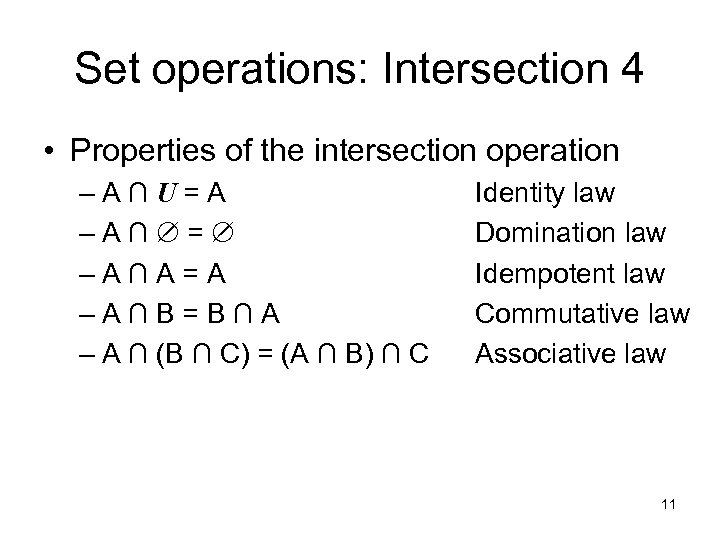 Set operations: Intersection 4 • Properties of the intersection operation –A∩U=A –A∩ = –A∩A=A –A∩B=B∩A – A ∩ (B ∩ C) = (A ∩ B) ∩ C Identity law Domination law Idempotent law Commutative law Associative law 11
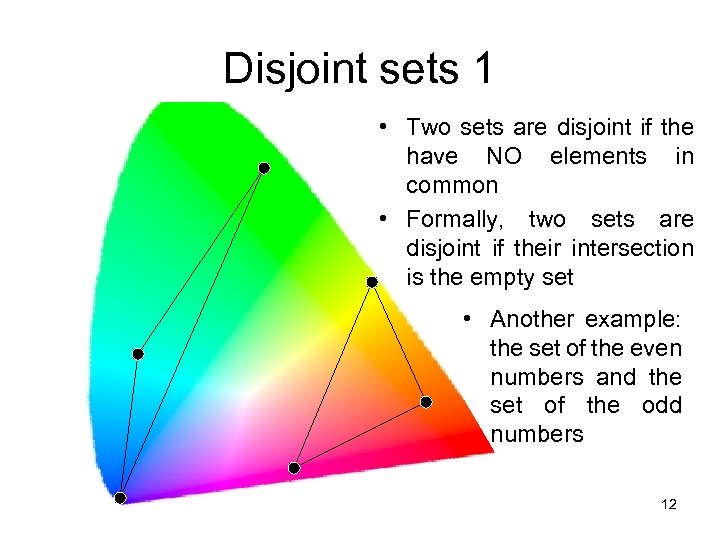 Disjoint sets 1 • Two sets are disjoint if the have NO elements in common • Formally, two sets are disjoint if their intersection is the empty set • Another example: the set of the even numbers and the set of the odd numbers 12
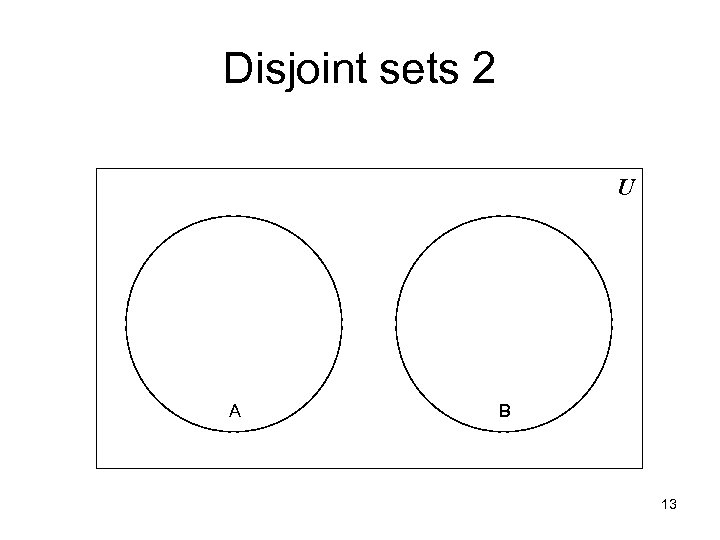 Disjoint sets 2 U A B 13
 Disjoint sets 3 • Formal definition for disjoint sets: two sets are disjoint if their intersection is the empty set • Further examples – {1, 2, 3} and {3, 4, 5} are not disjoint – {New York, Washington} and {3, 4} are disjoint – {1, 2} and are disjoint • Their intersection is the empty set – and are disjoint! • Their intersection is the empty set 14
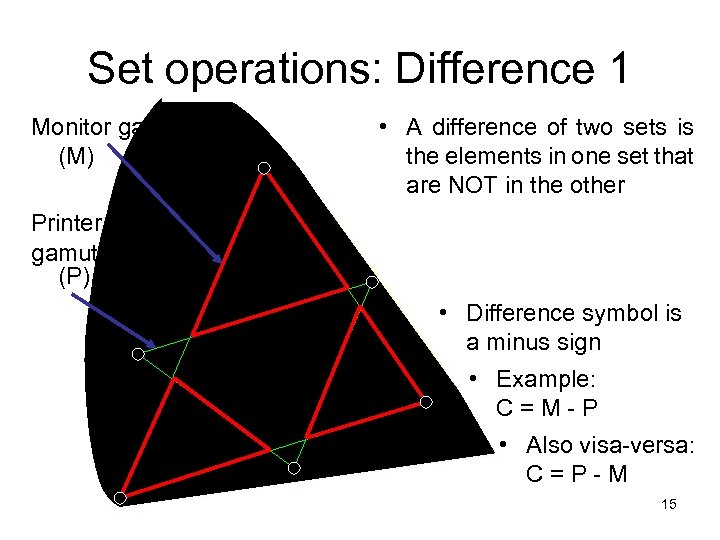 Set operations: Difference 1 Monitor gamut (M) • A difference of two sets is the elements in one set that are NOT in the other Printer gamut (P) • Difference symbol is a minus sign • Example: C=M-P • Also visa-versa: C=P-M 15
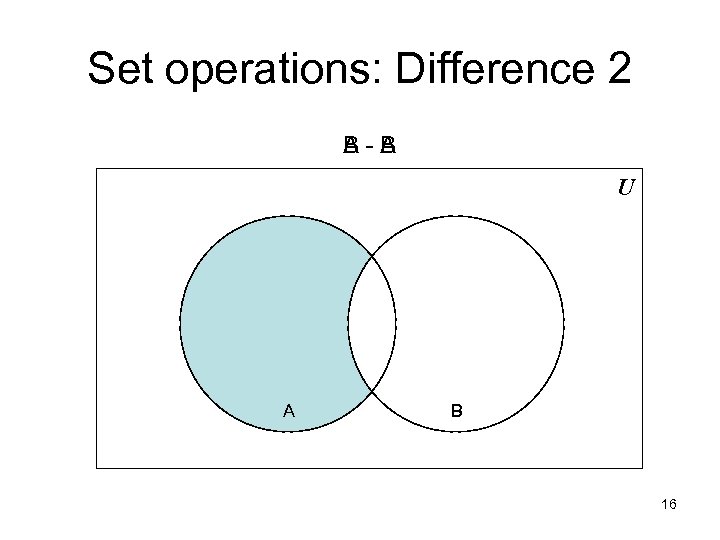 Set operations: Difference 2 A B B-A U A B 16
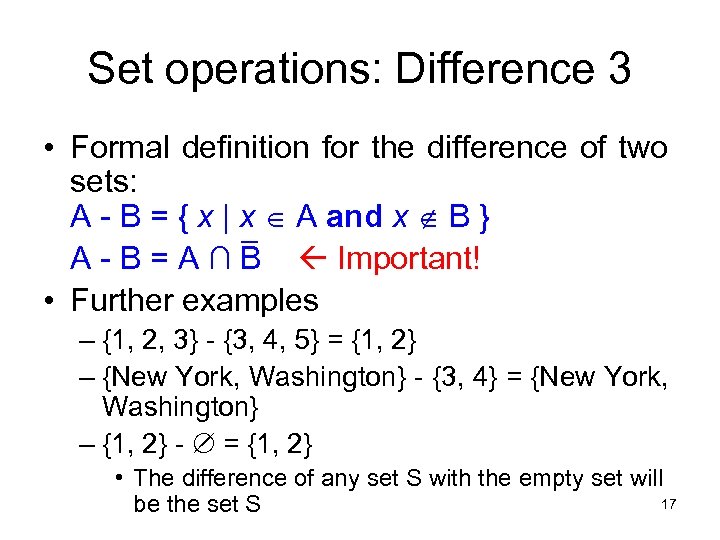 Set operations: Difference 3 • Formal definition for the difference of two sets: A - B = { x | x A and x B } _ A - B = A ∩ B Important! • Further examples – {1, 2, 3} - {3, 4, 5} = {1, 2} – {New York, Washington} - {3, 4} = {New York, Washington} – {1, 2} - = {1, 2} • The difference of any set S with the empty set will 17 be the set S
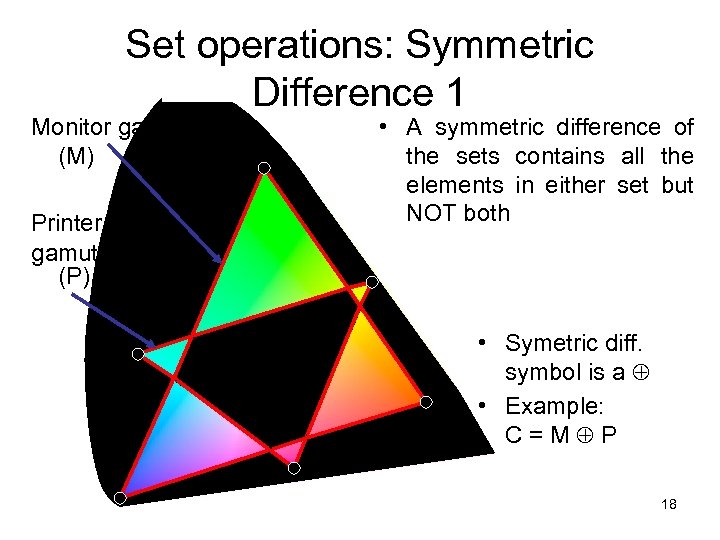 Set operations: Symmetric Difference 1 Monitor gamut (M) Printer gamut (P) • A symmetric difference of the sets contains all the elements in either set but NOT both • Symetric diff. symbol is a • Example: C=M P 18
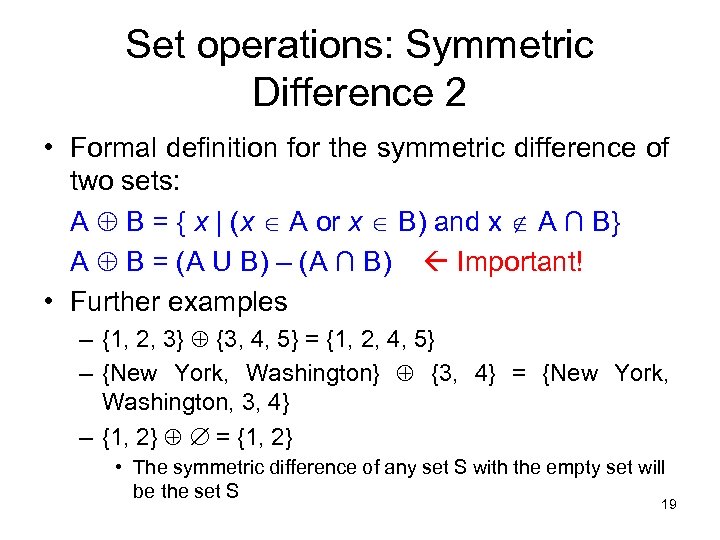 Set operations: Symmetric Difference 2 • Formal definition for the symmetric difference of two sets: A B = { x | (x A or x B) and x A ∩ B} A B = (A U B) – (A ∩ B) Important! • Further examples – {1, 2, 3} {3, 4, 5} = {1, 2, 4, 5} – {New York, Washington} {3, 4} = {New York, Washington, 3, 4} – {1, 2} = {1, 2} • The symmetric difference of any set S with the empty set will be the set S 19
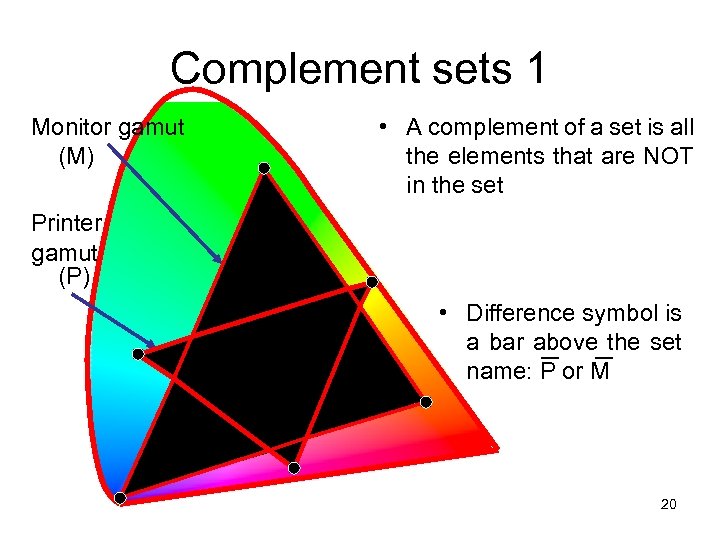 Complement sets 1 Monitor gamut (M) • A complement of a set is all the elements that are NOT in the set Printer gamut (P) • Difference symbol is a bar above_ the set _ name: P or M 20
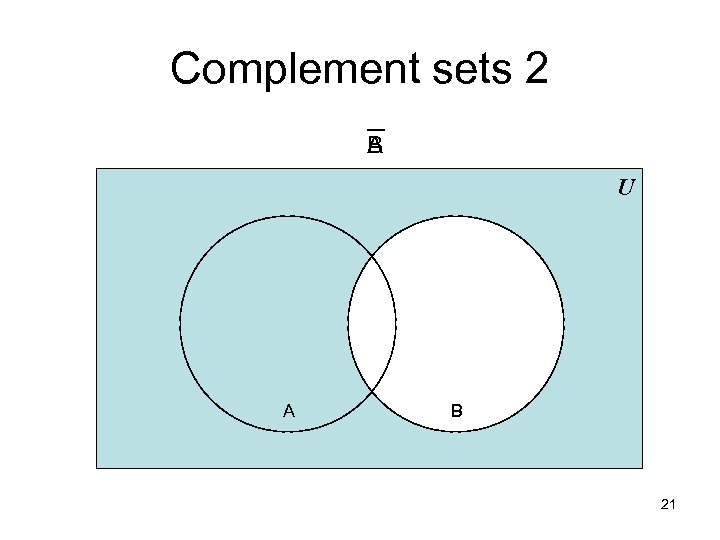 Complement sets 2 _ B A U A B 21
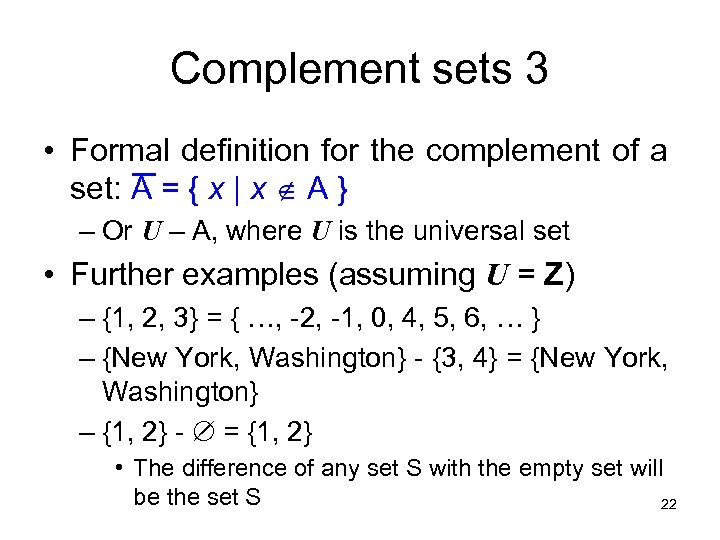 Complement sets 3 • Formal definition for the complement of a set: A = { x | x A } – Or U – A, where U is the universal set • Further examples (assuming U = Z) – {1, 2, 3} = { …, -2, -1, 0, 4, 5, 6, … } – {New York, Washington} - {3, 4} = {New York, Washington} – {1, 2} - = {1, 2} • The difference of any set S with the empty set will be the set S 22
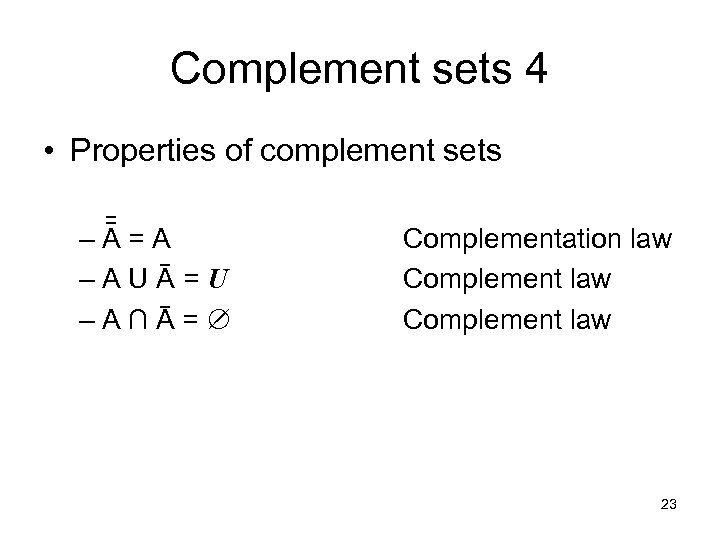 Complement sets 4 • Properties of complement sets ¯ ¯ –A=A ¯ –AUA=U ¯ –A∩A= Complementation law Complement law 23
 Quick survey n a) b) c) d) I understand the various set operations Very well With some review, I’ll be good Not really Not at all 24
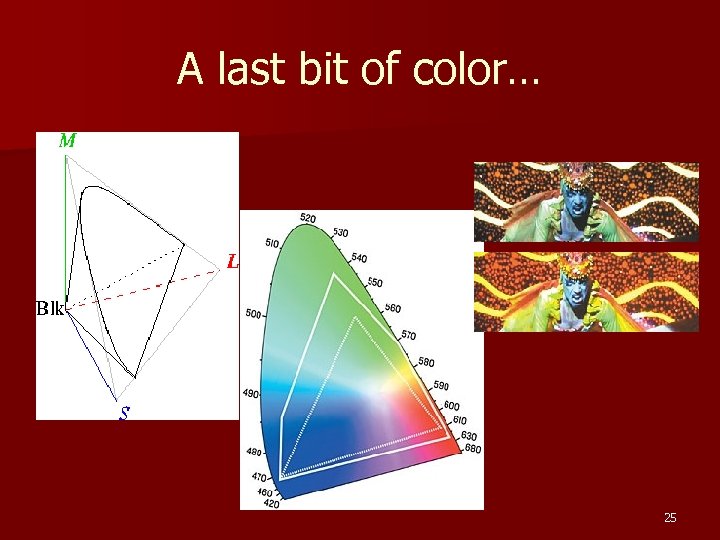 A last bit of color… 25
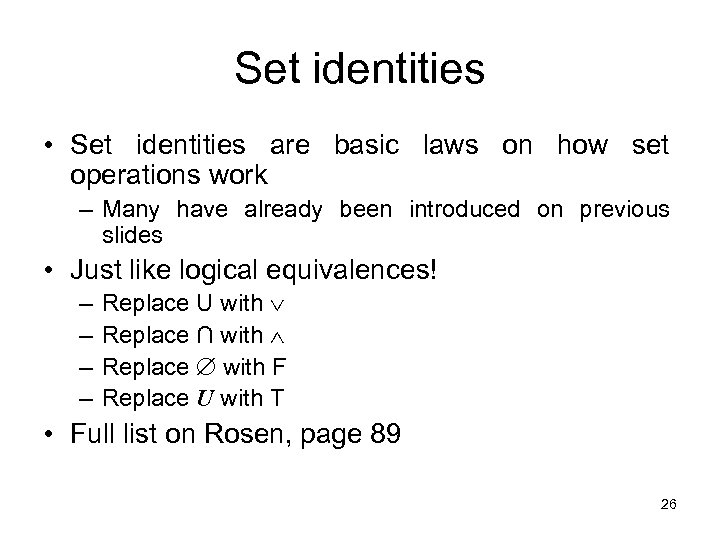 Set identities • Set identities are basic laws on how set operations work – Many have already been introduced on previous slides • Just like logical equivalences! – – Replace U with Replace ∩ with Replace with F Replace U with T • Full list on Rosen, page 89 26
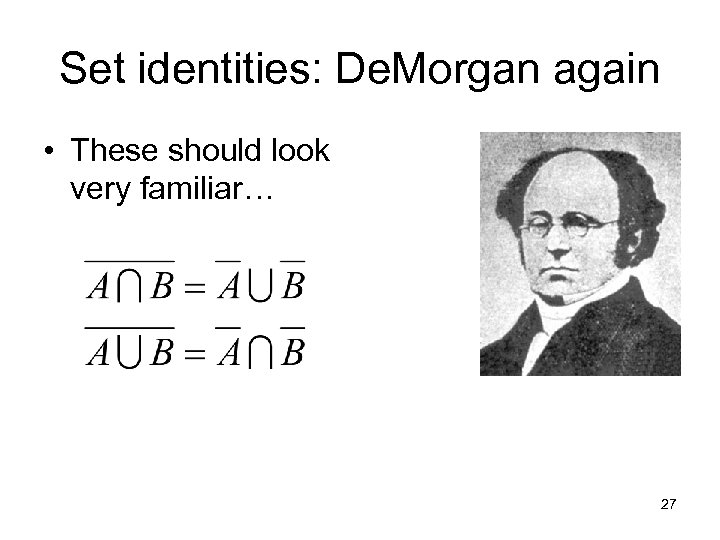 Set identities: De. Morgan again • These should look very familiar… 27
 How to prove a set identity • For example: A∩B=B-(B-A) • Four methods: – Use the basic set identities (Rosen, p. 89) – Use membership tables – Prove each set is a subset of each other • This is like proving that two numbers are equal by showing that each is less than or equal to the other – Use set builder equivalences notation and logical 28
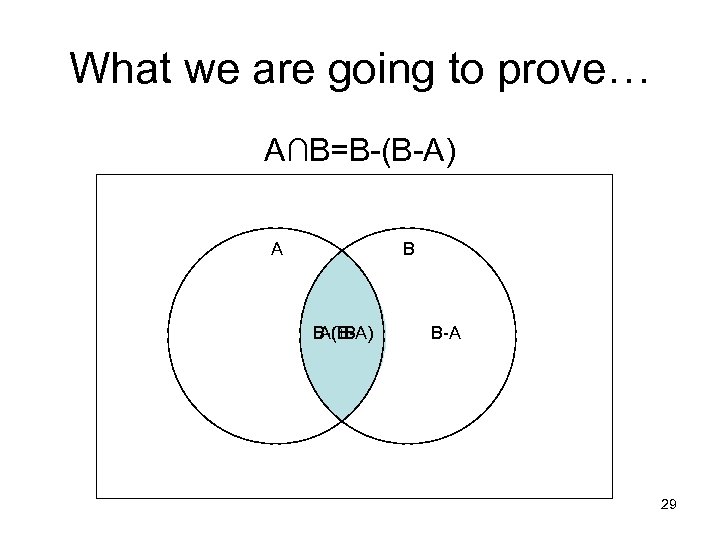 What we are going to prove… A∩B=B-(B-A) A B B-(B-A) A∩B B-A 29
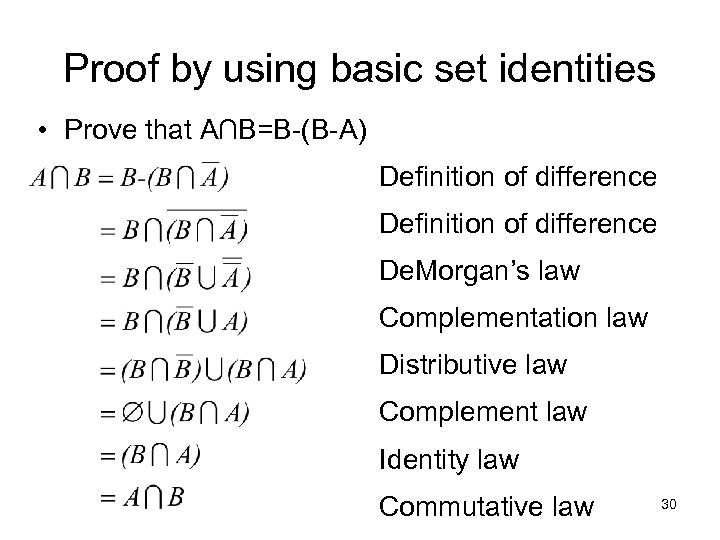 Proof by using basic set identities • Prove that A∩B=B-(B-A) Definition of difference De. Morgan’s law Complementation law Distributive law Complement law Identity law Commutative law 30
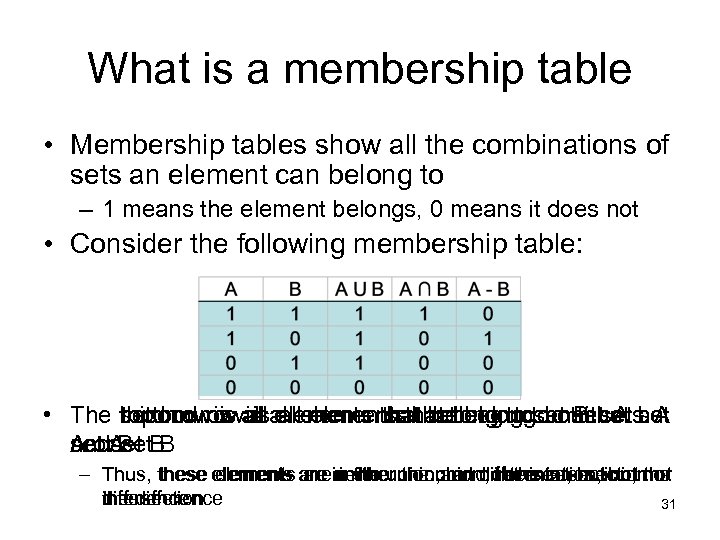 What is a membership table • Membership tables show all the combinations of sets an element can belong to – 1 means the element belongs, 0 means it does not • Consider the following membership table: • The bottom row all elements that belong to neither but thirdrow rowall elements that belongset setsets A second is is all elements belong to both but not top row is is belong to to B A set A or set B not set B and. Aset. B – Thus, these elements are in the union, intersection, but nor elements are neither unionbut difference, but not in theunion, and not the intersection or the and the intersection, the difference intersection the difference 31
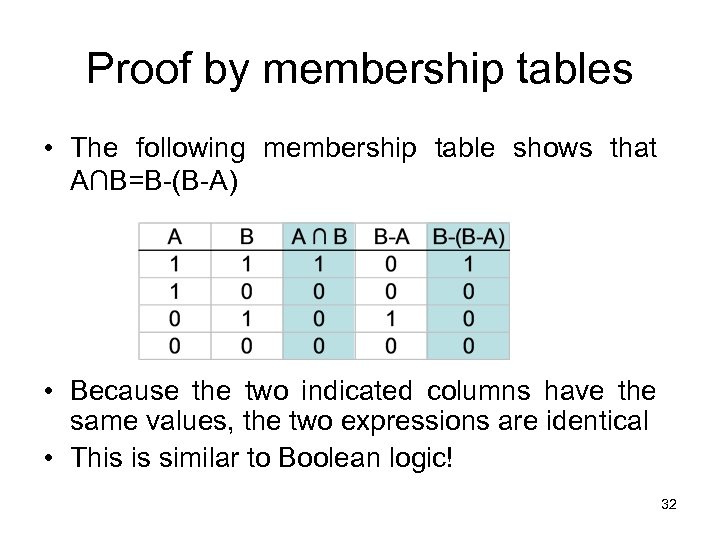 Proof by membership tables • The following membership table shows that A∩B=B-(B-A) • Because the two indicated columns have the same values, the two expressions are identical • This is similar to Boolean logic! 32
 Proof by showing each set is a subset of the other 1 • Assume that an element is a member of one of the identities – Then show it is a member of the other • Repeat for the other identity • We are trying to show: – (x A∩B→ x B-(B-A)) (x B-(B-A)→ x A∩B) – This is the biconditional! • Not good for long proofs • Basically, it’s an English run-through of the proof 33
 Proof by showing each set is a subset of the other 2 • Assume that x B-(B-A) – By definition of difference, we know that x B and x B-A • Consider x B-A – If x B-A, then (by definition of difference) x B and x A – Since x B-A, then only one of the inverses has to be true (De. Morgan’s law): x B or x A • So we have that x B and (x B or x A) – It cannot be the case where x B and x B – Thus, x B and x A – This is the definition of intersection • Thus, if x B-(B-A) then x A∩B 34
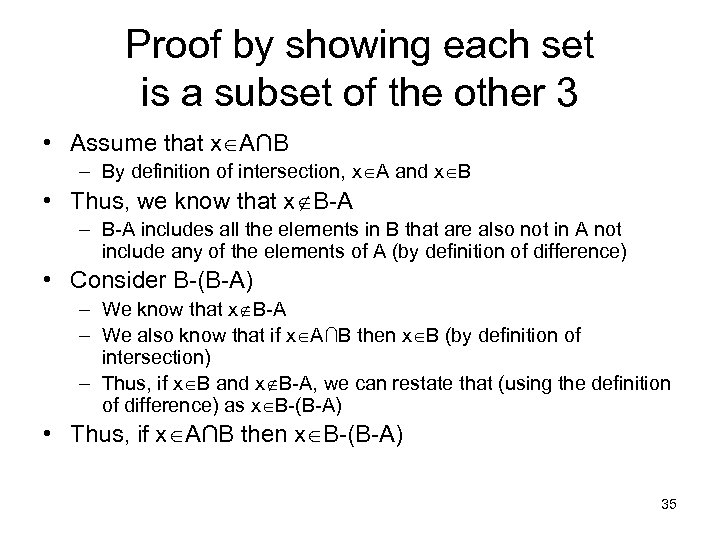 Proof by showing each set is a subset of the other 3 • Assume that x A∩B – By definition of intersection, x A and x B • Thus, we know that x B-A – B-A includes all the elements in B that are also not in A not include any of the elements of A (by definition of difference) • Consider B-(B-A) – We know that x B-A – We also know that if x A∩B then x B (by definition of intersection) – Thus, if x B and x B-A, we can restate that (using the definition of difference) as x B-(B-A) • Thus, if x A∩B then x B-(B-A) 35
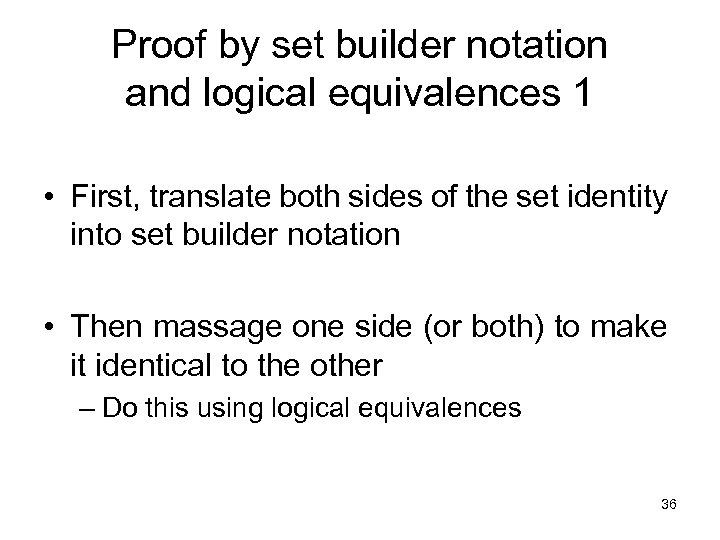 Proof by set builder notation and logical equivalences 1 • First, translate both sides of the set identity into set builder notation • Then massage one side (or both) to make it identical to the other – Do this using logical equivalences 36
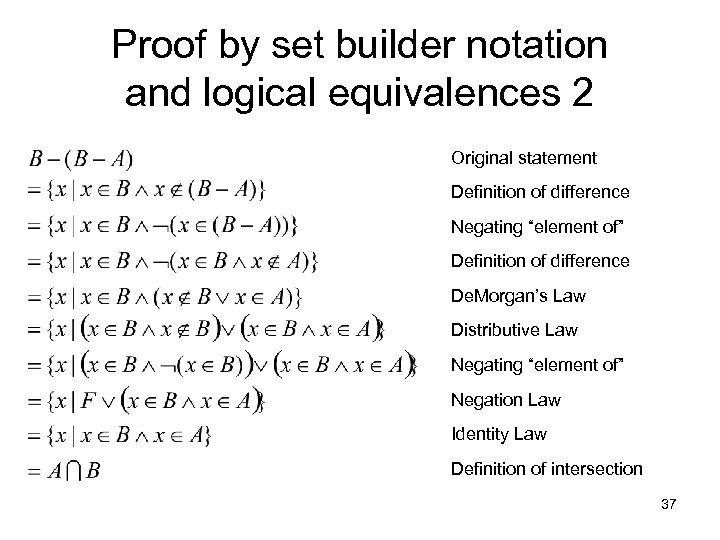 Proof by set builder notation and logical equivalences 2 Original statement Definition of difference Negating “element of” Definition of difference De. Morgan’s Law Distributive Law Negating “element of” Negation Law Identity Law Definition of intersection 37
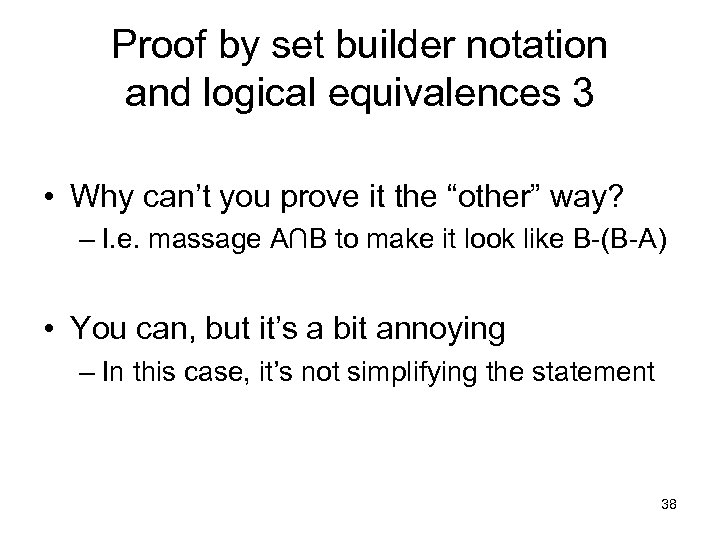 Proof by set builder notation and logical equivalences 3 • Why can’t you prove it the “other” way? – I. e. massage A∩B to make it look like B-(B-A) • You can, but it’s a bit annoying – In this case, it’s not simplifying the statement 38
 Quick survey n a) b) c) d) I understand (more or less) the four ways of proving a set identity Very well With some review, I’ll be good Not really Not at all 39
 Today’s demotivators 40
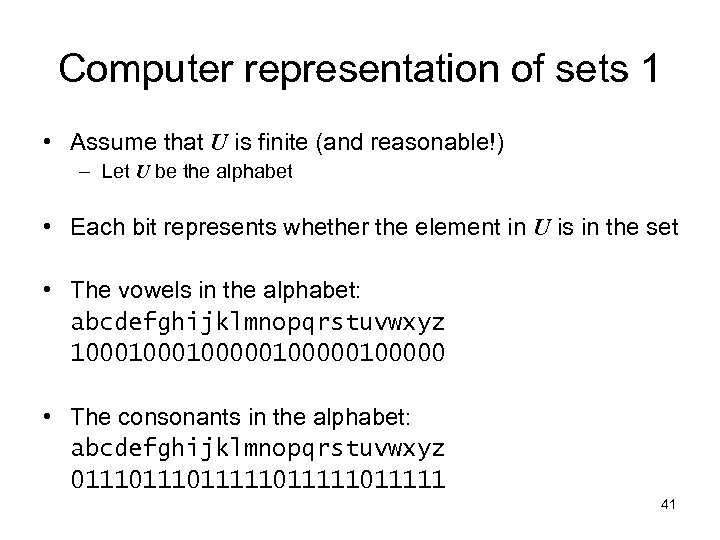 Computer representation of sets 1 • Assume that U is finite (and reasonable!) – Let U be the alphabet • Each bit represents whether the element in U is in the set • The vowels in the alphabet: abcdefghijklmnopqrstuvwxyz 1000100000100000 • The consonants in the alphabet: abcdefghijklmnopqrstuvwxyz 0111011111011111 41
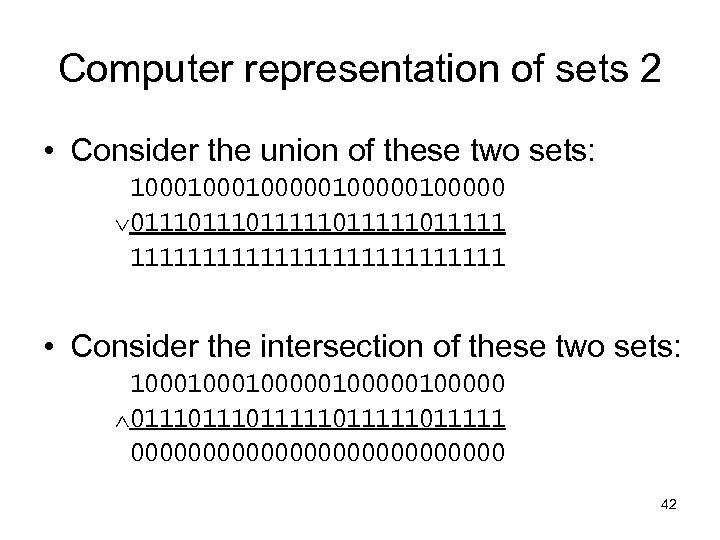 Computer representation of sets 2 • Consider the union of these two sets: 1000100000100000 011101111101111111111111 • Consider the intersection of these two sets: 1000100000100000 0111011111011111 0000000000000 42
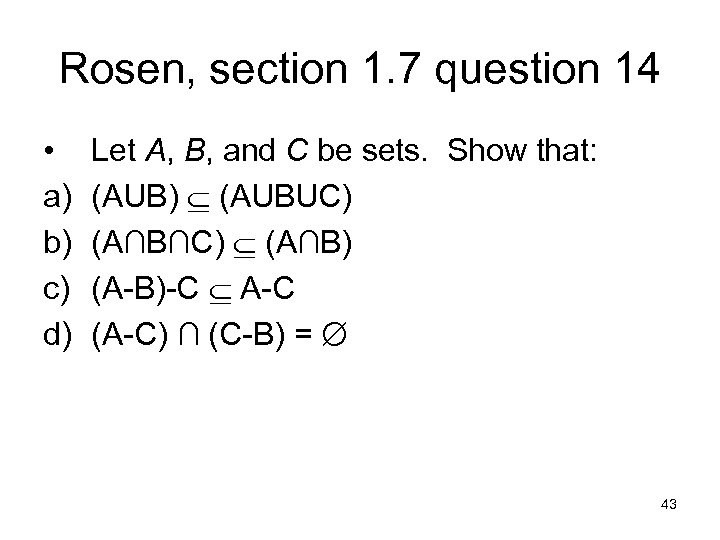 Rosen, section 1. 7 question 14 • a) b) c) d) Let A, B, and C be sets. Show that: (AUB) (AUBUC) (A∩B∩C) (A∩B) (A-B)-C A-C (A-C) ∩ (C-B) = 43
 Quick survey n a) b) c) d) I felt I understood the material in this slide set… Very well With some review, I’ll be good Not really Not at all 44
 Quick survey n a) b) c) d) The pace of the lecture for this slide set was… Fast About right A little slow Too slow 45