 Скачать презентацию Session 42 Foreign Schools Professional Judgement David Bartlett
e2a6bb00190bb164c5a7097aab3f9f9e.ppt
- Количество слайдов: 58



Session 42 Foreign Schools: Professional Judgement David Bartlett and Kevin Campbell | Nov Dec. 2016 U. S. Department of Education 2016 FSA Training Conference for Financial Aid Professionals
Disclaimer • Some of the documentation requirements for Professional Judgement cases are open ended • Some of the documentation requirements for Professional Judgement cases are very specific • Here we’re going to discuss both some general concepts and some exact procedures • Regardless of the situation, you want to view the appeals so that you’re helping the student and retaining program integrity • Yes, we want to help students but we can only help them in the parameters of the laws and regulations 2
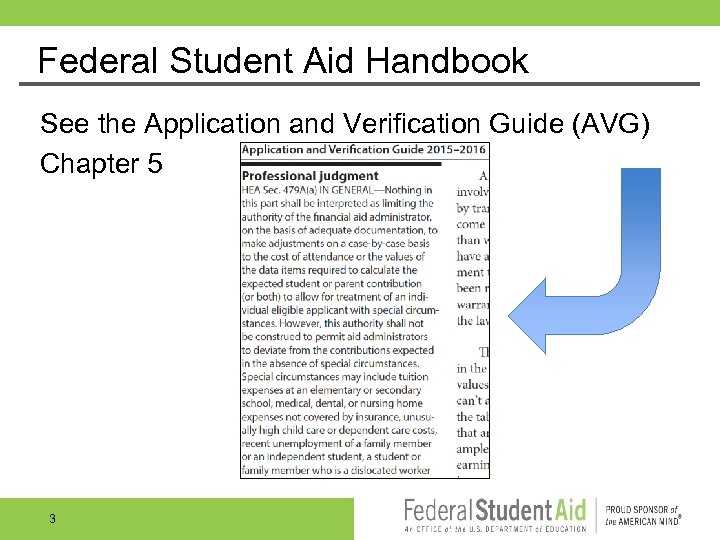
Federal Student Aid Handbook See the Application and Verification Guide (AVG) Chapter 5 3
Types of Professional Judgement • • • Changes to EFC Formula Elements Dependency Overrides Cost of Attendance Modifications Refusing or Reducing Loan Origination Amount When parent refuses to complete FAFSA and refuses to support the student 4
Groundwork • You must have Policies and Procedures to guide your staff how these professional judgements are: Reviewed • Considered • Documented • Communicated to student • Finalized • 5
More Groundwork • All PJ decisions must be case by case • The reason for the adjustment must be documented in the student’s file • It must relate to the special circumstances that differentiate him or her—not to conditions that exist for a whole class of students • You must resolve any in consistent or conflicting information shown on the output document before making any adjustments 6
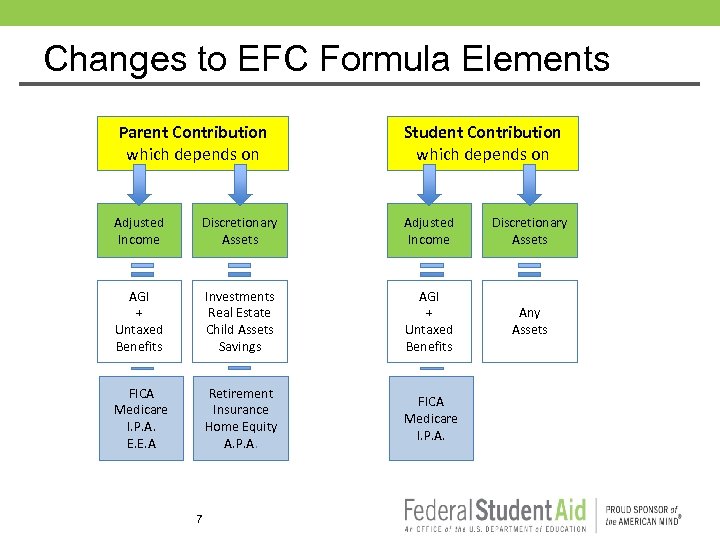
Changes to EFC Formula Elements Parent Contribution which depends on Student Contribution which depends on Adjusted Income Discretionary Assets AGI + Untaxed Benefits Investments Real Estate Child Assets Savings AGI + Untaxed Benefits Any Assets FICA Medicare I. P. A. E. E. A Retirement Insurance Home Equity A. P. A. FICA Medicare I. P. A. 7
Recent Income Changes You CANNOT directly adjust a student’s EFC • You can only make reasonable adjustments to elements of the EFC calculation (AGI, tax paid) • Whose AGI/tax paid? • Parent? Student? • See data items on FAFSA • See EFC Formula Guide on IFAP • 8
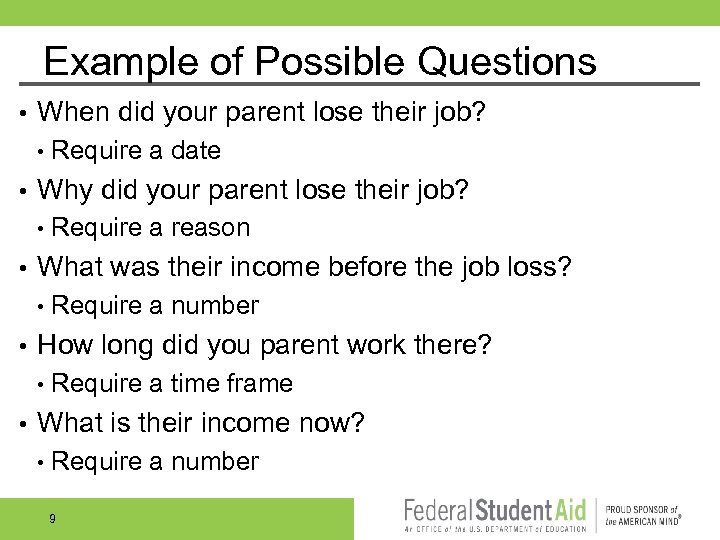
Example of Possible Questions • When did your parent lose their job? • • Why did your parent lose their job? • • Require a number How long did you parent work there? • • Require a reason What was their income before the job loss? • • Require a date Require a time frame What is their income now? • Require a number 9
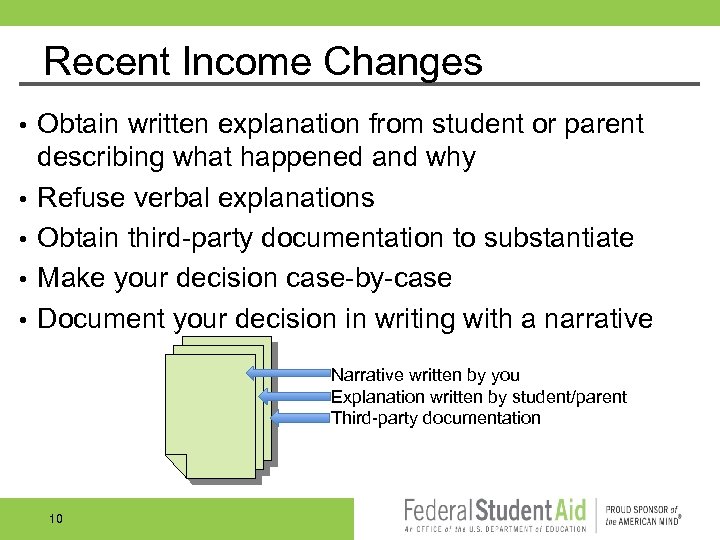
Recent Income Changes • • • Obtain written explanation from student or parent describing what happened and why Refuse verbal explanations Obtain third party documentation to substantiate Make your decision case by case Document your decision in writing with a narrative Narrative written by you Explanation written by student/parent Third party documentation 10
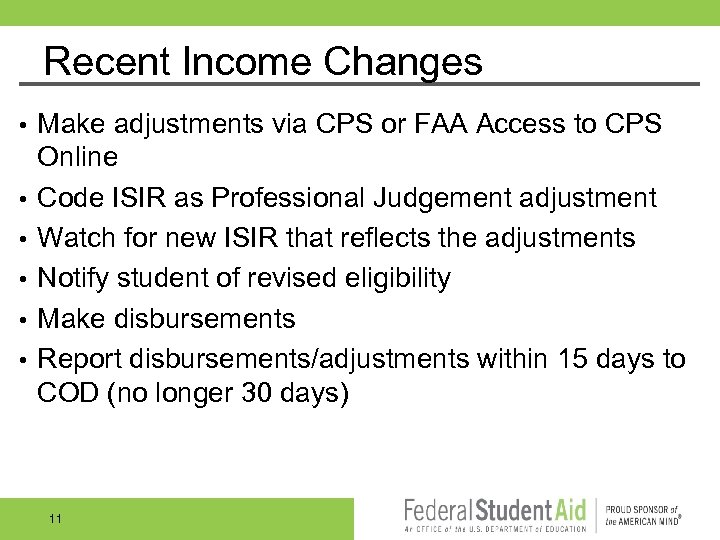
Recent Income Changes • • • Make adjustments via CPS or FAA Access to CPS Online Code ISIR as Professional Judgement adjustment Watch for new ISIR that reflects the adjustments Notify student of revised eligibility Make disbursements Report disbursements/adjustments within 15 days to COD (no longer 30 days) 11
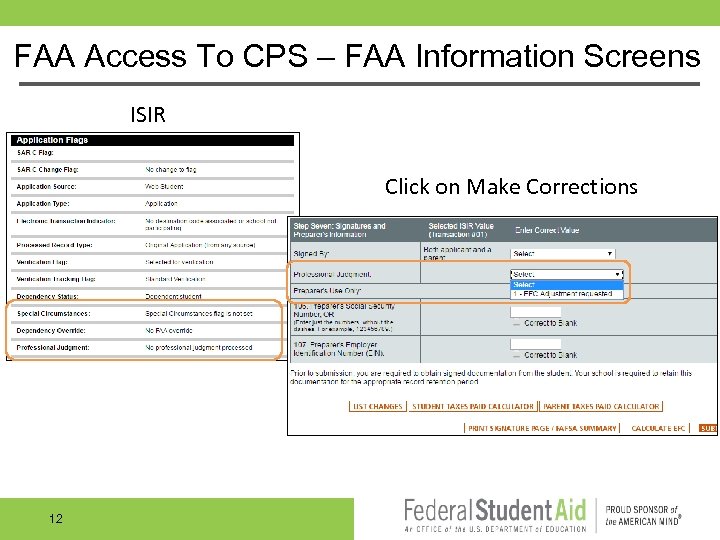
FAA Access To CPS – FAA Information Screens ISIR Click on Make Corrections 12
What About the Transition to Early FAFSA? Use of 2015 income for 2016 2017 and 2017 2018 may increase use of professional judgement • See Electronic Announcements and FAQ’s at https: //ifap. ed. gov/Early. FAFSA/index. V 1. html • GEN 16 03 – Use of PJ When Prior Year Income is used • 13
Dependency Overrides 14
Dependency Overrides A financial aid administrator (FAA) may do dependency overrides on a case-by-case basis for students with unusual circumstances • If the FAA determines that an override is appropriate, he/she must write a statement detailing the determination and must include the statement and supporting documentation in the student’s file • The best type of written statement is a narrative • 15
Dependency Overrides • A financial aid administrator (FAA) may NOT do dependency overrides based on the: Parents refusal to contribute to the student’s education • Parents unwillingness to provide information on the FAFSA or for verification • Parents not claiming the student as a dependent for income tax purposes • Student demonstrating total self sufficiency • 16
Dependency Overrides Unusual circumstances do include abandonment by parents, an abusive family environment that threatens the student’s health or safety, or the student being unable to locate his parents • Documentation is critical to the dependency override process • 17
Dependency Overrides The docu mentation must support, and include the reason for, the decision and should in almost all cases originate from a third party with knowledge of the unusual circumstances of the student • A third party is someone that knows the student’s situation—such as a teacher, counselor, medical authority, member of the clergy, prison administrator, government agency, or court • 18
Dependency Overrides Evidence can be a signed letter or an official document, such as a court order • If third party documentation is truly not available, the school may accept a signed and dated statement from the student or a family member detailing the unusual circumstances • Such a statement should be a last resort • 19
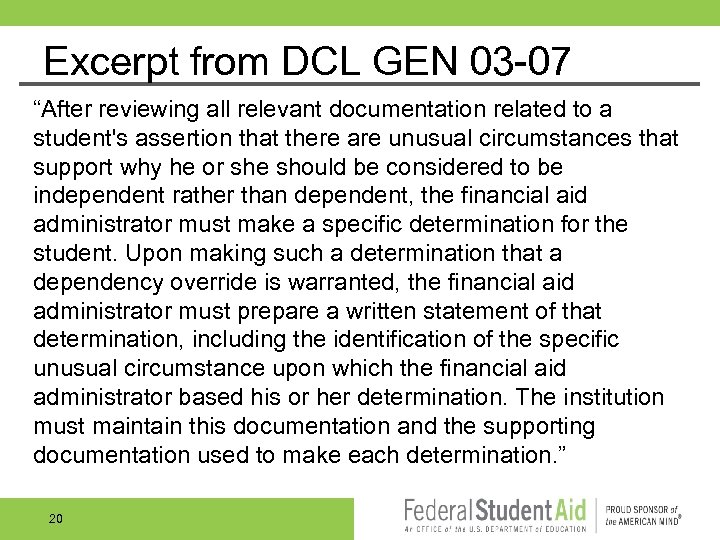
Excerpt from DCL GEN 03 07 “After reviewing all relevant documentation related to a student's assertion that there are unusual circumstances that support why he or she should be considered to be independent rather than dependent, the financial aid administrator must make a specific determination for the student. Upon making such a determination that a dependency override is warranted, the financial aid administrator must prepare a written statement of that determination, including the identification of the specific unusual circumstance upon which the financial aid administrator based his or her determination. The institution must maintain this documentation and the supporting documentation used to make each determination. ” 20
Dependency Override – Example – Katy requests a Dependency Override because she has been working and living on her own during her gap year as a SCUBA instructor in the British Virgin Islands • She has had very little contact with her family during this time because she chose to disobey her family’s wishes to become a theoretical physicist and instead hopes to become a marine biologist • She has provided pay statements, rent, and utility bills all in her name for the past year • Her father has indicated that she is willfully independent and he doesn’t understand her wishes to become a biologist, but he is willing to assist with her college financing, if needed • 21
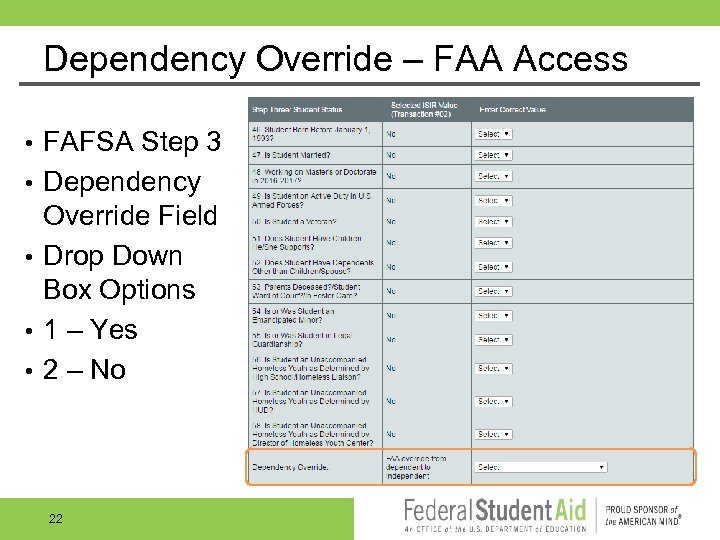
Dependency Override – FAA Access • • • FAFSA Step 3 Dependency Override Field Drop Down Box Options 1 – Yes 2 – No 22
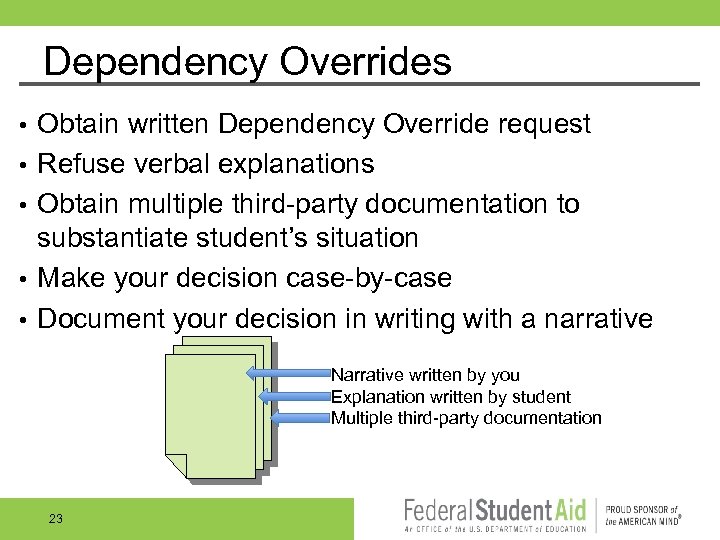
Dependency Overrides • • • Obtain written Dependency Override request Refuse verbal explanations Obtain multiple third party documentation to substantiate student’s situation Make your decision case by case Document your decision in writing with a narrative Narrative written by you Explanation written by student Multiple third party documentation 23
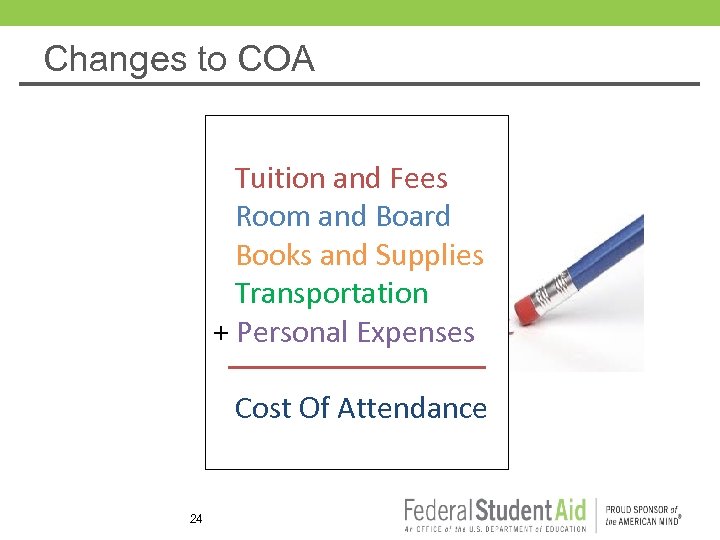
Changes to COA Tuition and Fees Room and Board Books and Supplies Transportation + Personal Expenses Cost Of Attendance 24
Cost of Attendance Adjustments • COA components Tuition and Fees; • Room and Board; • Books and Supplies; • Transportation; • Personal Expenses; • Other costs that are applicable to some students and not others • Dependent care • Costs associated with being disabled • 25
Cost of Attendance Adjustments A school may adjust, as an act of professional judgement, any of the COA components • The adjustment may increase or decrease the value attached to the component • • Usual result is an increase The PJ must be documented • Typical result is an increase in COA and sometimes an increase in need • • COA – EFC = Need 26
Cost of Attendance – Example Hector, a US citizen, attends Fredonia College located in the Kingdom of Fredonia § Fredonia College requires that all students live in institutional housing § The Room and Board component in the COA established by Fredonia College is 24, 000 Quatloos (the national currency of Fredonia) which is equal to approximately USD 10, 000 of which USD 5, 000 is for housing and the other half is for board § 27
Cost of Attendance – Example – Hector discovers that he is allergic to the paint that covers every wall in the institutional housing § Hector locates an apartment off campus but the cost of the apartment for the school year is the equivalent of USD 7, 000 § Hector also does some research and discovers that food will cost him about USD 7, 000/year if he has to buy his own groceries as opposed to eating in the Fredonia College cafeteria § 28
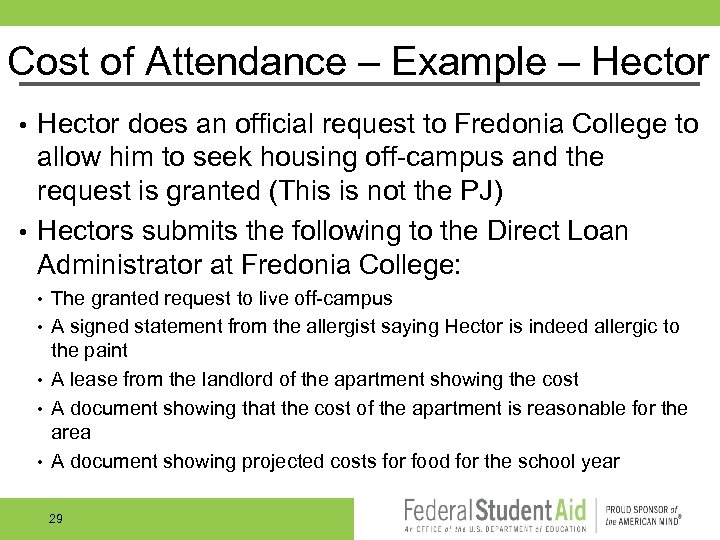
Cost of Attendance – Example – Hector does an official request to Fredonia College to allow him to seek housing off campus and the request is granted (This is not the PJ) • Hectors submits the following to the Direct Loan Administrator at Fredonia College: • • • The granted request to live off campus A signed statement from the allergist saying Hector is indeed allergic to the paint A lease from the landlord of the apartment showing the cost A document showing that the cost of the apartment is reasonable for the area A document showing projected costs for food for the school year 29
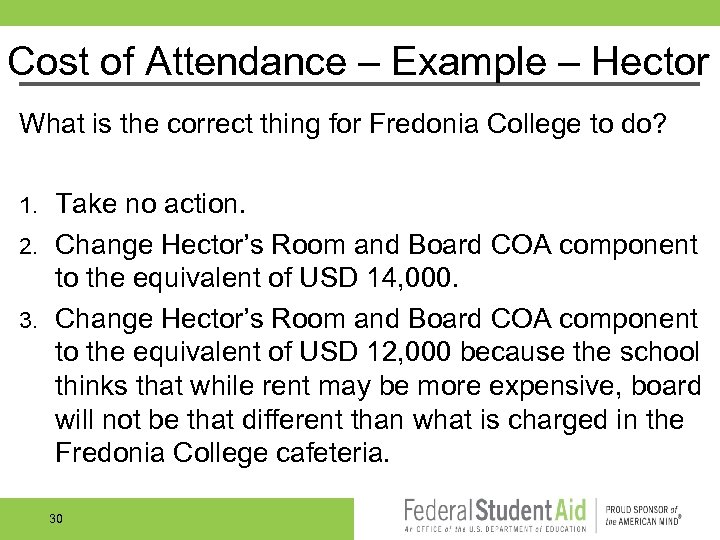
Cost of Attendance – Example – Hector What is the correct thing for Fredonia College to do? Take no action. 2. Change Hector’s Room and Board COA component to the equivalent of USD 14, 000. 3. Change Hector’s Room and Board COA component to the equivalent of USD 12, 000 because the school thinks that while rent may be more expensive, board will not be that different than what is charged in the Fredonia College cafeteria. 1. 30
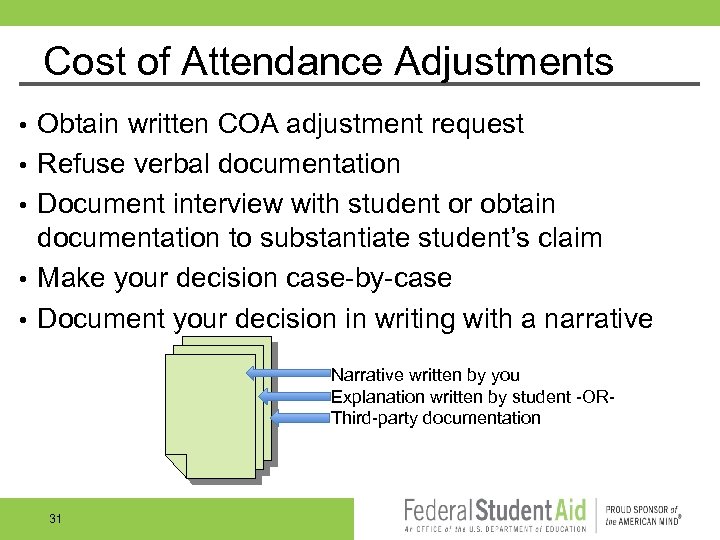
Cost of Attendance Adjustments • • • Obtain written COA adjustment request Refuse verbal documentation Document interview with student or obtain documentation to substantiate student’s claim Make your decision case by case Document your decision in writing with a narrative Narrative written by you Explanation written by student OR Third party documentation 31
Refuse to Originate a DL or Reduce the Amount of the DL 32
Direct Loan Refusal or Reduction On a case by case basis, you may refuse to originate the loan for an individual borrower, or you may originate a loan for an amount less than the borrower’s maximum eligibility • Authority: • HEA Sec. 479(A)(c) • 34 CFR 685. 301(a)(8) • DCL GEN 11 07 • 33
Direct Loan Refusal or Reduction • What you must do: You must ensure that these decisions are made on a case by case basis, and do not constitute a pattern or practice that denies access to borrowers because of race, sex, color, income, religion, national origin, age, or handicapped status • When you make a decision not to originate a loan or to reduce the amount of the loan, you must document the reasons and provide the explanation to the student in writing • 34
Direct Loan Refusal or Reduction • What you cannot do: limit borrowing by students or parents on an across the board or categorical basis • engage in a practice of originating Direct Loans only in the amount needed to cover the school charges • limit Direct Unsubsidized borrowing by independent students • 35
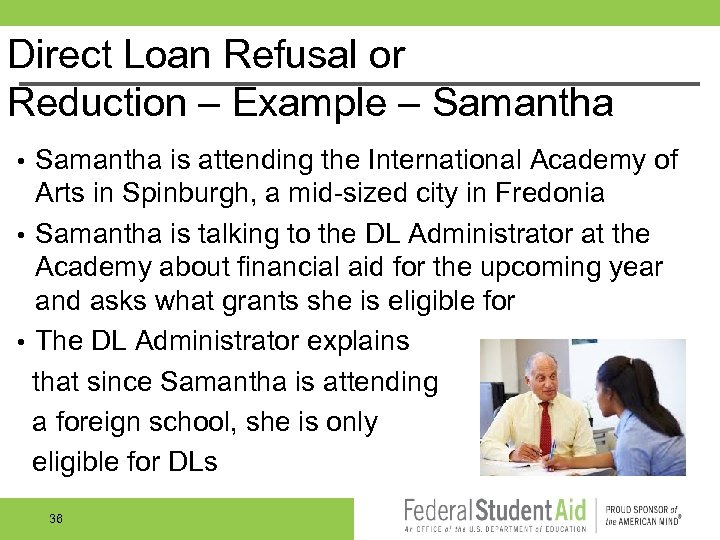
Direct Loan Refusal or Reduction – Example – Samantha is attending the International Academy of Arts in Spinburgh, a mid sized city in Fredonia • Samantha is talking to the DL Administrator at the Academy about financial aid for the upcoming year and asks what grants she is eligible for • The DL Administrator explains that since Samantha is attending a foreign school, she is only eligible for DLs • 36
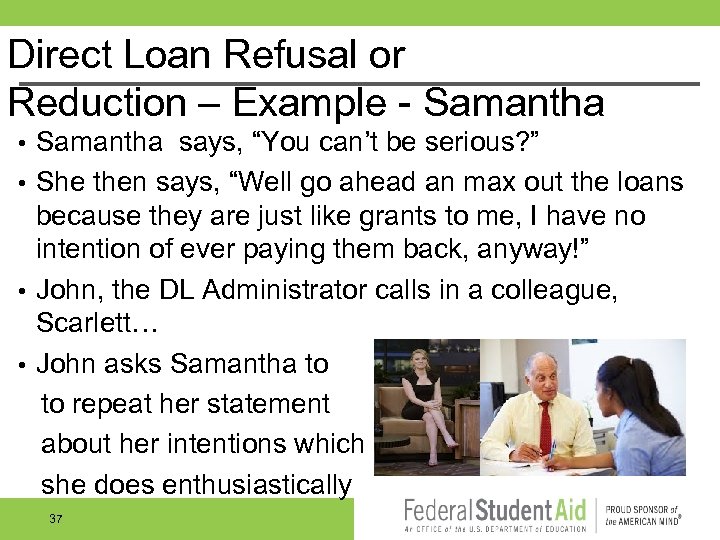
Direct Loan Refusal or Reduction – Example Samantha says, “You can’t be serious? ” • She then says, “Well go ahead an max out the loans because they are just like grants to me, I have no intention of ever paying them back, anyway!” • John, the DL Administrator calls in a colleague, Scarlett… • John asks Samantha to to repeat her statement about her intentions which she does enthusiastically • 37
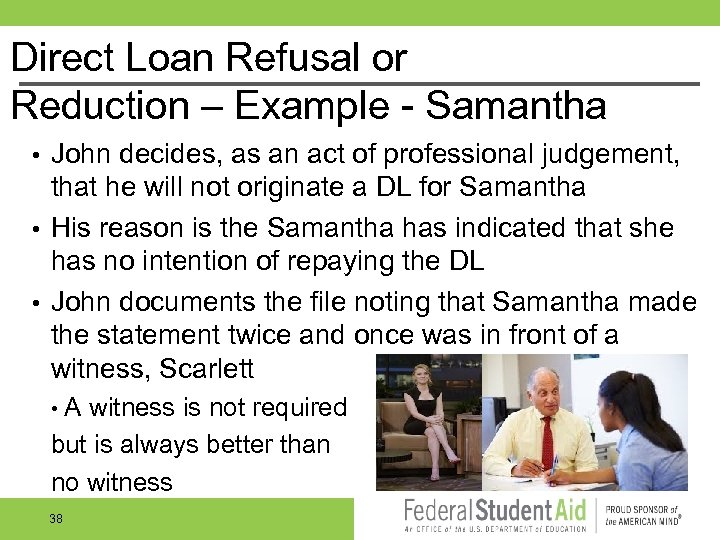
Direct Loan Refusal or Reduction – Example Samantha John decides, as an act of professional judgement, that he will not originate a DL for Samantha • His reason is the Samantha has indicated that she has no intention of repaying the DL • John documents the file noting that Samantha made the statement twice and once was in front of a witness, Scarlett • A witness is not required but is always better than no witness • 38
Direct Loan Refusal or Reduction – Example – Samantha John shares his reason for refusing to originate the DL with Samantha • He gives her the decision and reason in writing • Samantha now states she was only kidding… • What should John do? • 39
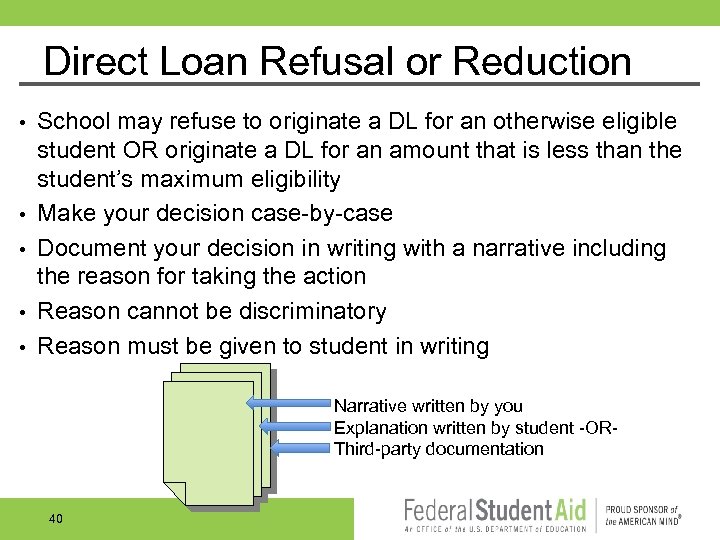
Direct Loan Refusal or Reduction • • • School may refuse to originate a DL for an otherwise eligible student OR originate a DL for an amount that is less than the student’s maximum eligibility Make your decision case by case Document your decision in writing with a narrative including the reason for taking the action Reason cannot be discriminatory Reason must be given to student in writing Narrative written by you Explanation written by student OR Third party documentation 40
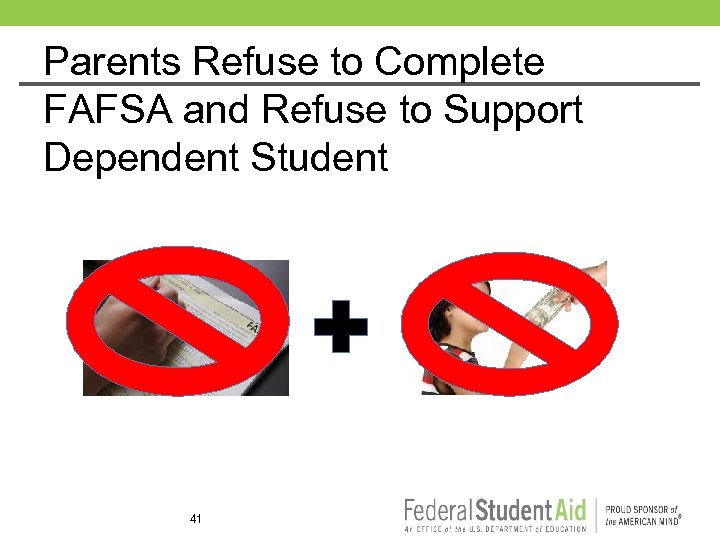
Parents Refuse to Complete FAFSA and Refuse to Support Dependent Student 41
Parent Refusal Parent refuses to complete FAFSA AND • Parent refuses to support dependent student THEN • School may, as a professional judgement, award and disburse unsubsidized DLs • 42
Parent Refusal Parent refuses to complete FAFSA • Parent NEVER completes the parental part of the FAFSA • Parent cannot complete it, submit it, and then claim they wish to cancel the submission • 43
Parent Refusal Parent refuses to complete FAFSA AND • Parent refuses to support dependent student THEN • School may, as a professional judgement, award and disburse unsubsidized DLs • 44
Parent Refusal • Parent refuses to support dependent student • Parent does not support student in any way • Including, but not limited to: • Health insurance coverage • Payment of any bills • Auto insurance • Auto maintenance 45
Parent Refusal Parent refuses to complete FAFSA AND • Parent refuses to support dependent student THEN • School may, as a professional judgement, award and disburse unsubsidized DLs • 46
Parent Refusal School may, as a professional judgement, award and disburse unsubsidized DLs • Refusal to support AND refusal to complete FAFSA must be documented • • Ideally by parents themselves • If not possible, a third party is acceptable • Student’s declaration alone is not acceptable • Documentation must include date support ended 47
Parent Refusal Student may receive, if school agrees, unsubsidized DL assistance up to the annual limit for a dependent student • This is the only FSA for which the student will qualify • FAFSA will be submitted and school will receive a rejected ISIR • School will document situation and award student unsubsidized DL assistance • 48
Parent Refusal This is NOT a dependency override • Nor, by itself, would it qualify for a dependency override • Don’t forget that both refusal to complete the FAFSA and refusal to support must be documented • 49
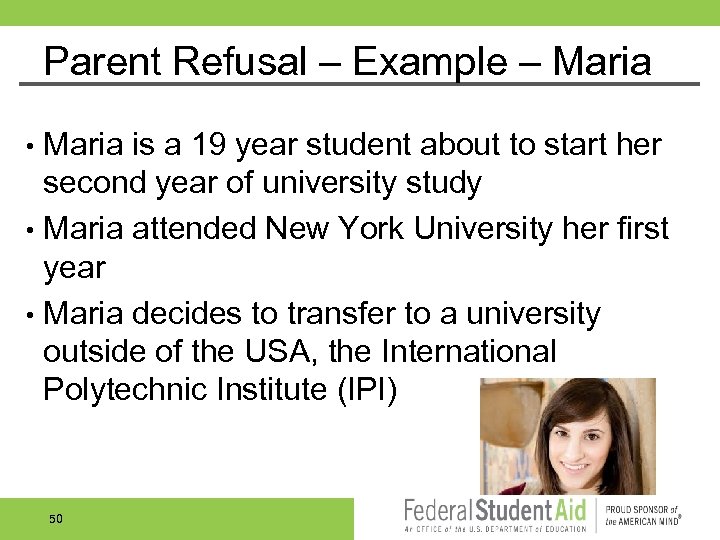
Parent Refusal – Example – Maria is a 19 year student about to start her second year of university study • Maria attended New York University her first year • Maria decides to transfer to a university outside of the USA, the International Polytechnic Institute (IPI) • 50
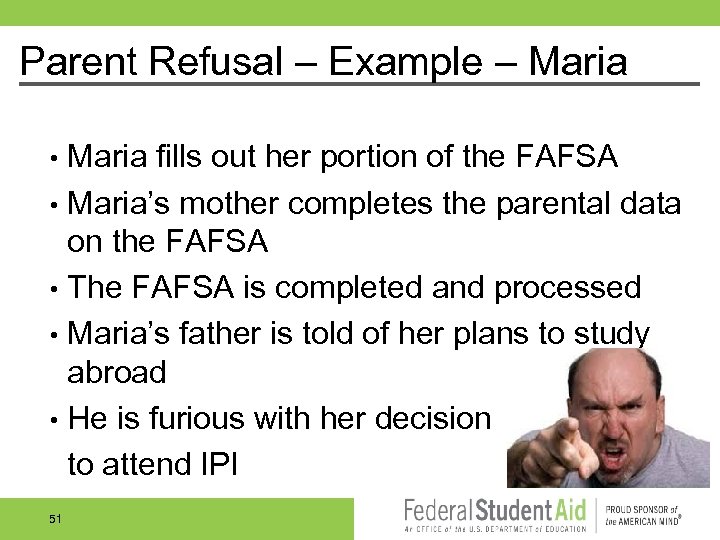
Parent Refusal – Example – Maria fills out her portion of the FAFSA • Maria’s mother completes the parental data on the FAFSA • The FAFSA is completed and processed • Maria’s father is told of her plans to study abroad • He is furious with her decision to attend IPI • 51
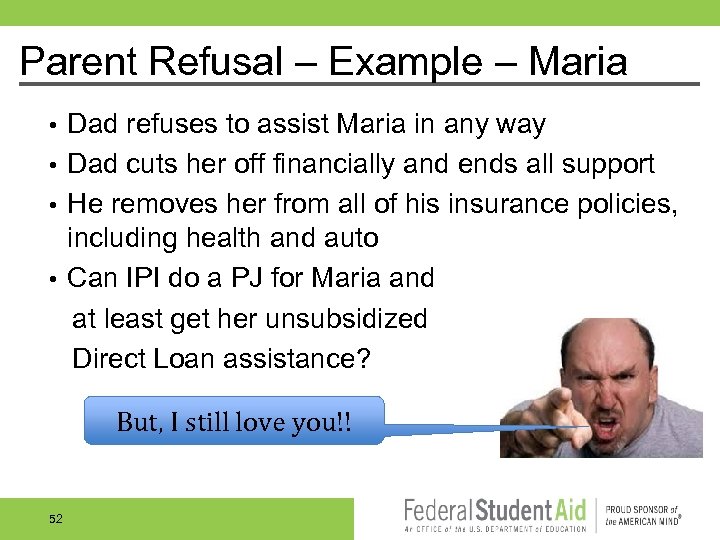
Parent Refusal – Example – Maria Dad refuses to assist Maria in any way • Dad cuts her off financially and ends all support • He removes her from all of his insurance policies, including health and auto • Can IPI do a PJ for Maria and at least get her unsubsidized Direct Loan assistance? • But, I still love you!! 52
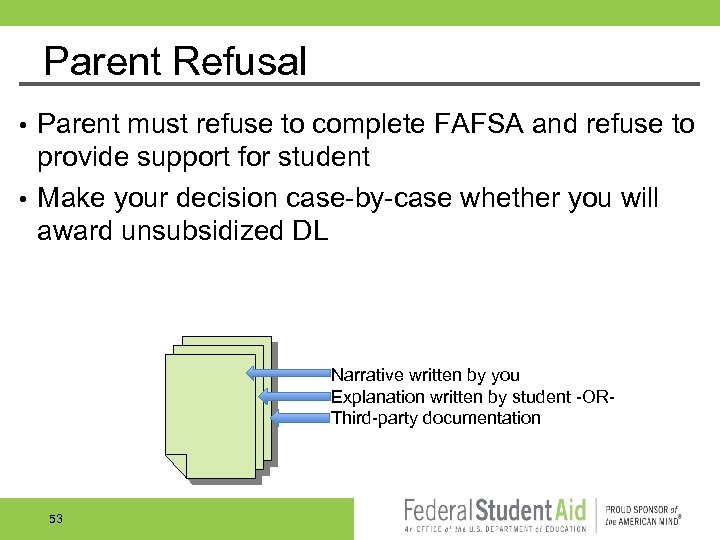
Parent Refusal Parent must refuse to complete FAFSA and refuse to provide support for student • Make your decision case by case whether you will award unsubsidized DL • Narrative written by you Explanation written by student OR Third party documentation 53
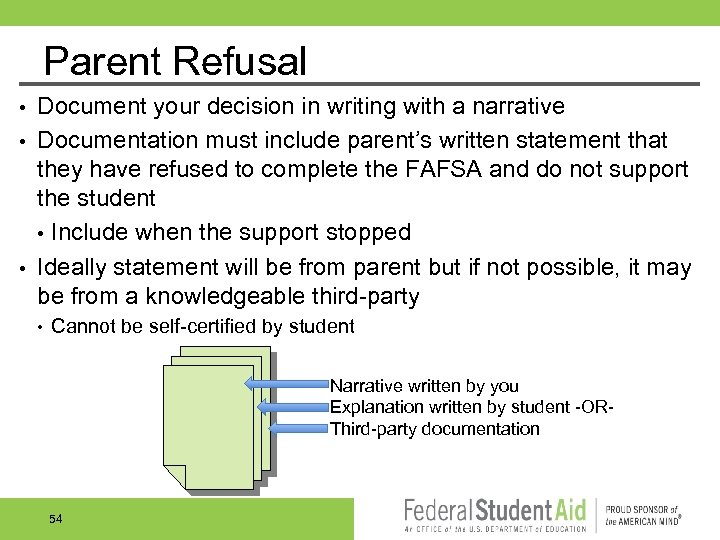
Parent Refusal Document your decision in writing with a narrative • Documentation must include parent’s written statement that they have refused to complete the FAFSA and do not support the student • Include when the support stopped • Ideally statement will be from parent but if not possible, it may be from a knowledgeable third party • • Cannot be self certified by student Narrative written by you Explanation written by student OR Third party documentation 54
Professional Judgement Resources 55
Professional Judgement Resources • Higher Education Act of 1965 (HEA) as amended • • Federal Student Aid Handbook • • Application and Verification Guide, Chapter 5 Refusal to Award or Reduce a Direct Loan • • • § Section 479 A(a) HEA Sec. 479(A)(c) 34 CFR 685. 301(a)(8) DCL GEN 11 07 PJ and Unemployment § Dear Colleague Letters: GEN 09 04, GEN 09 05, and GEN 11 04 56
QUESTIONS? 57
Contact Info David Bartlett Training Officer Federal Student Aid Region VII 816 268 0434 david. bartlett@ed. gov Kevin Campbell Training Officer Federal Student Aid Region VI 214 661 9448 kevin. campbell@ed. gov 58
Скачать презентацию Session 42 Foreign Schools Professional Judgement David Bartlett
e2a6bb00190bb164c5a7097aab3f9f9e.ppt