


 Скачать презентацию Session 31 Working with Veterans Affairs to Help
9c62cfacc9475be4f432f72eff304696.ppt
- Количество слайдов: 48
 Session 31 Working with Veterans Affairs to Help Students Bill Susling U. S. Department of Veterans Affairs Harold Mc. Cullough U. S. Department of Education, FSA
 Session Overview • Veterans Education Programs that VA Does and Does Not Administer • General Payment Rules and Processing Claims for VA Programs • Statutory and Regulatory Definitions for Title IV Purposes • Treatment of Veterans Education Benefits for Title IV Purposes 2
 Veterans Education Benefits • Veterans Education Programs that VA administers – Montgomery GI Bill—Active Duty – Montgomery GI Bill—Selected Reserve – Dependents Educational Assistance – Reserve Educational Assistance Program 3
 Veterans Education Benefits – Post Vietnam Era Educational Assistance Program – Vocational Rehabilitation and Employment – Restored Entitlement Program for Survivors 4
 Veterans Education Benefits • Veterans Education Programs VA Doesn’t Administer – Reserve Officer Training Corps Scholarship – Reserve Officer Training Corps Program 5
 Veterans Education Benefits • General Payment Rules for VA Programs – Payments generally are made to the student – Payments are generally made monthly – Payments are affected by • The program • The student’s “training time” 6
 Montgomery GI Bill—Active Duty (Ch. 30) • For Individuals Who Entered Active Duty Pre-1977 or Post-mid-1985 • Three Basic Full-time Monthly Rates – $840 – $1, 034 – $1, 222 7
 Montgomery GI Bill—Active Duty (Ch. 30) • Factors that Affect the Amount of MGIB—Active Duty Payments – Number of Dependents – “Kickers” – “Buy Up” – Active Duty Status 8
 Montgomery GI Bill—Selected Reserve (Ch. 1606) • For Individuals Who Entered the Selected Reserve (Including the Guard) from Mid-1985 to Present • Current basic rate is $297 per month • Factors that Affect the Amount of MGIB—Selected Reserve Payments – Continued eligibility – “Kickers” 9
 Reserve Educational Assistance Program (REAP or Ch. 1607) • For Reservists Called to Active Duty After Sept. 10, 2001 • Factors that Affect REAP Payments – Continued eligibility – Length of time spent on active duty • Basic full-time monthly rates are $413. 60, $620. 40, and $827. 20 – MGIB—SR “kickers” – Active Duty Status 10
 Reserve Educational Assistance Program (REAP or Ch. 1607) • Timeline for Making the First Payments – Goal is to begin payments as soon as possible – Payments cannot be made until Do. D and the Coast Guard establish procedures for determining who is eligible 11
 Reserve Educational Assistance Program (REAP or Ch. 1607) • Initial Payments Will Include Many Lump-Sum Payments for Training Completed Before the First Payment Is Made 12
 Post-Vietnam Era Veterans’ Educational Assistance Program (VEAP or Ch. 32) • For Individuals Who Entered Active Duty 1977 -mid-1985 • Educational Assistance Pilot Program • Factors that Affect the Amount of Payments – Amount contributed – “Kickers” 13
 Vocational Rehabilitation and Employment (Ch. 31) • Served on or after September 16, 1940 AND • Service-connected disabilities are rated at least 20% VA (or 10% if there is a serious employment handicap) AND 14
 Vocational Rehabilitation and Employment (Ch. 31) • Vocational rehabilitation is required to overcome an employment handicap AND • Less than 12 years since VA notified of the eligibility (longer if certain conditions prevented training) 15
 Vocational Rehabilitation and Employment (Ch. 31) • A veteran eligible for this benefit has his/her tuition and fees paid by VA to the educational institution • VA also pays for necessary books and supplies • Veteran receives a monthly subsistence allowance – Current basic full-time rate is $488. 50 per month 16
 Dependents’ Educational Assistance (Ch. 35) • For Children, Spouses and Surviving Spouses of Individuals— – Who died while on active duty; or – Whose death was caused by a service -connected disability; or 17
 Dependents’ Educational Assistance (Ch. 35) – Who died while permanently and totally disabled as a result of a service-connected disability; or – Who have a permanent and total service-connected disability 18
 Dependents’ Educational Assistance (Ch. 35) • Current basic full-time rate is $827 per month • Choice of beginning date of eligibility affects payments 19
 Restored Entitlement Program for Survivors • Restores to the survivors of some military personnel the Social Security benefits lost in 1981 • Survivors include children in college between age 18 -22 • Monthly payments range from $800 to $1, 700 20
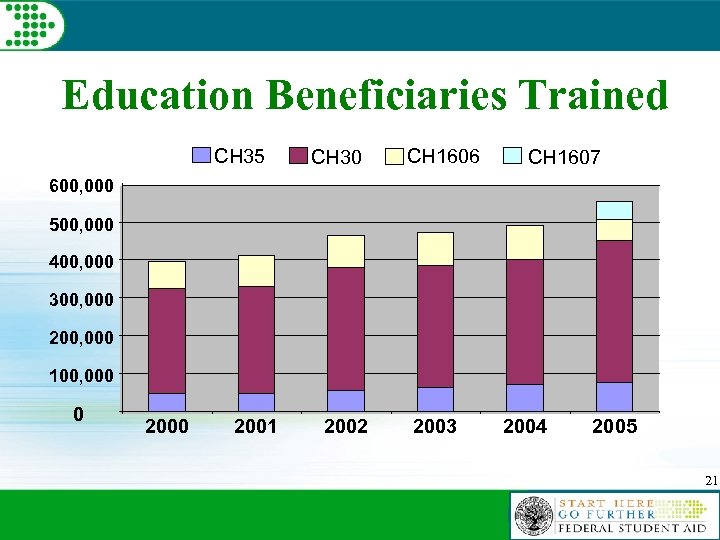 Education Beneficiaries Trained CH 35 CH 30 CH 1606 CH 1607 600, 000 500, 000 400, 000 300, 000 200, 000 100, 000 0 2001 2002 2003 2004 2005 21
 Processing Claims for Veterans Educational Benefits • Vocational Rehabilitation claims are processed at each of VA’s 58 regional offices • REPS claims are processed in St. Louis, MO 22
 Processing Claims for Veterans Educational Benefits • Other claims for educational benefits are processed at four regional processing offices – Buffalo, NY; Atlanta, GA; St. Louis, MO and Muskogee, OK 23
 Processing Claims for Veterans Educational Benefits • Original Vocational Rehabilitation and Dependents’ Educational Assistance claims take the longest time • Re-enrollments take the shortest time 24
 Claims Processing—VR&E • Veteran applies for VR&E (completes 28 -1900) • VR&E Division in the regional office determines eligibility • VR&E counselor determines entitlement 25
 Claims Processing—VR&E • Veteran and counselor explore vocational goal based upon comprehensive assessment of skills, aptitudes and interests • VR&E counselor and veteran develop rehabilitation plan • VR&E provides case management services until veteran is rehabilitated 26
 Claims Processing—REPS • Claims may be submitted at any VA office, but will be processed in St. Louis • If eligibility has never been established, it takes 4 to 6 months for the claim to be processed • After eligibility is established it takes 3045 days to process a supplemental claim 27
 Claims Processing—Other Programs • Claimant files a 22 -1990 or 22 -5490 • Educational institution certifies claimant’s enrollment • VA, Do. D or Coast Guard determines eligibility • Payment is authorized 28
 Web Sites • Education Service Home Page http: //www. GIBill. va. gov – Has information on basic monthly rates for ch. 30, ch. 1606, and ch. 1607 • Veterans Benefits Administration Home Page at http: //www. vba. va. gov – Click on Vocational Rehabilitation and Employment and drill down to ch. 31 rates 29
 Statutory Definitions: “Untaxed Income and Benefits” • “Untaxed Income and Benefits” (HEA section 480(b)) – Includes veterans non-education benefits but not veterans education benefits – Veterans non-education benefits are collected on FAFSA Worksheet B – Veterans non-education benefits are used in calculating the student’s EFC 30
 Statutory Definitions: “Other Financial Assistance” • “Other Financial Assistance” (HEA section 480(j)) – Includes veterans education benefits (HEA section 480(c)) a student will receive during the award year – Veterans education benefits are reported in questions 46 and 47 of the 2005 -2006 FAFSA – Veterans education benefits are not used in EFC calculation 31
 Regulatory Definitions: “Resources” and “Estimated Financial Assistance” • “Resources” is the term used for “Other Financial Assistance” under the campusbased regulations (34 CFR 673. 5) • The same items are referred to as “Estimated Financial Assistance” under the FFEL and Direct Loan regulations (34 CFR 682. 200 and 685. 102) 32
 Regulatory Definition: “Estimated Financial Assistance” • The HEA (section 428(a)(2)(C)) requires a school to exclude Montgomery GI Bill-Active Duty (Chapter 30) veterans education benefits and Ameri. Corps education awards or post-service benefits from EFA when determining subsidized FFEL and Direct Loan eligibility 33
 Regulatory Definition: “Estimated Financial Assistance” • This exclusion is repeated in the definition of EFA in the FFEL and Direct Loan regulations 34
 Regulatory Definition: “Resources” • The HEA did not provide a similar exclusion of these benefits for the campusbased programs • To allow students to have the full advantage of the statutory exclusion of these benefits for subsidized loans without losing campusbased eligibility, the campus-based regulations added an exclusion to the definition of “resources” 35
 Regulatory Definition: “Resources” • When determining a student’s eligibility for campus-based funds, a school may exclude as a “resource” any portion of a subsidized FFEL or Direct Loan that is equal to or less than the amount of the student’s Montgomery GI Bill-Active Duty benefits and Ameri. Corps education awards or post-service benefits 36
 Packaging Example: Montgomery GI Bill-Active Duty Benefits • John is a first-year, independent undergraduate enrolled in a 4 -year program at Bradford University – He has an EFC of 1800, a Pell Grant of $2, 000, and Montgomery GI Bill-Active Duty benefits of $4, 200 – His need is $7, 700 ($9, 500 COA – 1800 EFC) 37
 Packaging Example – His assistance from the Pell Grant and Montgomery GI Bill-Active Duty benefits equals $6, 200 ($2, 000 + 4, 200) – The difference between his need and assistance is $1, 500 ($7, 700 – 6, 200) 38
 Packaging Example • Because the Montgomery GI Bill. Active Duty benefits do not count as EFA for subsidized loans, John is eligible for a subsidized Stafford loan in an amount that exceeds $1, 500 39
 Packaging Example – His COA minus his EFC and Pell Grant would leave an unmet need of $5, 700 ($9, 500 – 1, 800 – 2, 000) based on the required exclusion – The maximum subsidized loan amount for a first-year student is $2, 625 and is less than his $5, 700 unmet need for subsidized loan purposes, so he is able to receive a subsidized loan up to $2, 625 40
 Packaging Example – The decision to take out a subsidized loan is the student’s to make and the school must follow the HEA and regulations – In this example, his assistance totals $8, 825 ($2, 000 + 4, 200 + 2, 625) which exceeds his need of $7, 700 – This is not considered an overaward or an overpayment under the HEA and regulations 41
 Packaging Example • John is also eligible for campus-based aid if the school chooses to exclude his subsidized loan as a resource up to the amount of his Montgomery GI Bill. Active Duty benefits – His need is $7, 700 and his total resources minus the subsidized loan would be $6, 200 ($8, 825 – 2, 625) 42
 Packaging Example – The school may award campus-based aid up to $1, 500 ($7, 700 – 6, 200), for example, $1, 000 in FWS funds and $500 in FSEOG funds – The decision to apply the campusbased “resource” exclusion is a school option, it is not required 43
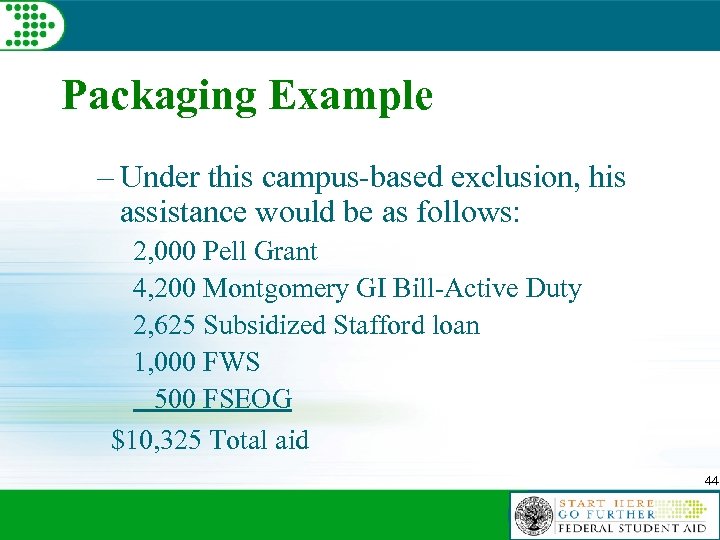 Packaging Example – Under this campus-based exclusion, his assistance would be as follows: 2, 000 Pell Grant 4, 200 Montgomery GI Bill-Active Duty 2, 625 Subsidized Stafford loan 1, 000 FWS 500 FSEOG $10, 325 Total aid 44
 Packaging Example – His assistance of $10, 325 would exceed his need of $7, 700 and his COA of $9, 500 – Again, this is not considered an overaward or an overpayment 45
 Treatment of New Chapter 1607 Veterans Education Benefits • A school must account for Chapter 1607 veterans education benefits as a “resource” and “estimated financial assistance” beginning with the 2005 -2006 award year, excluding payments made for previous award years 46
 Treatment of New Chapter 1607 Veterans Education Benefits • Retroactive payments for the 20012002, 2002 -2003, 2003 -2004, and 2004 -2005 award years will not have to be considered by a school for purposes of overawards and overpayments 47
 Contact Information If you have further questions, we can be contacted at: Bill. Susling@vba. va. gov Harold. Mc. Cullough@ed. gov 48