


 Скачать презентацию Session 3 3 Situation Analysis 2010 -05 WFP
271cdd5c567d8e436e97e4184c818f6d.ppt
- Количество слайдов: 12
 Session 3. 3. Situation Analysis 2010 -05 WFP Initial EFSA Learning 1
 Session Objectives After this session, participants should be able to: – Describe the process and intended outcome of a situation analysis – Conduct a situation analysis (compiling and summarising Initial EFSA data using the Initial EFSA Templates) 2010 -05 WFP Initial EFSA Learning 2
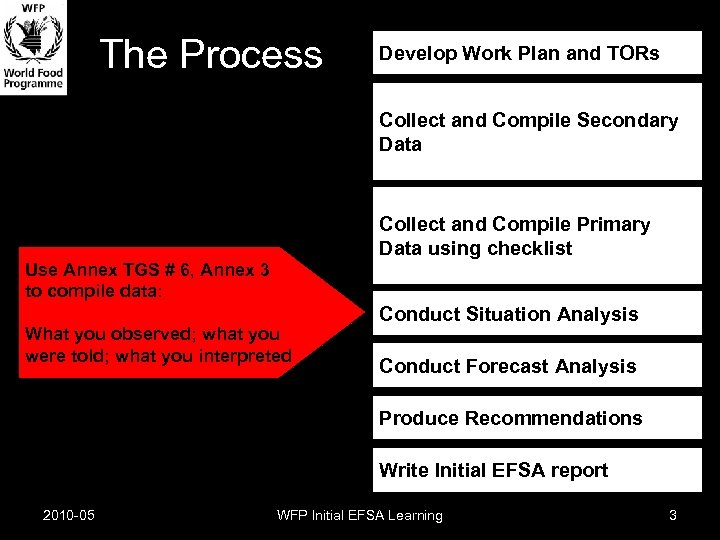 The Process Develop Work Plan and TORs Collect and Compile Secondary Data Collect and Compile Primary Data using checklist Use Annex TGS # 6, Annex 3 to compile data: What you observed; what you were told; what you interpreted Conduct Situation Analysis Conduct Forecast Analysis Produce Recommendations Write Initial EFSA report 2010 -05 WFP Initial EFSA Learning 3
 Situation Analysis • a process that examines a situation, its elements, and their relations • defines and interprets the general position or combination of conditions of the population at the time of the assessment • provides the context and knowledge for effective decision-making 2010 -05 WFP Initial EFSA Learning 4
 Compiling data…today… • Each team will work with the KI, CG & HH checklists that its notetakers generated 2010 -05 WFP Initial EFSA Learning 5
 Situation Analysis Build 3 templates to compile data 2010 -05 WFP Initial EFSA Learning 6
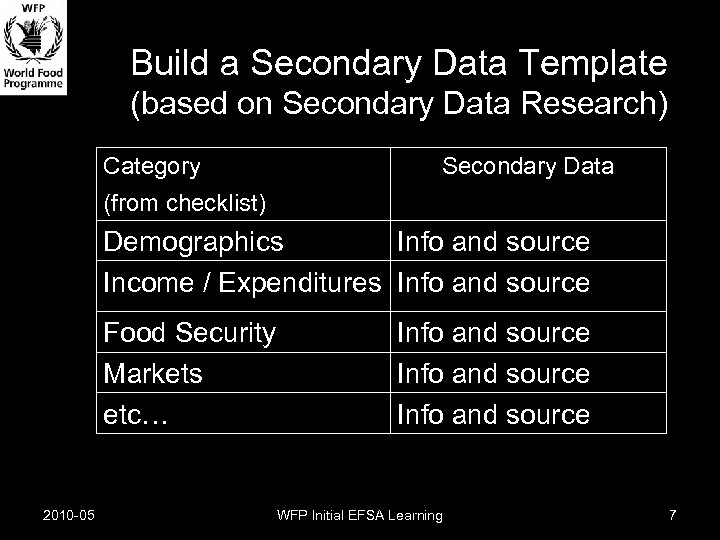 Build a Secondary Data Template (based on Secondary Data Research) Category Secondary Data (from checklist) Demographics Info and source Income / Expenditures Info and source Food Security Markets etc… 2010 -05 Info and source WFP Initial EFSA Learning 7
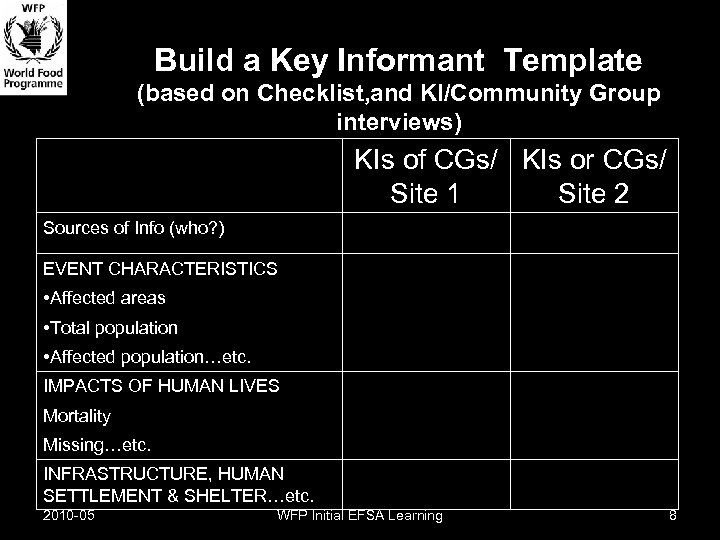 Build a Key Informant Template (based on Checklist, and KI/Community Group interviews) KIs of CGs/ KIs or CGs/ Site 1 Site 2 Sources of Info (who? ) EVENT CHARACTERISTICS • Affected areas • Total population • Affected population…etc. IMPACTS OF HUMAN LIVES Mortality Missing…etc. INFRASTRUCTURE, HUMAN SETTLEMENT & SHELTER…etc. 2010 -05 WFP Initial EFSA Learning 8
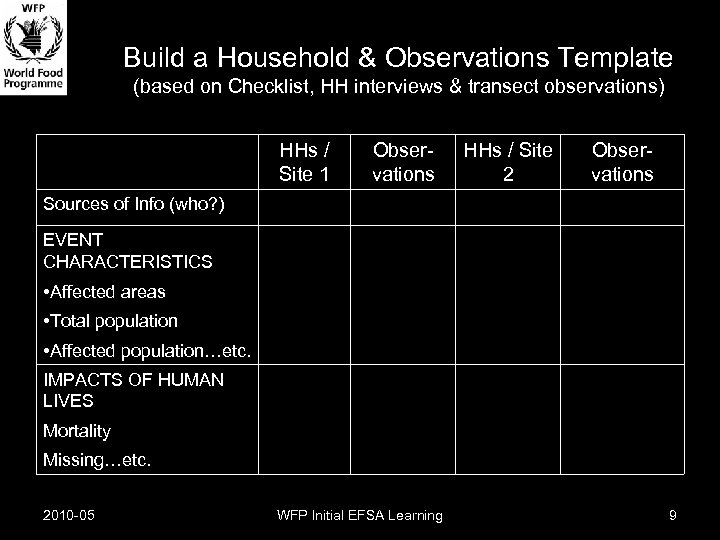 Build a Household & Observations Template (based on Checklist, HH interviews & transect observations) HHs / Site 1 Observations HHs / Site 2 Observations Sources of Info (who? ) EVENT CHARACTERISTICS • Affected areas • Total population • Affected population…etc. IMPACTS OF HUMAN LIVES Mortality Missing…etc. 2010 -05 WFP Initial EFSA Learning 9
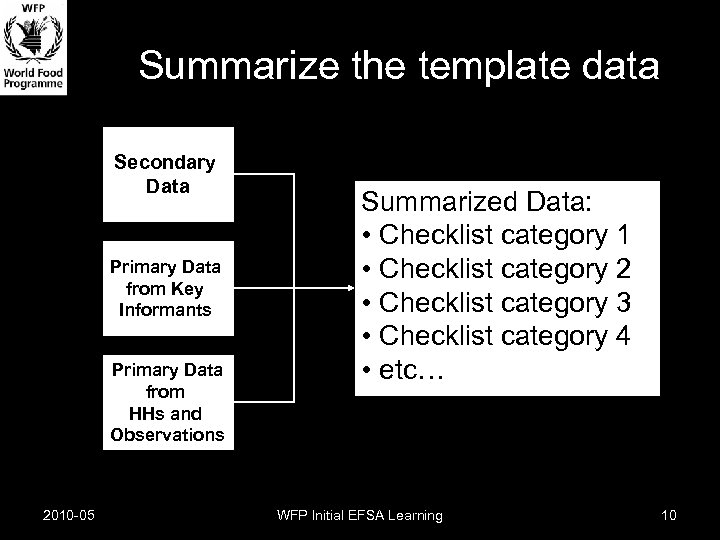 Summarize the template data Secondary Data Primary Data from Key Informants Primary Data from HHs and Observations 2010 -05 Summarized Data: • Checklist category 1 • Checklist category 2 • Checklist category 3 • Checklist category 4 • etc… WFP Initial EFSA Learning 10
 Before you begin… Review: • Parts 9 -13 of Annex 1 in TGS #6 • Useful guidance in compiling and interpreting your findings 2010 -05 WFP Initial EFSA Learning 11
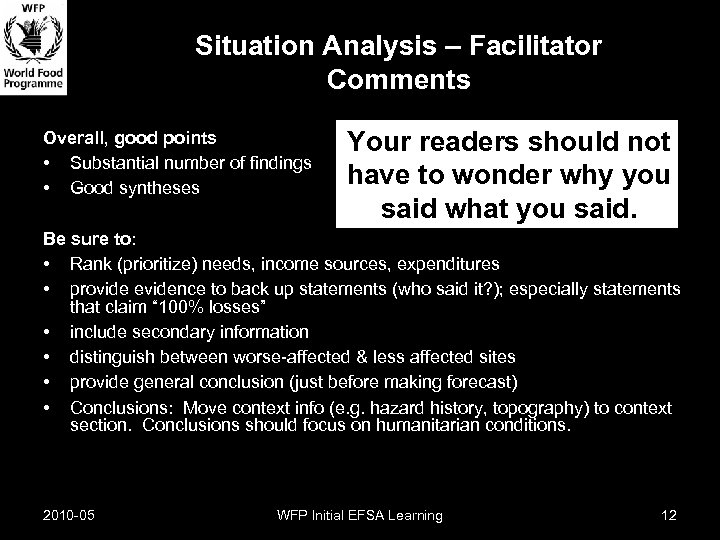 Situation Analysis – Facilitator Comments Overall, good points • Substantial number of findings • Good syntheses Your readers should not have to wonder why you said what you said. Be sure to: • Rank (prioritize) needs, income sources, expenditures • provide evidence to back up statements (who said it? ); especially statements that claim “ 100% losses” • include secondary information • distinguish between worse-affected & less affected sites • provide general conclusion (just before making forecast) • Conclusions: Move context info (e. g. hazard history, topography) to context section. Conclusions should focus on humanitarian conditions. 2010 -05 WFP Initial EFSA Learning 12