


 Скачать презентацию Session 2 Valuation of Environmental Resources John A
acfd2610b7294747336f95a55d06a4ab.ppt
- Количество слайдов: 24
 Session 2 Valuation of Environmental Resources John A. Dixon johnkailua@aol. com World Bank Institute Ashgabad, November, 2005 Caspian EVE 2005/UNDP and WBI John A. Dixon, Valuing Environmental Resources GEF
 Why Do We Want Valuation in NRM projects? ? • To do a fuller accounting of benefits and costs • To explicitly include environmental goods and services that are often ignored • To improve the chance of projects passing an IRR test • To overcome shortages in existing markets Caspian EVE 2005/UNDP and WBI John A. Dixon, Valuing Environmental Resources GEF
 Externalities and Valuation – key ingredients in environmental economics • The two major causes of poor environmental / NRM analysis are externalities and valuation • Externalities – a disconnect between cause and effect, either over space or over time • Valuation – lack of market prices to signal scarcity or value Caspian EVE 2005/UNDP and WBI John A. Dixon, Valuing Environmental Resources GEF
 Externalities (both environmental or economic) • An externality occurs when the action of one person affects the well-being of another person and that second person is not part of the decision-making process • Externalities can be addressed (internalized) by various means: – Eliminating the problem – Making compensation to the person affected – Consultation with and receiving approval from the person affected Caspian EVE 2005/UNDP and WBI John A. Dixon, Valuing Environmental Resources GEF
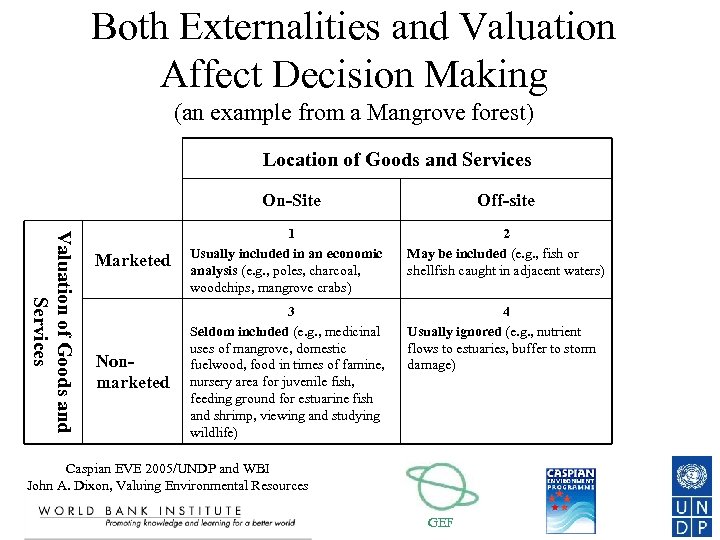 Both Externalities and Valuation Affect Decision Making (an example from a Mangrove forest) Location of Goods and Services On-Site Off-site Valuation of Goods and Services Marketed 1 Usually included in an economic analysis (e. g. , poles, charcoal, woodchips, mangrove crabs) 2 May be included (e. g. , fish or shellfish caught in adjacent waters) Nonmarketed 3 Seldom included (e. g. , medicinal uses of mangrove, domestic fuelwood, food in times of famine, nursery area for juvenile fish, feeding ground for estuarine fish and shrimp, viewing and studying wildlife) 4 Usually ignored (e. g. , nutrient flows to estuaries, buffer to storm damage) Caspian EVE 2005/UNDP and WBI John A. Dixon, Valuing Environmental Resources GEF
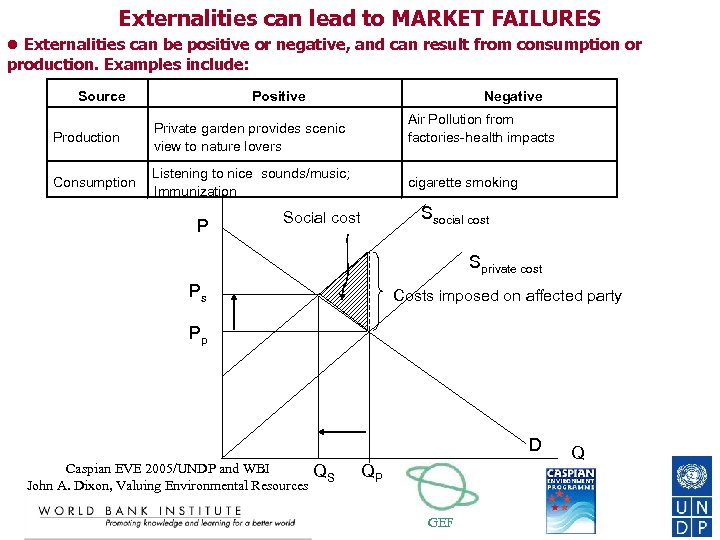 Externalities can lead to MARKET FAILURES Externalities can be positive or negative, and can result from consumption or production. Examples include: Source Positive Production Air Pollution from factories-health impacts Private garden provides scenic view to nature lovers Consumption Negative Listening to nice sounds/music; Immunization P cigarette smoking Ssocial cost Sprivate cost Ps Costs imposed on affected party Pp D Caspian EVE 2005/UNDP and WBI QS John A. Dixon, Valuing Environmental Resources QP GEF Q
 The Total Economic Value (TEV) Approach • Includes both Use Values and Non-Use Values • Use values include direct use, indirect use, and option values • Non-use values include bequest values and existence values • The TEV is the sum of all of these values Caspian EVE 2005/UNDP and WBI John A. Dixon, Valuing Environmental Resources GEF
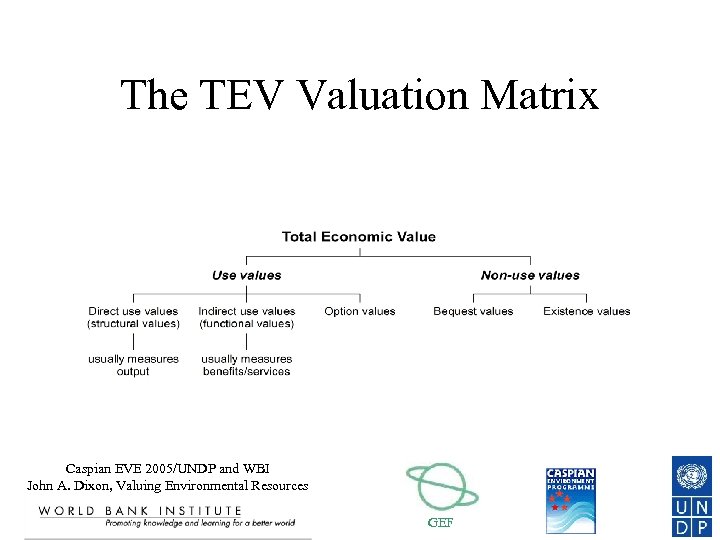 The TEV Valuation Matrix Caspian EVE 2005/UNDP and WBI John A. Dixon, Valuing Environmental Resources GEF
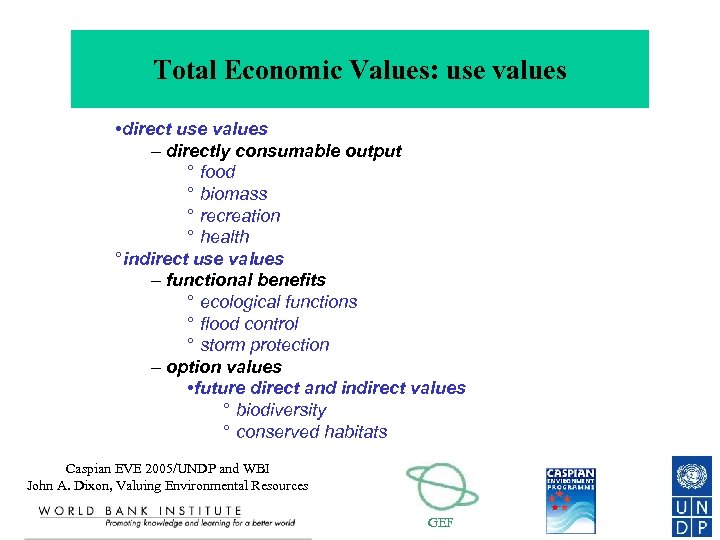 Total Economic Values: use values • direct use values – directly consumable output ° food ° biomass ° recreation ° health °indirect use values – functional benefits ° ecological functions ° flood control ° storm protection – option values • future direct and indirect values ° biodiversity ° conserved habitats Caspian EVE 2005/UNDP and WBI John A. Dixon, Valuing Environmental Resources GEF
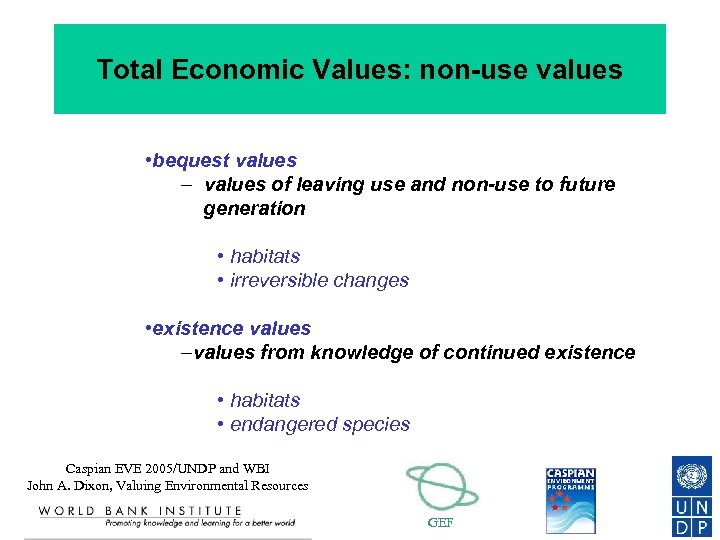 Total Economic Values: non-use values • bequest values – values of leaving use and non-use to future generation • habitats • irreversible changes • existence values –values from knowledge of continued existence • habitats • endangered species Caspian EVE 2005/UNDP and WBI John A. Dixon, Valuing Environmental Resources GEF
 Choosing the best form of project/ policy analysis : BCA or CEA? ? • B/CA or benefit –cost analysis – is preferred since it includes monetary estimates of benefits and costs over time • CEA – or cost-effectiveness analysis – is useful when it is impossible to estimate benefits of a project (project costs are almost always known) and so we seek the least cost way to reach a stated goal or objective Caspian EVE 2005/UNDP and WBI John A. Dixon, Valuing Environmental Resources GEF
 Why BCA is usually preferred (and NPV is best) • BCA gives a quantitative measure of the generation of net social benefits (what we are most concerned about as societies) • BCA can take several forms – NPV (net present value), BC Ratio (benefit cost ratio) or IRR (internal rate of return) • All three use the same data as inputs but vary in how they use the discount rate • NPV is usually the best measure – WHY? ? ? Caspian EVE 2005/UNDP and WBI John A. Dixon, Valuing Environmental Resources GEF
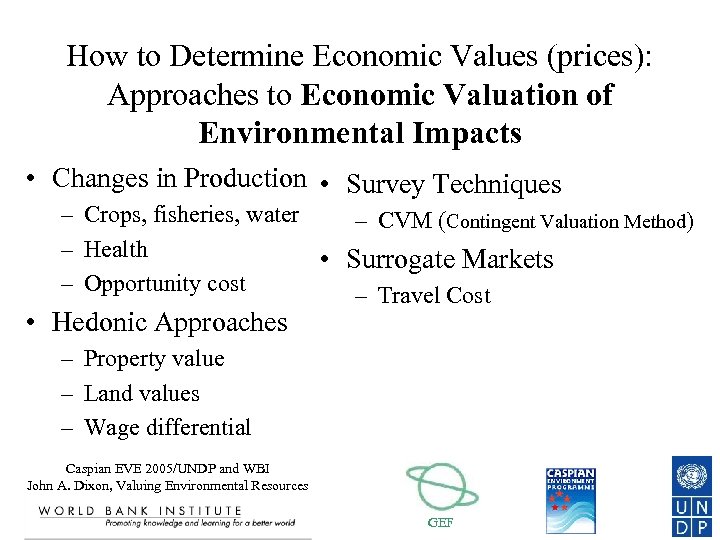 How to Determine Economic Values (prices): Approaches to Economic Valuation of Environmental Impacts • Changes in Production • Survey Techniques – Crops, fisheries, water – CVM (Contingent Valuation Method) – Health • Surrogate Markets – Opportunity cost – Travel Cost • Hedonic Approaches – Property value – Land values – Wage differential Caspian EVE 2005/UNDP and WBI John A. Dixon, Valuing Environmental Resources GEF
 Valuation techniques: Change in production • A basic “price x quantity” approach that is very useful in many NRM projects • Changes in production may have been ignored because they occurred “off-site” (externalities) or because of pricing problems (valuation) • Easy to sell to decision makers Caspian EVE 2005/UNDP and WBI John A. Dixon, Valuing Environmental Resources GEF
 Valuation techniques: Hedonic price methods • Value environmental amenities (and disamenities) by changes in property values or location-specific prices • Applied to housing, hotels, land other sitespecific valuation issues • A very strong revealed preference approach • Willingness to pay limited by ability to pay Caspian EVE 2005/UNDP and WBI John A. Dixon, Valuing Environmental Resources GEF
 Valuation techniques: Contingent valuation method (CVM) • CVM as a second-best approach that relies on surveys and questions on willingness-to-pay (WTP) or willingness-accept-compensation (WTAC) • When should you use WTP and when WTAC? ? ? – in theory and in practice? ? • Especially useful when the market does not exist (e. g. a yet to be established protected area) or for bequest and existence values Caspian EVE 2005/UNDP and WBI John A. Dixon, Valuing Environmental Resources GEF
 Valuation techniques: Contingent valuation method (CVM) –contd. • Extensively used for ecosystem damage assessment • Sometimes applied by the use of Benefit Transfer techniques – apply value from study A to location B for a similar resource • Good point about CVM – you always get an answer! • Bad point about CVM – you always get an answer!! Caspian EVE 2005/UNDP and WBI John A. Dixon, Valuing Environmental Resources GEF
 Surrogate valuation techniques: the Travel Cost Method • A “revealed preference” approach based on observation or survey data on actual travel patterns • Solid theoretical and practical foundations and applications • A good technique for many recreational/ cultural amenities • The travel cost itself is not the value – but is used to derive a demand curve to then estimate values Caspian EVE 2005/UNDP and WBI John A. Dixon, Valuing Environmental Resources GEF
 Selected Case Studies – illustrating various valuation approaches • National Parks in Georgia • Lake Sevan in Armenia • Marine Park management in Cancun, Mexico Caspian EVE 2005/UNDP and WBI John A. Dixon, Valuing Environmental Resources GEF
 WTP for a National Park in Georgia – case study #1 • Estimating the WTP for new and existing national parks in Georgia • Uses CVM to estimate WTP • Surveys Georgians within the country, and foreigners living in Georgia, Armenia, and Azerbaijan • Derives estimates for both daily and annual passes for Georgians Caspian EVE 2005/UNDP and WBI John A. Dixon, Valuing Environmental Resources GEF
 Measuring WTP for Restoration of Lake Sevan, Armenia – case study #2 • Designed to supplement a change in productivity analysis of an investment operation by including use and non-use values • Includes Armenians in Armenia and also those Armenians who live abroad (a larger number) • Tests two payment vehicles – a one-time payment and monthly payments for 3 years • Applies Benefit Transfer to estimate expatriate WTP (based on relative income levels and other factors) Caspian EVE 2005/UNDP and WBI John A. Dixon, Valuing Environmental Resources GEF
 Paying for Management of a Marine Park in Cancun, Mexico – case study #3 • A “paper park” in need of financial support • Large visitor numbers and large revenues associated with park use (snorkeling tours), but no entrance fees collected • Challenge : how to tap visitor WTP (and ability to pay), and retain revenues locally to help pay management costs • Used creative financing, working with stakeholders, new legal measures, and revenue sharing Caspian EVE 2005/UNDP and WBI John A. Dixon, Valuing Environmental Resources GEF
 Conclusions • A wide variety of valuation techniques exist that can be used to value environmental resources • Literature expanding rapidly in both developed and developing countries • Increased acceptance of the techniques and the results by government decision makers • Cannot value all NRM project components –e. g. what is biodiversity worth? ? Caspian EVE 2005/UNDP and WBI John A. Dixon, Valuing Environmental Resources GEF
 Conclusions (cont’d) • Some short cuts are possible (e. g. quick and dirty approaches; benefit transfer) but have to be used with caution • Valuation can be built into project design and does not have to be terribly expensive • See your friendly local World Bank/ UNDP environmental economist for assistance!!! Caspian EVE 2005/UNDP and WBI John A. Dixon, Valuing Environmental Resources GEF