


 Скачать презентацию Session 2 American Literature Lectures Paed Dr Jana
9799aadea11bae2f6eb152cb942667d0.ppt
- Количество слайдов: 56
 Session 2: American Literature Lectures: Paed. Dr. Jana Javorčíková, Ph. D. Institution: Zvolen, TUZVO, koordinátorka: doc. Ivica Lenčová Organization: (Lessons/Hodín: 24; t. j. 9 a 9 prezenčne, 6 dištančne)
 stretnutie (9 hod. , 10 okruhov) – Literatúra USA 1. Introduction to US literature: timeline (Úvod do US literatúry: časová os) 2. Colonial literature (Koloniálna literatúra) 3. Age of Reason: Benjamin Franklin (Vek rozumu: Benjamin Franklin) 4. Romanticism: J. F. Cooper (Romantizmus: J. F. Cooper) 5. Romanticism: E. A. Poe (Romantizmus: E. A. Poe) 6. Realism: M. Twain, H. B. Stowe (Realizmus: M. Twain, H. B. Stowe) 7. Modernism: R. Frost (Moderna: R. Frost, E. Hemingway) 8. 20 th century: War novel, Beat Generation: J. Heller (20. storočie: vojnový román, Beatnici: J. Heller) 9. The Present: literature of minorities: T. Morisson (Súčasnosť: literatúra menšín: T. Morissonová) 10. Juvenile literature: Dr. Seuss (Detská literatúra: Dr. Seuss)
 HODNOTENIE/ASSESSMENT Pripravené v rámci: dištančného štúdia- Rozsah: 3 hodiny: Príprava záverečného projektu: Aktivita v rozsahu ½-1 vyuč. hodiny, využívajúca reálie na výučbu konkrétneho jazykového javu.
 Texts for seminars/Kde nájsť texty na semináre: • • • www. fhv. umb Katedra anglistiky a amerikanistiky Pracovníci katedry Jana Javorčíková Dištančné štúdium – Interkultúrna komunikácia
 Lecture 1/Prednáška 1: Introduction to American Literature Terminology and Periods
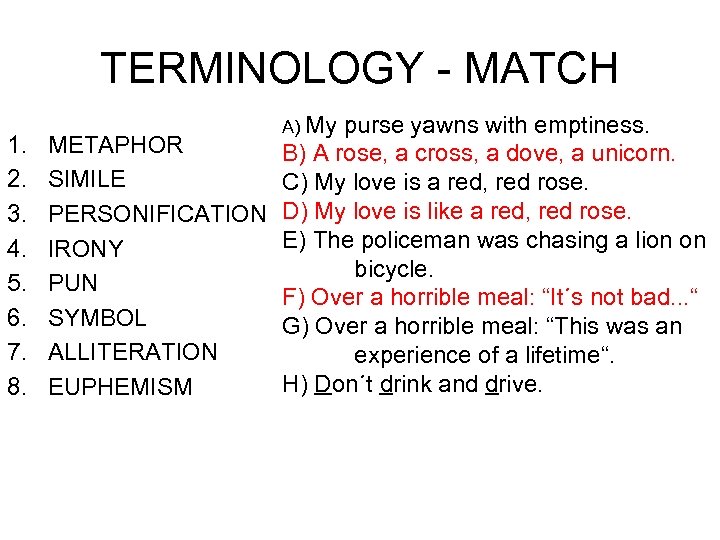 TERMINOLOGY - MATCH 1. 2. 3. 4. 5. 6. 7. 8. METAPHOR SIMILE PERSONIFICATION IRONY PUN SYMBOL ALLITERATION EUPHEMISM A) My purse yawns with emptiness. B) A rose, a cross, a dove, a unicorn. C) My love is a red, red rose. D) My love is like a red, red rose. E) The policeman was chasing a lion on bicycle. F) Over a horrible meal: “It´s not bad. . . “ G) Over a horrible meal: “This was an experience of a lifetime“. H) Don´t drink and drive.
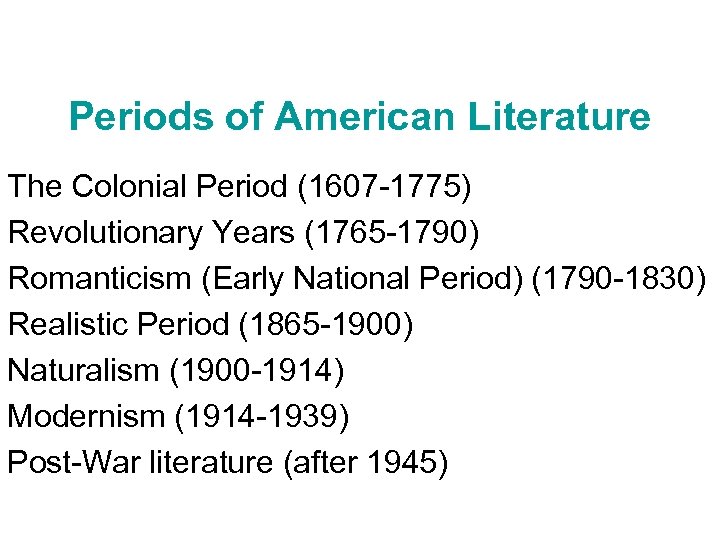 Periods of American Literature The Colonial Period (1607 -1775) Revolutionary Years (1765 -1790) Romanticism (Early National Period) (1790 -1830) Realistic Period (1865 -1900) Naturalism (1900 -1914) Modernism (1914 -1939) Post-War literature (after 1945)
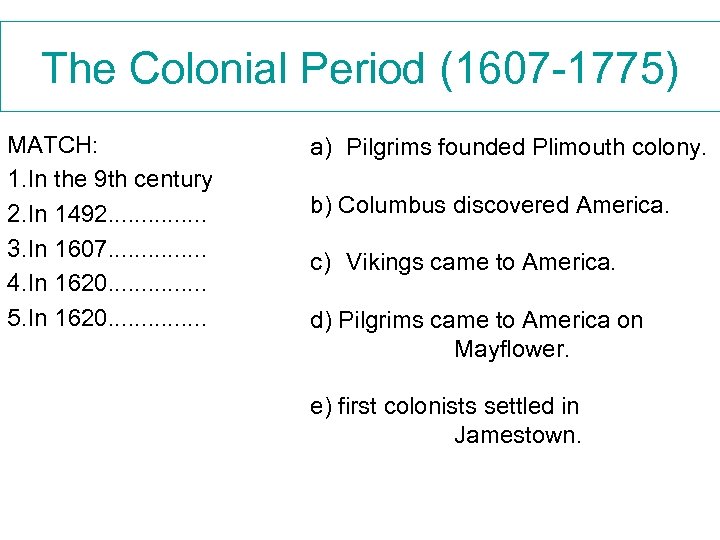 The Colonial Period (1607 -1775) MATCH: 1. In the 9 th century 2. In 1492. . . . 3. In 1607. . . . 4. In 1620. . . . 5. In 1620. . . . a) Pilgrims founded Plimouth colony. b) Columbus discovered America. c) Vikings came to America. d) Pilgrims came to America on Mayflower. e) first colonists settled in Jamestown.
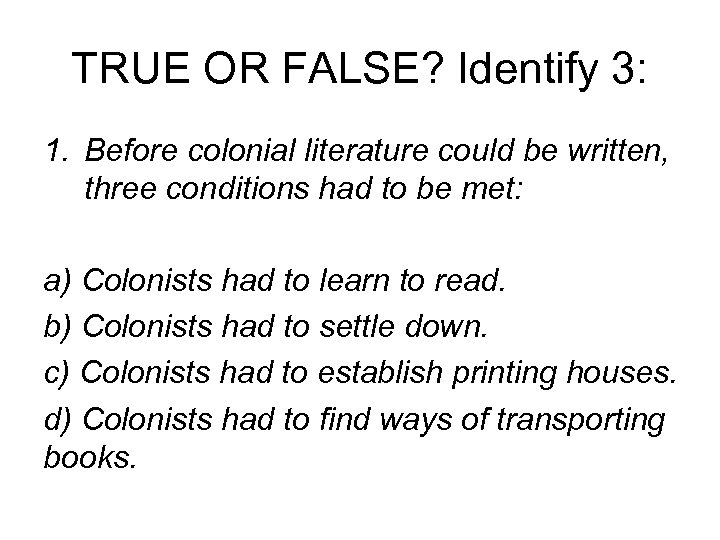 TRUE OR FALSE? Identify 3: 1. Before colonial literature could be written, three conditions had to be met: a) Colonists had to learn to read. b) Colonists had to settle down. c) Colonists had to establish printing houses. d) Colonists had to find ways of transporting books.
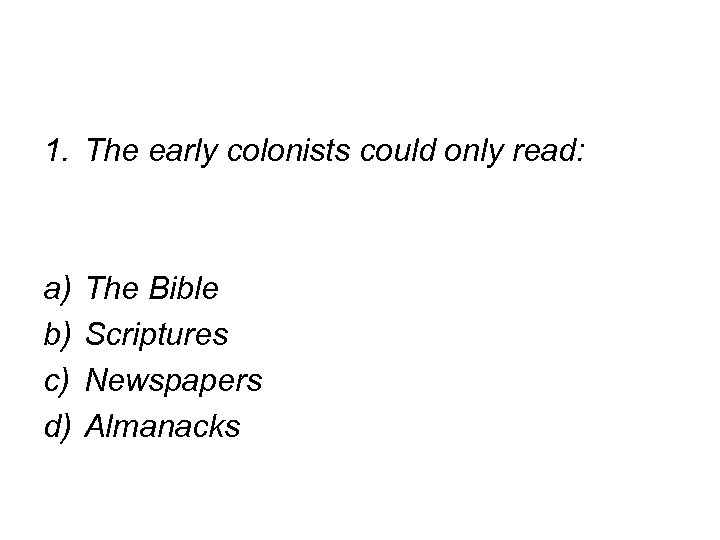 1. The early colonists could only read: a) b) c) d) The Bible Scriptures Newspapers Almanacks
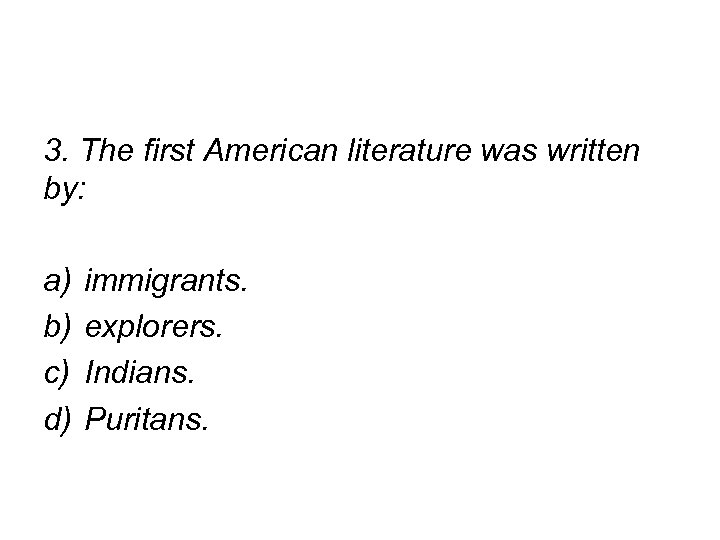 3. The first American literature was written by: a) b) c) d) immigrants. explorers. Indians. Puritans.
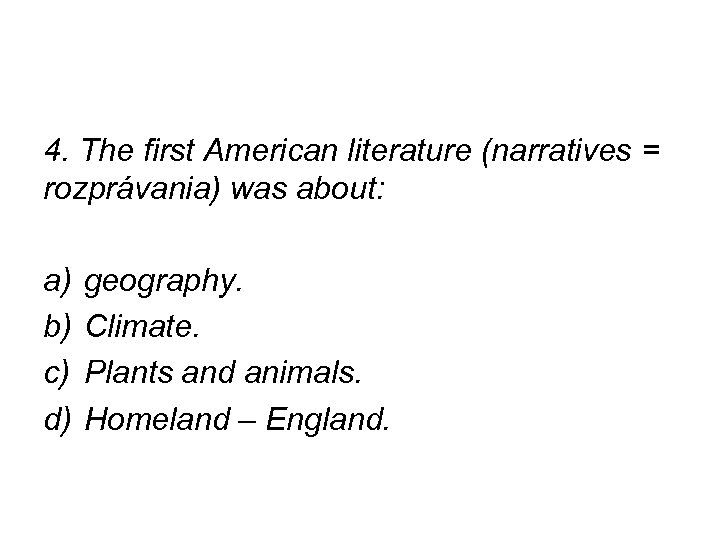 4. The first American literature (narratives = rozprávania) was about: a) b) c) d) geography. Climate. Plants and animals. Homeland – England.
 5. There were three major colonial writers: a) b) c) d) Mary Rowlandson. Cotton Mather. Stephen King. William Bradford.
 Puritan Style: Mary Rowlandson: A Narrative of the Captivity and restoration: Now away we must go with those Barbarous Creatures, with our bodies wounded and bleeding. . . This was the dolefullest night that my eyes ever saw. Oh the roaring, and singing and danceing and yelling of those black creatures in the night, which made the place a lively resemblance of hell.
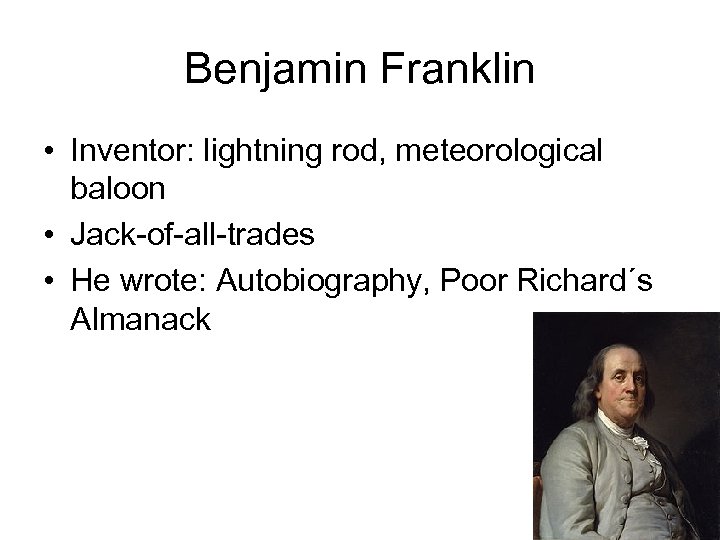 Benjamin Franklin • Inventor: lightning rod, meteorological baloon • Jack-of-all-trades • He wrote: Autobiography, Poor Richard´s Almanack
 From Poor Richard´s Almanack: • Almanack = a type of calendar with proverbs (príslovia), sayings (porekadlá): - He that lies with dogs, shall rise with fleas. - Make haste slowly. - Have you something to do to-morrow, do it do-day.
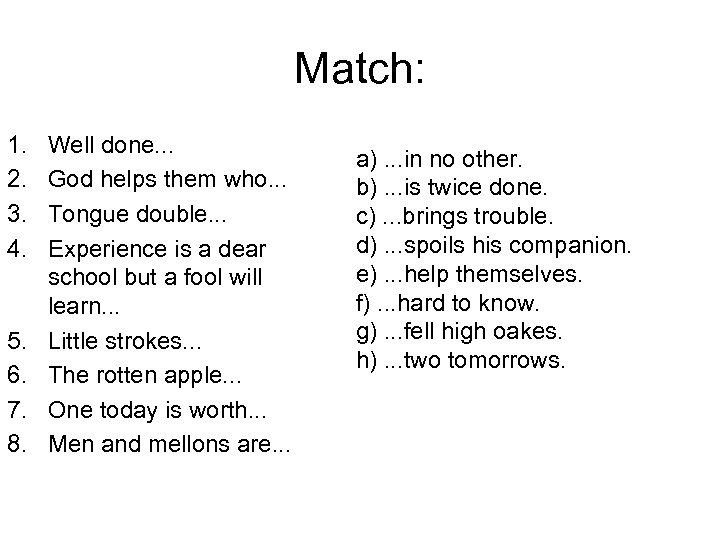 Match: 1. 2. 3. 4. 5. 6. 7. 8. Well done. . . God helps them who. . . Tongue double. . . Experience is a dear school but a fool will learn. . . Little strokes. . . The rotten apple. . . One today is worth. . . Men and mellons are. . . a). . . in no other. b). . . is twice done. c). . . brings trouble. d). . . spoils his companion. e). . . help themselves. f). . . hard to know. g). . . fell high oakes. h). . . two tomorrows.
 Answer: which of these proverbs. . . 1. 2. 3. 4. 5. Celebrates hard work? Criticises something? Praises (Chváli) God? Mocks (vysmieva sa) fools? Mentions (zmieňuje sa o) flowers, trees, fruits, vegetables and parts of human body?
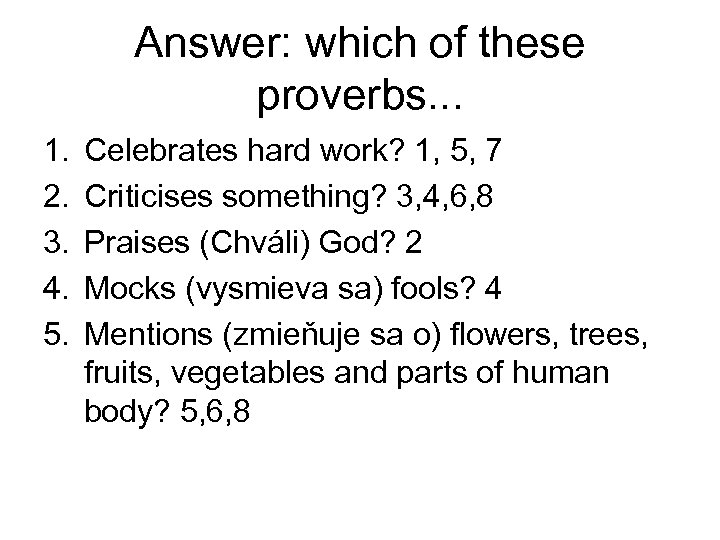 Answer: which of these proverbs. . . 1. 2. 3. 4. 5. Celebrates hard work? 1, 5, 7 Criticises something? 3, 4, 6, 8 Praises (Chváli) God? 2 Mocks (vysmieva sa) fools? 4 Mentions (zmieňuje sa o) flowers, trees, fruits, vegetables and parts of human body? 5, 6, 8
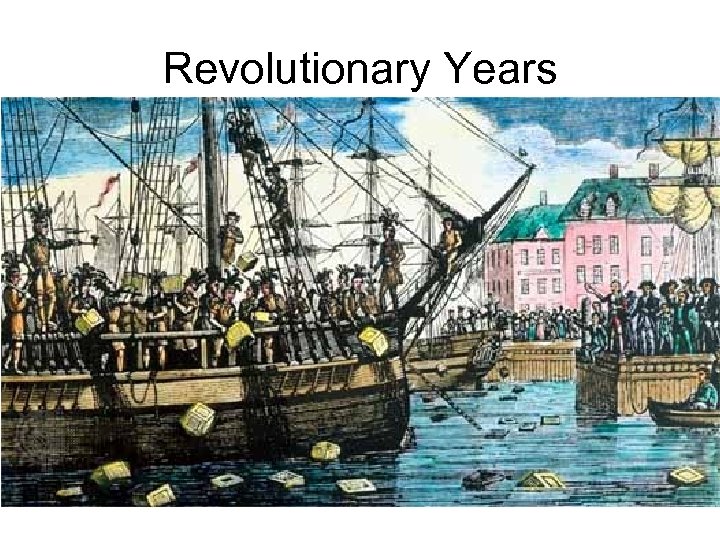 Revolutionary Years
 Memory test • • • 1. How many ships did you see? 2. Did you see the sea? 3. Was it day or night? 4. What were they throwing into the sea? 5. Did you see any Indians? 6. Did you see any white people? 7. Did you see any houses? 8. What colour were the houses? 9. Did you see any mountains?
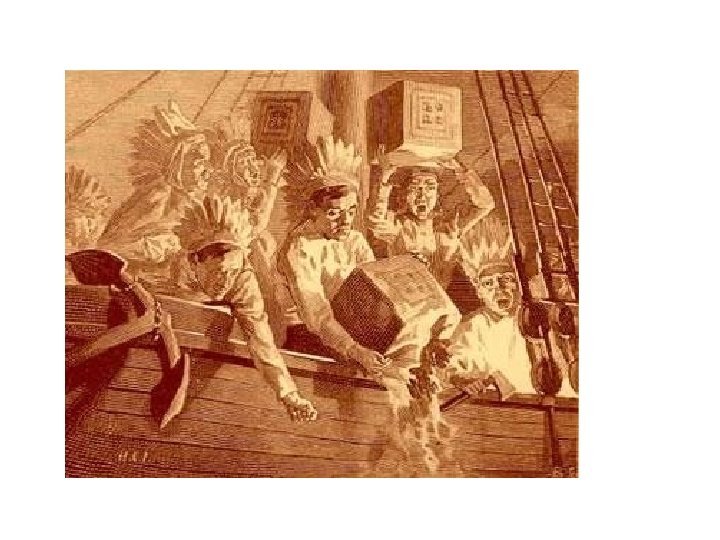
 Romanticism/ Revolutionary Years • Order words to make sentences (passive voice): 1. In 1765 by England “stamp act“ was passed. 2. “Boston Tea Party“ was by citizens of Boston organized in 1773 3. “The Declaration of Independence“ was declared 1775 in. 4. American Revolution in 1883 was finished.
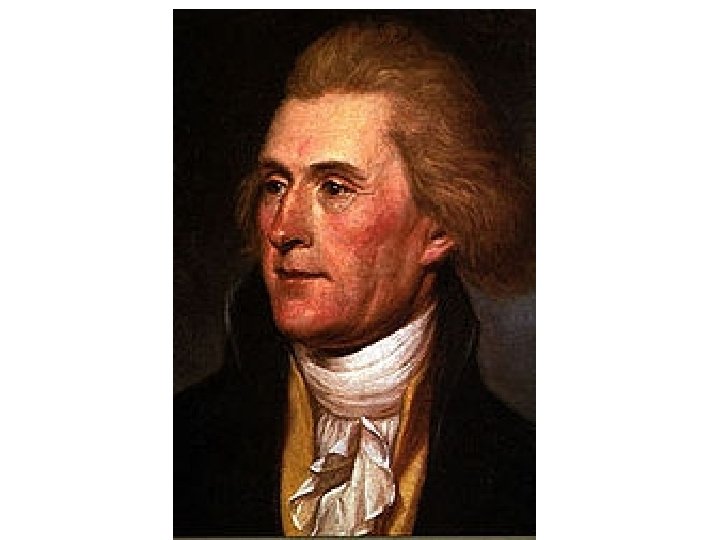
 Thomas Jefferson 1743 -1826 • We hold these truths to be self-evident, that all men and women are created equal, . . . with certain unalienable rights, that among these are Life, Liberty and the Pursuit of Happiness. • -That to secure these rights, Governments are instituted among Men, deriving their just power from the consent of the governed.
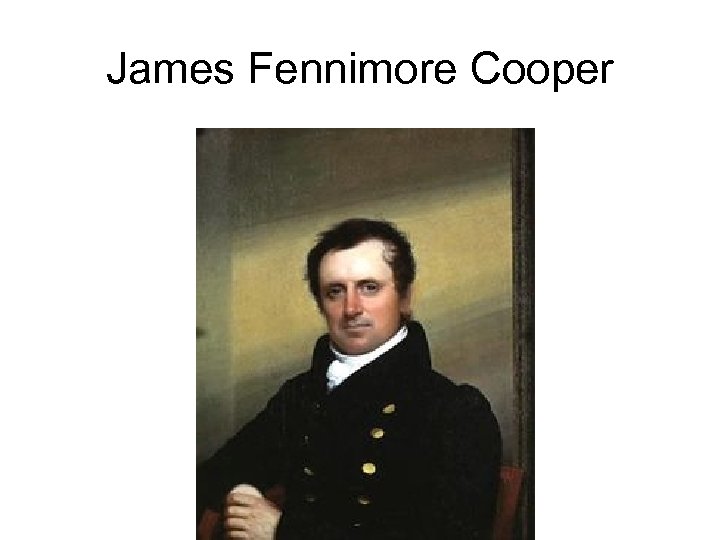 James Fennimore Cooper
 Revolutionary Years – James Fennimore Cooper • The Last of the Mohicans • http: //www. youtube. com/watch? v=2 k 6 pn. XT 7 JA&feature=related beginning • http: //www. youtube. com/watch? v=7 ti. KM 4 f x. Y 1 U&feature=related last scene • http: //www. youtube. com/watch? v=yg. Nu. Rp w. Zq. RU music
 Romanticism - Poetry 5 features of Romanticism: 1. Setting is romantic, in castles, ruins, wild beauty; 2. Characters are idealised: beauty-in-need courageous hero extreme villain 3. Plot: Love story, struggle for love, victory of good, defeat of evil, 4. Gothic elements 5. Happy or melodramatic ending.
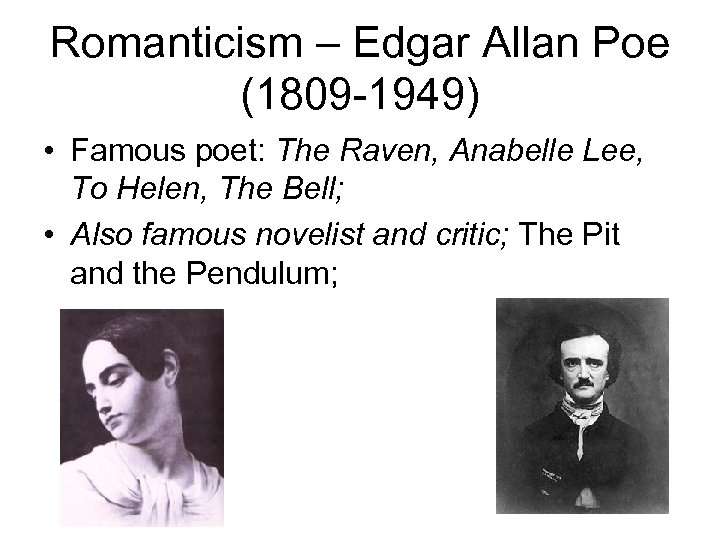 Romanticism – Edgar Allan Poe (1809 -1949) • Famous poet: The Raven, Anabelle Lee, To Helen, The Bell; • Also famous novelist and critic; The Pit and the Pendulum;
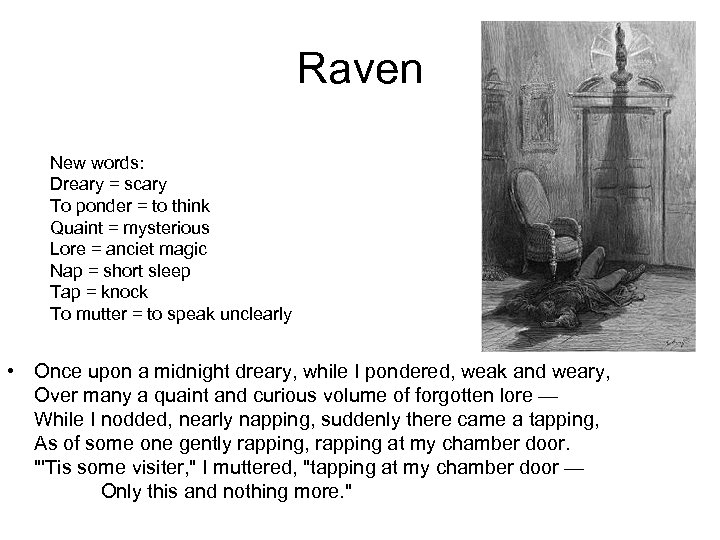 Raven New words: Dreary = scary To ponder = to think Quaint = mysterious Lore = anciet magic Nap = short sleep Tap = knock To mutter = to speak unclearly • Once upon a midnight dreary, while I pondered, weak and weary, Over many a quaint and curious volume of forgotten lore — While I nodded, nearly napping, suddenly there came a tapping, As of some one gently rapping, rapping at my chamber door. "'Tis some visiter, " I muttered, "tapping at my chamber door — Only this and nothing more. "
 Realism (1865 -1900) • Put into right order: 1. Civil war finished in 1865. 2. The Industrial Revolution started. 3. The cotton gin (stroj na spracovanie bavlny) was invented in 1703. 4. Civil was started in 1861. 5. Re-construction of the South started after 1865. 6. Slavery was abolished after 1865.
 Realism – Features: 1. Setting is realistic (uses dialects, customs); 2. Characters are common, ordinary men, not idealised heroes; 3. Plot: true-to-life, social criticism Representatives: Mark Twain, Harriet Beecher Stowe
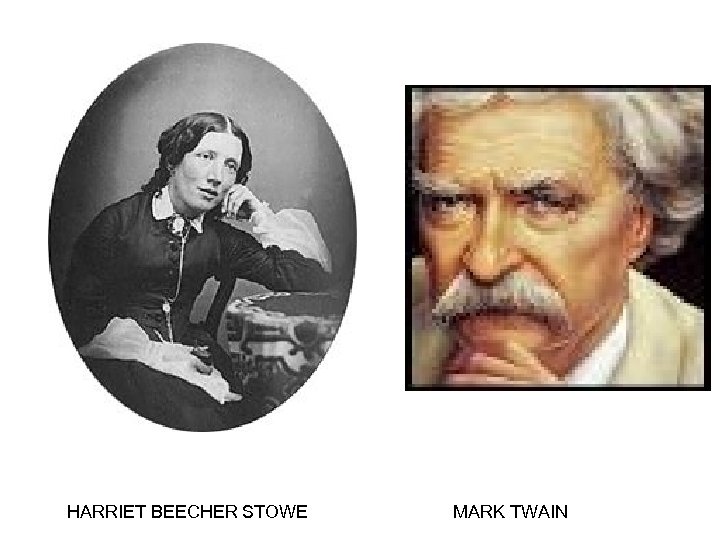 HARRIET BEECHER STOWE MARK TWAIN
 Mark Twain Quizz – true or false? 1. 2. 3. 4. 5. 6. 7. M. Twain was born in Missouri. M. Twain was born under a different name. M. Twain chose his pen-name according to his profession. He worked as a pilot. Many of his stories are set on the Mississippi river. He often Criticised Puritanism and slavery. He wrote Prince and the Pauper, The Adventures of Huck Finn and Tom Sawyer.
 Naturalism - features • - extreme realism; • - focused on Nature and its power (survival of the fittest, law of the superior) • - de-idealised view (Nature is stronger than Man)
 Jack London
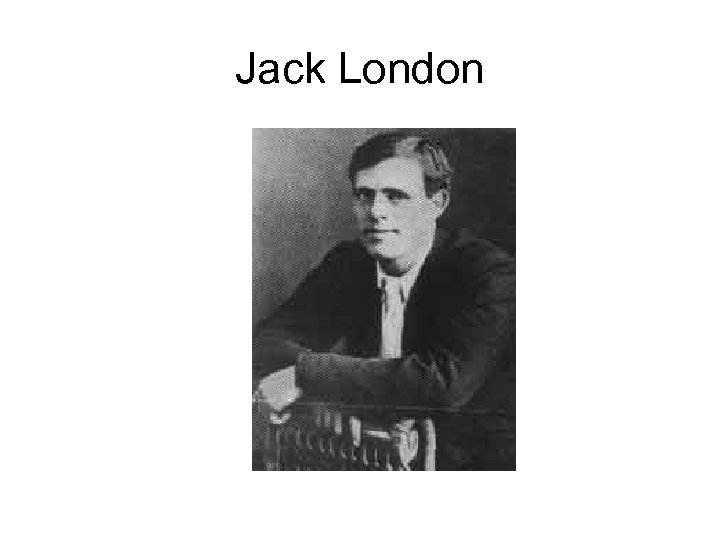
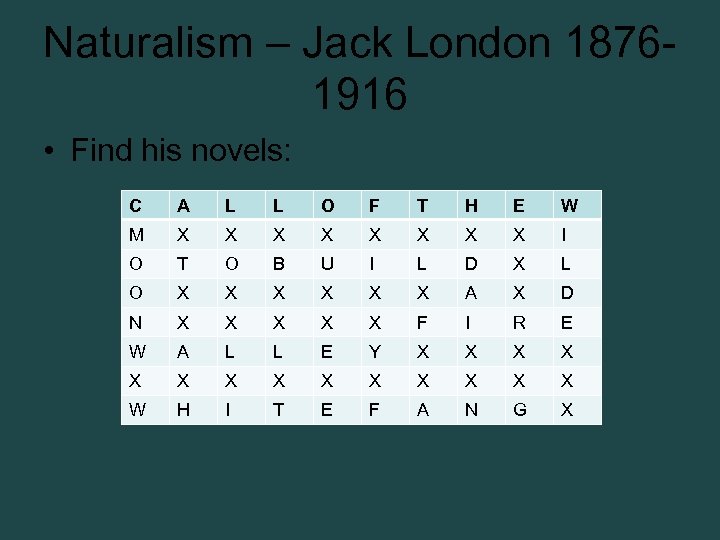 Naturalism – Jack London 18761916 • Find his novels: C A L L O F T H E W M X X X X I O T O B U I L D X L O X X X A X D N X X X F I R E W A L L E Y X X X X W H I T E F A N G X
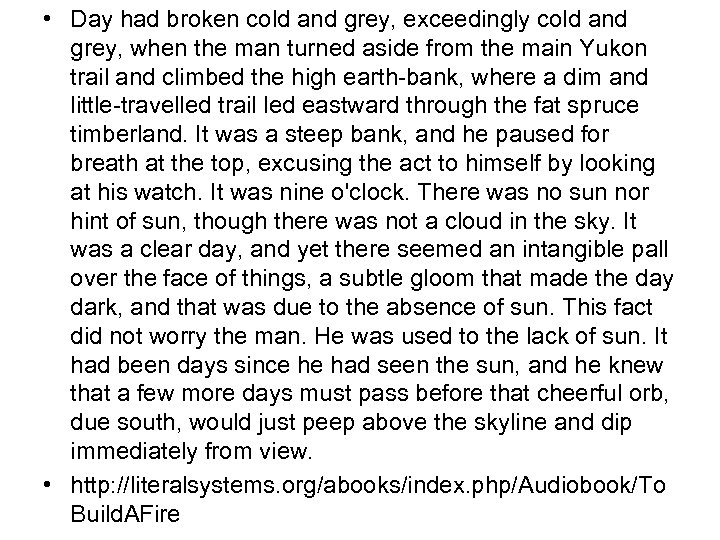 • Day had broken cold and grey, exceedingly cold and grey, when the man turned aside from the main Yukon trail and climbed the high earth-bank, where a dim and little-travelled trail led eastward through the fat spruce timberland. It was a steep bank, and he paused for breath at the top, excusing the act to himself by looking at his watch. It was nine o'clock. There was no sun nor hint of sun, though there was not a cloud in the sky. It was a clear day, and yet there seemed an intangible pall over the face of things, a subtle gloom that made the day dark, and that was due to the absence of sun. This fact did not worry the man. He was used to the lack of sun. It had been days since he had seen the sun, and he knew that a few more days must pass before that cheerful orb, due south, would just peep above the skyline and dip immediately from view. • http: //literalsystems. org/abooks/index. php/Audiobook/To Build. AFire
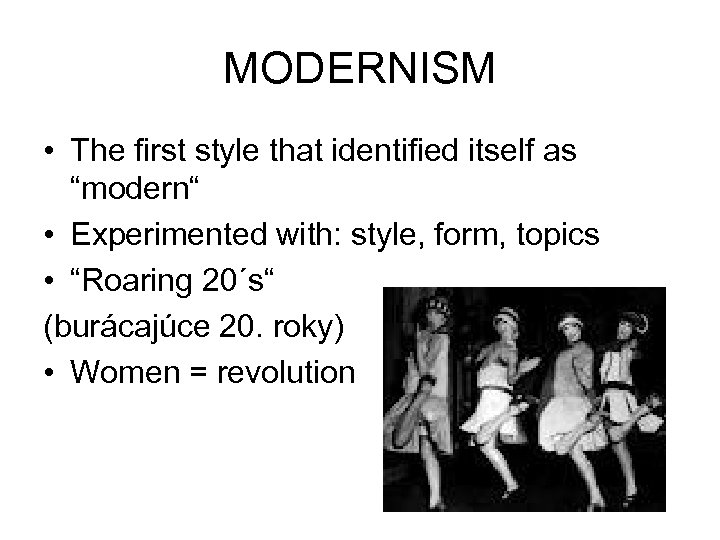 MODERNISM • The first style that identified itself as “modern“ • Experimented with: style, form, topics • “Roaring 20´s“ (burácajúce 20. roky) • Women = revolution
 Modernism - • http: //www. youtube. com/watch? v=3 svv. Cj 4 yh. Yc • Identify 5 things that women could not do before but now they could:
 1. 2. 3. 4. 5. 6. They could not wear short hair. They could not wear short skirts. They could not smoke and drink. They could not show their body. They could not walk alone. They could not have fun.
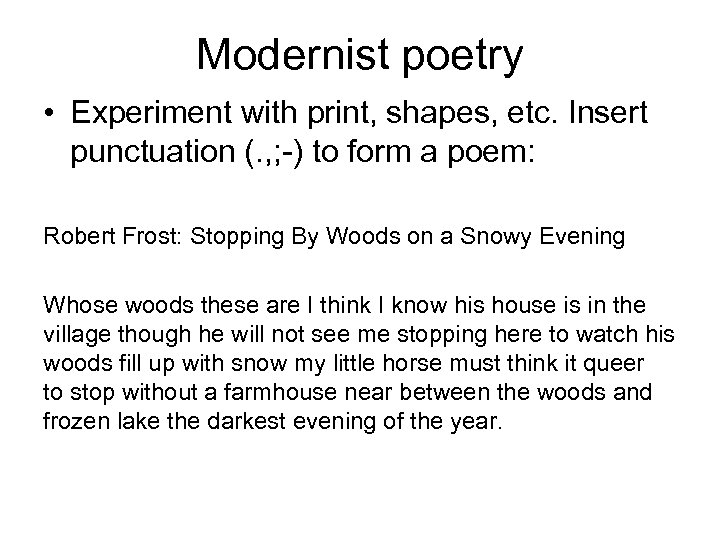 Modernist poetry • Experiment with print, shapes, etc. Insert punctuation (. , ; -) to form a poem: Robert Frost: Stopping By Woods on a Snowy Evening Whose woods these are I think I know his house is in the village though he will not see me stopping here to watch his woods fill up with snow my little horse must think it queer to stop without a farmhouse near between the woods and frozen lake the darkest evening of the year.
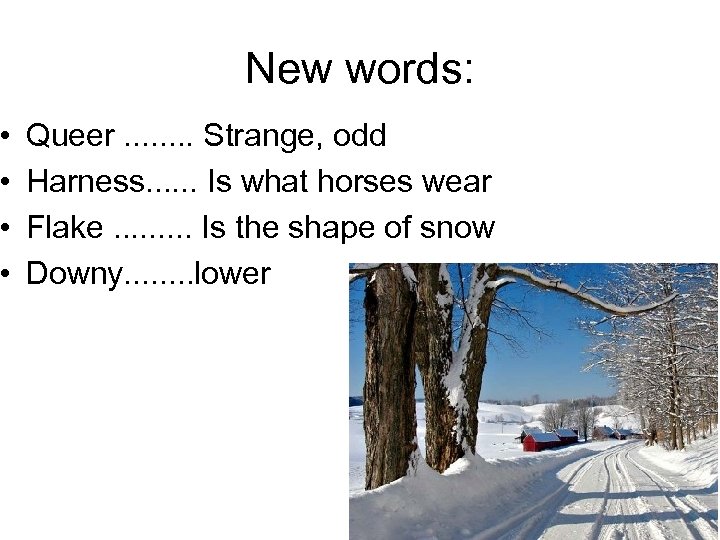 • • New words: Queer. . . . Strange, odd Harness. . . Is what horses wear Flake. . Is the shape of snow Downy. . . . lower
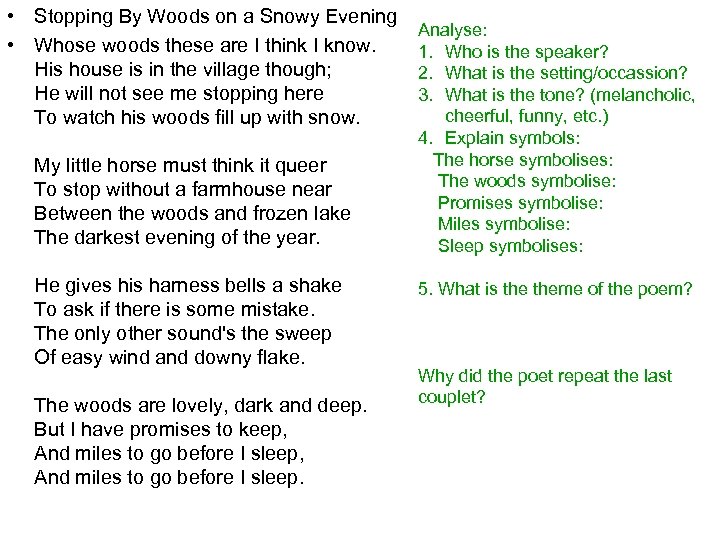 • Stopping By Woods on a Snowy Evening • Whose woods these are I think I know. His house is in the village though; He will not see me stopping here To watch his woods fill up with snow. My little horse must think it queer To stop without a farmhouse near Between the woods and frozen lake The darkest evening of the year. He gives his harness bells a shake To ask if there is some mistake. The only other sound's the sweep Of easy wind and downy flake. The woods are lovely, dark and deep. But I have promises to keep, And miles to go before I sleep. Analyse: 1. Who is the speaker? 2. What is the setting/occassion? 3. What is the tone? (melancholic, cheerful, funny, etc. ) 4. Explain symbols: The horse symbolises: The woods symbolise: Promises symbolise: Miles symbolise: Sleep symbolises: 5. What is theme of the poem? Why did the poet repeat the last couplet?
 • http: //www. youtube. com/watch? v=d_ume CKLIU 8&feature=related • Child http: //www. youtube. com/watch? v=Iwjg 1 c. U d 5 PA&feature=related
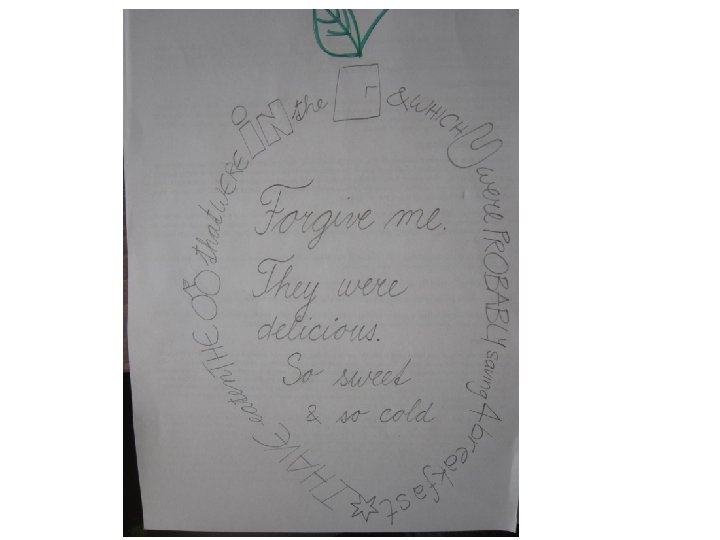
 William Carlos Williams Organize the poem into a meaningful shape: This is just to say I have eaten the plums that were in the icebox and which you were probably saving for breakfast Forgive me they were delicious so sweet and so cold
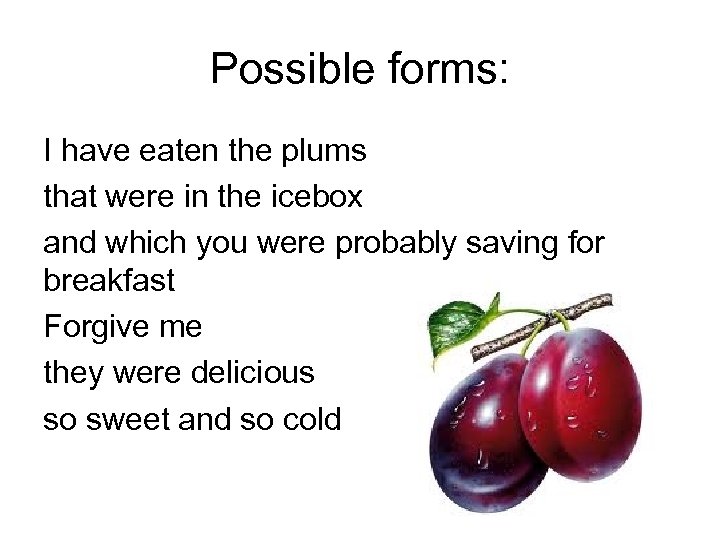 Possible forms: I have eaten the plums that were in the icebox and which you were probably saving for breakfast Forgive me they were delicious so sweet and so cold
 Literature after 1945 • There were various trends, movements, groups and genres: • POETRY: The Beat Generation • PROSE: women literature (Ami Tan) African-American (Toni Morisson) Jewish (Saul Bellow) postmodern (Richard Brautigan) • DRAMA: Eugene O´Neill, Arthur Miller, Tennessee Williams
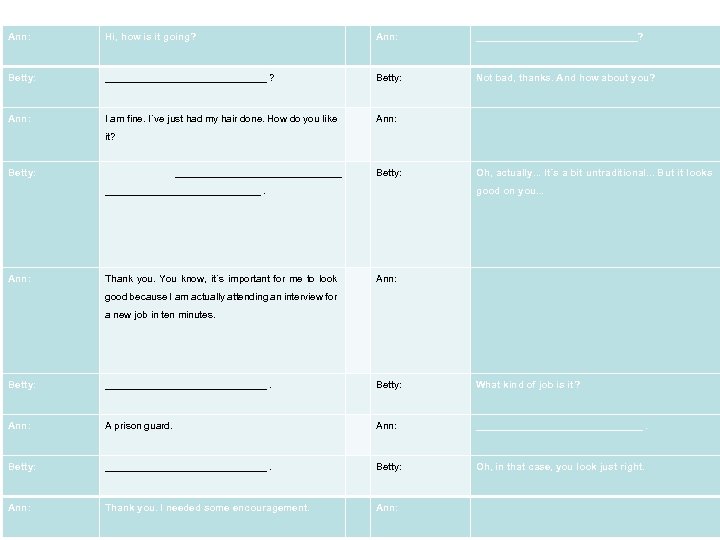 Ann: Hi, how is it going? Ann: _______________? Betty: _______________ ? Betty: Not bad, thanks. And how about you? Ann: I am fine. I´ve just had my hair done. How do you like Ann: it? Betty: _______________ Betty: ______________. Ann: Thank you. You know, it´s important for me to look good because I am actually attending an interview for Pracovný list A pre prvú skupinu a new job in ten minutes. Oh, actually. . . It´s a bit untraditional. . . But it looks good on you. . . Ann: Pracovný list B pre druhú skupinu študentov Betty: _______________. Betty: What kind of job is it? Ann: A prison guard. Ann: _______________. Betty: _______________. Betty: Oh, in that case, you look just right. Ann: Thank you. I needed some encouragement. Ann:
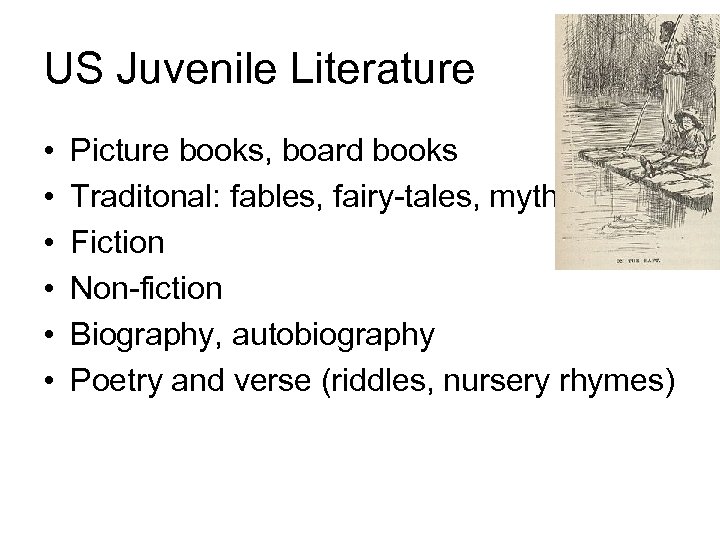 US Juvenile Literature • • • Picture books, board books Traditonal: fables, fairy-tales, myths Fiction Non-fiction Biography, autobiography Poetry and verse (riddles, nursery rhymes)
 Fairy Tales • • Little Red Riding Hood Cinderella Puss in Boots Sleeping Beauty Snow White Hansel and Gretel Rapunzel
 • • • Washington Irving: Rip van Winkle, 1820 Luisa May Alcott: Little Women, 1868 Joel Chandler Harris: Uncle Remus, 1881 Theodore Seuss Geisel: The Cat in the Hat Hugh Lofting (British): The Story of Dr. Doolittle • J. London: The Call of the Wild • J. M. Barrie (Scottish): Peter Pan, Peter and Wendy
 • Little Red Riding Hood • http: //www. youtube. com/watch? v=MRdx. L Tu 0 rv. E&feature=related
 http: //funnies. paco. to/riding. Hood. html • There once was a young person named Little Red Riding Hood who lived on the edge of a large forest full of endangered owls and rare plants that would probably provide a cure for cancer if only someone took the time to study them. Red Riding Hood lived with a nurture giver whom she sometimes referred to as "mother", although she didn't mean to imply by this term that she would have thought less of the person if a close biological link did not in
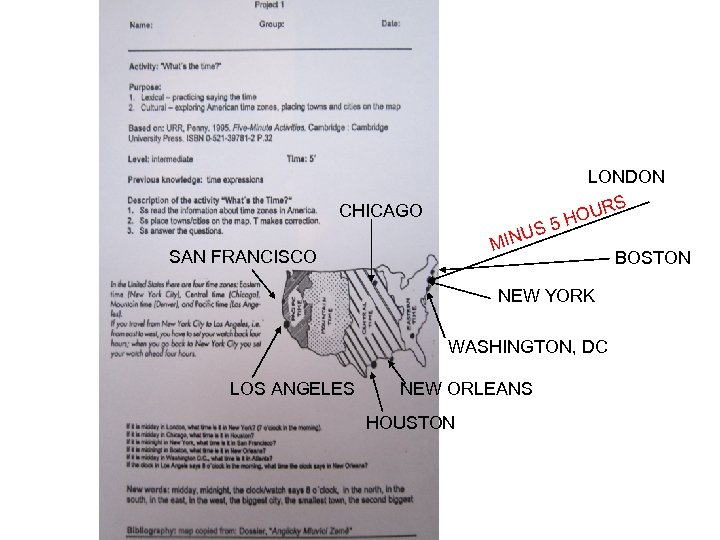 LONDON S OUR H S 5 U MIN BOSTON CHICAGO SAN FRANCISCO NEW YORK WASHINGTON, DC LOS ANGELES NEW ORLEANS HOUSTON