


 Скачать презентацию Session 12 Standardisation and Modernisation Vienna June
3850d5e95cb8434f3e4abbbd3abc4ed2.ppt
- Количество слайдов: 23
 Session 12 – Standardisation and Modernisation Vienna, June 2 nd – 5 th 2014 A Business Architecture Model to Foster Standardisation in Official Statistics Nadia Mignolli Giulio Barcaroli, Piero Demetrio Falorsi, Alessandra Fasano Italian National Institute of Statistics (Istat) Department for Integration, Quality, Research and Production Networks Development (DIQR) Vienna, June 2 nd – 5 th 2014
 Outline § Background § Main reference definitions § BA Business Lines: contents and activities § BA model § BA Principles § Concluding remarks and key elements Nadia Mignolli. Vienna, June 3 rd 2014
 Background (I) § Istat modernisation programme Stat 2015: with the main purpose of Standardisation and Industrialisation of the statistical production process § First simplified proposal: elaborated by the Sponsorship on Standardisation on the basis of Statistics Netherlands (CBS) model § Current BA Model: a joint task of ü ESSNet on Standardisation (to refine the Sponsorship proposal) ü Statistical Network - the Business Architecture Project (Institutes of Australia, Canada, Italy, New Zealand, Norway) BA model sharable and adoptable by NSIs: this represents the foundations to foster and intensify the creation of a ESS BA model, considering higher level interactions among NSIs and Eurostat Nadia Mignolli. Vienna, June 3 rd 2014
 Background (II) § BA current model is: ü Consistent with current actions carried out at international and European level (SN BA Project; CSPA; EU vision - from 1. 0 to 2. 0) ü Cost-efficient (re-use of data, methods, processes, tools) ü Aligned both with organisational frameworks adopted by mature industries (Service Oriented Architecture – SOA) and with statistical standards (GSBPM; GSIM) Nadia Mignolli. Vienna, June 3 rd 2014
 Main General Developments § Alignment of all the activities defined within BA business lines with phases and sub-processes of GSBPM 5. 0 § Consistent Decision and Design principles § Definition of common and shared infrastructures based on Repositories of: ü Human Resource Competencies (RHC) ü Data and Metadata (RDM) ü Standard Methods and Guidelines (RMG) ü Tools and Applications (RTA) Nadia Mignolli. Vienna, June 3 rd 2014
 Core Definitions: The General Reference Framework § Enterprise Architecture (EA) ü The process of translating business vision and strategy into effective enterprise change by creating, communicating and improving the key requirements, principles and models that describe the enterprise’s future state and enable its evolution (Gartner 2012) ü It is about understanding all the different elements that make up the enterprise and how those elements interrelate (SN BA Project Team; CSPA; ESSNet on Standardisation) ü It is divided in four layers: 1. Business Architecture (BA) 2. Information Architecture (IA) 3. Application Architecture (AA) 4. Technology Architecture (TA) Nadia Mignolli. Vienna, June 3 rd 2014
 Core Definitions: Business Architecture § Business Architecture (BA) ü It is the conceptual and strategic part of the EA ü It drives the overall EA (its four layers – AA; IA; TA) within an NSI ü It covers all the activities undertaken to produce statistical outputs, including conceptualisation, design, build and maintain information and application assets ü It is a reference model to optimise work processes within an Institution/Organisation and make them more efficient. It covers both statistical activities and strategic organisational tasks and capabilities ü It is a common language to undertake congruent innovation paths (Statistical Network BA Project Team; CSPA; ESSNet on Standardisation, 2013) Nadia Mignolli. Vienna, June 3 rd 2014
 Core Definitions: the other EA Layers § Information Architecture (IA) classifies the information and knowledge assets gathered, produced and used within the BA. It also describes the information standards and frameworks that underpin statistical information (e. g. GSIM, DDI, SDMX). IA facilitates discoverability and accessibility of available data and metadata, leading to greater re-use and sharing § Applications Architecture (AA) classifies and hosts the individual applications describing their deployment, interactions and relationships with the business processes of the organisation (e. g. estimation, editing and seasonal adjustment, etc. ). AA facilitates discoverability and accessibility of available systems and tools, leading to greater re-use and sharing § Technology Architecture (TA) describes the IT infrastructures required to support the deployment of applications and IT services, including hardware, middleware, networks, platforms, etc. . (Statistical Network BA Standardisation, 2013) Nadia Mignolli. Vienna, June 3 rd 2014 Project Team; CSPA; ESSNet on
 BA Business Lines § They are homogeneous areas with respect to the aim of the activities carried out and the nature of the information processed and/or services that insist on this information ü They are defined in order to guarantee independence from the Institute current organisational structure, so as to ensure stability with regard to any future reorganisation ü They facilitate NSIs to refer to a unique organisational model at the enterprise level, overcoming their internal tendency to replication/duplication ü They enhance harmonisation and standardisation against stovepipe models characterised by strong heterogeneity (of procedural, methodological and technological approaches), lack of standards and redundancy of data and applications Nadia Mignolli. Vienna, June 3 rd 2014
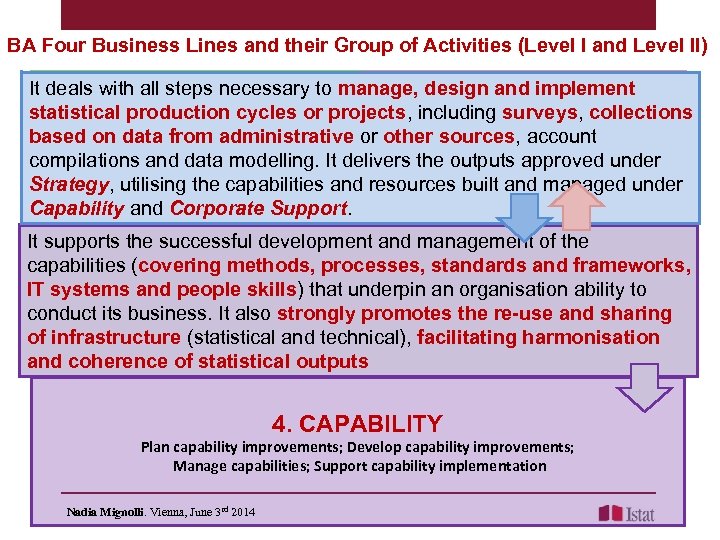 BA Four Business Lines and their Group of Activities (Level I and Level II) It deals with all steps necessary to manage, design and implement 2. CORPORATE SUPPORT statisticalbusiness and performances; production cycles or projects, including surveys, collections Manage 1. STRATEGY based on data from administrative or other sources, account Manage finances; Manage human Position; Govern; Influence and resources; compilations and data modelling. It delivers the outputs approved under collaborate Manage utilising the capabilities and resources built and managed under IT; Manage information and Strategy, knowledge; Manage users and suppliers Capability and Corporate Support. It covers the cross-cutting, non-statistical management of the by an the supports the successful development and that enable NSIs to consists of high-level strategic activities functions required deliver 3. PRODUCTION organisation to deliver methods, processes, standards and frameworks, capabilities (covering its work programme efficiently and effectively. products and services needed by governments and communities nationally DEVELOP IMPLEMENT IT systems and people skills) and internationally. These. Build that influence, shape and drive future activities underpin an organisation ability to Specify needs; Design; Collect; Process; Analyse; Disseminate conduct its business. It also strongly the development and sharing directions and investments through promotes the re-use consideration of infrastructure (statistical and MANAGE facilitating harmonisation of high-level strategies to advance statistical capabilities and optimise technical), and coherence of statistical. Plan; Monitor; Adjust the statistical portfolio outputs 4. CAPABILITY Plan capability improvements; Develop capability improvements; Manage capabilities; Support capability implementation Nadia Mignolli. Vienna, June 3 rd 2014
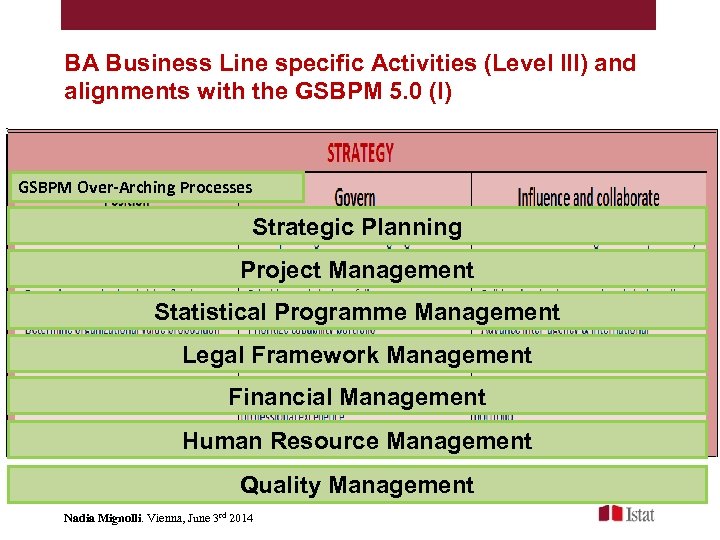 BA Business Line specific Activities (Level III) and alignments with the GSBPM 5. 0 (I) GSBPM Over-Arching Processes Strategic Planning Project Management Statistical Programme Management Legal Framework Management Financial Management Human Resource Management Quality Management Nadia Mignolli. Vienna, June 3 rd 2014
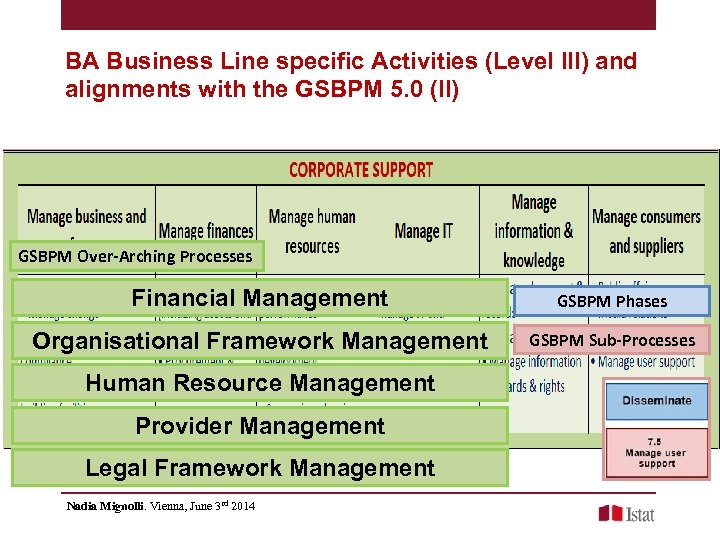 BA Business Line specific Activities (Level III) and alignments with the GSBPM 5. 0 (II) GSBPM Over-Arching Processes Financial Management GSBPM Phases Organisational Framework Management GSBPM Sub-Processes Human Resource Management Provider Management Legal Framework Management Nadia Mignolli. Vienna, June 3 rd 2014
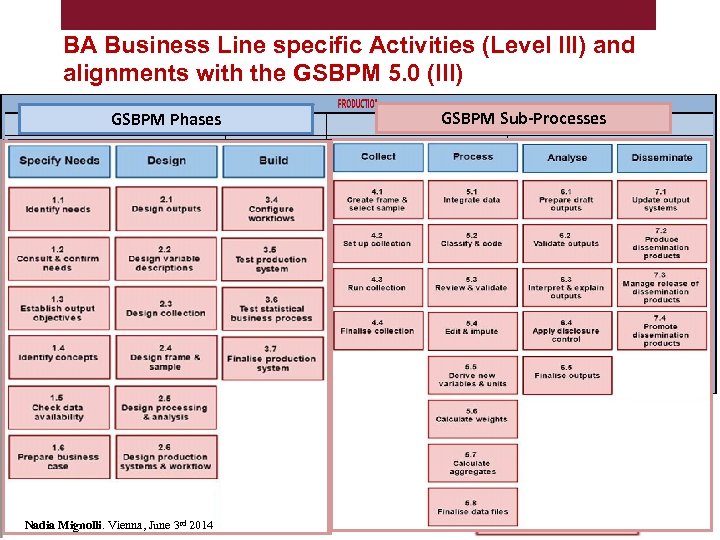 BA Business Line specific Activities (Level III) and alignments with the GSBPM 5. 0 (III) GSBPM Phases GSBPM Sub-Processes GSBPM Phases GSBPM Over-Arching Processes Quality Management Metadata Management Nadia Mignolli. Vienna, June 3 rd 2014 GSBPM Sub-Processes
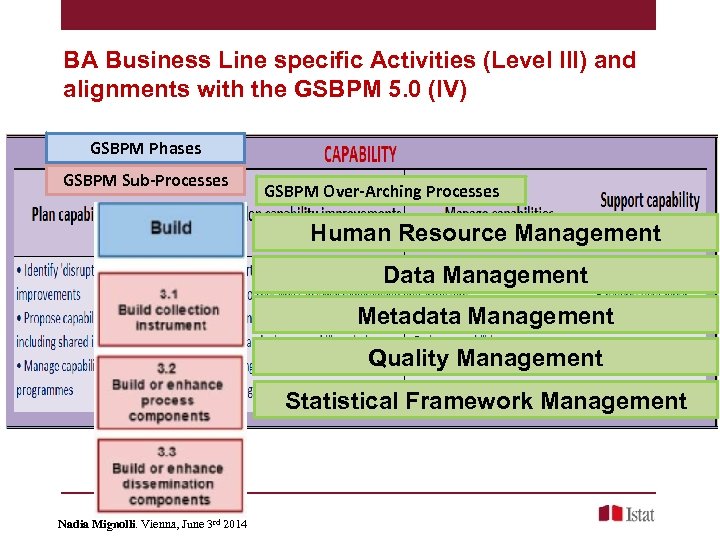 BA Business Line specific Activities (Level III) and alignments with the GSBPM 5. 0 (IV) GSBPM Phases GSBPM Sub-Processes GSBPM Over-Arching Processes Human Resource Management Data Management Metadata Management Quality Management Statistical Framework Management Nadia Mignolli. Vienna, June 3 rd 2014
 Stylised Business Architecture Model Nadia Mignolli. Vienna, June 3 rd 2014
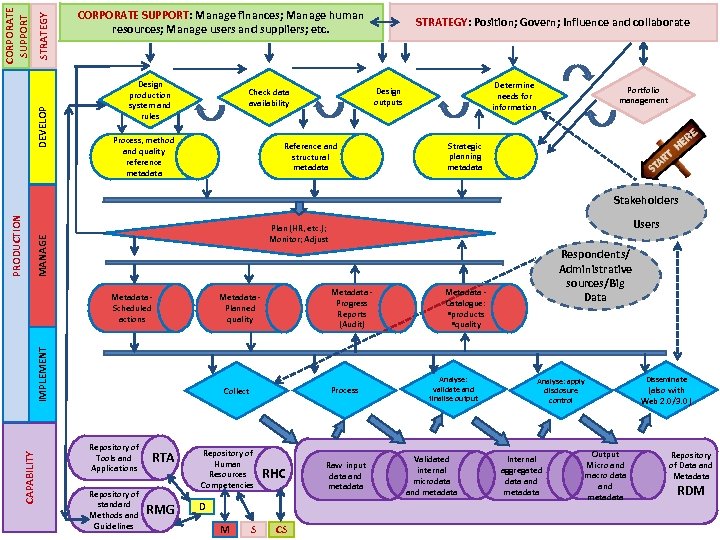 DEVELOP STRATEGY CORPORATE SUPPORT: Manage finances; Manage human resources; Manage users and suppliers; etc. Design production system and rules Determine needs for information Design outputs Check data availability Process, method and quality reference metadata STRATEGY: Position; Govern; Influence and collaborate Reference and structural metadata Portfolio management Strategic planning metadata Metadata Scheduled actions Metadata Progress Reports (Audit) Metadata Planned quality IMPLEMENT CAPABILITY Users Plan (HR, etc. ); Monitor; Adjust MANAGE PRODUCTION Stakeholders Process Collect Repository of Tools and Applications Repository of standard Methods and Guidelines RTA RMG Repository of Human Resources Competencies RHC D M S CS Raw input data and metadata Respondents/ Administrative sources/Big Data Metadata Catalogue: §products §quality Analyse: validate and finalise output Validated internal microdata and metadata Analyse: apply disclosure control Internal aggregated data and metadata Output Micro and macro data and metadata Disseminate (also with Web 2. 0/3. 0 ) Repository of Data and Metadata RDM
 BA Principle Assessment § The whole BA model is led by fundamental principles that become practical guidelines for the implementation of each business line activity and for ensuring the success of the model itself § Different Decision (7) and Design Principles (9) have been suitably defined, also taking into account the international and European context § Principles regard the overall governance, the process rules and the specific infrastructures Nadia Mignolli. Vienna, June 3 rd 2014
 Key Messages from BA Principles (I) § The whole statistical process is output and metadata-driven ü The statistical process chain starts from the output desired (from required products) and goes backwards, defining the various aspects of the process ü Firstly metadata are designed and then data production can start ü Metadata have to be generally accessible and, as far as possible, standardised with regard to the types of units, the definition of concepts, classifications, quality characteristics, process § Quality Assessment ü Quality has to be evaluated and documented at the different stages of the process ü It is defined and planned during Develop or Re-develop ü It is monitored and assessed in each phase of GSBPM and in correspondence of intermediate and final data releases Nadia Mignolli. Vienna, June 3 rd 2014
 Key Messages from BA Principles (II) § Re-use and Adoption of Standards: Repositories ü Focuses on both what is produced within the Institute and what is issued outside, with particular attention to the standards defined at international and European level ü Reuse of existing and available data is generally to be preferred over the decision to conduct a new survey ü The “to be” statistical production consists of a series of standardised single processes and of modular services that can be shared and reused in different contexts and statistical areas ü Developments from scratch should be limited Nadia Mignolli. Vienna, June 3 rd 2014
 Key Messages from Principles (III) § Industrialisation of the Statistical Process ü Statistical production has a repetitive nature with a rather rigid organisation style that can be largely automated ü An industrialised process can be realised by agents other than those who have designed it ü Ensuring the independence between Develop and Implement ü Develop is performed only when needed, while a current statistical process is carried out on a regular basis ü Implementation of a new project involving several innovations requires a new Develop phase Nadia Mignolli. Vienna, June 3 rd 2014
 Concluding Remarks § The adoption of a common language (BA model) becomes essential to undertake congruent innovation paths § A BA model sharable and adoptable by NSIs represents the foundations to foster and intensify the creation of a BA model also at European/international Statistical System level § This is consistent with what is taking place at European and international level ü Sponsorship and ESSNet on standardisation ü Statistical Network ü High-Level Group for the Modernisation of Statistical Production and Services - CSPA Nadia Mignolli. Vienna, June 3 rd 2014
 Key Elements § Achieve consensus on BA Model and Principles (with a BA Model generic enough and involving representative Groups/Projects/Stakeholders working on this topic both at international and EU level, etc. ) § Refer to BA Principles for guiding implementation § Set up a Governance model for ensuring compliance with Principles § Individuate common and shared Infrastructures enabling higher cooperation levels and a cooperative System Nadia Mignolli. Vienna, June 3 rd 2014
 Thank you for your attention Danke für Ihre Aufmerksamkeit Contacts: mignolli@istat. it www. istat. it Nadia Mignolli. Vienna, June 3 rd 2014