


 Скачать презентацию Session 12 Affairs of Statewide Models Semi-Automated Approach
ac54039df374d3f1e83c4b34d3c0f06b.ppt
- Количество слайдов: 16
 Session 12: Affairs of Statewide Models Semi-Automated Approach to Develop Focus Area Forecasts from a Statewide Model 12 th TRB National Transportation Planning Applications Conference May 17 -21, 2009, Houston, Texas Ramakrishna Yennamani | PB | 503 -382 -7658 | yennamani@pbworld. com Sam Granato | ODOT |614 -644 -6796| Sam. Granato@dot. state. oh. us Greg Giaimo | ODOT | Greg. Giaimo@dot. state. oh. us Greg Erhardt | PB | Erhardt@pbworld. com
 Agenda Overview Motivation Application Focusing model Summary
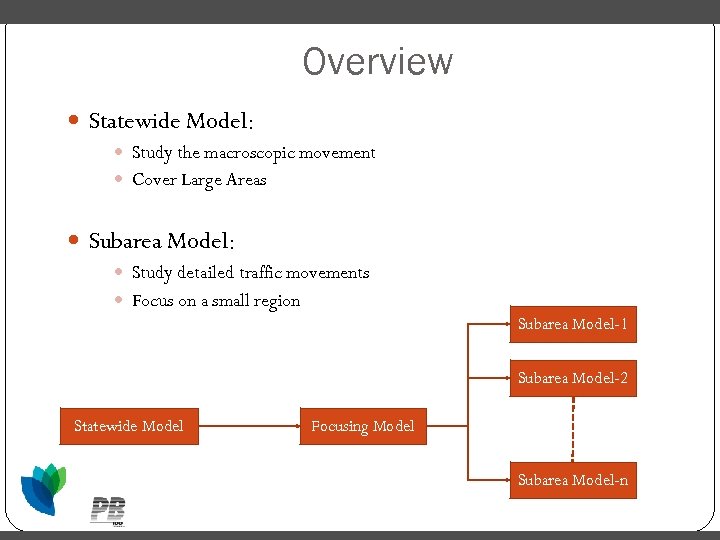 Overview Statewide Model: Study the macroscopic movement Cover Large Areas Subarea Model: Study detailed traffic movements Focus on a small region Subarea Model-1 Subarea Model-2 Statewide Model Focusing Model Subarea Model-n
 Motivation Why focusing model? 1. Subarea networks are manually developed 2. Trip tables are manually developed 3. Deal with external zones Such efforts are usually isolated Subarea studies frequently conducted by MPO’s Significant part of such studies involves developing networks
 Motivation Provide a framework for a semi automated approach: To develop a subarea network using the statewide model Derive the detailed networks and forecasts effortlessly: Subarea analysis Corridor studies Reduced burden on MPO’s Skip network development Skip trip tables development Eliminate external zones Consistent format (Network & Trip Tables): Across all MPO’s Across multiple studies within an MPO
 Application Who might be interested in such a tool? What elements are required to use this tool? Advantages? Control Quality Speed
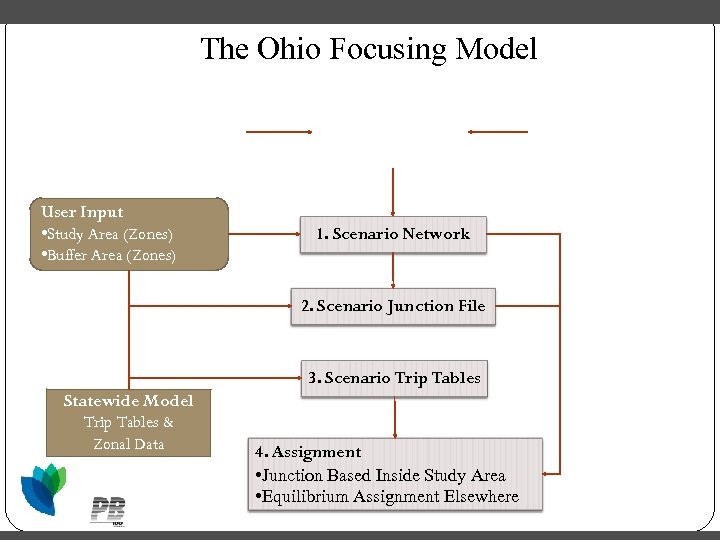 The Ohio Focusing Model Statewide Model Network User Input • Study Area (Zones) • Buffer Area (Zones) Master Network Or Hybrid Network 1. Scenario Network 2. Scenario Junction File 3. Scenario Trip Tables Statewide Model Trip Tables & Zonal Data 4. Assignment • Junction Based Inside Study Area • Equilibrium Assignment Elsewhere Detailed Network
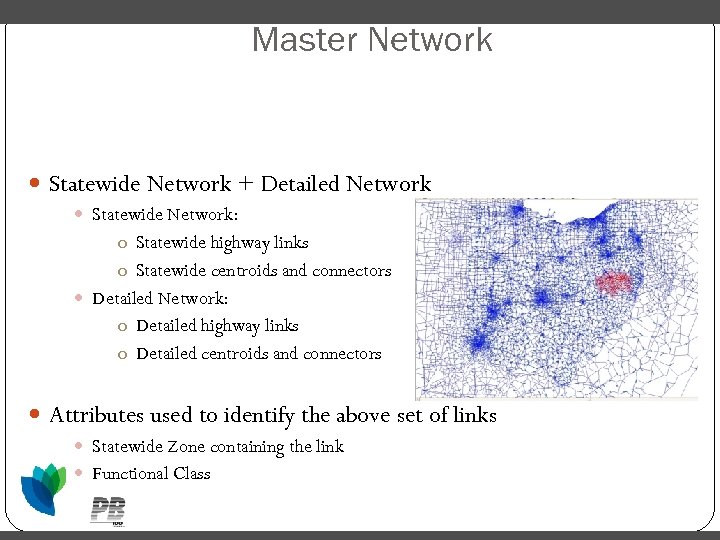 Master Network Statewide Model Network Master Network Or Hybrid Network Statewide Network + Detailed Network Statewide Network: o Statewide highway links o Statewide centroids and connectors Detailed Network: o Detailed highway links o Detailed centroids and connectors Attributes used to identify the above set of links Statewide Zone containing the link Functional Class Detailed Network
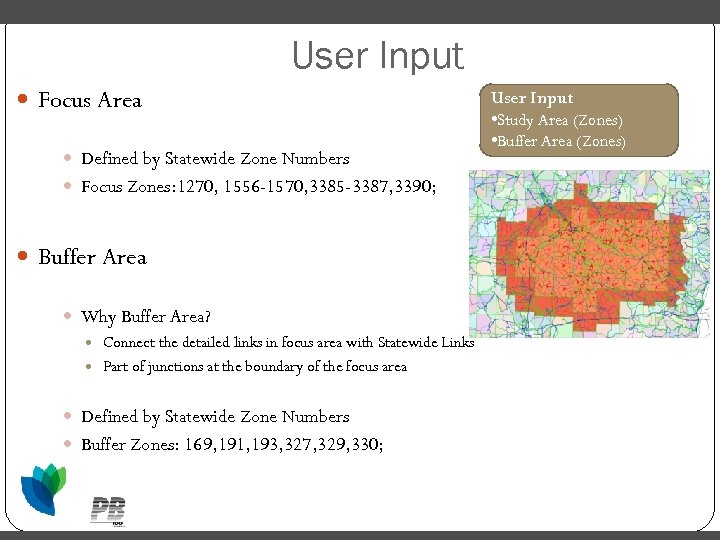 User Input Focus Area Defined by Statewide Zone Numbers Focus Zones: 1270, 1556 -1570, 3385 -3387, 3390; Buffer Area Why Buffer Area? Connect the detailed links in focus area with Statewide Links Part of junctions at the boundary of the focus area Defined by Statewide Zone Numbers Buffer Zones: 169, 191, 193, 327, 329, 330; User Input • Study Area (Zones) • Buffer Area (Zones)
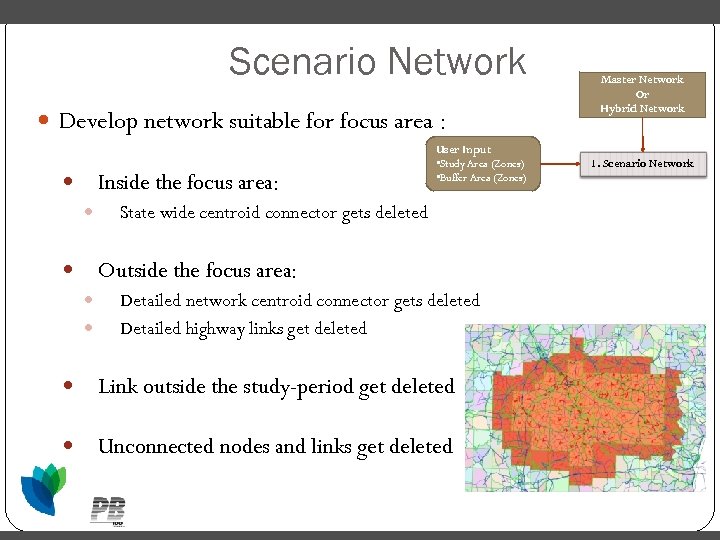 Scenario Network Develop network suitable for focus area : Inside the focus area: User Input • Study Area (Zones) • Buffer Area (Zones) State wide centroid connector gets deleted Outside the focus area: Detailed network centroid connector gets deleted Detailed highway links get deleted Link outside the study-period get deleted Unconnected nodes and links get deleted Master Network Or Hybrid Network 1. Scenario Network
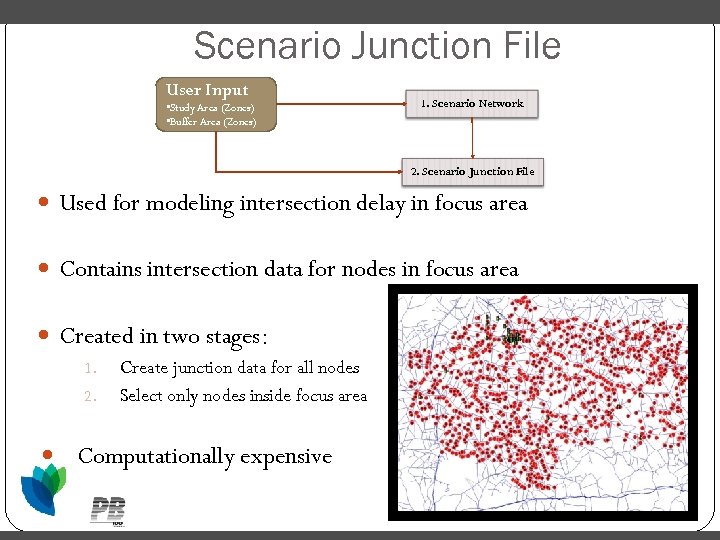 Scenario Junction File User Input • Study Area (Zones) • Buffer Area (Zones) 1. Scenario Network 2. Scenario Junction File Used for modeling intersection delay in focus area Contains intersection data for nodes in focus area Created in two stages: 1. 2. Create junction data for all nodes Select only nodes inside focus area Computationally expensive
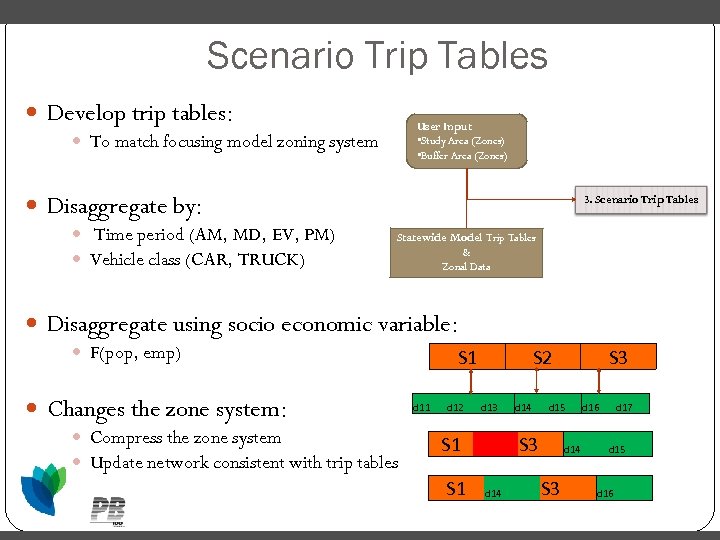 Scenario Trip Tables Develop trip tables: User Input • Study Area (Zones) • Buffer Area (Zones) To match focusing model zoning system Disaggregate by: Time period (AM, MD, EV, PM) Vehicle class (CAR, TRUCK) 3. Scenario Trip Tables Statewide Model Trip Tables & Zonal Data Disaggregate using socio economic variable: F(pop, emp) Changes the zone system: Compress the zone system Update network consistent with trip tables S 1 d 12 S 2 d 13 S 1 d 14 d 15 S 3 d 14 S 3 d 16 d 17 d 15 d 16
 Trip Table Estimation Option available to estimate better trip tables using: Scenario trip table Traffic count data Screen line counts User provided confidence levels Cube analyst required!
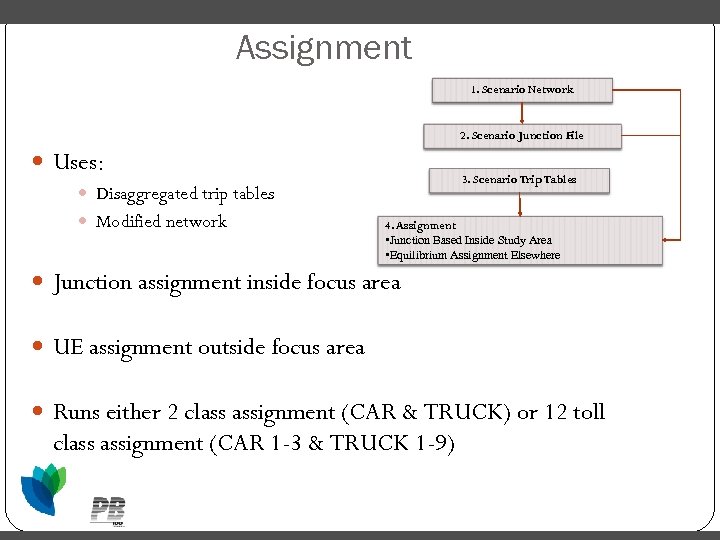 Assignment 1. Scenario Network 2. Scenario Junction File Uses: 3. Scenario Trip Tables Disaggregated trip tables Modified network 4. Assignment • Junction Based Inside Study Area • Equilibrium Assignment Elsewhere Junction assignment inside focus area UE assignment outside focus area Runs either 2 class assignment (CAR & TRUCK) or 12 toll class assignment (CAR 1 -3 & TRUCK 1 -9)
 Conclusions Extension to statewide models Derive the detailed networks and forecasts effortlessly Consistent format across several studies Junction assignment inside focus area UE assignment outside focus area
 Focusing Model Team Yennamani Ramakrishna: Greg Giaimo: Sam Granato: Greg Erhardt: Patrick Costinett: Yennamani@pbworld. com Greg. Giaimo@dot. state. oh. us Sam. Granato@dot. state. oh. us Erhardt@pbworld. com costinett@pbworld. com