 Скачать презентацию Session 1 Database Marketing Agenda n Administrative
a6fa07f424db38d1f465d3f6e41ba483.ppt
- Количество слайдов: 55



Session 1 Database Marketing
Agenda n Administrative n Course Work – Group/Individual n Syllabus n Course Overview n Regression Analysis n Introduction to SAS
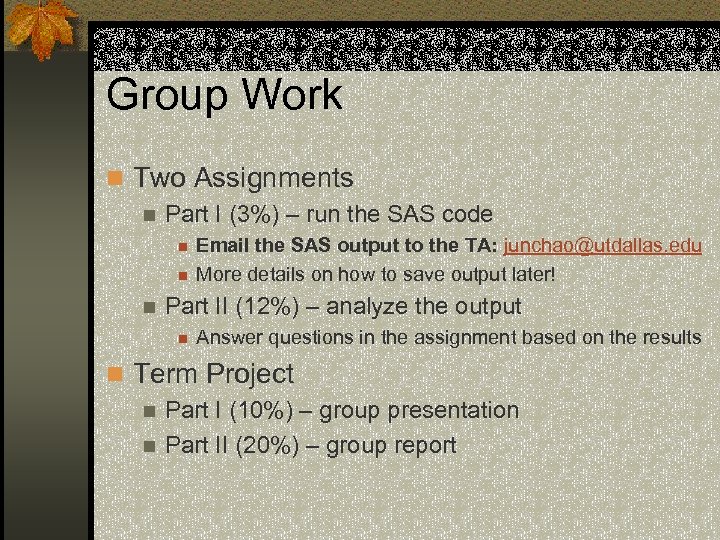
Group Work n Two Assignments n Part I (3%) – run the SAS code n n n Email the SAS output to the TA: junchao@utdallas. edu More details on how to save output later! Part II (12%) – analyze the output n Answer questions in the assignment based on the results n Term Project n Part I (10%) – group presentation n Part II (20%) – group report
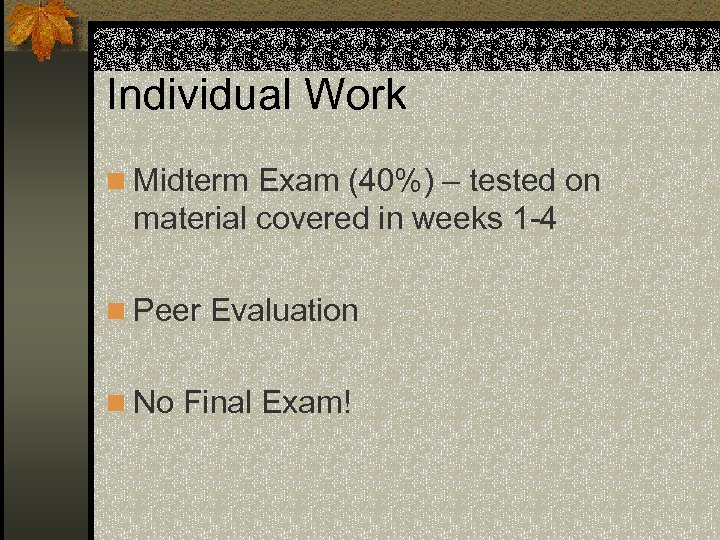
Individual Work n Midterm Exam (40%) – tested on material covered in weeks 1 -4 n Peer Evaluation n No Final Exam!
What the Course does NOT cover? n Hardware/Software issues related to database management systems n Building a Marketing Database n Neural Networks/Genetic Algorithms
What does the course cover? n Relationship between variables (Chapters 18, 19) n Simple/Multiple Regression analysis n Segmentation Analysis (Chapter 21) n Cluster Analysis n Data reduction technique – Factor Analysis n Response Analysis (Chapters 20, 28, 29, 30) n Regression Analysis n Discriminant Analysis n Logistic Regression
Database Marketing? n Managing a computerized relational database system, in real time, of comprehensive up-to-date, relevant data on customers, inquiries, prospects and suspects, to identify our most responsive customers for the purpose of developing a high quality, long-standing relationship of repeat business by developing predictive models which enable us to send desired messages at the right time in the right form to the right people – all with the result of pleasing our customers, increasing our response rate per marketing dollar, lowering our cost per order, building our business and increasing our profits. - National Center for Database Marketing
What is the Big Deal? n All customers are not created equal! n 80% of all repeat business of goods and services comes from 20% of the customer base n Lot of direct marketing efforts are misdirected resulting in lower payoffs n Credit card mailings
Direct Marketing vs Database Marketing n My view: n Direct Marketing done well is Database Marketing n Read Chapter 32
Market Research Techniques? n Will always continue to be helpful n Earlier … n. A mutual fund company could tell that 20% of 40 -45 year old males making $50 -$75 K were interested in investing in mutual funds n But which 20%? n Now n They can probably tell
Why? Increased Data Availability!
Data Sources (chapter 4) n Transaction Data n Easily available with increased use of scanners n Prospect Data n Either maintained or acquired n Directly Supplied Data n Data that is provided directly by customers n Data acquired from third-party
Data Sources …contd. n Directly Supplied Data n Demographic n Attitudinal – preferences, met/unmet needs, lifestyle preferences, values, opinions etc. n Behavioral – purchase/buying habits etc. n Traditionally acquired by conducting surveys n Advances in the database technology, precipitous drop in the price of computing/storage, rapid diffusion of the internet all aid the collection of this data
Where are We Now? n Firms have access to a reasonable amount of customer data n Certainly enough to enable them to do better job of marketing n More consumer data is certainly desirable
Catalog Marketing n JCPenney n Mails out fliers frequently to inform customers about ongoing promotions n Mailings are not costless – firms operate under budget constraints and would reasonably want to maximize the payoffs from such mailings! n What criteria should they use in mailing out these fliers? n Should they include a $10 coupon or $5 coupon?
Fund Raising n Non-Profit Organizations n Solicit Donations – solicitation process costly n Who should they solicit? n What amount should they solicit? Is the amount solicited too high or too low?
Admission Process n Schools may wish to manage the matriculation process efficiently n Schools send out marketing materials to prospective students – some students may seek application material n Schools invest additional (costly) marketing efforts – are these even worthwhile if the student is not likely to matriculate?
Cross-Selling n Buy tickets for a Maverick’s game from the ticket master n Ticket master will attempt to sell you something by transferring you to a potential seller n Is there a more effective way?
Communication Strategies n BMW recently introduced an SUV to compete with the Mercedes’ M-series n In which magazines or cable programs should they advertise? n What should the advertising copy emphasize? n …. . countless other applications !!
Economics of Database Marketing n Trade-offs n Short-term costs vs long-term pay-offs n Inter-relationship between costs and payoffs n Benefits of Segmentation
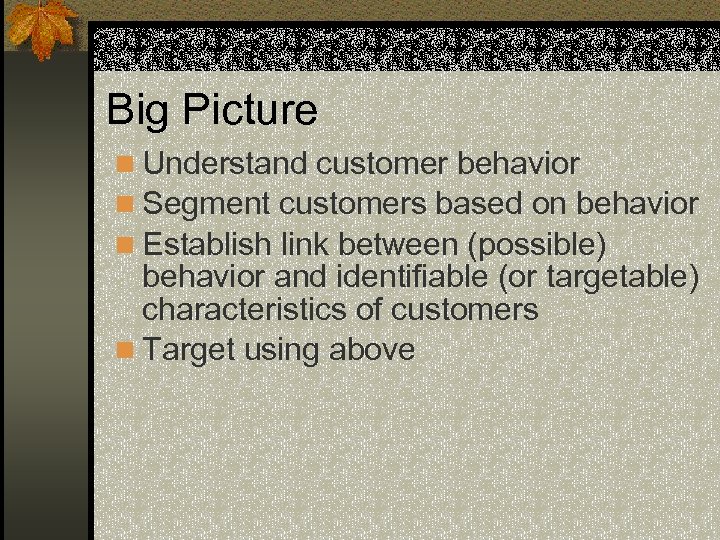
Big Picture n Understand customer behavior n Segment customers based on behavior n Establish link between (possible) behavior and identifiable (or targetable) characteristics of customers n Target using above
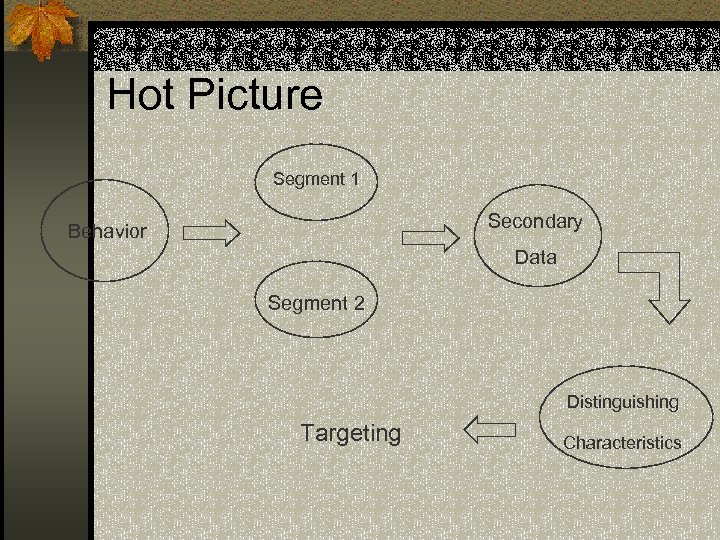
Hot Picture Segment 1 Secondary Behavior Data Segment 2 Distinguishing Targeting Characteristics
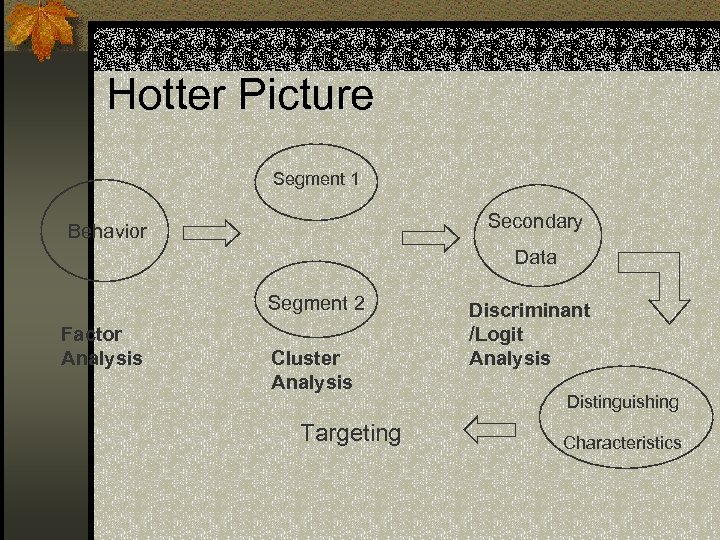
Hotter Picture Segment 1 Secondary Behavior Data Segment 2 Factor Analysis Cluster Analysis Targeting Discriminant /Logit Analysis Distinguishing Characteristics
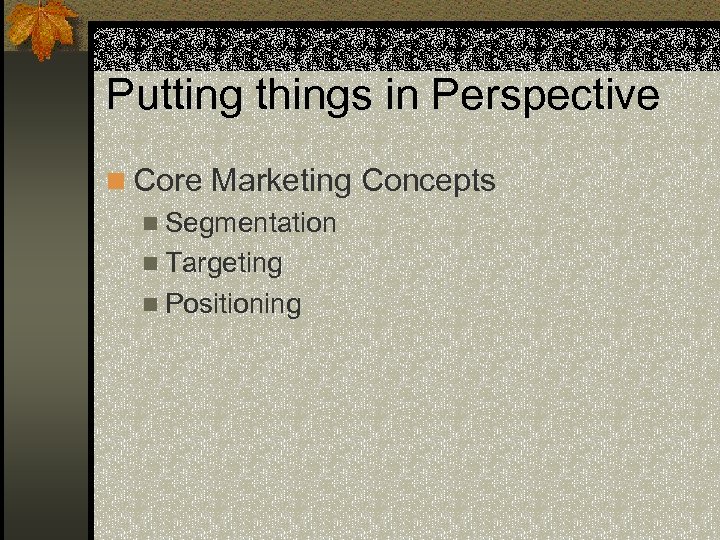
Putting things in Perspective n Core Marketing Concepts n Segmentation n Targeting n Positioning
Agenda n Relationship between variables n Review of Regression Analysis (chapter 18) n Introduction to SAS programming
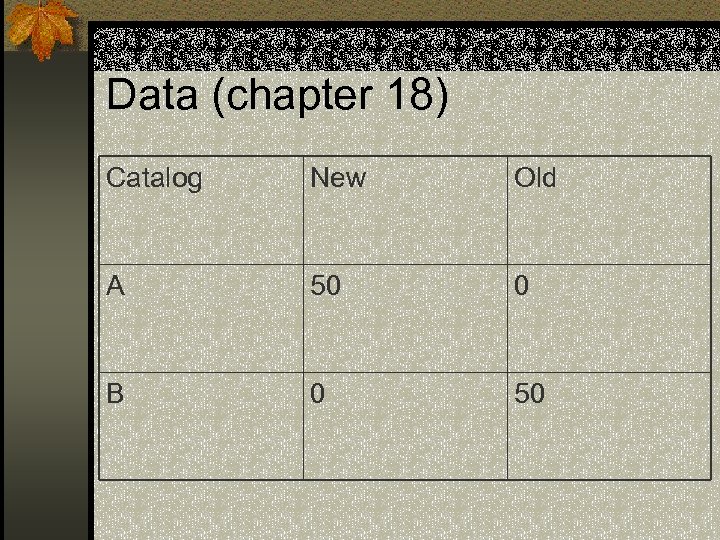
Data (chapter 18) Catalog New Old A 50 0 B 0 50
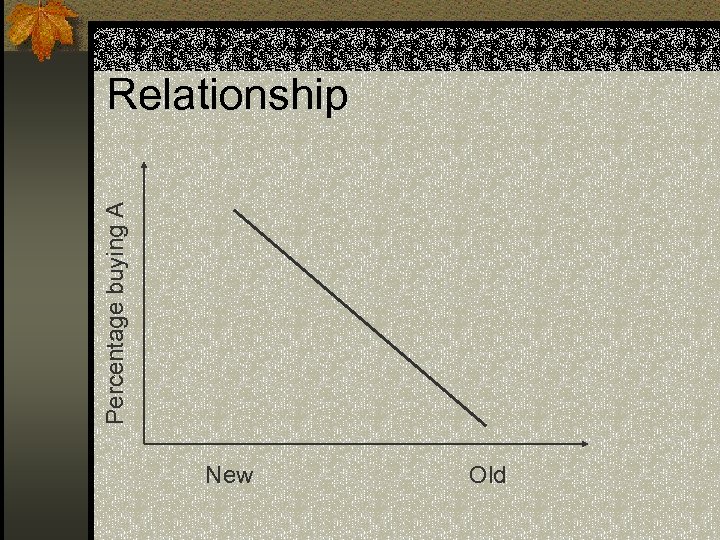
Percentage buying A Relationship New Old
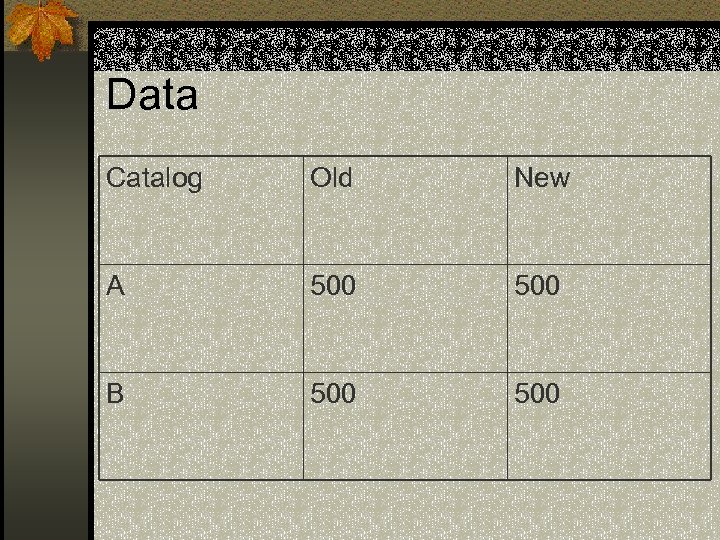
Data Catalog Old New A 500 B 500
Percentage buying A Relationship New Old
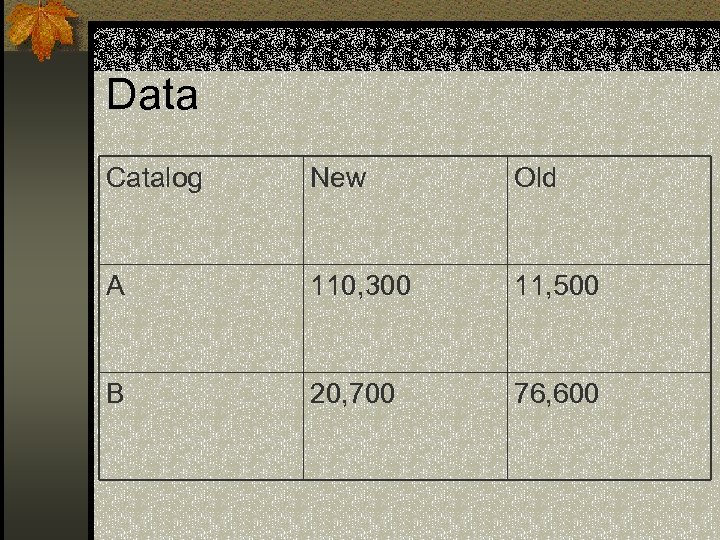
Data Catalog New Old A 110, 300 11, 500 B 20, 700 76, 600
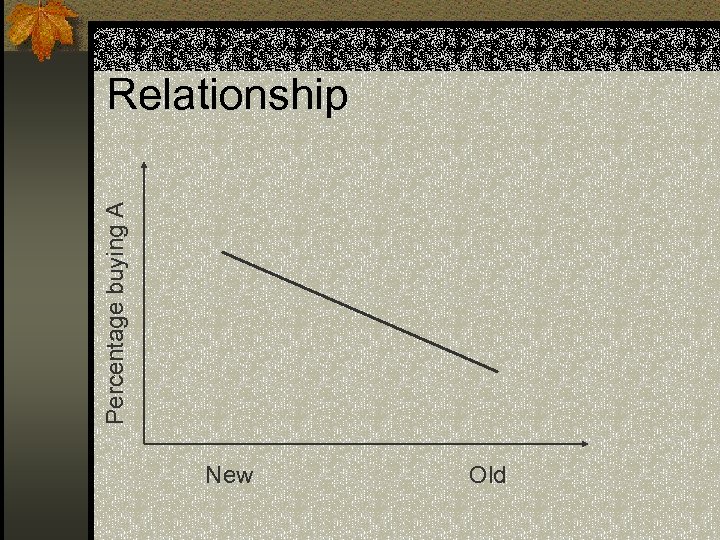
Percentage buying A Relationship New Old
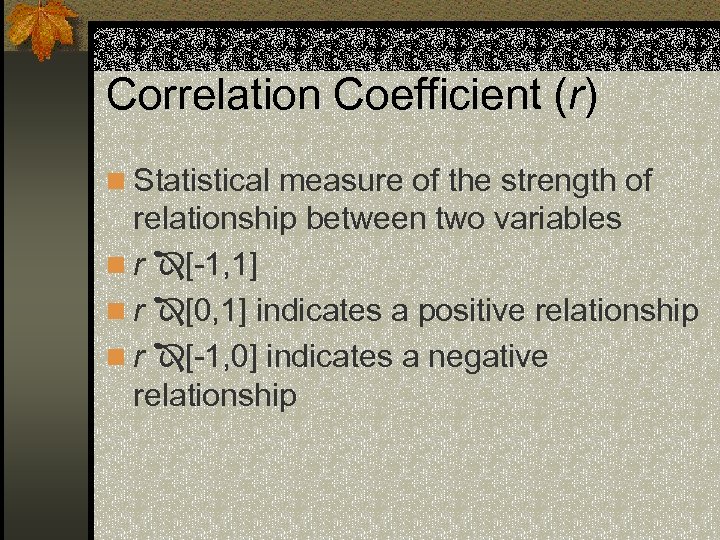
Correlation Coefficient (r) n Statistical measure of the strength of relationship between two variables n r [-1, 1] n r [0, 1] indicates a positive relationship n r [-1, 0] indicates a negative relationship
Know your Data n Sample should be representative of the population data n Reason why experts advocate the use of random samples
Regression Analysis n What does it do? n Uncovers the relationship between a set of variables n Simple Regression y = f(x) n Regression sets out to find the f(x) that best fits the data
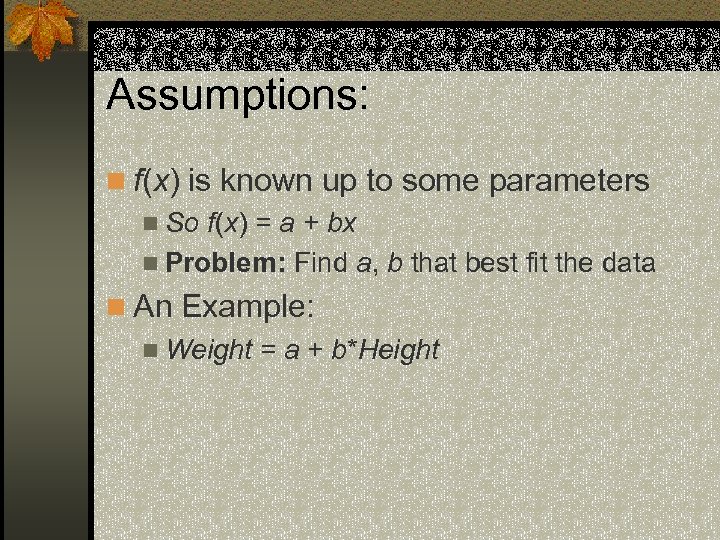
Assumptions: n f(x) is known up to some parameters n So f(x) = a + bx n Problem: Find a, b that best fit the data n An Example: n Weight = a + b*Height
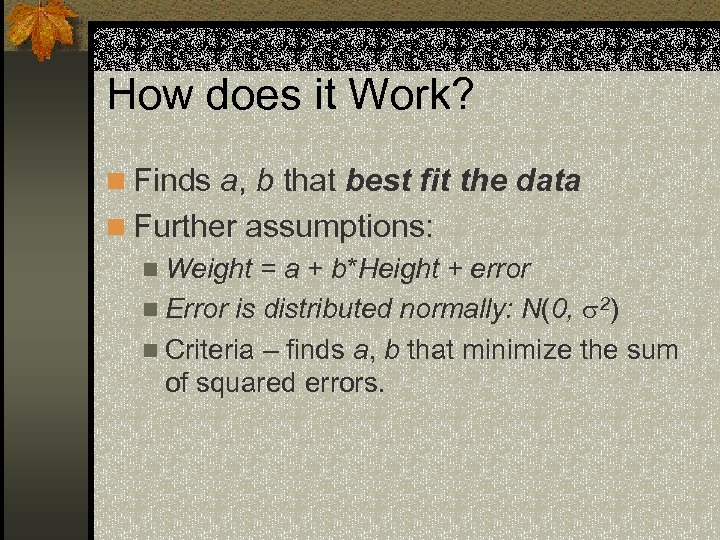
How does it Work? n Finds a, b that best fit the data n Further assumptions: n Weight = a + b*Height + error n Error is distributed normally: N(0, 2) n Criteria – finds a, b that minimize the sum of squared errors.

Picture
Return to Catalog Example Hypothesis: n Customers who purchase more frequently also buy bigger ticket items
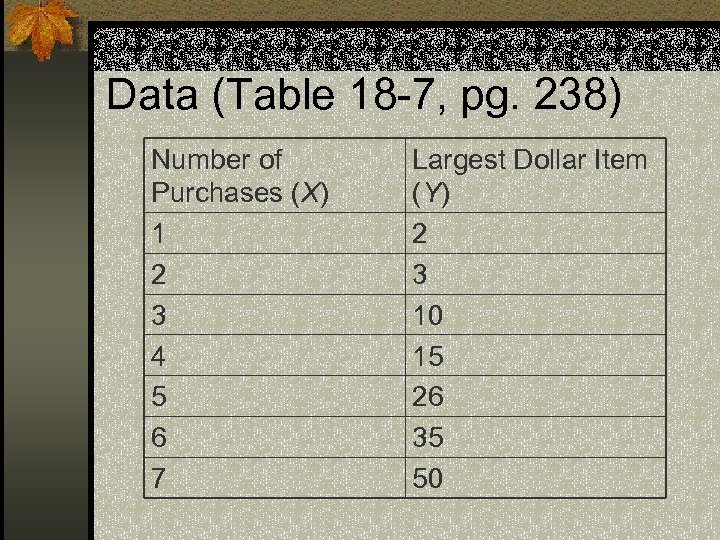
Data (Table 18 -7, pg. 238) Number of Purchases (X) 1 2 3 4 5 6 7 Largest Dollar Item (Y) 2 3 10 15 26 35 50
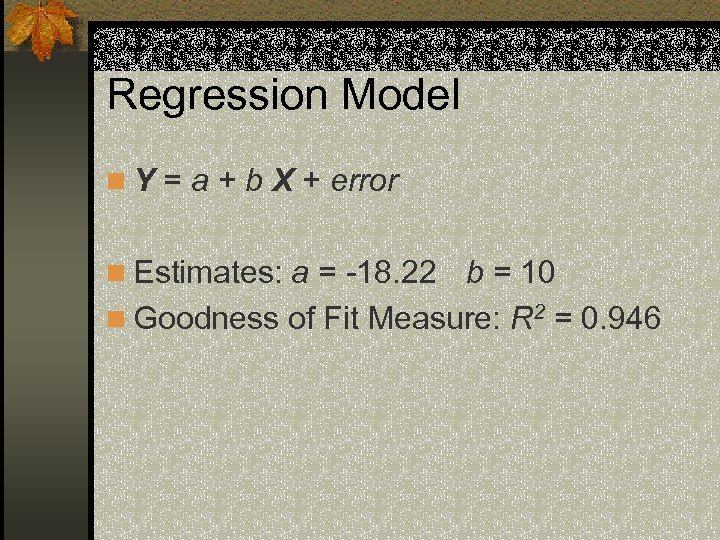
Regression Model n Y = a + b X + error n Estimates: a = -18. 22 b = 10 n Goodness of Fit Measure: R 2 = 0. 946
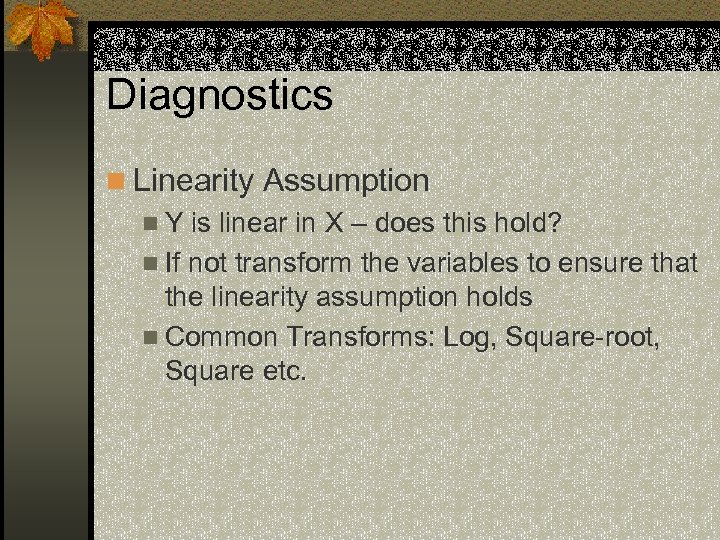
Diagnostics n Linearity Assumption n Y is linear in X – does this hold? n If not transform the variables to ensure that the linearity assumption holds n Common Transforms: Log, Square-root, Square etc.
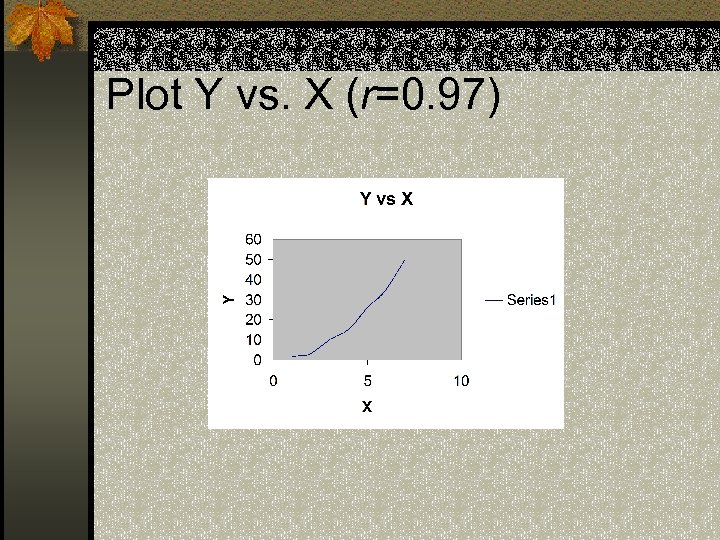
Plot Y vs. X (r=0. 97)
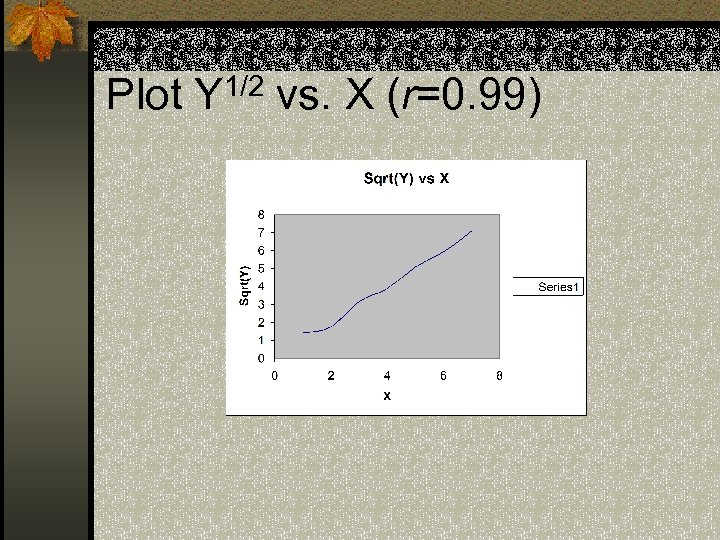
Plot Y 1/2 vs. X (r=0. 99)
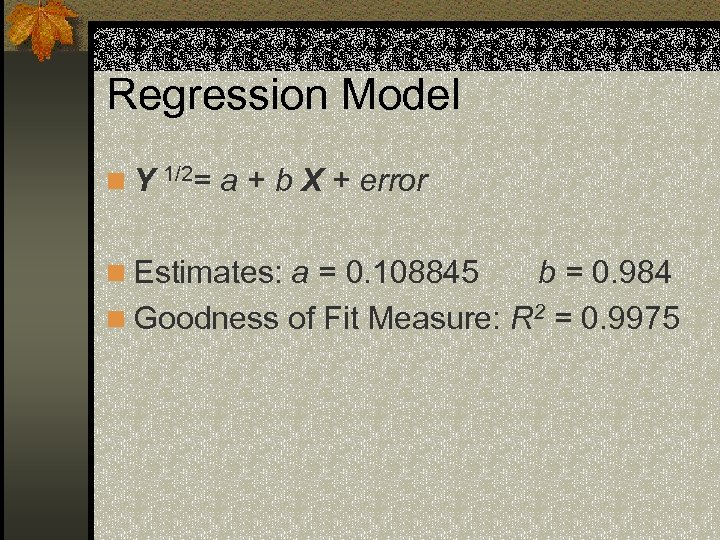
Regression Model n. Y 1/2= a + b X + error n Estimates: a = 0. 108845 b = 0. 984 n Goodness of Fit Measure: R 2 = 0. 9975
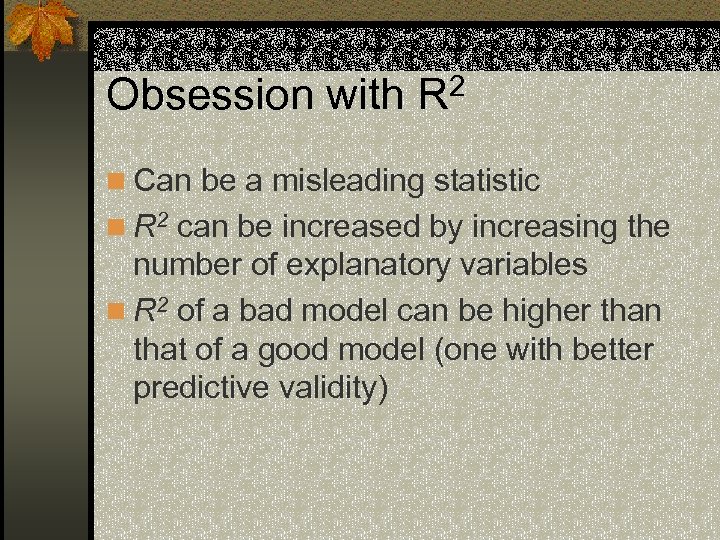
Obsession with R 2 n Can be a misleading statistic n R 2 can be increased by increasing the number of explanatory variables n R 2 of a bad model can be higher than that of a good model (one with better predictive validity)
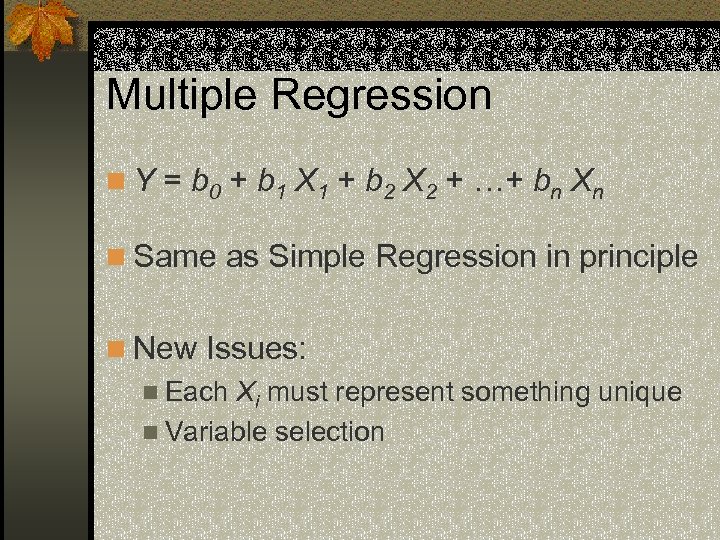
Multiple Regression n Y = b 0 + b 1 X 1 + b 2 X 2 + …+ bn Xn n Same as Simple Regression in principle n New Issues: n Each Xi must represent something unique n Variable selection
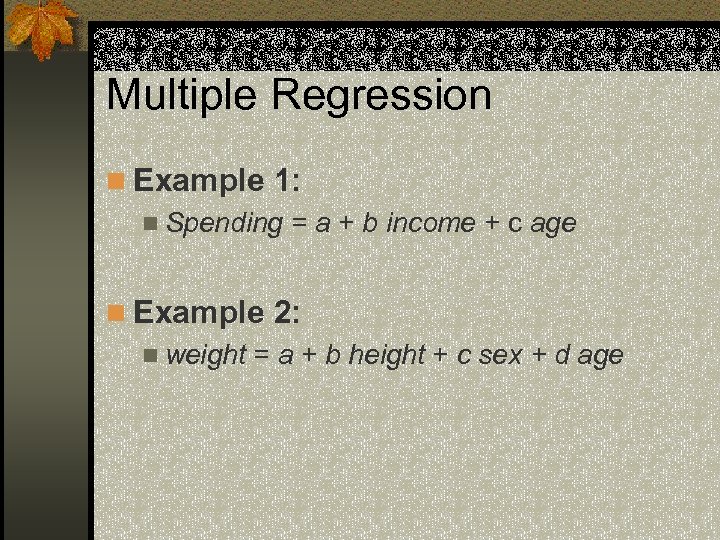
Multiple Regression n Example 1: n Spending = a + b income + c age n Example 2: n weight = a + b height + c sex + d age
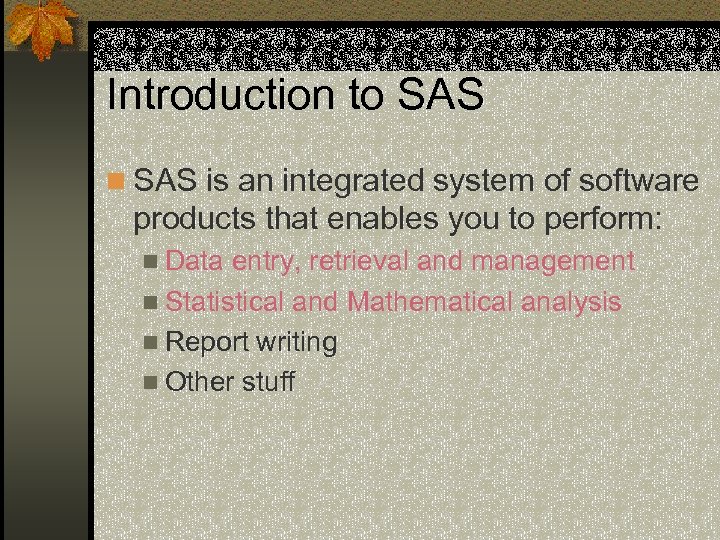
Introduction to SAS n SAS is an integrated system of software products that enables you to perform: n Data entry, retrieval and management n Statistical and Mathematical analysis n Report writing n Other stuff
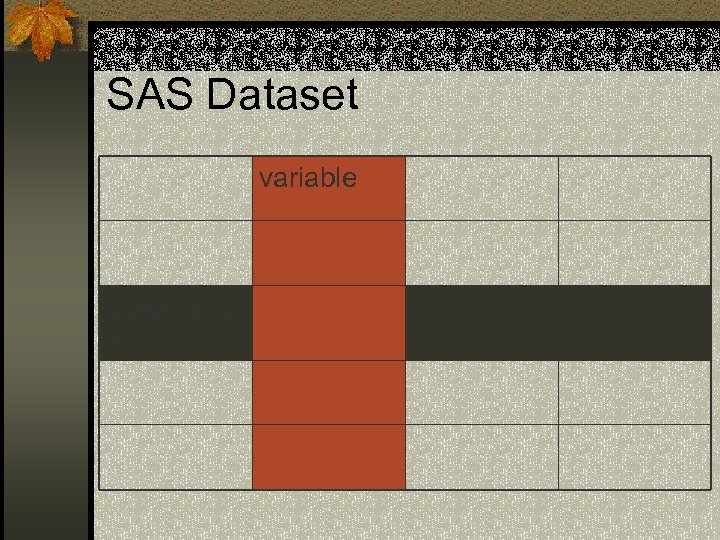
SAS Dataset variable observatio n
DATA Step and SAS Procedures n DATA step n Consists of a group of statements that read/manipulate raw data or operates on existing SAS data sets to create a SAS data set n SAS Procedures n Work with SAS data sets to help in data management, statistical analysis etc.
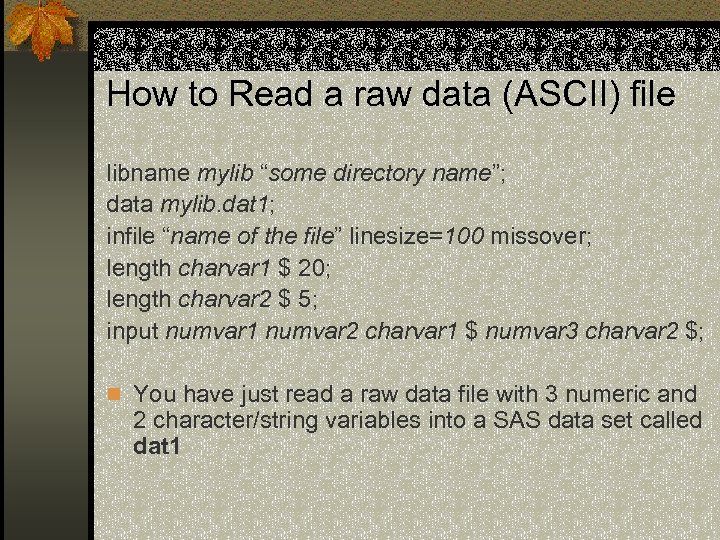
How to Read a raw data (ASCII) file libname mylib “some directory name”; data mylib. dat 1; infile “name of the file” linesize=100 missover; length charvar 1 $ 20; length charvar 2 $ 5; input numvar 1 numvar 2 charvar 1 $ numvar 3 charvar 2 $; n You have just read a raw data file with 3 numeric and 2 character/string variables into a SAS data set called dat 1
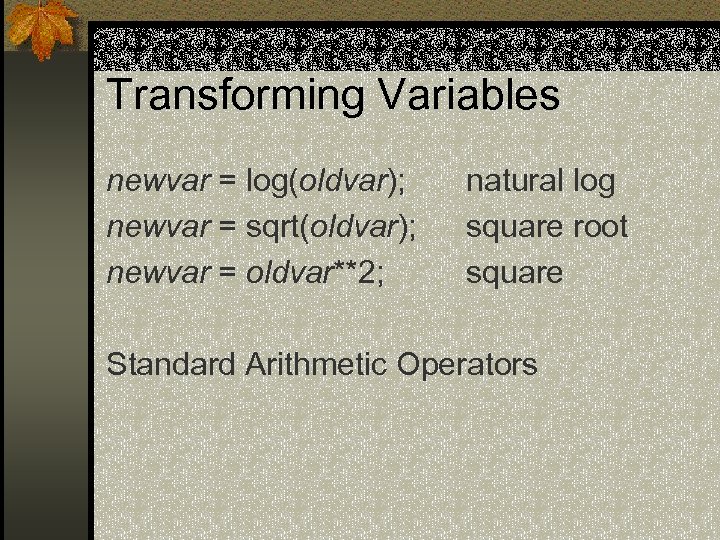
Transforming Variables newvar = log(oldvar); newvar = sqrt(oldvar); newvar = oldvar**2; natural log square root square Standard Arithmetic Operators
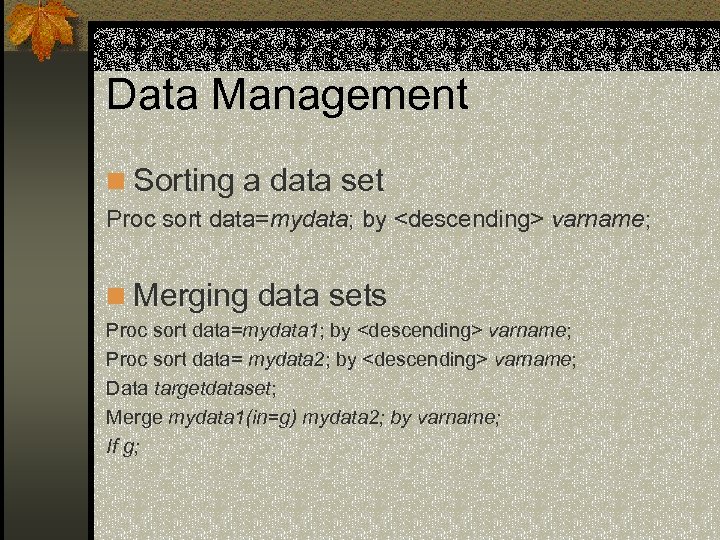
Data Management n Sorting a data set Proc sort data=mydata; by <descending> varname; n Merging data sets Proc sort data=mydata 1; by <descending> varname; Proc sort data= mydata 2; by <descending> varname; Data targetdataset; Merge mydata 1(in=g) mydata 2; by varname; If g;
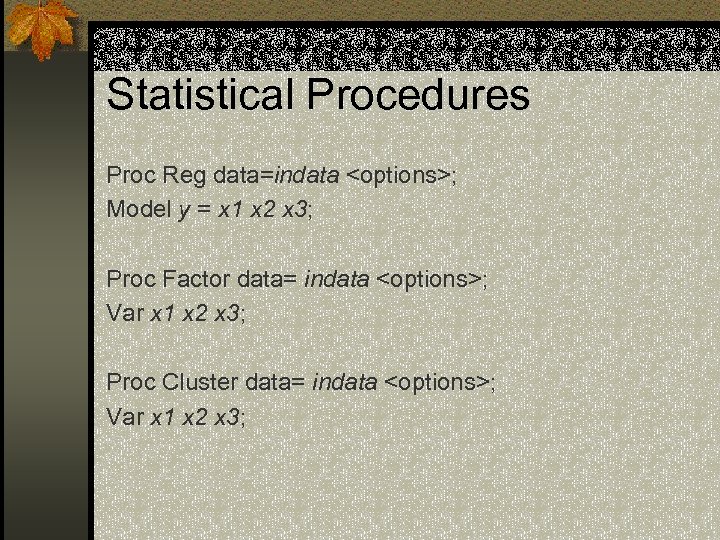
Statistical Procedures Proc Reg data=indata <options>; Model y = x 1 x 2 x 3; Proc Factor data= indata <options>; Var x 1 x 2 x 3; Proc Cluster data= indata <options>; Var x 1 x 2 x 3;
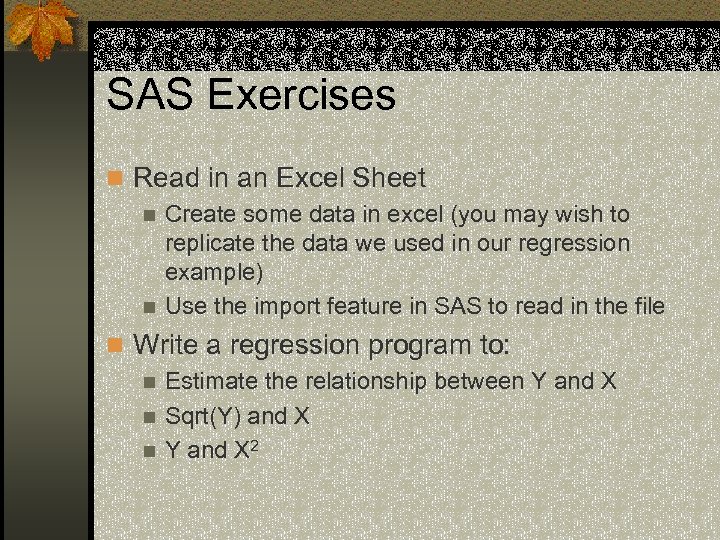
SAS Exercises n Read in an Excel Sheet n Create some data in excel (you may wish to replicate the data we used in our regression example) n Use the import feature in SAS to read in the file n Write a regression program to: n Estimate the relationship between Y and X n Sqrt(Y) and X n Y and X 2
Скачать презентацию Session 1 Database Marketing Agenda n Administrative
a6fa07f424db38d1f465d3f6e41ba483.ppt