 Скачать презентацию Session 05 — Goodbye to geography ed —
6ff11f04624e38628cff7d038a3ce492.ppt
- Количество слайдов: 48



Session 05 - Goodbye to geography ed - Hello to history ed - (And a diversity ed implication of SS) - An organizing concept for your methods toolbox Dr. Hammond Elementary Social Studies Fall, 2017
• HTCE prep returned. Any questions? • OIP #2 turned in today…any questions? Set up forum for sharing • Upcoming assignments: Field experience “first steps” (just a check in); curriculum map HOUSEKEEPING
Goodbye to geography ed • What is geography ed? • Topics / concepts / content • Skills • (Why do we teach geography? ) • How to teach geography ed? • Methods? • Resources? • Different trade-offs / concerns when teaching geography
Something we didn’t get into • An additional concern in geography ed, one I’ll try to show, then tell
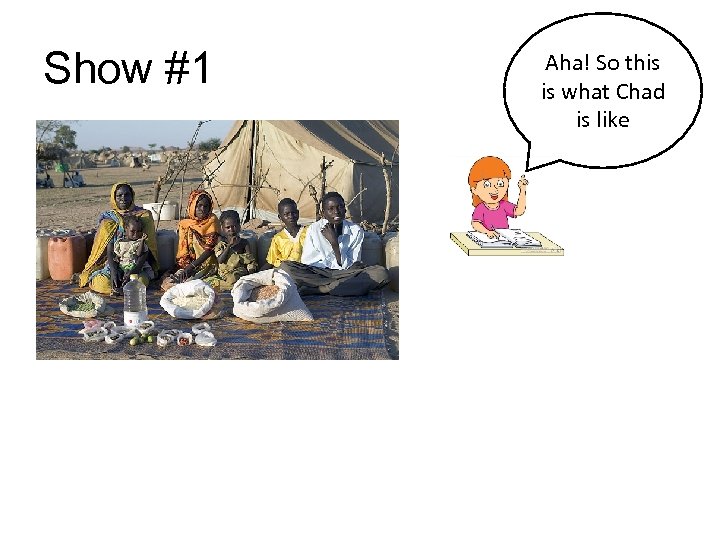
Show #1 Aha! So this is what Chad is like
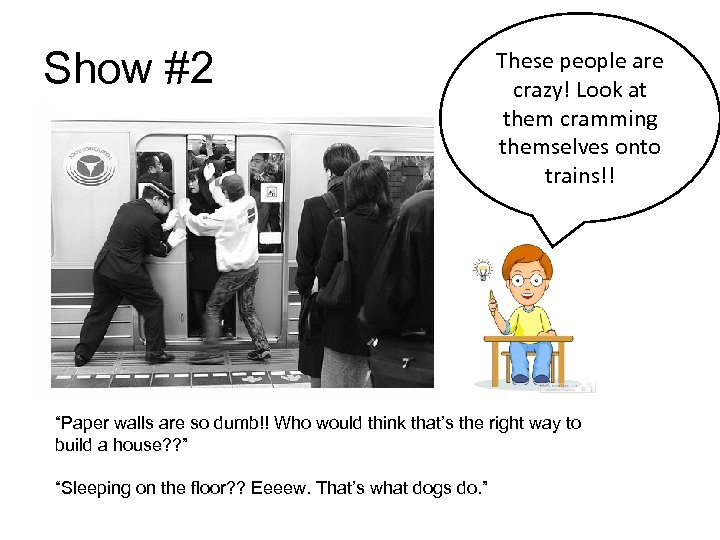
Show #2 These people are crazy! Look at them cramming themselves onto trains!! “Paper walls are so dumb!! Who would think that’s the right way to build a house? ? ” “Sleeping on the floor? ? Eeeew. That’s what dogs do. ”
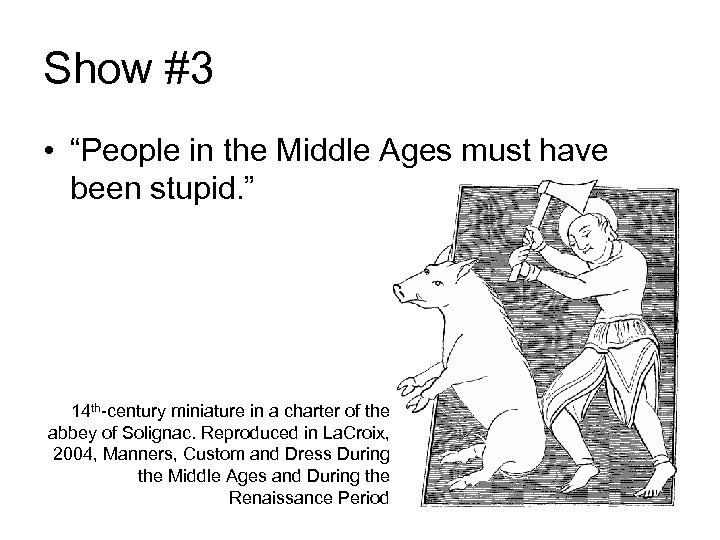
Show #3 • “People in the Middle Ages must have been stupid. ” 14 th-century miniature in a charter of the abbey of Solignac. Reproduced in La. Croix, 2004, Manners, Custom and Dress During the Middle Ages and During the Renaissance Period
(#3, cont’d) • “When you were in the prison camp, why didn’t you try to escape? ” • “I would never collaborate! I would have been in the Resistance. ” • (I would get in a tank and go kill Hitler!)
So what’s the additional concern in geo / history ed?
Learning about human geography • What we know (or think we know) about others is what we choose to see (or what we are shown) • Positive aspects: This is the way we come to know the world; this is a framework for expanding our knowledge • Negative aspects: Reliance upon generalization, stereotype, selective emphasis …What can we do to build upon the positive and diminish the negative?
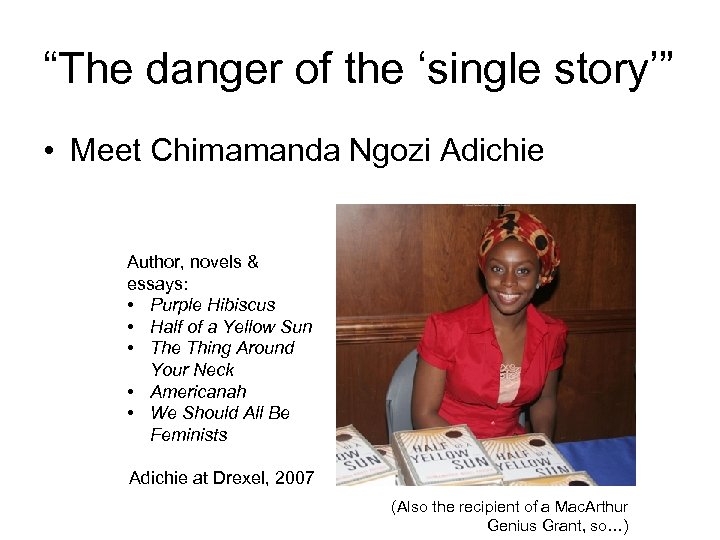
“The danger of the ‘single story’” • Meet Chimamanda Ngozi Adichie Author, novels & essays: • Purple Hibiscus • Half of a Yellow Sun • The Thing Around Your Neck • Americanah • We Should All Be Feminists Adichie at Drexel, 2007 (Also the recipient of a Mac. Arthur Genius Grant, so…)
Consider the following, in a geography ed context… 1. Do maps necessarily tell a “single story”? • Do textbooks tell a “single story”? 2. Do maps preclude empathy? • Do textbooks preclude multiple / conflicted understandings?
Consider the following, in a geography ed context… 1. Do maps necessarily tell a “single story”? • Do textbooks tell a “single story”? 2. Do maps preclude empathy? • Do textbooks preclude multiple / conflicted understandings?
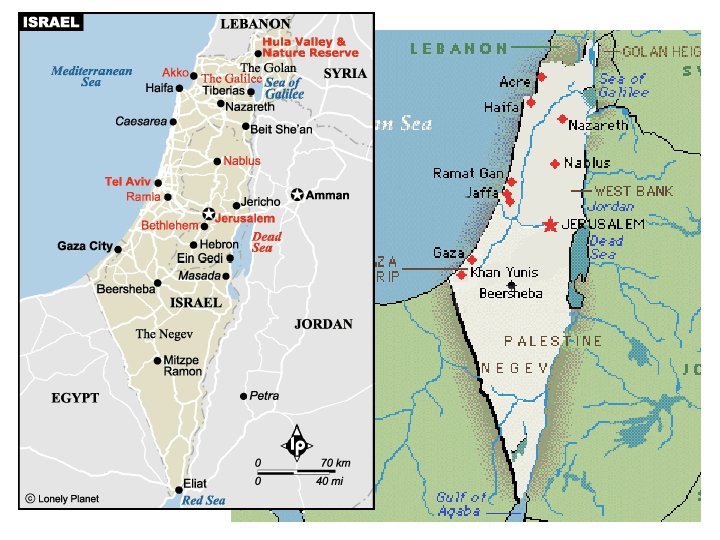
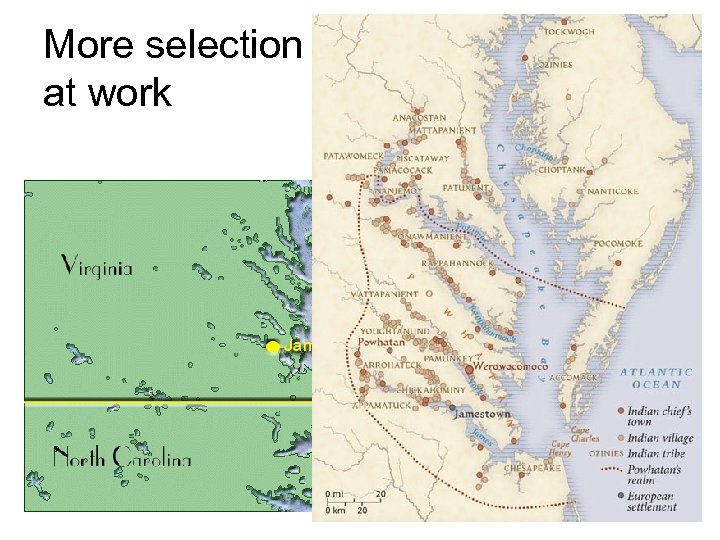
More selection at work
Say it again, Korzybski! The map is not the territory • What does this mean in terms of physical geography? • …Human geography? • …Diversity ed?
Goodbye to geography ed, fin • What is geography ed? • Topics / concepts / content • Skills • (Why do we teach geography? ) • How to teach geography ed? • Methods? • Resources? • Different trade-offs / concerns when teaching geography What is our new wrinkle here? What to do about it?
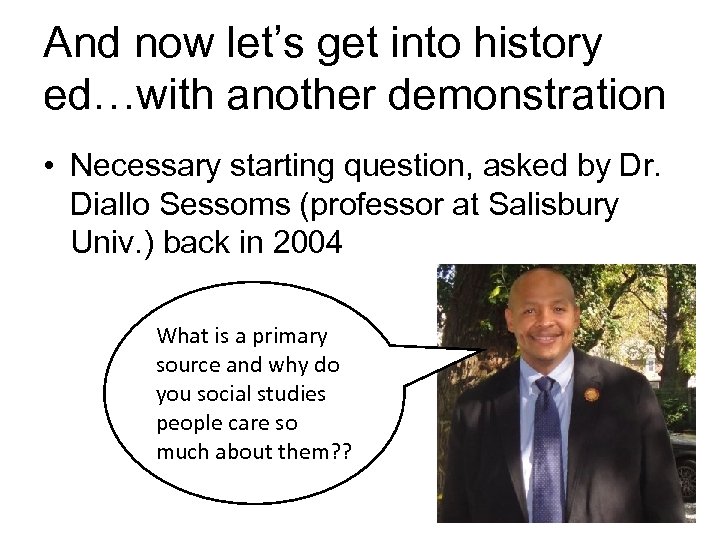
And now let’s get into history ed…with another demonstration • Necessary starting question, asked by Dr. Diallo Sessoms (professor at Salisbury Univ. ) back in 2004 What is a primary source and why do you social studies people care so much about them? ?
…and now, let’s look at some primary sources
As with geography, so with history… • What is history ed? • Topics / concepts / content • Skills • (Why do we teach history? ) • How to teach history ed? • Methods? • Resources? • Different trade-offs / concerns when teaching history (And don’t forget that diversity ed point we made earlier!)
Leaving some issues aside for now… • What is history ed? • Topics / concepts / content • Skills • (Why do we teach history? ) • How to teach history ed? • Methods? • Resources? • Different trade-offs / concerns when teaching history (A refinement for your thinking about methods)
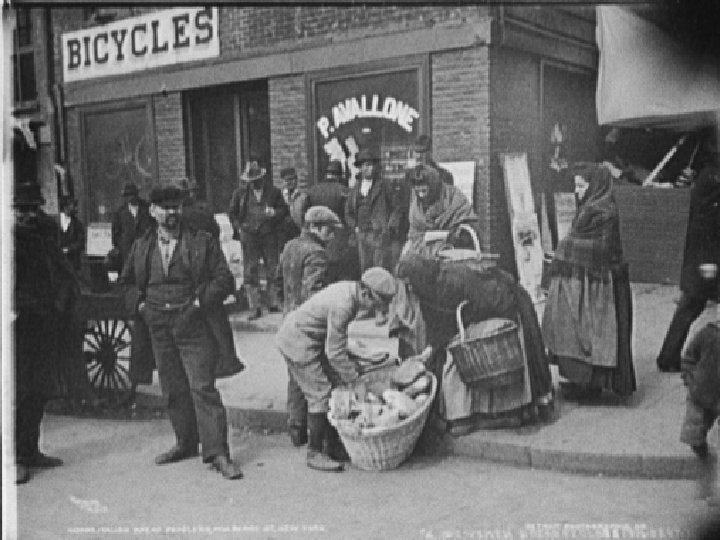
Was that history ed? …what time period / topic did we address? …what resource(s) did we use? …what would you call that teaching technique, anyway?
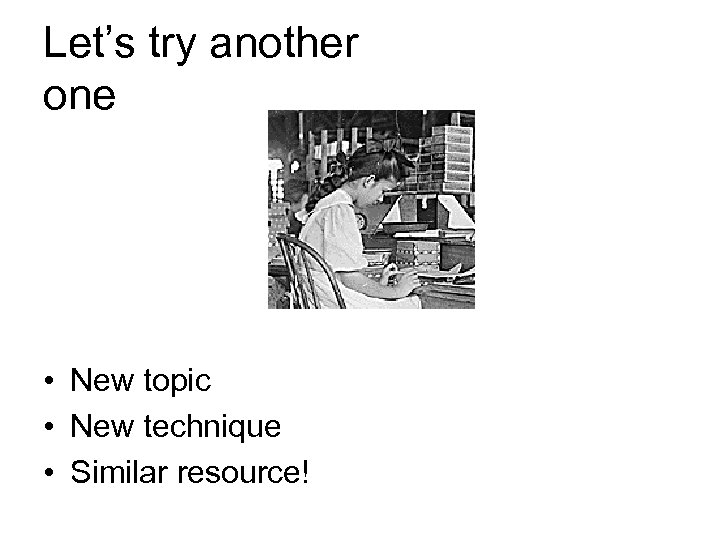
Let’s try another one • New topic • New technique • Similar resource!
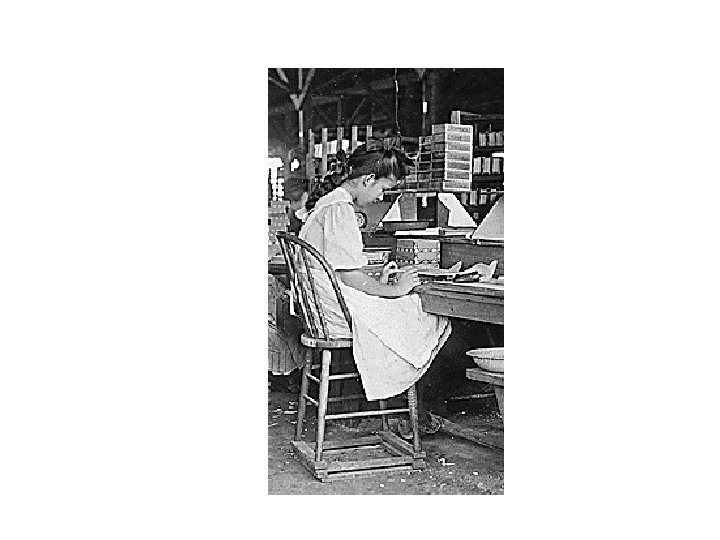
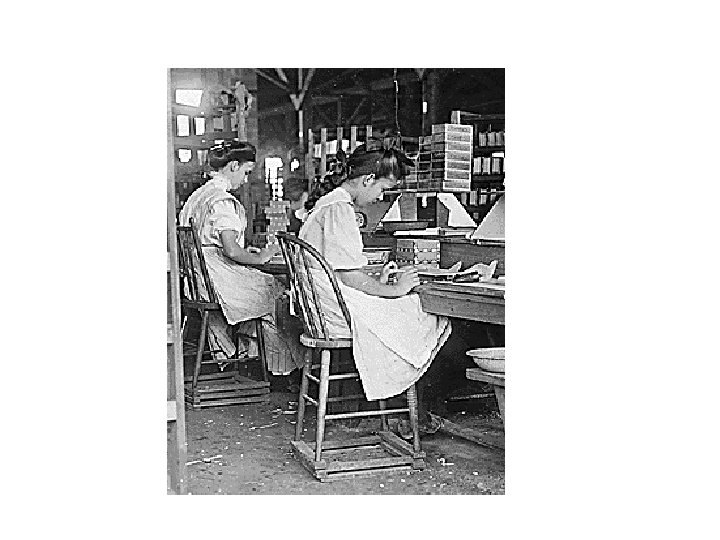
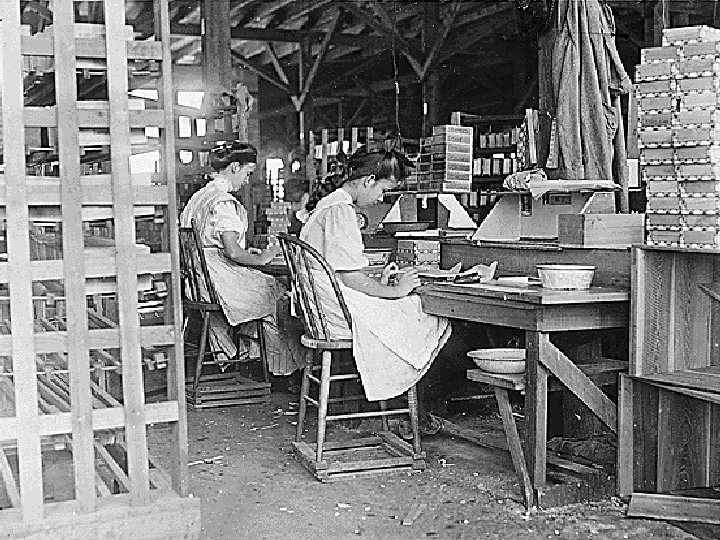
Putting the two activities in a common context… …in historical time / place …as teaching techniques Image analysis Hide-and-seek Slow reveal …what else might you do with images?
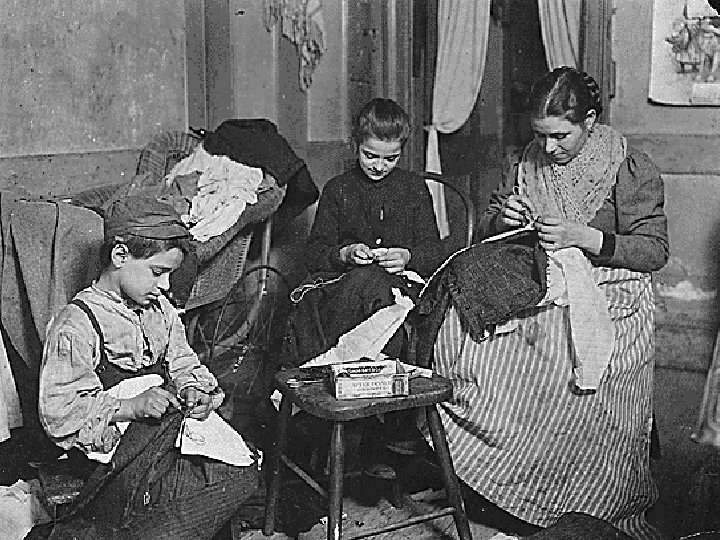
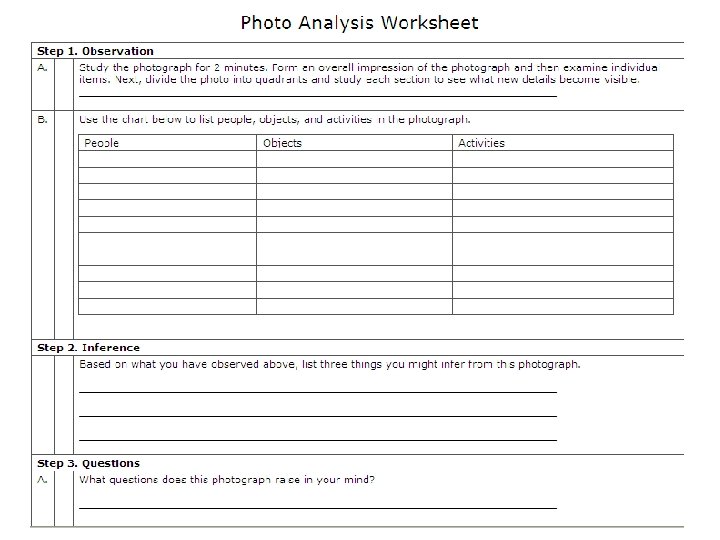
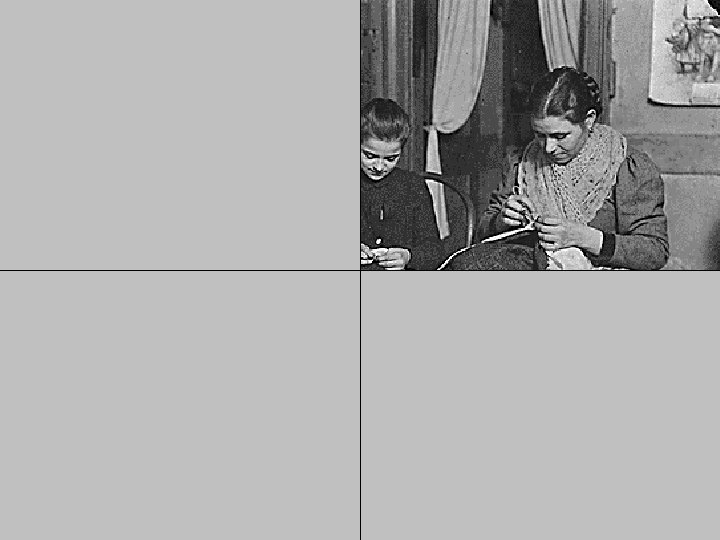
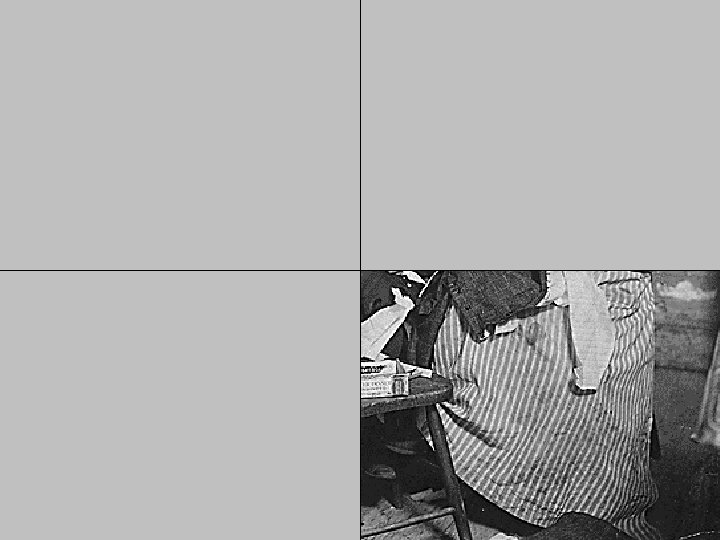
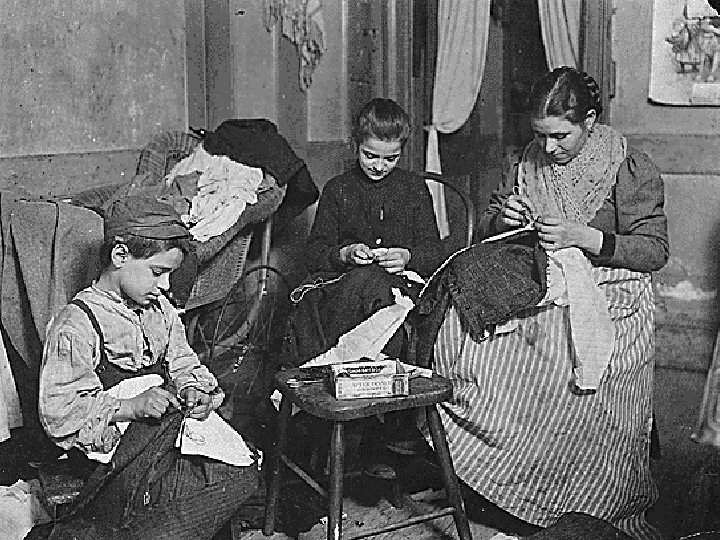
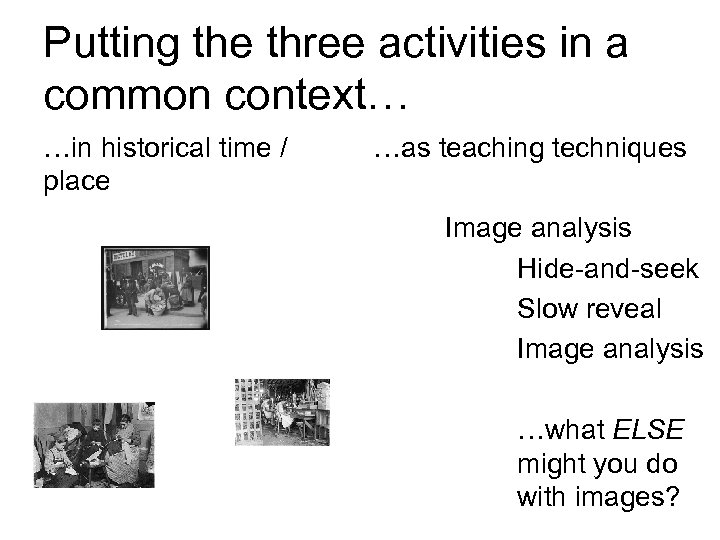
Putting the three activities in a common context… …in historical time / place …as teaching techniques Image analysis Hide-and-seek Slow reveal Image analysis …what ELSE might you do with images?
Another tactic: Zooming in • Requires high-quality image (e. g. , TIFF) • …and a decent image viewer
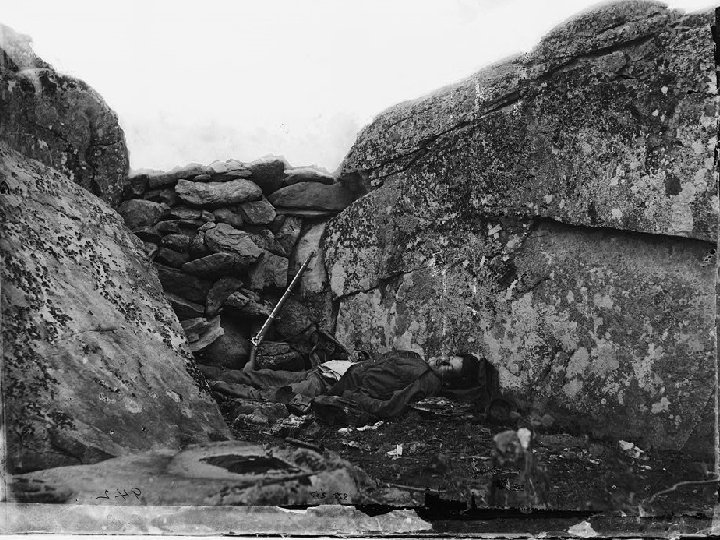
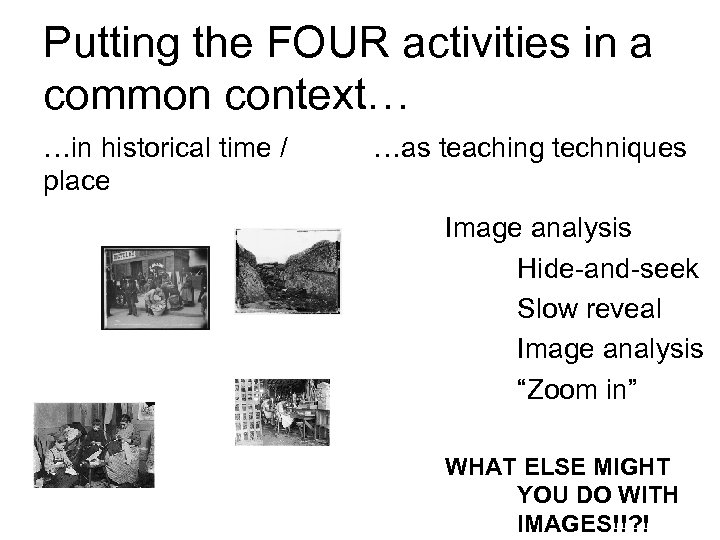
Putting the FOUR activities in a common context… …in historical time / place …as teaching techniques Image analysis Hide-and-seek Slow reveal Image analysis “Zoom in” WHAT ELSE MIGHT YOU DO WITH IMAGES!!? !
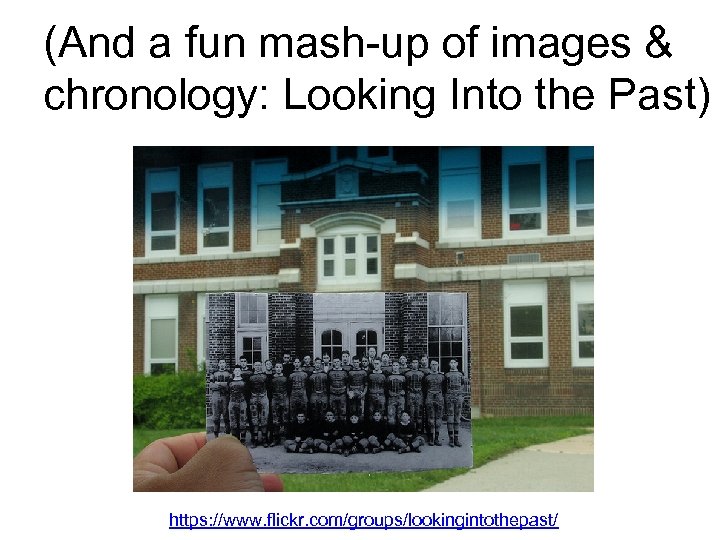
(And a fun mash-up of images & chronology: Looking Into the Past) https: //www. flickr. com/groups/lookingintothepast/
Before we close the book on this chunk of history work • …have you done these sorts of activities in the past? • (Could they be used for geography? Civics? Other content areas? ) • Were our 5 uses of images interactive? Did they help make history more accessible? Fun? Concrete? Personable? What did it do to your imagination?
…and here’s the pedagogical point that I’m building up to
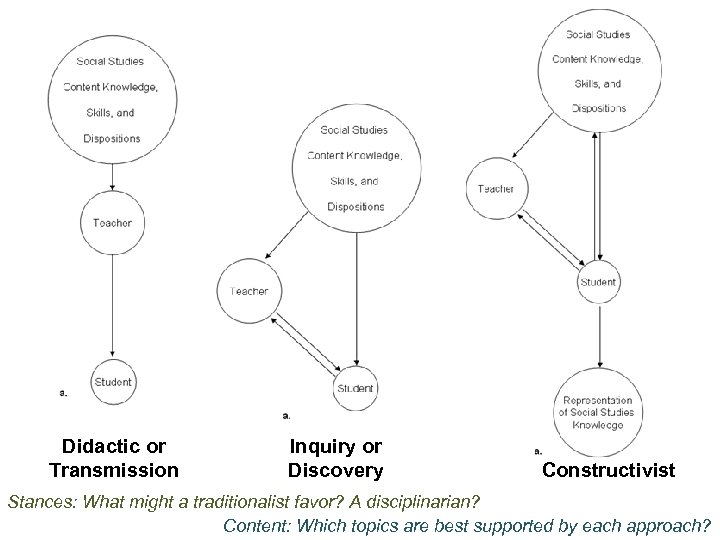
Didactic or Transmission Inquiry or Discovery Constructivist Stances: What might a traditionalist favor? A disciplinarian? Content: Which topics are best supported by each approach?
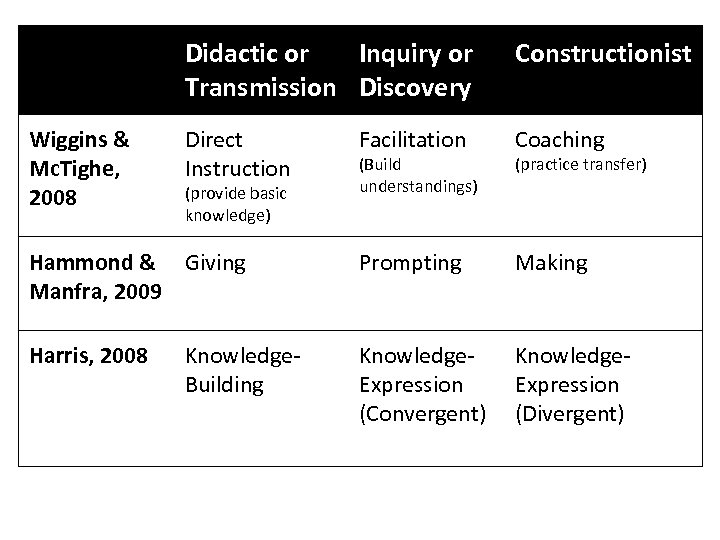
Didactic or Inquiry or Transmission Discovery Constructionist Direct Instruction Facilitation Coaching Hammond & Giving Manfra, 2009 Prompting Making Harris, 2008 Knowledge. Expression (Convergent) Knowledge. Expression (Divergent) Wiggins & Mc. Tighe, 2008 (provide basic knowledge) Knowledge. Building (Build understandings) (practice transfer)
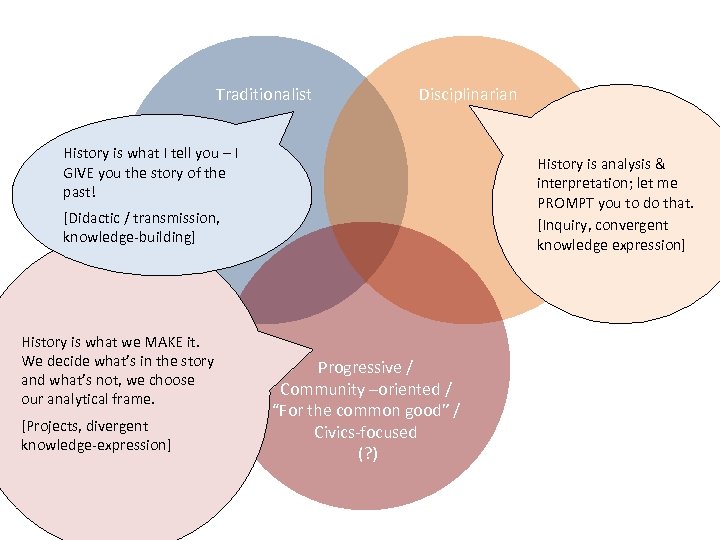
Traditionalist Disciplinarian History is what I tell you – I GIVE you the story of the past! History is analysis & interpretation; let me PROMPT you to do that. [Inquiry, convergent knowledge expression] [Didactic / transmission, knowledge-building] History is what we MAKE it. We decide what’s in the story and what’s not, we choose our analytical frame. [Projects, divergent knowledge-expression] Progressive / Community –oriented / “For the common good” / Civics-focused (? )
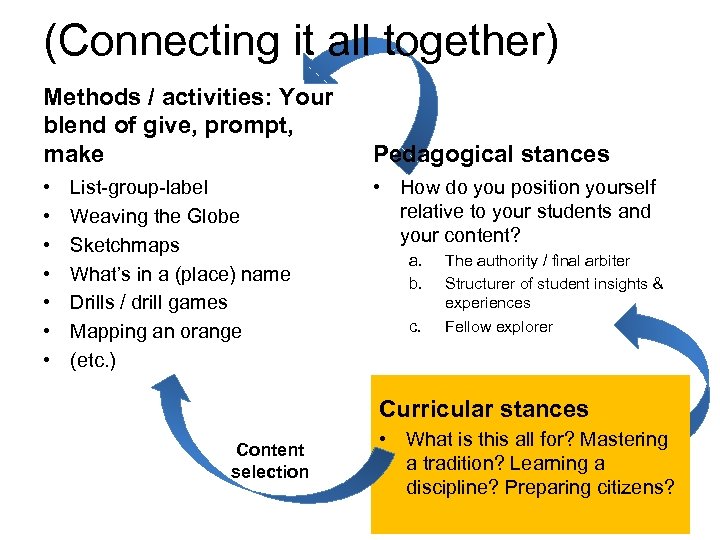
(Connecting it all together) Methods / activities: Your blend of give, prompt, make • • List-group-label Weaving the Globe Sketchmaps What’s in a (place) name Drills / drill games Mapping an orange (etc. ) Pedagogical stances • How do you position yourself relative to your students and your content? a. b. c. The authority / final arbiter Structurer of student insights & experiences Fellow explorer Curricular stances Content selection • What is this all for? Mastering a tradition? Learning a discipline? Preparing citizens?
And to re-visit our questions… • What is history ed? • Topics / concepts / content • Skills • (Why do we teach history? ) • How to teach history ed? • Methods? • Resources? • Different trade-offs / concerns when teaching history (And don’t forget that diversity ed point we made earlier!)
For next session (Mon, 2 Oct) Reading • Maxim, Ch. 7 (history) • History standards: C 3, PDE, look at NCHS if you wish • Maxim, Ch. 4 -5 -6 (just get started, think about pedagogy) • Skim: Hammond & Manfra, 2009 Assignments • WTL on history ed • Field experience update • Think about curriculum map
Скачать презентацию Session 05 — Goodbye to geography ed —
6ff11f04624e38628cff7d038a3ce492.ppt