


 Скачать презентацию SESAME and Nuclear Energy in the Middle East
0b977053d865caab567279ca430c0d08.ppt
- Количество слайдов: 69
 SESAME and Nuclear Energy in the Middle East Dr. Khaled Toukan 1 Jordan Atomic Energy Commission
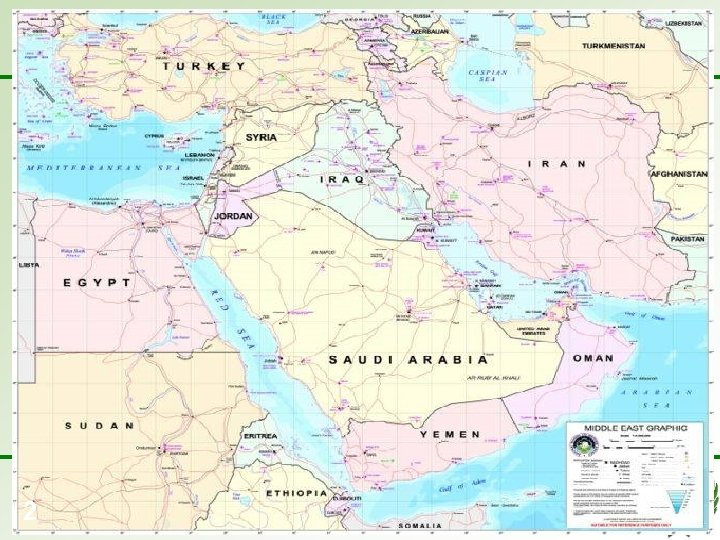 2 Jordan Atomic Energy Commission
 S&T Collaboration § Nuclear science, technology and applications provide many areas of regional collaboration Common facilities for HRD and R&D § Regional fuel cycle facilities § § 3 SESAME offers a model Jordan Atomic Energy Commission
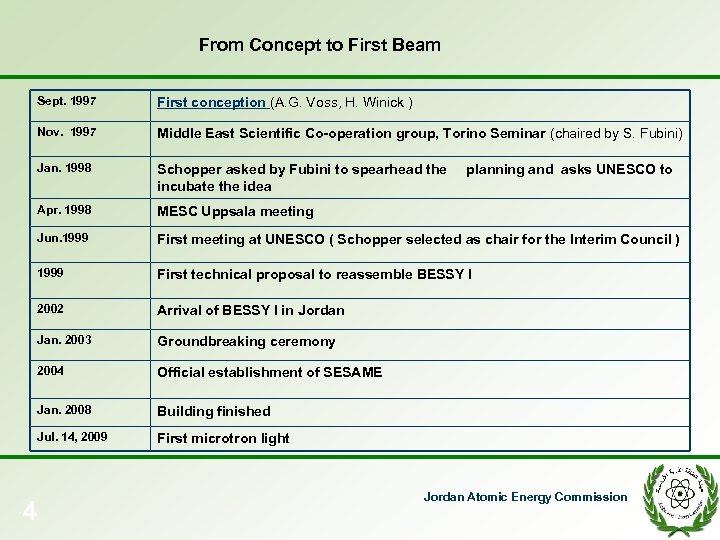 From Concept to First Beam Sept. 1997 Nov. 1997 Middle East Scientific Co-operation group, Torino Seminar (chaired by S. Fubini) Jan. 1998 Schopper asked by Fubini to spearhead the incubate the idea Apr. 1998 MESC Uppsala meeting Jun. 1999 First meeting at UNESCO ( Schopper selected as chair for the Interim Council ) 1999 First technical proposal to reassemble BESSY I 2002 Arrival of BESSY I in Jordan Jan. 2003 Groundbreaking ceremony 2004 Official establishment of SESAME Jan. 2008 Building finished Jul. 14, 2009 4 First conception (A. G. Voss, H. Winick ) First microtron light planning and asks UNESCO to Jordan Atomic Energy Commission
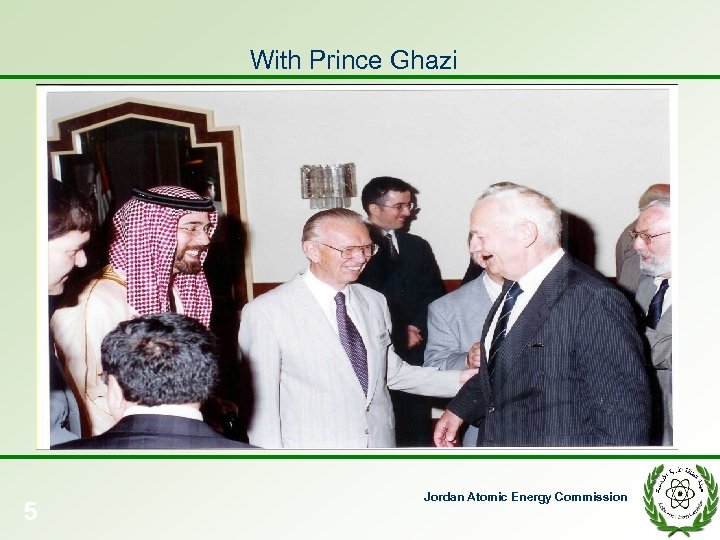 With Prince Ghazi 5 Jordan Atomic Energy Commission
 SESAME: Lofty Goals § § § § 6 Offer facilities for world-class interdisciplinary research Promote basic and applied research and technology in the Middle East Address Middle East biomedical and environmental issues and concerns Train graduate students who will no longer have to go abroad Reverse the brain drain by offering scientists working abroad research facilities Promote international collaborations Promote the development of high-tech industry Promote peace and understanding between people from different traditions, religions, races, and political systems Jordan Atomic Energy Commission
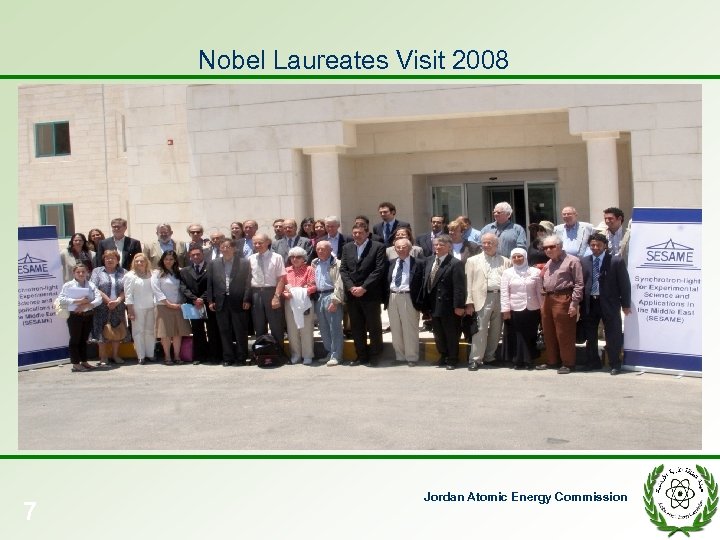 Nobel Laureates Visit 2008 7 Jordan Atomic Energy Commission
 Managing Unconventional Project § Securing high-level commitment § Letter of HM King Abdullah II “it is my pleasure to inform you that I have agreed to host such a centre in Jordan on negotiation basis” § UNESCO – Involvement of DG and support of the Executive Council Membership § Financial strategy (host country, members, observers, external ) § 8 Jordan Atomic Energy Commission
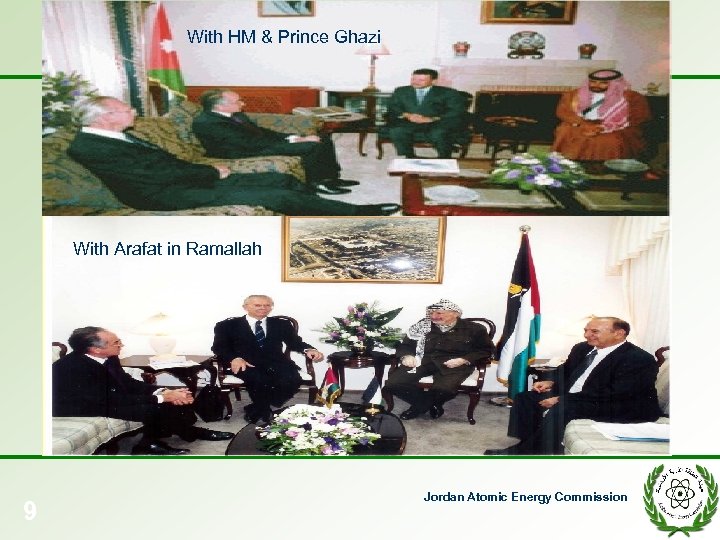 With HM & Prince Ghazi With Arafat in Ramallah 9 Jordan Atomic Energy Commission
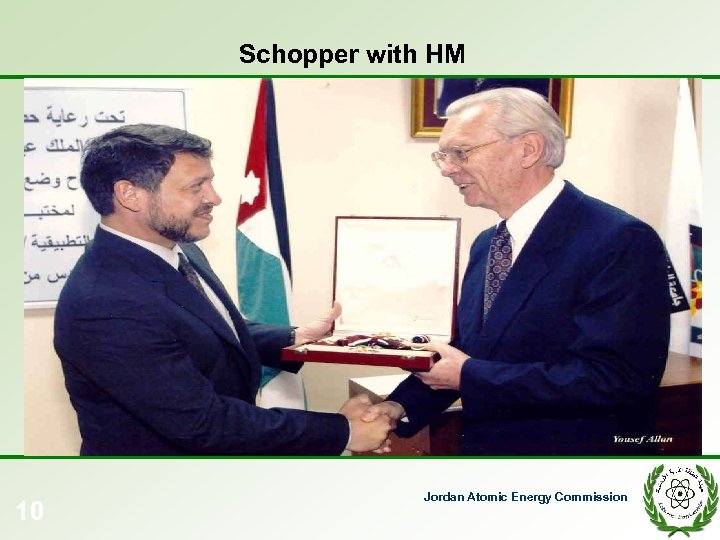 Schopper with HM 10 Jordan Atomic Energy Commission
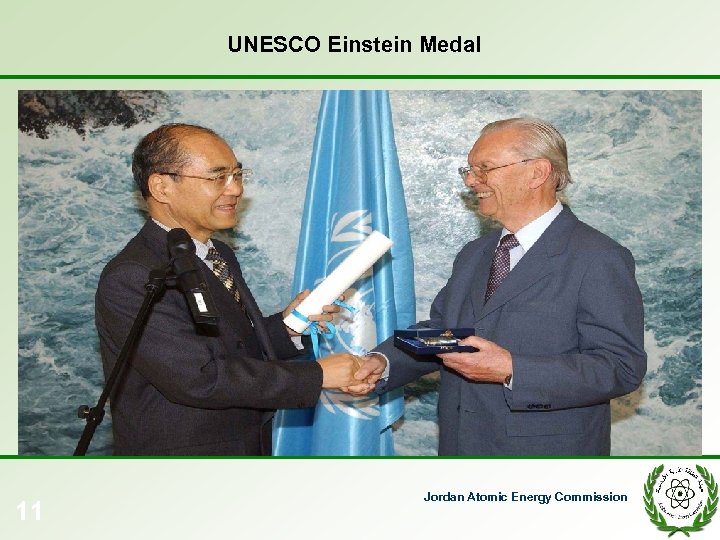 UNESCO Einstein Medal 11 Jordan Atomic Energy Commission
 Creative Financing Seek funds for the different parts of the project from different sources: § § § 12 Land, building and technical infrastructure from the host country Parts of the machine from donations Funds for the upgrading of the main ring from outside sources Beamlines to be provided by various countries Operation (mainly salaries of staff) by Members Training to be financed by observers and other organisations Jordan Atomic Energy Commission
 Host Country Contribution In-Kind Site: 80 donums (80, 000 m 2) land donated free- of-charge The main building, which was borne entirely by the Jordanian Authorities, amounted to about 6 Million euros § Independent electrical power line § § Cash § § § 13 3. 2 Million euros from Jordan-EU bilateral programme 2. 4 Million euros from Royal Court 1 Million euros from MHESR for LAN Network Jordan Atomic Energy Commission
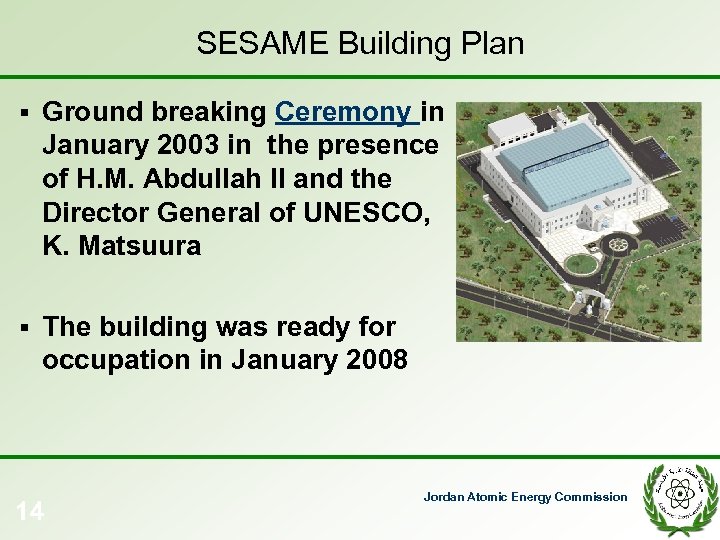 SESAME Building Plan § Ground breaking Ceremony in January 2003 in the presence of H. M. Abdullah II and the Director General of UNESCO, K. Matsuura § The building was ready for occupation in January 2008 14 Jordan Atomic Energy Commission
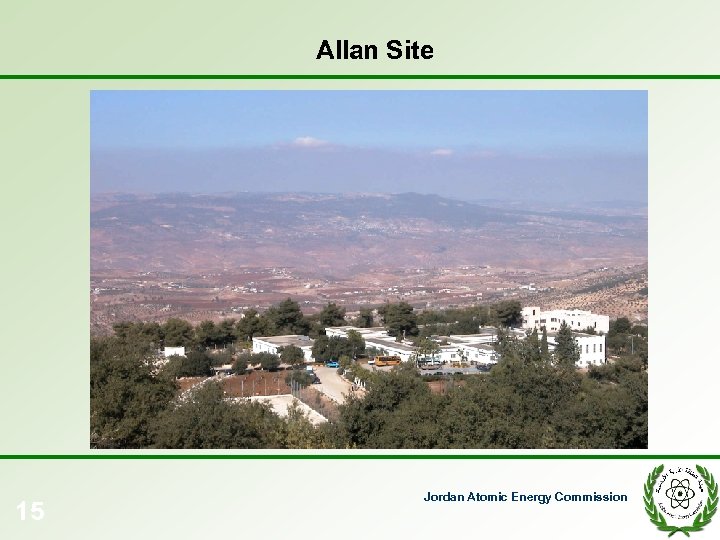 Allan Site 15 Jordan Atomic Energy Commission
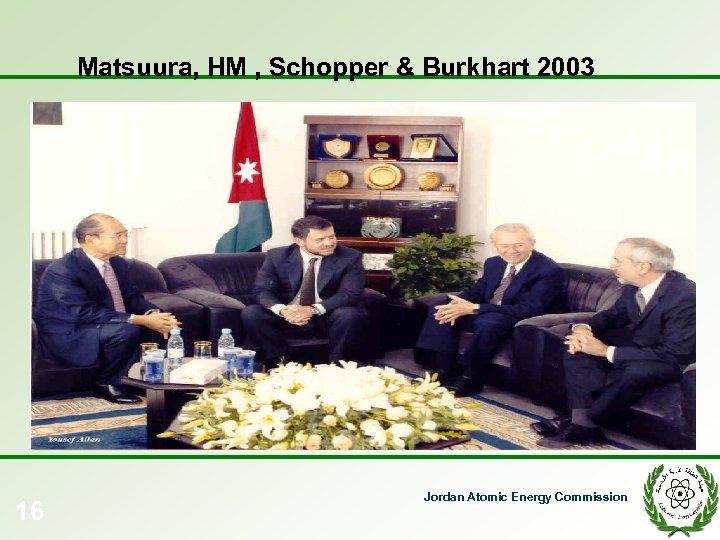 Matsuura, HM , Schopper & Burkhart 2003 16 Jordan Atomic Energy Commission
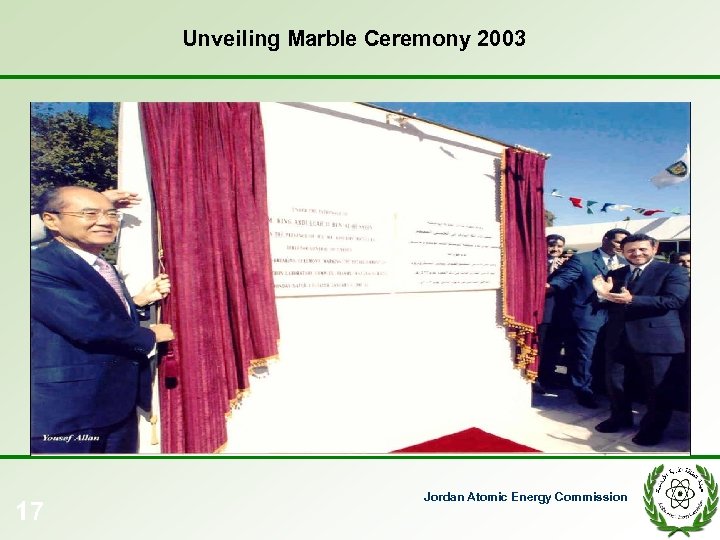 Unveiling Marble Ceremony 2003 17 Jordan Atomic Energy Commission
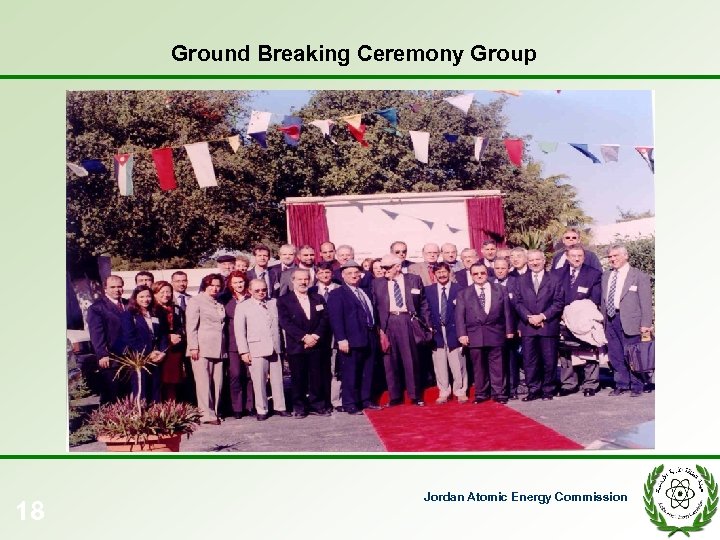 Ground Breaking Ceremony Group 18 Jordan Atomic Energy Commission
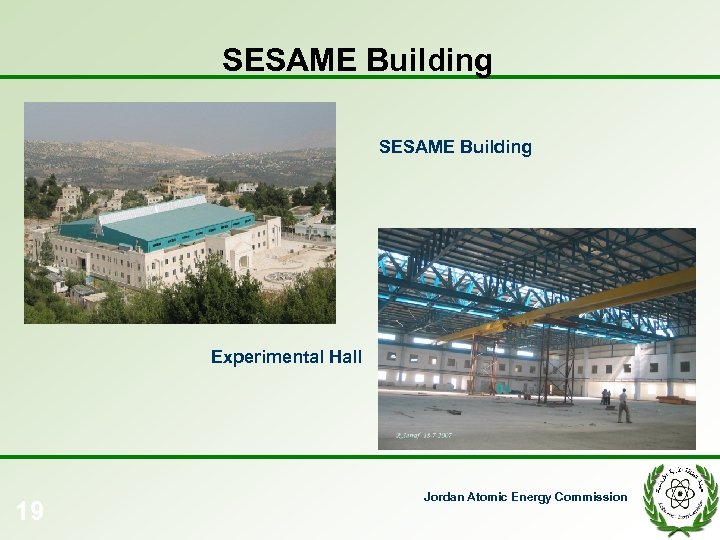 SESAME Building Experimental Hall 19 Jordan Atomic Energy Commission
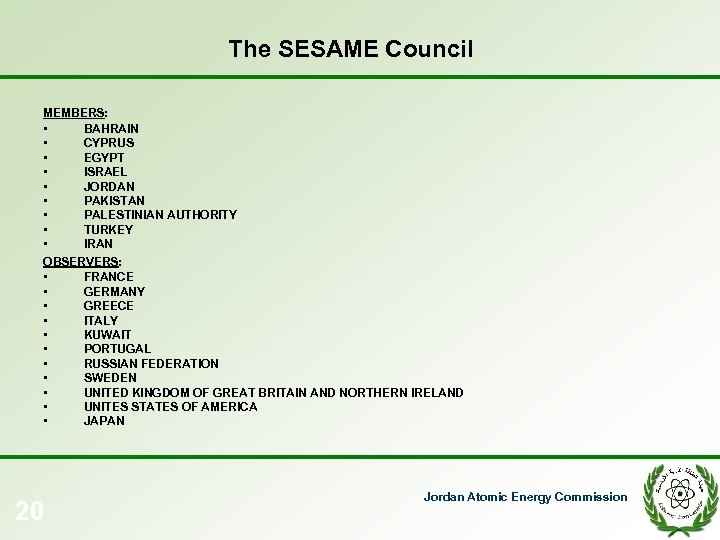 The SESAME Council MEMBERS: • BAHRAIN • CYPRUS • EGYPT • ISRAEL • JORDAN • PAKISTAN • PALESTINIAN AUTHORITY • TURKEY • IRAN OBSERVERS: • FRANCE • GERMANY • GREECE • ITALY • KUWAIT • PORTUGAL • RUSSIAN FEDERATION • SWEDEN • UNITED KINGDOM OF GREAT BRITAIN AND NORTHERN IRELAND • UNITES STATES OF AMERICA • JAPAN 20 Jordan Atomic Energy Commission
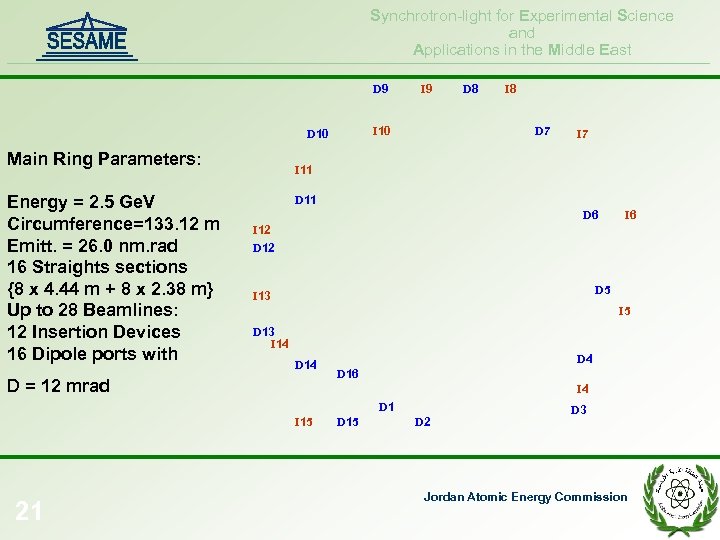 Synchrotron-light for Experimental Science and Applications in the Middle East ________________________________________ D 9 I 10 D 10 Main Ring Parameters: Energy = 2. 5 Ge. V Circumference=133. 12 m Emitt. = 26. 0 nm. rad 16 Straights sections {8 x 4. 44 m + 8 x 2. 38 m} Up to 28 Beamlines: 12 Insertion Devices 16 Dipole ports with I 9 I 8 D 7 I 11 D 6 I 12 D 5 I 13 I 5 D 13 I 14 D = 12 mrad D 4 D 16 I 4 D 1 I 15 21 D 8 D 15 D 2 D 3 Jordan Atomic Energy Commission
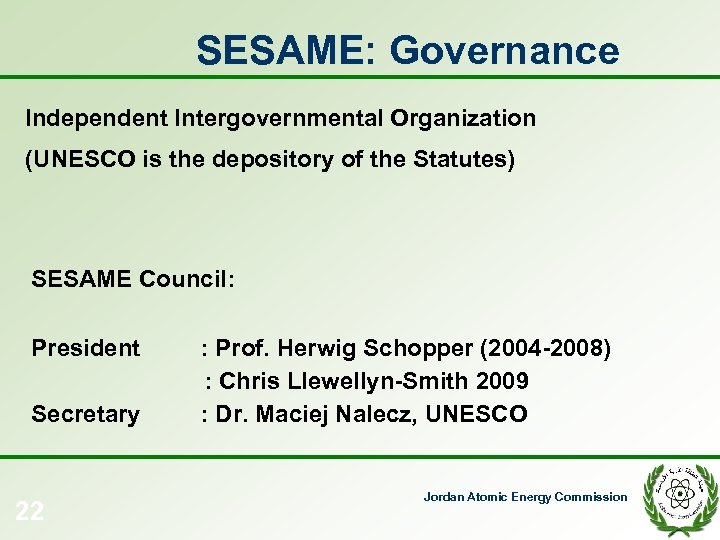 SESAME: Governance Independent Intergovernmental Organization (UNESCO is the depository of the Statutes) SESAME Council: President Secretary 22 : Prof. Herwig Schopper (2004 -2008) : Chris Llewellyn-Smith 2009 : Dr. Maciej Nalecz, UNESCO Jordan Atomic Energy Commission
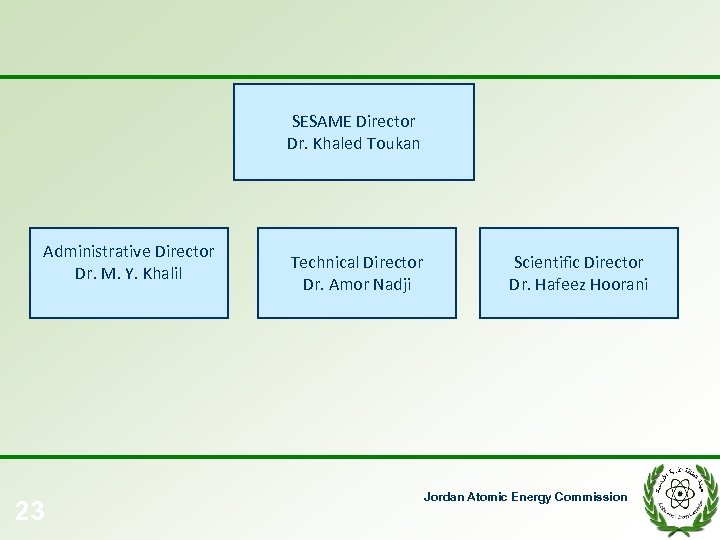 SESAME Director Dr. Khaled Toukan Administrative Director Dr. M. Y. Khalil 23 Technical Director Dr. Amor Nadji Scientific Director Dr. Hafeez Hoorani Jordan Atomic Energy Commission
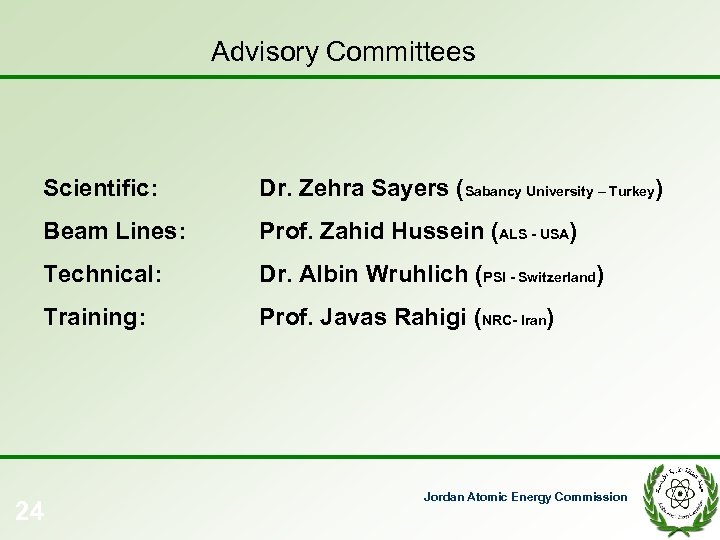 Advisory Committees Scientific: Dr. Zehra Sayers (Sabancy University – Turkey) Beam Lines: Prof. Zahid Hussein (ALS - USA) Technical: Dr. Albin Wruhlich (PSI - Switzerland) Training: Prof. Javas Rahigi (NRC- Iran) 24 Jordan Atomic Energy Commission
 SESAME Users Community § Between 1997 and 2006, more than 15 workshops took place in countries including Greece, Cyprus, Jordan, Turkey, Egypt, Pakistan etc § Meetings focus on applications in biology, materials science, accelerator technology etc § Focused workshops provide training for specific needs e. g. accelerator scientists and some those with a broad range of topics aim to establish the community § In total well above 500 scientists from the Middle East region and observer countries have come together 25 Jordan Atomic Energy Commission
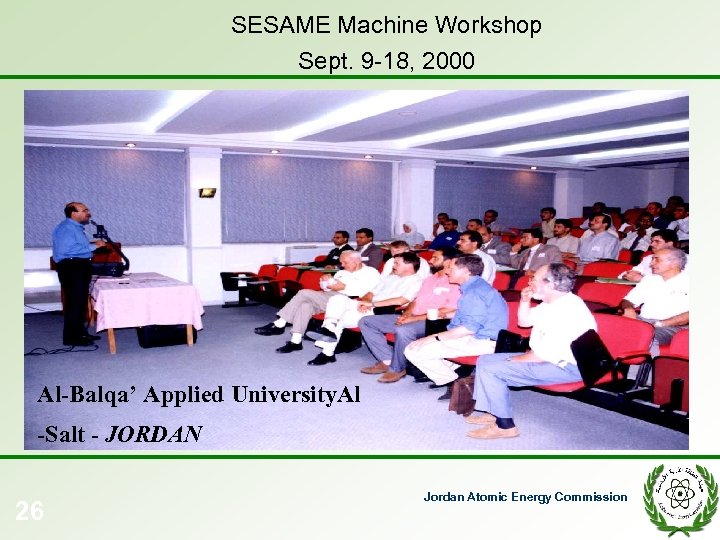 SESAME Machine Workshop Sept. 9 -18, 2000 Al-Balqa’ Applied University. Al -Salt - JORDAN 26 Jordan Atomic Energy Commission
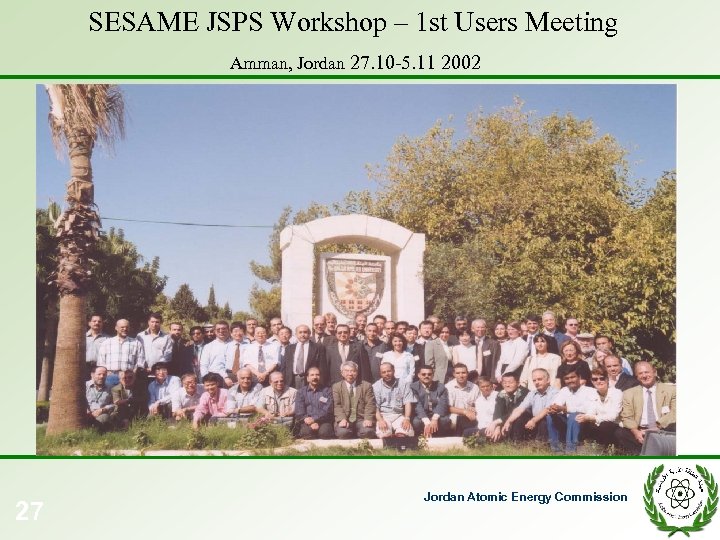 SESAME JSPS Workshop – 1 st Users Meeting Amman, Jordan 27. 10 -5. 11 2002 27 Jordan Atomic Energy Commission
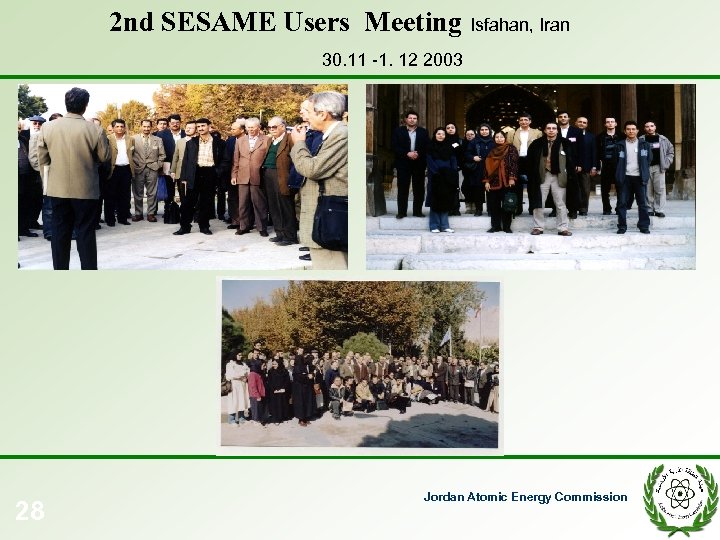 2 nd SESAME Users Meeting Isfahan, Iran 30. 11 -1. 12 2003 28 Jordan Atomic Energy Commission
 SESAME Staff Diverse Nationalities: § § § § 29 Egyptian French Iranian Italian Jordanian Pakistani Palestinian Jordan Atomic Energy Commission 29
 SESAME § Capacity building for creating a “Centre of Excellence” open to all nations of the region - Science for Peace § Reverse the brain drain to US and Europe § Provides a returning ground to ME Scientists § Help is provided by many § IAEA, Do. E, JSPS, ASICTP, NSRRC, Portugal, Brazil, Canon Foundation 30 Jordan Atomic Energy Commission 30
 Capacity Building § IAEA - SESAME – Training of BL Scientists & Users – Training visits of staff from Machine group – Expert visits to SESAME – Support for workshops, conferences, user meetings – Project INT 1 -055 started in 2007 end in 2011 § 31 Total IAEA contribution USD 1. 2 million Jordan Atomic Energy Commission 31
 Scientific Programme The main domains of research will be : § § § § 32 Physics (mainly condensed matter) Material science Molecular biology Nanotechnology Archaeology Environmental studies Medical research Jordan Atomic Energy Commission
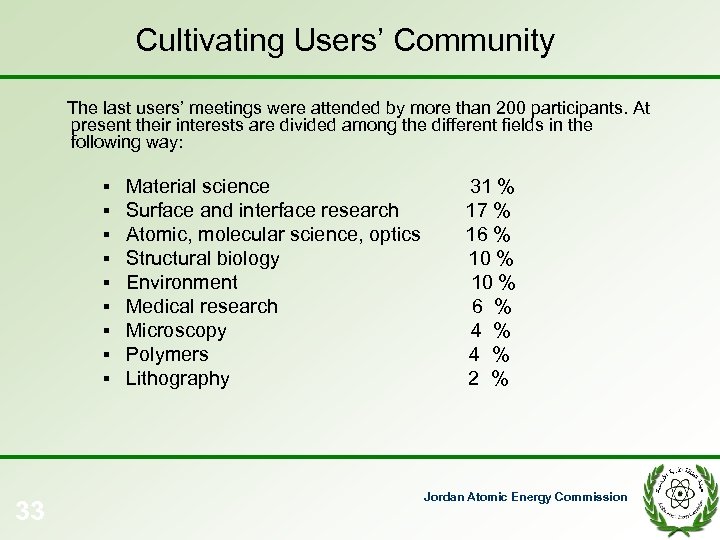 Cultivating Users’ Community The last users’ meetings were attended by more than 200 participants. At present their interests are divided among the different fields in the following way: § § § § § 33 Material science 31 % Surface and interface research 17 % Atomic, molecular science, optics 16 % Structural biology 10 % Environment 10 % Medical research 6 % Microscopy 4 % Polymers 4 % Lithography 2 % Jordan Atomic Energy Commission
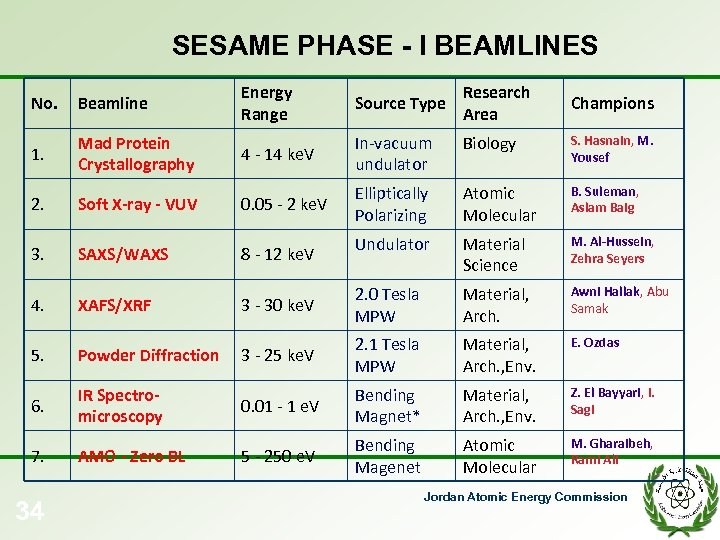 SESAME PHASE - I BEAMLINES No. Beamline Energy Range Source Type 1. Mad Protein Crystallography 4 - 14 ke. V 0. 05 - 2 ke. V 2. Soft X-ray - VUV Research Area Champions In-vacuum undulator Biology S. Hasnain, M. Yousef Elliptically Polarizing Atomic Molecular B. Suleman, Aslam Baig Undulator Material Science M. Al-Hussein, Zehra Seyers 3. SAXS/WAXS 8 - 12 ke. V 4. XAFS/XRF 3 - 30 ke. V 2. 0 Tesla MPW Material, Arch. Awni Hallak, Abu Samak Material, Arch. , Env. E. Ozdas 5. Powder Diffraction 3 - 25 ke. V 2. 1 Tesla MPW 6. IR Spectromicroscopy 0. 01 - 1 e. V Bending Magnet* Material, Arch. , Env. Z. El Bayyari, I. Sagi 5 - 250 e. V Bending Magenet Atomic Molecular M. Gharaibeh, Rami Ali 7. 34 AMO - Zero BL Jordan Atomic Energy Commission
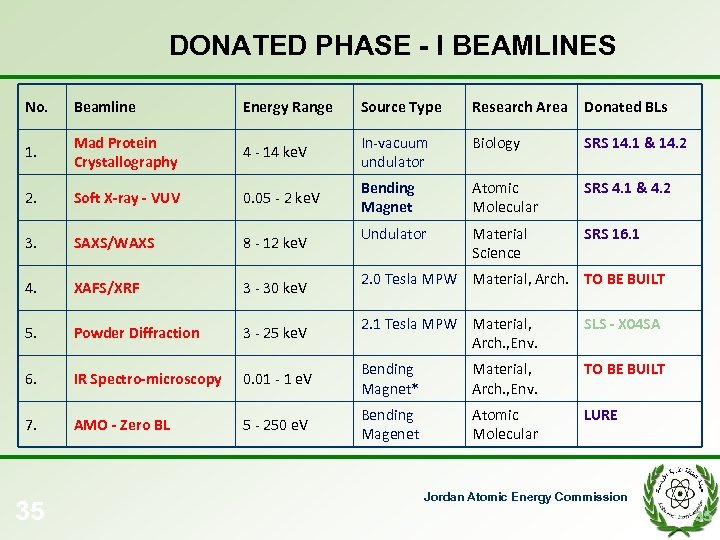 DONATED PHASE - I BEAMLINES No. Beamline Energy Range Source Type Research Area Donated BLs 1. Mad Protein Crystallography 4 - 14 ke. V In-vacuum undulator Biology SRS 14. 1 & 14. 2 2. Soft X-ray - VUV 0. 05 - 2 ke. V Bending Magnet Atomic Molecular SRS 4. 1 & 4. 2 3. SAXS/WAXS 8 - 12 ke. V Undulator Material Science SRS 16. 1 4. XAFS/XRF 3 - 30 ke. V 5. Powder Diffraction 3 - 25 ke. V 2. 1 Tesla MPW Material, Arch. , Env. SLS - X 04 SA 6. IR Spectro-microscopy 0. 01 - 1 e. V Bending Magnet* Material, Arch. , Env. TO BE BUILT 7. AMO - Zero BL 5 - 250 e. V Bending Magenet Atomic Molecular LURE 35 2. 0 Tesla MPW Material, Arch. TO BE BUILT Jordan Atomic Energy Commission 35
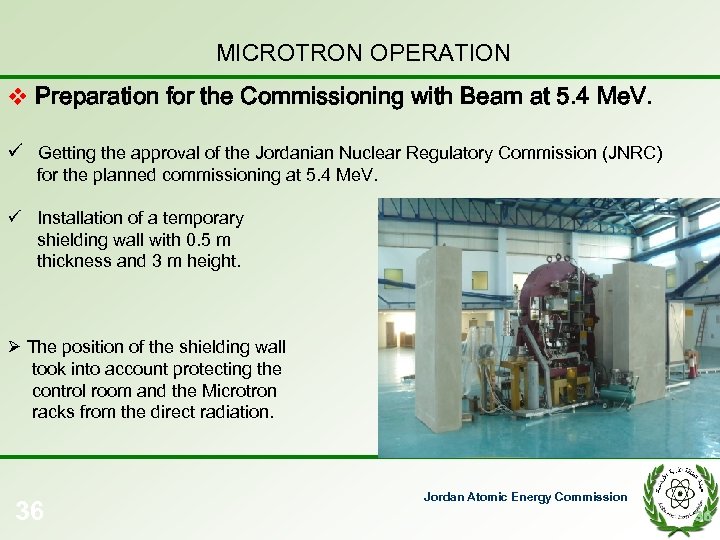 MICROTRON OPERATION v Preparation for the Commissioning with Beam at 5. 4 Me. V. ü Getting the approval of the Jordanian Nuclear Regulatory Commission (JNRC) for the planned commissioning at 5. 4 Me. V. ü Installation of a temporary shielding wall with 0. 5 m thickness and 3 m height. The position of the shielding wall took into account protecting the control room and the Microtron racks from the direct radiation. 36 Jordan Atomic Energy Commission 36
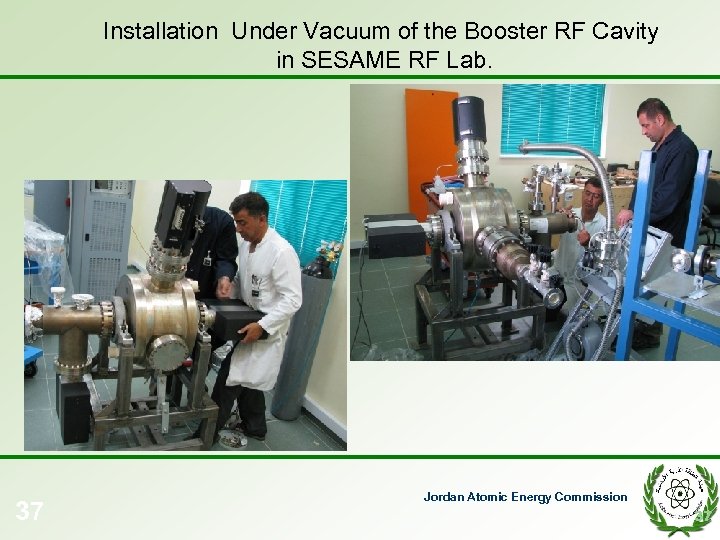 Installation Under Vacuum of the Booster RF Cavity in SESAME RF Lab. 37 Jordan Atomic Energy Commission 37
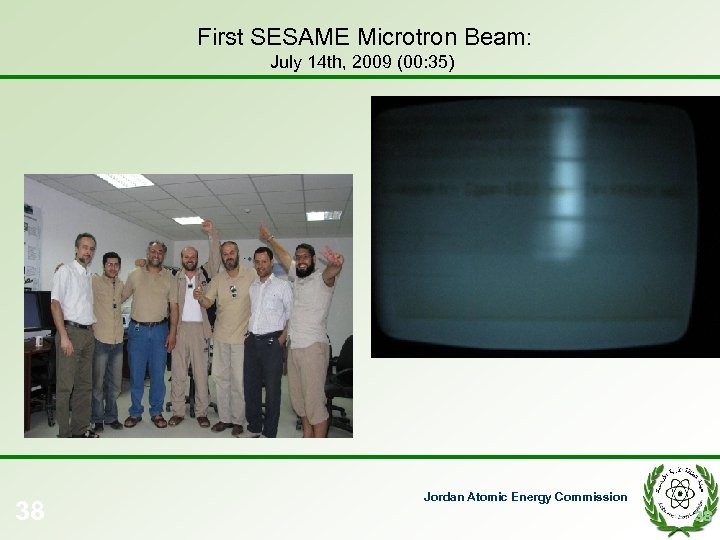 First SESAME Microtron Beam: July 14 th, 2009 (00: 35) 38 Jordan Atomic Energy Commission 38
 Countries in the Region are Facing Different Challenges § § § 39 Growing energy demand Increasing energy costs Lack of conventional energy resources Increasing dependence on fossil resources Scarcity of water resources Degradation of environmental conditions due to increasing consumption of fossil resources Jordan Atomic Energy Commission
 Energy Demand for Arab Countries § § § 40 Demand increased by 3. 8%/yr from 1985 to 2005 while the world was at 1. 6%/yr Arab share in 2005 world demand was only 4% Energy intensity (E/GDP) has declined from 1. 55 in the period , 1985 -90, to 0. 74 in the period, 2000 -05 Per capita energy consumption grew at 1. 3%/yr in the period 1985 -2005 Average per capita consumption reached 1. 28 toe in 2005 but with much disparity between countries Jordan Atomic Energy Commission
 Aggregation is Misleading Arab countries are at differing stages of development, with different resource endowments and income levels § On average per capita income in the region is high, but this disguises enormous differences between countries § - In Egypt, income is about $4000 per capita but 44% of the population lives on less than $2 a day - While, UAE has an average income of $22, 000 per capita Several non-oil economies rely heavily on aid, capital inflows and remittances from workers in the oilproducing countries § Poverty is widespread in several countries § 41 Jordan Atomic Energy Commission
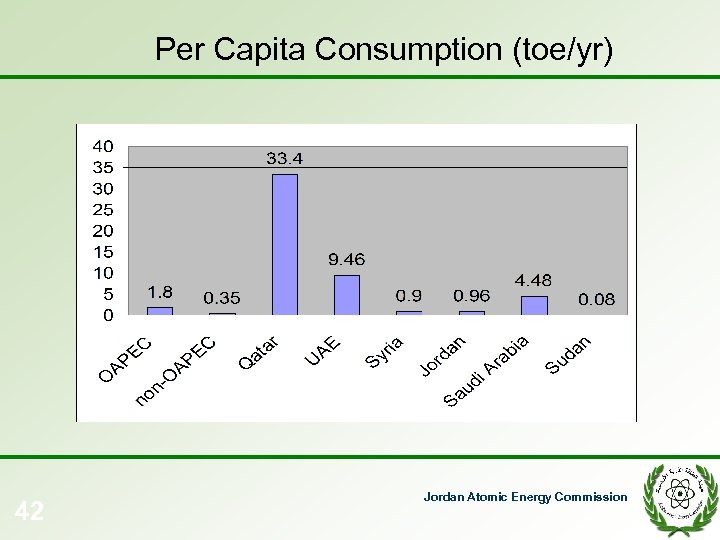 Per Capita Consumption (toe/yr) 42 Jordan Atomic Energy Commission
 Electricity Consumption § Arab countries consume about 1750 k. Wh/yr per capita whereas - Europe 6, 000 - North America 14, 000 - Developed countries 8, 000 § 43 Electricity is central to achieving sustainable development goals and HDI is closely correlated with high k. Wh/capita Jordan Atomic Energy Commission
 Regional Energy Demand Projections § Regional demand is projected to grow at 3. 7%/ yr according to OAPEC’s Reference Scenario (2006 to 2020) § Only 44% of the additional regional energy demand over the projection period will be met by oil and 3. 2% by hydro and coal § Hence, another source will have to fill the gap amounting to 52. 8% of the demand. Assuming BAU, it could be gas but not necessarily true in alternative scenarios 44 Jordan Atomic Energy Commission
 Desalination § § GCC such as Saudi Arabia, the UAE and Kuwait use dual -purpose power and desalination plants on a major scale § 45 Arab countries are the biggest users of desalination technology, with over 50% of the world’s capacity R& D are needed to develop dual-use plants to produce both water and power at affordable costs Jordan Atomic Energy Commission
 Implications Looking at the Region as an aggregate, oil and gas will dominate the supply until post-2020 § Non-fossil sources are projected to play minor role in the region’s future in business-as usual assumptions entrenching the singular dependence of the region on hydrocarbon resources § However, it is highly uncertain that such overoptimistic assumptions about the supply of natural gas will be met, especially for non-OAPEC countries § Nuclear will offer an insurance to highly uncertain supplies and escalating costs, and in several countries. A serious alternative to fossil sources § 46 Jordan Atomic Energy Commission
 Nuclear Power NP offers a medium to long term alternative electricity option for the Middle East § Worldwide prospect of NP is improving § The barriers facing the development of the nuclear industry are being addressed favorably : - Public acceptance - Reactor and fuel cycle safety - Disposal of high-level nuclear waste - Proliferation risk - Nuclear security - Economic competitiveness § 47 Jordan Atomic Energy Commission
 NP: Benefits for the Economy § § § § 48 Provides economically competitive electricity Reduces pollution and greenhouse gas emissions Displaces use of oil Creates demand for new services and products Creates new employment opportunities in high-tech and manufacturing Enhances industrial development and higher standard of living Provides low cost energy source for seawater desalination & process heat Jordan Atomic Energy Commission
 NP: Near Term Challenges High investment cost § Human resources § International & regional political climate § Infrastructure - Fabrication and manufacturing capacity - Engineering capability - Skilled construction trades - Transmission grid & reliability § 49 Jordan Atomic Energy Commission
 Political Support for Nuclear Power § § § 50 Interest in nuclear power in the Region is not new As far as 1994, the Arab League urged its member states to enhance education in nuclear science and technology In 2006, the Arab League reiterated its call and more specifically for establishing a regional reactor project Officials from the Gulf Co-operation Council (GCC) , in their December 2006 meeting, said they were exploring the possibility of creating a shared nuclear programme The Arab League , at the end of its summit meeting in March 2007, "called on the Arab states to expand the use of peaceful nuclear technology in all domains serving continuous development. “ Countries expressed interest so far: Jordan, Egypt, UAE, Morocco, Algeria, Tunisia, Saudi Arabia, Kuwait Jordan Atomic Energy Commission
 Jordan as Case Study 51 Jordan Atomic Energy Commission
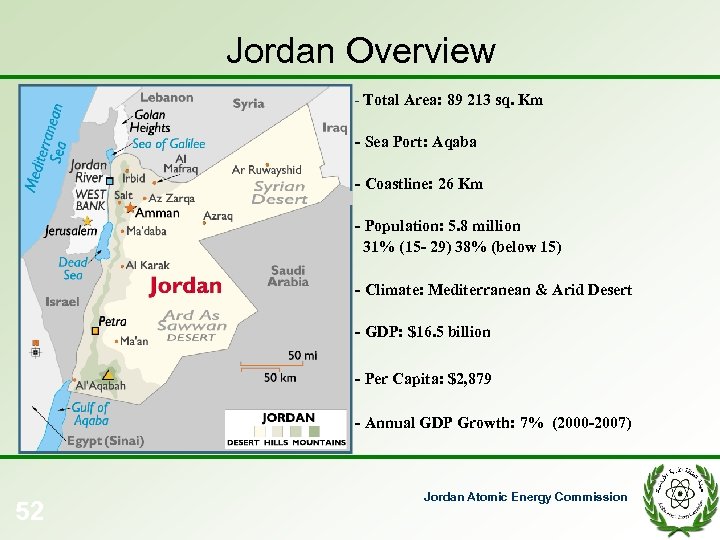 Jordan Overview - Total Area: 89 213 sq. Km - Sea Port: Aqaba - Coastline: 26 Km - Population: 5. 8 million 31% (15 - 29) 38% (below 15) - Climate: Mediterranean & Arid Desert - GDP: $16. 5 billion - Per Capita: $2, 879 - Annual GDP Growth: 7% (2000 -2007) 52 Jordan Atomic Energy Commission
 Jordan Energy Options § Options are limited: § § Renewable Technologies are mainly high cost, limited utilization, and cannot be base load. § 53 Natural Gas is a short term option and cannot be relied on for mid or longer term. Oil Shale, a limited medium term, reserved for special uses. Jordan Atomic Energy Commission
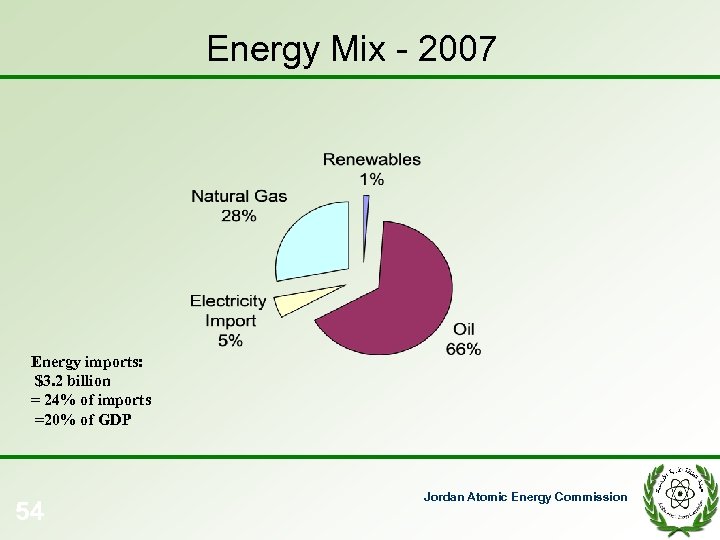 Energy Mix - 2007 Energy imports: $3. 2 billion = 24% of imports =20% of GDP 54 Jordan Atomic Energy Commission
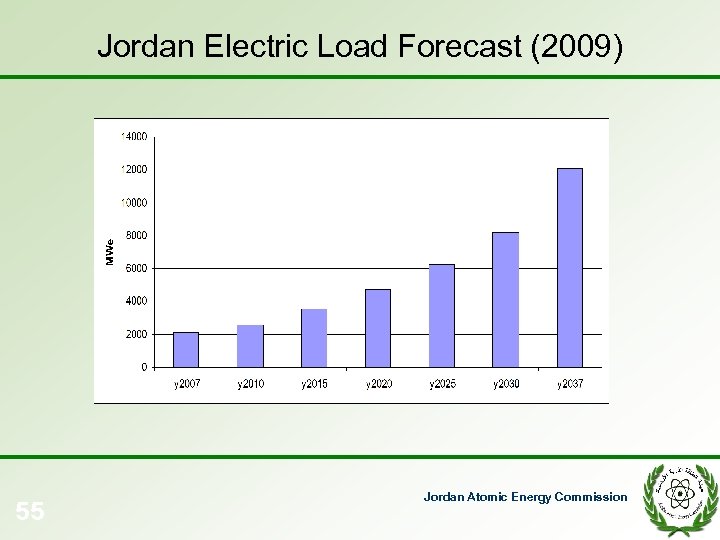 Jordan Electric Load Forecast (2009) 55 Jordan Atomic Energy Commission
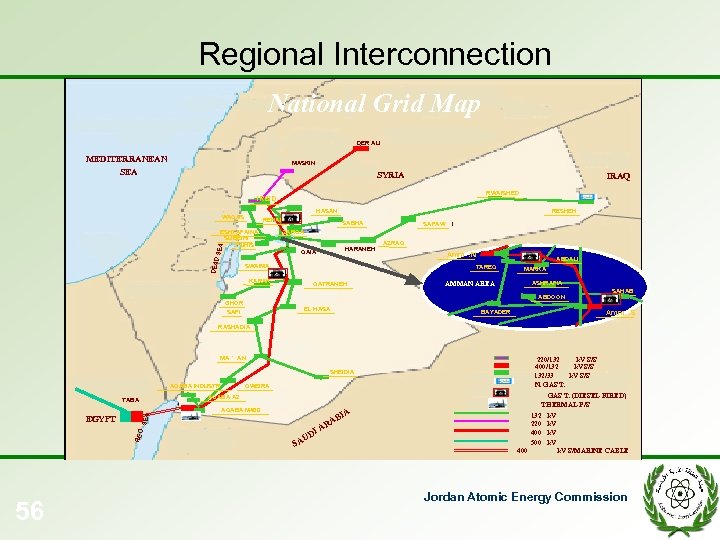 Regional Interconnection National Grid Map DER ALI MEDITERRANEAN SEA MASKIN SYRIA IRAQ RWAISHED IRBID HASAN WAQAS REHAB SEA ESHTAFAINA SUBEIHI FUHIS SAFAW I ZARQA HARANEH QAIA DEA D RESHEH SABHA SWAIMA AZRAQ Amm. N ABDALI TAREQ KARAK QATRANEH MARKA ASHRAFIA AMMAN AREA ABDOON GHOR EL HASA SAFI SAHAB Amm. S BAYADER RASHADIA MA ’ AN 220/132 k. V S/S 400/132 k. V S/S 132/33 k. V S/S N. GAS T. SHEIDIA AQABA INDUSTR QWEIRA AQABA M 400 56 A BI SEA RED EGYPT GAS T. (DIESEL FIRED) THERMAL P/S AQABA A 2 TABA DI U SA 132 220 400 500 A AR 400 k. V k. V S/MARINE CABLE Jordan Atomic Energy Commission
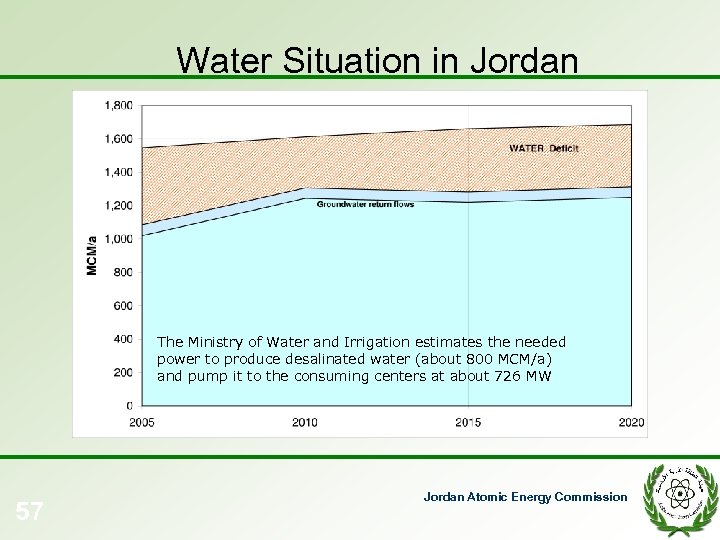 Water Situation in Jordan The Ministry of Water and Irrigation estimates the needed power to produce desalinated water (about 800 MCM/a) and pump it to the consuming centers at about 726 MW 57 Jordan Atomic Energy Commission
 Programme Vision § § Make available power to fuel economic growth at low cost § 58 Transform Jordan from net energy importing to net electricity exporting country by 2030 Go for major transformation away from fossil fuel Jordan Atomic Energy Commission
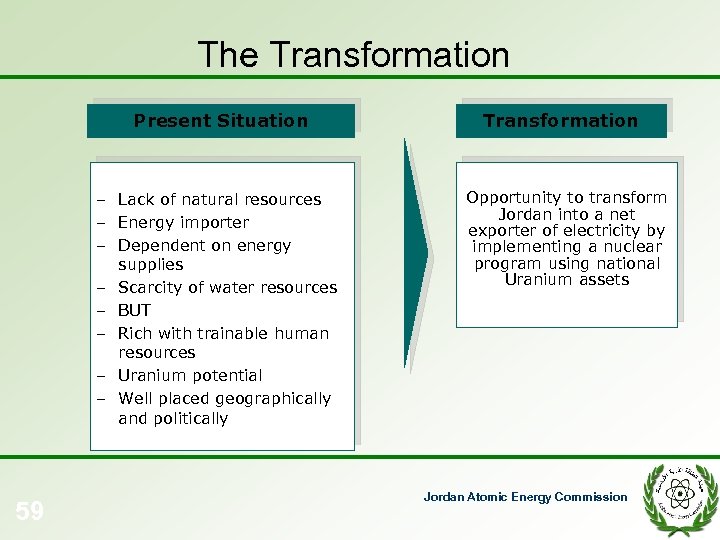 The Transformation Present Situation – Lack of natural resources – Energy importer – Dependent on energy supplies – Scarcity of water resources – BUT – Rich with trainable human resources – Uranium potential – Well placed geographically and politically 59 Transformation Opportunity to transform Jordan into a net exporter of electricity by implementing a nuclear program using national Uranium assets Jordan Atomic Energy Commission
 Jordan’s Nuclear Strategy § § § § 60 Ensuring security of supply including fuel Leveraging of national Uranium assets Promoting public/private partnerships Ensuring effective technology transfer and national participation in all phases Providing for water desalination and eventually hydrogen production Development of spin-off industries Enhancing electricity export Enabling competitive energy-intensive industries Jordan Atomic Energy Commission
 Challenges § Several challenges need to be addressed in order to develop Jordan’s nuclear energy programme: 1. 2. 3. 4. 5. 6. 61 Siting, technology choice, and grid limitation Exploitation of Uranium Fuel cycle and waste management Human resources development Funding Political environment Jordan Atomic Energy Commission
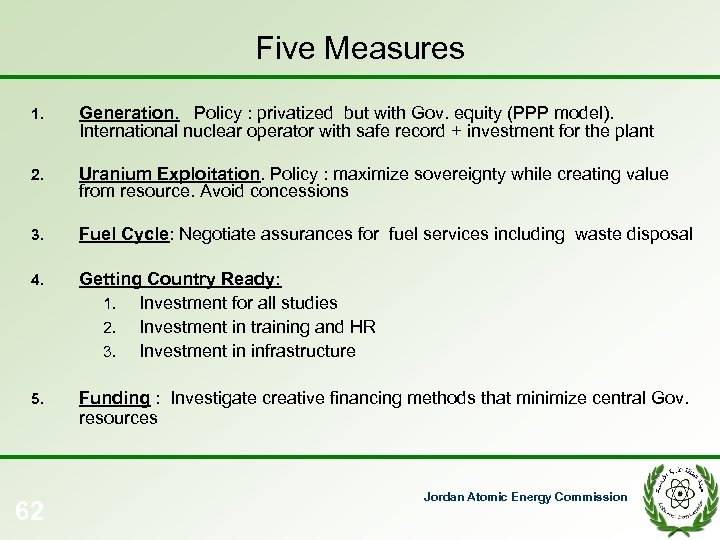 Five Measures 1. Generation. Policy : privatized but with Gov. equity (PPP model). International nuclear operator with safe record + investment for the plant 2. Uranium Exploitation. Policy : maximize sovereignty while creating value from resource. Avoid concessions 3. Fuel Cycle: Negotiate assurances for fuel services including waste disposal 4. Getting Country Ready: 1. Investment for all studies 2. Investment in training and HR 3. Investment in infrastructure 5. Funding : Investigate creative financing methods that minimize central Gov. resources 62 Jordan Atomic Energy Commission
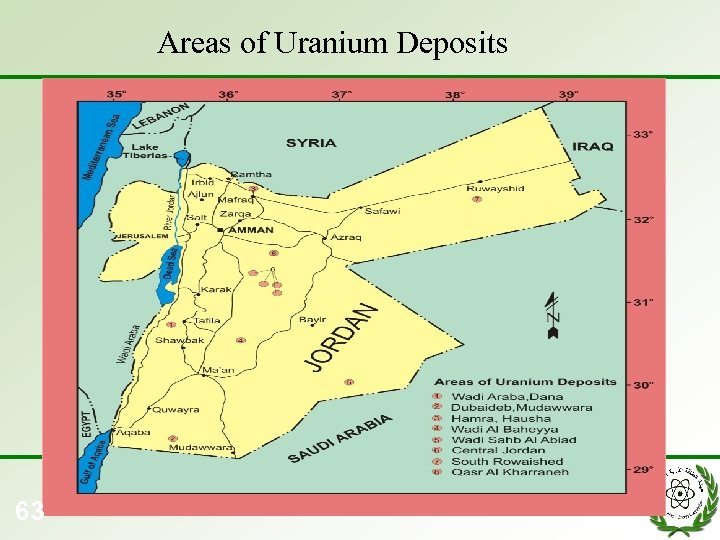 Areas of Uranium Deposits 63 Jordan Atomic Energy Commission
 Current Activities in Uranium Exploitation § Areva started since Oct. 2008 field work in Central Jordan with promising results so far § A JV Mining company, named “The Jordan French Uranium Mining Company” was registered on Dec. 18, 2008 § Negotiations on the Mining Agreement are underway 64 Jordan Atomic Energy Commission
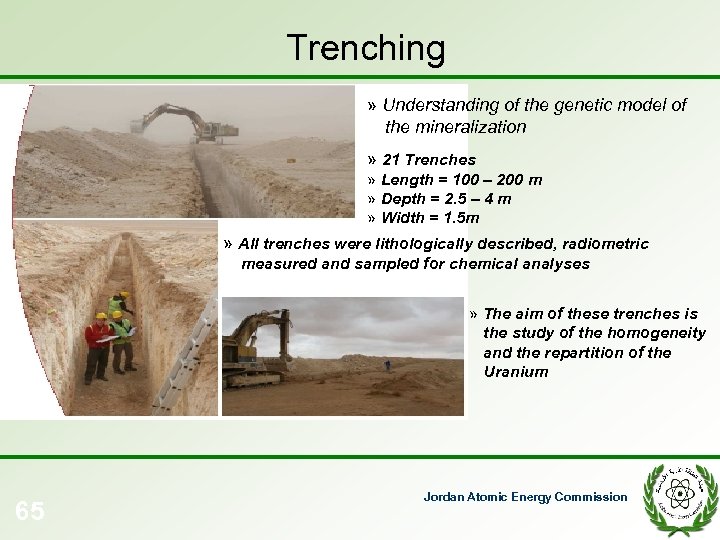 Trenching » Understanding of the genetic model of the mineralization » 21 Trenches » Length = 100 – 200 m » Depth = 2. 5 – 4 m » Width = 1. 5 m » All trenches were lithologically described, radiometric measured and sampled for chemical analyses » The aim of these trenches is the study of the homogeneity and the repartition of the Uranium 65 Jordan Atomic Energy Commission
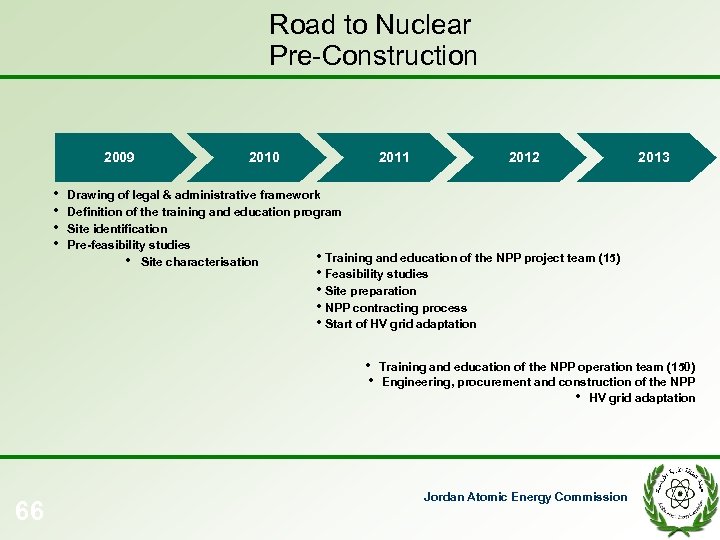 Road to Nuclear Pre-Construction 2009 • • 2010 2011 2013 Drawing of legal & administrative framework Definition of the training and education program Site identification Pre-feasibility studies • Training and education of the NPP project team (15) • Site characterisation • Feasibility studies • Site preparation • NPP contracting process • Start of HV grid adaptation • • 66 2012 Training and education of the NPP operation team (150) Engineering, procurement and construction of the NPP • HV grid adaptation Jordan Atomic Energy Commission
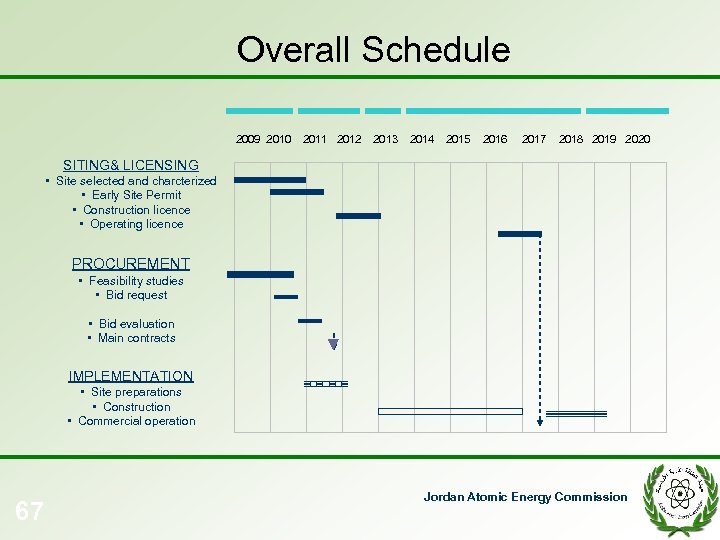 Overall Schedule 2009 2010 2011 2012 2013 2014 2015 2016 2017 2018 2019 2020 SITING& LICENSING • Site selected and charcterized • Early Site Permit • Construction licence • Operating licence PROCUREMENT • Feasibility studies • Bid request • Bid evaluation • Main contracts IMPLEMENTATION • Site preparations • Construction • Commercial operation 67 Jordan Atomic Energy Commission
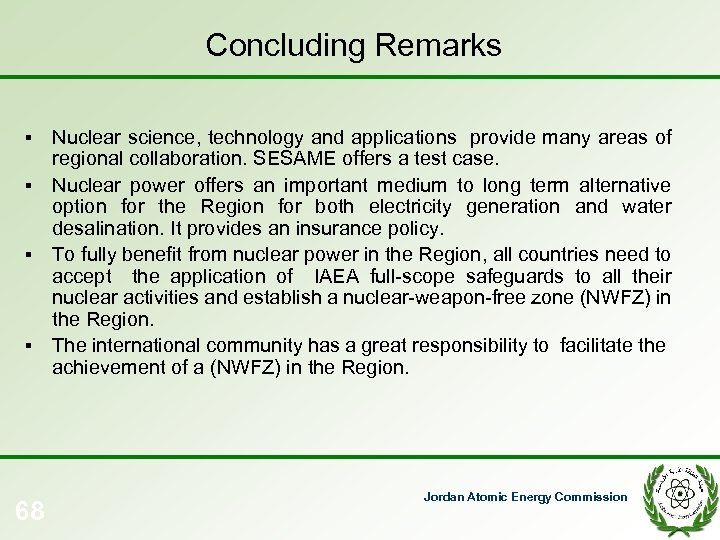 Concluding Remarks Nuclear science, technology and applications provide many areas of regional collaboration. SESAME offers a test case. § Nuclear power offers an important medium to long term alternative option for the Region for both electricity generation and water desalination. It provides an insurance policy. § To fully benefit from nuclear power in the Region, all countries need to accept the application of IAEA full-scope safeguards to all their nuclear activities and establish a nuclear-weapon-free zone (NWFZ) in the Region. § The international community has a great responsibility to facilitate the achievement of a (NWFZ) in the Region. § 68 Jordan Atomic Energy Commission
 THANK YOU 69 Jordan Atomic Energy Commission